Proceedings of the 45th Annual Meeting of the Association of Computational Linguistics, pages 208–215, Prague, Czech Republic, June 2007. c2007 Association for Computational Linguistics
Learning Predictive Structures for Semantic Role Labeling of NomBank
Chang Liu and Hwee Tou Ng Department of Computer Science National University of Singapore 3 Science Drive 2, Singapore 117543
{liuchan1, nght}@comp.nus.edu.sg
Abstract
This paper presents a novel application of Alternating Structure Optimization (ASO) to the task of Semantic Role Labeling (SRL) of noun predicates in NomBank. ASO is a recently proposed linear multi-task learn-ing algorithm, which extracts the common structures of multiple tasks to improve accu-racy, via the use of auxiliary problems. In this paper, we explore a number of different auxiliary problems, and we are able to sig-nificantly improve the accuracy of the Nom-Bank SRL task using this approach. To our knowledge, our proposed approach achieves the highest accuracy published to date on the English NomBank SRL task.
1 Introduction
The task of Semantic Role Labeling (SRL) is to identify predicate-argument relationships in natural language texts in a domain-independent fashion. In recent years, the availability of large human-labeled corpora such as PropBank (Palmer et al., 2005) and FrameNet (Baker et al., 1998) has made possible a statistical approach of identifying and classifying the arguments of verbs in natural language texts. A large number of SRL systems have been evalu-ated and compared on the standard data set in the CoNLL shared tasks (Carreras and Marquez, 2004; Carreras and Marquez, 2005), and many systems have performed reasonably well. Compared to the previous CoNLL shared tasks (noun phrase bracket-ing, chunkbracket-ing, clause identification, and named en-tity recognition), SRL represents a significant step
towards processing the semantic content of natural language texts.
Although verbs are probably the most obvious predicates in a sentence, many nouns are also ca-pable of having complex argument structures, often with much more flexibility than its verb counterpart. For example, compare affect and effect:
[subj Auto prices] [arg−ext greatly] [pred
affect] [obj the PPI].
[subj Auto prices] have a [arg−ext big]
[predeffect] [obj on the PPI].
The [pred effect] [subj of auto prices] [obj on the PPI] is [arg−extbig].
[subjThe auto prices’] [predeffect] [objon the PPI] is [arg−extbig].
The arguments of noun predicates can often be more easily omitted compared to the verb predi-cates:
The [pred effect] [subj of auto prices] is [arg−extbig].
The [pred effect] [obj on the PPI] is [arg−extbig].
The [predeffect] is [arg−extbig].
With the recent release of NomBank (Meyers et al., 2004), it becomes possible to apply machine learning techniques to the task. So far we are aware of only one English NomBank-based SRL system (Jiang and Ng, 2006), which uses the maximum entropy classifier, although similar efforts are re-ported on the Chinese NomBank by (Xue, 2006)
and on FrameNet by (Pradhan et al., 2004) us-ing a small set of hand-selected nominalizations. Noun predicates also appear in FrameNet semantic role labeling (Gildea and Jurafsky, 2002), and many FrameNet SRL systems are evaluated in Senseval-3 (Litkowski, 2004).
Semantic role labeling of NomBank is a multi-class multi-classification problem by nature. Using the
one-vs-all arrangement, that is, one binary
classi-fier for each possible outcome, the SRL task can be treated as multiple binary classification problems. In the latter view, we are presented with the oppor-tunity to exploit the common structures of these re-lated problems. This is known as multi-task learning in the machine learning literature (Caruana, 1997; Ben-David and Schuller, 2003; Evgeniou and Pon-til, 2004; Micchelli and PonPon-til, 2005; Maurer, 2006). In this paper, we apply Alternating Structure
Op-timization (ASO) (Ando and Zhang, 2005a) to the
semantic role labeling task on NomBank. ASO is a recently proposed linear multi-task learning algo-rithm based on empirical risk minimization. The method requires the use of multiple auxiliary prob-lems, and its effectiveness may vary depending on the specific auxiliary problems used. ASO has been shown to be effective on the following natu-ral language processing tasks: text categorization, named entity recognition, part-of-speech tagging, and word sense disambiguation (Ando and Zhang, 2005a; Ando and Zhang, 2005b; Ando, 2006).
This paper makes two significant contributions. First, we present a novel application of ASO to the SRL task on NomBank. We explore the effect of different auxiliary problems, and show that learn-ing predictive structures with ASO results in signifi-cantly improved SRL accuracy. Second, we achieve accuracy higher than that reported in (Jiang and Ng, 2006) and advance the state of the art in SRL re-search.
The rest of this paper is organized as follows. We give an overview of NomBank and ASO in Sec-tions 2 and 3 respectively. The baseline linear clas-sifier is described in detail in Section 4, followed by the description of the ASO classifier in Sec-tion 5, where we focus on exploring different auxil-iary problems. We provide discussions in Section 6, present related work in Section 7, and conclude in Section 8.
2 NomBank
NomBank annotates the set of arguments of noun predicates, just as PropBank annotates the argu-ments of verb predicates. As many noun predicates are nominalizations (e.g., replacement vs. replace), the same frames are shared with PropBank as much as possible, thus achieving some consistency with the latter regarding the accepted arguments and the meanings of each label.
Unlike in PropBank, arguments in NomBank can overlap with each other and with the predicate. For example:
[location U.S.] [pred,subj,obj steelmakers] have supplied the steel.
Here the predicate make has subject steelmakers and object steel, analogous to Steelmakers make steel. The difference is that here make and steel are both part of the word steelmaker.
Each argument in NomBank is given one or more labels, out of the following 20:ARG0,ARG1,ARG2, ARG3, ARG4, ARG5, ARG8, ARG9, ARGM-ADV,
ARGM-CAU, ARGM-DIR, ARGM-DIS, ARGM-EXT,
ARGM-LOC, ARGM-MNR, ARGM-MOD, ARGM -NEG, ARGM-PNC, ARGM-PRD, and ARGM-TMP. Thus, the above sentence is annotated in NomBank as:
[ARGM-LOC U.S.] [PRED,ARG0,ARG1 steelmak-ers] have supplied the steel.
3 Alternating structure optimization
This section gives a brief overview of ASO as imple-mented in this work. For a more complete descrip-tion, see (Ando and Zhang, 2005a).
3.1 Multi-task linear classifier
Given a set of training samples consisting ofn fea-ture vectors and their corresponding binary labels,
{Xi, Yi} for i ∈ {1, . . . , n} where each Xi is a p-dimensional vector, a binary linear classifier at-tempts to approximate the unknown relation byYi= uTXi. The outcome is considered +1 ifuTXis pos-itive, or –1 otherwise. A well-established way to find the weight vectoruis empirical risk
minimiza-tion with least square regularizaminimiza-tion:
ˆ
u= arg min
u
1
n n
X
i=1
Function L(p, y) is known as the loss function. It encodes the penalty for a given discrepancy be-tween the predicted label and the true label. In this work, we use a modification of Huber’s robust loss function, similar to that used in (Ando and Zhang, 2005a):
L(p, y) =
−4py ifpy <−1 (1−py)2 if−1≤py <1 0 ifpy≥1
(2)
We fix the regularization parameter λ to 10−4
, similar to that used in (Ando and Zhang, 2005a). The expressionkuk2is defined asPp
i=1u2p. Whenmbinary classification problems are to be solved together, ah×pmatrixΘmay be used to cap-ture the common struccap-tures of themweight vectors ul forl ∈ {1, . . . , m} (h ≤ m). We mandate that the rows ofΘ be orthonormal, i.e., ΘΘT = I
h×h.
The h rows of Θ represent the h most significant components shared by all theu’s. This relationship is modeled by
ul =wl+ ΘTvl (3)
The parameters [{wl,vl},Θ] may then be found by joint empirical risk minimization over all the m problems, i.e., their values should minimize the combined empirical risk:
m
X
l=1 1
n n
X
i=1
L
(wl+ ΘTvl)TXl i, Yil
+λkwlk2
!
(4)
3.2 The ASO algorithm
An important observation in (Ando and Zhang, 2005a) is that the binary classification problems used to deriveΘare not necessarily those problems we are aiming to solve. In fact, new problems can be invented for the sole purpose of obtaining a betterΘ. Thus, we distinguish between two types of problems in ASO: auxiliary problems, which are used to ob-tainΘ, and target problems, which are the problems we are aiming to solve1.
For instance, in the argument identification task, the only target problem is to identify arguments vs.
1
Note that this definition deviates slightly from the one in (Ando and Zhang, 2005a). We find the definition here more convenient for our subsequent discussion.
non-arguments, whereas in the argument classifica-tion task, there are 20 binary target problems, one to identify each of the 20 labels (ARG0,ARG1,. . .).
The target problems can also be used as an iliary problem. In addition, we can invent new aux-iliary problems, e.g., in the argument identification stage, we can predict whether there are three words between the constituent and the predicate using the features of argument identification.
Assuming there arektarget problems andm aux-iliary problems, it is shown in (Ando and Zhang, 2005a) that by performing one round of minimiza-tion, an approximate solution ofΘcan be obtained from (4) by the following algorithm:
1. For each of themauxiliary problems, learnul as described by (1).
2. FindU = [u1,u2, . . . ,um], a p ×m matrix. This is a simplified version of the definition in (Ando and Zhang, 2005a), made possible be-cause the sameλis used for all auxiliary prob-lems.
3. Perform Singular Value Decomposition (SVD) onU: U =V1DV2T, whereV1is ap×m ma-trix. The first h columns of V1 are stored as
rows ofΘ.
4. Given Θ, we learn w and v for each of the ktarget problems by minimizing the empirical
risk of the associated training samples:
1
n n
X
i=1
L
(w+ ΘTv)TXi, Yi
+λkwk2 (5)
5. The weight vector of each target problem can be found by:
u=w+ ΘTv (6)
By choosing a convex loss function, e.g., (2), steps 1 and 4 above can be formulated as convex op-timization problems and are efficiently solvable.
The procedure above can be considered as a Prin-cipal Component Analysis in the predictor space. Step (3) above extracts the most significant compo-nents shared by the predictors of the auxiliary prob-lems and hopefully, by the predictors of the target
problems as well. The hint of potential significant components helps (5) to outperform the simple lin-ear predictor (1).
4 Baseline classifier
The SRL task is typically separated into two stages: argument identification and argument classification. During the identification stage, each constituent in a sentence’s parse tree is labeled as either argument or non-argument. During the classification stage, each argument is given one of the 20 possible labels (ARG0,ARG1,. . .). The linear classifier described by (1) is used as the baseline in both stages. For comparison, the F1 scores of a maximum entropy classifier are also reported here.
4.1 Argument identification
Eighteen baseline features and six additional
fea-tures are proposed in (Jiang and Ng, 2006) for
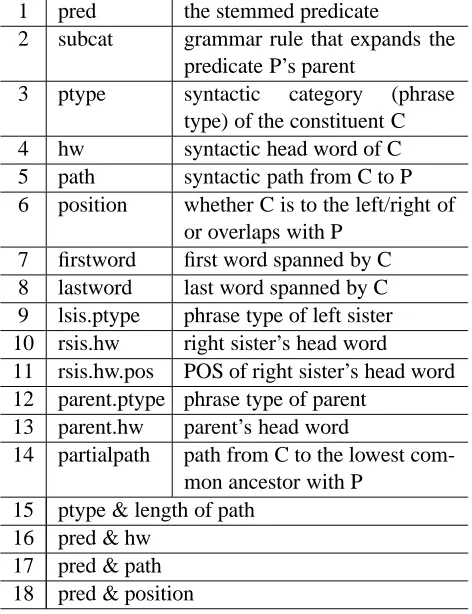
Nom-Bank argument identification. As the improvement of the F1 score due to the additional features is not statistically significant, we use the set of eighteen baseline features for simplicity. These features are reproduced in Table 1 for easy reference.
Unlike in (Jiang and Ng, 2006), we do not prune arguments dominated by other arguments or those that overlap with the predicate in the training data. Accordingly, we do not maximize the probability of the entire labeled parse tree as in (Toutanova et al., 2005). After the features of every constituent are extracted, each constituent is simply classified inde-pendently as either argument or non-argument.
The linear classifier described above is trained on sections 2 to 21 and tested on section 23. A max-imum entropy classifier is trained and tested in the same manner. The F1 scores are presented in the first row of Table 3, in columns linear and maxent respectively. The J&N column presents the result reported in (Jiang and Ng, 2006) using both base-line and additional features. The last column aso presents the best result from this work, to be ex-plained in Section 5.
4.2 Argument classification
In NomBank, some constituents have more than one label. For simplicity, we always assign exactly one label to each identified argument in this step. For the 0.16% arguments with multiple labels in the training
1 pred the stemmed predicate
2 subcat grammar rule that expands the predicate P’s parent
3 ptype syntactic category (phrase type) of the constituent C 4 hw syntactic head word of C 5 path syntactic path from C to P 6 position whether C is to the left/right of
or overlaps with P 7 firstword first word spanned by C 8 lastword last word spanned by C 9 lsis.ptype phrase type of left sister 10 rsis.hw right sister’s head word
11 rsis.hw.pos POS of right sister’s head word 12 parent.ptype phrase type of parent
13 parent.hw parent’s head word
14 partialpath path from C to the lowest com-mon ancestor with P
15 ptype & length of path 16 pred & hw
[image:4.612.313.549.74.381.2]17 pred & path 18 pred & position
Table 1: Features used in argument identification
data, we pick the first and discard the rest. (Note that the same is not done on the test data.)
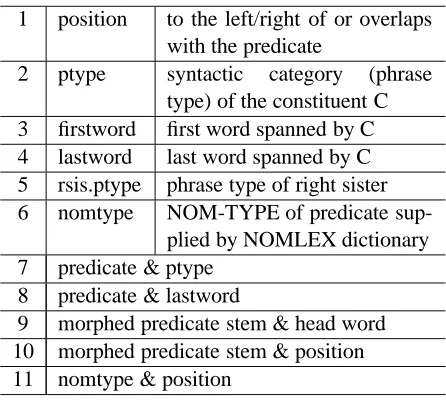
A diverse set of 28 features is used in (Jiang and Ng, 2006) for argument classification. In this work, the number of features is pruned to 11, so that we can work with reasonably many auxiliary problems in later experiments with ASO.
To find a smaller set of effective features, we start with all the features considered in (Jiang and Ng, 2006), in (Xue and Palmer, 2004), and various com-binations of them, for a total of 52 features. These features are then pruned by the following algorithm:
1. For each feature in the current feature set, do step (2).
2. Remove the selected feature from the feature set. Obtain the F1 score of the remaining fea-tures when applied to the argument classifica-tion task, on development data secclassifica-tion 24 with gold identification.
1 position to the left/right of or overlaps with the predicate
2 ptype syntactic category (phrase type) of the constituent C 3 firstword first word spanned by C 4 lastword last word spanned by C 5 rsis.ptype phrase type of right sister 6 nomtype NOM-TYPE of predicate
sup-plied by NOMLEX dictionary 7 predicate & ptype
8 predicate & lastword
[image:5.612.74.297.69.269.2]9 morphed predicate stem & head word 10 morphed predicate stem & position 11 nomtype & position
Table 2: Features used in argument classification
step (2). The corresponding feature is removed from the current feature set if its F1 score is the same as or higher than the F1 score of retaining all features.
4. Repeat steps (1)-(3) until the F1 score starts to drop.
The 11 features so obtained are presented in Ta-ble 2. Using these features, a linear classifier and a maximum entropy classifier are trained on sections 2 to 21, and tested on section 23. The F1 scores are presented in the second row of Table 3, in columns
linear and maxent respectively. The J&N column
presents the result reported in (Jiang and Ng, 2006).
4.3 Further experiments and discussion
In the combined task, we run the identification task with gold parse trees, and then the classification task with the output of the identification task. This way the combined effect of errors from both stages on the final classification output can be assessed. The scores of this complete SRL system are presented in the third row of Table 3.
To test the performance of the combined task on automatic parse trees, we employ two different con-figurations. First, we train the various classifiers on sections 2 to 21 using gold argument labels and
automatic parse trees produced by Charniak’s
re-ranking parser (Charniak and Johnson, 2005), and test them on section 23 with automatic parse trees.
[image:5.612.311.551.394.479.2]This is the same configuration as reported in (Prad-han et al., 2005; Jiang and Ng, 2006). The scores are presented in the fourth row auto parse (t&t) in Table 3.
Next, we train the various classifiers on sections 2 to 21 using gold argument labels and gold parse
trees. To minimize the discrepancy between gold
and automatic parse trees, we remove all the nodes in the gold trees whose POS are -NONE-, as they do not span any word and are thus never generated by the automatic parser. The resulting classifiers are then tested on section 23 using automatic parse trees. The scores are presented in the last row auto parse
(test) of Table 3. We note that auto parse (test)
con-sistently outperforms auto parse (t&t).
We believe that auto parse (test) is a more realis-tic setting in which to test the performance of SRL on automatic parse trees. When presented with some previously unseen test data, we are forced to rely on its automatic parse trees. However, for the best re-sults we should take advantage of gold parse trees whenever possible, including those of the labeled training data.
J&N maxent linear aso identification 82.50 83.58 81.34 85.32 classification 87.80 88.35 87.86 89.17 combined 72.73 75.35 72.63 77.04 auto parse (t&t) 69.14 69.61 67.38 72.11 auto parse (test) - 71.19 69.05 72.83
Table 3: F1 scores of various classifiers on Nom-Bank SRL
Our maximum entropy classifier consistently out-performs (Jiang and Ng, 2006), which also uses a maximum entropy classifier. The primary difference is that we use a later version of NomBank (Septem-ber 2006 release vs. Septem(Septem-ber 2005 release). In ad-dition, we use somewhat different features and treat overlapping arguments differently.
5 Applying ASO to SRL
Our ASO classifier uses the same features as the baseline linear classifier. The defining characteris-tic, and also the major challenge in successfully ap-plying the ASO algorithm is to find related auxiliary problems that can reveal common structures shared
with the target problem. To organize our search for good auxiliary problems for SRL, we separate them into two categories, unobservable auxiliary
prob-lems and observable auxiliary probprob-lems.
5.1 Unobservable auxiliary problems
Unobservable auxiliary problems are problems whose true outcome cannot be observed from a raw text corpus but must come from another source, e.g., human labeling. For instance, predicting the argument class (i.e., ARG0, ARG1, . . .) of a con-stituent is an unobservable auxiliary problem (which is also the only usable unobservable auxiliary prob-lem here), because the true outcomes (i.e., the argu-ment classes) are only available from human labels annotated in NomBank.
For argument identification, we invent the follow-ing 20 binary unobservable auxiliary problems to take advantage of information previously unused at this stage:
To predict the outcome of argument classi-fication (i.e.,ARG0,ARG1,. . .) using the features of argument identification (pred,
subcat,. . .).
Thus for argument identification, we have 20 auxil-iary problems (one auxilauxil-iary problem for predicting each of the argument classesARG0,ARG1,. . .) and
one target problem (predicting whether a constituent is an argument) for the ASO algorithm described in Section 3.2.
In the argument classification task, the 20 binary target problems are also the unobservable auxiliary problems (one auxiliary problem for predicting each of the argument classes ARG0, ARG1, . . .). Thus, we use the same 20 problems as both auxiliary prob-lems and target probprob-lems.
We train an ASO classifier on sections 2 to 21 and test it on section 23. With the 20 unobservable aux-iliary problems, we obtain the F1 scores reported in the last column of Table 3. In all the experiments, we keeph = 20, i.e., all the 20 columns of V1 are kept.
Comparing the F1 score of ASO against that of the linear classifier in every task (i.e., identification, classification, combined, both auto parse configura-tions), the improvement achieved by ASO is statis-tically significant (p < 0.05) based on the χ2 test.
Comparing the F1 score of ASO against that of the maximum entropy classifier, the improvement in all but one task (argument classification) is statistically significant (p < 0.05). For argument classifica-tion, the improvement is not statistically significant (p= 0.08).
5.2 Observable auxiliary problems
Observable auxiliary problems are problems whose true outcome can be observed from a raw text cor-pus without additional externally provided labels. An example is to predict whether hw=trader from a constituent’s other features, since the head word of a constituent can be obtained from the raw text alone. By definition, an observable auxiliary prob-lem can always be formulated as predicting a fea-ture of the training data. Depending on whether the baseline linear classifier already uses the feature to be predicted, we face two possibilities:
Predicting a used feature In auxiliary problems of this type, we must take care to remove the feature itself from the training data. For example, we must not use the feature path or pred&path to predict path itself.
Predicting an unused feature These auxiliary problems provide information that the classifier was previously unable to incorporate. The desirable characteristics of such a feature are:
1. The feature, although unused, should have been considered for the target problem so it is prob-ably related to the target problem.
2. The feature should not be highly correlated with a used feature, e.g., since the lastword fea-ture is used in argument identification, we will not consider predicting lastword.pos as an aux-iliary problem.
5.2.1 Argument identification
In argument identification using gold parse trees, we experiment with predicting three unused features as auxiliary problems: distance (distance between the predicate and the constituent), parent.lsis.hw (head word of the parent constituent’s left sister) and
parent.rsis.hw (head word of the parent constituent’s
right sister). We then experiment with predicting four used features: hw, lastword, ptype and path.
The ASO classifier is trained on sections 2 to 21, and tested on section 23. Due to the large data size, we are unable to use more than 20 binary auxil-iary problems or to experiment with combinations of them. The F1 scores are presented in Table 4.
5.2.2 Argument classification
In argument classification using gold parse trees and gold identification, we experiment with pre-dicting three unused features path, partialpath, and
chunkseq (concatenation of the phrase types of text
chunks between the predicate and the constituent). We then experiment with predicting three used fea-tures hw, lastword, and ptype.
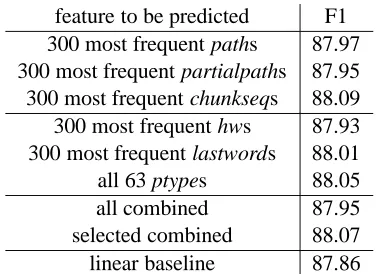
Combinations of these auxiliary problems are also tested. In all combined, we use the first 100 prob-lems from each of the six groups of observable aux-iliary problems. In selected combined, we use the first 100 problems from each of path, chunkseq,
last-word and ptype problems.
The ASO classifier is trained on sections 2 to 21, and tested on section 23. The F1 scores are shown in Table 5.
[image:7.612.332.520.70.207.2]feature to be predicted F1 20 most frequent distances 81.48 20 most frequent parent.lsis.hws 81.51 20 most frequent parent.rsis.hws 81.60 20 most frequent hws 81.40 20 most frequent lastwords 81.33 20 most frequent ptypes 81.35 20 most frequent paths 81.47 linear baseline 81.34
Table 4: F1 scores of ASO with observable auxiliary problems on argument identification. Allh= 20.
From Table 4 and 5, we observe that although the use of observable auxiliary problems
consis-feature to be predicted F1 300 most frequent paths 87.97 300 most frequent partialpaths 87.95 300 most frequent chunkseqs 88.09 300 most frequent hws 87.93 300 most frequent lastwords 88.01 all 63 ptypes 88.05 all combined 87.95 selected combined 88.07 linear baseline 87.86
Table 5: F1 scores of ASO with observable auxiliary problems on argument classification. Allh= 100.
tently improves the performance of the classifier, the differences are small and not statistically signif-icant. Further experiments combining unobservable and observable auxiliary problems fail to outperform ASO with unobservable auxiliary problems alone.
In summary, our work shows that unobservable auxiliary problems significantly improve the perfor-mance of NomBank SRL. In contrast, observable auxiliary problems are not effective.
6 Discussions
Some of our experiments are limited by the exten-sive computing resources required for a fuller ex-ploration. For instance, “predicting unused features” type of auxiliary problems might hold some hope for further improvement in argument identification, if a larger number of auxiliary problems can be used.
ASO has been demonstrated to be an effec-tive semi-supervised learning algorithm (Ando and Zhang, 2005a; Ando and Zhang, 2005b; Ando, 2006). However, we have been unable to use un-labeled data to improve the accuracy. One possible reason is the cumulative noise from the many cas-cading steps involved in automatic SRL of unlabeled data: syntactic parse, predicate identification (where we identify nouns with at least one argument), ar-gument identification, and finally arar-gument classi-fication, which reduces the effectiveness of adding unlabeled data using ASO.
7 Related work
Multi-output neural networks learn several tasks si-multaneously. In addition to the target outputs,
[image:7.612.88.285.517.642.2](Caruana, 1997) discusses configurations where both used inputs and unused inputs (due to excessive noise) are utilized as additional outputs. In contrast, our work concerns linear predictors using empirical risk minimization.
A variety of auxiliary problems are tested in (Ando and Zhang, 2005a; Ando and Zhang, 2005b) in the semi-supervised settings, i.e., their auxiliary problems are generated from unlabeled data. This differs significantly from the supervised setting in our work, where only labeled data is used. While (Ando and Zhang, 2005b) uses “predicting used features” (previous/current/next word) as auxiliary problems with good results in named entity recog-nition, the use of similar observable auxiliary prob-lems in our work gives no statistically significant im-provements.
More recently, for the word sense disambiguation (WSD) task, (Ando, 2006) experimented with both supervised and semi-supervised auxiliary problems, although the auxiliary problems she used are differ-ent from ours.
8 Conclusion
In this paper, we have presented a novel application of Alternating Structure Optimization (ASO) to the Semantic Role Labeling (SRL) task on NomBank. The possible auxiliary problems are categorized and tested extensively. Our results outperform those re-ported in (Jiang and Ng, 2006). To the best of our knowledge, we achieve the highest SRL accuracy published to date on the English NomBank.
References
R. K. Ando and T. Zhang. 2005a. A framework for learning predictive structures from multiple tasks and unlabeled data. Journal of Machine Learning Research.
R. K. Ando and T. Zhang. 2005b. A high-performance semi-supervised learning method for text chunking. In Proc. of ACL.
R. K. Ando. 2006. Applying alternating structure optimization to word sense disambiguation. In Proc. of CoNLL.
C. F. Baker, C. J. Fillmore, and J. B. Lowe. 1998. The Berkeley FrameNet project. In Proc. of COLING-ACL.
S. Ben-David and R. Schuller. 2003. Exploiting task related-ness for multiple task learning. In Proc. of COLT.
X. Carreras and L. Marquez. 2004. Introduction to the CoNLL-2004 shared task: Semantic role labeling. In Proc. of CoNLL.
X. Carreras and L. Marquez. 2005. Introduction to the CoNLL-2005 shared task: Semantic role labeling. In Proc. of CoNLL.
R. Caruana. 1997. Multitask Learning. Ph.D. thesis, School of Computer Science, CMU.
E. Charniak and M. Johnson. 2005. Coarse-to-fine n-best pars-ing and MaxEnt discriminative rerankpars-ing. In Proc. of ACL.
T. Evgeniou and M. Pontil. 2004. Regularized multitask learn-ing. In Proc. of KDD.
D. Gildea and D. Jurafsky. 2002. Automatic labeling of seman-tic roles. Computational Linguisseman-tics.
Z. P. Jiang and H. T. Ng. 2006. Semantic role labeling of Nom-Bank: A maximum entropy approach. In Proc. of EMNLP.
K. C. Litkowski. 2004. Senseval-3 task: automatic labeling of semantic roles. In Proc. of SENSEVAL-3.
A. Maurer. 2006. Bounds for linear multitask learning. Journal of Machine Learning Research.
A. Meyers, R. Reeves, C. Macleod, R. Szekeley, V. Zielinska, B. Young, and R. Grishman. 2004. The NomBank project: An interim report. In Proc. of HLT/NAACL Workshop on Frontiers in Corpus Annotation.
C. A. Micchelli and M. Pontil. 2005. Kernels for multitask learning. In Proc. of NIPS.
M. Palmer, D. Gildea, and P. Kingsbury. 2005. The Proposition Bank: an annotated corpus of semantic roles. Computational Linguistics.
S. S. Pradhan, H. Sun, W. Ward, J. H. Martin, and D. Jurafsky. 2004. Parsing arguments of nominalizations in English and Chinese. In Proc. of HLT/NAACL.
S. Pradhan, K. Hacioglu, V. Krugler, W. Ward, J. H. Martin, and D. Jurafsky. 2005. Support vector learning for semantic argument classification. Machine Learning.
K. Toutanova, A. Haghighi, and C. D. Manning. 2005. Joint learning improves semantic role labeling. In Proc. of ACL.
N. Xue and M. Palmer. 2004. Calibrating features for semantic role labeling. In Proc. of EMNLP.