Proceedings of the 45th Annual Meeting of the Association of Computational Linguistics, pages 840–847,
Chinese Segmentation with a Word-Based Perceptron Algorithm
Yue Zhang and Stephen Clark Oxford University Computing Laboratory
Wolfson Building, Parks Road Oxford OX1 3QD, UK
{yue.zhang,stephen.clark}@comlab.ox.ac.uk
Abstract
Standard approaches to Chinese word seg-mentation treat the problem as a tagging task, assigning labels to the characters in the sequence indicating whether the char-acter marks a word boundary. Discrimina-tively trained models based on local char-acter features are used to make the tagging decisions, with Viterbi decoding finding the highest scoring segmentation. In this paper we propose an alternative, word-based seg-mentor, which uses features based on com-plete words and word sequences. The gener-alized perceptron algorithm is used for dis-criminative training, and we use a beam-search decoder. Closed tests on the first and secondSIGHANbakeoffs show that our sys-tem is competitive with the best in the litera-ture, achieving the highest reported F-scores for a number of corpora.
1 Introduction
Words are the basic units to process for most NLP tasks. The problem of Chinese word segmentation (CWS) is to find these basic units for a given sen-tence, which is written as a continuous sequence of characters. It is the initial step for most Chinese pro-cessing applications.
Chinese character sequences are ambiguous, of-ten requiring knowledge from a variety of sources for disambiguation. Out-of-vocabulary (OOV) words are a major source of ambiguity. For example, a difficult case occurs when an OOV word consists
of characters which have themselves been seen as words; here an automatic segmentor may split the OOV word into individual single-character words. Typical examples of unseen words include Chinese names, translated foreign names and idioms.
The segmentation of known words can also be ambiguous. For example, “ÙÌb” should be “Ù
Ì(here)b(flour)” in the sentence “ÙÌbs 5” (flour and rice are expensive here) or “Ù(here) Ìb (inside)” in the sentence “ÙÌb·” (it’s
cold inside here). The ambiguity can be resolved with information about the neighboring words. In comparison, for the sentences “=”,
possible segmentations include “= (the
discus-sion)(will) (very)(be successful)” and
“=(the discussion meeting)(very)(be
successful)”. The ambiguity can only be resolved with contextual information outside the sentence. Human readers often use semantics, contextual in-formation about the document and world knowledge to resolve segmentation ambiguities.
There is no fixed standard for Chinese word seg-mentation. Experiments have shown that there is only about75% agreement among native speakers regarding the correct word segmentation (Sproat et al., 1996). Also, specificNLPtasks may require dif-ferent segmentation criteria. For example, “¬ö
L” could be treated as a single word (Bank of
Bei-jing) for machine translation, while it is more natu-rally segmented into “¬ (Beijing)öL (bank)”
for tasks such as text-to-speech synthesis. There-fore, supervised learning with specifically defined training data has become the dominant approach.
Following Xue (2003), the standard approach to
supervised learning forCWSis to treat it as a tagging task. Tags are assigned to each character in the sen-tence, indicating whether the character is a single-character word or the start, middle or end of a multi-character word. The features are usually confined to a five-character window with the current character in the middle. In this way, dynamic programming algorithms such as the Viterbi algorithm can be used for decoding.
Several discriminatively trained models have re-cently been applied to the CWS problem. Exam-ples include Xue (2003), Peng et al. (2004) and Shi and Wang (2007); these use maximum entropy (ME) and conditional random field (CRF) models (Ratna-parkhi, 1998; Lafferty et al., 2001). An advantage of these models is their flexibility in allowing knowl-edge from various sources to be encoded as features. Contextual information plays an important role in word segmentation decisions; especially useful is in-formation about surrounding words. Consider the sentence “-ý”, which can be from “
v-(among which)ý(foreign) (companies)”,
or “-ý (in China) (foreign companies)
¡(business)”. Note that the five-character window
surrounding “” is the same in both cases, making
the tagging decision for that character difficult given the local window. However, the correct decision can be made by comparison of the two three-word win-dows containing this character.
In order to explore the potential of word-based models, we adapt the perceptron discriminative learning algorithm to the CWS problem. Collins (2002) proposed the perceptron as an alternative to the CRF method for HMM-style taggers. However, our model does not map the segmentation problem to a tag sequence learning problem, but defines fea-tures on segmented sentences directly. Hence we use a beam-search decoder during training and test-ing; our idea is similar to that of Collins and Roark (2004) who used a beam-search decoder as part of a perceptron parsing model. Our work can also be seen as part of the recent move towards search-based learning methods which do not rely on dynamic pro-gramming and are thus able to exploit larger parts of the context for making decisions (Daume III, 2006). We study several factors that influence the per-formance of the perceptron word segmentor, includ-ing the averaged perceptron method, the size of the
beam and the importance of word-based features. We compare the accuracy of our final system to the state-of-the-art CWS systems in the literature using the first and secondSIGHAN bakeoff data. Our sys-tem is competitive with the best syssys-tems, obtaining the highest reported F-scores on a number of the bakeoff corpora. These results demonstrate the im-portance of word-based features for CWS. Further-more, our approach provides an example of the po-tential of search-based discriminative training meth-ods forNLPtasks.
2 The Perceptron Training Algorithm
We formulate theCWSproblem as finding a mapping from an input sentencex∈Xto an output sentence
y∈Y, whereXis the set of possible raw sentences and Y is the set of possible segmented sentences. Given an input sentence x, the correct output seg-mentationF(x)satisfies:
F(x) = arg max
y∈GEN(x)
Score(y)
where GEN(x)denotes the set of possible segmen-tations for an input sentencex, consistent with nota-tion from Collins (2002).
The score for a segmented sentence is computed by first mapping it into a set of features. A feature is an indicator of the occurrence of a certain pattern in a segmented sentence. For example, it can be the occurrence of “Ìb” as a single word, or the
occur-rence of “Ì” separated from “b” in two adjacent
words. By defining features, a segmented sentence is mapped into a global feature vector, in which each dimension represents the count of a particular fea-ture in the sentence. The term “global” feafea-ture vec-tor is used by Collins (2002) to distinguish between feature count vectors for whole sequences and the “local” feature vectors inMEtagging models, which are Boolean valued vectors containing the indicator features for one element in the sequence.
Denote the global feature vector for segmented sentence y with Φ(y) ∈ Rd, where d is the total
number of features in the model; then Score(y) is computed by the dot product of vector Φ(y) and a parameter vectorα∈Rd, whereα
iis the weight for
theith feature:
Inputs: training examples(xi, yi)
Initialization: setα= 0
Algorithm:
fort= 1..T,i= 1..N
calculatezi = arg maxy∈GEN(xi)Φ(y)·α ifzi6=yi
α=α+ Φ(yi)−Φ(zi)
Outputs:α
Figure 1: the perceptron learning algorithm, adapted from Collins (2002)
The perceptron training algorithm is used to deter-mine the weight valuesα.
The training algorithm initializes the parameter vector as all zeros, and updates the vector by decod-ing the traindecod-ing examples. Each traindecod-ing sentence is turned into the raw input form, and then decoded with the current parameter vector. The output seg-mented sentence is compared with the original train-ing example. If the output is incorrect, the parameter vector is updated by adding the global feature vector of the training example and subtracting the global feature vector of the decoder output. The algorithm can perform multiple passes over the same training sentences. Figure 1 gives the algorithm, whereN is the number of training sentences andT is the num-ber of passes over the data.
Note that the algorithm from Collins (2002) was designed for discriminatively training anHMM-style tagger. Features are extracted from an input se-quencexand its corresponding tag sequencey:
Score(x, y) = Φ(x, y)·α
Our algorithm is not based on anHMM. For a given input sequencex, even the length of different candi-datesy(the number of words) is not fixed. Because the output sequencey(the segmented sentence) con-tains all the information from the input sequencex
(the raw sentence), the global feature vectorΦ(x, y)
is replaced withΦ(y), which is extracted from the candidate segmented sentences directly.
Despite the above differences, since the theorems of convergence and their proof (Collins, 2002) are only dependent on the feature vectors, and not on the source of the feature definitions, the perceptron algorithm is applicable to the training of our CWS model.
2.1 The averaged perceptron
The averaged perceptron algorithm (Collins, 2002) was proposed as a way of reducing overfitting on the training data. It was motivated by the voted-perceptron algorithm (Freund and Schapire, 1999) and has been shown to give improved accuracy over the non-averaged perceptron on a number of tasks. Let N be the number of training sentences, T the number of training iterations, andαn,tthe
parame-ter vector immediately afparame-ter thenth sentence in the
tth iteration. The averaged parameter vectorγ ∈Rd
is defined as:
γ = 1
N T
X
n=1..N,t=1..T
αn,t
To compute the averaged parametersγ, the train-ing algorithm in Figure 1 can be modified by keep-ing a total parameter vectorσn,t=Pαn,t, which is
updated usingα after each training example. After the final iteration,γis computed asσn,t/N T. In the
averaged perceptron algorithm,γ is used instead of
αas the final parameter vector.
With a large number of features, calculating the total parameter vectorσn,tafter each training
exam-ple is expensive. Since the number of changed di-mensions in the parameter vectorαafter each train-ing example is a small proportion of the total vec-tor, we use a lazy update optimization for the train-ing process.1 Define an update vector τ to record the number of the training sentencenand iteration
t when each dimension of the averaged parameter vector was last updated. Then after each training sentence is processed, only update the dimensions of the total parameter vector corresponding to the features in the sentence. (Except for the last exam-ple in the last iteration, when each dimension ofτ
is updated, no matter whether the decoder output is correct or not).
Denote the sth dimension in each vector before processing the nth example in the tth iteration as
αns−1,t, σns−1,t andτsn−1,t = (nτ,s, tτ,s). Suppose
that the decoder output zn,t is different from the
training example yn. Now αn,ts , σsn,t and τsn,t can
1
be updated in the following way:
σn,ts =σn−1,t
s +αn
−1,t
s ×(tN+n−tτ,sN−nτ,s)
αn,ts =αn−1,t
s + Φ(yn)−Φ(zn,t)
σn,t
s =σn,ts + Φ(yn)−Φ(zn,t)
τsn,t= (n, t)
We found that this lazy update method was signif-icantly faster than the naive method.
3 The Beam-Search Decoder
The decoder reads characters from the input sen-tence one at a time, and generates candidate seg-mentations incrementally. At each stage, the next in-coming character is combined with an existing can-didate in two different ways to generate new candi-dates: it is either appended to the last word in the candidate, or taken as the start of a new word. This method guarantees exhaustive generation of possible segmentations for any input sentence.
Two agendas are used: the source agenda and the target agenda. Initially the source agenda contains an empty sentence and the target agenda is empty. At each processing stage, the decoder reads in a character from the input sentence, combines it with each candidate in the source agenda and puts the generated candidates onto the target agenda. After each character is processed, the items in the target agenda are copied to the source agenda, and then the target agenda is cleaned, so that the newly generated candidates can be combined with the next incom-ing character to generate new candidates. After the last character is processed, the decoder returns the candidate with the best score in the source agenda. Figure 2 gives the decoding algorithm.
For a sentence with lengthl, there are2l−1
differ-ent possible segmdiffer-entations. To guarantee reasonable running speed, the size of the target agenda is lim-ited, keeping only theBbest candidates.
4 Feature templates
The feature templates are shown in Table 1. Features 1 and 2 contain only word information, 3 to 5 tain character and length information, 6 and 7 con-tain only character information, 8 to 12 concon-tain word and character information, while 13 and 14 contain
Input: raw sentencesent– a list of characters
Initialization: set agendassrc=[[]],tgt=[]
Variables: candidate sentenceitem– a list of words
Algorithm:
forindex= 0..sent.length−1: varchar=sent[index] foreachiteminsrc:
// append as a new word to the candidate varitem1 =item
item1.append(char.toWord()) tgt.insert(item1)
// append the character to the last word ifitem.length>1:
varitem2 =item
item2[item2.length−1].append(char) tgt.insert(item2)
src=tgt tgt=[]
Outputs:src.best item
Figure 2: The decoding algorithm
word and length information. Any segmented sen-tence is mapped to a global feature vector according to these templates. There are356,337features with non-zero values after6 training iterations using the development data.
For this particular feature set, the longest range features are word bigrams. Therefore, among partial candidates ending with the same bigram, the best one will also be in the best final candidate. The decoder can be optimized accordingly: when an in-coming character is combined with candidate items as a new word, only the best candidate is kept among those having the same last word.
5 Comparison with Previous Work
1 wordw
2 word bigramw1w2
3 single-character wordw
4 a word starting with charactercand having lengthl
5 a word ending with charactercand having lengthl
6 space-separated charactersc1andc2
7 character bigramc1c2in any word
8 the first and last charactersc1andc2of any
word
9 wordwimmediately before characterc
10 charactercimmediately before wordw
11 the starting charactersc1andc2of two
con-secutive words
12 the ending charactersc1andc2of two
con-secutive words
13 a word of lengthland the previous wordw
14 a word of lengthland the next wordw
Table 1: feature templates
do not involve word information. Wang et al. (2006) incorporates an N-gram language model inME tag-ging, making use of word information to improve the character tagging model. The key difference be-tween our model and the above models is the word-based nature of our system.
One existing method that is based on sub-word in-formation, Zhang et al. (2006), combines aCRFand a rule-based model. Unlike the character-tagging models, the CRF submodel assigns tags to sub-words, which include single-character words and the most frequent multiple-character words from the training corpus. Thus it can be seen as a step towards a word-based model. However, sub-words do not necessarily contain full word information. More-over, sub-word extraction is performed separately from feature extraction. Another difference from our model is the rule-based submodel, which uses a dictionary-based forward maximum match method described by Sproat et al. (1996).
6 Experiments
Two sets of experiments were conducted. The first, used for development, was based on the part of Chi-nese Treebank 4 that is not in ChiChi-nese Treebank
3 (since CTB3 was used as part of the first bake-off). This corpus contains 240K characters (150K words and 4798 sentences). 80% of the sentences (3813) were randomly chosen for training and the rest (985sentences) were used as development test-ing data. The accuracies and learntest-ing curves for the non-averaged and averaged perceptron were com-pared. The influence of particular features and the agenda size were also studied.
The second set of experiments used training and testing sets from the first and second international Chinese word segmentation bakeoffs (Sproat and Emerson, 2003; Emerson, 2005). The accuracies are compared to other models in the literature.
F-measure is used as the accuracy measure. De-fine precisionpas the percentage of words in the de-coder output that are segmented correctly, and recall
r as the percentage of gold standard output words that are correctly segmented by the decoder. The (balanced) F-measure is2pr/(p+r).
CWSsystems are evaluated by two types of tests. The closed tests require that the system is trained only with a designated training corpus. Any extra knowledge is not allowed, including common sur-names, Chinese and Arabic numbers, European let-ters, lexicons, part-of-speech, semantics and so on. The open tests do not impose such restrictions.
Open tests measure a model’s capability to utilize extra information and domain knowledge, which can lead to improved performance, but since this extra information is not standardized, direct comparison between open test results is less informative.
In this paper, we focus only on the closed test. However, the perceptron model allows a wide range of features, and so future work will consider how to integrate open resources into our system.
6.1 Learning curve
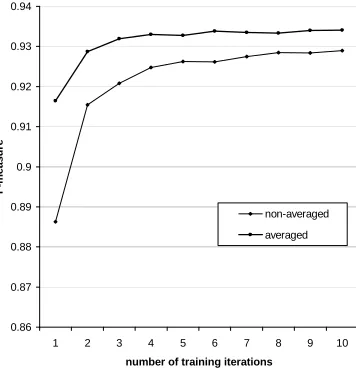
In this experiment, the agenda size was set to16, for both training and testing. Table 2 shows the preci-sion, recall and F-measure for the development set after1to10training iterations, as well as the num-ber of mistakes made in each iteration. The corre-sponding learning curves for both the non-averaged and averaged perceptron are given in Figure 3.
per-Iteration 1 2 3 4 5 6 7 8 9 10
P (non-avg) 89.0 91.6 92.0 92.3 92.5 92.5 92.5 92.7 92.6 92.6
R (non-avg) 88.3 91.4 92.2 92.6 92.7 92.8 93.0 93.0 93.1 93.2
F (non-avg) 88.6 91.5 92.1 92.5 92.6 92.6 92.7 92.8 92.8 92.9
P (avg) 91.7 92.8 93.1 92.2 93.1 93.2 93.2 93.2 93.2 93.2
R (avg) 91.6 92.9 93.3 93.4 93.4 93.5 93.5 93.5 93.6 93.6
F (avg) 91.6 92.9 93.2 93.3 93.3 93.4 93.3 93.3 93.4 93.4
#Wrong sentences 3401 1652 945 621 463 288 217 176 151 139
Table 2: accuracy using non-averaged and averaged perceptron. P - precision (%), R - recall (%), F - F-measure.
B 2 4 8 16 32 64 128 256 512 1024
Tr 660 610 683 830 1111 1645 2545 4922 9104 15598
Seg 18.65 18.18 28.85 26.52 36.58 56.45 95.45 173.38 325.99 559.87
[image:6.612.91.269.339.523.2]F 86.90 92.95 93.33 93.38 93.25 93.29 93.19 93.07 93.24 93.34
Table 3: the influence of agenda size.
B - agenda size, Tr - training time (seconds), Seg - testing time (seconds), F - F-measure.
0.86 0.87 0.88 0.89 0.9 0.91 0.92 0.93 0.94
1 2 3 4 5 6 7 8 9 10
number of training iterations
F
-m
e
a
s
u
re
non-averaged
averaged
Figure 3: learning curves of the averaged and non-averaged perceptron algorithms
ceptron algorithm improves the segmentation ac-curacy at each iteration, compared with the non-averaged perceptron. The learning curve was used to fix the number of training iterations at 6 for the remaining experiments.
6.2 The influence of agenda size
Reducing the agenda size increases the decoding speed, but it could cause loss of accuracy by elimi-nating potentially good candidates. The agenda size
also affects the training time, and resulting model, since the perceptron training algorithm uses the de-coder output to adjust the model parameters. Table 3 shows the accuracies with ten different agenda sizes, each used for both training and testing.
Accuracy does not increase beyond B = 16. Moreover, the accuracy is quite competitive even withBas low as 4. This reflects the fact that the best segmentation is often within the current top few can-didates in the agenda.2Since the training and testing time generally increases asN increases, the agenda size is fixed to16for the remaining experiments.
6.3 The influence of particular features
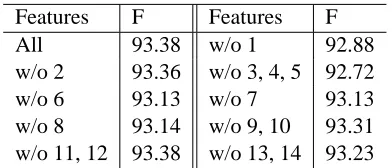
OurCWS model is highly dependent upon word in-formation. Most of the features in Table 1 are related to words. Table 4 shows the accuracy with various features from the model removed.
Among the features, vocabulary words (feature 1) and length prediction by characters (features 3 to 5) showed strong influence on the accuracy, while word bigrams (feature 2) and special characters in them (features 11 and 12) showed comparatively weak in-fluence.
2
Features F Features F
All 93.38 w/o 1 92.88
w/o 2 93.36 w/o 3, 4, 5 92.72
w/o 6 93.13 w/o 7 93.13
w/o 8 93.14 w/o 9, 10 93.31
w/o 11, 12 93.38 w/o 13, 14 93.23
Table 4: the influence of features. (F: F-measure. Feature numbers are from Table 1)
6.4 Closed test on theSIGHANbakeoffs
Four training and testing corpora were used in the first bakeoff (Sproat and Emerson, 2003), including the Academia Sinica Corpus (AS), the Penn Chinese Treebank Corpus (CTB), the Hong Kong City Uni-versity Corpus (CU) and the Peking UniUni-versity Cor-pus (PU). However, because the testing data from the Penn Chinese Treebank Corpus is currently un-available, we excluded this corpus. The corpora are encoded in GB (PU, CTB) and BIG5 (AS, CU). In order to test them consistently in our system, they are all converted to UTF8 without loss of informa-tion.
The results are shown in Table 5. We follow the format from Peng et al. (2004). Each row repre-sents a CWS model. The first eight rows represent models from Sproat and Emerson (2003) that partic-ipated in at least one closed test from the table, row “Peng” represents the CRF model from Peng et al. (2004), and the last row represents our model. The first three columns represent tests with the AS, CU and PU corpora, respectively. The best score in each column is shown in bold. The last two columns rep-resent the average accuracy of each model over the tests it participated in (SAV), and our average over the same tests (OAV), respectively. For each row the best average is shown in bold.
We achieved the best accuracy in two of the three corpora, and better overall accuracy than the major-ity of the other models. The average score of S10 is0.7%higher than our model, but S10 only partici-pated in the HK test.
Four training and testing corpora were used in the second bakeoff (Emerson, 2005), including the Academia Sinica corpus (AS), the Hong Kong City University Corpus (CU), the Peking University Cor-pus (PK) and the Microsoft Research CorCor-pus (MR).
AS CU PU SAV OAV
S01 93.8 90.1 95.1 93.0 95.0
S04 93.9 93.9 94.0
S05 94.2 89.4 91.8 95.3
S06 94.5 92.4 92.4 93.1 95.0
S08 90.4 93.6 92.0 94.3
S09 96.1 94.6 95.4 95.3
S10 94.7 94.7 94.0
S12 95.9 91.6 93.8 95.6
Peng 95.6 92.8 94.1 94.2 95.0
[image:7.612.328.525.68.223.2]96.5 94.6 94.0
Table 5: the accuracies over the firstSIGHAN bake-off data.
AS CU PK MR SAV OAV
S14 94.7 94.3 95.0 96.4 95.1 95.4
S15b 95.2 94.1 94.1 95.8 94.8 95.4
S27 94.5 94.0 95.0 96.0 94.9 95.4
Zh-a 94.7 94.6 94.5 96.4 95.1 95.4
Zh-b 95.1 95.1 95.1 97.1 95.6 95.4
94.6 95.1 94.5 97.2
Table 6: the accuracies over the second SIGHAN bakeoff data.
Different encodings were provided, and the UTF8 data for all four corpora were used in this experi-ment.
Following the format of Table 5, the results for this bakeoff are shown in Table 6. We chose the three models that achieved at least one best score in the closed tests from Emerson (2005), as well as the sub-word-based model of Zhang et al. (2006) for comparison. Row “Zh-a” and “Zh-b” represent the pure sub-wordCRFmodel and the confidence-based combination of theCRF and rule-based models, re-spectively.
Again, our model achieved better overall accu-racy than the majority of the other models. One tem to achieve comparable accuracy with our sys-tem is Zh-b, which improves upon the sub-wordCRF model (Zh-a) by combining it with an independent dictionary-based submodel and improving the accu-racy of known words. In comparison, our system is based on a single perceptron model.
[image:7.612.88.284.70.154.2]system compared with the best results in the litera-ture. Our word-based system achieved the best F-measures over the AS (96.5%) and CU (94.6%) cor-pora in the first bakeoff, and the CU (95.1%) and MR (97.2%) corpora in the second bakeoff.
7 Conclusions and Future Work
We proposed a word-based CWS model using the discriminative perceptron learning algorithm. This model is an alternative to the existing character-based tagging models, and allows word information to be used as features. One attractive feature of the perceptron training algorithm is its simplicity, con-sisting of only a decoder and a trivial update process. We use a beam-search decoder, which places our work in the context of recent proposals for search-based discriminative learning algorithms. Closed tests using the first and secondSIGHAN CWS bake-off data demonstrated our system to be competitive with the best in the literature.
Open features, such as knowledge of numbers and European letters, and relationships from semantic networks (Shi and Wang, 2007), have been reported to improve accuracy. Therefore, given the flexibility of the feature-based perceptron model, an obvious next step is the study of open features in the seg-mentor.
Also, we wish to explore the possibility of in-corporating POS tagging and parsing features into the discriminative model, leading to joint decod-ing. The advantage is two-fold: higher level syn-tactic information can be used in word segmenta-tion, while joint decoding helps to prevent bottom-up error propagation among the different processing steps.
Acknowledgements
This work is supported by the ORS and Clarendon Fund. We thank the anonymous reviewers for their insightful comments.
References
Michael Collins and Brian Roark. 2004. Incremental parsing with the perceptron algorithm. In Proceedings of ACL’04, pages 111–118, Barcelona, Spain, July.
Michael Collins. 2002. Discriminative training methods for hidden markov models: Theory and experiments with
per-ceptron algorithms. In Proceedings of EMNLP, pages 1–8, Philadelphia, USA, July.
Hal Daume III. 2006. Practical Structured Learning for
Natu-ral Language Processing. Ph.D. thesis, USC.
Thomas Emerson. 2005. The second international Chinese word segmentation bakeoff. In Proceedings of The Fourth
SIGHAN Workshop, Jeju, Korea.
Y. Freund and R. Schapire. 1999. Large margin classification using the perceptron algorithm. In Machine Learning, pages 277–296.
J. Lafferty, A. McCallum, and F. Pereira. 2001. Conditional random fields: Probabilistic models for segmenting and la-beling sequence data. In Proceedings of the 18th ICML, pages 282–289, Massachusetts, USA.
Y. Li, Zaragoza, R. H., Herbrich, J. Shawe-Taylor, and J. Kan-dola. 2002. The perceptron algorithm with uneven margins. In Proceedings of the 9th ICML, pages 379–386, Sydney, Australia.
Yaoyong Li, Chuanjiang Miao, Kalina Bontcheva, and Hamish Cunningham. 2005. Perceptron learning for Chinese word segmentation. In Proceedings of the Fourth SIGHAN
Work-shop, Jeju, Korea.
Percy Liang. 2005. Semi-supervised learning for natural lan-guage. Master’s thesis, MIT.
F. Peng, F. Feng, , and A. McCallum. 2004. Chinese segmenta-tion and new word detecsegmenta-tion using condisegmenta-tional random fields. In Proceedings of COLING, Geneva, Switzerland.
Adwait Ratnaparkhi. 1998. Maximum Entropy Models for
Nat-ural Language Ambiguity Resolution. Ph.D. thesis, UPenn.
Yanxin Shi and Mengqiu Wang. 2007. A dual-layer CRF based joint decoding method for cascade segmentation and labelling tasks. In Proceedings of IJCAI, Hyderabad, India.
Richard Sproat and Thomas Emerson. 2003. The first interna-tional Chinese word segmentation bakeoff. In Proceedings
of The Second SIGHAN Workshop, pages 282–289, Sapporo,
Japan, July.
R. Sproat, C. Shih, W. Gail, and N. Chang. 1996. A stochas-tic finite-state word-segmentation algorithm for Chinese. In
Computational Linguistics, volume 22(3), pages 377–404.
Xinhao Wang, Xiaojun Lin, Dianhai Yu, Hao Tian, and Xihong Wu. 2006. Chinese word segmentation with maximum en-tropy and n-gram language model. In Proceedings of the
Fifth SIGHAN Workshop, pages 138–141, Sydney, Australia,
July.
N. Xue. 2003. Chinese word segmentation as character tag-ging. In International Journal of Computational Linguistics
and Chinese Language Processing, volume 8(1).
Ruiqiang Zhang, Genichiro Kikui, and Eiichiro Sumita. 2006. Subword-based tagging by conditional random fields for Chinese word segmentation. In Proceedings of the Human
Language Technology Conference of the NAACL, Compan-ion, volume Short Papers, pages 193–196, New York City,