Analysis of the Thermal Activation of High-Mobility Dislocation Loops
Kazuhito Ohsawa
*and Eiichi Kuramoto
Research Institute for Applied Mechanics, Kyushu University, Fukuoka 816-8580, Japan
We report thermally activated transport of highly mobile dislocation loops in terms of a line tension model where the dislocation loops are assumed to be a flexible string. The activation energy and transition rate are calculated on the basis of a classical rate theory. The activation energy merely increases with the length of the dislocation loops. However, the activation process and temperature dependence of the transition rate qualitatively change at a critical lengthLc. If the dislocation loops are longer than the critical length, the thermal activation occurs through the conventional double-kink formation process on the dislocation lines. On the other hand, if the dislocation loops are shorter than that, the saddle point configuration is not the double-kink type but non-deformation one. Therefore, the critical lengthLcis a plausible criterion for the dislocation loops to distinguish dislocation like from point-defect like in size.
(Received September 8, 2004; Accepted December 27, 2004)
Keywords: dislocation, self-interstitial atom, thermal activation, rate theory, crowdion, bifurcation
1. Introduction
Prismatic dislocation loops are commonly observed in metals irradiated with high-energy particles.1)In particular, perfect edge dislocation loops in BCC metals with Burgers vector b¼a=2h1;1;1i are expected to have quite high mobility. Therefore, they play an important role in formation of radiation damage and mechanism of defect accumula-tion.2) In fact, the motion of the dislocation loops in irradiation-induced cascade is essential for understanding swelling behavior due to voids in terms of the production bias model.3,4)
In molecular-dynamics simulations, the dislocation loops are treated as the periphery of self-interstitial atom (SIA) clusters located on a habit plane. The atomistic configuration in finite temperatures and activation energy were calculated in pure metals, especially in-Fe using appropriate empirical potentials.5–8) These simulations clearly indicated that the SIA clusters are one-dimensionally mobile along a close-packed row of atoms, in particular, clusters larger than three to four SIAs. Such one-dimensional motion was first pointed out for migration of single SIA in the so-called crowdion configuration.9)The jump frequencyof the SIA clusters is represented with the activation energyEa(migration energy for thermal diffusion) and pre-exponential factor0as
¼0expðEa=kBTÞ; ð1Þ
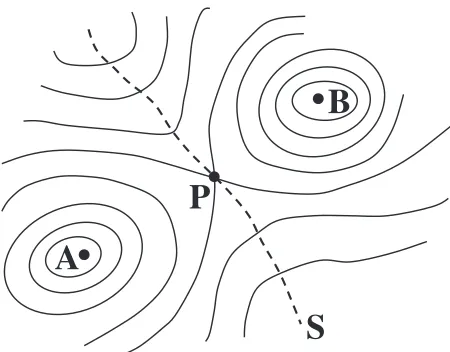
whereT is temperature andkBis Boltzmann constant. On the other hand, the thermal activation of dislocations was investigated on a rate theory10)as well. Let the potential energy defined in the high-dimensional configuration space be. According to the theory, there exists a saddle point P between two separated stable states, A and B, in the configuration space, as shown in Fig. 1. The transition rate from A to B is determined by the flux intensity passing across the hyper-surfaceSseparating the region around A from that around B. In particular, the flux in the vicinity of the saddle point P mainly contributes to the transition. Generally speaking, plural saddle points exist between the two stable
states. However, the lowest saddle point with respect to energy among them is realized as the transition path. The activation energyEais equal to the difference of the potential energyðPÞ ðAÞ, which is extensively used concept in the field of chemical reaction.11)Recently, a numerical method was established to find the saddle point12) in the high-dimensional configuration space. It was applied to a research on the thermal activation of dislocations.13)
The rate theory10)was mainly applied to the calculation for the activation energy of infinitely long or pinned straight dislocations lying almost parallel to Peierls potential valley; Peierls potential is a barrier that dislocations encounter in crystals. Then, the dislocations are assumed to be a smooth flexible string with line tension (line tension model). The activation energy was estimated as double-kink formation energy on the dislocation line using various kinds of Peierls potentials, e.g., double sine-Gordon type,14) subsequently, piecewise parabolic15)and cubic polynomial ones.16)
In this paper, we calculate the activation energy and transition rate of the prismatic dislocation loop in terms of the line tension model. The dislocation loop corresponds to the
A
B
P
S
Fig. 1 Schematic view of configuration space represented by constant potential energy (solid lines): A and B are stable states; P is saddle point. Hyper-surface S passes through P.
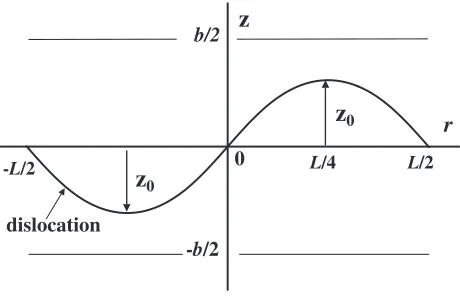
[image:1.595.313.538.298.474.2]periphery of an SIA cluster and it is bound on the lateral surface of a circular cylinder, as shown in Fig. 2. This model is, of course, a drastic simplification of the actual prismatic dislocation loops in metals. For example, in the present model we ignore contributions such as the vertices of the prismatic dislocation loops and self-interactions of the dislocation segments,17,18)etc.Nevertheless, we can system-atically investigate and analytically express the properties of the dislocation loops. The line tension model would be valid for sufficiently large SIA clusters to which continuum elasticity theory can be applied. In addition to it, we find by numerical calculations that the contribution of the self-interaction energy to the activation energy is faint. Besides, such simplified model is probably more appropriate for prismatic dislocation loops composed of so-called ‘magic number’, 7, 19, 37, 61, 91, , SIAs,19) because they are expected to be very glissile and particularly stable.5,6)
2. Line Tension Model
We estimate the activation energy Ea of the dislocation loop in the line tension model. The dislocation loop is exhibited on the flattened lateral surface of the circular cylinder, as shown in Fig. 3. The parameterz0depicted in it is
quite important to obtain analytic solutions for the saddle point configuration. The Peierls potentialVðzÞis minimum at z¼ b=2 and maximum atz¼0. At first, we assume the saddle point configuration of the dislocation loop to be the double-kink type solution likely depicted in Fig. 3. Although a multiple-kink type solution20,21) is also possible, its total energy is most likely higher than that of the double-kink one. According to the line tension model,14–16)the total energyE
t of the dislocation loop is written as
Et¼
ZL=2
L=2
1 20
dz dr
2 þVðzÞ
( )
dr; ð2Þ
wherezðrÞindicates the displacement of the dislocation line at the point r; 0 is the energy per unit length of the
dislocation line;Lis the length of the dislocation loop. We do not consider the external stress exerted on the dislocation
loop in the present work. Equilibrium condition of the dislocation line is
0
d2z
dr2 ¼
dV
dz : ð3Þ
One of the trivial solutions to eq. (3) isz0. Then, we look for nontrivial solutions of the double-kink type likely depicted in Fig. 3. Integration of eq. (3) yields
0
2 dz dr
2
¼VðzÞ C0; ð4Þ
whereC0¼Vðz0Þ. By separation of variables, one obtains
L¼2 ffiffiffiffiffiffiffi20
p Zz0
0
1
ffiffiffiffiffiffiffiffiffiffiffiffiffiffiffiffiffiffiffiffi
VðzÞ C0
p dz: ð5Þ
Inserting eq. (4) in eq. (2), and using eq. (4) again, the saddle point (unstable equilibrium) energyEs is found to be
Es¼C0Lþ4
ffiffiffiffiffiffiffi
20
p Z z0
0
ffiffiffiffiffiffiffiffiffiffiffiffiffiffiffiffiffiffiffiffi
VðzÞ C0
p
dz: ð6Þ
These integrals, (5) and (6), are fundamental relations to analyze the dislocation loops in terms of the line tension model.
3. Activation Energy and Critical Length
We take a sinusoidal function (sine-Gordon type) as the Peierls potential in this paper for practical purposes,
VðzÞ ¼V0 1þcos
2z b
: ð7Þ
Then, one calculates the Peierls stressP, minimum external stress required to move a straight dislocation14,22)
P¼ 2V0
b2 : ð8Þ
Inserting eq. (7) in eqs. (5) and (6), we obtain
L¼2b
ffiffiffiffiffiffi
0
V0
r
Kðs0Þ ð9Þ
Es¼ 4E0
2Eðs0Þ cos
2z0
b Kðs0Þ
; ð10Þ
dislocation loop
r
-
b
/2
b
/2
Z
0
V
(z)
Peierls potential
Fig. 2 Flexible dislocation loop surrounding a circular cylinder. Peierls potential is maximum atz¼0and minimum atz¼ b=2.
z
00
-L/2
z
r
b/2
-b/2
z
0dislocation
L/4 L/2
[image:2.595.53.284.65.248.2] [image:2.595.313.543.73.221.2]wheres0¼sinbz0;KandEare complete elliptic integrals23)
defined in Appendix A. The energy unit in eq. (10) is
E0 ¼
ffiffiffiffiffiffiffiffiffiffi 0V0
p
b: ð11Þ
We add that periodic systems similar to ours have already been investigated especially in the field of the solitons,e.g.,24) Now, we introduce an important constant, i.e., critical length of the dislocation loops, according to eq. (9). Let’s define the critical length
Lc¼
ffiffiffiffiffiffi
0
V0
r
b: ð12Þ
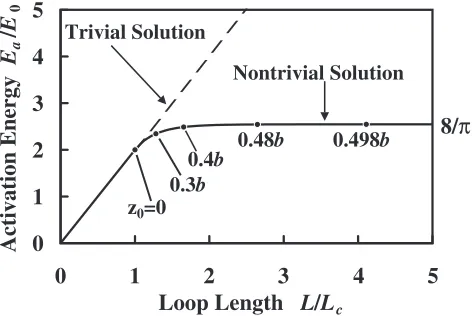
[image:3.595.52.288.75.233.2]WhenL<Lc, then there is no real solution to eq. (9) because the complete elliptic integral of the first kindKðkÞis larger than=2.23)However, the trivial solution,z0, is possible to be the saddle point configuration for dislocation loops of arbitrary length. Therefore, it is a unique solution for the saddle point configuration in this range,L<Lc. As shown in Fig. 4, the activation energyEais merely proportional to the loop length L in this range, which is easily explained by taking into account that the saddle point configuration is the trivial solution. On the other hand, ifL>Lc, there exists an appropriate double-kink type solution. Exactly speaking, two saddle point configurations, the trivial and double-kink types simultaneously exist. Practically, the transition path always passes through the energetically lowest saddle point.10,11) Anyway, the trivial and double-kink solution bifurcate at L¼Lc, as shown in Fig. 4. The activation energyEais rather constant for sufficiently long dislocation loops and converges to a finite value8E0=, which, of course, corresponds to the
double-kink formation energy on the infinitely long disloca-tions.14)
Based on the present result, we estimate the energy unitE0
and critical lengthLcfor the dislocation loops in actual BCC metals, especially in -Fe from eqs. (11) and (12). We assume here that the Peierls potential for the dislocation loops is identical to that for infinitely long dislocations, which is also a drastic assumption but plausible for somewhat long dislocation loops. Many researchers investigated the
metals,25–27) because actual plastic deformation of BCC metals is dominated by the screw dislocations. The magni-tude ofs
Pis roughly of order of103G,28)whereGis shear modulus. On the other hand, there is only a little knowledge about the plastic deformation by non-screw dislocations,e.g., a series of microyielding experiment29,30) and simula-tions.31–34) Anyway, they inferred that the Peierls stress for the edge dislocations e
P is about an order of magnitude smaller than s
P. We take here Pe¼4104G for edge dislocation alongh1122iwith Burgers vectorb¼a=2h111iin
-Fe; it was calculated using Finnis–Sinclair potential35,36)in cooperation with graduate students.37)About the energy per unit length 0, there are some ambiguities but some
researchers recommended it is the same order as or smaller than the core energy.14,16,38,39)Therefore, we assume it to be
0¼0:2Gb2. Finally, we evaluate the critical length asLc¼ 56bfrom eqs. (8) and (12); energy unitE0¼0:040eV from
eq. (11).
4. Transition Rate
According to the rate theory,10)the transition ratein eq. (1),i.e., jump frequency from A to B through P in Fig. 1, is expressed as the ratio of two configurational partition functions, as follows
¼
ffiffiffiffiffiffiffiffiffi
kBT
2
r Z
S
eðPÞ=kBTdS
Z
V
eðAÞ=kBTdV
: ð13Þ
The integration with respect toSis over the hyper-surface S in Fig. 1. On the other hand, the integration with respect toV is over the portion of configuration space to the A-side of the hyper-surface S. We now employ the theory of small vibrations to approximate eq. (13). The potential energy
near A and P can be expanded in Taylor series to second order.
ðAÞ ¼0ðAÞ þ1=2
X
n¼0
ð2nqnÞ2
ðPÞ ¼0ðPÞ þ1=2
X
n0¼0
ð20nq0nÞ2;
ð14Þ
whereqn andq0n are generalized coordinates;n and0n are normal modes. Inserting eq. (14) in eq. (13), we obtain an explicit form of the transition rate. The activation energy Ea is calculated in the previous section. The normal modes about the point A and P are derived from the equation of motion of the dislocation line
0
@2z
@t2 ¼0
@2z
@r2
@V
@z ; ð15Þ where0 is effective mass per unit length.
4.1 Short dislocation loop,L<Lc
As pointed out in the previous section, saddle point configuration for dislocation loops shorter than Lc is the trivial solution,z0. Therefore, the normal modes about A and P are
0
1
2
3
4
5
0
1
2
3
4
5
Loop Length
L
/
L
cActivation Energy
E
a/
E
z0=0 0.3b
0.4b
0.48b 0.498b
Nontrivial Solution Trivial Solution
8/
π
Fig. 4 Normalized activation energyEa=E0versus dislocation loop length
[image:3.595.368.483.389.436.2]2n¼ V0
0b2
L2c L2n
2 þ1
about A
02n ¼ V0
0b2
L2
c L2n
21
about P; ð16Þ
wheren¼0, 1, 2, 3, andLcis the critical length defined in eq. (12). The frequency 0
0 about the saddle point P is
imaginary and is called ‘longitudinal transition mode’.15) From the physical requirement of the saddle point config-uration, it is necessary that there should be at least one imaginary frequency. By removing this unstable mode, the pre-exponential factor of the Arrhenius equation in eq. (1) is expressed10)
0 ¼Y 1
n¼0
n Y1
n¼1
0n !1
: ð17Þ
Inserting eq. (16) in eq. (17), the pre-exponential factor in eq. (1) is estimated
0¼
ffiffiffiffiffiffiffiffiffiffi
V0
0b2
s ffiffiffiffiffiffiffiffiffiffiffiffiffiffiffiffiffiffiffiffiffiffiffiffi
sinhðL=LcÞ sinðL=LcÞ
s
: ð18Þ
4.2 Long dislocation loop,L>Lc
The saddle point configuration for dislocation loops longer thanLcis the double-kink type. The normal modes around the double-kink solution 0n are derived from Lame´’s equa-tion24,40)as mentioned in Appendix B. There are two special modes, 0
0 and 0 1:
0
0 corresponds to the ‘longitudinal
translation mode’ (imaginary frequency);0
1is called
‘trans-verse translation mode’ (zero frequency). This mode 0 1
corresponds to a translating double-kink, with each kink moving in the same direction of the dislocation line while keeping the same separation. All other modes,0
2,03,04 ,
have real frequencies. Then, the pre-exponential factor in eq. (1) is represented as,15)
0¼L
ffiffiffiffiffiffiffiffiffiffiffiffi
2Mk kBT
s
Y1
n¼0
n Y1
n¼2
0n !1
; ð19Þ
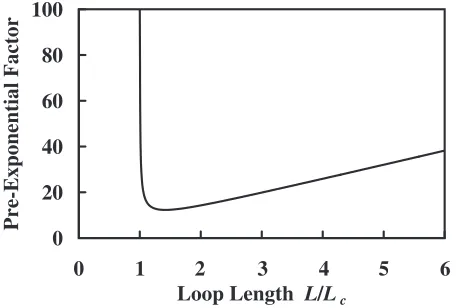
whereMkis effective mass of double-kink. Equation (19) is numerically estimated and the result is shown in Fig. 5.
5. Discussion
Now, we present a new concept about the thermal activation of the high-mobility dislocation loops (SIA clusters). As shown in Fig. 6, the high-mobility SIA clusters are supposed to be bundles of h111i crowdions. The edge dislocation is also regarded as a large bundle of the crowdions which fill up the extra half plane. In brief, the single crowdion, dislocation loop (periphery of SIA cluster) and edge dislocation are essentially the same type of defects but different in size. However, we infer that the SIA clusters should qualitatively change from point-defect-like to dis-location-like somewhere. As mentioned in the present paper, the transition rate and activation energy depend on the length of the dislocation loops; the dependence drastically changes
at the critical lengthLc, as shown in Fig. 4 and eqs. (17) and (19). If the dislocation loops are longer than Lc, the saddle point configuration is the conventional double-kink type; this thermal activation is regarded as a typical dislocation-like reaction. On the other hand, if the dislocation loops are shorter than that, the trivial solution,z0, is the saddle point configuration; this non-deformation type motion would be related to the migration of point defects. Therefore, we propose that the critical length Lc should be a criterion to classify the dislocation loops as dislocation-like or point-defect-like.
We confirm here the validity of the line tension model used in the present paper. It is a kind of approximation,e.g., the elastic energy is proportional to the dislocation length, the Peierls potential does not depend on the loop length, etc. Such model is inappropriate for small prismatic loops and abrupt kink, of course. We suppose that the present model would be adequate in the range where linear elasticity theory can be applied; the range is usually further than35bfrom the dislocation and the gradient of the dislocation line dz=dr1. Although these conditions are not always satisfied, the dislocation loops longer than Lc would be adequate in BCC metals. For example, as mentioned in the previous section, we estimate P¼4104G and 0¼
0:2Gb2 for -iron. The critical length is evaluated asLc¼ 56b and the diameter of the prismatic dislocation loop is
0 20 40 60 80 100
0 1 2 3 4 5 6
Loop Length L/Lc
Pre-Exponential Factor
Fig. 5 Pre-exponential factor
0 versus normalized loop length derived from numerical calculation.
I
<112>
I
7I
nDislocation-like Point-defect -like
{111} -plane
edge dislocation
[image:4.595.314.542.75.229.2] [image:4.595.306.547.299.414.2]the elasticity model. The gradient of the dislocation line is estimated from eqs. (4) and (7) as
dz
dr
<2 ffiffiffiffiffiffiffiffiffiffiffiffiV0=0
p
: ð20Þ
The maximum is evaluated as 0.036, which is sufficiently small.
The mechanism for thermal activation of the dislocation loops (SIA clusters) have been still controversial. According to numerical calculations in -Fe, Osetskyet al.6)show the activation energy does not depend on the number of interstitials,0:0210:024eV, and suggest that crowdions in the SIA clusters independently migrate toward the close-packed direction. It is similar to our result for sufficiently long dislocation loops, as shown in Fig. 4. However, we rather assume a kind of collective motion of SIA clusters. Sonedaet al.7)and Marianet al.8)obtain similar results; the migration energies are calculated for up to about 20 SIAs; the single and small SIA clusters,I2andI3, have somewhat larger
migration energies than other larger ones. Wirth et al.5) investigate so-called ‘magic number’ clusters; the activation energies of I19 and I37 are 0.023 eV and 0.052 eV,
respec-tively. They describe intrinsic kinks at the periphery of the SIA clusters. The main reason why these numerical results are different is that they used different interatomic potentials.
The pre-exponential factor
0 has singularity at L¼Lc, according to eqs. (17) and (19). We suppose the assumption of the infinitesimal vibration of the dislocation line and linear approximation associated with it are not valid around the critical length. Therefore, such singularity would not be realized for prismatic dislocation loops in actual metals owing to non-linear effectetc.
6. Summary
We analyze thermal activation of high-mobility disloca-tion loops in terms of the line tension model where the Peierls potential and line tension energy are taken into account. This is qualitative but suggestive analysis. We introduce the critical length Lc which is evaluated by material constants. The properties of dislocation loops quite change at Lc. In particular, the dependence of the activation energy on the loop length obviously changes at the critical length. It is caused by alteration of the saddle point configuration of the dislocation loops. If the length is longer than the critical length, the saddle point configuration is double-kink type which is well known as the transition process of the straight dislocation. On the other hand, the saddle point configuration is trivial solution, if the length is shorter than that. This fact suggests that the critical lengthLcis probably an appropriate criterion to distinguish dislocations from SIA clusters. We estimate the critical length Lc¼56b and energy unit E0¼
0:040eV for-Fe, assuming that the dislocation loops have the same Peierls potential as straight dislocations. The maximum activation energy is8E0=, which is corresponds
to the infinitely long dislocation. The jump frequency (Arrhenius equation) of the dislocation loops is also calculated from normal modes of the dislocation line. Although the pre-exponential factor has singularity at the
we doubt whether it would be realized.
Acknowledgments
The authors would like to thank professor M. Oikawa of Research Institute for Applied Mechanics, Kyushu Univer-sity for providing precious suggestions about non-linear equations. One of the Authors (Kazuhito Ohsawa) would also like to thank emeritus professors T. Ninomiya and T. Suzuki of University of Tokyo for making discussion about dislocation theory.
REFERENCES
1) M. Kiritani: J. Nucl. Mater.276(2000) 41–49.
2) J. Marian, B. D. Wirth and J. M. Perlado: Phys. Rev. Lett.88(2002) 255507.
3) C. H. Woo and B. N. Singh: Philos. Mag. A65(1992) 889–912. 4) B. N. Singh and A. J. E. Foreman: Philos. Mag. A66(1992) 975–990. 5) B. D. Wirth, G. R. Odette, D. Maroudas and G. E. Lucas: J. Nucl.
Mater.276(2000) 33–40.
6) Y. N. Osetsky, D. J. Bacon, A. Serra, B. N. Singh and S. I. Golubov: Philos. Mag.83(2003) 61–91.
7) N. Soneda and T. Diaz de la Rubia: Philos. Mag. A81(2001) 331–343. 8) J. Marian, B. D. Wirth, A. Caro, B. Sadigh, G. R. Odette, J. M. Perlado
and T. Dias de la Rubia: Phys. Rev. B65(2002) 144102. 9) H. R. Paneth: Phys. Rev.80(1950) 708–711.
10) G. H. Vineyard: J. Phys. Chem. Solids3(1957) 121–127. 11) K. Mu¨ller: Angew. Chem. Int. Ed. Engl.19(1980) 1–13.
12) G. Mills, H. Jo´nsson and G. K. Schenter: Surf. Sci.324(1995) 305– 337.
13) K. Edagawa and T. Suzuki: Mater. Sci. Eng. A309–310(2001) 164– 167.
14) A. Seeger: Philos. Mag.1(1956) 651–662.
15) V. Celli, M. Kabler, T. Ninomiya and R. Thomson: Phys. Rev.131
(1963) 58–72.
16) T. Mori and M. Kato: Philos. Mag. A43(1981) 1315–1320. 17) R. de Wit:Solid State Physics, (Academic Press, New York, 1960)
Vol. 10, pp. 249–292.
18) N. M. Ghoniem, B. N. Singh, L. Z. Sun and T. Diaz de la Rubia: J. Nucl. Mater.276(2000) 166–177.
19) E. Kuramoto: J. Nucl. Mater.276(2000) 143–153.
20) T. Suzuki and H. Koizumi: Philos. Mag. A67(1993) 1153–1160. 21) H. Koizumi, K. Ohno, T. Suzuki and F. R. N. Nabarro: Philos. Mag. A
79(1999) 467–484.
22) J. P. Hirth and J. Lothe:Theory of Dislocations, (McGraw-Hill, New York, 1968) pp. 227–228.
23) Derek F. Lawden: Elliptic Functions and Applications, (Springer-Verlag, New York, 1989) pp. 73–76.
24) I. Bakas and C. Sourdis: Fortschr. Phys.50(2002) 815–824. 25) V. Vı´tex, R. C. Perrin and D. K. Bowen: Philos. Mag.21(1970) 1049–
1073.
26) E. Kuramoto, Y. Aono, K. Kitajima, K. maeda and S. Takeuchi: Philos. Mag. A39(1979) 717–724.
27) C. Woodward and S. I. Rao: Phys. Rev. Lett.88(2002) 216402. 28) K. Ohsawa, H. Koizumi, H. O. K. Kirchner and T. Suzuki: Philos. Mag.
A69(1994) 171–181.
29) H. D. Solomon and C. J. McMahon, Jr.: Acta Met.19(1971) 291–302. 30) A. Sato and M. Meshii: Phys. Status Solidi A28(1975) 561–569. 31) M. Yamaguchi and V. Vı´tek: J. Phys. F, Metal Phys.3(1973) 523–536. 32) M. Yamaguchi and V. Vı´tek: J. Phys. F, Metal Phys.3(1973) 527–542. 33) M. Yamaguchi and V. Vı´tek: J. Phys. F, Metal Phys.5(1973) 1–10. 34) M. Yamaguchi and V. Vı´tek: J. Phys. F, Metal Phys.5(1973) 11–16. 35) M. W. Finnis and J. E. Sinclair: Philos. Mag. A50(1984) 45–55. 36) M. W. Finnis and J. E. Sinclair: Philos. Mag. A53(1986) 161. 37) J. Imai and S. Obata: master’s thesis (unpublished).
39) J. P. Hirth and J. Lothe:Theory of Dislocations, (McGraw-Hill, New York, 1968) pp. 212–214.
40) F. M. Arscott: Periodic Differential Equations, (Pergamon Press, Oxford, 1964) pp. 191–205.
Appendix A: Jacobi’s elliptic functions and elliptic integrals
IntegrationsKandEare complete elliptic integrals of the first and second kinds,23)respectively
KðkÞ ¼
Z1
0
1
ffiffiffiffiffiffiffiffiffiffiffiffiffiffiffiffiffiffiffiffiffiffiffiffiffiffiffiffiffiffiffiffiffiffi
ð1t2Þð1k2t2Þ
p dt
EðkÞ ¼
Z1
0
ffiffiffiffiffiffiffiffiffiffiffiffiffiffiffiffiffi
1k2t2
1t2
r
dt:
ðA:1Þ
Parameterkis termed the modulus of the elliptic functions; 0 k<1.
Jacobi’s elliptic function is
sn1ðx;kÞ ¼
Zx
0
1
ffiffiffiffiffiffiffiffiffiffiffiffiffiffiffiffiffiffiffiffiffiffiffiffiffiffiffiffiffiffiffiffiffiffi
ð1t2Þð1k2t2Þ
p dt: ðA:2Þ
In addition to it, supplementary functions are
cn2ðx;kÞ ¼1sn2ðx;kÞ
dn2ðx;kÞ ¼1k2sn2ðx;kÞ: ðA :3Þ
Appendix B: Lame´’s equation
Saddle point configuration of the double-kink type is represented24)as,
zk¼ b
sin
1
ðs0snðR;s0ÞÞ; ðB:1Þ
where R¼2r=Lc, s0¼sinbz0. We assume infinitesimal
vibration around the double-kink solution
zðtÞ ¼zkþnexpð20ntiÞ: ðB:2Þ
Inserting eq. (B·2) in eq. (15) and neglecting the higher order terms, one obtains
~
02nn¼
dn
dR2þ f2s 2 0sn
2ðR;s
0Þ 1gn ðB:3Þ
where ~02
n ¼b202n=V0. This shro¨ginger like equation has
infinite number of eigenfunctions n and three of them are analytically expressed24,40)as
0¼dnðR;s0Þ; with ~020 ¼s 2 01
1¼cnðR;s0Þ; with ~021 ¼0 ðB:4Þ