Pseudo-Projective Dependency Parsing
Joakim Nivre and Jens Nilsson
School of Mathematics and Systems Engineering V¨axj¨o University
SE-35195 V¨axj¨o, Sweden
{nivre,jni}@msi.vxu.se
Abstract
In order to realize the full potential of dependency-based syntactic parsing, it is desirable to allow non-projective depen-dency structures. We show how a data-driven deterministic dependency parser, in itself restricted to projective structures, can be combined with graph transforma-tion techniques to produce non-projective structures. Experiments using data from the Prague Dependency Treebank show that the combined system can handle non-projective constructions with a precision sufficient to yield a significant improve-ment in overall parsing accuracy. This leads to the best reported performance for robust non-projective parsing of Czech.
1 Introduction
It is sometimes claimed that one of the advantages of dependency grammar over approaches based on constituency is that it allows a more adequate treat-ment of languages with variable word order, where discontinuous syntactic constructions are more com-mon than in languages like English (Mel’ˇcuk, 1988; Covington, 1990). However, this argument is only plausible if the formal framework allows non-projective dependency structures, i.e. structures where a head and its dependents may correspond to a discontinuous constituent. From the point of view of computational implementation this can be problematic, since the inclusion of non-projective
structures makes the parsing problem more com-plex and therefore compromises efficiency and in practice also accuracy and robustness. Thus, most broad-coverage parsers based on dependency gram-mar have been restricted to projective structures. This is true of the widely used link grammar parser for English (Sleator and Temperley, 1993), which uses a dependency grammar of sorts, the probabilis-tic dependency parser of Eisner (1996), and more recently proposed deterministic dependency parsers (Yamada and Matsumoto, 2003; Nivre et al., 2004). It is also true of the adaptation of the Collins parser for Czech (Collins et al., 1999) and the finite-state dependency parser for Turkish by Oflazer (2003).
This is in contrast to dependency treebanks, e.g. Prague Dependency Treebank (Hajiˇc et al., 2001b), Danish Dependency Treebank (Kromann, 2003), and the METU Treebank of Turkish (Oflazer et al., 2003), which generally allow annotations with non-projective dependency structures. The fact that pro-jective dependency parsers can never exactly repro-duce the analyses found in non-projective treebanks is often neglected because of the relative scarcity of problematic constructions. While the proportion of sentences containing non-projective dependencies is often 15–25%, the total proportion of non-projective arcs is normally only 1–2%. As long as the main evaluation metric is dependency accuracy per word, with state-of-the-art accuracy mostly below 90%, the penalty for not handling non-projective construc-tions is almost negligible. Still, from a theoretical point of view, projective parsing of non-projective structures has the drawback that it rules out perfect accuracy even as an asymptotic goal.
(“Only one of them concerns quality.”) R
Z (Out-of
?
AuxP
P nich them
? Atr
VB je is
T jen only
? AuxZ
C jedna one-FEM-SG
? Sb
R na to
? AuxP
N4 kvalitu quality ? Adv
Z: . .)
[image:2.612.130.469.56.192.2]
? AuxZ
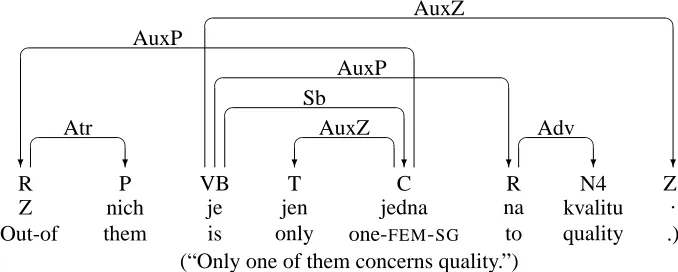
Figure 1: Dependency graph for Czech sentence from the Prague Dependency Treebank1
There exist a few robust broad-coverage parsers that produce non-projective dependency structures, notably Tapanainen and J¨arvinen (1997) and Wang and Harper (2004) for English, Foth et al. (2004) for German, and Holan (2004) for Czech. In addi-tion, there are several approaches to non-projective dependency parsing that are still to be evaluated in the large (Covington, 1990; Kahane et al., 1998; Duchier and Debusmann, 2001; Holan et al., 2001; Hellwig, 2003). Finally, since non-projective con-structions often involve long-distance dependencies, the problem is closely related to the recovery of empty categories and non-local dependencies in constituency-based parsing (Johnson, 2002; Dienes and Dubey, 2003; Jijkoun and de Rijke, 2004; Cahill et al., 2004; Levy and Manning, 2004; Campbell, 2004).
In this paper, we show how non-projective depen-dency parsing can be achieved by combining a data-driven projective parser with special graph transfor-mation techniques. First, the training data for the parser is projectivized by applying a minimal num-ber of lifting operations (Kahane et al., 1998) and encoding information about these lifts in arc labels. When the parser is trained on the transformed data, it will ideally learn not only to construct projective dependency structures but also to assign arc labels that encode information about lifts. By applying an inverse transformation to the output of the parser, arcs with non-standard labels can be lowered to their proper place in the dependency graph, giving rise
1The dependency graph has been modified to make the final
period a dependent of the main verb instead of being a depen-dent of a special root node for the sentence.
to non-projective structures. We call this pseudo-projective dependency parsing, since it is based on a notion of pseudo-projectivity (Kahane et al., 1998).
The rest of the paper is structured as follows. In section 2 we introduce the graph transformation techniques used to projectivize and deprojectivize dependency graphs, and in section 3 we describe the data-driven dependency parser that is the core of our system. We then evaluate the approach in two steps. First, in section 4, we evaluate the graph transfor-mation techniques in themselves, with data from the Prague Dependency Treebank and the Danish De-pendency Treebank. In section 5, we then evaluate the entire parsing system by training and evaluating on data from the Prague Dependency Treebank.
2 Dependency Graph Transformations
We assume that the goal in dependency parsing is to construct a labeled dependency graph of the kind de-picted in Figure 1. Formally, we define dependency graphs as follows:
1. LetR={r1, . . . , rm}be the set of permissible
dependency types (arc labels).
2. A dependency graph for a string of words
W = w1· · ·wn is a labeled directed graph D= (W, A), where
(a) W is the set of nodes, i.e. word tokens in the input string, ordered by a linear prece-dence relation<,
(b) Ais a set of labeled arcs(wi, r, wj), where wi, wj ∈W,r∈R,
(c) for everywj ∈W, there is at most one arc
(“Only one of them concerns quality.”) R
Z (Out-of
?
AuxP
P nich them
? Atr
VB je is
T jen only
? AuxZ
C jedna one-FEM-SG
? Sb
R na to
? AuxP
N4 kvalitu quality ? Adv
Z: . .)
[image:3.612.136.469.59.181.2]
? AuxZ
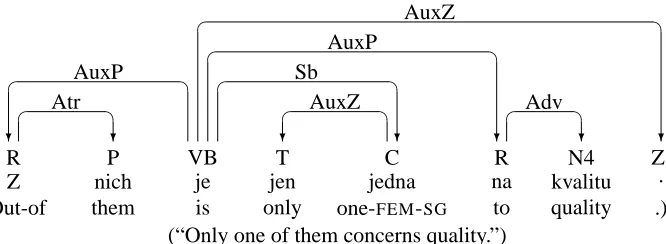
Figure 2: Projectivized dependency graph for Czech sentence
3. A graph D = (W, A) is well-formed iff it is acyclic and connected.
If(wi, r, wj) ∈ A, we say thatwiis the head ofwj
andwj a dependent ofwi. In the following, we use the notationwi →r wj to mean that(wi, r, wj) ∈A; we also usewi →wj to denote an arc with
unspeci-fied label andwi→∗wjfor the reflexive and
transi-tive closure of the (unlabeled) arc relation.
The dependency graph in Figure 1 satisfies all the defining conditions above, but it fails to satisfy the condition of projectivity (Kahane et al., 1998):
1. An arcwi→wkis projective iff, for every word wj occurring between wi andwk in the string (wi< wj< wkorwi> wj> wk),wi→∗wj.
2. A dependency graphD= (W, A)is projective iff every arc inAis projective.
The arc connecting the head jedna (one) to the de-pendent Z (out-of) spans the token je (is), which is not dominated by jedna.
As observed by Kahane et al. (1998), any (non-projective) dependency graph can be transformed into a projective one by a lifting operation, which replaces each non-projective arcwj →wkby a pro-jective arcwi → wk such thatwi →∗ wj holds in
the original graph. Here we use a slightly different notion of lift, applying to individual arcs and moving their head upwards one step at a time:
LIFT(wj →wk) =
(
wi →wkifwi →wj
undefined otherwise
Intuitively, lifting an arc makes the wordwk
depen-dent on the headwiof its original headwj(which is
unique in a well-formed dependency graph), unless
wjis a root in which case the operation is undefined (but thenwj → wk is necessarily projective if the
dependency graph is well-formed).
Projectivizing a dependency graph by lifting non-projective arcs is a nondeterministic operation in the general case. However, since we want to preserve as much of the original structure as possible, we are interested in finding a transformation that in-volves a minimal number of lifts. Even this may be nondeterministic, in case the graph contains sev-eral non-projective arcs whose lifts interact, but we use the following algorithm to construct a minimal projective transformation D0 = (W, A0) of a (non-projective) dependency graphD= (W, A):
PROJECTIVIZE(W,A) 1 A0 ←A
2 while(W, A0)is non-projective 3 a← SMALLEST-NONP-ARC(A0)
4 A0 ←(A0− {a})∪ {LIFT(a)}
5 return(W, A0)
The function SMALLEST-NONP-ARC returns the non-projective arc with the shortest distance from head to dependent (breaking ties from left to right). Applying the function PROJECTIVIZE to the graph in Figure 1 yields the graph in Figure 2, where the problematic arc pointing to Z has been lifted from the original head jedna to the ancestor je. Using the terminology of Kahane et al. (1998), we say that
jedna is the syntactic head of Z, while je is its linear head in the projectivized representation.
in-Lifted arc label Path labels Number of labels
Baseline d p n
Head d↑h p n(n+ 1)
Head+Path d↑h p↓ 2n(n+ 1)
[image:4.612.159.453.56.125.2]Path d↑ p↓ 4n
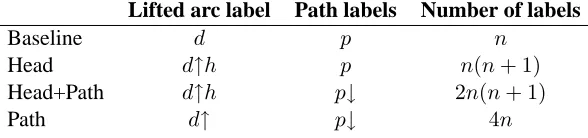
Table 1: Encoding schemes (d= dependent,h= syntactic head,p= path;n= number of dependency types)
verse transformation to recover the underlying (non-projective) dependency graph. In order to facilitate this task, we extend the set of arc labels to encode information about lifting operations. In principle, it would be possible to encode the exact position of the syntactic head in the label of the arc from the linear head, but this would give a potentially infinite set of arc labels and would make the training of the parser very hard. In practice, we can therefore expect a trade-off such that increasing the amount of infor-mation encoded in arc labels will cause an increase in the accuracy of the inverse transformation but a decrease in the accuracy with which the parser can construct the labeled representations. To explore this tradeoff, we have performed experiments with three different encoding schemes (plus a baseline), which are described schematically in Table 1.
The baseline simply retains the original labels for all arcs, regardless of whether they have been lifted or not, and the number of distinct labels is therefore simply the numbernof distinct dependency types.2 In the first encoding scheme, called Head, we use a new labeld↑h for each lifted arc, where dis the dependency relation between the syntactic head and the dependent in the non-projective representation, andh is the dependency relation that the syntactic head has to its own head in the underlying structure. Using this encoding scheme, the arc from je to Z in Figure 2 would be assigned the label AuxP↑Sb (signifying an AuxP that has been lifted from a Sb). In the second scheme, Head+Path, we in addition modify the label of every arc along the lifting path from the syntactic to the linear head so that if the original label ispthe new label isp↓. Thus, the arc from je to jedna will be labeledSb↓(to indicate that there is a syntactic head below it). In the third and final scheme, denoted Path, we keep the extra
infor-2Note that this is a baseline for the parsing experiment only
(Experiment 2). For Experiment 1 it is meaningless as a base-line, since it would result in 0% accuracy.
mation on path labels but drop the information about the syntactic head of the lifted arc, using the labeld↑
instead ofd↑h(AuxP↑instead of AuxP↑Sb). As can be seen from the last column in Table 1, both Head and Head+Path may theoretically lead to a quadratic increase in the number of distinct arc labels (Head+Path being worse than Head only by a constant factor), while the increase is only linear in the case of Path. On the other hand, we can expect
Head+Path to be the most useful representation for
reconstructing the underlying non-projective depen-dency graph. In approaching this problem, a vari-ety of different methods are conceivable, including a more or less sophisticated use of machine learn-ing. In the present study, we limit ourselves to an algorithmic approach, using a deterministic breadth-first search. The details of the transformation proce-dure are slightly different depending on the encod-ing schemes:
• Head: For every arc of the formwi d↑h −→ wn,
we search the graph top-down, left-to-right, breadth-first starting at the head nodewi. If we find an arcwl
h
−→wm, called a target arc, we
replacewi d↑h
−→ wnbywm −→d wn; otherwise
we replacewi d↑h
−→ wnbywi d
−→ wn (i.e. we
let the linear head be the syntactic head).
• Head+Path: Same as Head, but the search
only follows arcs of the formwj −→p↓ wkand a
target arc must have the formwl h↓
−→wm; if no target arc is found, Head is used as backoff.
• Path: Same as Head+Path, but a target arc
must have the formwl −→p↓ wm and no
out-going arcs of the formwm p 0↓
−→wo; no backoff.
Feature type Top−1 Top Next Next+1 Next+2 Next+3
Word form + + + +
Part-of-speech + + + + + +
Dep type of head +
leftmost dep + +
[image:5.612.115.502.57.137.2]rightmost dep +
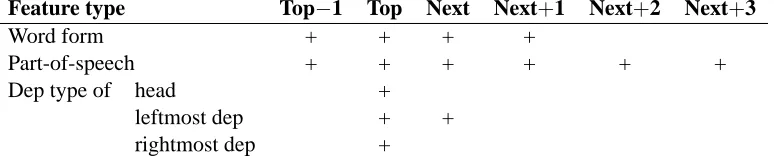
Table 2: Features used in predicting the next parser action
we turn to the evaluation, however, we need to intro-duce the data-driven dependency parser used in the latter experiments.
3 Memory-Based Dependency Parsing
In the experiments below, we employ a data-driven deterministic dependency parser producing labeled projective dependency graphs,3previously tested on Swedish (Nivre et al., 2004) and English (Nivre and Scholz, 2004). The parser builds dependency graphs by traversing the input from left to right, using a stack to store tokens that are not yet complete with respect to their dependents. At each point during the derivation, the parser has a choice between pushing the next input token onto the stack – with or with-out adding an arc from the token on top of the stack to the token pushed – and popping a token from the stack – with or without adding an arc from the next input token to the token popped. More details on the parsing algorithm can be found in Nivre (2003).
The choice between different actions is in general nondeterministic, and the parser relies on a memory-based classifier, trained on treebank data, to pre-dict the next action based on features of the cur-rent parser configuration. Table 2 shows the features used in the current version of the parser. At each point during the derivation, the prediction is based on six word tokens, the two topmost tokens on the stack, and the next four input tokens. For each to-ken, three types of features may be taken into ac-count: the word form; the part-of-speech assigned by an automatic tagger; and labels on previously as-signed dependency arcs involving the token – the arc from its head and the arcs to its leftmost and right-most dependent, respectively. Except for the
left-3The graphs satisfy all the well-formedness conditions given
in section 2 except (possibly) connectedness. For robustness reasons, the parser may output a set of dependency trees instead of a single tree.
most dependent of the next input token, dependency type features are limited to tokens on the stack.
The prediction based on these features is a k -nearest neighbor classification, using the IB1 algo-rithm andk= 5, the modified value difference met-ric (MVDM) and class voting with inverse distance weighting, as implemented in the TiMBL software package (Daelemans et al., 2003). More details on the memory-based prediction can be found in Nivre et al. (2004) and Nivre and Scholz (2004).
4 Experiment 1: Treebank Transformation
The first experiment uses data from two dependency treebanks. The Prague Dependency Treebank (PDT) consists of more than 1M words of newspaper text, annotated on three levels, the morphological, ana-lytical and tectogrammatical levels (Hajiˇc, 1998). Our experiments all concern the analytical annota-tion, and the first experiment is based only on the training part. The Danish Dependency Treebank (DDT) comprises about 100K words of text selected from the Danish PAROLE corpus, with annotation of primary and secondary dependencies (Kromann, 2003). The entire treebank is used in the experiment, but only primary dependencies are considered.4 In all experiments, punctuation tokens are included in the data but omitted in evaluation scores.
In the first part of the experiment, dependency graphs from the treebanks were projectivized using the algorithm described in section 2. As shown in Table 3, the proportion of sentences containing some non-projective dependency ranges from about 15% in DDT to almost 25% in PDT. However, the over-all percentage of non-projective arcs is less than 2% in PDT and less than 1% in DDT. The last four
4If secondary dependencies had been included, the
# Lifts in projectivization
Data set # Sentences % NonP # Tokens % NonP 1 2 3 >3
[image:6.612.96.521.57.111.2]PDT training 73,088 23.15 1,255,333 1.81 93.79 5.60 0.51 0.11 DDT total 5,512 15.48 100,238 0.94 79.49 13.28 4.36 2.87
Table 3: Non-projective sentences and arcs in PDT and DDT (NonP = non-projective)
Data set Head H+P Path
PDT training (28 labels) 92.3 (230) 99.3 (314) 97.3 (84) DDT total (54 labels) 92.3 (123) 99.8 (147) 98.3 (99)
Table 4: Percentage of non-projective arcs recovered correctly (number of labels in parentheses)
columns in Table 3 show the distribution of non-projective arcs with respect to the number of lifts required. It is worth noting that, although non-projective constructions are less frequent in DDT than in PDT, they seem to be more deeply nested, since only about 80% can be projectivized with a single lift, while almost 95% of the non-projective arcs in PDT only require a single lift.
In the second part of the experiment, we applied the inverse transformation based on breadth-first search under the three different encoding schemes. The results are given in Table 4. As expected, the most informative encoding, Head+Path, gives the highest accuracy with over 99% of all non-projective arcs being recovered correctly in both data sets. However, it can be noted that the results for the least informative encoding, Path, are almost comparable, while the third encoding, Head, gives substantially worse results for both data sets. We also see that the increase in the size of the label sets for Head and Head+Path is far below the theoretical upper bounds given in Table 1. The increase is gener-ally higher for PDT than for DDT, which indicates a greater diversity in non-projective constructions.
5 Experiment 2: Memory-Based Parsing
The second experiment is limited to data from PDT.5 The training part of the treebank was projectivized under different encoding schemes and used to train memory-based dependency parsers, which were run on the test part of the treebank, consisting of 7,507
5Preliminary experiments using data from DDT indicated
that the limited size of the treebank creates a severe sparse data problem with respect to non-projective constructions.
sentences and 125,713 tokens.6 The inverse trans-formation was applied to the output of the parsers and the result compared to the gold standard test set. Table 5 shows the overall parsing accuracy at-tained with the three different encoding schemes, compared to the baseline (no special arc labels) and to training directly on non-projective dependency graphs. Evaluation metrics used are Attachment Score (AS), i.e. the proportion of tokens that are at-tached to the correct head, and Exact Match (EM), i.e. the proportion of sentences for which the depen-dency graph exactly matches the gold standard. In the labeled version of these metrics (L) both heads and arc labels must be correct, while the unlabeled version (U) only considers heads.
The first thing to note is that projectivizing helps in itself, even if no encoding is used, as seen from the fact that the projective baseline outperforms the non-projective training condition by more than half a percentage point on attachment score, although the gain is much smaller with respect to exact match. The second main result is that the pseudo-projective approach to parsing (using special arc labels to guide an inverse transformation) gives a further improve-ment of about one percentage point on attachimprove-ment score. With respect to exact match, the improvement is even more noticeable, which shows quite clearly that even if non-projective dependencies are rare on the token level, they are nevertheless important for getting the global syntactic structure correct.
All improvements over the baseline are statisti-cally significant beyond the 0.01 level (McNemar’s
6The part-of-speech tagging used in both training and testing
Encoding UAS LAS UEM LEM
Non-projective 78.5 71.3 28.9 20.6 Baseline 79.1 72.0 29.2 20.7
Head 80.1 72.8 31.6 22.2
Head+Path 80.0 72.8 31.8 22.4
[image:7.612.199.416.54.136.2]Path 80.0 72.7 31.6 22.0
Table 5: Parsing accuracy (AS = attachment score, EM = exact match; U = unlabeled, L = labeled)
Unlabeled Labeled
Encoding P R F P R F
Head 61.3 54.1 57.5 55.2 49.8 52.4 Head+Path 63.9 54.9 59.0 57.9 50.6 54.0 Path 58.2 49.5 53.4 51.0 45.7 48.2
Table 6: Precision, recall and F-measure for non-projective arcs
test). By contrast, when we turn to a comparison of the three encoding schemes it is hard to find any significant differences, and the overall impression is that it makes little or no difference which encoding scheme is used, as long as there is some indication of which words are assigned their linear head instead of their syntactic head by the projective parser. This may seem surprising, given the experiments reported in section 4, but the explanation is probably that the non-projective dependencies that can be recovered at all are of the simple kind that only requires a single lift, where the encoding of path information is often redundant. It is likely that the more complex cases, where path information could make a difference, are beyond the reach of the parser in most cases.
However, if we consider precision, recall and F-measure on non-projective dependencies only, as shown in Table 6, some differences begin to emerge. The most informative scheme, Head+Path, gives the highest scores, although with respect to Head the difference is not statistically significant, while the least informative scheme, Path – with almost the same performance on treebank transformation – is significantly lower (p < 0.01). On the other hand, given that all schemes have similar parsing accuracy overall, this means that the Path scheme is the least likely to introduce errors on projective arcs.
The overall parsing accuracy obtained with the pseudo-projective approach is still lower than for the best projective parsers. Although the best published results for the Collins parser is 80% UAS (Collins,
1999), this parser reaches 82% when trained on the entire training data set, and an adapted version of Charniak’s parser (Charniak, 2000) performs at 84% (Jan Hajiˇc, pers. comm.). However, the accuracy is considerably higher than previously reported results for robust non-projective parsing of Czech, with a best performance of 73% UAS (Holan, 2004).
Compared to related work on the recovery of long-distance dependencies in constituency-based parsing, our approach is similar to that of Dienes and Dubey (2003) in that the processing of non-local dependencies is partly integrated in the parsing pro-cess, via an extension of the set of syntactic cate-gories, whereas most other approaches rely on post-processing only. However, while Dienes and Dubey recognize empty categories in a pre-processing step and only let the parser find their antecedents, we use the parser both to detect dislocated dependents and to predict either the type or the location of their syn-tactic head (or both) and use post-processing only to transform the graph in accordance with the parser’s analysis.
6 Conclusion
[image:7.612.185.427.168.238.2]especially with respect to the exact match criterion, leading to the best reported performance for robust non-projective parsing of Czech.
Acknowledgements
This work was supported in part by the Swedish Research Council (621-2002-4207). Memory-based classifiers for the experiments were created using TiMBL (Daelemans et al., 2003). Special thanks to Jan Hajiˇc and Matthias Trautner Kromann for assis-tance with the Czech and Danish data, respectively, and to Jan Hajiˇc, Tom´aˇs Holan, Dan Zeman and three anonymous reviewers for valuable comments on a preliminary version of the paper.
References
Cahill, A., Burke, M., O’Donovan, R., Van Genabith, J. and Way, A. 2004. Long-distance dependency resolution in automatically acquired wide-coverage PCFG-based LFG ap-proximations. In Proceedings of ACL.
Campbell, R. 2004. Using linguistic principles to recover empty categories. In Proceedings of ACL.
Charniak, E. 2000. A maximum-entropy-inspired parser. In
Proceedings of NAACL.
Collins, M., Hajiˇc, J., Brill, E., Ramshaw, L. and Tillmann, C. 1999. A statistical parser for Czech. In Proceedings of ACL. Collins, M. 1999. Head-Driven Statistical Models for Natural
Language Parsing. Ph.D. thesis, University of Pennsylvania.
Covington, M. A. 1990. Parsing discontinuous constituents in dependency grammar. Computational Linguistics, 16:234– 236.
Daelemans, W., Zavrel, J., van der Sloot, K. and van den Bosch, A. 2003. TiMBL: Tilburg Memory Based Learner, version 5.0, Reference Guide. Technical Report ILK 03-10, Tilburg University, ILK.
Dienes, P. and Dubey, A. 2003. Deep syntactic processing by combining shallow methods. In Proceedings of ACL. Duchier, D. and Debusmann, R. 2001. Topological dependency
trees: A constraint-based account of linear precedence. In
Proceedings of ACL.
Eisner, J. M. 1996. Three new probabilistic models for depen-dency parsing: An exploration. In Proceedings of COLING. Foth, K., Daum, M. and Menzel, W. 2004. A broad-coverage parser for German based on defeasible constraints. In
Pro-ceedings of KONVENS.
Hajiˇc, J., Krbec, P., Oliva, K., Kveton, P. and Petkevic, V. 2001. Serial combination of rules and statistics: A case study in Czech tagging. In Proceedings of ACL.
Hajiˇc, J., Vidova Hladka, B., Panevov´a, J., Hajiˇcov´a, E., Sgall, P. and Pajas, P. 2001. Prague Dependency Treebank 1.0. LDC, 2001T10.
Hajiˇc, J. 1998. Building a syntactically annotated corpus: The Prague Dependency Treebank. In Issues of Valency and
Meaning, pages 106–132. Karolinum.
Hellwig, P. 2003. Dependency unification grammar. In
Depen-dency and Valency, pages 593–635. Walter de Gruyter.
Holan, T., Kuboˇn, V. and Pl´atek, M. 2001. Word-order re-laxations and restrictions within a dependency grammar. In
Proceedings of IWPT.
Holan, T. 2004. Tvorba zavislostniho syntaktickeho analyza-toru. In Proceedings of MIS’2004.
Jijkoun, V. and de Rijke, M. 2004. Enriching the output of a parser using memory-based learning. In Proceedings of
ACL.
Johnson, M. 2002. A simple pattern-matching algorithm for re-covering empty nodes and their antecedents. In Proceedings
of ACL.
Kahane, S., Nasr, A. and Rambow, O. 1998. Pseudo-projectivity: A polynomially parsable non-projective depen-dency grammar. In Proceedings of ACL-COLING.
Kromann, M. T. 2003. The Danish Dependency Treebank and the DTAG treebank tool. In Proceedings of TLT 2003. Levy, R. and Manning, C. 2004. Deep dependencies from
context-free statistical parsers: Correcting the surface depen-dency approximation. In Proceedings of ACL.
Mel’ˇcuk, I. 1988. Dependency Syntax: Theory and Practice. State University of New York Press.
Nivre, J. and Scholz, M. 2004. Deterministic dependency pars-ing of English text. In Proceedpars-ings of COLING.
Nivre, J., Hall, J. and Nilsson, J. 2004. Memory-based depen-dency parsing. In Proceedings of CoNLL.
Nivre, J. 2003. An efficient algorithm for projective depen-dency parsing. In Proceedings of IWPT.
Oflazer, K., Say, B., Hakkani-T¨ur, D. Z. and T¨ur, G. 2003. Building a Turkish treebank. In Treebanks: Building and
Using Parsed Corpora, pages 261–277. Kluwer Academic
Publishers.
Oflazer, K. 2003. Dependency parsing with an extended finite-state approach. Computational Linguistics, 29:515–544. Sleator, D. and Temperley, D. 1993. Parsing English with a
link grammar. In Proceedings of IWPT.
Tapanainen, P. and J¨arvinen, T. 1997. A non-projective depen-dency parser. In Proceedings of ANLP.
Wang, W. and Harper, M. P. 2004. A statistical constraint dependency grammar (CDG) parser. In Proceedings of the
Workshop in Incremental Parsing (ACL).
Yamada, H. and Matsumoto, Y. 2003. Statistical dependency analysis with support vector machines. In Proceedings of