Munich Personal RePEc Archive
Sen cycles and externalities
Piggins, Ashley and Salerno, Gillian
NUI Galway
6 September 2016
Sen cycles and externalities
∗
Ashley Piggins
†and Gillian Salerno
‡September 6, 2016
Abstract
It has long been understood that externalities of some kind are responsible for Sen’s (1970) theorem on the impossibility of a Paretian liberal. However, Saari and Petron (2006) show that for any social preference cycle generated by combining the weak Pareto principle and individual decisiveness, every decisive individual must suffer at least one strong negative externality. We show that this fundamental result only holds when individual preferences are strict. Building on their contribution, we prove a general theorem for the case of weak preferences.
Keywords: Sen’s impossibility theorem; Liberal paradox; Saari-Petron theorem; Externalities; Social preference cycles
JEL classification: D71
∗We thank Conal Duddy for helpful comments. Gillian Salerno’s PhD research was
supported by a scholarship from the College of Arts, Social Sciences and Celtic Studies at NUI Galway.
†Corresponding author. J. E. Cairnes School of Business and Economics, NUI Galway,
Galway, Ireland. Email: [email protected]
‡J. E. Cairnes School of Business and Economics, NUI Galway, Galway, Ireland. Email:
1
Introduction
Sen’s (1970) theorem on the impossibility of a Paretian liberal is one of the landmark results of social choice theory.1
To illustrate the theorem, Sen presents the following example. There are two individuals, Prude and Lewd, and a copy of the risqué Lady Chatterley’s Lover. There are three options: Prude reads the book (x), Lewd reads the book (y), or no one reads the book (z). Lewd prefers most for Prude to read the book. Sen says that Lewd would “delight” in Prude’s discomfort (p. 155). Given a choice between reading the book himself or no one reading it, Lewd would prefer (being a lewd) to read it. His preference ordering is, therefore, xPlyPlz.
2
Prude prefers most that no one reads it. However, if someone must then he would rather it be him. Prude believes that if Lewd reads it then he could become even more depraved. Prude’s ordering is, therefore, zPpxPpy.
Given that the alternatives are taken to represent social states with “each state being a complete description of society including every individual’s position in it”,3
alternatives y and z differ only in ways that are private to Lewd, and x and z differ only in ways that are private to Prude. On foot of this, we might feel that Lewd’s and Prude’s preferences over these respective pairs should be given special status when determining the social preference. Suppose we make Lewd decisive over {y, z}. This means that yPlz implies
yP z and zPlyimplies zP y. Similarly, make Prude decisive over{x, z}. If we
combine this decisiveness with the weak Pareto principle then we obtain a cycle in the social preference relation, yP zP xP y.
Many argue that Sen’s formal framework is not the correct one for mod-eling individual rights.4
However, there are aggregation contexts where Sen’s
1
Suzumura (2011) is a survey. Salles (2008, 2009) and Salles and Zhang (2010) is recent foundational work on Sen’s theorem.
2
Our notation is standard.
3
Sen (1970, p. 152).
4
idea of decisiveness remains relevant.5
For example, the alternatives could represent candidates for appointment at a university rather than complete social states. In this case, Professor A could be a co-author of candidates y
and z and Professor B could be a co-author of candidates x and z. On the basis of the superior information that co-authorship typically provides, the university could assign {y, z}decisiveness to A and{x, z} decisiveness to B. A similar social preference cycle can arise. We call cycles that are generated by combining both weak Pareto and decisiveness Sen cycles.
2
Saari-Petron theorem
Saari and Petron (2006) establish an important necessary condition for Sen cycles. Every individual must suffer at least one strong negative externality. This notion of “strong preference” is used in Saari (1995, 2001) and the idea can be traced back to Luce and Raiffa (1957) and Blau (1975). Given Lewd’s ordering xPlyPlz we can write, following Saari and Petron, [yz,0] to denote
that no alternative separates y and z. Lewd’s {y, z} ranking is weak. For Prude,zPpxPpyand so[zy,1]. Prude’s{y, z}ranking isstrong (and opposed
to Lewd’s). In this formulation 0 and 1 are meant to indicate the intensity
of the binary {y, z}ranking. This intensity measure can be greater than 1if there are more alternatives.
Saari and Petron give the following definition (Definition 2, p. 272): For any pair of alternatives{x, y}, a decisive agent’s choice ofxcreates a strong, negative externality if another agent’s sincere ranking is [yx, α] withpositive
α intensity. It is easy to verify that Prude and Lewd both suffer strong negative externalities from each other’s choices. However, surprisingly, this property is general. Saari and Petron show that if there is a Sen cycle then
every individual who is decisive over some pair in the cycle must suffer at
5
least one strong negative externality. We call this theSaari-Petron theorem.6 In this paper, we show that this result only holds when individual preferences are strict, i.e. no individual can be indifferent between alternatives. As the examples below demonstrate, the result does not hold when individual preferences are weak. However, building on their ideas, we can prove a general theorem that covers the case of weak preferences.
We say that individualrsuffers a negative externality if there exists{a, b}
such that aP band yet for r we have [ba, β] with β ≥0.
Example 1. There are three individuals i, j and k, and their preferences over the four alternatives are (respectively) xPiyPizPiw, wPjzPjxPjy and
zPkxIkwPky. Note that individual k is indifferent betweenx andw. Making
i decisive over{y, w}, j decisive over{w, z}, andk decisive over{z, x} leads to yP wP zP xP y where xP y follows from the weak Pareto principle. For
i we have [xz,1] and for j we have [wy,2]. Both suffer strong negative externalities. However, for k we have both [wy,0] and [zw,0], and so k
suffers only weak negative externalities.
The next example shows that cycles can occur where no individual suffers a strong negative externality.
Example 2. There are four individuals i, j, k and l, and their preferences over the five alternatives are (respectively) xPiyIizPiwPiv, yPjvIjxPjzPjw,
yIkwPkvIkzIkx and zPlxIlyIlwPlv. Making i decisive over {x, y}, j
deci-sive over {v, w}, k decisive over {w, z} and l decisive over {z, x} leads to
xP yP vP wP zP x where yP v follows from the weak Pareto principle. It is easy to verify that all individuals suffer only weak negative externalities.
It can be verified in these examples that if individual indifference is bro-ken in some way, then each individual suffers at least one strong negative externality.
6
Theorem 3 in their paper. The clause that the strong negative externalities are suffered bydecisive individuals is important. In the Lady Chatterley example, a third individual
{x, y} {y, z} {z, x}
r xPry yPrz zPrx
r yPrx − zPrx
[image:6.595.232.379.123.189.2]r xIry zPry zPrx
Table 1: Restoring transitivity for r.
3
General theorem
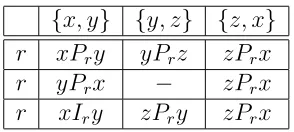
Saari and Petron (p. 269) describe an “information table” (Table 1) and we use this to prove our theorem. We consider two cases: one where the cycle involves three alternatives, and another where the cycle involves four or more alternatives (but a finite number). Let us consider the first case and assume that xP yP zP x.
Imagine that we assign to an arbitrary individual r each of these social
pairwise rankings (Table 1, first row). The result is intransitive preferences for r. In order to restore transitivity (and recover r’s original pairwise rank-ings induced by her transitive preferences), we need to change at least one of these pairwise rankings. Assume that zP x follows from the application of the weak Pareto principle. Therefore, we cannot change that pairwise ranking. We have to change at least one pairwise ranking over which the individual is not decisive. The individual cannot be decisive over all of the decisive pairs in the Sen cycle, otherwise her preferences would be intransi-tive. Therefore, there must be some pair (or pairs) of alternatives over which she is not decisive. She could be decisive over no pair.
Without loss of generality, assume that she is not decisive over{x, y}and either yPrx or xIry (second and third rows of Table 1 respectively). Note
that xIry implieszPry by transitivity.
This leads immediately to the following result.7
Lemma 3. If there is a Sen cycle involving three alternatives, every individ-ual suffers a negative externality.
7
This statement holds for all individuals (not just decisive ones). If r is decisive over either {x, y} or {y, z} (but not both) then xPry or yPrz. In
the former case, transitivity implies that zPrxPry and in the latter case it
implies yPrzPrx. Lemma 3 states that r suffers a negative externality, and
the preceding argument shows that it must be a strong negative externality. Therefore, we can state the following.
Lemma 4. If there is a Sen cycle involving three alternatives, then every
individual who is decisive over some pair in the cycle suffers a strong negative
externality.
Note that for Examples 1 and 2, the cycles involve more than three alter-natives. Lemma 4 says that counter-examples to the Saari-Petron theorem cannot be found with three alternatives.
We now consider the case of cycles involving four or more alternatives. Suppose that xP yP zP w...vP x. In the arguments below, and without loss of generality, assume thatxP y follows from the application of the weak Pareto principle. The following generalization of Lemma 3 holds.
Lemma 5. If there is a Sen cycle involving four or more alternatives, every
individual suffers a negative externality.
Proof. Consider the set of pairs in the cycle that follow from the exercise of someone’s power of decisiveness. We need to prove that there exists {z, w}
in this set such that zP w but wPrz. By contradiction, if this is not the case
then zRrw for all {z, w} in the set. Transitivity implies yRrx. However,
this must be false since, by assumption, xP y follows from the weak Pareto principle.
Like Lemma 3, this statement holds for all individuals. Suppose now that
ris decisive over some pair in the cycle. We can establish the following result.
Lemma 6. Suppose there is a Sen cycle involving four or more alternatives.
individual suffers only one negative externality, then that externality must be
strong.
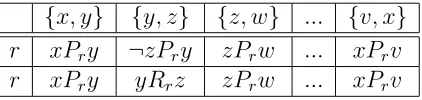
Proof. Lemma 5 implies thatr must suffer a negative externality. Recall the information table of Saari and Petron. Without loss of generality assume thatr is decisive over{z, w}and that the sole externality suffered byrarises from vP x.
{x, y} {y, z} {z, w} ... {v, x}
r xPry ¬zPry zPrw ... xPrv
[image:8.595.201.412.251.301.2]r xPry yRrz zPrw ... xPrv
Table 2: Information table.
The assumption that the only externality suffered arises fromvP ximplies row 1 of Table 2, which can be written as row 2. Note that xPryRrzPrwRiv
implies that [xv, α] with α >0. The externality is strong.
It is now possible to state our main result.
Theorem 7. If there is a Sen cycle, then every individual who is decisive
over some pair in the cycle suffers at least one strong negative externality, or at least two weak negative externalities.
Proof. If there is a Sen cycle involving three alternatives then Lemma 4 shows that the externality suffered must be strong. If the Sen cycle involves four or more alternatives then Lemma 6 shows that the decisive individual cannot suffer only one weak negative externality. Therefore, the individual must suffer at least one strong negative externality, or at least two weak negative externalities.
We now state and prove the Saari-Petron theorem. Our proof is differ-ent to theirs, and it highlights the role played by the assumption of strict preferences.
Theorem 8. If there is a Sen cycle, then every individual who is decisive
over some pair in the cycle and holds a strict preference ordering suffers at least one strong negative externality.
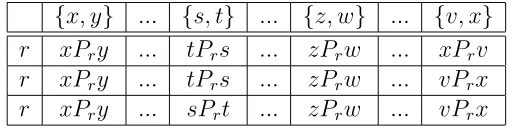
Proof. If the Sen cycle involves three alternatives then the result follows from Lemma 4. Suppose the Sen cycle involves four or more alternatives. If there is just one negative externality, then the result follows from Lemma 6. Consider Table 3. Without loss of generality, assume that r is decisive over {z, w}and thatr suffers negative externalities fromsP t and vP x. This gives rise to the first row of the information table. The dots in the columns indicate that r’s ranking of that pair in the cycle is identical to the social ranking. By way of contradiction, assume that both the {s, t} and {v, x}
externalities are weak, with s, t, v and x distinct.
{x, y} ... {s, t} ... {z, w} ... {v, x}
r xPry ... tPrs ... zPrw ... xPrv
r xPry ... tPrs ... zPrw ... vPrx
[image:9.595.177.434.425.491.2]r xPry ... sPrt ... zPrw ... vPrx
Table 3: Saari-Petron theorem.
Note that if r holds a strict preference ordering and these two negative externalities are weak, then these pairwise rankings can be reversed (one at a time) without affecting any other pairwise ranking. In row 2, r’s {v, x}
ranking has been reversed, for example, without any other pairwise ranking changing. However, in row 3, r’s {s, t} ranking has been reversed and this leads to intransitive preferences for r. This is a contradiction and so the
{x, y} ... {s, t} {t, x}
r xPry ... tPrs xPrt
Table 4: When t=v.
From row 1, we can see that xPryPrs and also that xPrtPrs. Given that
the externalities are weak and that r holds a strict preference ordering, we have xPrtPrsPryPrs. However, this leads to intransitive preferences for r
and so one of these externalities must have been strong, not weak.
When preferences are weak, the argument in Theorem 8 no longer ap-plies. First, if r holds a weak preference ordering and negative externalities are weak, then it does not follow that these pairwise rankings can be reversed (one at a time) without affecting any other pairwise ranking. In Example 1 we have zPkxIkwPky and k suffers a weak negative externality from yP w. Reversing k’s {y, w} ranking will affect her {x, y} ranking. Second, for the argument in Table 4, the assumption of strict preferences is critical. If pref-erences are weak, then we could have xPryIrtPrs and this would not be
intransitive.
References
[1] Bernholz, P., 1982. Externalities as a necessary condition for cyclical social preferences. Quarterly Journal of Economics, 97, 699-705.
[2] Blau, J.H., 1975. Liberal values and independence. Review of Economic Studies, 42, 395–402.
[3] Campbell, D.E. and J.S. Kelly, 1997. Sen’s theorem and externalities. Economica, 64, 375-386.
[5] Gaertner, W., Pattanaik, P.K. and K. Suzumura, 1992. Individual rights revisited. Economica, 59, 161-177.
[6] Li, Lingfang (Ivy). and D.G. Saari, 2008. Sen’s theorem: geometric proof, new interpretations. Social Choice and Welfare, 31, 393-413.
[7] Luce, R.D. and H. Raiffa, 1957.Games and Decisions. New York: Wiley.
[8] Nozick, R., 1974. Anarchy, State and Utopia. Oxford: Basil Blackwell.
[9] Risse, M., 2001. What to make of the liberal paradox? Theory and Decision, 50, 169-196.
[10] Saari, D.G., 1995. Basic Geometry of Voting. New York: Springer.
[11] Saari, D.G., 2001. Elections and Decisions; explaining the unexpected. Cambridge: Cambridge University Press.
[12] Saari, D.G., 2011. Source of complexity in the social and managerial sciences: an extended Sen’s theorem. Social Choice and Welfare, 37, 609-620.
[13] Saari, D.G. & Petron, A., 2006. Negative externalities and Sen’s liber-alism theorem. Economic Theory, 28, 265-281.
[14] Salles, M., 2008. Limited rights as partial veto and Sen’s impossibility theorem. In P.K. Pattanaik & al., eds. Rational Choice and Social Wel-fare, Theory and Applications: Essays in honor of Kotaro Suzumura. Heidelberg: Springer.
[16] Salles, M. and F. Zhang, 2010. Rights revisited and limited. In A. Van Deemen & A. Rusinowska, eds. Collective Decision Making. Heidelberg: Springer.
[17] Sen, A.K., 1970. The impossibility of a Paretian liberal. Journal of Po-litical Economy, 78, 152-157.
[18] Sugden, R., 1985. Liberty, preference and choice. Economics and Phi-losophy, 1, 185-205.