Long-Distance Dependency Resolution in Automatically Acquired
Wide-Coverage PCFG-Based LFG Approximations
Aoife Cahill, Michael Burke, Ruth O’Donovan, Josef van Genabith, Andy Way
National Centre for Language Technology and School of Computing, Dublin City University, Dublin, Ireland
{acahill,mburke,rodonovan,josef,away}@computing.dcu.ie
Abstract
This paper shows how finite approximations of long distance dependency (LDD) resolution can be obtained automatically for wide-coverage, robust, probabilistic Lexical-Functional Grammar (LFG) resources acquired from treebanks. We extract LFG subcategorisation frames and paths linking LDD reentrancies from f-structures generated automati-cally for the Penn-II treebank trees and use them in an LDD resolution algorithm to parse new text. Unlike (Collins, 1999; Johnson, 2002), in our ap-proach resolution of LDDs is done at f-structure (attribute-value structure representations of basic predicate-argument or dependency structure) with-out empty productions, traces and coindexation in CFG parse trees. Currently our best automatically induced grammars achieve 80.97% score for f-structures parsing section 23 of the WSJ part of the Penn-II treebank and evaluating against the DCU
1051 and 80.24% against the PARC 700
Depen-dency Bank (King et al., 2003), performing at the same or a slightly better level than state-of-the-art hand-crafted grammars (Kaplan et al., 2004).
1 Introduction
The determination of syntactic structure is an im-portant step in natural language processing as syn-tactic structure strongly determines semantic inter-pretation in the form of predicate-argument struc-ture, dependency relations or logical form. For a substantial number of linguistic phenomena such as topicalisation, wh-movement in relative clauses and interrogative sentences, however, there is an im-portant difference between the location of the (sur-face) realisation of linguistic material and the loca-tion where this material should be interpreted se-mantically. Resolution of such long-distance pendencies (LDDs) is therefore crucial in the de-termination of accurate predicate-argument
struc-1
Manually constructed f-structures for 105 randomly se-lected trees from Section 23 of the WSJ section of the Penn-II Treebank
ture, deep dependency relations and the construc-tion of proper meaning representaconstruc-tions such as log-ical forms (Johnson, 2002).
Modern unification/constraint-based grammars such as LFG or HPSG capture deep linguistic infor-mation including LDDs, predicate-argument struc-ture, or logical form. Manually scaling rich uni-fication grammars to naturally occurring free text, however, is extremely time-consuming, expensive and requires considerable linguistic and computa-tional expertise. Few hand-crafted, deep unification grammars have in fact achieved the coverage and robustness required to parse a corpus of say the size and complexity of the Penn treebank: (Riezler et al., 2002) show how a deep, carefully hand-crafted LFG is successfully scaled to parse the Penn-II tree-bank (Marcus et al., 1994) with discriminative (log-linear) parameter estimation techniques.
The last 20 years have seen continuously increas-ing efforts in the construction of parse-annotated
corpora. Substantial treebanks2 are now available
for many languages (including English, Japanese, Chinese, German, French, Czech, Turkish), others are currently under construction (Arabic, Bulgarian) or near completion (Spanish, Catalan). Treebanks have been enormously influential in the develop-ment of robust, state-of-the-art parsing technology: grammars (or grammatical information) automat-ically extracted from treebank resources provide the backbone of many state-of-the-art probabilis-tic parsing approaches (Charniak, 1996; Collins, 1999; Charniak, 1999; Hockenmaier, 2003; Klein and Manning, 2003). Such approaches are attrac-tive as they achieve robustness, coverage and per-formance while incurring very low grammar devel-opment cost. However, with few notable exceptions (e.g. Collins’ Model 3, (Johnson, 2002), (Hocken-maier, 2003) ), treebank-based probabilistic parsers return fairly simple “surfacey” CFG trees, with-out deep syntactic or semantic information. The grammars used by such systems are sometimes
re-2
ferred to as “half” (or “shallow”) grammars (John-son, 2002), i.e. they do not resolve LDDs but inter-pret linguistic material purely locally where it oc-curs in the tree.
Recently (Cahill et al., 2002) showed how wide-coverage, probabilistic unification grammar resources can be acquired automatically from f-structure-annotated treebanks. Many second gen-eration treebanks provide a certain amount of deep syntactic or dependency information (e.g. in the form of Penn-II functional tags and traces) supporting the computation of representations of
deep linguistic information. Exploiting this
in-formation (Cahill et al., 2002) implement an automatic LFG f-structure annotation algorithm that associates nodes in treebank trees with f-structure annotations in the form of attribute-value structure equations representing abstract predicate-argument structure/dependency relations. From the f-structure annotated treebank they automatically extract wide-coverage, robust, PCFG-based LFG approximations that parse new text into trees and f-structure representations.
The LFG approximations of (Cahill et al., 2002), however, are only “half” grammars, i.e. like most of their probabilistic CFG cousins (Charniak, 1996; Johnson, 1999; Klein and Manning, 2003) they do not resolve LDDs but interpret linguistic material purely locally where it occurs in the tree.
In this paper we show how finite approxima-tions of long distance dependency resolution can be obtained automatically for wide-coverage, robust, probabilistic LFG resources automatically acquired from treebanks. We extract LFG subcategorisation frames and paths linking LDD reentrancies from f-structures generated automatically for the Penn-II treebank trees and use them in an LDD resolu-tion algorithm to parse new text. Unlike (Collins, 1999; Johnson, 2002), in our approach LDDs are resolved on the level of f-structure representation, rather than in terms of empty productions and co-indexation on parse trees. Currently we achieve f-structure/dependency f-scores of 80.24 and 80.97 for parsing section 23 of the WSJ part of the Penn-II treebank, evaluating against the PARC 700 and DCU 105 respectively.
The paper is structured as follows: we give a brief introduction to LFG. We outline the automatic f-structure annotation algorithm, PCFG-based LFG grammar approximations and parsing architectures of (Cahill et al., 2002). We present our subcategori-sation frame extraction and introduce the treebank-based acquisition of finite approximations of LFG functional uncertainty equations in terms of LDD
paths. We present the f-structure LDD resolution algorithm, provide results and extensive evaluation. We compare our method with previous work. Fi-nally, we conclude.
2 Lexical Functional Grammar (LFG)
Lexical-Functional Grammar (Kaplan and Bres-nan, 1982; Dalrymple, 2001) minimally involves two levels of syntactic representation:3 c-structure and f-structure. C(onstituent)-structure represents the grouping of words and phrases into larger constituents and is realised in terms of a
CF-PSG grammar. F(unctional)-structure represents
abstract syntactic functions such as SUBJ(ect),
OBJ(ect), OBL(ique), closed and open clausal
COMP/XCOMP(lement), ADJ(unct), APP(osition) etc. and is implemented in terms of recursive feature
structures (attribute-value matrices). C-structure
captures surface grammatical configurations, f-structure encodes abstract syntactic information approximating to predicate-argument/dependency structure or simple logical form (van Genabith
and Crouch, 1996). C- and f-structures are
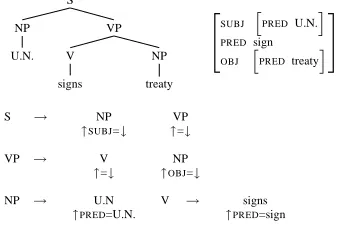
re-lated in terms of functional annotations (constraints, attribute-value equations) on c-structure rules (cf. Figure 1).
S
NP VP
U.N. V NP
signs treaty
"
SUBJ PREDU.N.
PREDsign
OBJ PREDtreaty
#
S → NP VP
↑SUBJ=↓ ↑=↓
VP → V NP
↑=↓ ↑OBJ=↓
NP → U.N V → signs
[image:2.595.343.512.417.532.2]↑PRED=U.N. ↑PRED=sign
Figure 1: Simple LFG C- and F-Structure
Uparrows point to the f-structure associated with the mother node, downarrows to that of the local node. The equations are collected with arrows instanti-ated to unique tree node identifiers, and a constraint solver generates an f-structure.
3 Automatic F-Structure Annotation
The Penn-II treebank employs CFG trees with addi-tional “funcaddi-tional” node annotations (such as -LOC, -TMP, -SBJ, -LGS, . . . ) as well as traces and coin-dexation (to indicate LDDs) as basic data structures. The f-structure annotation algorithm of (Cahill et
3LFGs may also involve morphological and semantic levels
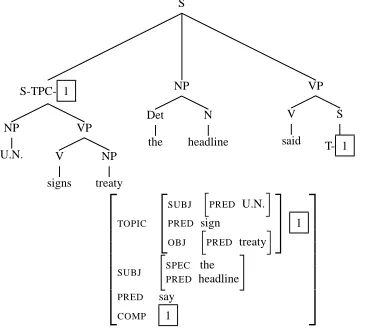
al., 2002) exploits configurational, categorial, Penn-II “functional”, local head and trace information to annotate nodes with LFG feature-structure equa-tions. A slightly adapted version of (Magerman, 1994)’s scheme automatically head-lexicalises the Penn-II trees. This partitions local subtrees of depth one (corresponding to CFG rules) into left and right contexts (relative to head). The annotation algo-rithm is modular with four components (Figure 2): left-right (L-R) annotation principles (e.g. leftmost NP to right of V head of VP type rule is likely to be an object etc.); coordination annotation principles (separating these out simplifies other components of the algorithm); traces (translates traces and coin-dexation in trees into corresponding reentrancies in f-structure (1 in Figure 3)); catch all and clean-up. Lexical information is provided via macros for POS tag classes.
[image:3.595.320.529.71.117.2]L/R Context⇒Coordination ⇒Traces ⇒Catch-All
Figure 2: Annotation Algorithm
The f-structure annotations are passed to a con-straint solver to produce f-structures. Annotation is evaluated in terms of coverage and quality, sum-marised in Table 1. Coverage is near complete with 99.82% of the 48K Penn-II sentences receiving a single, connected f-structure. Annotation quality is measured in terms of precision and recall (P&R) against the DCU 105. The algorithm achieves an F-score of 96.57% for full f-structures and 94.3% for preds-only f-structures.4
S S-TPC- 1 NP U.N. VP V signs NP treaty NP Det the N headline VP V said S T- 1 TOPIC "
SUBJ PREDU.N.
PREDsign
OBJ PREDtreaty
# 1 SUBJ h SPEC the PRED headline i PRED say COMP 1
Figure 3: Penn-II style tree with LDD trace and cor-responding reentrancy in f-structure
4
Full f-structures measure all attribute-value pairs includ-ing“minor” features such as person, number etc. The stricter preds-only captures only paths ending inPRED:VALUE.
# frags # sent percent
0 85 0.176
1 48337 99.820
2 2 0.004
all preds P 96.52 94.45 R 96.63 94.16
Table 1: F-structure annotation results for DCU 105
4 PCFG-Based LFG Approximations
Based on these resources (Cahill et al., 2002) de-veloped two parsing architectures. Both generate PCFG-based approximations of LFG grammars.
In the pipeline architecture a standard PCFG is extracted from the “raw” treebank to parse unseen text. The resulting parse-trees are then annotated by the automatic f-structure annotation algorithm and resolved into f-structures.
In the integrated architecture the treebank
is first annotated with f-structure equations.
An annotated PCFG is then extracted where
each non-terminal symbol in the grammar
has been augmented with LFG f-equations:
NP[↑OBJ=↓] → DT[↑SPEC=↓] NN[↑=↓] . Nodes followed by annotations are treated as a monadic category for grammar extraction and parsing. Post-parsing, equations are collected from parse trees and resolved into f-structures.
Both architectures parse raw text into “proto” f-structures with LDDs unresolved resulting in in-complete argument structures as in Figure 4.
S S NP U.N. VP V signs NP treaty NP Det the N headline VP V said TOPIC "
SUBJ PREDU.N.
PREDsign
OBJ PREDtreaty
[image:3.595.326.495.446.598.2]# SUBJ h SPEC the PRED headline i PRED say
Figure 4: Shallow-Parser Output with Unresolved LDD and Incomplete Argument Structure (cf. Fig-ure 3)
5 LDDs and LFG FU-Equations
Theoretically, LDDs can span unbounded amounts of intervening linguistic material as in
[U.N. signs treaty]1the paper claimed . . . a source said []1.
[image:3.595.78.262.501.668.2]in trees (Dalrymple, 2001), using functional uncer-tainty (FU) equations. FUs are regular expressions specifying paths in f-structure between a source (where linguistic material is encountered) and a tar-get (where linguistic material is interpreted seman-tically). To account for the fronted sentential con-stituents in Figures 3 and 4, an FU equation of the form↑TOPIC=↑COMP*COMPwould be required.
The equation states that the value of the TOPIC
at-tribute is token identical with the value of the final
COMP argument along a path through the
immedi-ately enclosing f-structure along zero or moreCOMP
attributes. This FU equation is annotated to the top-icalised sentential constituent in the relevant CFG rules as follows
S → S NP VP
↑TOPIC=↓ ↑SUBJ=↓ ↑=↓ ↑TOPIC=↑COMP*COMP
and generates the LDD-resolved proper f-structure in Figure 3 for the traceless tree in Figure 4, as re-quired.
In addition to FU equations, subcategorisation in-formation is a crucial ingredient in LFG’s account of LDDs. As an example, for a topicalised con-stituent to be resolved as the argument of a local predicate as specified by the FU equation, the local predicate must (i) subcategorise for the argument in question and (ii) the argument in question must not be already filled. Subcategorisation requirements are provided lexically in terms of semantic forms (subcat lists) and coherence and completeness con-ditions (all GFs specified must be present, and no others may be present) on f-structure representa-tions. Semantic forms specify which grammatical functions (GFs) a predicate requires locally. For our example in Figures 3 and 4, the relevant lexical en-tries are:
V → said ↑PRED=sayh↑SUBJ,↑COMPi
V → signs ↑PRED=signh↑SUBJ,↑OBJi
FU equations and subcategorisation requirements together ensure that LDDs can only be resolved at suitable f-structure locations.
6 Acquiring Lexical and LDD Resources
In order to model the LFG account of LDD resolu-tion we require subcat frames (i.e. semantic forms) and LDD resolution paths through f-structure. Tra-ditionally, such resources were handcoded. Here we show how they can be acquired from f-structure an-notated treebank resources.
LFG distinguishes between governable (argu-ments) and nongovernable (adjuncts)
grammati-cal functions (GFs). If the automatic f-structure
annotation algorithm outlined in Section 3 gen-erates high quality f-structures, reliable seman-tic forms can be extracted (reverse-engineered): for each f-structure generated, for each level of
embedding we determine the local PRED value
and collect the governable, i.e.
subcategoris-able grammatical functions present at that level
of embedding. For the proper f-structure in
Figure 3 we obtain sign([subj,obj]) and
say([subj,comp]). We extract frames from the full WSJ section of the Penn-II Treebank with 48K trees. Unlike many other approaches, our ex-traction process does not predefine frames, fully reflects LDDs in the source data-structures (cf. Figure 3), discriminates between active and pas-sive frames, computes GF, GF:CFG category pair-as well pair-as CFG category-bpair-ased subcategorisation frames and associates conditional probabilities with frames. Given a lemmaland an argument lists, the probability ofsgivenlis estimated as:
P(s|l) := Pncount(l, s) i=1count(l, si)
Table 2 summarises the results. We extract 3586 verb lemmas and 10969 unique verbal semantic form types (lemma followed by non-empty argu-ment list). Including prepositions associated with
the subcategorised OBLs and particles, this number
goes up to 14348. The number of unique frame types (without lemma) is 38 without specific prepo-sitions and particles, 577 with. F-structure anno-tations allow us to distinguish passive and active frames. Table 3 shows the most frequent
seman-tic forms for accept. Passive frames are marked
p. We carried out a comprehensive evaluation of
the automatically acquired verbal semantic forms against the COMLEX Resource (Macleod et al., 1994) for the 2992 active verb lemmas that both re-sources have in common. We report on the evalu-ation of GF-based frames for the full frames with complete prepositional and particle infomation. We use relative conditional probability thresholds (1% and 5%) to filter the selection of semantic forms (Table 4). (O’Donovan et al., 2004) provide a more detailed description of the extraction and evaluation of semantic forms.
Without Prep/Part With Prep/Part
Lemmas 3586 3586
Sem. Forms 10969 14348
Frame Types 38 577
Active Frame Types 38 548
Passive Frame Types 21 177
Semantic Form Occurrences Prob.
accept([obj,subj]) 122 0.813
accept([subj],p) 9 0.060
accept([comp,subj]) 5 0.033
accept([subj,obl:as],p) 3 0.020
accept([obj,subj,obl:as]) 3 0.020
accept([obj,subj,obl:from]) 3 0.020
accept([subj]) 2 0.013
accept([obj,subj,obl:at]) 1 0.007
accept([obj,subj,obl:for]) 1 0.007
[image:5.595.73.301.71.181.2]accept([obj,subj,xcomp]) 1 0.007
Table 3: Semantic forms for the verbaccept.
Threshold 1% Threshold 5%
P R F-Score P R F-Score
Exp. 73.7% 22.1% 34.0% 78.0% 18.3% 29.6%
Table 4: COMLEX Comparison
We further acquire finite approximations of FU-equations. by extracting paths between co-indexed material occurring in the automatically generated f-structures from sections 02-21 of the Penn-II
tree-bank. We extract 26 unique TOPIC, 60 TOPIC-REL
and 13FOCUSpath types (with a total of 14,911
to-ken occurrences), each with an associated
probabil-ity. We distinguish between two types of TOPIC
-RELpaths, those that occur in wh-less constructions, and all other types (c.f Table 5). Given a pathpand
an LDD type t (either TOPIC, TOPIC-REL or FO
-CUS), the probability ofpgiventis estimated as:
P(p|t) :=Pncount(t, p) i=1count(t, pi)
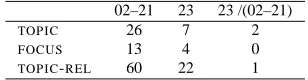
In order to get a first measure of how well the ap-proximation models the data, we compute the path types in section 23 not covered by those extracted from 02-21: 23/(02-21). There are 3 such path types (Table 6), each occuring exactly once. Given that the total number of path tokens in section 23 is 949, the finite approximation extracted from 02-23 cov-ers 99.69% of all LDD paths in section 23.
7 Resolving LDDs in F-Structure
Given a set of semantic forms swith probabilities
P(s|l) (where l is a lemma), a set of paths pwith
P(p|t)(wheretis eitherTOPIC,TOPIC-REL orFO -CUS) and an f-structuref, the core of the algorithm to resolve LDDs recursively traversesf to:
find TOPIC|TOPIC-REL|FOCUS:g pair; retrieve
TOPIC|TOPIC-REL|FOCUS paths; for each path p
with GF1 :. . .:GFn :GF, traversefalong GF1: . . . :
GFnto sub-f-structureh; retrieve localPRED:l;
add GF:gtohiff
∗ GF is not present ath
wh-lessTOPIC-REL # wh-lessTOPIC-REL #
subj 5692 adjunct 1314
xcomp:adjunct 610 obj 364
xcomp:obj 291 xcomp:xcomp:adjunct 96
comp:subj 76 xcomp:subj 67
Table 5: Most frequent wh-lessTOPIC-REL paths
02–21 23 23 /(02–21)
TOPIC 26 7 2
FOCUS 13 4 0
TOPIC-REL 60 22 1
Table 6: Number of path types extracted
∗ htogether with GF is locally complete and co-herent with respect to a semantic formsforl
rank resolution byP(s|l)× P(p|t)
The algorithm supports multiple, interactingTOPIC, TOPIC-REL and FOCUS LDDs. We use P(s|l) × P(p|t)to rank a solution, depending on how likely
the PRED takes semantic frame s, and how likely
the TOPIC, FOCUS orTOPIC-REL is resolved using
path p. The algorithm also supports resolution of
LDDs where no overt linguistic material introduces a source TOPIC-REL function (e.g. in reduced rela-tive clause constructions). We distinguish between passive and active constructions, using the relevant semantic frame type when resolving LDDs.
8 Experiments and Evaluation
We ran experiments with grammars in both the pipeline and the integrated parsing architectures. The first grammar is a basic PCFG, while A-PCFG
includes the f-structure annotations. We apply a
parent transformation to each grammar (Johnson, 1999) to give P-PCFG and PA-PCFG. We train on sections 02-21 (grammar, lexical extraction and LDD paths) of the Penn-II Treebank and test on sec-tion 23. The only pre-processing of the trees that we do is to remove empty nodes, and remove all Penn-II functional tags in the integrated model. We evalu-ate the parse trees using evalb. Following (Riezler et al., 2002), we convert f-structures into dependency triple format. Using their software we evaluate the f-structure parser output against:
1. The DCU 105 (Cahill et al., 2002)
[image:5.595.349.503.165.205.2]Pipeline Integrated PCFG P-PCFG A-PCFG PA-PCFG
2416 Section 23 trees
# Parses 2416 2416 2416 2414
Lab. F-Score 75.83 80.80 79.17 81.32
Unlab. F-Score 78.28 82.70 81.49 83.28
DCU 105 F-Strs
All GFs F-Score (before LDD resolution) 79.82 79.24 81.12 81.20 All GFs F-Score (after LDD resolution) 83.79 84.59 86.30 87.04 Preds only F-Score (before LDD resolution) 70.00 71.57 73.45 74.61 Preds only F-Score (after LDD resolution) 73.78 77.43 78.76 80.97
2416 F-Strs
All GFs F-Score (before LDD resolution) 81.98 81.49 83.32 82.78 All GFs F-Score (after LDD resolution) 84.16 84.37 86.45 86.00 Preds only F-Score (before LDD resolution) 72.00 73.23 75.22 75.10 Preds only F-Score (after LDD resolution) 74.07 76.12 78.36 78.40
[image:6.595.130.481.69.262.2]PARC 700 Dependency Bank Subset of GFs following (Kaplan et al., 2004) 77.86 80.24 77.68 78.60
Table 7: Parser Evaluation
3. A subset of 560 dependency structures of the PARC 700 Dependency Bank following (Ka-plan et al., 2004)
The results are given in Table 7. The
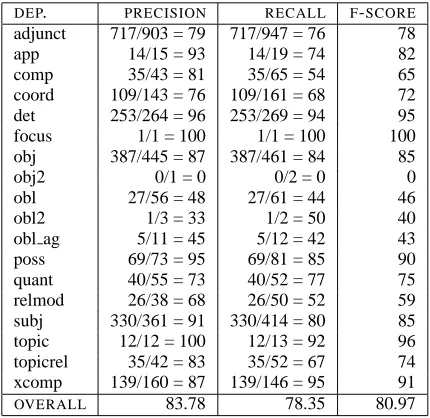
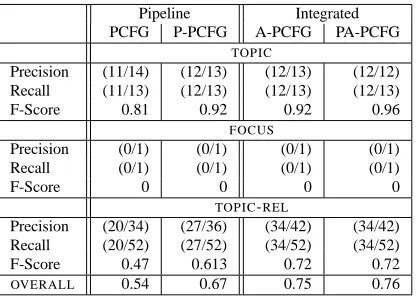
parent-transformed grammars perform best in both archi-tectures. In all cases, there is a marked improve-ment (2.07-6.36%) in the f-structures after LDD res-olution. We achieve between 73.78% and 80.97% preds-only and 83.79% to 87.04% all GFs f-score, depending on gold-standard. We achieve between 77.68% and 80.24% against the PARC 700 follow-ing the experiments in (Kaplan et al., 2004). For details on how we map the f-structures produced by our parsers to a format similar to that of the PARC 700 Dependency Bank, see (Burke et al., 2004). Table 8 shows the evaluation result broken down by individual GF (preds-only) for the inte-grated model PA-PCFG against the DCU 105. In order to measure how many of the LDD reentran-cies in the gold-standard f-structures are captured correctly by our parsers, we developed evaluation software for f-structure LDD reentrancies (similar to Johnson’s (2002) evaluation to capture traces and their antecedents in trees). Table 9 shows the results with the integrated model achieving more than 76% correct LDD reentrancies.
9 Related Work
(Collins, 1999)’s Model 3 is limited to wh-traces in relative clauses (it doesn’t treat topicalisation,
focus etc.). Johnson’s (2002) work is closest to
ours in spirit. Like our approach he provides a fi-nite approximation of LDDs. Unlike our approach, however, he works with tree fragments in a post-processing approach to add empty nodes and their
DEP. PRECISION RECALL F-SCORE
adjunct 717/903 = 79 717/947 = 76 78 app 14/15 = 93 14/19 = 74 82 comp 35/43 = 81 35/65 = 54 65 coord 109/143 = 76 109/161 = 68 72 det 253/264 = 96 253/269 = 94 95 focus 1/1 = 100 1/1 = 100 100 obj 387/445 = 87 387/461 = 84 85
obj2 0/1 = 0 0/2 = 0 0
obl 27/56 = 48 27/61 = 44 46
obl2 1/3 = 33 1/2 = 50 40
obl ag 5/11 = 45 5/12 = 42 43 poss 69/73 = 95 69/81 = 85 90 quant 40/55 = 73 40/52 = 77 75 relmod 26/38 = 68 26/50 = 52 59 subj 330/361 = 91 330/414 = 80 85 topic 12/12 = 100 12/13 = 92 96 topicrel 35/42 = 83 35/52 = 67 74 xcomp 139/160 = 87 139/146 = 95 91
OVERALL 83.78 78.35 80.97
Table 8: Preds-only results of PA-PCFG against the DCU 105
[image:6.595.319.534.306.515.2]Pipeline Integrated PCFG P-PCFG A-PCFG PA-PCFG
TOPIC
Precision (11/14) (12/13) (12/13) (12/12) Recall (11/13) (12/13) (12/13) (12/13) F-Score 0.81 0.92 0.92 0.96
FOCUS
Precision (0/1) (0/1) (0/1) (0/1) Recall (0/1) (0/1) (0/1) (0/1)
F-Score 0 0 0 0
TOPIC-REL
Precision (20/34) (27/36) (34/42) (34/42) Recall (20/52) (27/52) (34/52) (34/52) F-Score 0.47 0.613 0.72 0.72
[image:7.595.81.290.70.218.2]OVERALL 0.54 0.67 0.75 0.76
Table 9: LDD Evaluation on the DCU 105
Charniak -LDD res. +LDD res. (Johnson, 2002)
All GFs 80.86 86.65 85.16
Preds Only 74.63 80.97 79.75
Table 10: Comparison at f-structure level of LDD resolution to (Johnson, 2002) on the DCU 105
parser (Charniak, 1999) and, using the pipeline f-structure annotation model, evaluate against the DCU 105, both before and after LDD resolution. Using the software described in (Johnson, 2002) we add empty nodes to the output of Charniak’s parser, pass these trees to our automatic annotation algo-rithm and evaluate against the DCU 105. The re-sults are given in Table 10. Our method of resolv-ing LDDs at f-structure level results in a preds-only f-score of 80.97%. Using (Johnson, 2002)’s method of adding empty nodes to the parse-trees results in an f-score of 79.75%.
(Hockenmaier, 2003) provides CCG-based mod-els of LDDs. Some of these involve extensive clean-up of the underlying Penn-II treebank resource prior to grammar extraction. In contrast, in our approach we leave the treebank as is and only add (but never correct) annotations. Earlier HPSG work (Tateisi et al., 1998) is based on independently constructed
hand-crafted XTAG resources. In contrast, we
ac-quire our resources from treebanks and achieve sub-stantially wider coverage.
Our approach provides wide-coverage, robust, and – with the addition of LDD resolution – “deep” or “full”, PCFG-based LFG approximations. Cru-cially, we do not claim to provide fully adequate sta-tistical models. It is well known (Abney, 1997) that PCFG-type approximations to unification grammars can yield inconsistent probability models due to loss of probability mass: the parser successfully re-turns the highest ranked parse tree but the constraint solver cannot resolve the f-equations (generated in
the pipeline or “hidden” in the integrated model) and the probability mass associated with that tree is lost. This case, however, is surprisingly rare for our grammars: only 0.0018% (85 out of 48424) of the original Penn-II trees (without FRAGs) fail to pro-duce an f-structure due to inconsistent annotations (Table 1), and for parsing section 23 with the in-tegrated model (A-PCFG), only 9 sentences do not receive a parse because no f-structure can be gen-erated for the highest ranked tree (0.4%). Parsing with the pipeline model, all sentences receive one complete f-structure. Research on adequate prob-ability models for unification grammars is impor-tant. (Miyao et al., 2003) present a Penn-II tree-bank based HPSG with log-linear probability mod-els. They achieve coverage of 50.2% on section 23, as against 99% in our approach. (Riezler et al., 2002; Kaplan et al., 2004) describe how a care-fully hand-crafted LFG is scaled to the full Penn-II treebank with log-linear based probability models. They achieve 79% coverage (full parse) and 21% fragement/skimmed parses. By the same measure, full parse coverage is around 99% for our automat-ically acquired PCFG-based LFG approximations. Against the PARC 700, the hand-crafted LFG gram-mar reported in (Kaplan et al., 2004) achieves an f-score of 79.6%. For the same experiment, our best automatically-induced grammar achieves an f-score of 80.24%.
10 Conclusions
We presented and extensively evaluated a finite approximation of LDD resolution in automati-cally constructed, wide-coverage, robust, PCFG-based LFG approximations, effectively turning the “half”(or “shallow”)-grammars presented in (Cahill et al., 2002) into “full” or “deep” grammars. In our approach, LDDs are resolved in f-structure, not trees. The method achieves a preds-only f-score of 80.97% for f-structures with the PA-PCFG in the integrated architecture against the DCU 105 and 78.4% against the 2,416 automatically gener-ated f-structures for the original Penn-II treebank
trees. Evaluating against the PARC 700
Depen-dency Bank, the P-PCFG achieves an f-score of 80.24%, an overall improvement of approximately 0.6% on the result reported for the best hand-crafted grammars in (Kaplan et al., 2004).
Acknowledgements
References
S. Abney. 1997. Stochastic attribute-value
gram-mars. Computational Linguistics, 23(4):597–
618.
M. Burke, A. Cahill, R. O’Donovan, J. van Gen-abith, and A. Way 2004. The Evaluation of an Automatic Annotation Algorithm against the PARC 700 Dependency Bank. In Proceedings
of the Ninth International Conference on LFG,
Christchurch, New Zealand (to appear).
A. Cahill, M. McCarthy, J. van Genabith, and A. Way. 2002. Parsing with PCFGs and Auto-matic F-Structure Annotation. In Miriam Butt and Tracy Holloway King, editors, Proceedings
of the Seventh International Conference on LFG,
pages 76–95. CSLI Publications, Stanford, CA.
E. Charniak. 1996. Tree-Bank Grammars. In
AAAI/IAAI, Vol. 2, pages 1031–1036.
E. Charniak. 1999. A Maximum-Entropy-Inspired Parser. Technical Report CS-99-12, Brown Uni-versity, Providence, RI.
M. Collins. 1999. Head-Driven Statistical Models
for Natural Language Parsing. Ph.D. thesis,
Uni-versity of Pennsylvania, Philadelphia, PA. M. Dalrymple. 2001. Lexical-Functional
Gram-mar. San Diego, CA; London Academic Press.
J. Hockenmaier. 2003. Parsing with Generative models of Predicate-Argument Structure. In
Pro-ceedings of the 41st Annual Conference of the Association for Computational Linguistics, pages
359–366, Sapporo, Japan.
M. Johnson. 1999. PCFG models of linguistic tree representations. Computational Linguistics, 24(4):613–632.
M. Johnson. 2002. A simple pattern-matching al-gorithm for recovering empty nodes and their antecedents. In Proceedings of the 40th Annual
Meeting of the Association for Computational Linguistics, pages 136–143, Philadelphia, PA.
R. Kaplan and J. Bresnan. 1982. Lexical Func-tional Grammar, a Formal System for Grammat-ical Representation. In The Mental
Representa-tion of Grammatical RelaRepresenta-tions, pages 173–281.
MIT Press, Cambridge, MA.
R. Kaplan, S. Riezler, T. H. King, J. T. Maxwell, A. Vasserman, and R. Crouch. 2004. Speed and accuracy in shallow and deep stochastic parsing. In Proceedings of the Human Language
Tech-nology Conference and the 4th Annual Meeting of the North American Chapter of the Associ-ation for ComputAssoci-ational Linguistics, pages 97–
104, Boston, MA.
T.H. King, R. Crouch, S. Riezler, M. Dalrymple,
and R. Kaplan. 2003. The PARC700 dependency bank. In Proceedings of the EACL03: 4th
Inter-national Workshop on Linguistically Interpreted Corpora (LINC-03), pages 1–8, Budapest.
D. Klein and C. Manning. 2003. Accurate Unlexi-calized Parsing. In Proceedings of the 41st
An-nual Meeting of the Association for Computa-tional Linguistics (ACL’02), pages 423–430,
Sap-poro, Japan.
C. Macleod, A. Meyers, and R. Grishman. 1994. The COMLEX Syntax Project: The First Year. In Proceedings of the ARPA Workshop on Human
Language Technology, pages 669-703, Princeton,
NJ.
D. Magerman. 1994. Natural Language Parsing as
Statistical Pattern Recognition. PhD thesis,
Stan-ford University, CA.
M. Marcus, G. Kim, M.A. Marcinkiewicz, R. Mac-Intyre, A. Bies, M. Ferguson, K. Katz, and B. Schasberger. 1994. The Penn Treebank: Anno-tating Predicate Argument Structure. In
Proceed-ings of the ARPA Workshop on Human Language Technology, pages 110–115, Princeton, NJ.
Y. Miyao, T. Ninomiya, and J. Tsujii. 2003. Proba-bilistic modeling of argument structures includ-ing non-local dependencies. In Proceedinclud-ings of
the Conference on Recent Advances in Natural Language Processing (RANLP), pages 285–291,
Borovets, Bulgaria.
R. O’Donovan, M. Burke, A. Cahill, J. van Gen-abith, and A. Way. 2004. Large-Scale Induc-tion and EvaluaInduc-tion of Lexical Resources from the Penn-II Treebank. In Proceedings of the 42nd
Annual Conference of the Association for Com-putational Linguistics (ACL-04), Barcelona.
S. Riezler, T.H. King, R. Kaplan, R. Crouch, J. T. Maxwell III, and M. Johnson. 2002. Pars-ing the Wall Street Journal usPars-ing a Lexical-Functional Grammar and Discriminative Estima-tion Techniques. In Proceedings of the 40th
An-nual Conference of the Association for Compu-tational Linguistics (ACL-02), pages 271–278,
Philadelphia, PA.
Y. Tateisi, K. Torisawa, Y. Miyao, and J. Tsujii. 1998. Translating the XTAG English Grammar to HPSG. In 4th International Workshop on Tree
Adjoining Grammars and Related Frameworks,
Philadelphia, PA, pages 172–175.
J. van Genabith and R. Crouch. 1996. Direct
and Underspecified Interpretations of LFG f-Structures. In Proceedings of the 16th