Automatic Evaluation of Machine Translation Quality Using Longest
Com-mon Subsequence and Skip-Bigram Statistics
Chin-Yew Lin and Franz Josef Och
Information Sciences Institute University of Southern California
4676 Admiralty Way Marina del Rey, CA 90292, USA
{cyl,och}@isi.edu
Abstract
In this paper we describe two new objective automatic evaluation methods for machine translation. The first method is based on long-est common subsequence between a candidate translation and a set of reference translations. Longest common subsequence takes into ac-count sentence level structure similarity natu-rally and identifies longest co-occurring in-sequence n-grams automatically. The second method relaxes strict n-gram matching to skip-bigram matching. Skip-skip-bigram is any pair of words in their sentence order. Skip-bigram co-occurrence statistics measure the overlap of skip-bigrams between a candidate translation and a set of reference translations. The empiri-cal results show that both methods correlate with human judgments very well in both ade-quacy and fluency.
1
IntroductionUsing objective functions to automatically evalu-ate machine translation quality is not new. Su et al. (1992) proposed a method based on measuring edit distance (Levenshtein 1966) between candidate and reference translations. Akiba et al. (2001) ex-tended the idea to accommodate multiple refer-ences. Nießen et al. (2000) calculated the length-normalized edit distance, called word error rate (WER), between a candidate and multiple refer-ence translations. Leusch et al. (2003) proposed a related measure called position-independent word error rate (PER) that did not consider word posi-tion, i.e. using bag-of-words instead. Instead of error measures, we can also use accuracy measures that compute similarity between candidate and ref-erence translations in proportion to the number of common words between them as suggested by Melamed (1995). An n-gram co-occurrence
meas-ure, BLEU, proposed by Papineni et al. (2001) that
calculates co-occurrence statistics based on n-gram overlaps have shown great potential. A variant of
BLEU developed by NIST (2002) has been used in
two recent large-scale machine translation evalua-tions.
Recently, Turian et al. (2003) indicated that standard accuracy measures such as recall, preci-sion, and the F-measure can also be used in evalua-tion of machine translaevalua-tion. However, results based on their method, General Text Matcher (GTM), showed that unigram F-measure correlated best with human judgments while assigning more weight to higher n-gram (n > 1) matches achieved similar performance as Bleu. Since unigram matches do not distinguish words in consecutive positions from words in the wrong order, measures based on position-independent unigram matches are not sensitive to word order and sentence level structure. Therefore, systems optimized for these unigram-based measures might generate adequate but not fluent target language.
Since BLEU has been used to report the
perform-ance of many machine translation systems and it has been shown to correlate well with human
judgments, we will explain BLEU in more detail
and point out its limitations in the next section. We then introduce a new evaluation method called ROUGE-L that measures sentence-to-sentence similarity based on the longest common subse-quence statistics between a candidate translation and a set of reference translations in Section 3. Section 4 describes another automatic evaluation method called ROUGE-S that computes skip-bigram co-occurrence statistics. Section 5 presents the evaluation results of L, and
ROUGE-S and compare them with BLEU, GTM, NIST,
PER, and WER in correlation with human judg-ments in terms of adequacy and fluency. We con-clude this paper and discuss extensions of the current work in Section 6.
2
BLEU and N-gram Co-OccurrenceTo automatically evaluate machine translations the machine translation community recently adopted an n-gram co-occurrence scoring
proce-dure BLEU (Papineni et al. 2001). In two recent
evalua-tion method, simply called NIST score, was used. The NIST (NIST 2002) scoring method is based on BLEU.
The main idea of BLEU is to measure the
simi-larity between a candidate translation and a set of reference translations with a numerical metric. They used a weighted average of variable length n-gram matches between system translations and a set of human reference translations and showed that the weighted average metric correlating highly with human assessments.
BLEU measures how well a machine translation
overlaps with multiple human translations using n-gram co-occurrence statistics. N-n-gram precision in
BLEU is computed as follows:
∑
∑
∑
∑
∈ − ∈
∈ − ∈
−
−
=
} {
} {
)
(
)
(
Candidates
C n gram C Candidates
C ngram C clip
n
Count
n
gram
gram
n
Count
p
(1)Where Countclip(n-gram) is the maximum
num-ber of n-grams co-occurring in a candidate
transla-tion and a reference translatransla-tion, and Count(
n-gram) is the number of n-grams in the candidate
translation. To prevent very short translations that
try to maximize their precision scores, BLEU adds a
brevity penalty, BP, to the formula:
)
2
(
1
|) |/ | | 1 (
⎭
⎬
⎫
⎩
⎨
⎧
≤
>
=
−r
c
if
e
r
c
if
BP
r cWhere |c| is the length of the candidate
transla-tion and |r| is the length of the reference
transla-tion. The BLEU formula is then written as follows:
)
3
(
log
exp
1
⎟
⎠
⎞
⎜
⎝
⎛
•
=
∑
= N
n
n n
p
w
BP
BLEU
The weighting factor, wn, is set at 1/N.
Although BLEU has been shown to correlate well
with human assessments, it has a few things that can be improved. First the subjective application of the brevity penalty can be replaced with a recall related parameter that is sensitive to reference length. Although brevity penalty will penalize can-didate translations with low recall by a factor of e (1-|r|/|c|), it would be nice if we can use the traditional recall measure that has been a well known measure in NLP as suggested by Melamed (2003). Of course we have to make sure the resulting compos-ite function of precision and recall is still correlates highly with human judgments.
Second, although BLEU uses high order n-gram
(n>1) matches to favor candidate sentences with
consecutive word matches and to estimate their fluency, it does not consider sentence level struc-ture. For example, given the following sentences:
S1. police killed the gunman
S2.police kill the gunman1
S3.the gunman kill police
We only consider BLEU with unigram and
bi-gram, i.e. N=2, for the purpose of explanation and
call this BLEU-2. Using S1 as the reference and S2
and S3 as the candidate translations, S2 and S3
would have the same BLEU-2 score, since they
both have one bigram and three unigram matches2.
However, S2 and S3 have very different meanings.
Third, BLEU is a geometric mean of unigram to
N-gram precisions. Any candidate translation
without a N-gram match has a per-sentence BLEU
score of zero. Although BLEU is usually calculated
over the whole test corpus, it is still desirable to have a measure that works reliably at sentence level for diagnostic and introspection purpose.
To address these issues, we propose three new automatic evaluation measures based on longest common subsequence statistics and skip bigram co-occurrence statistics in the following sections.
3
Longest Common Subsequence3.1 ROUGE-L
A sequence Z = [z1, z2, ..., zn] is a subsequence of
another sequence X = [x1, x2, ..., xm], if there exists
a strict increasing sequence [i1, i2, ..., ik] of indices
of X such that for all j = 1, 2, ..., k, we have xij = zj
(Cormen et al. 1989). Given two sequences X and
Y, the longest common subsequence (LCS) of X
and Y is a common subsequence with maximum
length. We can find the LCS of two sequences of
length m and n using standard dynamic
program-ming technique in O(mn) time.
LCS has been used to identify cognate candi-dates during construction of N-best translation lexicons from parallel text. Melamed (1995) used the ratio (LCSR) between the length of the LCS of two words and the length of the longer word of the two words to measure the cognateness between them. He used as an approximate string matching algorithm. Saggion et al. (2002) used normalized pairwise LCS (NP-LCS) to compare similarity be-tween two texts in automatic summarization evaluation. NP-LCS can be shown as a special case
of Equation (6) with β = 1. However, they did not
provide the correlation analysis of NP-LCS with
1 This is a real machine translation output.
2 The “kill” in S2 or S3 does not match with “killed” in
human judgments and its effectiveness as an auto-matic evaluation measure.
To apply LCS in machine translation evaluation, we view a translation as a sequence of words. The intuition is that the longer the LCS of two transla-tions is, the more similar the two translatransla-tions are. We propose using LCS-based F-measure to
esti-mate the similarity between two translations X of
length m and Y of length n, assuming X is a refer-ence translation and Y is a candidate translation, as follows:
Rlcs
m
Y
X
LCS
(
,
)
=
(4)Plcs
n
Y
X
LCS
(
,
)
=
(5)Flcs
lcs lcs
lcs lcs
P
R
P
R
2 2
)
1
(
β
β
+
+
=
(6)Where LCS(X,Y) is the length of a longest common
subsequence of X and Y, and β = Plcs/Rlcs when ∂Flcs/∂Rlcs_=_∂Flcs/∂Plcs. We call the LCS-based
F-measure, i.e. Equation 6, ROUGE-L. Notice that ROUGE-L is 1 when X = Y since LCS(X,Y) = m or
n; while ROUGE-L is zero when LCS(X,Y) = 0, i.e.
there is nothing in common between X and Y.
F-measure or its equivalents has been shown to have met several theoretical criteria in measuring accu-racy involving more than one factor (Van Rijsber-gen 1979). The composite factors are LCS-based recall and precision in this case. Melamed et al. (2003) used unigram F-measure to estimate ma-chine translation quality and showed that unigram
F-measure was as good as BLEU.
One advantage of using LCS is that it does not require consecutive matches but in-sequence matches that reflect sentence level word order as n-grams. The other advantage is that it automatically includes longest in-sequence common n-grams, therefore no predefined n-gram length is necessary. ROUGE-L as defined in Equation 6 has the prop-erty that its value is less than or equal to the
mini-mum of unigram F-measure of X and Y. Unigram
recall reflects the proportion of words in X
(refer-ence translation) that are also present in Y
(candi-date translation); while unigram precision is the
proportion of words in Y that are also in X.
Uni-gram recall and precision count all co-occurring words regardless their orders; while ROUGE-L counts only in-sequence co-occurrences.
By only awarding credit to in-sequence unigram matches, ROUGE-L also captures sentence level structure in a natural way. Consider again the ex-ample given in Section 2 that is copied here for convenience:
S1. police killed the gunman
S2.police kill the gunman
S3.the gunman kill police
As we have shown earlier, BLEU-2 cannot
differ-entiate S2 from S3. However, S2 has a ROUGE-L score of 3/4 = 0.75 and S3 has a ROUGE-L score
of 2/4 = 0.5, with β= 1. Therefore S2 is better than
S3 according to ROUGE-L. This example also il-lustrated that ROUGE-L can work reliably at sen-tence level.
However, LCS only counts the main in-sequence words; therefore, other longest common subse-quences and shorter sesubse-quences are not reflected in the final score. For example, consider the follow-ing candidate sentence:
S4.the gunman police killed
Using S1 as its reference, LCS counts either “the gunman” or “police killed”, but not both; therefore,
S4 has the same ROUGE-L score as S3. BLEU-2
would prefer S4 over S3. In Section 4, we will in-troduce skip-bigram co-occurrence statistics that do not have this problem while still keeping the advantage of in-sequence (not necessary consecu-tive) matching that reflects sentence level word order.
3.2 Multiple References
So far, we only demonstrated how to compute ROUGE-L using a single reference. When multiple references are used, we take the maximum LCS
matches between a candidate translation, c, of n
words and a set of u reference translations of mj
words. The LCS-based F-measure can be computed as follows:
Rlcs-multi ⎟⎟
⎠ ⎞ ⎜
⎜ ⎝ ⎛
= =
j j u
j m
c r LCS( , )
max 1 (7)
Plcs-multi ⎟⎟
⎠ ⎞ ⎜⎜
⎝ ⎛
= =
n c r LCS j u
j
) , (
max 1 (8)
Flcs-multi
multi lcs multi
lcs
multi lcs multi lcs
P
R
P
R
− −
− −
+
+
=
22
)
1
(
β
β
(9)where β = Plcs-multi/Rlcs-multi when ∂Flcs-multi/∂R lcs-multi_=_∂Flcs-multi/∂Plcs-multi.
3.3 ROUGE-W: Weighted Longest Common Subsequence
LCS has many nice properties as we have de-scribed in the previous sections. Unfortunately, the basic LCS also has a problem that it does not dif-ferentiate LCSes of different spatial relations within their embedding sequences. For example,
given a reference sequence X and two candidate
sequences Y1 and Y2 as follows:
X: [A B C D E F G]
Y1: [A B C D H I K]
Y2: [A H B K C I D]
Y1 and Y2 have the same ROUGE-L score.
How-ever, in this case, Y1 should be the better choice
than Y2 because Y1 has consecutive matches. To
improve the basic LCS method, we can simply re-member the length of consecutive matches encoun-tered so far to a regular two dimensional dynamic program table computing LCS. We call this
weighted LCS (WLCS) and use k to indicate the
length of the current consecutive matches ending at words xi and yj. Given two sentences X and Y, the
WLCS score of X and Y can be computed using the
following dynamic programming procedure:
(1) For (i = 0; i <=m; i++) c(i,j) = 0 // initialize c-table
w(i,j) = 0 // initialize w-table
(2) For (i = 1; i <= m; i++) For (j = 1; j <= n; j++) If xi = yj Then
// the length of consecutive matches at
// position i-1 and j-1 k = w(i-1,j-1)
c(i,j) = c(i-1,j-1) + f(k+1) – f(k)
// remember the length of consecutive
// matches at position i, j w(i,j) = k+1
Otherwise
If c(i-1,j) > c(i,j-1) Then
c(i,j) = c(i-1,j)
w(i,j) = 0 // no match at i, j
Else c(i,j) = c(i,j-1)
w(i,j) = 0 // no match ati, j
(3) WLCS(X,Y) = c(m,n)
Where c is the dynamic programming table, c(i,j)
stores the WLCS score ending at word xi of X and
yj of Y, w is the table storing the length of consecu-tive matches ended at c table position i and j, and f
is a function of consecutive matches at the table position, c(i,j). Notice that by providing different
weighting function f, we can parameterize the
WLCS algorithm to assign different credit to con-secutive in-sequence matches.
The weighting function f must have the property
that f(x+y) > f(x) + f(y) for any positive integers x
and y. In other words, consecutive matches are
awarded more scores than non-consecutive matches. For example, f(k)-=-αk – βwhen k >= 0,
and α,β > 0. This function charges a gap penalty
of –β for each non-consecutive n-gram sequences.
Another possible function family is the polynomial family of the form kα where -α > 1. However, in order to normalize the final ROUGE-W score, we also prefer to have a function that has a close form inverse function. For example, f(k)-=-k2 has a close form inverse function f -1(k)-=-k1/2. F-measure based on WLCS can be computed as follows, given two sequences X of length m and Y of length
n:
Rwlcs ⎟⎟
⎠ ⎞ ⎜⎜
⎝ ⎛
= −
) (
) , (
1
m f
Y X WLCS
f (10)
Pwlcs ⎟⎟
⎠ ⎞ ⎜⎜
⎝ ⎛
= −
) (
) , (
1
n f
Y X WLCS
f (11)
Fwlcs
wlcs wlcs
wlcs wlcs
P
R
P
R
2 2
)
1
(
β
β
+
+
=
(12)Where f -1 is the inverse function of f. We call the WLCS-based F-measure, i.e. Equation 12, ROUGE-W. Using Equation 12 and f(k)-=-k2 as the
weighting function, the ROUGE-Wscores for
se-quences Y1 and Y2 are 0.571 and 0.286
respec-tively. Therefore, Y1 would be ranked higher than
Y2 using WLCS. We use the polynomial function
of the form kαin the ROUGE evaluation package. In
the next section, we introduce the skip-bigram co-occurrence statistics.
4
ROUGE-S: Skip-Bigram Co-OccurrenceStatistics
Skip-bigram is any pair of words in their sen-tence order, allowing for arbitrary gaps. Skip-bigram co-occurrence statistics measure the over-lap of skip-bigrams between a candidate translation and a set of reference translations. Using the ex-ample given in Section 3.1:
S1. police killed the gunman
S2.police kill the gunman
S3.the gunman kill police
S4.the gunman police killed
Each sentence has C(4,2)3 = 6 skip-bigrams. For
example, S1 has the following skip-bigrams:
(“police killed”, “police the”, “police gunman”, “killed the”, “killed gunman”, “the gunman”)
S2 has three skip-bigram matches with S1 (“
po-lice the”, “police gunman”, “the gunman”), S3 has
one skip-bigram match with S1 (“the gunman”),
and S4 has two skip-bigram matches with S1 (“
po-lice killed”, “the gunman”). Given translations X
of length m and Y of length n, assuming X is a
ref-erence translation and Y is a candidate translation,
we compute skip-bigram-based F-measure as fol-lows:
Rskip2
)
2
,
(
)
,
(
2
m
C
Y
X
SKIP
=
(13)Pskip2
)
2
,
(
)
,
(
2
n
C
Y
X
SKIP
=
(14)Fskip2
2 2 2
2 2 2)
1 (
skip skip
skip skip
P R
P R
β
β
+ +
= (15)
Where SKIP2(X,Y) is the number of skip-bigram
matches between X and Y, β = Pskip2/Rskip2 when ∂Fskip2/∂Rskip2_=_∂Fskip2/∂Pskip2, and C is the
combi-nation function. We call the skip-bigram-based F-measure, i.e. Equation 15, ROUGE-S.
Using Equation 15 with β = 1 and S1 as the
ref-erence, S2’s ROUGE-S score is 0.5, S3 is 0.167, and S4 is 0.333. Therefore, S2 is better than S3 and S4, and S4 is better than S3. This result is more
intuitive than using BLEU-2 and ROUGE-L. One
advantage of skip-bigram vs. BLEU is that it does
not require consecutive matches but is still sensi-tive to word order. Comparing skip-bigram with LCS, skip-bigram counts all in-order matching word pairs while LCS only counts one longest common subsequence.
We can limit the maximum skip distance, dskip,
between two in-order words that is allowed to form a skip-bigram. Applying such constraint, we limit skip-bigram formation to a fix window size. There-fore, computation time can be reduced and hope-fully performance can be as good as the version
without such constraint. For example, if we set dskip
to 0 then ROUGE-S is equivalent to bigram
over-lap. If we set dskip to 4 then only word pairs of at
most 4 words apart can form skip-bigrams.
Adjusting Equations 13, 14, and 15 to use maxi-mum skip distance limit is straightforward: we
only count the skip-bigram matches, SKIP2(X,Y),
within the maximum skip distance and replace
de-nominators of Equations 13, C(m,2), and 14,
C(n,2), with the actual numbers of within distance
skip-bigrams from the reference and the candidate respectively.
In the next section, we present the evaluations of ROUGE-L, ROUGE-S, and compare their per-formance with other automatic evaluation meas-ures.
5
EvaluationsOne of the goals of developing automatic evalua-tion measures is to replace labor-intensive human evaluations. Therefore the first criterion to assess the usefulness of an automatic evaluation measure is to show that it correlates highly with human judgments in different evaluation settings. How-ever, high quality large-scale human judgments are hard to come by. Fortunately, we have access to eight MT systems’ outputs, their human assess-ment data, and the reference translations from 2003 NIST Chinese MT evaluation (NIST 2002a). There were 919 sentence segments in the corpus. We first computed averages of the adequacy and fluency scores of each system assigned by human evalua-tors. For the input of automatic evaluation meth-ods, we created three evaluation sets from the MT outputs:
1. Case set: The original system outputs with
case information.
2. NoCase set: All words were converted
into lower case, i.e. no case information was used. This set was used to examine whether human assessments were affected by case information since not all MT sys-tems generate properly cased output.
3. Stem set: All words were converted into
lower case and stemmed using the Porter stemmer (Porter 1980). Since ROUGE computed similarity on surface word level, stemmed version allowed ROUGE to perform more lenient matches.
To accommodate multiple references, we use a Jackknifing procedure. Given N references, we compute the best score over N sets of N-1 refer-ences. The final score is the average of the N best scores using N different sets of N-1 references. The Jackknifing procedure is adopted since we often need to compare system and human perform-ance and the reference translations are usually the only human translations available. Using this pro-cedure, we are able to estimate average human per-formance by averaging N best scores of one reference vs. the rest N-1 references.
We then computed average BLEU1-124, GTM
with exponents of 1.0, 2.0, and 3.0,NIST, WER,
and PER scores over these three sets. Finally we applied ROUGE-L, ROUGE-W with weighting
function k1.2, and ROUGE-S without skip distance
4 B
limit and with skip distant limits of 0, 4, and 9. Correlation analysis based on two different correla-tion statistics, Pearson’s ρ and Spearman’s ρ, with respect to adequacy and fluency are shown in Ta-ble 1.
The Pearson’s correlation coefficient5 measures the
strength and direction of a linear relationship
be-tween any two variables, i.e. automatic metric score and human assigned mean coverage score in our case. It ranges from +1 to -1. A correlation of 1 means that there is a perfect positive linear rela-tionship between the two variables, a correlation of -1 means that there is a perfect negative linear rela-tionship between them, and a correlation of 0 means that there is no linear relationship between them. Since we would like to use automatic evaluation metric not only in comparing systems
5 For a quick overview of the Pearson’s coefficient, see:
http://davidmlane.com/hyperstat/A34739.html.
but also in in-house system development, a good linear correlation with human judgment would en-able us to use automatic scores to predict corre-sponding human judgment scores. Therefore, Pearson’s correlation coefficient is a good measure to look at.
Spearman’s correlation coefficient6 is also a
measure of correlation between two variables. It is a non-parametric measure and is a special case of the Pearson’s correlation coefficient when the val-ues of data are converted into ranks before comput-ing the coefficient. Spearman’s correlation coefficient does not assume the correlation be-tween the variables is linear. Therefore it is a use-ful correlation indicator even when good linear correlation, for example, according to Pearson’s correlation coefficient between two variables could
6 For a quick overview of the Spearman’s coefficient, see:
http://davidmlane.com/hyperstat/A62436.html. Adequacy
Method P 9 5 %L 9 5 %U S 9 5 %L 9 5 %U P 9 5 %L 9 5 %U S 9 5 %L 9 5 %U P 9 5 %L 9 5 %U S 9 5 %L 9 5 %U BLEU1 0.86 0.83 0.89 0.80 0.71 0.90 0.87 0.84 0.90 0.76 0.67 0.89 0.91 0.89 0.93 0.85 0.76 0.95
BLEU4 0.77 0.72 0.81 0.77 0.71 0.89 0.79 0.75 0.82 0.67 0.55 0.83 0.82 0.78 0.85 0.76 0.67 0.89
BLEU12 0.66 0.60 0.72 0.53 0.44 0.65 0.72 0.57 0.81 0.65 0.25 0.88 0.72 0.58 0.81 0.66 0.28 0.88
NIST 0.89 0 .8 6 0 .9 2 0.78 0.71 0.89 0.87 0.85 0.90 0.80 0.74 0.92 0.90 0.88 0.93 0.88 0 .8 3 0 .9 7 WER 0.47 0.41 0.53 0.56 0.45 0.74 0.43 0.37 0.49 0.66 0.60 0.82 0.48 0.42 0.54 0.66 0.60 0.81
PER 0.67 0.62 0.72 0.56 0.48 0.75 0.63 0.58 0.68 0.67 0.60 0.83 0.72 0.68 0.76 0.69 0.62 0.86
ROUGE-L 0.87 0.84 0.90 0.84 0 .7 9 0 .9 3 0.89 0.86 0.92 0.84 0 .7 1 0 .9 4 0.92 0.90 0.94 0.87 0.76 0.95
ROUGE-W 0.84 0.81 0.87 0.83 0.74 0.90 0.85 0.82 0.88 0.77 0.67 0.90 0.89 0.86 0.91 0.86 0.76 0.95
ROUGE-S* 0.85 0.81 0.88 0.83 0.76 0.90 0.90 0.88 0.93 0.82 0.70 0.92 0.95 0 .9 3 0 .9 7 0.85 0.76 0.94
ROUGE-S0 0.82 0.78 0.85 0.82 0.71 0.90 0.84 0.81 0.87 0.76 0.67 0.90 0.87 0.84 0.90 0.82 0.68 0.90
ROUGE-S4 0.82 0.78 0.85 0.84 0 .7 9 0 .9 3 0.87 0.85 0.90 0.83 0.71 0.90 0.92 0.90 0.94 0.84 0.74 0.93
ROUGE-S9 0.84 0.80 0.87 0.84 0 .7 9 0 .9 2 0.89 0.86 0.92 0.84 0 .7 6 0 .9 3 0.94 0.92 0.96 0.84 0.76 0.94
GTM10 0.82 0.79 0.85 0.79 0.74 0.83 0.91 0 .8 9 0 .9 4 0.84 0 .7 9 0 .9 3 0.94 0.92 0.96 0.84 0.79 0.92
GTM20 0.77 0.73 0.81 0.76 0.69 0.88 0.79 0.76 0.83 0.70 0.55 0.83 0.83 0.79 0.86 0.80 0.67 0.90
GTM30 0.74 0.70 0.78 0.73 0.60 0.86 0.74 0.70 0.78 0.63 0.52 0.79 0.77 0.73 0.81 0.64 0.52 0.80
Fluency
Method P 9 5 %L 9 5 %U S 9 5 %L 9 5 %U P 9 5 %L 9 5 %U S 9 5 %L 9 5 %U P 9 5 %L 9 5 %U S 9 5 %L 9 5 %U BLEU1 0.81 0.75 0.86 0.76 0.62 0.90 0.73 0.67 0.79 0.70 0.62 0.81 0.70 0.63 0.77 0.79 0.67 0.90
BLEU4 0.86 0.81 0.90 0.74 0.62 0.86 0.83 0.78 0.88 0.68 0.60 0.81 0.83 0.78 0.88 0.70 0.62 0.81
BLEU12 0.87 0 .7 6 0 .9 3 0.66 0.33 0.79 0.93 0 .8 1 0 .9 7 0.78 0.44 0.94 0.93 0 .8 4 0 .9 7 0.80 0 .4 9 0 .9 4 NIST 0.81 0.75 0.87 0.74 0.62 0.86 0.70 0.64 0.77 0.68 0.60 0.79 0.68 0.61 0.75 0.77 0.67 0.88
WER 0.69 0.62 0.75 0.68 0.57 0.85 0.59 0.51 0.66 0.70 0.57 0.82 0.60 0.52 0.68 0.69 0.57 0.81
PER 0.79 0.74 0.85 0.67 0.57 0.82 0.68 0.60 0.73 0.69 0.60 0.81 0.70 0.63 0.76 0.65 0.57 0.79
ROUGE-L 0.83 0.77 0.88 0.80 0 .6 7 0 .9 0 0.76 0.69 0.82 0.79 0.64 0.90 0.73 0.66 0.80 0.78 0.67 0.90
ROUGE-W 0.85 0.80 0.90 0.79 0.63 0.90 0.78 0.73 0.84 0.72 0.62 0.83 0.77 0.71 0.83 0.78 0.67 0.90
ROUGE-S* 0.84 0.78 0.89 0.79 0.62 0.90 0.80 0.74 0.86 0.77 0.64 0.90 0.78 0.71 0.84 0.79 0.69 0.90
ROUGE-S0 0.87 0 .8 1 0 .9 1 0.78 0.62 0.90 0.83 0.78 0.88 0.71 0.62 0.82 0.82 0.77 0.88 0.76 0.62 0.90
ROUGE-S4 0.84 0.79 0.89 0.80 0 .6 7 0 .9 0 0.82 0.77 0.87 0.78 0.64 0.90 0.81 0.75 0.86 0.79 0.67 0.90
ROUGE-S9 0.84 0.79 0.89 0.80 0 .6 7 0 .9 0 0.81 0.76 0.87 0.79 0.69 0.90 0.79 0.73 0.85 0.79 0.69 0.90
GTM10 0.73 0.66 0.79 0.76 0.60 0.87 0.71 0.64 0.78 0.80 0 .6 7 0 .9 0 0.66 0.58 0.74 0.80 0 .6 4 0 .9 0 GTM20 0.86 0.81 0.90 0.80 0 .6 7 0 .9 0 0.83 0.77 0.88 0.69 0.62 0.81 0.83 0.77 0.87 0.74 0.62 0.89
GTM30 0.87 0 .8 1 0 .9 1 0.79 0.67 0.90 0.83 0.77 0.87 0.73 0.62 0.83 0.83 0.77 0.88 0.71 0.60 0.83
With Case Information (Case) Lower Case (NoCase) Lower Case & Stemmed (Stem)
[image:6.595.71.526.54.429.2]With Case Information (Case) Lower Case (NoCase) Lower Case & Stemmed (Stem)
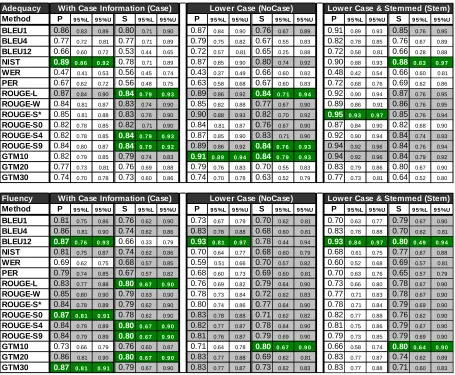
Table 1. Pearson’s ρ and Spearman’s ρ correlations of automatic evaluation measures vs. adequacy
and fluency: BLEU1, 4, and 12 are BLEU with maximum of 1, 4, and 12 grams, NIST is the NIST
score, ROUGE-L is LCS-based F-measure (β = 1), ROUGE-W is weighted LCS-based F-measure (β
= 1). S* is skip-bigram-based co-occurrence statistics with any skip distance limit,
ROUGE-SN is skip-bigram-based F-measure (β = 1) with maximum skip distance of N, PER is position
inde-pendent word error rate, and WER is word error rate. GTM 10, 20, and 30 are general text matcher
not be found. It also suits the NIST MT evaluation scenario where multiple systems are ranked ac-cording to some performance metrics.
To estimate the significance of these correlation statistics, we applied bootstrap resampling, gener-ating random samples of the 919 different sentence segments. The lower and upper values of 95% con-fidence interval are also shown in the table. Dark (green) cells are the best correlation numbers in their categories and light gray cells are statistically equivalent to the best numbers in their categories. Analyzing all runs according to the adequacy and fluency table, we make the following observations:
Applying the stemmer achieves higher correla-tion with adequacy but keeping case informacorrela-tion achieves higher correlation with fluency except for
BLEU7-12 (only BLEU12 is shown). For example,
the Pearson’s ρ (P) correlation of ROUGE-S* with
adequacy increases from 0.85 (Case) to 0.95
(Stem) while its Pearson’s ρ correlation with
flu-ency drops from 0.84 (Case) to 0.78 (Stem). We will focus our discussions on the Stem set in ade-quacy and Case set in fluency.
The Pearson's ρ correlation values in the Stem
set of the Adequacy Table, indicates that ROUGE-L and ROUGE-S with a skip distance longer than 0 correlate highly and linearly with adequacy and
outperform BLEU and NIST. ROUGE-S* achieves
that best correlation with a Pearson’s ρ of 0.95.
Measures favoring consecutive matches, i.e.
BLEU4 and 12, ROUGE-W, GTM20 and 30,
ROUGE-S0 (bigram), and WER have lower
Pear-son’s ρ. Among them WER (0.48) that tends to
penalize small word movement is the worst per-former. One interesting observation is that longer
BLEU has lower correlation with adequacy.
Spearman’s ρ values generally agree with
Pear-son's ρ but have more equivalents.
The Pearson's ρ correlation values in the Stem
set of the Fluency Table, indicates that BLEU12 has
the highest correlation (0.93) with fluency. How-ever, it is statistically indistinguishable with 95% confidence from all other metrics shown in the Case set of the Fluency Table except for WER and GTM10.
GTM10 has good correlation with human judg-ments in adequacy but not fluency; while GTM20 and GTM30, i.e. GTM with exponent larger than 1.0, has good correlation with human judgment in fluency but not adequacy.
ROUGE-L and ROUGE-S*, 4, and 9 are good automatic evaluation metric candidates since they
perform as well as BLEU in fluency correlation
analysis and outperform BLEU4 and 12
signifi-cantly in adequacy. Among them, ROUGE-L is the best metric in both adequacy and fluency correla-tion with human judgment according to
Spear-man’s correlation coefficient and is statistically indistinguishable from the best metrics in both adequacy and fluency correlation with human judgment according to Pearson’s correlation coef-ficient.
6
ConclusionIn this paper we presented two new objective automatic evaluation methods for machine transla-tion, ROUGE-L based on longest common subse-quence (LCS) statistics between a candidate translation and a set of reference translations. Longest common subsequence takes into account sentence level structure similarity naturally and identifies longest co-occurring isequence n-grams automatically while this is a free parameter in BLEU.
To give proper credit to shorter common se-quences that are ignored by LCS but still retain the flexibility of non-consecutive matches, we pro-posed counting skip bigram co-occurrence. The skip-bigram-based ROUGE-S* (without skip
dis-tance restriction) had the best Pearson's ρ
correla-tion of 0.95 in adequacy when all words were lower case and stemmed. ROUGE-L, ROUGE-W, ROUGE-S*, ROUGE-S4, and ROUGE-S9 were
equal performers to BLEU in measuring fluency.
However, they have the advantage that we can
ap-ply them on sentence level while longer BLEU such
as BLEU12 would not differentiate any sentences
with length shorter than 12 words (i.e. no 12-gram matches). We plan to explore their correlation with human judgments on sentence-level in the future. We also confirmed empirically that adequacy and fluency focused on different aspects of machine translations. Adequacy placed more emphasis on terms co-occurred in candidate and reference trans-lations as shown in the higher corretrans-lations in Stem set than Case set in Table 1; while the reverse was true in the terms of fluency.
data, we then need to design a soft matching func-tion that assigns partial credits to these approxi-mate matches. In this scenario, statistically generated data has the advantage of being able to provide scores reflecting the strength of similarity between synonyms and paraphrased.
ROUGE-L, ROUGE-W, and ROUGE-S have also been applied in automatic evaluation of sum-marization and achieved very promising results (Lin 2004). In Lin and Och (2004), we proposed a framework that automatically evaluated automatic MT evaluation metrics using only manual transla-tions without further human involvement. Accord-ing to the results reported in that paper, ROUGE-L, ROUGE-W, and ROUGE-S also outperformed
BLEU and NIST.
References
Akiba, Y., K. Imamura, and E. Sumita. 2001. Us-ing Multiple Edit Distances to Automatically
Rank Machine Translation Output. In
Proceed-ings of the MT Summit VIII, Santiago de Com-postela, Spain.
Barzilay, R. and L. Lee. 2003. Learning to Para-phrase: An Unsupervised Approach Using
Mul-tiple-Sequence Alignmen. In Proceeding of
NAACL-HLT 2003, Edmonton, Canada.
Leusch, G., N. Ueffing, and H. Ney. 2003. A Novel String-to-String Distance Measure with Applications to Machine Translation Evaluation. In Proceedings of MT Summit IX, New Orleans, U.S.A.
Levenshtein, V. I. 1966. Binary codes capable of correcting deletions, insertions and reversals.
Soviet Physics Doklady.
Lin, C.Y. 2004. ROUGE: A Package for Automatic
Evaluation of Summaries. In Proceedings of the
Workshop on Text Summarization Branches
Out, post-conference workshop of ACL 2004,
Barcelona, Spain.
Lin, C.-Y. and F. J. Och. 2004. ORANGE: a Method
for Evaluating Automatic Evaluation Metrics for
Machine Translation. In Proceedings of 20th
In-ternational Conference on Computational Lin-guistic (COLING 2004), Geneva, Switzerland. Miller, G. 1990. WordNet: An Online Lexical
Da-tabase. International Journal of Lexicography,
3(4).
Melamed, I.D. 1995. Automatic Evaluation and Uniform Filter Cascades for Inducing N-best
Translation Lexicons. In Proceedings of the 3rd
Workshop on Very Large Corpora (WVLC3). Boston, U.S.A.
Melamed, I.D., R. Green and J. P. Turian. 2003.
Precision and Recall of Machine Translation. In
Proceedings of NAACL/HLT 2003, Edmonton, Canada.
Nießen S., F.J. Och, G, Leusch, H. Ney. 2000. An Evaluation Tool for Machine Translation: Fast
Evaluation for MT Research. In Proceedings of
the 2nd International Conference on Language Resources and Evaluation, Athens, Greece. NIST. 2002. Automatic Evaluation of Machine
Translation Quality using N-gram
Co-Occurrence Statistics. AAAAAAAAAAA
http://www.nist.gov/speech/tests/mt/doc/ngram-study.pdf
Pantel, P. and Lin, D. 2002. Discovering Word
Senses from Text. In Proceedings of
SIGKDD-02. Edmonton, Canada.
Papineni, K., S. Roukos, T. Ward, and W.-J. Zhu.
2001. BLEU: a Method for Automatic Evaluation
of Machine Translation. IBM Research Report
RC22176 (W0109-022).
Porter, M.F. 1980. An Algorithm for Suffix
Strip-ping. Program, 14, pp. 130-137.
Saggion H., D. Radev, S. Teufel, and W. Lam. 2002. Meta-Evaluation of Summaries in a Cross-Lingual Environment Using
Content-Based Metrics. In Proceedings of
COLING-2002, Taipei, Taiwan.
Su, K.-Y., M.-W. Wu, and J.-S. Chang. 1992. A New Quantitative Quality Measure for Machine
Translation System. In Proceedings of
COLING-92, Nantes, France.
Thompson, H. S. 1991. Automatic Evaluation of Translation Quality: Outline of Methodology
and Report on Pilot Experiment. In Proceedings
of the Evaluator’s Forum, ISSCO, Geneva, Switzerland.
Turian, J. P., L. Shen, and I. D. Melamed. 2003. Evaluation of Machine Translation and its
Evaluation. In Proceedings of MT Summit IX,
New Orleans, U.S.A.
Van Rijsbergen, C.J. 1979. Information Retrieval.