D e v e l o p m e n t a n d U s e o f a G o l d - S t a n d a r d D a t a S e t for
S u b j e c t i v i t y C l a s s i f i c a t i o n s
J a n y c e M . W i e b e t a n d R e b e c c a F . Bruce:[: a n d T h o m a s P . O ' H a r a t t D e p a r t m e n t of C o m p u t e r Science a n d C o m p u t i n g Research L a b o r a t o r y
New Mexico S t a t e University, Las Cruces, N M 88003 :~Department of C o m p u t e r Science
University of N o r t h C a r o l i n a at Asheville Asheville, NC 28804-8511
wiebe, tomohara@cs, nmsu. edu, bruce@cs, unca. edu
A b s t r a c t
This paper presents a case study of analyzing and improving intercoder reliability in discourse tagging using statistical techniques. Bias- corrected tags are formulated and successfully used to guide a revision of the coding manual and develop an automatic classifier.
1 I n t r o d u c t i o n
This paper presents a case study of analyz- ing and improving intercoder reliability in dis- course tagging using the statistical techniques presented in (Bruce and Wiebe, 1998; Bruce and Wiebe, to appear). Our approach is data driven: we refine our understanding and pre- sentation of the classification scheme guided by the results of the intercoder analysis. We also present the results of a probabilistic classifier developed on the resulting annotations.
Much research in discourse processing has focused on task-oriented and instructional di- alogs. The task addressed here comes to the fore in other genres, especially news reporting. The task is to distinguish sentences used to ob- jectively present factual information from sen- tences used to present opinions and evaluations. There are many applications for which this dis- tinction promises to be important, including text categorization and summarization. This research takes a large step toward developing a reliably annotated gold standard to support experimenting with such applications.
This research is also a case study of ana- lyzing and improving manual tagging that is applicable to any tagging task. We perform a statistical analysis that provides information that complements the information provided by
Cohen's Kappa (Cohen, 1960; Carletta, 1996). In particular, we analyze patterns of agreement to identify systematic disagreements that result from relative bias among judges, because they can potentially be corrected automatically. The corrected tags serve two purposes in this work. They are used to guide the revision of the cod- ing manual, resulting in improved K a p p a scores, and they serve as a gold standard for developing a probabilistic classifier. Using bias-corrected tags as gold-standard tags is one way to define a single best tag when there are multiple judges who disagree.
The coding manual and data from our exper- iments are available at:
http://www.cs.nmsu.edu/~wiebe/projects. In the remainder of this paper, we describe the classification being performed (in section 2), the statistical tools used to analyze the data and produce the bias-corrected tags (in section 3), the case study of improving intercoder agree- ment (in section 4), and the results of the clas- sifter for automatic subjectivity tagging (in sec- tion 5).
2 T h e
Subjective
a n dObjective
C a t e g o r i e sWe address
evidentiality
in text (Chafe, 1986), which concerns issues such as what is the source of information, and whether information is be- ing presented as fact or opinion. These ques- tions are particularly important in news report- ing, in which segments presenting opinions and verbal reactions are mixed with segments pre- senting objective fact (van Dijk, 1988; K a n et al., 1998).ing manual are intention-based: "If the primary intention of a sentence is objective presentation of material that is factual to the reporter, the sentence is objective. Otherwise, the sentence is
subjective." 1
We focus on sentences about private states,
such as belief, knowledge, emotions, etc. (Quirk et al., 1985), and sentences about speech events,
such as speaking and writing. Such sentences may be either subjective or objective. From the coding manual: "Subjective speech-event (and private-state) sentences are used to com- municate the speaker's evaluations, opinions, emotions, and speculations. T h e primary in- tention of objective speech-event (and private- state) sentences, on the other hand, is to ob- jectively communicate material that is factual to the reporter. T h e speaker, in these cases, is being used as a reliable source of information." Following are examples of subjective and ob- jective sentences:
1. At several different levels, it's a fascinating tale. Subjective sentence.
2. Bell Industries Inc. increased its quarterly to 10 cents from seven cents a share. Ob- jective sentence.
3. Northwest Airlines settled the remaining lawsuits filed on behalf of 156 people killed in a 1987 crash, b u t claims against the jetliner's maker axe being pursued, a fed- eral judge said. Objective speech-event sen- tence.
4. T h e South African Broadcasting Corp. said the song "Freedom Now" was "un- desirable for broadcasting." Subjective speech-event sentence.
In sentence 4, there is no uncertainty or eval- uation expressed toward the speaking event. Thus, from one point of view, one might have considered this sentence to be objective. How- ever, the object of the sentence is not presented as material t h a t is factual to the reporter, so the sentence is classified as subjective.
Linguistic categorizations usually do not cover all instances perfectly. For example, sen-
1 The category specifications in the coding manual axe based on our previous work on tracking point of view (Wiebe, 1994), which builds on Banfield's (1982) linguis- tic theory of subjectivity.
tences may fall on the borderline between two categories. To allow for uncertainty in the an- notation process, the specific tags used in this work include certainty ratings, ranging from 0, for least certain, to 3, for most certain. As dis- cussed below in section 3.2, the certainty ratings allow us to investigate whether a model positing additional categories provides a better descrip- tion of the judges' annotations t h a n a binary model does.
Subjective and objective categories are poten- tially important for many text processing ap- plications, such as information extraction and information retrieval, where the evidential sta- tus of information is important. In generation and machine translation, it is desirable to gener- ate text that is appropriately subjective or ob- jective (Hovy, 1987). In summarization, sub- jectivity j u d g m e n t s could be included in doc- ument profiles, to augment automatically pro- duced document summaries, and to help the user make relevance j u d g m e n t s when using a search engine. In addition, they would be useful in text categorization. In related work (Wiebe et al., in preparation), we found that article types, such as announcement and opinion piece,
are significantly correlated with the subjective
and objective classification.
Our subjective category is related to b u t dif- fers from the statement-opinion category of the Switchboard-DAMSL discourse annotation project (Jurafsky et al., 1997), as well as the
gives opinion category of Bale's (1950) model of small-group interaction. All involve expres- sions of opinion, but while our category spec- ifications focus on evidentiality in text, theirs focus on how conversational participants inter- act with one another in dialog.
3 S t a t i s t i c a l T o o l s
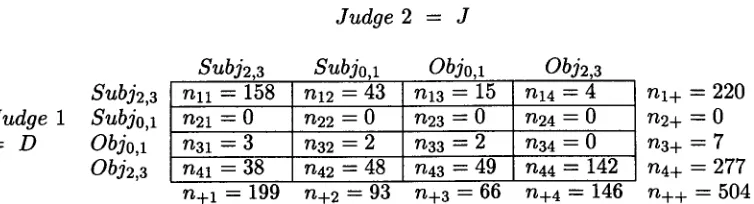
Table 1 presents data for two judges. T h e rows correspond to the tags assigned by judge 1 and the columns correspond to the tags assigned by judge 2. Let nij denote the number of sentences that judge 1 classifies as i and judge 2 classi- fies as j, and let/~ij be the probability that a randomly selected sentence is categorized as i by judge 1 and j by judge 2. Then, the max- i m u m likelihood estimate of 15ij is ~ where
n_l_ + ,
n++ = ~ i j nij = 504.
Judge 1 = D
Sub j2,3
Subjoj Objo,1 Obj2,3
Judge 2 = J
Sub j2,3
S u b j o a
Objoa
Obj2,3
n13 = 15 n14 = 4 rill = 158 n12 = 43
n21 = 0 n22 = 0 n23 = 0 n24 = 0 n31 = 3 n32 = 2 n33 = 2 n34 = 0 n41 = 38 n42 - - 48 n43 = 49 n44 = 142
n+z = 199 n+2 = 93 n+3 = 66 n+4 = 146
n l + = 220 n2+ = 0
n3+ = 7
n4+ = 277 n + + = 504
Table 1: Four-Category Contingency Table
ration, in which certainty ratings 0 and 1 are combined and ratings 2 and 3 are combined. Note t h a t the analyses described in this section cannot be performed on the two-category data configuration (in which the certainty ratings are not considered), due to insufficient degrees of freedom (Bishop et al., 1975).
Evidence of confusion among the classifica- tions in Table 1 can be found in the marginal totals, ni+ and n+j. We see that judge 1 has a relative preference, or bias, for objective, while judge 2 has a bias for subjective. Relative bias is one aspect of agreement among judges. A second is whether the judges' disagreements are systematic, t h a t is, correlated. One p a t t e r n of systematic disagreement is symmetric disagree- ment. W h e n disagreement is symmetric, the differences between the actual counts, and the counts expected if the judges' decisions were not correlated, are symmetric; that is, 5n~j = 5n~i
for i ~ j , where 5ni~ is the difference from inde- pendence.
Our goal is to correct correlated disagree- ments automatically. We are particularly in- terested in systematic disagreements resulting from relative bias. We test for evidence of such correlations by fitting probability models to the data. Specifically, we study bias using the model for marginal homogeneity, and sym- metric disagreement using the model for quasi- symmetry. W h e n there is such evidence, we propose using the latent class model to correct the disagreements; this model posits an unob- served (latent) variable to explain the correla- tions among the judges' observations.
T h e remainder of this section describes these models in more detail. All models can be eval- uated using the freeware package CoCo, which
was developed by Badsberg (1995) and is avail- able at:
h t t p : / / w e b . m a t h . a u c . d k / - j h b / C o C o .
3.1 P a t t e r n s o f D i s a g r e e m e n t
A probability model enforces constraints on t h e counts in the data. T h e degree to which the counts in the data conform to the constraints is called the fit of the model. In this work, model fit is reported in terms of the likelihood ra- tio statistic, G 2, and its significance (Read and Cressie, 1988; Dunning, 1993). T h e higher the G 2 value, the poorer the fit. We will consider model fit to be acceptable if its reference sig- nificance level is greater t h a n 0.01 (i.e., if there is greater t h a n a 0.01 probability that the d a t a sample was randomly selected from a popula- tion described by the model).
Bias of one judge relative to another is evi- denced as a discrepancy between the marginal totals for the two judges (i.e., ni+ and n+j in Table 1). Bias is measured by testing t h e fit of the model for marginal homogeneity: ~i+ = P+i
for all i. T h e larger the G 2 value, t h e greater the bias. T h e fit of the model can be evaluated as described on pages 293-294 of Bishop et al.
(1975).
[image:3.612.127.504.89.191.2]table for independence and a symmetric table,
nij = hi+ × )~+j ×/~ij,
such that /kij = )~ji. In this formula, )~i+ × ,k+j is the model for inde- pendence and ),ij is the symmetric interaction term. Intuitively,/~ij
represents the difference between the actual counts and those predicted by independence. This model can be evaluated using CoCo as described on pages 289-290 of Bishop et al. (1975).3.2
Producing Bias-Corrected Tags
We use the latent class model to correct sym- metric disagreements that appear to result from bias. The latent class model was first intro- duced by Lazarsfeld (1966) and was later made computationally efficient by G o o d m a n (1974). G o o d m a n ' s procedure is a specialization of the EM algorithm (Dempster et al., 1977), which is implemented in the freeware program CoCo (Badsberg, 1995). Since its development, the latent class model has been widely applied, and is the underlying model in various unsupervised machine learning algorithms, including Auto- Class (Cheeseman and Stutz, 1996).
T h e form of the latent class model is that of naive Bayes: the observed variables are all con- ditionally independent of one another, given the value of the latent variable. T h e latent variable represents the
true
state of the object, and is the source of the correlations among the observed variables.As applied here, the observed variables are the classifications assigned by the judges. Let B, D, J, and M be these variables, and let L be the latent variable. Then, the latent class model is:
p ( b , d , j , m , l )
= p(bll)p(dll)p(jll)p(mll)p(l )
(by C.I. assumptions)p( b, l )p( d, l )p(j , l )p( m, l)
p(t)3
(by definition)T h e parameters of the model
a r e
{p(b, l),p(d, l),p(j, l),p(m, l)p(l)}.
O n c e es- t i m a t e s of these parameters are obtained, each clause can be assigned the most probable latent category given the tags assigned by the judges. T h e EM algorithm takes as input the number of latent categories hypothesized, i.e., the num- ber of values of L, and produces estimates of theparameters. For a description of this process, see G o o d m a n (1974), Dawid & Skene (1979), or Pedersen & Bruce (1998).
Three versions of the latent class model are considered in this study, one with two latent categories, one with three latent categories, and one with four. We apply these models to three data configurations: one with two categories
(subjective
andobjective
with no certainty rat- ings), one with four categories(subjective
andobjective
with coarse-grained certainty ratings, as shown in Table 1), and one with eight cate- gories(subjective
andobjective
with fine-grained certainty ratings). All combinations of model and data configuration are evaluated, except the four-category latent class model with the two- category data configuration, due to insufficient degrees of freedom.In all cases, the models fit the data well, as measured by G 2. T h e model chosen as final is the one for which the agreement among the latent categories assigned to the three data con- figurations is highest, that is, the model that is most consistent across the three d a t a configura- tions.
4
Improving Agreement in
Discourse Tagging
Our annotation project consists of the following steps: 2
1. A first draft of the coding instructions is developed.
2. Four judges annotate a corpus according to the first coding manual, each spending about four hours.
3. The a n n o t a t e d corpus is statistically ana- lyzed using the m e t h o d s presented in sec- tion 3, and bias-corrected tags are pro- duced.
4. The judges are given lists of sentences for which their tags differ from the bias- corrected tags. Judges M, D, and J par- ticipate in interactive discussions centered around the differences. In addition, after reviewing his or her list of differences, each judge provides feedback, agreeing with the
bias-corrected tag in many cases, b u t argu- ing for his or her own tag in some cases. Based on the judges' feedback, 22 of the 504 bias-corrected tags are changed, and a second draft of the coding manual is writ- ten.
5. A second corpus is a n n o t a t e d by the same four judges according to the new coding manual. Each spends about five hours.
6. T h e results of the second tagging experi- ment are analyzed using the m e t h o d s de- scribed in section 3, and bias-corrected tags are produced for the second d a t a set.
Two disjoint corpora are used in steps 2 and 5, b o t h consisting of complete articles taken from the Wall Street Journal Treebank Corpus (Marcus et al., 1993). In b o t h corpora, judges assign tags to each n o n - c o m p o u n d sentence and to each conjunct of each c o m p o u n d sentence, 504 in the first corpus and 500 in the second. T h e segmentation of c o m p o u n d sentences was performed manually before the judges received the data.
Judges J a n d B, the first two authors of this paper, are NLP researchers. Judge M is an u n d e r g r a d u a t e computer science student, and judge D has no background in computer science or linguistics. Judge J, with help from M, devel- oped the original coding instructions, and Judge J directed the process in step 4.
T h e analysis performed in step 3 reveals strong evidence of relative bias among the judges. Each pairwise comparison of judges also shows a strong p a t t e r n of symmetric disagree- ment. T h e two-category latent class model pro- duces the most consistent clusters across the d a t a configurations. It, therefore, is used to de- fine the bias-corrected tags.
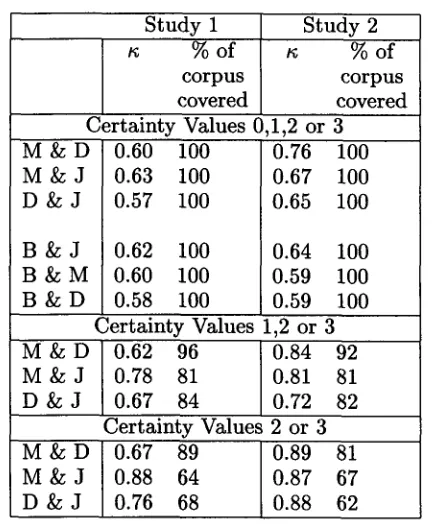
In step 4, judge B was excluded from the in- teractive discussion for logistical reasons. Dis- cussion is apparently important, because, al- t h o u g h B's K a p p a values for the first study are on par with t h e others, B's K a p p a values for agreement with the other judges change very little from the first to the second study (this is true across the range of certainty values). In contrast, agreement among the other judges no- ticeably improves. Because judge B's poor Per- formance in the second tagging experiment is linked to a difference in procedure, judge B's
Study 1 Study 2 % o f ~ % o f
corpus corpus
covered covered Certainty Values 0,1,2 or 3 M & D
M & J D & J
B & J B & M B & D
0.60 100 0.63 100 0.57 100
0.62 100 0.60 100 0.58 100
0.76 100 0.67 100 0.65 100
0.64 100 0.59 100 0.59 100 Certainty Values 1,2 or 3 M & D 0.62 96 0.84 92
M & J 0.78 81 0.81 81 D & J 0.67 84 0.72 82
Certainty Values 2 or 3 M & D
M & J D & J
0.67 89 0.88 64 0.76 68
0.89 81 0.87 67 0.88 62
Table 2: Palrwise K a p p a (a) Scores
tags are excluded from our subsequent analysis of the d a t a gathered during the second tagging experiment.
Table 2 shows the changes, from s t u d y 1 to study 2, in the K a p p a values for pairwise agree- ment among the judges. T h e best results are clearly for the two who are not authors of this paper (D and M). T h e K a p p a value for the agreement between D and M considering all cer- tainty ratings reaches .76, which allows tenta- tive conclusions on Krippendorf's scale (1980). If we exclude the sentences with certainty rat- ing 0, the K a p p a values for pairwise agreement between M and D and between J and M are b o t h over .8, which allows definite conclusions on Krippendorf's scale. Finally, if we only con- sider sentences with certainty 2 or 3, t h e pair- wise agreements among M, D, and J all have high K a p p a values, 0.87 and over.
[image:5.612.328.545.84.346.2]Test
DIJ
M.H.:
G 2 104.912
Sig.
0.000Q . S . :
G 2 0.054
Sig.
0.997DIM
JIM
17.343 136.660 0.001 0.000
0.128 0.350 0.998 0.95
Table 3: Tests for Patterns of Agreement
accounted for a large proportion of our interla- beler error" (Jurafsky et al., 1997).
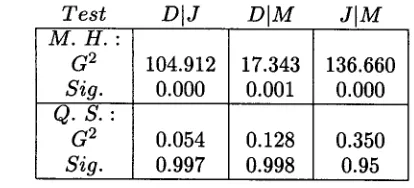
In step 6, as in step 3, there is strong evi- dence of relative bias among judges D, J and M. Each pairwise comparison of judges also shows a strong pattern of symmetric disagreement. The results of this analysis are presented in Table 3. 3 Also as in step 3, the two-category latent class model produces the most consistent clus- ters across the d a t a configurations. Thus, it is used to define the bias-corrected tags for the second data set as well.
5 M a c h i n e L e a r n i n g R e s u l t s
Recently, there have been many successful ap- plications of machine learning to discourse pro- cessing, such as (Litman, 1996; Samuel et al., 1998). In this section, we report the results of machine learning experiments, in which we develop probablistic classifiers to automatically perform the
subjective
andobjective
classifica- tion. In the method we use for developing clas- sifters (Bruce and Wiebe, 1999), a search is per- formed to find a probability model that cap- tures important interdependencies among fea- tures. Because features can be dropped and added during search, the method also performs feature selection.In these experiments, the system considers naive Bayes, full independence, full interdepen- dence, and models generated from those using forward and backward search. The model se- lected is the one with the highest accuracy on a held-out portion of the training data.
10-fold cross validation is performed. The data is partitioned randomly into 10 different
SFor the analysis in Table 3, certainty ratings 0 and 1,
and 2 and 3 are combined. Similar results are obtained when all ratings are treated as distinct.
sets. On each fold, one set is used for testing, and the other nine are used for training. Fea- ture selection, model selection, and parameter estimation are performed anew on each fold.
The following are the potential features con- sidered on each fold. A binary feature is in- cluded for each of the following: the presence in the sentence of a pronoun, an adjective, a cardinal number, a modal other t h a n
will,
and an adverb other thannot.
We also include a binary feature representing whether or not the sentence begins a new paragraph. Finally, a fea- ture is included representing co-occurrence of word tokens and punctuation marks with thesubjective
andobjective
classification. 4 There are many other features to investigate in future work, such as features based on tags assigned to previous utterances (see, e.g., (Wiebe et al., 1997; Samuel et al., 1998)), and features based on semantic classes, such as positive and neg- ative polarity adjectives (Hatzivassiloglou and McKeown, 1997) and reporting verbs (Bergler, 1992).The data consists of the concatenation of the two corpora annotated with bias-corrected tags as described above. The baseline accuracy, i.e., the frequency of the more frequent class, is only
51%.
The results of the experiments are very promising. The average accuracy across all folds is 72.17%, more than 20 percentage points higher than the baseline accuracy. Interestingly, the system performs better on the sentences for which the judges are certain. In a post hoc anal- ysis, we consider the sentences from the second data set for which judges M, J, and D rate their certainty as 2 or 3. There are 299/500 such sen- tences. For each fold, we calculate the system's accuracy on the subset of the test set consisting of such sentences. The average accuracy of the subsets across folds is 81.5%.
Taking human performance as an upper bound, the system has room for improvement. The average pairwise percentage agreement be- tween D, J, and M and the bias-corrected tags in the entire data set is 89.5%, while the system's percentage agreement with the bias-corrected tags (i.e., its accuracy) is 72.17%.
[image:6.612.66.273.88.182.2]6 C o n c l u s i o n
This paper demonstrates a procedure for auto- matically formulating a single best tag when there are multiple judges who disagree. The procedure is applicable to any tagging task in which the judges exhibit symmetric disagree- ment resulting from bias. We successfully use bias-corrected tags for two purposes: to guide a revision of the coding manual, and to develop an automatic classifier. The revision of the cod- ing manual results in as much as a 16 point im- provement in pairwise Kappa values, and raises the average agreement among the judges to a Kappa value of over 0.87 for the sentences that can be tagged with certainty.
Using only simple features, the classifier achieves an average accuracy 21 percentage points higher than the baseline, in 10-fold cross validation experiments. In addition, the aver- age accuracy of the classifier is 81.5% on the sentences the judges tagged with certainty. The strong performance of the classifier and its con- sistency with the judges demonstrate the value of this approach to developing gold-standard tags.
7 A c k n o w l e d g e m e n t s
This research was supported in part by the Office of Naval Research under grant number N00014-95-1-0776. We are grateful to Matthew T. Bell and Richard A. Wiebe for participating in the annotation study, and to the anonymous reviewers for their comments and suggestions. R e f e r e n c e s
J. Badsberg. 1995.
An Environment for Graph-
ical Models.
Ph.D. thesis, Aalborg University. R. F. Bales. 1950.Interaction Process Analysis.
University of Chicago Press, Chicago, ILL. Ann Banfield. 1982.
Unspeakable Sentences:
Narration and Representation in the Lan-
guage of Fiction.
Routledge & Kegan Paul, Boston.S. Bergler. 1992.
Evidential Analysis o.f Re-
ported Speech.
Ph.D. thesis, Brandeis Univer- sity.Y.M. Bishop, S. Fienberg, and P. Holland. 1975.
Discrete Multivariate Analysis: Theory
and Practice.
The MIT Press, Cambridge. R. Bruce and J. Wiebe. 1998. Word sense dis-tinguishability and inter-coder agreement. In
Proc. 3rd Conference on Empirical Methods
in Natural Language Processing (EMNLP-
98),
pages 53-60, Granada, Spain, June. ACL SIGDAT.R. Bruce and J. Wiebe. 1999. Decompos- able modeling in natural language processing.
Computational Linguistics,
25(2).R. Bruce and J. Wiebe. to appear. Recognizing subjectivity: A case study of manual tagging.
Natural Language Engineering.
J. Carletta. 1996. Assessing agreement on clas- sification tasks: The kappa statistic.
Compu-
tational Linguistics,
22(2):249-254.W. Chafe. 1986. Evidentiality in English con- versation and academic writing. In Wallace Chafe and Johanna Nichols, editors,
Eviden-
tiality: The Linguistic Coding of Epistemol-
ogy,
pages 261-272. Ablex, Norwood, NJ. P. Cheeseman and J. Stutz. 1996. Bayesianclassification (AutoClass): Theory and re- sults. In Fayyad, Piatetsky-Shapiro, Smyth, and Uthurusamy, editors,
Advances in
Knowledge Discovery and Data Mining.
AAAI Press/MIT Press.
J. Cohen. 1960. A coefficient of agreement for nominal scales.
Educational and Psychologi-
cal Meas.,
20:37-46.A. P. Dawid and A. M. Skene. 1979. Maximum likelihood estimation of observer error-rates using the EM algorithm.
Applied Statistics,
28:20-28.
A. Dempster, N. Laird, and D. Rubin.
1977.
Maximum likelihood from incomplete data via the EM algorithm.
Journal of the Royal
Statistical Society,
39 (Series B):1-38.T. Dunning. 1993. Accurate methods for the statistics of surprise and coincidence.
Com-
putational Linguistics,
19(1):75-102.L. Goodman. 1974. Exploratory latent struc- ture analysis using both identifiable and unidentifiable models.
Biometrika,
61:2:215- 231.V. Hatzivassiloglou and K. McKeown. 1997. Predicting the semantic orientation of adjec- tives. In
ACL-EACL 1997,
pages 174-181, Madrid, Spain, July.Eduard Hovy. 1987.
Generating Natural Lan-
guage under Pragmatic Constraints.
Ph.D. thesis, Yale University.discourse-function annotation coders manual, draft 13. Technical Report 97-01, University of Colorado Institute of Cognitive Science. M.-Y. Kan, J. L. Klavans, and K. R. McKe-
own. 1998. Linear segmentation and segment significance. In Proc. 6th Workshop on Very Large Corpora (WVLC-98), pages 197-205, Montreal, Canada, August. ACL SIGDAT. K. Krippendorf. 1980. Content Analysis: An
Introduction to its Methodology. Sage Publi- cations, Beverly Hills.
P. Lazarsfeld. 1966. Latent structure analy- sis. In S. A. Stouffer, L. Guttman, E. Such- man, P.Lazarfeld, S. Star, and J. Claussen, editors, Measurement and Prediction. Wiley, New York.
D. Litman. 1996. Cue phrase classification us- ing machine learning. Journal of Artificial Intelligence Research, 5:53-94.
M. Marcus,
Santorini, B., and M. Marcinkiewicz. 1993. Building a large annotated corpus of English: The penn treebank. Computational Linguis- tics, 19(2):313-330.
Ted Pedersen and Rebecca Bruce. 1998. Knowledge lean word-sense disambiguation. In Proc. of the 15th National Conference on Artificial Intelligence (AAAI-98), Madison, Wisconsin, July.
R. Quirk, S. Greenbaum, G. Leech, and J. Svartvik. 1985. A Comprehensive Gram- mar of the English Language. Longman, New York.
T. Read and N. Cressie. 1988. Goodness-of- fit Statistics for Discrete Multivariate Data.
Springer-Verlag Inc., New York, NY.
K. Samuel, S. Carberry, and K. Vijay- Shanker. 1998. Dialogue act tagging with transformation-based learning. In Proc.
COLING-ACL 1998, pages 1150-1156, Mon- treal, Canada, August.
T.A. van Dijk. 1988. News as Discourse.
Lawrence Erlbaum, Hillsdale, NJ.
J. Wiebe, R. Bruce, and L. Duan. 1997. Probabilistic event categorization. In Proc. Recent Advances in Natural Language Pro- cessing (RANLP-97), pages 163-170, Tsigov Chark, Bulgaria, September.
J. Wiebe, K. McKeever, and R. Bruce. 1998. Mapping collocational properties into ma- chine learning features. In Proc. 6th Work-
shop on Very Large Corpora (WVLC-98),
pages 225-233, Montreal, Canada, August. ACL SIGDAT.
J. Wiebe, J. Klavans, and M.Y. Kan. in prepa- ration. Verb profiles for subjectivity judg- ments and text classification.
J. Wiebe. 1994. Tracking point of view in narrative. Computational Linguistics,