A Memory-Based Approach to Learning Shallow Natural
Language Patterns
S h l o m o A r g a m o n a n d
Ido Dagan
a n d Y u v a l K r y m o l o w s k i D e p a r t m e n t o f M a t h e m a t i c s a n d C o m p u t e r ScienceB a r - I l a n U n i v e r s i t y 52900 R a m a t G a n , Israel
{
argamon,
dagan, yuvalk}@cs,
b i u .ac. il
A b s t r a c t
Recognizing shallow linguistic patterns, such as ba- sic syntactic relationships between words, is a com- mon task in applied natural language and text pro- cessing. The common practice for approaching this task is by tedious manual definition of possible pat- tern structures, often in the form of regular expres- sions or finite automata. This paper presents a novel memory-based learning method that recognizes shal- low patterns in new text based on a bracketed train- ing corpus. The training data are stored as-is, in efficient suffix-tree data structures. Generalization is performed on-line at recognition time by compar- ing subsequences of the new text to positive and negative evidence in the corpus. This way, no in- formation in the training is lost, as can happen in other learning systems that construct a single gen- eralized model at the time of training. The paper presents experimental results for recognizing noun phrase, subject-verb and verb-object patterns in En- glish. Since the learning approach enables easy port- ing to new domains, we plan to apply it to syntac- tic patterns in other languages and to sub-language patterns for information extraction.
1 I n t r o d u c t i o n
Identifying local patterns of syntactic sequences and relationships is a fundamental task in natural lan- guage processing (NLP). Such patterns may corre- spond to syntactic phrases, like noun phrases, or to pairs of words that participate in a syntactic rela- tionship, like the heads of a verb-object relation. Such patterns have been found useful in various application areas, including information extraction, text summarization, and bilingual alignment. Syn- tactic patterns are useful also for many basic com- putational linguistic tasks, such as statistical word similarity and various disambiguation problems.
One approach for detecting syntactic patterns is to obtain a full parse of a sentence and then extract the required patterns. However, obtaining a complete parse tree for a sentence is difficult in many cases, and may not be necessary at all for identifying most instances of local syntactic patterns.
An alternative approach is to avoid the complex- ity of full parsing and instead to rely only on local information. A variety of methods have been devel- oped within this framework, known as shallow pars- ing, chunking, local parsing etc. (e.g., (Abney, 1991; Greffenstette, 1993)). These works have shown that it is possible to identify most instances of local syn- tactic patterns by rules that examine only the pat- tern itself and its nearby context. Often, the rules are applied to sentences that were tagged by part- of-speech (POS) and are phrased by some form of regular expressions or finite state automata.
Manual writing of local syntactic rules has become a common practice for many applications. However, writing rules is often tedious and time consuming. Furthermore, extending the rules to different lan- guages or sub-language domains can require sub- stantial resources and expertise that are often not available. As in many areas of NLP, a learning ap- proach is appealing. Surprisingly, though, rather lit- tle work has been devoted to learning local syntactic patterns, mostly noun phrases (Ramshaw and Mar- cus, 1995; Vilain and Day, 1996).
This paper presents a novel general learning ap- proach for recognizing local sequential patterns, that may be perceived as falling within the memory- based learning paradigm. The method utilizes a part-of-speech tagged training corpus in which all in- stances of the target pattern are marked (bracketed). The training data are stored as-is in suffix-tree data structures, which enable linear time searching for subsequences in the corpus.
The memory-based nature of the presented algo- rithm stems from its deduction strategy: a new in- stance of the target pattern is recognized by exam- ining the raw training corpus, searching for positive and negative evidence with respect to the given test sequence. No model is created for the training cor- pus, and the raw examples are not converted to any other representation.
Consider the following example 1. Suppose we 1We use here the POS tags: DT ---- determiner, ADJ = adjective, hDV = adverb, C0NJ = conjunction, VB=verb,
want to decide whether the candidate sequence DT ADJ ADJ NN NNP
is a noun phrase (NP) by comparing it to the train- ing corpus. A good match would be if the entire sequence appears as-is several times in the corpus. However, due to d a t a sparseness, an exact match cannot always be expected.
A somewhat weaker match may be obtained if we consider sub-parts of the candidate sequence (called
tiles). For example, suppose the corpus contains noun phrase instances with the following structures:
(i) DT ADJ ADJ NN NN (2) DT ADJ NN NNP
T h e first structure provides positive evidence that the sequence "DT ADJ ADJ NN" is a possible N P pre- fix while the second structure provides evidence for "ADJ NN NNP" being an N P suffix. Together, these two training instances provide positive evidence t h a t
covers the entire candidate. Considering evidence for sub-parts of the p a t t e r n enables us to general- ize over the exact structures t h a t are present in the corpus. Similarly, we also consider the negative evi- dence for such sub-parts by noting where they occur in the corpus without being a corresponding part of a target instance.
T h e proposed method, as described in detail in the next section, formalizes this type of reasoning. It searches specialized d a t a structures for both positive and negative evidence for sub-parts of the candidate structure, and considers additional factors such as context and evidence overlap. Section 3 presents ex- perimental results for three target syntactic patterns in English, and Section 4 describes related work. 2 T h e A l g o r i t h m
T h e input to the Memory-Based Sequence Learning (MBSL) algorithm is a sentence represented as a se- quence of POS tags, and its o u t p u t is a bracketed sentence, indicating which subsequences of the sen- tence are to be considered instances of the target p a t t e r n (target instances). MBSL determines the bracketing by first considering each subsequence of the sentence as a candidate to be a target instance. It computes a score for each candidate by comparing it to the training corpus, which consists of a set of pre-bracketed sentences. T h e algorithm then finds a consistent bracketing for the input sentence, giving preference to high scoring subsequences. In the re- mainder of this section we describe the scoring and bracketing methods in more detail.
2.1 S c o r i n g c a n d i d a t e s
We first describe the mechanism for scoring an in- dividual candidate. T h e input is a candidate sub- sequence, along with its context, i.e., the other tags
in the input sentence. The m e t h o d is presented at two levels: a general memory-based learning schema and a particular instantiation of it. Further instan- tiations of the schema are expected in future work. 2.1.1 T h e g e n e r a l M B S L s c h e m a
The MBSL scoring algorithm works by considering
situated candidates. A situated candidate is a sen- tence containing one pair of brackets, indicating a candidate to be a target instance. T h e portion of the sentence between the brackets is the candidate
(as above), while the portion before and after the candidate is its context. (Although we describe the algorithm here for the general case of unlimited con- text, for computational reasons our implementation only considers a limited a m o u n t of context on either side of the candidate.) This subsection describes how to compute the score of a situated candidate from the training corpus.
T h e idea of the MBSL scoring algorithm is to con- struct a tiling of subsequences of a situated candi- date which covers the entire candidate. We con- sider as tiles subsequences of the situated candidate which contain a bracket. (We thus consider only tiles within or adjacent to the candidate t h a t also include a candidate boundary.)
Each tile is assigned a score based on its occur- rence in the training memory. Since brackets cor- respond to the boundaries of potential target in- stances, it is i m p o r t a n t to consider how the bracket positions in the tile correspond to those in the train- ing memory.
For example, consider the training sentence [ NN ] VB [ ADJ NN NN ] ADV PP [ NN ]
W e m a y n o w examine the occurrence in this sentence of several possible tiles:
VB [ ADJ NN occurs positively in the sentence, and
NN NN ] ADV also occurs positively, while
NN [ NN ADV occurs negatively in the training sen- tence, since the bracket does not correspond.
T h e positive evidence for a tile is measured by its
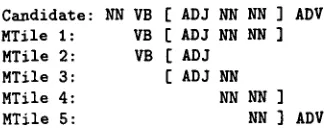
Candidate: NN VB [ ADJ NN NN ] ADV
MTile I: VB [ ADJ NN NN ]
MTile 2: VB [ ADJ
MTile 3: [ ADJ NN
MTile 4: NN NN ]
MTile 5: NN ] ADV
Figure 1: A candidate subsequence with some of its context, and 5 matching tiles found in the training corpus.
The overall score of a situated candidate is gen- erally a function of the scores of all the tiles for the candidate, as well as the relations between the tiles' positions. These relations include tile adjacency, overlap between tiles, the a m o u n t of context in a tile, and so on.
2.1.2 A n i n s t a n t i a t i o n o f t h e M B S L s c h e m a In our instantiation of the MBSL schema, we define the score f i t ) of a tile t as the ratio of its positive count pos(t) and its total count total(t):
1 if -P-P--~!!- > 0 total(t) I ( t ) = 0 otherwise
for a predefined threshold O. Tiles with a score of 1, and so with sufficient positive evidence, are called matching tiles.
Each matching tile gives supporting evidence t h a t a part of the candidate can be a part of a target in- stance. In order to combine this evidence, we try to cover the entire candidate by a set of matching tiles, with no gaps. Such a covering constitutes evidence that the entire candidate is a target instance. For example, consider the matching tiles shown for the candidate in Figure 1. The set of matching tiles 2, 4, and 5 covers the candidate, as does the set of tiles 1 and 5. Also note t h a t tile 1 constitutes a cover on its own.
To make this precise, we first say that a tile T1 connects to a tile T2 if (i) T2 starts after T1 starts, (ii) there is no gap between the end of T1 and the start of T2 (there may be some overlap), and (iii) T2 ends after T1 (neither tile includes the other). For example, tiles 2 and 4 in the figure connect, while tiles 2 and 5 do not, and neither do tiles 1 and 4 (since tile 1 includes tile 4 as a subsequence).
A cover for a situated candidate c is a sequence of matching tiles which collectively cover the en- tire candidate, including the b o u n d a r y brackets, and possibly some context, such that each tile connects to the following one. A cover thus provides posi- tive evidence for the entire sequence of tags in the candidate.
The set of all the covers for a candidate summa- rizes all of the evidence for the candidate being a
target instance. We therefore compute the score of a candidate as a function of some statistics of the set of all its covers. For example, if a candidate has many different covers, it is more likely to be a target instance, since many different pieces of evidence can be brought to bear.
We have empirically found several statistics of the cover set to be useful. These include, for each cover, the number of tiles it contains, the total number of context tags it contains, and the number of positions which more than one tile covers (the amount of over- lap). We thus compute, for the set of all covers of a candidate c, the
• Total number of different covers, n u m ( c ) , * Minimum number of matches in any cover,
m i n s i z e ( c ) ,
• Maximum amount of context in any cover, m a x c o n t e x t ( c ) , and
• Maximum total overlap between tiles for any cover, m a x o v e r l a p ( c ) .
Each of these items gives an indication regarding the overall strength of the cover-based evidence for the candidate.
The score of the candidate is a linear function of its statistics:
f ( c ) = a n u m ( c ) - 1 3 m i n s i z e ( c ) + 3' m a x c o n t e x t (c) +
m a x o v e r l a p (c)
If candidate c has no covers, we set f ( c ) = O. Note that m i n s i z e is weighted negatively, since a cover with fewer tiles provides stronger evidence for the candidate.
In the current implementation, the weights were chosen so as to give a lexicographic ordering, pre- ferring first candidates with more covers, then those with covers containing fewer tiles, then those with larger contexts, and finally, when all else is equal, preferring candidates with more overlap between tiles. We plan to investigate in the future a data- driven approach (based on the Winnow algorithm) for optimal selection and weighting of statistical fea- tures of the score.
[image:3.612.67.232.57.122.2]2.1.3 S u m m a r y
Given a candidate sequence and its context (a situ- ated candidate):
1. Consider all the subsequences of the situated candidate which include a bracket as tiles; 2. Compute a tile score as a function of its positive
count and total counts, by searching the train- ing corpus. Determine which tiles are matching tiles;
3. Construct the set of all possible covers for the candidate, that is, sequences of connected matching tiles that cover the entire candidate; 4. Compute the candidate score based on the
statistics of its covers.
2.2 Searching the training m e m o r y
The MBSL scoring algorithm searches the training corpus for each subsequence of the sentence in or- der to find matching tiles. Implementing this search efficiently is therefore of prime importance. We do so by encoding the training corpus using suffix trees (Edward and McCreight, 1976), which provide string searching in time which is linear in the length of the searched string.
Inspired by Satta (1997), we build two suffix trees for retrieving the positive and total counts for a tile. The first suffix tree holds all pattern instances from the training corpus surrounded by bracket symbols and a fixed amount of context. Searching a given tile (which includes a bracket symbol) in this tree yields the positive count for the tile. The second suffix tree holds an unbracketed version of the en- tire training corpus. This tree is used for searching the POS sequence of a tile, with brackets omitted, yielding the total count for the tile (recall that the negative count is the difference between the total and positive counts).
2.3 Selecting candidates
After the above procedure, each situated candidate is assigned a score. In order to select a bracketing for the input sentence, we assume that target instances are non-overlapping (this is usually the case for the types of patterns with which we experimented). We use a simple constraint propagation algorithm that finds the best choice of non-overlapping candidates in an input sentence:
1. Examine each situated candidate c with f ( c ) > 0, in descending order of f(c):
(a) Add c's brackets to the sentence;
(b) Remove all situated candidates overlapping with c which have not yet been examined. 2. Return the bracketed sentence.
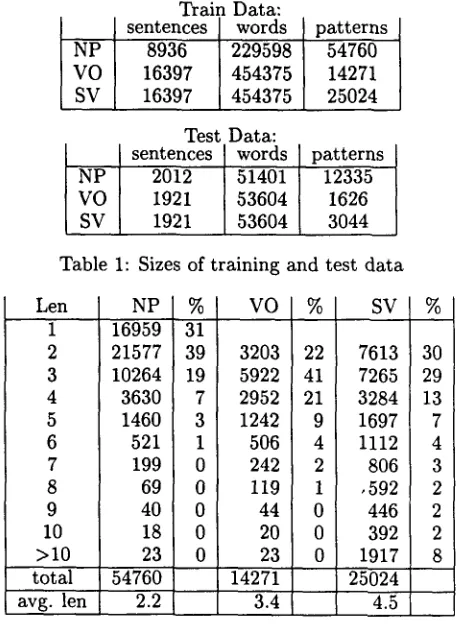
NP VO SV
NP VO SV
Train Data: sentences words
8936 229598 16397 454375 16397 454375
patterns 54760 14271 25024 Test Data:
sentences words patterns 2 0 1 2 5 1 4 0 1 12335 1 9 2 1 53604 1626 1 9 2 1 53604 3044 Table 1: Sizes of training and test data Len
1 16959 31
2 21577 39 3203 22 7613 30 3 10264 19 5922 41 7265 29
4 3630 7 2952 21 3284 13
5 1460 3 1242 9 1697 7
6 521 1 506 4 1112 4
7 199 0 242 2 806 3
8 69 0 119 1 ,592 2
9 40 0 44 0 446 2
10 18 0 20 0 392 2
>10 23 0 23 0 1917 8
total 54760 14271 25024
avg. len 2.2 3.4 4.5
Table 2: Distribution of pattern lengths, total num- ber of patterns and average length in the training data.
3 E v a l u a t i o n
3.1 The D a t a
We have tested our algorithm in recognizing three syntactic patterns: noun phrase sequences (NP), verb-object (VO), and subject-verb (SV) relations. The NP patterns were delimited by ' [' and ' ] ' symbols at the borders of the phrase. For VO pat- terns, we have put the starting delimiter before the main verb and the ending delimiter after the object head, thus covering the whole noun phrase compris- ing the object; for example:
... i n v e s t i g a t o r s s t a r t e d to [ v i e w t h e l o w e r p r i c e l e v e l s ] as a t t r a c t i v e ...
We used a similar policy for SV patterns, defining the start of the pattern at the start of the subject noun phrase and the end at the first verb encoun- tered (not including auxiliaries and medals); for ex- ample:
... a r g u e t h a t
[ t h e U.S. s h o u l d r e g u l a t e ]
[image:4.612.314.542.55.367.2]90
t~ O
L
o. 80
70
I , , t , I s , , [ , , ,
70 80 90
Recall
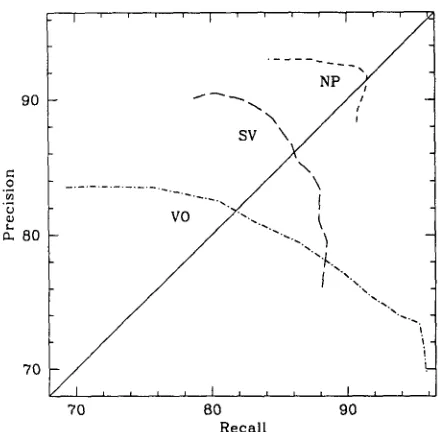
Figure 2: Recall-Precision curves for NP, VO, and SV; 0.1 < 8 < 0.99
The subject and object noun-phrase borders were those specified by the annotators, phrases which con- tain conjunctions or appositives were not further an- alyzed.
The training and testing data were derived from the Penn TreeBank. We used the NP data prepared by Ramshaw and Marcus (1995), hereafter RM95. The SV and VO data were obtained using T (Tree- Bank's search script language) scripts. 2 Table 1 summarizes the sizes of the training and test data sets and the number of examples in each.
The T scripts did not attempt to match depen- dencies over very complex structures, since we are concerned with shallow, or local, patterns. Table 2 shows the distribution of pattern length in the train data. We also did not attempt to extract passive- voice VO relations.
3.2 T e s t i n g M e t h o d o l o g y
The test procedure has two parameters: (a) maxi- mum context size of a candidate, which limits what queries are performed on the memory, and (b) the threshold 8 used for establishing a matching tile, which determines h o w to make use of the query re- sults.
Recall and precision figures were obtained for var- ious parameter values. F~ (van Rijsbergen, 1979), a common measure in information retrieval, was used
2The scripts may be found at the URL
http://www.cs.biu.ac.il/,-~yuvalk/MBSL.
as a single-figure measure of performance: (f12 + 1). P . n F~ = f12 . P + R
We use ~ = 1 which gives no preference to either recall or precision.
3.3 R e s u l t s
Table 3 summarizes the optimal parameter settings and results for NP, VO, and SV on the test set. In order to find the optimal values of the context size and threshold, we tried 0.1 < t~ < 0.95, and maxi- mum context sizes of 1,2, and 3. Our experiments used 5-fold cross-validation on the training data to determine the optimal parameter settings.
In experimenting with the maximum context size parameter, we found that the difference between the values of F~ for context sizes of 2 and 3 is less than 0.5% for the optimal threshold. Scores for a context size of 1 yielded F~ values smaller by more than 1% than the values for the larger contexts.
Figure 2 shows recall/precision curves for the three data sets, obtained by varying 8 while keeping the maximum context size at its optimal value. The difference between F~=I values for different thresh- olds was always less than 2%.
Performance may be measured also on a word-by word basis, counting as a success any word which was identified correctly as being part of the tar- get pattern. That method was employed, along with recall/precision, by RM95. We preferred to measure performance by recall and precision for complete patterns. Most errors involved identifica- tions of slightly shifted, shorter or longer sequences. Given a pattern consisting of five words, for example, identifying only a four-word portion of this pattern would yield both a recall and precision errors. Tag- assignment scoring, on the other hand, will give it a score of 80%. We hold the view that such an identi- fication is an error, rather than a partial success.
We used the datasets created by RM95 for NP learning; their results are shown in Table 3. 3 The F~ difference is small (0.4%), yet they use a richer feature set, which incorporates lexicai information as well. The method of Ramshaw and Marcus makes a decision per word, relying on predefined rule tem- plates. The method presented here makes deci- sions on sequences and uses sequences as its mem- ory, thereby attaining a dynamic perspective of the
SNotice t h a t our results, as well as those we cite from
[image:5.612.79.298.91.307.2]Thresh.
VO 2 0.5 81.3
SV 3 0.6 86.1
NP 3 0.6 91.4
aM95 (NP) I I - I
Recall (%) Precision (%)
89.8 77.1
84.5 88.6
91.6 91.6
I
92.3
91.883.0 86.5 91.6
192.0
Table 3: Results with optimal parameter settings for context size and threshold, and breakeven points. The last line shows the results of Ramshaw and Marcus (1995) (recognizing NP's) with the same train/test data. The optimal parameters were obtained by 5-fold cross-validation.
9 0
8 5
J
8 0
t 1 . . . t ' - - _ ' _ _ - ,
/ / / /
/ NP. 8 = 0 . 7 C o n . = 2
90
/ . / SV. 8 = 0 . 8 C o n . - 3
. / /
l/
=i/
Ii
J
L V O . 0 ~ 0 . 3 C o n . - 2
n
2 0 0 0 0
8 5
Y,
8 0
75 ' ' ] ~ ' ~ ] 75
0 4 0 0 0 0
' ' ' ' I ' ' ' ' I _ ' - ' ' ' I ' ' ' i 1 ' ' '
/ t / /
N P . e = o . 7 C o n . = 2
0 E x a m p l e s
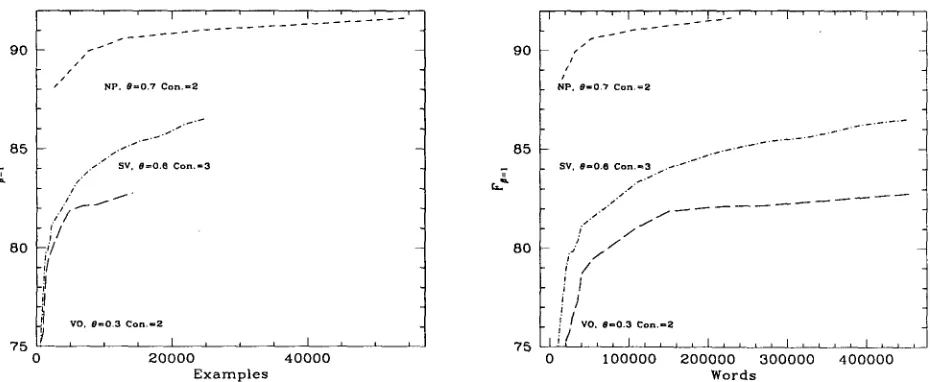
Figure 3: Learning curves for NP, VO, and SV by number of
SV, 8 ~ 0 . 6 C o n . ~ 3 . ~ ' ~
i . I
. i " ~ - - ~
/ / i / /
I /
I
~ ! vo. ,-o.~ ~ . . . . ,
/ /
i 0 0 0 0 0 2 0 0 0 0 0 3 0 0 0 0 0 4 0 0 0 0 0
W o r d s
examples (left) and words (right)
pattern structure. We aim to incorporate lexical in- formation as well in the future, it is still unclear whether that will improve the results.
Figure 3 shows the learning curves by amount of training examples and number of words in the train- ing data, for particular parameter settings.
4 R e l a t e d W o r k
Two previous methods for learning local syntactic patterns follow the transformation-based paradigm introduced by Brill (1992). Vilain and Day (1996) identify (and classify) name phrases such as com- pany names, locations, etc. Ramshaw and Marcus (1995) detect noun phrases, by classifying each word as being inside a phrase, outside or on the boundary between phrases.
Finite state machines (FSMs) are a natural for- malism for learning linear sequences. It was used for learning linguistic structures other than shallow syntax. Gold (1978) showed that learning regular languages from positive examples is undecidable in the limit. Recently, however, several learning meth- ods have been proposed for restricted classes of FSM. OSTIA (Onward Subsequential Transducer Infer- ence Algorithm; Oncina, Garcia, and Vidal 1993), learns a subsequential transducer in the limit. This algorithm was used for natural-language tasks by Vi-
lar, Marzal, and Vidal (1994) for learning translation of a limited-domain language, as well as by Gildea and Jurafsky (1994) for learning phonological rules. Ahonen et al. (1994) describe an algorithm for learn- ing (k,h)-contextual regular languages, which they use for learning the structure of SGML documents.
Apart from deterministic FSMs, there are a num- ber of algorithms for learning stochastic models, eg., (Stolcke and Omohundro, 1992; Carrasco and Oncina, 1994; Ron et al., 1995). These algorithms differ mainly by their state-merging strategies, used for generalizing from the training data.
A major difference between the abovementioned learning methods and our memory-based approach is that the former employ generalized models that were created at training time while the latter uses the training corpus as-is and generalizes only at recog- nition time.
[image:6.612.137.476.51.116.2] [image:6.612.75.540.169.360.2]on subsequences of training instances.
Other implementations of the memory-based paradigm for NLP tasks include Daelemans et al. (1996), for POS tagging; Cardie (1993), for syntactic and semantic tagging; and Stanfill and Waltz (1986), for word pronunciation. In all these works, examples are represented as sets of features and the deduction is carried out by finding the most similar cases. The method presented here is radically different in that it makes use of the
raw sequential
form of the data, and generalizes by reconstructing test examples from different pieces of the training data.5 C o n c l u s i o n s
We have presented a novel general schema and a par- ticular instantiation of it for learning sequential pat- terns. Applying the method to three syntactic pat- terns in English yielded positive results, suggesting its applicability for recognizing local linguistic pat- terns. In future work we plan to investigate a data- driven approach for optimal selection and weighting of statistical features of candidate scores, as well as to apply the method to syntactic patterns of Hebrew and to domain-specific patterns for information ex- traction.
6 a c k n o w l e d g e m e n t s
The authors wish to thank Yoram Singer for his collaboration in an earlier phase of this research project, and Giorgio Satta for helpful discussions. We also thank the anonymous reviewers for their in- structive comments. This research was supported in part by grant 498/95-1 from the Israel Science Foundation, and by grant 8560296 from the Israeli Ministry of Science.
R e f e r e n c e s
S. P. Abney. 1991. Parsing by chunks. In R. C. Berwick, S. P. Abney, and C. Tenny, editors,
Principle-Based Parsing: Computation and Psy-
cholinguistics,
pages 257-278. Kluwer, Dordrecht. H. Ahonen, H. Mannila, and E. Nikunen. 1994. Forming grammars for structured documents: An application of grammatical inference. In R. C. Carrasco and J. Oncina, editors,Grammatical In-
ference and Applications (ICGI-9~),
pages 153-167. Springer, Berlin, Heidelberg.
R. Bod. 1992. A computational model of language performance: Data oriented parsing. In
Coling,
pages 855-859, Nantes, France.
E. Brill. 1992. A simple rule-based part of speech tagger. In
proc. of the DARPA Workshop on
Speech and Natural Language.
C. Cardie. 1993. A case-based approach to knowl- edge acquisition for domain-specific sentence anal- ysis. In
Proceedings of the 11th National Con-
ference on Artificial Intelligence,
pages 798-803, Menlo Park, CA, USA, July. AAAI Press. R. C. Carrasco and J. Oncina. 1994. Learn-ing stochastic regular grammars by means of a state merging method. In R. C. Carrasco and J. Oncina, editors,
Grammatical Inference and
Applications (ICGI-94),
pages 139-152. Springer, Berlin, Heidelberg.W. Daelemans, J. Zavrel, Berck P., and Gillis S. 1996. Mbt: A memory-based part of speech tag- ger generator. In Eva Ejerhed and Ido Dagan, edi- tors,
Proceedings of the Fourth Workshop on Very
Large Corpora,
pages 14-27. ACL SIGDAT. T. Edward and M. McCreight. 1976. space-economical suffix tree construction algorithm.
Journal of the ACM,
23(2):262-272, April. D. Gildea and D. Jurafsky. 1994. Automatic induc-tion of finite state transducers for simple phono- logical rules. Technical Report TR-94-052, In- ternational Computer Science Institute, Berkeley, CA, October.
E. M. Gold. 1978. Complexity of automaton iden- tification from given data.
Information and Con-
trol,
37:302-320.Gregory Greffenstette. 1993. Evaluation techniques for automatic semantic extraction: Comparing syntactic and window based approaches. In
A CL
Workshop on Acquisition of Lexical Knowledge
From Text,
Ohio State University, June.L. A. Ramshaw and M. P. Marcus. 1995. Text chunking using transformation-based learning. In
Proceedings of the Third Workshop on Very Large
Corpora.
D. Ron, Y. Singer, and N. Tishby. 1995. On the learnability and usage of acyclic probabilistic fi- nite automata. In
Proceedings of the 8th Annual
Conference on Computational Learning Theory
(COLT'95),
pages 31-40, New York, NY, USA, July. ACM Press.G. Satta. 1997. String transformation learning. In
Proc. of the ACL/EACL Annual Meeting,
pages 444-451, Madrid, Spain, July.C. Stanfill and D. Waltz. 1986. Toward memory- based reasoning.
Communications of the ACM,
29(12):1213-1228, December.
A. Stolcke and S. Omohundro. 1992. Hidden markov model induction by bayesian model merg- ing. In
Proceedings of Neural Information Pro-
cessing Systems 5 (NIPS-5).
C. J. van Rijsbergen. 1979.
Information Retrieval.
Buttersworth.
M. B. Vilain and D. S. Day. 1996. Finite-state phrase parsing by rule sequences. In