Microstructural and Mechanical Characteristics of AZ61 Magnesium
Alloy Processed by High-Pressure Torsion
*1Yosuke Harai
1, Masaaki Kai
1, Kenji Kaneko
1, Zenji Horita
1;*2and Terence G. Langdon
2;3 1Department of Materials Science and Engineering, Faculty of Engineering, Kyushu University, Fukuoka 819-0395, Japan
2Departments of Aerospace & Mechanical Engineering and Materials Science,
University of Southern California, Los Angeles, CA 90089-1453, U.S.A.
3Materials Research Group, School of Engineering Sciences, University of Southampton, Southampton SO17 1BJ, U.K.
Experiments were conducted on an AZ61 magnesium alloy to evaluate the microstructural characteristics and the mechanical properties after processing by High-Pressure Torsion (HPT). The results show that processing by HPT produces excellent grain refinement with average grain sizes of0:22and0:11mmafter processing at 423 K and room temperature, respectively. Tensile testing after HPT revealed the potential for achieving superplastic elongations with a maximum recorded elongation of 620% when testing at a temperature of 473 K. Using microhardness measurements, it is demonstrated that the the microstructure gradually evolves with increasing torsional straining in HPT so that ultimately there is a reasonably homogeneous structure across the disk. [doi:10.2320/matertrans.ME200718]
(Received July 13, 2007; Accepted October 4, 2007; Published November 21, 2007)
Keywords: hardness, high-pressure torsion, magnesium alloy, superplasticity, ultrafine grains
1. Introduction
The grain size of a polycrystalline metal is an important parameter because it determines both the strength of the material at ambient temperatures and the ability to conduct superplastic forming operations at elevated temperatures. When the grain size lies within the low micrometer range, from1to10mm, the material exhibits high strength and there is a potential for achieving high superplastic ductilities when pulling in tension at high temperatures.
Very recently, considerable attention has focused on the fabrication of metallic alloys with grain sizes within the submicrometer range. For grain sizes lying below 1000 nm, these are termed ultrafine-grained materials1) and they are
most readily produced by processing through the application of severe plastic deformation (SPD).2)Several different SPD
processing techniques are now available but the most important are Equal-Channel Angular Pressing (ECAP),3)
High-Pressure Torsion4) and Accumulative Roll-Bonding (ARB).5)
Several investigations have shown that HPT is especially effective in producing materials with very small grain sizes.6) For example, detailed experiments on pure Ti and Ti-based alloys demonstrated that HPT was the most effective procedure for achieving grain refinement with reported average grain sizes after HPT of30nm.7)However, despite
the advantage of HPT, most experimental investigations to date have concentrated on the use of ECAP.
When materials are processed by ECAP, early experiments showed the feasibility of attaining exceptionally high super-plastic elongations provided the grain structure is reasonably stable at elevated temperatures.8)More recently, there have
been numerous reports of the advent of superplasticity in materials processed by ECAP and a comprehensive
tabu-lation is now available documenting all of the reports of superplastic flow in materials processed by ECAP.9)These
various reports are concentrated primarily on aluminum-based alloys but they include also a small number of reports documenting superplasticity in other materials such as Cu and Mg alloys.
The present investigation was initiated with three specific objectives.
First, although there was a very early report of the successful application of HPT to a magnesium alloy with the production of a grain size lying in the range of 110– 150 nm,10) very little subsequent work has focused on the
application of HPT to Mg-based alloys and instead much of the emphasis has centered on the application of HPT to Al, Cu and Ni alloys. Accordingly, the present investigation was designed to evaluate the microstructural and mechanical characteristics of a commercial AZ61 magnesium alloy after processing by HPT.
Second, magnesium alloys are generally difficult to process by SPD and this means that special procedures are required to effectively process these alloys using ECAP.11) For example, experiments on the AZ31 alloy using ECAP showed it was feasible to successfully press the alloy only at temperatures above 473 K when pressing without a back-pressure whereas the same alloy was successfully pressed at 373 K when a back-pressure was incorporated into the system.12)Since processing by HPT involves the imposition
of a high initial pressure, it is reasonable to anticipate the alloy may be effectively processed by HPT at lower temperatures including at room temperature. Thus, a second important objective was to evaluate the feasibility of successfully applying HPT to the AZ61 alloy over a range of temperatures.
Third, there are only limited reports to date of the occurrence of superplastic elongations after processing by HPT, with reports of elongations of500% and570% for an Al-3% Mg-0.2% Sc alloy13) and an Al-2024 alloy,14) respectively. An additional objective was therefore to *1This Paper was Originally Published in Japanese in J. Japan Inst. Metals
71(2007) 213–217.
*2Corresponding author, E-mail: [email protected]
Investigating Role of High-Density Lattice Defects
evaluate whether it is feasible to achieve superplastic ductilities in the AZ61 alloy after processing by HPT. In this connection, it should be noted there are reports of elongations up to 1190%15) and1320%16) in the AZ61
alloy after processing by ECAP.
2. Experimental Material and Procedures
The experiments were conducted using a commercial AZ61 alloy having a composition, in mass%, of 6.40% Al, 0.74% Zn, 0.35% Mn, 0.0012% Ni, 0.001% Cu, 0.001% Fe, 0.015% Si with the balance as Mg. Earlier experiments on pure magnesium and Mg alloys showed that it is often difficult to satisfactorily process these materials in ECAP when they are used in an as-cast form17) but excellent
processing may be achieved when the alloys are extruded prior to ECAP in a process designated EX-ECAP.18,19)In the
present investigation, the alloy was received as an extruded rod with a diameter of 15 mm and it was then machined to a diameter of 10 mm. Figure 1 shows the microstructure of the as-extruded AZ61 alloy and it is apparent that the grains are reasonably equiaxed, uniformly distributed and there was an average initial grain size of22mm.
Processing by HPT was achieved by cutting thin disks from the extruded rod with diameters of 10 mm and thicknesses of 0.8 mm. These disks were processed in the facility shown in Fig. 2 where the sample is placed between two anvils, subjected to a pressure, and then torsionally strained by rotation of the lower anvil. The HPT facility was described in detail earlier13)but it is important to note these
processing conditions correspond to constrained HPT where the sample is held in place in a cavity and therefore the straining occurs effectively in the presence of a back-pressure.20,21)The processing was conducted at room
temper-ature and at elevated tempertemper-atures of 373 and 423 K using a small heater placed around the anvils as shown on the right in Fig. 2. For all samples, the imposed pressure,P, was 3 GPa, the lower anvil was rotated at a speed of 1 rpm and the samples were subjected to totals,N, of 1, 3, 5 and 7 turns.
The equivalent von Mises strain in HPT is given by
2Nr=hp3, whereNis the total number of turns andrandh
locate positions in the disk in terms of the radius and height, respectively.22)It follows from this expression that the strain
varies across the disk and therefore it is important to take measurements of the local hardness across the disk diameters. In the present investigation, measurements of the Vickers microhardness, Hv, were recorded at intervals of 0.5 mm from the center to the edge of each disk using an applied load of 50 g and a dwell time of 15 s.
Following HPT, each disk was ground to a thickness of 0.6 mm and then tensile samples were cut from the disks with two samples located in each disk and, as in an earlier report,13)the samples were situated in off-center positions to
avoid possible inhomogeneities near the disk centers. Specifically, the central lines of the tensile specimens were located at a distance of 2 mm from a line passing through the center of the disk, as illustrated schematically in Fig. 3. These samples were pulled in tension using a testing machine operating at a constant rate of cross-head displacement and with initial strain rates in the range from 3:3104 to 3:3102s1. Tensile testing was conducted at 423 and 473 K after processing by HPT through 1, 3, 5 and 7 turns, respectively.
50
µ
m
Fig. 1 Optical micrograph of the as-extruded AZ61 alloy showing an initial grain size of22mm.
Rotation Load Upper Anvil
Lower Anvil
Load Sample
Heater
Fig. 2 Schematic illustration of the HPT facility showing the assembly on the left and torsional straining at an elevated temperature on the right.
3
1
1 2
R 0.2
Thickness: 0.6 (mm)
6
[image:2.595.49.291.72.258.2] [image:2.595.306.549.75.231.2] [image:2.595.318.537.279.463.2]Samples were examined after processing by HPT process and after tensile testing using both optical microscopy (OM) and transmission electron microcopy (TEM). For OM, the HPT samples were ground mechanically, polished electro-chemically using a solution of 10 ml of HCl, 10 ml of HNO3 and 160 ml of C2H5OH and etched chemically using a solution of 4.2 g of C6H3N3O7, 10 ml of CH3COOH, 10 ml of H2O and 160 ml of C2H5OH. For TEM, disks having diameters of 3 mm were cut from the HPT samples using an electro-discharge machine. The disk centers were situated at 2 mm from the centers of the HPT sample and the microstructures were therefore observed at locations corre-sponding to the gauge sections of the tensile specimens. These disks were ground mechanically to a thickness of 0.15 mm and polished electro-chemically using a twin-jet apparatus with a solution of 15 ml of HClO4, 15 ml of HOCH2CH(OH)CH2OH and 70 ml of C2H5OH. All values of the average grain sizes were measured from micrographs using the conventional linear intercept method.
3. Experimental Results
3.1 Microstructural characteristics after HPT
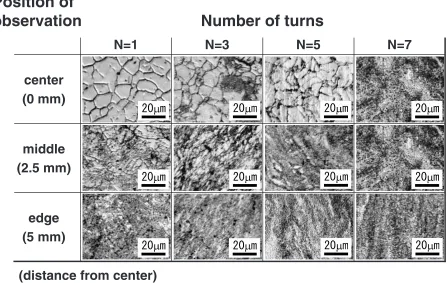
Processing by HPT is complex because the imposed strain varies both with the number of revolutions applied to the sample and with the position within the disk. The variations in microstructures attained in the AZ61 alloy after HPT at 423 K are documented by the optical micrographs in Fig. 4 which show typical microstructures at the centers, half-way positions and the edges of the disks after processing through 1, 3, 5 and 7 turns. The corresponding TEM micrographs for
the same samples are shown in Fig. 5 in bright-field (on the left) and dark-field (on the right) together with the associated selected area electron diffraction (SAED) patterns taken from regions having diameters of 2.3mm; as noted earlier, these TEM images were taken at approximately 2 mm from the centers of the HPT disks.
It is readily apparent from inspection of Fig. 4 that the microstructure develops more rapidly at the edge of the disk so that fewer turns are needed to achieve significant grain refinement. On the other hand, the optical micrographs taken in the center of the disk show an evolution towards an ultrafine-grained microstructure that is reasonably similar to the microstructure at the edge. There is also an evolution in the appearance by TEM such that the grains are better defined after larger numbers of turns. The dark-field images in Fig. 5 show clearly that the microstructures consist of ultrafine-grains. Furthermore, based on the rings visible in the SAED patterns, these grains are separated by boundaries having high angles of misorientation. It is also apparent that the average grain size was relatively large after a single turn but decreased with increasing numbers of turns.
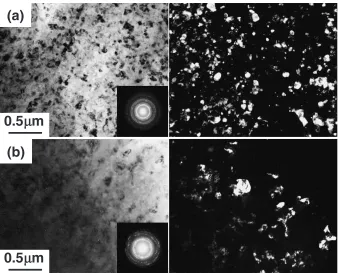
Measurements of the average grain sizes for these samples gave the results plotted in Fig. 6. Thus, the average grain size was reduced to 0.52mm after one turn and it was further reduced to 0.37 and 0.23mmafter 3 and 5 turns, respectively. Thereafter, the microstructure appeared reasonably stable and the measured grain size after 7 turns was 0.22mm. By comparison, as shown in Fig. 7 with bight-field images and dark-field images including SAED patterns, processing through 5 turns of HPT gave grain sizes of 0.11mmat room temperature and 0.25mmat 373 K thereby demonstrating that
edge
(5 mm)
middle
(2.5 mm)
center
(0 mm)
N=7
N=5
N=3
N=1
Number of turns
Position of
observation
(distance from center)
[image:3.595.78.525.81.364.2]smaller grain are achieved when processing at lower temper-atures. The dark-field image shown in Fig. 7(a) clearly demonstrates that the grain size is reduced significantly when pressing at room temperature. It is significant also to note that the AZ61 alloy was successfully processed in this inves-tigation through up to 5 turns at room temperature although subsequent tensile testing, described in the following section, suggested that some internal cracking may have been introduced at this relatively low processing temperature.
Figure 8 shows the variation across the radius of the disk of the Vickers microhardness, Hv, for the as-received condition in the absence of HPT and after 1, 3, 5 and 7 turns at 423 K. As anticipated from earlier investigations, the hardness increases across the disk in the first turn but with a significantly lower hardness measured in the central re-gion.4,23) Nevertheless, the hardness values become more uniform with additional turns and after 7 turns the values of
0.5
µ
m
0.5
µ
m
0.5
µ
m
0.5
µ
m
(a)
(b)
(c)
(d)
Fig. 5 Equivalent TEM micrographs in bright-field (left) and dark-field (right), plus the associated SAED patterns, after HPT at 423 K through 1, 3, 5 and 7 turns: these images were taken at2mm from the centers of the disks.
[image:4.595.148.449.70.526.2] [image:4.595.54.284.613.769.2]Hv are essentially constant except only in the precise center of the disk. This gradual evolution towards homogeneity is consistent with an earlier report of hardness measurements taken on samples of pure Al processed by HPT.24)
3.2 Mechanical properties after HPT
It was recognized in early investigations of ECAP that superplastic ductilities can be achieved after processing only when the ultrafine grains are separated by boundaries having high angles of misorientation and the grains are reasonably stable at elevated temperatures.25) To check on the grain stability, samples were prepared by HPT through 5 turns at a processing temperature of 423 K and they were annealed for 1 hour at temperatures from 300 to 523 K. The measured grain sizes are shown in Fig. 9 and it is apparent that there
is excellent grain stability up to a temperature of 473 K but at 523 K there is significant grain growth to an average value of 1:2mm. These results suggest that superplastic ductilities may be attained at a tensile testing temperature of 473 K.
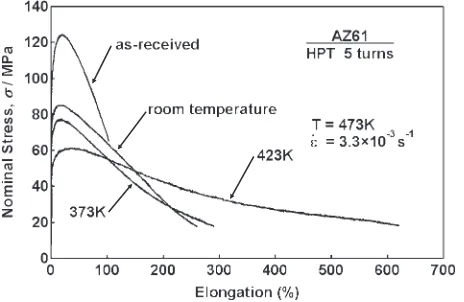
To check the viability of this conclusion, Fig. 10 shows plots of nominal stress against elongation for samples processed at 423 K through 5 turns and then pulled to failure at different temperatures using an initial strain rate of
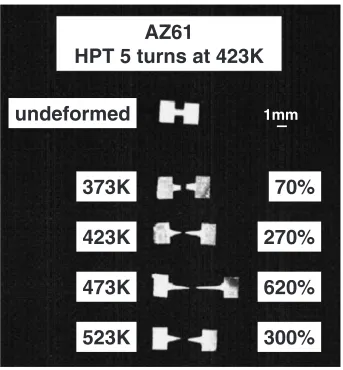
3:3103s1. As anticipated, good ductility was achieved at 473 K but there was a reduction in the ductility at 523 K and lower ductilities were attained when the samples were tested at lower temperatures. The appearance of these specimens is shown in Fig. 11 where the upper specimen is untested and the highest measured elongation of 620% was
0.5
µ
m
0.5
µ
m
(a)
(b)
Fig. 7 Micrographs in TEM in bight-field (left) and dark-field (right), and the associated SAED patterns, after processing through 5 turns at (a) room temperature and (b) 373 K.
Fig. 8 Values of the Vickers microhardness across the radii of disks in the as-received condition and after processing through 1, 3, 5 and 7 turns at 423 K.
[image:5.595.129.467.71.344.2] [image:5.595.56.287.397.551.2] [image:5.595.311.542.397.549.2]attained at 473 K. This elongation is within the superplastic range which is generally considered as elongations at and above 500%.9)
It appears that the elongation of 620% recorded in Fig. 11 is probably close to the optimum value because, as documented in Fig. 12, lower elongations are observed when pulling similar samples at either faster or slower strain rates. This is consistent with the characteristic of superplastic flow
[image:6.595.56.284.72.225.2]in conventional alloys where superplasticity occurs over a limited range of strain rates and there is a loss in ductility at both faster and slower rates.26,27)It was possible to estimate the strain rate sensitivity of the AZ61 alloy using the flow stresses at a nominal strain of0:1and this gave a value of 0:3. In practice, this is consistent with an earlier study where a similar strain rate sensitivity of 0:3was reported for the same alloy after processing by ECAP.16)
Fig. 10 Nominal stress versus elongation for tensile specimens processed by HPT through 5 turns at 423 K and then pulled to failure at different temperatures using an initial strain rate of3:3103s1.
AZ61
HPT 5 turns at 423K
undeformed
373K
423K
473K
523K
70%
270%
620%
300%
[image:6.595.311.543.73.225.2]1mm
[image:6.595.127.470.275.645.2]Fig. 11 Appearance of tensile specimens after processing through 5 turns at 423 K and then pulling to failure at temperatures from 373 to 523 K: the upper specimen is untested.
It appears from these results that a processing temperature of 423 K for HPT is probably close to the optimum condition for achieving superplastic flow in this alloy because, as shown in Fig. 13, lower elongations were achieved at 473 K when specimens were processed by HPT at either room temperature or 373 K: also included in Fig. 13 is a stress-strain curve for the as-received condition in the absence of HPT where the elongation to failure was100%. Despite the fact that the average grain size tends to be smaller after processing at room temperature as shown in Fig. 7, it is apparent that the elongation recorded in Fig. 13 for this condition is rather low. This apparent dichotomy is probably due to the presence of some limited internal cracking which may be introduced when conducting HPT processing at lower operating temperatures. Finally, testing at an initial strain rate of3:3103s1at 473 K gave elongations of 190% and 260% for samples processed by HPT at 423 K through 1 and 3 turns thereby demonstrating that high strains are required in order to achieve optimum superplastic flow. A similar result was reported earlier for samples of an Al-Mg-Sc alloy processed by ECAP through different numbers of passes.28)
4. Discussion
There are several important results from this investigation. First, excellent ultrafine-grained microstructures were achieved in the magnesium AZ61 alloy after processing by HPT. The measured equilibrium grain sizes were0:22mm
after HPT at 423 K and 0:11mm after HPT at room temperature. These grain sizes are significantly smaller than the reports of average grain sizes of 1:35 and0:62mm
after processing of the AZ61 alloy by ECAP at temperatures of 523 and 473 K, respectively.16)Thus, it is reasonable to
conclude that HPT is a preferable procedure for producing extremely small grains.
Second, the results show that the imposition of an applied pressure during torsional straining permits the effective use of HPT at relatively low temperatures because the deforma-tion process is then comparable to processing by ECAP in the presence of a back-pressure. Thus, HPT was successfully conducted at room temperature in the present investigation
although this relatively low temperature gave rise to the introduction of some limited internal cracking.
Third, excellent superplastic ductilities were achieved in the AZ61 alloy after processing by HPT and the maximum recorded elongation of 620% is higher than the maximum elongations achieved in earlier studies using samples of aluminum alloys after processing by HPT.13,14)The ability to
attain high elongations in the present work, despite using a magnesium-based alloy where tensile ductility is generally limited, is attributed to the exceptionally fine grain sizes produced by HPT.
Fourth, and most important, the results confirm earlier studies of a gradual microstructural evolution during tor-sional straining in HPT such that there is the development of an essentially homogeneous microstructure with increasing numbers of turns.4,24,29)This microstructural evolution was successfully interpreted recently using two complementary variants of a strain gradient plasticity model in which it was shown that a relatively uniform microstructure will develop across an HPT disk during continuous torsional straining. Furthermore, this homogeneity is predicted within the model despite the inherently non-uniform nature of the straining process.30)It follows therefore that the experimental results,
together with the associated theoretical interpretation, are important because they provide a clear demonstration of the feasibility of using the HPT processing technique to achieve reasonable levels of homogeneity and accordingly to produce materials that may be effectively used in commercial applications.
5. Summary and Conclusions
(1) An AZ61 magnesium alloy was successfully processed by High-Pressure Torsion over a range of temperatures from room temperature to 423 K. Excellent grain refinement was achieved with average equilibrium grain sizes of0:22and 0:11mm after HPT at 423 K and room temperature, respectively.
(2) Good ductilities were achieved in tensile testing after HPT with a maximum superplastic elongation of 620% in a specimen processed through 5 turns at 423 K and then tested in tension at 473 K using an initial strain rate of 3:3
103s1.
(3) Microhardness measurements demonstrate that, al-though there was initially a lower hardness in the central region of the disks processed by HPT, there was a gradual evolution towards a reasonably homogeneous structure with increasing numbers of turns and hence with increasing torsional strain.
Acknowledgments
[image:7.595.54.286.73.224.2]This work was supported in part by the Light Metals Educational Foundation of Japan, in part by a Grant-in-Aid for Scientific Research from the Ministry of Education, Culture, Sports, Science and Technology, Japan, on Priority Areas ‘‘Giant Straining Process for Advanced Materials Containing Ultra-High Density Lattice Defects’’ and in part by the National Science Foundation of the United States under Grant No. DMR-0243331.
REFERENCES
1) R. Z. Valiev, Y. Estrin, Z. Horita, T. G. Langdon, M. J. Zehetbauer and Y. T. Zhu: JOM58(4) (2006) 33.
2) R. Z. Valiev, R. K. Islamgaliev and I. V. Alexander: Prog. Mater. Sci.
45(2000) 103–189.
3) R. Z. Valiev and T. G. Langdon: Prog. Mater. Sci.51(2006) 881–981. 4) A. P. Zhilyaev, G. V. Nurislamova, B.-K. Kim, M. D. Baro´, J. A.
Szpunar and T. G. Langdon: Acta Mater.51(2003) 753–765. 5) Y. Saito, N. Tsuji, H. Utsunomiya, T. Sakai and R. G. Hong: Scripta
Mater.39(1998) 1221–1227.
6) Z. Horita and T. G. Langdon: Mater. Sci. Eng., A410–411(2005) 422– 425.
7) J. Dutkiewicz, J. Kas´nierz, W. Maziarz, M. Lejkowska, H. Garbacz, M. Lewandowska, A. V. Dobromyslov and K. J. Karzydlowski: Phys. Status Solidi A202(2005) 2309–2320.
8) R. Z. Valiev, D. A. Salimonenko, N. K. Tsenev, P. B. Berbon and T. G. Langdon: Scripta Mater.37(1997) 1945–1950.
9) M. Kawasaki and T. G. Langdon: J. Mater. Sci.42(2007) 1782–1796. 10) R. Z. Abdulov, R. Z. Valiev and N. A. Krasilnikov: J. Mater. Sci. Lett.9
(1990) 1445–1447.
11) R. B. Figueiredo, P. R. Cetlin and T. G. Langdon: Acta Mater. (2007) (in press).
12) K. Xia, J. T. Wang, X. Wu, G. Chen and M. Gurvan: Mater. Sci. Eng., A410–411(2005) 324–327.
13) G. Sakai, Z. Horita and T. G. Langdon: Mater. Sci. Eng., A393(2005) 344–351.
14) S. V. Dobatkin, E. N. Bastarache, G. Sakai, T. Fujita, Z. Horita and T. G. Langdon: Mater. Sci. Eng., A408(2005) 141–146.
15) Y. Yoshida, K. Arai, S. Itoh, S. Kamado and Y. Kojima: Mater. Trans.
45(2004) 2537–2541.
16) Y. Miyahara, Z. Horita and T. G. Langdon: Mater. Sci. Eng., A420
(2006) 240–244.
17) A. Yamashita, Z. Horita and T. G. Langdon: Mater. Sci. Eng., A300
(2001) 142–147.
18) Z. Horita, K. Matsubara, K. Makii and T. G. Langdon: Scripta Mater.
47(2002) 255–260.
19) K. Matsubara, Y. Miyahara, Z. Horita and T. G. Langdon: Acta Mater.
51(2003) 3073–3084.
20) A. P. Zhilyaev, K. Oh-ishi, T. G. Langdon and T. R. McNelley: Mater. Sci. Eng., A410–411(2005) 277–280.
21) A. P. Zhilyaev, T. R. McNelley and T. G. Langdon: J. Mater. Sci.42
(2007) 1517–1528.
22) F. Wetscher, A. Vorhauer, R. Stock and R. Pippan: Mater. Sci. Eng., A
387–389(2004) 809–816.
23) A. P. Zhilyaev, S. Lee, G. V. Nurislamova, R. Z. Valiev and T. G. Langdon: Scripta Mater.44(2001) 2753–2758.
24) C. Xu, Z. Horita and T. G. Langdon: Acta Mater.55(2007) 203–212. 25) P. B. Berbon, M. Furukawa, Z. Horita, M. Nemoto, N. K. Tsenev, R. Z.
Valiev and T. G. Langdon: Phil. Mag. Lett.78(1998) 313–318. 26) T. G. Langdon: Metall. Trans. A13A(1982) 689–701.
27) C. Xu, Z. Horita, M. Furukawa and T. G. Langdon: J. Mater. Eng. Perform.13(2004) 683–690.
28) S. Komura, M. Furukawa, Z. Horita, M. Nemoto and T. G. Langdon: Mater. Sci. Eng., A297(2001) 111–118.
29) Yu. Ivanisenko, R. Z. Valiev and H.-J. Fecht: Mater. Sci. Eng., A390
(2005) 159–165.