R E S O L U T I O N O F C O L L E C T I V E - D I S T R I B U T I V E A M B I G U I T Y U S I N G M O D E L - B A S E D R E A S O N I N G
C h i n a t s u Aone* M C C
3500 W e s t B a l c o n e s C e n t e r Dr. A u s t i n , T X 78759
a o n e @ m c c . c o m
A b s t r a c t
I present a semantic analysis of collective- distributive ambiguity, and resolution of such am- biguity by model-based reasoning. This approach goes beyond Scha and Stallard [17], whose reasoning capability was limited to checking semantic types. My semantic analysis is based on Link [14, 13] and Roberts [15], where distributivity comes uniformly from a quantificational operator, either explicit (e.g.
each) or implicit (e.g. the D operator). I view
the semantics module of the natural language sys- tem as a hypothesis generator and the reasoner in the pragmatics module as a hypothesis filter (cf. Simmons and Davis [18]). The reasoner utilizes a model consisting of domain-dependent constraints and domain-independent axioms for disambiguation. There are two kinds of constraints, type constraints and numerical constraints, and they are associated with predicates in the knowledge base. Whenever additional information is derived from the model, the Contradiction Checker is invoked to detect any contradiction in a hypothesis using simple mathe- matical knowledge. CDCL (Collective-Distributive Constraint Language) is used to represent hypothe- ses, constraints, and axioms in a way isomorphic to diagram representations of collective-distributive ambiguity.
1
S e m a n t i c s
o f
C o l l e c t i v e -
D i s t r i b u t i v e A m b i g u i t y
Collective-distributive ambiguity can be illustrated by the following sentence.(1) Two students moved a desk upstairs.
(1) means either that two students T O G E T H E R moved one desk (a collective reading) or that each
* T h e w o r k d e s c r i b e d in t h i s p a p e r w a s d o n e as a p a r t o f
of them moved a desk S E P A R A T E L Y ( a distributive reading). Following Link [14, 13] and Roberts [15], distributivity comes from either an explicit quantifi- cational operator like each or an implicit distributive operator called the D o p e r a t o r . The D operator was motivated by the equivalence in the semantics of the following sentences.
(2) a. Every student in this class lifted the piano. b. Students in this class each lifted the piano. c. Students in this class lifted the piano.
(the distributive reading)
Thus, the distributive readings of (1) and (2c) result from applying the D operator to the subjects.
Now, look at another sentence "Five students ate four slices of pizza." It has 8 POSSIBLE readings be- cause the D operator may apply to each of the two
arguments of eat, and the two NPs can take scope
over each other. Thus, 2 x 2 x 2 = 8. i j have extended Link's and Roberts's theories to quantify over events in Discourse Representation Theory (cf. Kamp [10], Heirn [9], Aone [2]) so that these readings can be sys- tematically generated and represented in the seman- tics module. However, the most PLAUSIBLE reading is the "distributive-distributive reading", where each of the five students ate four slices one at a time, as represented in a discourse representation structure (DRS) in Figure 1 ~. Such plausibility comes partly from the lexical semantics of eat. From our "common sense", we know that "eating" is an individual activ- ity unlike "moving a desk", which can be done either individually or in a group. However, such plausi- bility should not be a part of the semantic theory, but should be dealt with in pragmatics where world knowledge is available. In section 2, I'll identify the 1 A c t u a l l y t h e t w o collective-collective r e a d i n g s a r e e q u i v - a l e n t , so t h e r e a r e 7 d i s t i n c t r e a d i n g s .
(student x) (amount x 5) (measure x CU)
xl j
(i-part x' x)
Y (pizza y) (amount y 4) (measure y slice)
y' e
D
(i-part y' y]' ,(eat e x' y')
Figure h DRS for "Five students ate four slices of pizza"
necessary knowledge and develop a reasoner, which goes beyond Scha and Stallard [17].
There is a special reading called a c u m u l a t i v e reading (cf. Scha [16]).
(3) 500 students ate 1200 slices of pizza.
The cumulative reading of (3) says "there were 500 students and each student ate some slices of pizza, totaling 1200 slices." The semantics of a cumulative reading is UNDERSPECIFIED and is represented as a collective-collective reading at the semantic level (cf. Link [13], Roberts [15], Aone [2]). This means that a cumulative reading should have a more specific rep- resentation at the pragmatics level for inferencing. Reasoning about cumulative readings is particularly interesting, and I will discuss it in detail.
2
M o d e l - B a s e d
R e a s o n i n g
f o r
D i s a m b i g u a t i o n
Although scope ambiguity has been worked on by many researchers (e.g. Grosz et al. [8]), the main problem addressed has been how to generate all the scope choices and order them according to some heuristics. This approach might be sufficient as far as scope ambiguity goes. However, collective- distributive ambiguity subsumes scope ambiguity and a heuristics strategy would not be a strong method. I argue that the reason why some of the readings are implausible (and even do not occur to some people) is because we have access to d o m a i n - d e p e n d e n t knowledge (e.g. constraints on predi- cates) along with d o m a l n - i n d e p e n d e n t knowledge (e.g. mathematical knowledge). I have developed a reasoner based on the theory of model-based reason- ing (cf. Simmons and Davis [18], Fink and Lusth [6], Davis and Hamscher [5]) for collective-distributive ambiguity resolution. The model that the reasoner
uses consists of four kinds of knowledge, namely predicate constraints, two types of axioms, and sim- ple mathematical knowledge. First, I will discuss the representation language CDCL 3. Then, I will discuss how these four kinds of knowledge are utilized during reasoning.
2.1
C D C L
CDCL is used to represent collective-distributive readings, constraints and axioms for reasoning. There are three types of CDCL clauses as in (4), and I will explain them as I proceed 4.
(4) Core clause: (1 ((5) a0
4 al))
Number-of clause: (number-of al ?q:num) Number comparison clause: ( < = ?q:num 1) 2.1.1 E x p r e s s i n g C o l l e c t i v e a n d D i s t r i b u t i v e
R e a d i n g s in C D C L
CDCL is used to express collective and distributive readings. Below, a's are example sentences, b's are the most plausible readings of the sentences, and c's are representations of b's in CDCL.
(5) a. "5 students ate 4 slices of pizza."
b. Each of the 5 students ate 4 slices of pizza one at a time.
c. (eat a0 al): (5 (1 a0 -* 4 al))
3CDCL s t a n d s for "Collective-Distributive C o n s t r a i n t Language".
4 T h o u g h n o t described in t h i s p a p e r , CDCL h a s b e e n ex- t e n d e d to deal w i t h sentences w i t h explicit quantifiers as in
"Every s t u d e n t a t e 4 slices of pizza" a n d sentences w i t h n-ary predicates as in "2 c o m p a n i e s d o n a t e d 3 P C ' s to 5 schools". For example:
(i) (eat a0 a l ) : (every (1 a0 -* 4 a l ) )
(ii) (donate a0 a l a2): (2 (1 a0 --* (5 (1 a2 ---* (3) a l ) ) ) )
See Aone [2] for details of CDCL expressed in a context-free
g r a m m a r .
[image:2.612.174.448.56.194.2](6) a. "5 dogs had (a litter of) 4 puppies."
b. Each of the 5 m o t h e r dogs delivered a litter of 4 puppies.
c. (deliver-offspring a0 al): (5 (1 a0 --~ (4) a l ) )
(7) a. "5 alarms were installed in 6 buildings." b. Each of the 6 buildings was installed with 5
alarms one at a time.
c. (installed-in a0 a l ) : (6 (1 a l --* 5 a0))
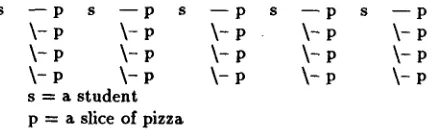
First, consider (5c). T h e representation should capture three pieces of information: scope relations, distributive-collective distinctions, and numerical re- lations between objects denoted by NP arguments. In CDCL, a0 and a l signify the arguments of a pred- icate, e.g. (eat a0 a l ) . T h e scope relation is repre- sented by the relative position of those arguments. T h a t is, the argument on the left hand side of an ar- row takes wide scope over the one on the right hand side (cf. (5) vs. (7)). T h e numerical relation such as "there is an eating relation from EACH student to 4 slices of pizza" is represented by the numbers before each argument. T h e number outside the parenthe- ses indicates how m a n y instances of such a numerical relation there are. Thus, (5c) says there are five in- stances of one-to-four relation from students to slices of pizza. CDCL is designed to be isomorphic to a di- agram representation as in Figure 2.
- - p s - - p s - - p s - - p s - - p
\ - p \ - p \ - p . \ - p \ - p \ - p \ - p \ - p \ - p \ - p
\ - p \ - p \ - p \ - p \ - p s = a student
p = a s~ce of pizza
Figure 2 : " 5 students ate 4 slices of pizza."
As for the collective-distributive information in CDCL, it was implicitly assumed in (5c) t h a t both arguments were read DISTRIBUTIVELY. T o mark t h a t an argument is read COLLECTIVELY, a n u m b e r be- fore an argument i s written in parentheses where the number indicates cardinality, as in (6c).
T h e r e are two additional symbols, anynum and
anyset for representing cumulative readings. T h e cumulative reading of (3) is represented in CDCL as follows.
(s)
(500 (1 a0 --* anynum0 a l ) ) ~c (1200 (1 a l --~ a n y n u m l a0))In (8), the situation is one in which each student (a0)
m a y differ from student to student. Thus,
anynumO
represents any positive integer which can vary with the value of a0.
2.1.2 C o n s t r a i n t s i n C D C L
CDCL is also used to express constraints. Each pred- icate, defined in the knowledge base, has its associ- ated constraints t h a t reflect our " c o m m o n sense". Thus, constraints are d o m a i n - d e p e n d e n t . T h e r e are two kinds of constraints: t y p e c o n s t r a i n t s (i.e. constraints on whether the arguments should be read collectively or distributively) and n u m e r i c a l c o n - s t r a i n t s (i.e. constraints on numerical relations be- tween arguments of predicates.) T h e r e are 6 t y p e
constraints (C1 - C6) and 6 numerical constraints ( C 7 - C12) as in Figure 3.
C1. (?p:num (1 ?a:arg ---* ?q:num ?b:arg)) :::~z inconsistent
"Both arguments are distributive." C2. (1 (?p:set ?a:arg ~ ?q:set ?b:arg))
:=~ inconsistent
"Both arguments are collective."
C3. (?p:num (1 a0 ---. ?r:set al)) :=~ inconsistent
C4. (1 (?q:set al ~ ?r:num a0)) :=~ inconsistent
"lst argument distributive and 2nd collective."
C5. (1 (?p:set a0 ---* ?q:num al)) :=~ inconsistent C6. (?p:num (1 al ~ ?q:set a0)) :=~ inconsistent
"lst argument collective and 2nd distributive." C7. (?p:num (1 ?a:arg ---* ?q:num ?b:arg))
=~ (<--- ?q:num ?r:num)
C8. (?p:num (1 ?a:arg --* ?q:num ?b:arg)) =~ ( < - - ?r:num ?q:num)
C9. (?p:num (1 a0 --, 1 al)) :=~ inconsistent "A relation from a0 to al is a function."
C10. (?p:num (1 al ---, 1 a0)) :=~ inconsistent "A relation from al to a0 is a function."
C l l . (1 (?p:set a0 --* 1 al)) :=~ inconsistent "Like C9, the domain is a set of sets."
C12. (1 (?p:set al --* 1 a0)) :=~ inconsistent "Like C10, the domain is a set of sets."
Figure 3: Constraints
[image:3.612.318.540.277.569.2] [image:3.612.81.297.423.488.2]types, which can be specified after the colon of each variable:
(9) ?a:arg ?b:num ?c:set ?d:n-s
argument type (e.g. a0, al, etc.) positive integer type
non-empty set type
either num type or set type
If an argument type variable is preceded by a set type variable, the argument should be read collec- tively while if an argument type variable is preceded by a number type variable, it should be read dis- tributively.
To explain type constraints, look at sentence (6). The predicate (deliver-offspring a0 al) requires its first argument to be distributive and its second to be collective, since delivering offspring is an individ- ual activity but offspring come in a group. So, the predicate is associated with constraints C3 and C4. As for constraints on numerical relations between arguments of a predicate, there are four useful con- straints (C9 - C12), i.e. constraints that a given re- lation must be a FUNCTION. For example, the pred- icate
deliver-o~spring
in (6) has a constraint of a biological nature: offspring have one and only one mother. Therefore, the relation from al (i.e. off- spring) to a0 (i.e. mothers) is a function whose do- main is a set of sets. Thus, the predicate is associ- ated with C12. Another example is (7). This time, the predicate (installed-in a0 al) has a constraint of a physical nature: one and the same object cannot be installed in greater than one place at the same time. Thus, the relation from a0 (i.e. alarms) to al (i.e. buildings) is a many-to-one function. The pred- icate is therefore associated with C9.In addition, more specific numerical constraints are defined for specific domains. For example, the constraint "each client machine (al) has at most one diskserver (a0)" is expressed as in (10), given (disk-used-by a0 al). It is an instance of a general constraint C7.
(10) (?p:num (1 al --* ?q:num a0)) ( ~ = ?q:num 1)
2.1.3 A x i o m s in C D C L
While constraints are associated only with particular predicates, axioms hold regardless of predicates (i.e. are d o m a l n - i n d e p e n d e n t ) . There are two kinds of axioms as in Figure 4. The first two are con- s t r a i n t a x i o m s , i.e. axioms about predicate con- straints. Constraint axioms derive more constraints if a predicate is associated with certain constraints.
CA1.
CA2.
RA1.
RA2.
RA3.
(?m:num (1 ?a:arg --~ 1 ?b:arg)) (number-of ?a:arg ?re:hum) & (number-of ?b:arg ?n:num) & (<= ?n:num ?m:num)
(?l:num (?s:set ?a:arg --~ 1 ?b:arg)) (number-of ?a:arg ?re:hum) & (number-of ?b:arg ?n:num) & (<= ?n:num ?re:hum)
(?m:num (1 ?a:arg -~ ?y:n-s ?b:arg)) (number-of ?a:arg ?m:num)
(?re:hum (1 ?a:arg --* ?y:num ?b:arg)) & (<= ?y:num ?z:num)
(number-of ?b:arg ?n:num) & (<= ?n:num (* ?m:num ?z:num)) (?m:num (1 ?a:arg --* ?y:num ?b:arg)) & (<= ?z:num ?y:num)
(number-of ?b:arg ?n:num) & (<= ?z:num ?n:num)
Figure 4: Axioms
(11) C9. CA1.
The others are r e a d i n g a x i o m s . They are ax- ioms about certain assertions representing particu- lar readings. Reading axioms derive more assertions from existing assertions.
The constraint axiom CA1 derives an additional numerical constraint. It says that if a relation is a function, the number of the objects in the range is less than or equal to the number of the objects in the domain. This axiom applies when constraints C9 or C10 is present. For example:
(?p:num (1 a0 ~ 1 al))
(?m:num (1 ?a:ar s --* 1 ?b:arg)) (number-of ?a:arg ?re:hum) & (number-of ?b:arg ?n:num) & (<= ?n:num ?re:hum) (number-of a0 ?m:num) & (number-of al ?n:num) & (<= ?n:num ?m:num)
The constraint axiom CA2 is similar to CA1 except that the domain is a set of sets.
The reading axiom RA1 asserts the number of all objects in the domain of a relation. For example: (12) A1. (5 (1 a0 --* 6 al))
RA1. (?m:num (1 - - ?y:n-s ?b:arg))
(number-of ?a:arg ?m:num) (number-of a0 5)
[image:4.612.318.520.56.339.2]Given an assertion A1, RA1 asserts that the number of objects in the domain is 5.
The reading axiom RA2 is for a relation where each object in the domain is related to less than or equal to n objects in the range. In such a case, the number of the objects in the range is less than or equal to the number of objects in the domain multiplied by n. For example:
(13) A2.
RA2.
(5 (1 a0 ~ ?x:num al)) & (<--- ?x:num 2)
(?m:num (1 ?a:arg --+ ?y:num ?b:arg)) & ( < = ?y:num ?z:num)
(number-of ?b:arg ?n:num) & ( < = ?n:num (, ?m:num ?z:num)) (number-of al ?n:num) & (<---- ?n:num (. 5 2))
The last axiom RA3 is similar to RA2.
These axioms are necessary to reason about con- sistency of cumulative readings when numerical con- straints are associated with the predicates. For ex- ample, given "5 alarms were installed in 6 buildings", intuitively we eliminate its cumulative reading be- cause the number of buildings is more than the num- ber of alarms. I claim t h a t behind this intuition is a calculation and comparison of the number of build- ings and the number of alarms given what we know about "being installed in". The constraint axioms above are intended to simulate how humans make such comparisons between two groups of objects re- lated by a predicate that has a numerical constraint. The reading axioms, on the other hand, are intended to simulate how we do such calculations of the num- ber of objects from what we know about the reading
(cf.
2.2.2).2 . 2 M o d e l - B a s e d R e a s o n e r
In this section, I describe how the reasoner per- forms disambiguation. But first I will describe spe- cial "unification" which is the basic operation of the reasoner 5 .
2.2.1 U n i f i c a t i o n
"Unification" is used to unify CDCL clauses during the reasoning process. However, it is not standard unification. It consists of three sequential matching operations: Syntax Match, ARG Match, and Value Match. First, Syntax Match tests if the syntax of
5 T h e r e a s o n e r h a s b e e n i m p l e m e n t e d in C o m m o n Lisp.
two expressions matches. The s y n t a x of two expres- sions matches when they belong to the same type of CDCL clauses (cf. (4)). If Syntax Match succeeds, ARG Match tests if the argument constants (i.e. a0, a l ) in the two expressions match. If this operation is successful, Value Match is performed. There are two ways Value Match fails. First, it fails when types do not match. For example, (14a) fails to unify with (14b) because ?r:set does not match the integer 4.
(14) a. (?p:num (?q:num a0 --* ?r:set a l ) ) b. (5 (1 a0 ---* 4 a l ) )
The second way Value Match fails is two values of the same type are simply not the same.
(15) a. (1 (?p:set a l --* 1 a0)) b. (1 ((4) a l --* 5 a0))
Unification fails only when the first and second operations succeed and the third one fails, and uni- fication succeeds only when all the three operations succeed. Otherwise, unification neither succeeds nor fails.
2.2.2 I n f e r e n c e s U s i n g A M o d e l
Each reading (i.e. a hypothesis) generated by the se- mantics module is stored in what I call a reading r e c o r d (RR). Initially, it just stores assertions t h a t represent the reading. As reasoning proceeds, more information is added to it. When the R R is updated and inconsistency arises, the R R is marked as incon- sistent and the hypothesis is filtered out.
The reasoner uses a model consisting of four kinds of knowledge. Inferences t h a t use these four (namely Predicate-Constraint inference, Constraint- Axiom inference, Reading-Axiom inference, and the Contradiction Checker) are controlled as in Figure
5.
First, Predicate-Constraint inference tests if each hypothesis satisfies predicate constraints. This is done by unifying each CDCL clause in the hypoth- esis with predicate constraints. For example, take a type constraint C1 and a hypothesis HI.
(16) H1. (eat a0 al): (5 (1 a0 --* (4) al))
c l . (?v:num (I ?a:arg - , ?q:num ?b:arg))
:=# i n c o n s i s t e n t i n c o n s i s t e n t
Figure 5: Control Structure
Second, Constraint-Axiom inference derives addi- tional CONSTRAINTS by unifying antecedents of con- straint axioms with predicate constraints. If the uni- fication is successful, the consequent is stored in each
R R
(cf.
(11)). (19)Third, Reading-Axiom inference derives more AS- SERTIONS by unifying reading axioms with assertions in each R R (cf. (12) and (13)).
While these three inferences are performed, the fourth kind, the Contradiction Checker, constantly monitors consistency of each RR. Each R R contains a c o n s i s t e n c y d a t a b a s e . Every time new infor- mation is derived through any other inference, the Contradiction Checker updates this database. If, at any point, the Contradiction Checker finds the new information inconsistent by itself or with other infor- mation in the database, the R R that contains this (20) database is filtered out.
For example, take the cumulative reading of (7a), which is implausible because there should be at least 6 alarms even when each building has only one alarm. The reading is represented in CDCL as fol- lows.
(17) (5 (1 a0 --* anynum0 al)) & (6 (1 al --* anynuml a0))
The Contradiction Checker has simple mathematical knowledge and works as follows. Initially, the con- (21) sistency database records that the upper and lower bounds on the number of objects denoted by each argument are plus infinity and zero respectively. (18) Number-of-a0 [0 +inf]
Number-of-al [0 +inf] Constraint NIL Consistent? T
Then, when the constraint axiom CA1 applies to the predicate constraint C9 associated with installed-in
(cf. (11)), a new numerical constraint "the number of buildings (al) should be less than or equal to the number of alarms (a0)" is added to the database.
Number-of-a0 [0 +inf] Number-of-al [0 +inf] Constraint ( < = al a0) Consistent? T
Now, the reading axiom RA1 applies to the first clause of (17) and adds an assertion (number-of a0 5) to the database (cf. (12)). The database is up- dated so that both upper and lower bounds on a0 are 5. Also, because of the constraint ( < = al a0), the upper bound on al is updated to 5.
Number-of-a0 [5 5] Number-of-al [0 5] Constraint ( < = al a0) Consistent? T
Finally, RA1 applies to the second clause of (17) and derives (number-of al 6). However, the Contradic- tion Checker detects that this assertion is inconsis- tent with the information in the database, i.e. the number of al must be at most 5. Thus, the cumula- tive reading is filtered out.
Number-of-a0 [5 5] Number-of-al [0 5] Constraint ( < = al a0) Consistent? NIL
[6 6]
2.2.3 E x a m p l e
[image:6.612.174.439.64.204.2](22)
R1 (5 (1 a0 -~ 6 al)) R2 (1 ((5) a0---. 6 al)) R3 (5 (1 a0 ---* (6) al)) R4 (6 (1 al ~ 5 a0)) R5 (1 ((6) al ~ 5 a0)) R6 (6 (1 al --* (5) a0))R7 (5 (1 a0 ~ anynumO al)) & (6 (1 al ---+ anynuml a0))
The predicate (be-installed a0 al) is associated with two constraints C1 and C9. Predicate-Constraint inference, using the type constraint C1 (i.e. both ar- guments should be read distributively), filters out
R2, R3, R5, and R6. The numerical constraint, C9, requires that the relation from alarms to buildings be a function. This eliminates R1, which says that each alarm was installed in 6 buildings. The cumu- lative reading R7 is filtered out by the other three inferences, as described in section 2.2.2. Thus, only R4 is consistent, which is what we want.
3 C o n c l u s i o n
A c k n o w l e d g m e n t s
I would like to thank Prof. Manfred Krifka and Prof. Benjamin Kuipers for their useful comments. The prototype of the reasoner was originally built using Algernon (cf. Crawford [3], Crawford and Kuipers [4]). Many thanks go to Dr. James Crawford, who gave me much useful help and advice.
R e f e r e n c e s
[1]
[2]
Harold Abelson and Gerald Sussman. Structure
and Interpretation of Computer Programs. The
MIT Press, Cambridge, Massachusetts, 1985.
[3]
Chinatsu Aone. Treatment of Plurals and Collective-Distributive Ambiguity in Natural
Language Understanding. PhD thesis, The Uni-
versity of Texas at Austin, 1991.
The work described in this paper improves upon previous works on collective-distributive ambiguity [4] (cf. Scha and Stallard [17], Gardiner et al. [7]), since they do not fully explore the necessary reason- ing. I believe that the reasoning method described in this paper is general enough to solve collective- distributive problems because 1) any special con- straints can be added as new predicates are added to the KB, and 2) intuitively simple reasoning to [5] solve numerical problems is done by using domain- independent axioms.
However, the current reasoning capability should be extended further to include different kinds of knowledge. For example, while the cumulative read- [6] ings of "5 alarms were installed in 6 building" is implausible and is successfully filtered out by the reasoner, that of "5 students ate 4 slices of pizza" is less implausible because a slice of pizza can be [7] shared by 2 students. The difference between the two cases is that an alarm is not divisible but a slice of pizza is. Thus knowledge about divisibility of ob- jects must be exploited. Further, if an object is divis- ible, knowledge about its "normal size" with respect to the predicate must be available with some prob- [8] ability. For example, the cumulative reading of "5
students ate 4 large pizzas" is very plausible because a large pizza is UNLIKELY to be a normal size for an individual to eat. On the other hand, the cumula- tive reading of "5 students ate 4 slices of pizza" is [9] less plausible because a slice of pizza is more LIKELY to be a normal size for an individual consumption.
James Crawford. Access-Limited Logic - A Lan-
guage for Knowledge Representation. PhD the-
sis, The University of Texas at Austin, 1990. James Crawford and Benjamin Kuipers. To- wards a theory of access-limited logic for knowl- edge representation. In Proceedings of the
First International Conference on Principles of
Knowledge Representation and Reasoning, Los
Altos, California, 1989. Morgan Kaufmann. Randall Davis and Walter Hamscher. Model- based reasoning: troubleshooting. In H. E. Shrobe, editor, Exploring Artificial Intelligence.
Morgan Kaufmann, Los Altos, California, 1988. Pamela Fink and John Lusth. A general expert system design for diagnostic problem solving.
IEEE Transactions on Systems, Man, and Cy-
bernetics, 17(3), 1987.
David Gardiner, Bosco Tjan, and James Single. Extended conceptual structures notation. Tech- nical Report T R 89-88, Department of Com- puter Science, University of Minnesota, Min- neapolis, Minnesota, 1989.
Barbara Grosz, Douglas Appelt, Paul Martin, and Fernando Pereira. Team: An experiment in the design of transportable natural-language interfaces. Artificial Intelligence, 32, 1987. Irene Heim. The Semantics of Definite and In-
definite Noun Phrases. PhD thesis, University
[10] Hans Kamp. A theory of truth and semantic representation. In Groenendijk et al., editor, Truth, Interpretation, and Information. Foris, 1981.
[11] Manfred Krifka. Nominal reference and tempo- ral constitution: Towards a semantics of quan- tity. In Proceedings of the Sixth Amsterdam Col- loquium, pages 153-173, University of Amster- dam, Institute for Language, Logic and Infor- mation, 1987.
[12] Godehard Link. The logical analysis of plurals and mass terms: Lattice-theoretical approach. In Rainer Banerle, Christoph Schwarze, and Arnim von Steehow, editors, Meaning, Use, and Interpretations of Language. de Gruyter, 1983. [13] Godehard Link. Plural. In Dieter Wunderlich
and Arnim yon Steehow, editors, To appear in: Handbook of Semantics. 1984.
[14] Godehard Link. Generalized quantifiers and plurals. In P. Gaerdenfors, editor, General- ized Qnantifiers: Linguistics and Logical Ap- proaches. Reidel, 1987.
[15] Craige Roberts. Modal Subordina- tion, Anaphora, and Distribntivitg. PhD thesis, University of Massachusetts at Amherst, 1987. [16] Remko Scha. Distributive, collective, and
cumulative quantification. In Janssen and Stokhof, editors, Truth, Interpretation and In- formation. Foris, 1984.
[17] Remko Scha and David Stallard. Multi-level plural and distributivity. In Proceedings of 26th Annual Meeting of the ACL, 1988.
[18] Reid Simmons and Randall Davis. Generate, test and debug: Combining associational rules and causal models. In Proceedings of the Tenth International Joint Conference on Artificial In- telligence, Los Altos, California, 1987.