Munich Personal RePEc Archive
The Influence of School Ability Measures
on Accounting Competencies: A Path
Analysis
Cimafranca, Jan Linster and Capuyan, Beverly and Cabilla,
Fabien and Cansancio, Angelique and Villaflor-Balacy,
Garnette Mae
University of Mindanao Digos College
December 2015
THE INFLUENCE OF SCHOOL ABILITY MEASURES ON ACCOUNTING COMPETENCIES: A PATH ANALYSIS
Jan Linster B. Cimafranca*, Beverly A. Capuyan*, Fabien B. Cabilla*, Angelique L. Cansancio* and Garnette Mae V. Balacy**
* BS Accounting Technology students
** Research Coordinator / Corresponding Author1
University of Mindanao (UM) Digos e-mail: [email protected]
________________________________________________________
ABSTRACT
This study aimed to assess the level of school ability measures and accounting competencies of fourth year BS in Accounting Technology students of UM Digos College. It also investigates which of the two school ability measures such as verbal and non-verbal significantly influence to accounting competencies. Quantitative correlational research was used, and primary data were gathered through the use of Accounting Competency Test questionnaire distributed to 32 fourth year BSAT students for the school year 2015-2016 who had took the Otis-Lennon School Ability Test at UMDC Guidance and Testing Center. Frequency and relative frequency, mean, statistical correlation, and multivariate regression analysis were used as statistical method to address the problem in the study. The findings revealed that the fourth year respondents are overall low in terms of school ability with a below average of verbal ability while average in terms of non-verbal ability. They were also found to be competent enough in accounting. Results also showed that among the school ability measures, only verbal ability has significant influence on accounting competencies. Furthermore, the two dimensions such as verbal comprehension and reasoning were significant predictors. On the other hand, the non-verbal ability, in terms of figural reasoning and quantitative reasoning, is a non-significant predictor of accounting competencies.
Keywords: school ability, verbal ability, non-verbal ability, Accounting competency, path analysis
__________________________________________________________
INTRODUCTION
To pursue accounting, there are needs for proficiencies especially in the areas of English and Mathematics. Based on the previous study of Buba and Umar (2015), the students, who had took and passed English and Mathematics, have good academic performance in Financial Accounting and it was found out that there is significant distinction for being proficient of both aforementioned subjects over to those deficient. This is because English language has something to do in understanding, and interpretation of the
financial information. Meanwhile, the Mathematics proficiency will execute
those understanding into problem solving. Furthermore, according to
Ballada and Ballada (2012), intellectual is one of the core competencies of accountants in which this carry out problems that need critical thinking. In this core competency, both English and Mathematics proficiencies are still highly involved like in the analysis of transaction, in the evaluation of which applicable principles to be used in problem solving, and how the problem will be solved based on understanding.
In the United States of America, after the Sarbanes-Oxley Act of 2002 signed into law and enacted, accounting degree holders are in higher need in the job industry. The Act was signed by President George W. Bush with co-sponsors Paul Sarbanes, and Michael G. Oxley, in the legislative body. This
Act is also called as “Public Company Accounting Reform and Investor Protection Act,” and “Corporate and Auditing Accountability and Responsibility Act,” in the senate, and in the house, respectively. The enactment of which was the response with the issue including those corporations in U.S such as the Enron and Worldcom. The case was about the issuance of fraudulent audited financial statements. The SOX attempts to
protect investors since President Franklin Delano Roosevelt’s Securities Act
following the great depression. Because of those, academes need to produce a numerous competent accountants to aid the increase on the demand of accounting professionals. According to American Institute of Certified Public Accountants (2011) as mentioned in the study of Lee, et al. (2014) that the public practice of accounting and auditing services or the CPA firms had raised their new hires in the year 2000 to 2010. It fluctuated from 20,951 to 33,321.
In the Philippines, with regards to professional arrangements, there were substantial flaws in the CPA licensure standards and quality assurance. The accounting education standards and training procedures may also need to be developed (Athukorala & Reid, 2003). Moreover, the committee on Accounting Terminology of the American Institute of Certified Public Accountants defines accounting as an art of recording, classifying, and summarizing in a significant manner and in terms of money, transactions and events which are in part at least of a financial character and interpreting the result thereof.
Scholastic studies have tried to determine the intellectual ability
accounting competencies among the fourth year BSAT students in UM Digos College. Specifically, this study sought to answer the following questions: (1)
the level of school ability measures among the 4th year BSAT students in
UMDC in terms of verbal ability (verbal comprehension and verbal reasoning) and non-verbal ability (figural reasoning and quantitative
reasoning); (2) the level of Accounting Competencies among the 4th year
BSAT students in UMDC; (3) if the two school abilities significantly influence accounting competencies.
THEORY BASED
There were studies examined about the correlation with language proficiency in accounting education and performance of accounting students. According to Ayers and Peters (1977) affirmed that academic success can be positively influenced by the English language proficiency. Meanwhile, it was seconded by Saville-Troike (1984) who stated that language is one of the most important factors in academic performance.
However, according to Tella (2007), who stated in contradiction with the above arguments that there is only one subject that pervades all learning areas, and it is Mathematics. This provokes critical thinking among students and predicts the achievement of students academically. He further supported that mathematics is important in sciences, technology, arts, and business. According to Zandi and Shahabi (2012), it is clear that mathematical skills are influential over the accounting discipline outperformance. He also added that the higher the mathematical knowledge, the better the accounting performance.
Most accounting educators readily acknowledge that mathematical ability has a significant impact on student performance in accounting courses (Yunker, Yunker & Krull, 2009). According to them, the discipline of accounting is concerned with accurate numerical measurement of precisely defined operational concepts. It follows that practitioners of accounting should be comfortable with mathematics in general and numbers in particular. Most accounting educators believe that arithmetic skills are important for students to understand accounting systems and financial statement analysis. Zandi, Shahabi and Bagheri (2012) also indicated the needs of accounting students for possessing calculation skills and an acceptable level of knowledge in Algebra. Both, Collier and McGowan (1989) and Yunker et al. (2009) noted that the mathematics talents of accounting graduates could contribute to a better development of the modern accounting that under laid both practice and academic capability. It seems obvious that academic and professional success in accounting will be facilitated by a high level of mathematical skill.
O’Neill and Theuri (2007) literature contains with studies indicating the need to develop students’ language skills. Their study investigates
whether a student’s English language proficiency can be associated with their
application, and analysis in an introducing accounting course. Foster et al. (2002) also added that future Accountants must be able to organize and express information with conciseness and clarity, determine what information is appropriate in context, and select the best medium for information
exchange since Accounting was known as the “Language of Business”.
METHOD
Research Design
The study was conducted as a non-experimental quantitative research in which the data were collected to describe variables, to examine relationships among variable and to determine cause and effect interactions between variables (Burns & Grove, 2005) following the quantitative correlational research which aims to systematically investigate and explain the nature of the relationship between variables in the real world (Porter and Carter, 2000). Applying these research designs, the study described, examined, and determined the relationship of the accounting competencies of the participants and their verbal and non-verbal abilities as variables of interest.
Research Participants
The participants of the study were the fourth year BS Accounting Technology students of UM Digos College who already took up the OLSAT exam just this first semester of the school year 2015-2016, and took up Basic Accounting subject up to Managerial Advisory Services One, in accordance with the prospectus of UMDC.
However, the selection of participants does not limit on the reason above. The fourth year students were the respondents because of their credits and experiences from basic to higher accounting subjects. By that, those students are enduring the hardship of the subject supported with their school abilities in verbal and non-verbal for almost four years. Moreover, they can relate the words used in the Accounting Competency Test. In that case then they can reliably measure their competencies in accounting.
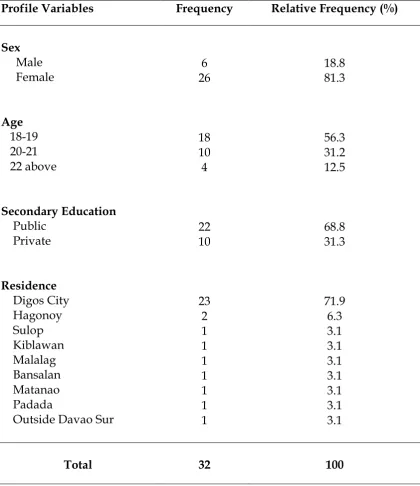
Table 1. Demographic Profile of BSAT Students in UM Digos College
Profile Variables Frequency Relative Frequency (%)
Sex Male Female 6 26 18.8 81.3 Age 18-19 20-21 22 above 18 10 4 56.3 31.2 12.5 Secondary Education Public Private 22 10 68.8 31.3 Residence Digos City Hagonoy Sulop Kiblawan Malalag Bansalan Matanao Padada
Outside Davao Sur
23 2 1 1 1 1 1 1 1 71.9 6.3 3.1 3.1 3.1 3.1 3.1 3.1 3.1
Total 32 100
Research Instrument
figural reasoning and quantitative reasoning. Below is the basis for giving interpretation of test result:
Subtest/Content Cluster Number of Items
Below Average
Average Above Average
Verbal 36 0 - 22 23 - 31 32 - 36
Verbal Comprehension 12 0 - 7 8 - 10 11 - 12
Verbal Reasoning 24 0 - 14 15 - 20 21 - 24
Non-verbal 36 0 - 22 23 - 32 33 - 36
Figural Reasoning 18 0 - 10 11 - 15 16 - 18
Quantitative Reasoning 18 0 -12 13 - 16 17 - 18
Total 72 0 - 45 46 - 63 64 - 72
Moreover, the Accounting Competencies Test is made up through the reliable sources such as Practical Accounting, and other reviewers. This test was validated by the three Certified Public Accountants. Moreover, this composed of questions with constructed five components of accounting competencies such as the following together with its basis in giving interpretation of the test result:
Subtest/Content
Cluster Items
Below
Average Average
Above Average
Basic Concept 15 0 – 6 7 – 10 11 – 15
Analysis 10 0 – 3 4 – 7 8 – 10
Problem Solving 10 0 – 3 4 – 7 8- 10
Decision Making 5 0 – 1.5 1.6 – 3.4 3.5-5
Communication 15 0 - 6 7 – 10 11 – 15
Total 55 0 – 17 18 - 37 38 – 55
Data Gathering Procedure
2. Request for the copy of OLSAT Result. This letter was being addressed to the guidance counselor of UMDC to ask for an access or copy of the OLSAT result of fourth year BSAT students at the UMDC Guidance and Testing Center. After the guidance counselor approved the request and psychometrician, as assigned person of the test, gave the copy of OLSAT result, the researchers were being taught about the interpretation of the result as it is expressed in quantitative and qualitative data
3. Construction of Accounting Competency Test Instrument. After the accumulation of data about thereof, the researchers made a draft of questionnaire with the help of different sources of textbooks for CPA
reviewers like Practical Accounting, and also questions used by CPA’s for the
examination of students in UMDC. The draft was being consulted to the three validators of this study, who are Certified Public Accountants, and one of
them has master’s degree and a program head of Accounting Education
Department of UMDC.
4. Asking through a Letter of Permission to conduct the Accounting Competency Test. After the instrument was being validated, the researchers made a letter addressed to the accounting professor of UMDC who handles the Advanced Accounting 2 subjects, which class were the fourth year BSAT students who are qualified as respondents. After the approval, the test was conducted one hour per class schedule and that was one hour for the morning session, and the same in the afternoon session.
After the data gathering, the researchers checked, encoded, and passed the accounting competency test result to the research statistician, including the OLSAT Result of the test takers.
Thereafter, with the help of the statistical data retrieved, it was being analyzed for the determination of which of the two components of school ability measures significantly influence to accounting competencies. After all, the result was the basis for the conclusion and recommendations of this research.
Statistical Treatment
FINDINGS
School Ability Measures of Fourth Year BSAT Students of UMDC
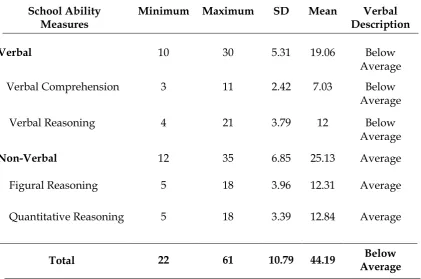
[image:9.595.105.527.262.541.2]Table 2 presents the data of the fourth year BS in Accounting Technology students of UM Digos College on their level of School Ability Measures. The level was measured in terms of its components such as verbal and non-verbal. Verbal ability comprised of verbal comprehension and verbal reasoning while non-verbal ability includes figural reasoning and quantitative reasoning.
Table 2. Descriptive Statistics of School Ability Measures
School Ability Measures
Minimum Maximum SD Mean Verbal Description
Verbal 10 30 5.31 19.06 Below
Average Verbal Comprehension 3 11 2.42 7.03 Below
Average
Verbal Reasoning 4 21 3.79 12 Below Average
Non-Verbal 12 35 6.85 25.13 Average
Figural Reasoning 5 18 3.96 12.31 Average
Quantitative Reasoning 5 18 3.39 12.84 Average
Total 22 61 10.79 44.19 Below Average
It can be gleaned in the results that in terms of verbal ability, the
overall mean is 19.06 with a standard deviation of 5.31, described as “below average”. This means that they are low in language intelligence. The dimensions under this component have mean scores that have verbal
description of “below average”. In addition, the dimension with the highest mean is “Verbal Reasoning” with a mean score of 12 and a standard deviation
of 3.79, while the item with the lowest mean is “Verbal Comprehension” with
a mean score of 7.03 and a standard deviation of 2.42. This means that in terms of verbal ability, they are more constructive thinker rather than vocabulary oriented.
In terms of non-verbal ability, the overall mean is 25.13 with a standard
deviation of 6.85, described as “average”. This means that their level of ability
under this component have mean scores that have verbal description of
“average”. In addition, the dimension with the highest mean is “Quantitative Reasoning” with a mean score of 12.84 and a standard deviation of 3.39, while the dimension with the lowest mean is “Figural Reasoning” with a mean
score of 12.31 and a standard deviation of 3.96. This means that in terms of non-verbal ability, they are more comfortable in dealing with numbers rather than working with figures.
Accounting Competency of Fourth Year BSAT Students of UMDC
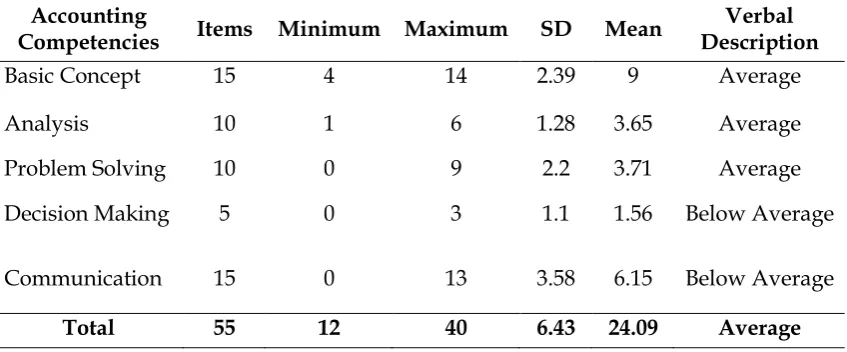
[image:10.595.106.530.380.556.2]Table 3 presents the data of the fourth year BS in Accounting Technology students of UM Digos College on their level of Accounting Competencies. The level was measured in terms of its components such as basic concept, analysis, problem solving, decision making, and communication. It is revealed in the table that the total items of Accounting Competencies was fifty five (55), with the minimum score of twelve (12) and a maximum of forty (40), a total result of Standard Deviation 6.43, and a total mean score of 24.09 described as Average.
Table 3. Descriptive Statistics of Accounting Competencies
Accounting
Competencies Items Minimum Maximum SD Mean
Verbal Description
Basic Concept 15 4 14 2.39 9 Average
Analysis 10 1 6 1.28 3.65 Average
Problem Solving 10 0 9 2.2 3.71 Average
Decision Making 5 0 3 1.1 1.56 Below Average
Communication 15 0 13 3.58 6.15 Below Average
Total 55 12 40 6.43 24.09 Average
minimum score is zero (0) and the maximum is thirteen (13) with the result of standard deviation 3.58, and the mean score is 6.15 described as below average.
The researchers found out that in the accounting competencies level;
basic concept described as average which explains that the 4th year BSAT
students were found to have a good foundation in basic terms and concepts in accounting while analysis, and problem solving which are labeled also as
average, implies that the 4th year BSAT students were found to have been on
their normal range of being a critical thinker in terms of computation, and analysis of transactions that lead to judgment and application of accounting principles. Moreover, with regards to decision making and communication which described as below average, this means that the respondents are at low level in terms of effective decision making, and communication or explanation of results based on their analysis and judgment.
Relationship of School Ability Measures and Accounting Competencies
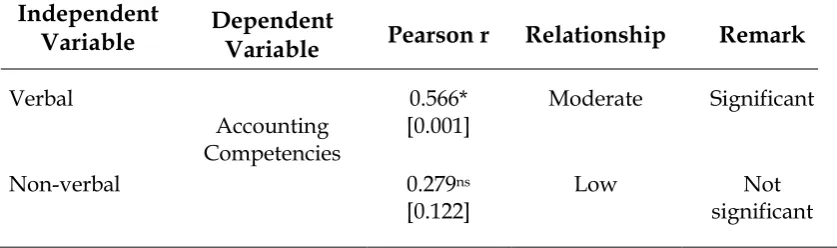
Between the two components of school ability measures, verbal ability, being an independent variable is indicated to have a significant relationship
to accounting competencies since it has a p-value of 0.001. The strength of its
relationship is moderately low as it has r-value of 0.566. On the other hand,
the table above reveals that non-verbal has no significant relationship to
accounting competencies since the p-value is 0.122. The strength of its
[image:11.595.109.528.476.600.2]relationship is low as it has r value of 0.279.
Table 4. Relationship of School Ability Measures and Accounting Competencies
Independent
Variable Dependent Variable Pearson r Relationship Remark
Verbal
Accounting Competencies
0.566* [0.001]
Moderate Significant
Non-verbal 0.279ns
[0.122]
Low Not significant
Enclosed figures in brackets are p-values.
More so, regression analysis was conducted on the different variables of the study in an attempt to trace the path of correlations to identify the significant predictors of students accounting competencies. The first analysis is on the verbal component of the school ability test. It was found that both its dimensions verbal comprehension and verbal reasoning are significantly correlated to it. It can also be noted that both verbal comprehension and verbal reasoning are significantly correlated to each other.
emphasized by Richard and Rogers (1986), verbal ability is an intelligence of
persons’ performance in language which includes comprehension and
reasoning. Furthermore, the two dimensions are sequentially interrelated from each other. Comprehension is a key element in verbal reasoning because it involves constructing of meaning using the information given, and how the
readers’ are going to reason prior to his knowledge. Although, verbal reasoning and comprehension are not at the same thing, but having a skill in critical reading is one of the most useful aspects of verbal reasoning (Burton et al. 2009).
Wagner and Stanovich (1996) also emphasized that reading and comprehension is especially likely to be a substantial contributor to the cognitive growth of verbal reasoning. Comprehension characterizes as an active process that involves building a mental representation of the text,
“constructing meaning”, calling up relevant knowledge from memory, evaluating differences between text and the reader’s existing knowledge and
beliefs, making inferences needed to fill gaps in understanding or clarify
meaning, integrating pertinent new information into the reader’s knowledge
base, and thinking about what are the important and unimportant points in the text and how the information can be used to enhance verbal reasoning of oneself (Chapman, 1993; Sweet, 1993).
In general, reasoning is always required when the reader is first learning to read or is confronting new content. As the reader becomes more proficient, and as his or her knowledge of the content grows, reading comprehension becomes more automatic, requiring less reasoning at a conscious level.
To further determine the amount of contribution of verbal comprehension and verbal reasoning to verbal, multivariate regression was done using the enter method. It was found that both verbal comprehension and verbal reasoning are significant predictors of verbal. The prediction equation could now be put as
Y = -0.033 + 1.003 x1 + 1.004 x2
where x1 = students’ verbal comprehension
x2 = students’ verbal reasoning
Second, the non-verbal component of the school ability test was examined. Both its components, quantitative reasoning and figural reasoning
are significantly correlated to it. Surprisingly, the students’ quantitative
reasoning and figural reasoning are also correlated.
Moving further about its components, according to the Otis-Lennon School Ability Test (OLSAT), the quantitative reasoning is the ability to infer and understand relationships with numbers, deduce and use computational rules in context. On the other hand, figural reasoning is the ability to infer relationships between different geometric shapes and figures, understand patterns and progressions, compare and contrast different figures or sets of figures and manipulate and work with figures in a spatial context. Hence, these two dimensions of non-verbal are sequentially interrelated. Although, they have overlap in meaning, they are considered slightly different and not fully interchangeable. What they all do have in common is that they address to your ability to understand and analyze visual information and both apply logical thinking and mathematical knowledge to the solution of pictorially presented problems. The understanding is built first with quantitative problems and followed by abstract understanding.
To identify the degree of influence of the two components of nonverbal ability, multivariate regression analysis was also performed. It was found that both figural reasoning and quantitative reasoning are significant predictors of non-verbal ability. The prediction model is now written as
Y = 0.034 + 1.01x1 + 0.985x2
where x1 = students score in figural reasoning
x2 =students score in quantitative reasoning
Third, similar analysis was performed on the endogenous variable of this study, which is the Accounting Competency, as measured by the Accounting Competency Test. There were five constructs considered, namely knowledge of basic concepts, analysis, problem solving, decision making and communication. It was found that all these five dimensions significantly correlated with the overall accounting competency.
These are consistent with the previous researches cited in the review of related literature that these five are predictors of being an accounting competent. Those aforementioned dimensions are the strong needs in the work place such as decision making, problem solving, and communication (Foster & Bolt-Lee, 2015), whereas the last two mentioned named as soft-skill competency according to the research study of Riggio et al. (2003). This further implies that the higher the skills of those dimensions, the more competencies an accountant possessed.
Edmonds et al. (2011) also mentioned about analysis. According to him, this will improve through acquiring a formal accounting education. The said ability, focused on financial information, and application of principles, which means that the analytical thinking serves as the assessor of those to perform accounting practice. Thus, it is a component of the overall accounting competencies. Moreover, Basic Concepts Knowledge also correlates to it since this involves the study of theories and principles towards application. Ballada and Ballada (2012) also considered this as one of the core competencies.
For the relationship of the two dimensions of the school ability test, namely verbal and nonverbal and the accounting competency test, it was found that only verbal ability had a positive direct correlation with the accounting competency test scores. On the other hand, the nonverbal ability was found to have insignificant association with accounting competencies.
Although it is true that accounting subsumes working with numbers, which talking about numerical matter is a non-verbal, it must be noted that accounting encompasses outside the limits or range of numbers and involves gathering and preparing reliable information (Siddiqui, 2014). The said information must be comprehended first before an application that deals with numbers. Also in the accountancy field, guiding principles are the bases of solving problems or numerical manipulation like the valuation of assets, liabilities and equity, and even recording of foreign currency transactions. According to Certified Public Accountants that it is almost enough if the students know the concepts and principles because it follows that students can manipulate the numbers or financial information in accounting problems based on the read theories and principles. In which knowing and application of those involves verbal comprehension and reasoning. Those are the supported reasons why verbal significantly predicts more the accounting competency while nonverbal is not but a secondary one.
Moreover, Donges (2001) stressed that even mathematics, which is a non-verbal, requires some verbal reasoning because it is generally taught through oral and written instruction. Thus, the comprehension and verbal reasoning comes first before the non-verbal, in learning phase. Meanwhile, in connection to that towards accounting, even if the student is good in mathematics, if he or she cannot understands the standards or guiding principles of accounting like the Philippine Accounting Standards or PAS and the Philippine Financial Reporting Standards or PFRS, and consequentially does not know how to apply it, then that student will not be competent in that case because of arriving a wrong solution and answer of the accounting problem. For instance, in the case of foreign currency financial statements translation, there are different exchange rates known, such as spot rate, closing rate, presentation currency, weighted average rate, and rate at declaration date, if the students cannot understand the transaction and PAS 21, which governs that certain problem, students shall end up of guessing, multiplying with wrong numbers, and as a result, students cannot explain their work. Moreover, this kind of problem also requires verbal reasoning skills for application purposes, in order to assess the understanding on which appropriate rate shall be used in the certain account title in accordance with the standards, and to explain the work.
transaction, accounting terms that has no translation into another language, and standards or guiding principles.
On the other hand, this result does not discourage about Non-Verbal Ability. Although it does not directly and significantly correlates to the accounting competencies, however, it can help through indirect connection to accounting competencies through passing with the verbal ability since those two school ability measures are found to be significantly correlated with each other as illustrated in the path model hereafter. The non-verbal ability is somehow useful since accounting still includes numbers.
However, as overall assessment, in the regression analysis, only the
students’ verbal abilities can significantly predict their accounting
competencies. The regression model is now
Y= 12.32 + 0.645 x1
where x1 is the verbal ability
Figure 1 shows the path analysis of the school ability test and
accounting competency. This exploration stresses that students’ accounting
competencies are really determined by students’ verbal abilities, which in
turn is determined by two dimensions, verbal comprehension and verbal reasoning. This is called direct effects. This further means that improving verbal comprehension and verbal reasoning will create an improvement in the verbal ability and consequentially, the accounting competency. This analysis also emphasizes the indirect effects of nonverbal ability to accounting competency. This means that the nonverbal abilities like quantitative reasoning and figural reasoning are secondary predictors of accounting competency. Remarkably, verbal and nonverbal abilities are also directly correlated.
Figure 1. Path Model Showing the Intercorrelation and Causal Relationships of the Verbal and Non-Verbal Scholastic Abilities on Accounting Competency
To sum it up, the path model shows that verbal ability significantly influences the accounting competencies, and not the non-verbal on where a sort of mathematical knowledge belong. This is the answer of the very aim of this research study mentioned in the statement of the problem. This result can be in contradiction to the other researches who enlightened that mathematical skills were determined to be the fundamental scholastic knowledge required for successful accounting students, and are influential over the accounting discipline outperformance (Lee et al., 2014; Zandi, Shahabi & Bagheri, 2012).
CONCLUSION
In terms of verbal ability, Accounting students are more constructive thinker rather than vocabulary oriented, and in terms of non-verbal ability, they are more comfortable in dealing with numbers rather than working with figures. In terms of accounting competencies, the students were found to have a good foundation in basic terms and concepts in accounting. Furthermore, in terms of analysis, and problem solving, the fourth year BSAT students were found to have been on their normal range of being a critical thinker in terms of computation, and analysis of transactions that lead to judgment and application of accounting principles. Moreover, with regards to decision making and communication, the respondents are at low level in terms of effective decision making, and communication or explanation of results based on their analysis and judgment.
The relationship of verbal ability and accounting competencies is significant and positive. On the other hand, no significant relationship was established by the analysis in the case of non-verbal ability and accounting competencies. These mean that among the school ability measures, only verbal ability has significant influence on accounting competencies.
Furthermore, the two dimensions such as verbal comprehension and reasoning were significant predictors. On the other hand, the non-verbal ability, in terms of figural reasoning and quantitative reasoning, is a
non-significant predictor of accounting competencies. This implies that between the
two school ability measures, the verbal ability significantly predicts and has a direct influential effect towards accounting competencies, while the non-verbal ability is a non-significant predictor and has indirect effects to accounting competencies.
REFERENCES
American Institute of Certified Public Accountants. (2011). 2011 Trends in the
Supply of Accounting Graduates and the Demand for Public Accounting Recruits. American Institute of CPAs. Retrieved from
http://www.aicpa.org/interestareas/accountingeducation/newsandp ublications/downloadabledocuments/2011trendsreport.pdf
Athukorala, S. L., & Reid, B. (2003). Accrual budgeting and accounting in
government and its relevance for developing member countries. Manila: Asian Development Bank.
Ayers, J. B., & Peters, R. M. (1977). Productive validity of the test of English as foreign language for Asian graduate students in engineering,
chemistry, or mathematics. Educational and Psychological Measurement,
37(2), 461-463. Retrieved from
http://dx.doi.org/10.1177/001316447703700221
Ballada, W. & Ballada, S. (2012). Basic Accounting. Manila, Philippines:
DomDane Publishers
Buba, M., & Umar, R. (2015). Effect of Mathematics and English Language Proficiency on Academic Performance of Business Education Students
in Financial Accounting. ATBU Journal of Science, Technology And
Education, 3(1), 58-67. Retrieved from
http://www.atbuftejoste.com/index.php/joste/article/view/97
Burns, N., & Grove, S.K (2005). The Practice of Nursing Research: Conduct,
Critique, and Utilization (5th Ed.). St. Louis, Elsevier Saunders
Chapman, A. (Ed.). (1993). Making sense: Teaching critical reading across the
curriculum. New York: The College Board.
Collier, H., & McGowan, C. (1989). An empirical examination of the relationship
between mathematic skills and course grade in intermediate accounting.
Donges, C. (n.d.). What Is Verbal Reasoning & How Does It Affect Learning?
Synonym.com © 2001-2015, Demand Media. Retrieved from
http://classroom.synonym.com/verbal-reasoning-affectlearning6737.html
Edmonds, T. P., McNair, F. M., Olds, P. R., & Milam, E. E. (2011).Fundamental
financial accounting concepts. New York, NY: McGraw-Hill Irwin.
Foster, S., & Bolt-Lee, C. (2002). New Competencies for Accounting Students.
The CPA Journal, 72(1), 68-71. Retrieved from
Lee, B. B., Debnath, S., Khan, M., & Sutanto, P. (2014). Identification of
lower-level course to predict accounting Student’s success in upper-level
courses: A structural Equation model. Journal of higher education Theory
and practice, 14(2), 69-77. Retrieved from
http://search.proquest.com/docview/1547943899?accountid=31259
O'Neill, K., & Theuri, P. (2007). A Correlation Analysis of English Language
Proficiency and Performance in Content-Area Cognitive Skills. Oxford
Business & Economics Conference
Otis, A. S. (2009). Otis–Lennon School Ability Test, (OLSAT-8). San Antonio, TX:
Pearson Education, Inc.
Porter, S., Carter, D.E. (2000). Common terms and concepts in research. In
Cormack, D. (Ed.) The Research Process in Nursing (4thEd.). Oxford,
Blackwell Science (pp. 17-28)
Richard, J. C., and Rogers, T.S. (1986). Approach and Methods in Language
Teaching. New York; Cambridge University press.
Riggio, R. E., Riggio, H. R., Salinas, C., & Cole, E. J. (2003). The role of social and emotional communication skills in leader emergence and
effectiveness.Group Dynamics: Theory, Research, and Practice, 7(2), 83.
Saville-Troike, M. (1984). What really matters in second language learning for
academic achievement?. TESOL quarterly, 199-219.
Siddiqui, F. (2014). Why Effective Communication Skills are Important for
Accounting Professionals. Retrieved from
https://www.linkedin.com/pulse/20140821194237-59817714-why-effective-
communication-skills-are-important-for-accounting-professionals
Sweet, A. P. (1993). State of the art: Transforming ideas for teaching and
learning to read. Washington, DC: U.S. Department of Education, Office of
Educational Research and Improvement Education Information.
Tella, D. (2007). The Impact of Motivation on Student’s Academic
Achievement and Learning Outcomes in Mathematics among
Secondary School Students in Nigeria. Eurasia Journal ofMathematics,
http://www.ejmste.org/v3n2/EJMSTE_v3n2_Tella.pdf
University of Kent (n.d). Non-verbal Reasoning Test. Career and Employability
Service. Retrieved from
http://ww.kent.ac.uk/careers/tests/spatialtest.html
Wagner, R. K., & Stanovich, K. E. (1996). Expertise in reading. In K. A.
Ericsson (Ed.), The road to excellence: The acquisition of expert performance
in the arts and sciences, sports and games. Mahwah, NJ: Lawrence Erlbaum Associates.
Yunker, J. A., Yunker, P. J., & Krull, G. (2009). The influence of mathematical
ability on performance in principles of accounting. The Accounting
Educators' Journal, 19.
Zandi, G., Shahabi, A., & Bagheri, M. (2012). The Relationship Between
Mathematics Excellency and Efficiency of Accounting Students. Journal