Effect of Quench Process on Mechanical Properties and Conductivity of 7475 Alloy
Dequan Shi, Kaijiao Kang, Guili Gao
+and Zhijun Chen
Department of Materials Science & Engineering, Harbin University of Science & Technology, Harbin 150040, China By using the mechanical property tester, conductivity tester, DSC and optical microscope, the effects of the solid solution temperature, water temperature, transfer time and delay time of quenching on the mechanical properties and conductivity of 7475 alloy were investigated, respectively. The results showed that all properties are satisfied at the solid solution temperature of 460°C480°C while the over-burning may occur above 490°C. The tensile strength, yield strength and elongation are changed about¹6.5 MPa,¹6.2 MPa and 0.17%when the water temperature is increased by 10°C, but the conductivity always remains about 37.6%IACS from 30°C to 60°C. The strengths and conductivity will drop while the elongation will gradually rise against the transfer time. With the extension of delay time, the strengths decrease and then increase while the elongation and conductivity has a reverse change. When the delay time is 8 h, the tensile strength and yield strength achieve the minimum of 512 MPa and 450 MPa, and the elongation and conductivity reaches the maximum of 17.8%and 37.4%IACS. The optimal quench parameters are that the solid solution is 470°C, water temperature is below 60°C, transfer time is below 30 s, and delay time is below 4 h or above 24 h. [doi:10.2320/matertrans.M2015308]
(Received July 30, 2015; Accepted October 30, 2015; Published December 11, 2015)
Keywords: quench process, mechanical property, conductivity, 7475 alloy
1. Introduction
7475 alloy belongs to the Al-Zn-Mg-Cu series alloy, and has been widely used as the structural materials in the aerospace field due to low density, high strength, good toughness and corrosion resistance.1,2) The strength of Al-Zn-Mg-Cu series alloy can be improved by solid solution, quench and ageing treatments. In recent years, the consid-erable achievements on the heat treatment process had been obtained.3,4) But most of researches focused on the solid
solution and artificial ageing,5,6) especially for 7475 alloy.
Ohnishiet al.7)suggested that the retention of high strength
and the improvements in fracture toughness and stress corrosion cracking resistance can be simultaneously affected by an optimum RRA process, and that the conventional over-aged treatments such as T76 and T73 which accompanied a loss of strength may be replaced by the RRA process. Poole et al.8) found that the kinetics of subsequent ageing was increased after 7475 alloy received the room temperature deformation, and that planar anisotropy in yield stress was affected by the deformation. Yanget al.9)concluded that the cooling rate after the intermediate over-ageing treatment should be fast to obtain thefinest grain size. The fast cooling rate ensured the presence of relatively large particles of MgZn2and some supersaturation prior to cold rolling. When
rapidly cooled after over-ageing, bands of fine grains were also observed in the transverse direction and they were associated with shear bands formed during rolling. However, the effects of the quench process on the mechanical properties and conductivity of 7475 alloy were rarely studied. 7475 alloy has a sensitivity to the quench process,10)namely, the decrease of quench cooling rate will degenerate its properties. Therefore, there is an urgent need to find out the effect of quench process on the properties.
In this study, the effects of the solid solution temperature, water temperature, transfer time and delay time of quenching on the mechanical properties and conductivity of 7475 alloy were investigated, and the optimal quench process was given.
2. Experimental Procedures
The experimental materials were the 7475 hot-rolled plate with a thickness of 18 mm, and its chemical composition was shown in Table 1. The previous researches had made clear that there was a close relation between the stress corrosion cracking (SCC) resistance and the conductivity of Al-Zn-Mg-Cu series alloy.11)The higher the conductivity is, the better the SCC resistance is. So the conductivity can be used to evaluate the SCC resistance.
When the solid solution temperature is too high, the over-heat or over-burning of 7475 alloy may occur. So, DSC technology was employed to analyze the melting temperature of the second phase in 7475 alloy. Figure 1 showed that an onset temperature point of melting appeared at 488.6°C accompanying with a melting enthalpy of 1.1968 J/g. Therefore, when the furnace temperature fluctuation is also considered, the solid solution temperature had better be below 480°C.
By independently changing the solid solution temperature, water temperature, transfer time and delay time of quenching, the effects of the quench process on the mechanical properties and conductivity of 7475 alloy were studied, respectively. The experimental design was shown in Table 2. The standard samples were prepared along the rolling direction of the 7475 hot-rolled plate according to the GB/ T228-2010. The samples were heated in the salt bath furnace with the accuracy of «1°C, and the time of holding at the temperature was 1 h. Then the samples were quenched according to the experimental design, and artificial ageing treatment of 140°C/24 h was carried out. The mechanical properties (tensile strength Rm, yield strength Rp0.2 and
Table 1 Chemical composition of experimental 7475 alloy.
(mass%)
Zn Mg Cu Cr Fe Si Mn Ti Al
5.82 2.35 1.70 0.21 0.11 0.03 0.06 0.02 Bal.
elongation A) were measured by the CSS-44100 materials testing system. The conductivity £ was measured by the Sigmascope SMP350 conductivity tester (produced by Fischer, Germany), and the measurement accuracy of the tester is«0.5%of reading.
3. Results and Discussion
3.1 Effect of solid solution temperature
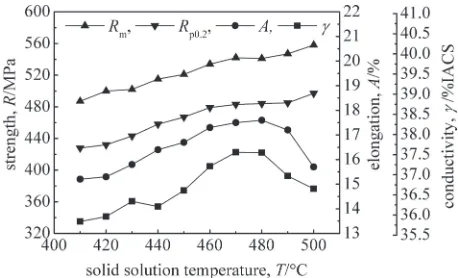
Figure 2 shows the effect of the solid solution temperature on the mechanical properties and conductivity of 7475 alloy. With the increase of the solid solution temperature, the tensile strength gradually increases from 487 MPa to 558 MPa, and the yield strength gradually increases from 428 MPa to 497 MPa. Even though the temperature excesses the over-burning temperature measured by DSC, the two strengths will still increase. Before over-burning temperature, the elongation increases from 15.2% to 17.6% with the solid solution temperature. Once it exceeds the over-burning temperature, the elongation will gradually drop to 15.7% at 500°C. The change of the conductivity is similar to that of the elongation. It increases from the minimum of 35.8%IACS to the maximum of 37.6%IACS, and then drops to 36.7%IACS at 500°C. Comprehensively, when the solid solution temper-ature is at 460°C480°C, the properties of 7475 alloy are
satisfied. The tensile strength and yield strength are 542 MPa and 479 MPa, and the elongation and conductivity are 17.6% and 37.6%IACS. However, in order to avoid the potential over-burning, the solid solution temperature is determined as 470°C.
As is known, the solid solution is at the dual super-saturation state of solute atoms and vacancy, and the vacancy is the prerequisite of atom diffusion.12) Therefore, the vacancy concentration and the interaction with the solute atoms play significant influences on the precipitation kinetics. By the solid solution treatment within¡solid solution region, and then quench and ageing, the 7475 alloy can obtain good mechanical properties. However, the melting of the partial enrichment zone of the Al2CuMg phase may happen when it
was heated rapidly at high temperature. Figure 1 indicated the temperature of the onset point and peak point is 488.6°C and 493.0°C, and the over-burning will occur above 488.6°C. According to the reference,5)the onset point and peak point
are the temperature of T phase (Al6CuMg4 and Al2Mg3Zn3)
and Al2CuMg phase. Before over-burning, the higher the
temperature is, the higher the solubility of the solid solution is, and the higher the strength of the alloy is. But, the excessively high temperature will result in the negative consequences. Firstly, the partial low melting-point phases may be melted and the over-burning may appear. Secondly, the dispersed intermetallic compound will cluster and grow up. They will weaken the strengthening effect and reduce the recrystallization temperature, which will exert a negative impact on the plastic and other properties.13) In Fig. 2, the
elongation and conductivity will drop remarkably once the temperature arrived at 500°C which is consistent with the result of DSC. Figure 3 showed the microstructure at 470°C and 500°C. The over-burning was not found in Fig. 3(a). The partial recrystallized grains appear and they are elongated along the deformation direction. Some of the residual phase and the insoluble phase are broken. However, the obvious over-burning and the re-melting grain boundaries appear in Fig. 3(b). Additionally, some of large particles randomly distribute in the grain and/or the grain boundaries.
3.2 Effect of water temperature and transfer time of quenching
[image:2.595.312.541.69.208.2]Figure 4 shows the effect of the water temperature on the mechanical properties and conductivity. With the increase of Fig. 1 DSC curve of 7475 hot-rolling plate with a thickness of 18 mm.
Table 2 Experiment design of investigating quench parameters.
No. solid solution temperature/°C
water temperature
/°C
transfer time of quenching/s
delay time of quenching/h
1
410,420,430, 440,450,460, 470,480,500
30 20 4
2 470
10,20,30, 40,50,60, 70,80,90
20 4
3 470 30 5,10,20,
30,40,50,60 4
4 470 30 20
1,4,8, 16,24,48, 72,96,120
[image:2.595.54.283.69.248.2] [image:2.595.48.291.303.456.2]water temperature, the tensile strength and yield strength of 7475 alloy decreases while the elongation increases. When the water temperature increases every 10°C, the tensile strength, yield strength and elongation will change about
¹6.5 MPa, ¹6.2 MPa and 0.17%. The conductivity always increases with the increase of water temperature at 10°C 30°C, but it almost remains about 37.6%IACS at 30°C60°C. When the water temperature is above 60°C, the conductivity drops quickly, and the minimum is 36.5%IACS. Therefore, the water temperature should be kept below 60°C, and had better be below 30°C. At this water temperature, the tensile strength, yield strength, elongation and conductivity are 540 MPa, 485 MPa, 17.6% and 37.5%IACS, respectively. However, in order to avoid the crack caused by the quenching, the cooling rate must be small. So, the water temperature must be high, which is contradictory to the requirement of low water temperature due to improving the strength. Alternatively, the water temperature is as low as possible on the condition that the crack doesn’t occur.
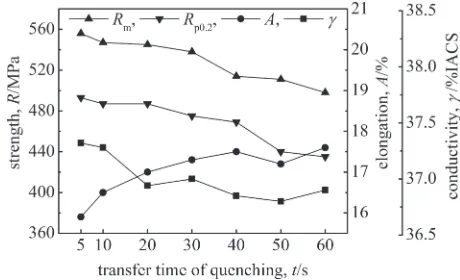
The effect of the transfer time of quenching on the mechanical properties and conductivity is shown in Fig. 5. A little effect on the strengths can be found before 30 s, but the strengths will drop remarkably after 30 s. So the transfer time should be kept within 30 s, and the tensile strength, yield strength, elongation and conductivity are 538 MPa, 475 MPa, 17.3% and 37.0%IACS at 30 s, respectively.
The effect of the water temperature and transfer time on the mechanical properties and conductivity can be attributed to the cooling rate. Before the alloy was put into the water, it was cooled in the air, and the cooling rate is very small. The longer the transfer time is or the higher the water temperature is, the smaller of the cooling rate is.
It is generally believed that the precipitation sequence of Al-Zn-Mg-Cu series alloy at low temperature ageing is super-saturation solid solution¼GP zone¼©A phase¼© phase.14) So, the size, density and distribution of GP zone
are very important for the forming of ©A phase. When the cooling rate is large, there is no enough time for the second phase to nucleate and precipitate at the grain boundary, which makes the concentration of solute atoms become higher. A lot of stable GP zones can be formed quickly. During ageing, many second phases can uniformly precipitate, and their size has no big difference. So they cannot effectively delay the propagation of the potential crack.15) Contrarily, when the cooling rate becomes small, there is enough time for the second phase to nucleate and precipitate at the grain boundary, and the formation of second phases will result in the decrease of the salute atom concentration at the grain boundary.16) According to Ostwald ripening mechanism,17)
these second phases can continue to grow up by absorbing the solute atoms near the grain boundary during ageing. So the GP zones will become few and instable.18) If the water
temperature is higher or the transfer time is longer, the cooling rate will be smaller. As a result, not only the pre-existing GP zones will partially dissolve, but also new GP zones are difficult to form. Therefore, the strengthening effect will become weak, and thus the mechanical properties of 7475 alloy will decrease. When the water temperature is low or the transfer time is short, the large cooling rate can accelerate the formation and grow-up of GP zones. When ageing treatment, these stable GP zones grow up into ©A phase. Consequently, the number of strengthening phases will be more than before. The mechanical properties of alloy will be promoted.
(a)
(b)
Fig. 3 Microstructure of 7475 alloy at different solution temperature: (a) 470°C, (b) 500°C.
Fig. 4 Effect of water temperature on mechanical properties and conductivity of 7475 alloy.
[image:3.595.130.468.70.187.2] [image:3.595.310.540.220.360.2] [image:3.595.54.285.222.359.2]The main factors affecting the conductivity of 7475 alloy includes the concentration of solute atoms, scattering of the electron, and the size, quantity, distribution of the GP zones and the©Aphases.19)If the higher the concentration of solute
atoms is, or the smaller the size of GP zones and©Aphases is, or the more the quantity of them is, or the more dispersing the distribution of them is, the lower the conductivity of the alloy is.19)When the water temperature becomes high, the cooling rate will become small. So the precipitated metastable phases are much more, and the solute atom remained in the matrix is less and thus the concentration of solute atoms becomes lower. Consequently, the conductivity will gradually become high against the water temperature. However, when the water temperature exceeded 60°C, the conductivity will drop, as shown in Fig. 4. This can be explained as follow. Although the decrease of the concentration of solute atoms will lead to the increase of the conductivity, the scattering of the alloy electron will also play a key impact on the conductivity. When the cooling rate becomes smaller, the quantity of the precipitated metastable phase will be larger and more dispersing, and it is more easily to form a strong strain field in the alloy matrix. So the bigger coherent strain will make the scattering of the electron stronger. As a result, the conductivity decrease caused by the scattering of the electron is greater than the conductivity increase caused by the solute atoms, so the conductivity will gradually drop with the water temperature. It is seen from Fig. 5 that the conductivity of 7475 alloy decreases with the increase of the transfer time except 60 s. This can be attributed to the leading role of the scattering of the electron. Here, we cannot give more reasonable explanations about the increase of conductivity at 60 s besides the error.
3.3 Effect of delay time of quenching
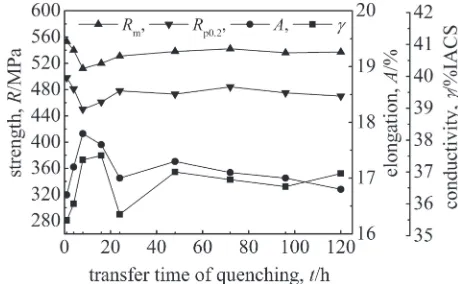
Figure 6 demonstrated the effect of the delay time of quenching on the mechanical properties and conductivity. The tensile strength and yield strength is on the decline as a whole with the delay time. Before 8 h, the strengths drop quickly while the elongation and conductivity rise continu-ously with the increase of the delay time. When the delay time is 8 h, the tensile strength and yield strength achieve the minimum of 512 MPa and 450 MPa, and the elongation and conductively reaches the maximum of 17.8% and 37.4%IACS. From 8 h to 24 h a rebound of the mechanical properties and conductivity appears, and the strengths rise while the elongation and conductivity drop. When the delay time is more than 24 h, the mechanical properties and conductivity achieve relatively stable. Considering the practical production, the delay time of quenching is confined into 4 h. If there is no enough time, the artificial aging can be performed after 24 h, which also can get ideal comprehensive performances.
Actually, this obvious effect began once the quenching was made, and it is related to the dissolution of GP zone.20)With the increase of the delay time, a large number of clustering groups will form, and thus the concentration of solute elements in the solid solutions is greatly reduced. During the artificial aging, the GP zones that are less than the critical size will resolve back to the solid solution, and it will reduce the number of the precipitation strengthening phase. So, the
strengths of the alloy will reduce. But if the delay time continue to be extended, these GP zones that are less than the critical size are likely to grow up to the stable crystal nucleus. Therefore, the effect of delay time became weak, and the mechanical properties of the alloy began to recover.
4. Conclusions
(1) When the solid solution temperature is at 460°C 480°C, all properties are satisfied. The tensile strength, yield strength, elongation and conductivity are 542 MPa and 479 MPa, 17.6% and 37.6%IACS, respectively. When the temperature is higher than 490°C, the over-burning may occur.
(2) With the increase of water temperature, the tensile strength and yield strength decrease while the elonga-tion increases. Every the water temperature increases 10°C, the tensile strength, yield strength and elongation will change about ¹6.5 MPa, ¹6.2 MPa and 0.17%. The conductivity almost remains at 37.6%IACS at 30°C60°C. When temperature is above 60°C, the conductivity drops quickly, and the minimum is 36.5%IACS.
(3) The strengths and conductivity will drop while the elongation will rise gradually along with the transfer time. When the transfer time is 30 s, the tensile strength, yield strength, elongation and conductivity are 538 MPa, 475 MPa, 17.3%and 37.0%IACS, respectively. (4) With the increase of the delay time, the strengths
decrease and then increase while the elongation and conductivity has a reverse change. When the delay time is 8 h, the tensile strength and yield strength achieve the minimum of 512 MPa and 450 MPa, and the elongation and conductivity reach the maximum of 17.8% and 37.4%IACS.
(5) The optimal quench parameters are: the solid solution is 470°C, water temperature is below 60°C, transfer time is below 30 s, and delay time is below 4 h or above 24 h.
Acknowledgements
This research was financially supported by the Natural Science Foundation of China (51105121).
[image:4.595.310.539.70.212.2]REFERENCES
1) X. Zhang, Y. Deng and Y. Zhang:Acta Metall. Sin.51(2015) 257271.
2) M. Nakai and T. Eto:Mater. Sci. Eng. A285(2000) 6268.
3) N. Jaburek and M. Merklein:Procedia CIRP18(2014) 108113.
4) D. A. Isadare, M. O. Adeoye, A. R. Adetunji, K. M. Oluwasegun, A. L. Rominiyi and K. J. Akinluwade:Int. J. Mater. Eng.5(2015) 59.
5) P. A. Rometsch, Y. Zhang and S. Knight:Trans. Nonferrous Met. Soc. China24(2014) 20032017.
6) G. Sha and A. Cerezo:Surf. Interface Anal.36(2004) 564568.
7) T. Ohnishi, Y. Ibaraki and T. Ito:Mater. Trans., JIM30(1989) 601 607.
8) W. J. Poole and H. R. Shercliff:Mater. Sci. Forum217(1996) 1287 1292.
9) S. Yang, A. K. Mukherjee and W. T. Roberts:J. Mater. Sci.27(1992) 25152524.
10) S. Liu, Q. Zhong, Y. Zhang, W. Liu, X. Zhang and Y. Deng:Mater. Des.31(2010) 31163120.
11) T. C. Tsai and T. H. Chuang:Corrosion52(1996) 414416.
12) M. J. Starink and X. M. Li:Metall. Mater. Trans. A34(2003) 899911.
13) G. S. Wang, Z. H. Zhao, Y. H. Zhang and J. Z. Cui:Trans. Nonferrous Met. Soc. China23(2013) 25372542.
14) A. Gazda, M. Warmuzek and W. Wierzchowski:Thermochim. Acta
303(1997) 197202.
15) A. K. Vasudévan and R. D. Doherty:Acta Metall.35(1987) 1193 1219.
16) M. D. Hass and J. T. M. D. Hosson:Scr. Mater.44(2001) 281286.
17) T. Philippe and P. W. Voorhees:Acta Mater.61(2013) 42374244.
18) J. T. Staley, R. H. Brown and R. Schmidt:Metall. Trans.3(1972) 191 199.
19) P. Guyot and L. Cottignies:Acta Mater.44(1996) 41614167.