
Munich Personal RePEc Archive
Major infrastructure changes occurring
in Polish host cities in connection with
the staging of Euro 2012
Ferrir, Richard
5 December 2015
Online at https://mpra.ub.uni-muenchen.de/68209/
Richard Ferrir
Major infrastructure changes occurring in Polish host cities in connection with the staging of Euro 2012
Abstract
In this study, an attempt was made to estimate the impact of the organisation of UEFA European Championships on the host cities: Gdańsk, Poznań, Warsaw and Wrocław. The adopted list of infrastructural undertakings executed as part of Euro 2012 preparations included 219 projects divided according to the urgency criterion into key, important and other projects. Analysis of project completion revealed that not all tasks had been executed as planned before the beginning of the event. Predictably, the key projects were found to have been completed in the greatest percentage of the cases (76%), while other projects were characterised by the lowest percentage of completion (51%). The degree of completion also varied between the individual cities. Gdańsk turned out to be the most efficient city with 74% of all projects completed, while Warsaw was at the bottom of the ranking with 63% of completed projects.
Introduction
The most significant value added by Euro 2012 is undoubtedly the infrastructural changes. The event became a catalyst for the execution of more than two hundred projects for an amount of ca. PLN 100 billion. This paper focuses on the key projects, including above all the road construction projects, as well as those connected to road and rail infrastructure.
compared in this respect with other events of this rank, staged in Europe since the beginning of the 21st century.
Air transport
[image:3.595.83.518.279.517.2]Predictably, air transport played a crucial role in the tourist traffic to and from Poland. According to representatives of the airports in the four host cities, more than 10 000 take-offs and landings took place during the group phase and quarterfinals (Figure 3.3). An overwhelming proportion of these were foreign flights, accounting for more than 82 per cent of all air traffic.
Figure 3. Use of the airports in the four host cities during Euro 2012
Source: own compilation based on the data received from the administrators of Warsaw Chopin Airport, Gdansk Lech Walesa Airport, Wroclaw Airport, Poznan Airport.
Such performance could not have been achieved without the extension of all the aforementioned airports, aimed at increasing their capacity and streamlining the handling of arriving and departing passengers (Table 3.5).
In addition to the efforts aimed at adjusting the capacity of the Polish airports to temporarily increased air traffic during the event, another objective of equal importance was to meet top safety standards and ensure minimum delays for traffic other than connected with Euro 2012. Achievement of these aims was
domestic take-offs domestic landings
foreign take-offs foreign landings
0 500 1000 1500 2000 2500 3000 3500 4000
Gdańsk Poznań Warsaw Wrocław
31 30
751
67
43 43
765
54
271 186
3456
150
257 277
3616
also facilitated by the introduction of new procedures – IAP, STAR and SID – for the individual airports.
Table 5. Effects of the expansion of airports in host cities
City Before/after upgrading
Capacity Operations
Number of passengers
arriving/hour
Number of passengers departing/hour
Number of operations/hour
Gdańsk Before upgrading 760 760 23
After upgrading 2240 2240 23
Poznań Before upgrading 900 500 10
After upgrading 1900 1100 20
Warsaw Before upgrading 3750 2340 36 After upgrading 5860 3660 38
Wrocław Before upgrading 1260 840 10
After upgrading 2240 2240 22
Source: own compilation based on the data received from the administrators of Warsaw Chopin Airport, Gdansk Lech Walesa Airport, Wroclaw Airport, Poznan Airport.
Rail transport
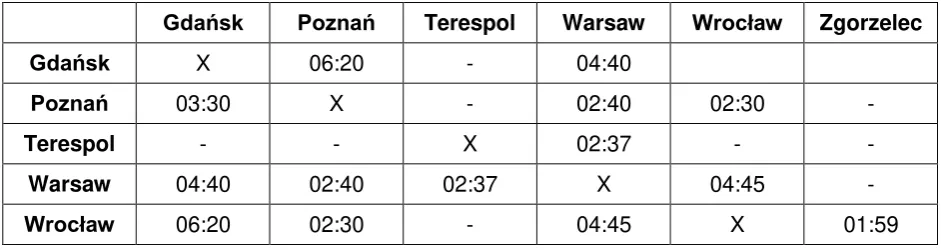
During the preparations for Euro 2012, a number of projects were carried out on the rail network, with the aim of reducing the time of journey between the host cities and from border crossings to the host cities (Table 3.6). In the latter case the modernisation related to the links on two routes: Terespol – Warsaw and Zgorzelec – Wrocław The longest journey is that between Gdańsk and Wrocław. It is noteworthy that before the upgrading the journey time on the same route was around 8 hours.
Table 6. Time of train journey between host cities and from border crossings to host cities
[in hours]
Gdańsk Poznań Terespol Warsaw Wrocław Zgorzelec
Gdańsk X 06:20 - 04:40
Poznań 03:30 X - 02:40 02:30 -
Terespol - - X 02:37 - -
Warsaw 04:40 02:40 02:37 X 04:45 -
[image:4.595.64.535.643.768.2]Zgorzelec - - - - 01:59 X
Source: Author’s compilation.
Beside the track upgrading, the goal was also achieved thanks to the new rolling stock. It consisted of 29 Elf electric multiple units and 10 Newag electric multiple units. In addition, 21 new train engines were added to the resources of Polish State Railways.
An important element of improvement of Poland's image were investments involving certain elements of rail infrastructure. These included, in particular:
railway stations:
Warszawa Centralna, Warszawa Wschodnia, Wrocław Główny, Poznań Główny; railway stops: Warszawa Stadion, Gdańsk Stadion Expo, Wrocław Stadion.
Road infrastructure
The amounts spent on this element of infrastructure were by far the most substantial. The data quoted at the beginning of this chapter show that the outlays on roads are greater than the total of all other infrastructure projects. Among the most important road infrastructure undertakings carried out as part of the preparations for Euro 2012 are the expressways, including motorways and ring roads. They contributed to reduced journey times, sometimes by as much as several hours; for example, A2 motorway with S8 expressway reduced the time of journey from Berlin to Warsaw from seven hours to four and a half hours. Furthermore, the investments improved the safety on Polish roads.
which is only 82% more than in 2012 alone. Meanwhile, from 2008 to the end of 2012 the motorway network was extended by 885 kilometres, and other expressway network – by 812 kilometres. Compared with the situation as of the end of 2007, there was a 171% increase in length. It was largely due to the organisation of UEFA European Championships. In this context, the Euro effect will continue to be discernible for a few more years. This is because of the roads whose construction began before the tournament, but was not completed before the end of 2012. General Directorate for National Roads and Motorways (GDDKiA) plans to put in operation an additional 64 kilometres of motorways and 300 kilometres of other expressways in 2013-2014 in the aftermath of Euro 2012 in Poland.
Figure 4. Development of the road network in Poland in 2008-2012 [km]
Source: own compilation based on GDDKiA data.
Final remarks
In this study, an attempt was made to estimate the impact of the organisation of UEFA European Championships on the host cities: Gdańsk, Poznań, Warsaw and Wrocław. The adopted list of infrastructural undertakings executed as part of Euro 2012 preparations included 219 projects divided according to the
0 200 400 600 800 1000
2008 2009 2010 2011 2012
65 88,9 14,5
217,3
499,9
130,5 119,1 13,3
96,6
453
motorways
urgency criterion into key, important and other projects. Analysis of project completion revealed that not all tasks had been executed as planned before the beginning of the event. Predictably, the key projects were found to have been completed in the greatest percentage of the cases (76%), while other projects were characterised by the lowest percentage of completion (51%). The degree of completion also varied between the individual cities. Gdańsk turned out to be the most efficient city with 74% of all projects completed, while Warsaw was at the bottom of the ranking with 63% of completed projects.
Even considering the high percentage of incomplete infrastructural projects, it is worth emphasising that Euro 2012 became a catalyst of important changes, especially with respect to broadly defined transport infrastructure. It is particularly striking in the case of road infrastructure. In 2012 alone 953 kilometres of expressways were completed. For comparison, by 2011 only slightly over 1700 kilometres of such roads had been built. What is important, the effects of Euro 2012 will still be noticeable at least until the end of 2014, when all projects undertaken in connection with the event will have been completed.
Such considerable infrastructural needs of Poland necessitated massive outlays. Euro 2012 proved to be the most expensive of the UEFA European Championships organised in the 21st century and, in all likelihood, in the whole history of the tournament. A highly disadvantageous fact for our country was the complete absence of commitment of private funds in the financing of the preparations. The public-private partnership program, in which high hopes had been placed in connection with the organisation of Euro 2012, turned out to be a total failure. It is noteworthy that it is an unprecedented case of financing a sporting event of this type exclusively from public sources.
References
[1] Feddersen A., Groetzinger A., Maennig W., Investment in stadia and
regional economic development – evidence from FIFA World Cup 2006
stadia, Hamburg Contemporary Economic Discussions, No 16/ 2008.
[2] Zawadzki K., Partnerstwo publiczno-prywatne jako źródło finansowania
wielkoformatowych imprez sportowych [in:] Juja T. (ed.), Dylematy i
wyzwania finansów publicznych, Publishing House of the University of
Economics in Poznań, Poznań 2010.
[3] Zawadzki K., Publiczne a prywatne finansowanie wielkoformatowych
imprez sportowych na przykładzie Mistrzostw Europy w Piłce Nożnej,
Zarządzanie i Finanse, Journal of Management and Finance, vol. 11, No. 2, Part 3, Gdańsk 2013.

![Figure 4. Development of the road network in Poland in 2008-2012 [km] Source: own compilation based on GDDKiA data](https://thumb-us.123doks.com/thumbv2/123dok_us/282406.527711/6.595.94.518.315.565/figure-development-network-poland-source-compilation-based-gddkia.webp)
