Munich Personal RePEc Archive
Forecasting German Car Sales Using
Google Data and Multivariate Models
Fantazzini, Dean and Toktamysova, Zhamal
Moscow School of Economics, Moscow State University (Russia),
Faculty of Economics, Higher School of Economics, Moscow (Russia)
2015
Online at
https://mpra.ub.uni-muenchen.de/67110/
Forecasting German Car Sales Using Google Data and
Multivariate Models
Dean Fantazzini
∗
Zhamal Toktamysova
†
Abstract
Long-term forecasts are of key importance for the car industry due to the lengthy period of time
required for the development and production processes. With this in mind, this paper proposes new
multivariate models to forecast monthly car sales data using economic variables and Google online
search data. An out-of-sample forecasting comparison with forecast horizons up to 2 years ahead
was implemented using the monthly sales of ten car brands in Germany for the period from 2001M1
to 2014M6. Models including Google search data statistically outperformed the competing models
for most of the car brands and forecast horizons. These results also hold after several robustness
checks which consider nonlinear models, different out-of-sample forecasts, directional accuracy, the
variability of Google data and additional car brands.
Keywords
: Car Sales, Forecasting, Google, Google Trends, Global Financial Crisis, Great
Reces-sion.
JEL classification
: C22, C32, C52, C53, L62.
∗
Moscow School of Economics, Moscow State University, Leninskie Gory, 1, Building 61, 119992, Moscow, Russia. Fax:
+7 4955105256 . Phone: +7 4955105267 . E-mail:
.
†
Faculty of Economics, Higher School of Economics, Moscow (Russia)
This is the working paper version of the paper
Forecasting German Car Sales Using Google Data and Multivariate Models
,
1
Introduction
Long-term forecasting of car sales plays an important role in the automobile industry. Accurate
pre-dictions allow firms to improve market performance, minimize profit losses, and plan manufacturing
processes and marketing policies more efficiently.
Tough competition, significant investments, and the need for quick model updates are the specifics of
the automotive industry which make forecasting an element of key importance for the sales and production
processes. Like other complex industries, it can be characterized by long product development cycles
varying from 12 up to 60 months. An effective planning of the production therefore requires accurate
long-term sales forecasts. Inaccurate forecasts may result in several negative consequences, such as
overstocking or shortage of production supplies, high costs for different workforce activities, loss of
reputation for the manufacturer and even bankruptcy.
There are several economic factors affecting the automobile industry, and they can be broadly
di-vided into three groups. The first group incorporates the technological aspects of the products: quality,
innovation and technology, performance and economy of the engine, functionality, safety, space
man-agement, design and aesthetics (Lin and Zhang, 2004; Sa-ngasoongsong and Bukkapatnam, 2011). The
second group comprises promotion and sales factors, including wholesale and retail prices, customer
ser-vice, advertising campaigns, and brand image (Landwehr, Labroo, and Herrmann, 2011). These factors
are significant, but usually do not have a long-term effect and automobile producers in most cases can
manage and control them (Dekimpe, Hanssens, and Silva-Risso, 1998; Nijs, Dekimpe, Steenkamp, and
Hanssens, 2001; Pauwels, Hanssens, and Siddarth, 2002; Pauwels, Silva-Risso, Srinivasan, and Hanssens,
2004). The third group includes various political, economic and social environmental factors which are
generally beyond the control of manufacturers, such as organizational issues, political issues, global
eco-nomic growth, ecological and physical forces, socio-cultural effects and consumer behavior. The use of
these factors for car sales forecasting has been rather limited, see Br¨
uhl, Borscheid, Friedrich, and
Re-ith (2009), Shahabuddin (2009), Wang, Chang, and Tzeng (2011) and Sa-ngasoongsong, Bukkapatnam,
Kim, Iyer, and Suresh (2012). Moreover, most previous studies have focused on the dynamics of car
sales in the short-term, with forecast horizons usually less than 4 months, whereas car sales forecasting
requires time scales with duration up to one year or more.
Following the growing number of Internet users (International Telecommunications Union, 2014)
and the increasing popularity of Google as a search engine for obtaining information about cars, we
propose the use of Google search data as a leading indicator for the long-term forecasting of car sales.
In this regard, Google Search holds the world leadership among all search engines with a 54% market
share (Net Applications, 2014). Since 2004, it has offered a tool called Google Trends, which provides
information on the relative interest of users in a particular search query, at a given geographic region and
at a given time (the data are available on a weekly or even daily basis). Moreover, Google Trends can
attribute queries to different search categories (Autos, Computers, Finance, Health and others). In recent
years, researchers worldwide have begun to use online search data to produce real-time forecasts where
information from official sources is released with a lag (such as ‘nowcasting’), or simply as an additional
variable for forecasting purposes, see Choi and Varian (2012), Askitas and Zimmermann (2009), Suhoy
(2009), Ginsberg, Mohebbi, Patel, Brammer, Smolinski, and Brilliant (2009), Da, Engelberg, and Pengjie
(2011), D’Amuri and Marcucci (2013) and Fantazzini and Fomichev (2014) for some recent applications.
With this in mind, we propose a set of models for the long-term forecasting of car sales in Germany,
which consider both economic variables and online search queries. Germany is the third biggest car
producer in the world (about 14 million vehicles in 2013 and 20% of the total world production) and
the absolute leader in Europe (31% of the total European production), see the reports by the German
Association of the Automotive Industry (GTAI, 2014) and the Germany Trade and Invest Organization
(VDA, 2014) for more details. As for Internet users, Germany has the second highest number of users
in Europe (12.3% of all European users) and the 7th in the world. In June 2014, more than 71 million
people in Germany visited the Web at least once a month, representing 88.6% of the adult population
(Internet World Stats, 2014).
multivariate models for both deseasonalized data, the usual approach in the economic literature, and
for data not seasonally adjusted, which is more common in practice, since planning and production
departments tend to work with raw data
1
.
The second contribution of our paper is a large-scale forecasting exercise for ten car brands in
Ger-many, where we compute out-of-sample forecasts ranging from 1 month to 24 months ahead. Our results
show that models including car sales, Google data and economic variables outperform the competing
models in the medium term for most of the car brands, while multivariate models including only car
sales and Google data outperform the other models for long-term forecasts up to 24 steps ahead. The use
of parsimonious models is crucial to obtain precise forecasts in the long run, and the use of Google search
data represents a simple and powerful way to summarize the large amount of information available (see
also Fantazzini and Fomichev, 2014).
The third contribution of the paper is a set of robustness checks to verify that our results also hold
when considering nonlinear models, different out-of-sample forecasts, the use of directional accuracy as
the main evaluation tool, Google data downloaded on different days, and additional car brands.
The paper is organized as follows. Section 2 describes the data and the in-sample analysis, and the
forecasting models and their out-of-sample performance are reported in Section 3. Robustness checks
are discussed in Section 4, and Section 5 briefly concludes.
2
Data and In-Sample analysis
We analyze new car registrations in the Federal Republic of Germany, as provided in press releases
by the Federal Motor Transport Authority (Kraftfahrt-Bundesamt). These data cover the period from
January 2001 to June 2014, for a total of 162 observations. The data consist of monthly numbers of
new vehicle registrations by vehicle type and new registrations of passenger cars by brand starting from
2001. For different reasons, the information for some car brands was truncated: certain brands were
present only after 2001; others stopped being observed well before 2014; or the registration statistics
were not published due to the small number of registrations per month. Our car brands were selected
based on the availability of a long time series for new car registrations and their presence in the “
Vehicle
Brands
” Google subcategory. Moreover, car brands were chosen to reflect both foreign and domestic car
producers.
There were only 22 brands which had both monthly data continuously available since 2001 and were
present in Google Trends. We divided these brands into clusters by taking the average sales for each
brand and using the method of k-means with Euclidian distance. We wanted to determine large, medium
and small car manufacturers, and assign all brands into three clusters. The method of k-means allowed us
to define the number of clusters a priori and minimize the within-cluster distance while maximizing the
between-cluster distance (see e.g. Hartigan (1975)). The initial
k
cluster centers are chosen to maximize
the initial distance. The data are arranged to the nearest cluster center, therefore
k
clusters are formed.
Next, new cluster centers are chosen as centers of mass for the clusters. After recalculation, the data are
again assigned to the nearest cluster centers. The procedure ends when all centers of mass are stabilized.
We found three clusters consisting of the following brands:
•
Large sellers: Volkswagen, Opel, Ford, BMW, Audi (average monthly sales between 19523 and
53820);
•
Medium-sized sellers: Renault, Toyota, Peugeot, Hyundai, Fiat, Mazda, Citroen, Nissan (average
monthly sales between 4976 and 14074);
•
Small sellers: Jaguar, Kia, Land Rover, Porsche, Subaru, Honda, Volvo, Mitsubishi, Suzuki (average
monthly sales between 355 and 3351).
We also used the method of k-means with the monthly sales data from January 2001 to June 2014 and
we obtained the same division into three clusters.
For the sake of space, interest and to keep the empirical analysis computationally tractable,
through-out the paper we will consider three large sellers (Volkswagen, Opel, BMW), three medium-sized sellers
(Toyota, Fiat, Citroen), and four small sellers (Jaguar, Kia, Mitsubishi, Suzuki). The remaining 12
brands will be examined as a robustness check in section 4.5.
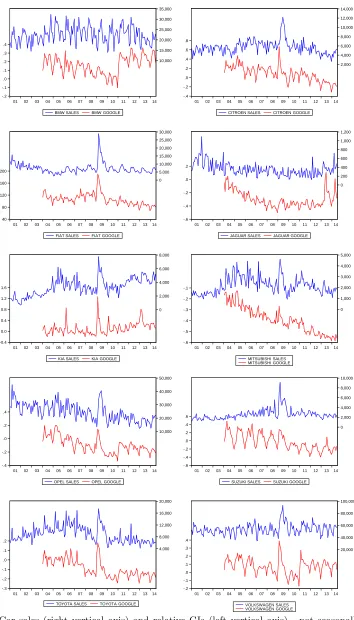
The plots of the monthly sales are reported in Figure 1 (right vertical axis). Car sales are subject to
seasonal fluctuations and all car brands tend to show several peaks during the year, with the biggest one
taking place at the end of spring. In general, car sales decline during winter. The Census X-12 tests for
seasonality detected that all brands exhibit stable seasonality, with no evidence of moving seasonality.
The second source of data consists of Google Trends data, which can be downloaded from
www.google.
com/trends/
, using the specific “
Autos and Vehicles
” category and its “
Vehicle Brands
”
subcate-gory. The Google Index (GI) is the ratio of the number of queries relative to a particular category (in
our case the car brand), with respect to all queries in the selected region at a given point of time. The
data were collected for the whole of Germany for the period January 2004 - June 2014. The data have a
weekly frequency and were converted to a monthly series by taking average values. While the GIs for a
keyword are normalized to be bounded between 0 to 100, where 100 is the peak of the search queries, the
GIs for a category are expressed in terms of percentage change from their first observation in January
2004, so that they can be both positive and negative. Their plots are reported in Figure 1 (left vertical
axis): it is interesting to note that the turning points in the GIs anticipate those in the car sales for
all car brands. This initial evidence suggests that Google data may be of some help for medium- and
long-term forecasting.
Additionally, we included a number of economic variables related to car sales, based on recent works
by Shahabuddin (2009) and Sa-ngasoongsong, Bukkapatnam, Kim, Iyer, and Suresh (2012). These
variables are assumed to reflect the state of the national economy, and the factors that can influence
a consumer’s decision to purchase a car. The selected economic variables and their descriptions are
presented in Table 1. The data were collected for the period January 2001 to June 2014. All data,
with the exception of building construction orders (which were available only seasonally adjusted), show
some form of seasonality, with peaks during the summer season and troughs at the end of the year. The
quarterly GDP data were converted to monthly data via the quadratic match average procedure, while
the daily data for Euribor rates were transformed into monthly data by taking their average. Their plots
are reported in Figure 2.
Economic variable
Frequency
Seasonally
adjusted
Source
Explanation
Building
Construction
(BC)
M
yes
GFB
Volume index of new orders for residential
buildings construction
Consumer Confidence
Indi-cator (CCI)
M
no
DG ECFIN
Consumer survey that reflects consumer
ex-pectations
Consumer
Price
Index
(CPI)
M
no
FSO
Measure of the ratio of a price of fixed set of
consumer goods and services in current period
to its price in a basic period
Euro
Interbank
Offered
Rate (EURIBOR)
D
no
EBF
Calculated as an average rate of lending rate of
the banks which participate in the survey. For
the current research EURIBOR for long-term
credits (1 year) is considered
Gross Domestic Product
(GDP)
Q
no
FSO
Market value of all goods and services
pro-duced within a country. In the present work
GDP in nominal billions Euro was taken
Production Index (PI)
M
no
FSO
Production Index for durable goods
Unemployment Rate (UR)
M
no
FEA
The registered unemployed population as a
percentage of the civilian labor force
Petrol Price (PP)
M
no
FSO
Consumer price for petrol, price index
Table 1: Description of economic variables used in the analysis. The second column reports the frequency
of publishing: M - monthly data, Q - quarterly data, D - daily data. The abbreviations used in the
fourth column represent the data sources: GFB - German Federal Bank (Deutsche Bundesbank), DG
ECFIN -Directorate General for Economic and Financial Affairs, FSO - The Federal Statistical Office
(Statistisches Bundesamt), EBF - The European Banking Federation, FEA - The Federal Employment
Agency (Bundesagentur f¨
ur Arbeit).
Data with seasonal behavior were seasonally adjusted with the Census X-12 adjustment program
developed by US Census Bureau. However, we also considered the raw data, since they are more common
in practice and of greater interest for production planners and marketing managers, who base their
decisions on real data which exhibit seasonality.
-.2 -.1 .0 .1 .2 .3 .4 10,000 15,000 20,000 25,000 30,000 35,000
01 02 03 04 05 06 07 08 09 10 11 12 13 14
BMW SALES BMW GOOGLE
-.4 -.2 .0 .2 .4 .6 .8 2,000 4,000 6,000 8,000 10,000 12,000 14,000
01 02 03 04 05 06 07 08 09 10 11 12 13 14
CITROEN SALES CITROEN GOOGLE
40 80 120 160 200 0 5,000 10,000 15,000 20,000 25,000 30,000
01 02 03 04 05 06 07 08 09 10 11 12 13 14
FIAT SALES FIAT GOOGLE
-.6 -.4 -.2 .0 .2 0 200 400 600 800 1,000 1,200
01 02 03 04 05 06 07 08 09 10 11 12 13 14
JAGUAR SALES JAGUAR GOOGLE
-0.4 0.0 0.4 0.8 1.2 1.6 0 2,000 4,000 6,000 8,000
01 02 03 04 05 06 07 08 09 10 11 12 13 14
KIA SALES KIA GOOGLE
-.6 -.5 -.4 -.3 -.2 -.1 0 1,000 2,000 3,000 4,000 5,000
01 02 03 04 05 06 07 08 09 10 11 12 13 14
MITSUBISHI SALES MITSUBISHI GOOGLE
-.4 -.2 .0 .2 .4 10,000 20,000 30,000 40,000 50,000
01 02 03 04 05 06 07 08 09 10 11 12 13 14
OPEL SALES OPEL GOOGLE
-.6 -.4 -.2 .0 .2 .4 .6 0 2,000 4,000 6,000 8,000 10,000
01 02 03 04 05 06 07 08 09 10 11 12 13 14
SUZUKI SALES SUZUKI GOOGLE
-.3 -.2 -.1 .0 .1 .2 4,000 8,000 12,000 16,000 20,000
01 02 03 04 05 06 07 08 09 10 11 12 13 14
TOYOTA SALES TOYOTA GOOGLE
-.2 -.1 .0 .1 .2 .3 .4 20,000 40,000 60,000 80,000 100,000
01 02 03 04 05 06 07 08 09 10 11 12 13 14
[image:6.612.119.473.48.668.2]VOLKSWAGEN SALES VOLKSWAGEN GOOGLE
60 80 100 120 140 160 180 200
010203 040506 07080910 111213 14
BUILDING CONSTRUCTION ORDERS
60 70 80 90 100 110 120
01020304 050607 08091011 1213 14
CONSUMER CONFIDENCE INDEX
85 90 95 100 105 110
01 02030405 060708 09101112 13 14
CPI 0 1 2 3 4 5 6
0102 03040506 070809 101112 13 14
EURIBOR 500 550 600 650 700 750
010203 040506 07080910 111213 14
GDP 70 80 90 100 110 120 130 140
01020304 050607 08091011 1213 14
PRODUCTION INDEX 6 7 8 9 10 11 12 13
01 02030405 060708 09101112 13 14
UNEMPLOYMENT RATE
70 80 90 100 110 120 130 140
0102 03040506 070809 101112 13 14
PETROL PRICE
Figure 2: Economic variables - not seasonally adjusted. Sample: 2001M1 - 2014M6
linear patterns
2
(see Sa-ngasoongsong, Bukkapatnam, Kim, Iyer, and Suresh (2012)). The descriptive
statistics for the car registrations, the Google data and the economic variables (both seasonally adjusted
and raw data) are not reported for the sake of space and are available from the authors upon request.
To select the best multivariate model for each car brand, we follow the structural relationship
identi-fication methodology discussed by Sa-ngasoongsong, Bukkapatnam, Kim, Iyer, and Suresh (2012) for the
case of the US car market. Briefly, the first step is to identify the order of integration using unit root tests;
if all variables are stationary, VAR and VARX (Vector Autoregressive with exogenous variables) models
are used. The second step determines the exogeneity of each variable using the sequential reduction
method for weak exogeneity by Hall, Henry, and Greenslade (2002), who consider weakly exogenous each
variable for which the test is not rejected and re-test the remaining variables until all weakly exogenous
variables are identified. For non-stationary variables, cointegration rank tests are employed to determine
the presence of a long-run relationship among the endogenous variables: if this is the case, VECM or
VECMX (Vector Error Correction model with exogenous variables) models are used, otherwise VAR or
VARX models in differences are applied. The last step is to compute the impulse response functions
from the chosen model to trace the effect of a unit shock in one of the variables on the future values
of car sales, and to compute out-of-sample forecasts (see Sa-ngasoongsong, Bukkapatnam, Kim, Iyer,
and Suresh (2012) for more details). Our approach differs from the one proposed by Sa-ngasoongsong,
Bukkapatnam, Kim, Iyer, and Suresh (2012) in two respects: first, we employ unit root tests and
coin-tegration tests allowing for structural breaks, given the possible break in the years 2008-2009 during the
global financial crisis. Second, we employ the previous identification methodology for both the seasonally
adjusted data and the raw data.
2.1
Stationarity
2.1.1
Seasonally Adjusted data
The stationarity of our variables is analyzed using several unit root tests allowing for potential endogenous
structural break(s), both under the null of a unit root and under the alternative. We justify this choice
considering the strong influence the global financial crisis in the years 2007-2009 had on the German
economy, which is visible when looking at Figures 1 and 2. As for the Google data, we remark that the
statistical effects of dividing the original search data by the total number of web searches in the same
week and area are unknown, so that we cannot say a priori whether they are stationary or not (see also
Fantazzini and Fomichev (2014) for a discussion on this issue). More specifically, we employed four unit
root tests: the Lee and Strazicich (2003) unit root tests allowing for one and two breaks, respectively, and
the Range Unit Root (RUR) and the Forward-Backward RUR tests suggested by Aparicio, Escribano,
and Garcia (2006), which are non-parametric tests robust against nonlinearities, error distributions,
structural breaks and outliers. A brief description of these tests is reported in the Technical Appendix
A accompanying this paper and can be found on the authors’ websites.
RUR
FB
LS 1 break
LS 2 breaks
The null hypothesis
Test
Test
Test
Test
is rejected
statistic
statistic
statistic
statistic
by all tests?
Car sales
BMW
0.71 *
1.16
-5.08
*
-11.14
*
no
Citroen
1.34
1.95
-5.12
*
-6.09
*
no
Fiat
0.79 *
1.89
-4.75
*
-6.31
*
no
Jaguar
0.87 *
1.39
-4.47
-6.98
*
no
Kia
1.42
2.01
-4.94
*
-5.89
*
no
Mitsubishi
0.79 *
1.34
-5.05
*
-5.79
*
no
Opel
0.87 *
1.56
-6.17
*
-6.87
*
no
Suzuki
1.02 *
1.67
-4.91
*
-6.47
*
no
Toyota
1.50
1.95
-4.92
*
-5.86
*
no
Volkswagen
0.87 *
1.73
-6.66
*
-7.52
*
no
Economic variables
BUILD
1.34
2.17
-2.33
-8.68
*
no
CCI
1.18
2.23
-3.60
-4.07
no
CPI
9.14 *
13.15*
-3.53
-4.10
no
EURIBOR
3.07
3.73 *
-3.46
-4.29
no
PP
2.68
3.96 *
-3.65
-5.26
no
GDP
6.30 *
8.75 *
-3.67
-4.53
no
PI
1.42
1.67
-3.88
-4.80
no
UR
5.28 *
7.30 *
-3.42
-5.66
no
Google data
BMW GI
1.34
1.77
-5.24
*
-8.59
*
no
Citroen GI
1.97
2.34
-5.98
*
-6.71
*
no
Fiat GI
1.43
2.34
-4.59
*
-7.07
*
no
Jaguar GI
1.52
1.90
-7.12
*
-8.10
*
no
Kia GI
0.80 *
1.39
-7.45
*
-8.12
*
no
Mitsubishi GI
2.68
2.97
-9.26
*
-9.83
*
no
Opel GI
1.25
2.53
-4.51
*
-5.24
no
Suzuki GI
1.88
2.09
-7.18
*
-8.24
*
no
Toyota GI
1.34
1.90
-4.67
*
-5.17
no
[image:8.612.122.475.61.340.2]Volkswagen GI
1.34
1.83
-4.96
*
-5.55
no
Table 2: Unit root tests: RUR = Range Unit Root test by Aparicio, Escribano, and Garcia (2006); FB
= Forward-Backward RUR test by Aparicio, Escribano, and Garcia (2006); LS = Unit Root test by Lee
and Strazicich (2003). Null hypothesis: the time series has a unit root.
* Significance at the 5% level.
The results in Table 2 show that the majority of our time series are not stationary. However, the
Lee and Strazicich (2003) tests show a stronger evidence of unit roots for economic variables, while the
Aparicio, Escribano, and Garcia (2006) tests show the same for car sales and Google data. If we follow
a conservative approach and analyze when all four tests reject the null hypothesis (see the last column
in Table 2), then all car brands can be deemed non-stationary.
2.1.2
Raw data
To test the null hypothesis of a periodic unit root, we follow the two-step strategy suggested by Boswijk
and Franses (1996) and Franses and Paap (2004). In the first step, a likelihood ratio test for testing a
single unit root in a Periodic Auto-Regressive (PAR) model of order
p
is performed. Since there is no
version of this test with endogenous breaks, we estimated it both with the full sample starting in 2001,
and with a smaller sample starting in 2008. The year 2008 was chosen following the previous evidence
of a possible break in this year, which emerged with the unit root tests allowing for breaks in the case
of seasonally adjusted data. If the null of a periodic unit root cannot be rejected, Boswijk and Franses
(1996) and Franses and Paap (2004) suggest to test in a second step whether the process contains a
non-periodic unit root equal to 1 for all seasons. A description of these tests is reported in the Technical
Appendix B.
Sample: 2001-2014
Sample: 2008-2014
1st step
2nd step
1st step
2nd step
H
0: periodic
H
0: non periodic
H
0: periodic
H
0: non periodic
unit root
unit root
unit root
unit root
Car Sales
BMW
NC
NC
NC
NC
Citroen
18.66*
/
7.21
0.46
Fiat
16.60*
/
4.43
0.00
Jaguar
42.41*
/
NC
NC
Kia
10.46*
/
4.96
0.08
Mitsubishi
22.97*
/
16.96*
/
Opel
15.38*
/
10.66*
/
Suzuki
24.85*
/
15.95*
/
Toyota
10.19*
/
15.81*
/
Volkswagen
58.20*
/
NC
NC
Economic Variables
BUILD
7.99
0.09
2.32
0.11
CCI
3.23
0.06
1.02
0.14
CPI
0.13
0.00
0.30
0.44
EURIBOR
0.37
0.66
1.99
0.15
PP
1.97
0.88
1.36
0.10
GDP
0.01
0.00
0.15
0.00
PI
36.79*
/
22.07*
/
UR
0.52
0.56
NC
NC
Google data
BMW GI
8.93
0.49
2.71
0.53
Citroen GI
4.90
0.47
4.46
0.13
Fiat GI
4.47
0.04
1.84
0.11
Jaguar GI
12.02*
/
5.17
0.01
Kia GI
16.82*
/
8.07
0.76
Mitsubishi GI
3.91
0.99
2.19
0.35
Opel GI
6.06
0.64
6.69
0.53
Suzuki GI
3.60
0.02
3.63
0.04
Toyota GI
5.86
0.46
5.15
0.01
[image:9.612.124.472.39.320.2]Volkswagen GI
11.20*
/
5.38
0.39
Table 3: Periodic Unit root tests by Boswijk and Franses (1996) and Franses and Paap (2004).
* Significance at the 5% level. NC = Not Converged. The second step is performed only if the first step
numerically converged and did not reject the null hypothesis.
p-values smaller than 0.05 are in bold.
2.2
Weak Exogeneity and Cointegration Tests
2.2.1
Seasonally Adjusted data
The next step in the structural relationship identification methodology discussed by Sa-ngasoongsong,
Bukkapatnam, Kim, Iyer, and Suresh (2012) is to determine the exogeneity of each variable using the
sequential reduction method for weak exogeneity proposed by Hall, Henry, and Greenslade (2002). This
method exogenizes all weakly exogenous variables and re-tests the remaining variables until all weakly
exogenous variables are identified. The variables that reject the null of weak exogeneity after re-testing
are reported in Table 12 in Appendix A: the Euribor series can be considered weakly exogenous for four
car brands, while almost all other variables are deemed endogenous (with some exceptions for Mitsubishi).
We then proceeded to test for cointegration using the variables which were deemed endogenous
according to the previous sequential test procedure by Hall, Henry, and Greenslade (2002). We test for
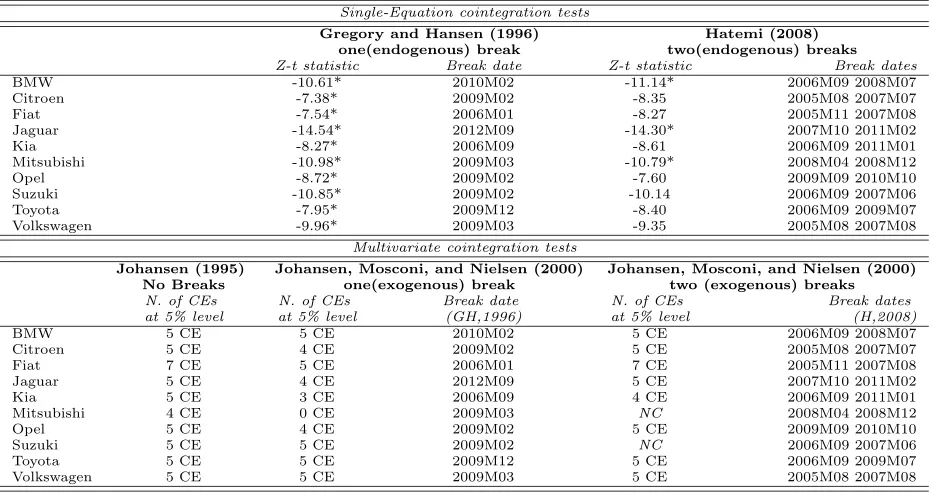
cointegration using a set of cointegration tests allowing for the presence of structural break(s):
•
Gregory and Hansen (1996) single-equation cointegration test allowing for one endogenous break;
•
Hatemi (2008) single-equation cointegration test allowing for two endogenous breaks;
•
Johansen, Mosconi, and Nielsen (2000) multivariate test allowing for the presence of one or two
exogenous break(s), where the dates of the breaks are the ones selected by the Gregory and Hansen
(1996) and Hatemi (2008) tests, respectively.
and Nielsen (2000) is that they allow only for exogenous breaks. Accordingly, we followed a 2-step
strategy: we first estimated the single-equation tests to obtain an indication of the structural break dates.
We then used these dates to compute the tests by Johansen, Mosconi, and Nielsen (2000). Finally, we
remark that the number of lags for the Johansen tests were chosen to minimize the Schwartz criterion
and to make the residuals approximately white noise.
Single-Equation cointegration tests
Gregory and Hansen (1996)
Hatemi (2008)
one(endogenous) break
two(endogenous) breaks
Z-t statistic
Break date
Z-t statistic
Break dates
BMW
-10.61*
2010M02
-11.14*
2006M09 2008M07
Citroen
-7.38*
2009M02
-8.35
2005M08 2007M07
Fiat
-7.54*
2006M01
-8.27
2005M11 2007M08
Jaguar
-14.54*
2012M09
-14.30*
2007M10 2011M02
Kia
-8.27*
2006M09
-8.61
2006M09 2011M01
Mitsubishi
-10.98*
2009M03
-10.79*
2008M04 2008M12
Opel
-8.72*
2009M02
-7.60
2009M09 2010M10
Suzuki
-10.85*
2009M02
-10.14
2006M09 2007M06
Toyota
-7.95*
2009M12
-8.40
2006M09 2009M07
Volkswagen
-9.96*
2009M03
-9.35
2005M08 2007M08
Multivariate cointegration tests
Johansen (1995)
Johansen, Mosconi, and Nielsen (2000)
Johansen, Mosconi, and Nielsen (2000)
No Breaks
one(exogenous) break
two (exogenous) breaks
N. of CEs
N. of CEs
Break date
N. of CEs
Break dates
at 5% level
at 5% level
(GH,1996)
at 5% level
(H,2008)
BMW
5 CE
5 CE
2010M02
5 CE
2006M09 2008M07
Citroen
5 CE
4 CE
2009M02
5 CE
2005M08 2007M07
Fiat
7 CE
5 CE
2006M01
7 CE
2005M11 2007M08
Jaguar
5 CE
4 CE
2012M09
5 CE
2007M10 2011M02
Kia
5 CE
3 CE
2006M09
4 CE
2006M09 2011M01
Mitsubishi
4 CE
0 CE
2009M03
NC
2008M04 2008M12
Opel
5 CE
4 CE
2009M02
5 CE
2009M09 2010M10
Suzuki
5 CE
5 CE
2009M02
NC
2006M09 2007M06
Toyota
5 CE
5 CE
2009M12
5 CE
2006M09 2009M07
[image:10.612.72.543.108.355.2]Volkswagen
5 CE
5 CE
2009M03
5 CE
2005M08 2007M08
Table 4: Single-equation and multivariate cointegration tests with and without structural break(s) for
seasonally-adjusted data. The null hypothesis for all tests is the absence of cointegration. The tests
considered the case of a level shift. The table cells for the Johansen tests report the number of CEs
selected at the 5% level. NC=not converged. * Significance at the 5% level.
Table 4 shows that there is strong evidence for cointegration for all considered car brands. However,
structural breaks seem to have a non-negligible effect, particularly when considering Johansen
multi-variate tests. Moreover, the effects of breaks appear to be much stronger for foreign brands than for
domestic brands (BMW, Volkswagen and, to a lesser extent, Opel), for which the cointegration tests do
not change substantially when breaks are taken into account.
2.2.2
Raw data
To determine the exogeneity of variables with potential seasonal behavior, we extend the previous
se-quential reduction method for weak exogeneity by including centered seasonal dummies: they sum to
zero over time and therefore do not affect the asymptotic distributions of the tests (see Johansen (1995,
2006)). The variables that reject the null of weak exogeneity after re-testing are reported in Table 13 in
Appendix A: the results for raw data are not too dissimilar to the seasonally-adjusted data, even though
there are less variables which are weakly exogenous. We then tested for cointegration using the
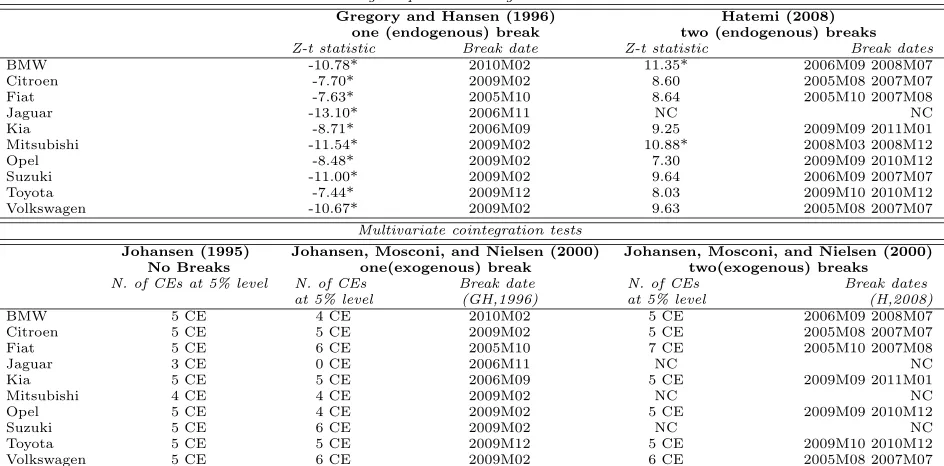
vari-ables which were found to be endogenous, and the previous cointegration tests augmented with centered
seasonal dummies, see Table 5.
In the case of raw data, the evidence for cointegration appears to be quite similar to that of
seasonally-adjusted data, particularly when considering the Johansen test without breaks and with one break.
Moreover, the fact that the Johansen test with two breaks failed to converge for some car brands indicates
that our sample is too small for two breaks and that only tests with one break should be considered.
Single-Equation cointegration tests
Gregory and Hansen (1996)
Hatemi (2008)
one (endogenous) break
two (endogenous) breaks
Z-t statistic
Break date
Z-t statistic
Break dates
BMW
-10.78*
2010M02
11.35*
2006M09 2008M07
Citroen
-7.70*
2009M02
8.60
2005M08 2007M07
Fiat
-7.63*
2005M10
8.64
2005M10 2007M08
Jaguar
-13.10*
2006M11
NC
NC
Kia
-8.71*
2006M09
9.25
2009M09 2011M01
Mitsubishi
-11.54*
2009M02
10.88*
2008M03 2008M12
Opel
-8.48*
2009M02
7.30
2009M09 2010M12
Suzuki
-11.00*
2009M02
9.64
2006M09 2007M07
Toyota
-7.44*
2009M12
8.03
2009M10 2010M12
Volkswagen
-10.67*
2009M02
9.63
2005M08 2007M07
Multivariate cointegration tests
Johansen (1995)
Johansen, Mosconi, and Nielsen (2000)
Johansen, Mosconi, and Nielsen (2000)
No Breaks
one(exogenous) break
two(exogenous) breaks
N. of CEs at 5% level
N. of CEs
Break date
N. of CEs
Break dates
at 5% level
(GH,1996)
at 5% level
(H,2008)
BMW
5 CE
4 CE
2010M02
5 CE
2006M09 2008M07
Citroen
5 CE
5 CE
2009M02
5 CE
2005M08 2007M07
Fiat
5 CE
6 CE
2005M10
7 CE
2005M10 2007M08
Jaguar
3 CE
0 CE
2006M11
NC
NC
Kia
5 CE
5 CE
2006M09
5 CE
2009M09 2011M01
Mitsubishi
4 CE
4 CE
2009M02
NC
NC
Opel
5 CE
4 CE
2009M02
5 CE
2009M09 2010M12
Suzuki
5 CE
6 CE
2009M02
NC
NC
Toyota
5 CE
5 CE
2009M12
5 CE
2009M10 2010M12
[image:11.612.75.547.45.278.2]Volkswagen
5 CE
6 CE
2009M02
6 CE
2005M08 2007M07
Table 5: Single-equation and multivariate cointegration tests with and without structural break(s) for
raw data. The null hypothesis for all tests is the absence of cointegration. The tests considered the case
of a level shift. The table cells for the Johansen tests report the number of CEs selected at the 5% level.
NC=not converged. * Significance at the 5% level.
parsimonious model can nevertheless be of interest for forecasting purposes. Moreover, the capacity
of Google data to summarize a wealth of information should not be underestimated. In this regard,
we implemented the single-equation periodic cointegration test discussed in Franses and Paap (2004),
which is an extension of the Boswijk (1994) cointegration test. The null hypothesis is the absence of
cointegration against the alternative of periodic cointegration and the right-hand variables should be
weakly exogenous. A description of this test as well as the test for weak exogeneity in the case of
periodic variables by Boswijk (1994) is reported in the Technical Appendix D. Since we are not aware of
any extension of this test allowing for structural breaks, we estimated it using both the full sample and a
reduced sample starting in 2008 to take any potential break into account and the results are reported in
Table 14 in Appendix A: the evidence in favor of periodic cointegration is fairly strong, but the results
of the Boskwijk test statistics change partially when the smaller sample starting in 2008 is considered.
Caution should therefore be exercised when dealing with this restricted model. Interestingly, the GIs are
weakly exogenous with respect to car sales for almost all brands at the 5% level and this outcome does
not change substantially with the sample used.
2.3
Impulse Response Functions
details about these tests). The full results are available from the authors upon request.
-.04 -.02 .00 .02 .041 2 3 4 5 6 7 8 9 10 11 12
Response of LOG(CAR BMW SALES) to LOG(BMW GI)
-.04 -.02 .00 .02 .04
1 2 3 4 5 6 7 8 9 10 11 12
Response of LOG(CAR CITROEN SALES) to LOG(CITROEN GI)
-.04 -.02 .00 .02 .04
1 2 3 4 5 6 7 8 9 10 11 12
Response of LOG(CAR FIAT SALES) to LOG(FIAT GI)
-.04 -.02 .00 .02 .04
1 2 3 4 5 6 7 8 9 10 11 12
Response of LOG(CAR JAGUAR SALES) to LOG(JAGUAR GI)
-.04 -.02 .00 .02 .04
1 2 3 4 5 6 7 8 9 10 11 12
Response of LOG(CAR KIA SALES) to LOG(KIA GI)
-.04 -.02 .00 .02 .04 .06 .08
1 2 3 4 5 6 7 8 9 10 11 12
Response of LOG(CAR MITSUBISHI SALES) to LOG(MITSUBISHI GI)
-.04 -.02 .00 .02 .04
1 2 3 4 5 6 7 8 9 10 11 12
Response of LOG(CAR OPEL SALES) to LOG(OPEL GI)
-.04 -.02 .00 .02 .04
1 2 3 4 5 6 7 8 9 10 11 12
Response of LOG(CAR SUZUKI SALES) to LOG(SUZUKI GI)
-.04 -.02 .00 .02 .04
1 2 3 4 5 6 7 8 9 10 11 12
Response of LOG(CAR TOYOTA SALES) to LOG(TOYOTA GI)
-.04 -.02 .00 .02 .04
1 2 3 4 5 6 7 8 9 10 11 12
[image:12.612.84.511.68.289.2]Response of LOG(CAR VOLKSWAGEN SALES) to LOG(VOLKSWAGEN GI)
Figure 3: Impulse response functions: response of car sales (in logs) to generalized one standard deviation
innovations in the Google Indexes.
Long-run parameters (
β
)
Misspecification tests
CE 1
CE 2
CE 3
CE 4
CE 5
p
-values
p
-values
Log(SALES(-1))
1
0
0
0
0
Multi. LM(1)
0.06
Uni. JB test
Log(BC(-1))
0
1
0
0
0
Multi. LM(2)
0.76
SALES
0.02
Log(CCI(-1))
0
0
1
0
0
Multi. LM(3)
0.22
BC
0.77
Log(CPI(-1))
0
0
0
1
0
Multi. LM(4)
0.35
CCI
0.12
Log(EURIBOR(-1))
0
0
0
0
1
Multi. LM(5)
0.02
CPI
0.09
[image:12.612.74.539.353.536.2]Log(PP(-1))
0.11
-0.71
-0.29
-0.03
0.77
Multi. LM(6)
0.65
EURIBOR
0.62
[ 0.35]
[-2.63]
[-0.91]
[-3.34]
[ 1.20]
Multi. LM(7)
0.75
PP
0.43
Log(PI(-1))
2.03
1.90
1.57
0.14
-8.97
Multi. LM(8)
0.09
PI
0.03
[ 5.19]
[ 5.60]
[ 3.97]
[ 14.10]
[-11.10]
Multi. LM(9)
0.52
UR
0.54
Log(UR(-1))
0.98
-1.12
-0.27
0.05
6.53
Multi. LM(10)
0.41
0.01
[ 3.51]
[-4.63]
[-0.95]
[ 6.33]
[ 11.31]
Multi. LM(11)
0.06
GDP
0.51
Log(GOOGLE(-1))
-1.95
-0.77
0.08
-0.03
-3.16
Multi. LM(12)
0.33
Multi. JB test
0.01
[-6.82]
[-3.08]
[ 0.26]
[-3.83]
[-5.34]
Multi. White
0.30
Log(GDP(-1))
2.16
-2.96
-0.83
-0.46
19.78
[ 2.91]
[-4.61]
[-1.11]
[-24.16]
[ 12.95]
Constant
-27.59
14.91
-4.73
-2.14
-89.07
[-6.64]
[ 4.13]
[-1.13]
[-20.05]
[-10.39]
Adjustment coefficients (
α
) - car sales equation
-0.72
-0.04
0.64
5.55
0.18
[-6.33]
[-0.23]
[ 4.60]
[ 1.70]
[ 4.25]
Table 6: Long-run parameters and adjustment coefficients for the Volkswagen car sales equation (left
table). Misspecification tests on the residuals from the Volkswagen VECMX model (right table).
t-statistics are reported in brackets, while
p-values smaller than 5% are reported in bold.
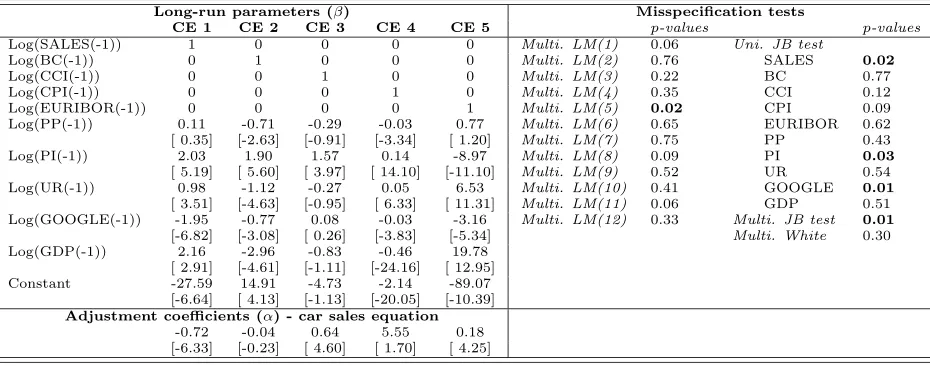
As expected, a unit shock in the Google Index has a rather long and positive effect for almost all
car brands. Similarly, the model estimates in Table 6 show that the Google Index enters almost all
cointegration equations with significant positive coefficients
3
, while the residual tests do not signal any
serious misspecification.
3
Out-of-Sample Forecasting Analysis
The last step in the structural relationship identification methodology discussed by Sa-ngasoongsong,
Bukkapatnam, Kim, Iyer, and Suresh (2012) is to compare the forecasting performances of the selected
VECM (or VECMX) models with a set of competitors.
3.1
Seasonally Adjusted data
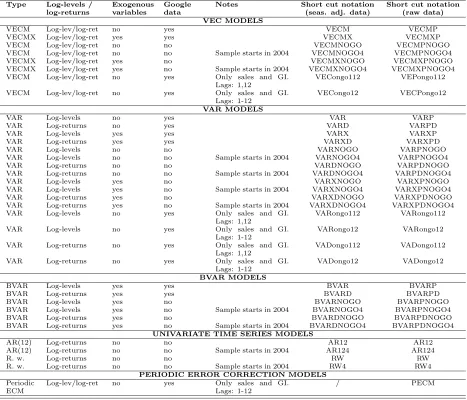
We compared a set of 34 models, which allow for different degrees of model flexibility, parsimonious
specifications and numerical tractability. More specifically, three types of multivariate models were
employed:
•
Vector Error Correction (VEC) models:
We considered both VECM and VECMX models, as well
as models with and without Google data, to better examine their effects on forecasting performance.
The number of lags was selected to minimize the Schwartz criteria and to make the residuals
ap-proximately white noise. We also considered a set of parsimonious bivariate specifications including
only car sales and Google data, which may be of interest for long-term forecasting.
•
Vector Auto-Regressive (VAR) models:
We considered VAR models with variables in log-levels and
in log-differences, to consider both cases of stationarity and non-stationarity. Moreover, models
with and without exogenous variables and with and without Google data were also considered.
Finally, a set of parsimonious bivariate VAR models including only car sales and Google data was
included.
•
Bayesian Vector Auto-Regressive (BVAR) models:
When there are a lot of variables and a high
number of lags, estimating the parameters of a VAR model can be very difficult, if not impossible.
One way to solve this issue is to shrink the parameters using Bayesian methods. Bayesian VAR
models have recently enjoyed a lot of success in macroeconomic forecasting (see Koop and Korobilis
(2010) for a recent review and Fantazzini and Fomichev (2014) for a recent application with Google
data). In this regard, we used the so-called Litterman/Minnesota prior, which was developed by
researchers at the University of Minnesota and at the Federal Reserve Bank of Minneapolis, and
which is a common choice in empirical applications due to its computational speed and forecasting
success (see Doan, Litterman, and Sims (1984), Litterman (1986) and Koop and Korobilis (2010)).
A brief description of BVAR models can be found in the Technical Appendix E. Similarly to the
VAR and VECM models, we considered models with and without exogenous variables, with and
without Google data and with variables both in log-levels and in log-differences.
Besides these models, we also considered a set of standard univariate time series models:
•
The Random Walk with drift;
•
An AR(12) model for the log-returns of car sales.
Moreover, all models without Google data were estimated using both a long sample starting in 2001
and a short one starting in 2004, in the hope that this will show more clearly the advantages of Google
data. The full details of all 34 multivariate models are reported in Table 7. For ease of reference, we
also report in the sixth column a short-cut notation for identifying each model in the tables reporting
the models forecasting performances.
We used the data between 2001M1 and 2008M9 as the first initialization sample for the models
without Google data, and data from 2004M1 till 2008M9 for the models with Google data and those
without Google data but estimated on a shorter sample. The evaluation period ranged from 2008M10
till 2014M6 and was used to compare forecasts from 1 step ahead up to 24 steps ahead. The top three
models in terms of the Mean Squared Prediction Error (MSPE) for each forecasting horizon and each
car brand are reported in Table 15, while the full results are available from the authors upon request.
Table 15 shows that there is no single model which outperforms all competitors for all horizons and
all car brands. However, some general indications can be retrieved:
•
The MSPEs of the competing models with forecasting horizons up to 8-10 steps ahead are relatively
Type
Log-levels /
Exogenous
Notes
Short cut notation
Short cut notation
log-returns
variables
data
(seas. adj. data)
(raw data)
VEC MODELS
VECM
Log-lev/log-ret
no
yes
VECM
VECMP
VECMX
Log-lev/log-ret
yes
yes
VECMX
VECMXP
VECM
Log-lev/log-ret
no
no
VECMNOGO
VECMPNOGO
VECM
Log-lev/log-ret
no
no
Sample starts in 2004
VECMNOGO4
VECMPNOGO4
VECMX
Log-lev/log-ret
yes
no
VECMXNOGO
VECMXPNOGO
VECMX
Log-lev/log-ret
yes
no
Sample starts in 2004
VECMXNOGO4
VECMXPNOGO4
VECM
Log-lev/log-ret
no
yes
Only sales and GI.
Lags: 1,12
VECongo112
VEPongo112
VECM
Log-lev/log-ret
no
yes
Only sales and GI.
Lags: 1-12
VECongo12
VECPongo12
VAR MODELS
VAR
Log-levels
no
yes
VAR
VARP
VAR
Log-returns
no
yes
VARD
VARPD
VAR
Log-levels
yes
yes
VARX
VARXP
VAR
Log-returns
yes
yes
VARXD
VARXPD
VAR
Log-levels
no
no
VARNOGO
VARPNOGO
VAR
Log-levels
no
no
Sample starts in 2004
VARNOGO4
VARPNOGO4
VAR
Log-returns
no
no
VARDNOGO
VARPDNOGO
VAR
Log-returns
no
no
Sample starts in 2004
VARDNOGO4
VARPDNOGO4
VAR
Log-levels
yes
no
VARXNOGO
VARXPNOGO
VAR
Log-levels
yes
no
Sample starts in 2004
VARXNOGO4
VARXPNOGO4
VAR
Log-returns
yes
no
VARXDNOGO
VARXPDNOGO
VAR
Log-returns
yes
no
Sample starts in 2004
VARXDNOGO4
VARXPDNOGO4
VAR
Log-levels
no
yes
Only sales and GI.
Lags: 1,12
VARongo112
VARongo112
VAR
Log-levels
no
yes
Only sales and GI.
Lags: 1-12
VARongo12
VARongo12
VAR
Log-returns
no
yes
Only sales and GI.
Lags: 1,12
VADongo112
VADongo112
VAR
Log-returns
no
yes
Only sales and GI.
Lags: 1-12
VADongo12
VADongo12
BVAR MODELS
BVAR
Log-levels
yes
yes
BVAR
BVARP
BVAR
Log-returns
yes
yes
BVARD
BVARPD
BVAR
Log-levels
yes
no
BVARNOGO
BVARPNOGO
BVAR
Log-levels
yes
no
Sample starts in 2004
BVARNOGO4
BVARPNOGO4
BVAR
Log-returns
yes
no
BVARDNOGO
BVARPDNOGO
BVAR
Log-returns
yes
no
Sample starts in 2004
BVARDNOGO4
BVARPDNOGO4
UNIVARIATE TIME SERIES MODELS
AR(12)
Log-returns
no
no
AR12
AR12
AR(12)
Log-returns
no
no
Sample starts in 2004
AR124
AR124
R. w.
Log-returns
no
no
RW
RW
R. w.
Log-returns
no
no
Sample starts in 2004
RW4
RW4
PERIODIC ERROR CORRECTION MODELS
Periodic
ECM
Log-lev/log-ret
no
yes
Only sales and GI.
Lags: 1-12
[image:14.612.72.539.38.438.2]/
PECM
Table 7: Models used for forecasting (baseline case).
•
Bayesian VAR models, particularly in differences and without Google data, perform rather well
across all car brands and for short and medium forecasts (up to 12 steps ahead);
•
Bivariate models including only car sales and Google models and using only the first and the 12th
lags perform extremely well across most of the car brands examined, particularly for long-term
forecasts. The parsimonious specifications of these models clearly allow for efficiency gains where
forecasting is of concern.
•
The forecasting power of the best models using Google data increases with the length of the forecast
horizon, particularly with forecast horizons higher than 12 steps ahead. This evidence is similar to
that found in D’Amuri and Marcucci (2013) and Fantazzini and Fomichev (2014).
•
Models without Google data estimated with the long sample starting in 2001 tend to perform better
than those estimated with a shorter sample starting in 2004.
•
There are no particular differences between large, medium-sized and small sellers and between
foreign and German manufacturers.
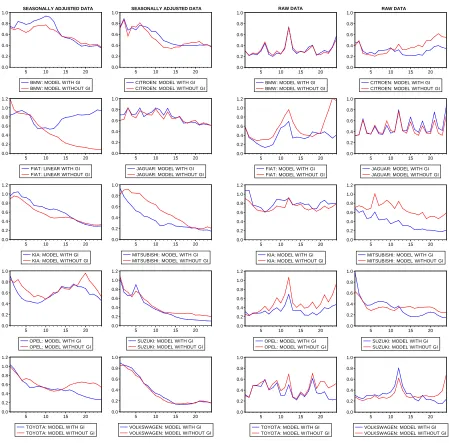
model without Google data and the Random Walk model. We remark that the best models tend to vary
across different horizons.
0.0 0.2 0.4 0.6 0.8 1.0
5 10 15 20
BMW: MODEL WITH GI BMW: MODEL WITHOUT GI
0.0 0.2 0.4 0.6 0.8 1.0
5 10 15 20
CITROEN: MODEL WITH GI CITROEN: MODEL WITHOUT GI
SEASONALLY ADJUSTED DATA
0.0 0.2 0.4 0.6 0.8 1.0 1.2
5 10 15 20
FIAT: LINEAR WITH GI FIAT: LINEAR WITHOUT GI
0.0 0.2 0.4 0.6 0.8 1.0
5 10 15 20
JAGUAR: MODEL WITH GI JAGUAR: MODEL WITHOUT GI
0.0 0.2 0.4 0.6 0.8 1.0 1.2
5 10 15 20
KIA: MODEL WITH GI KIA: MODEL WITHOUT GI
0.0 0.2 0.4 0.6 0.8 1.0
5 10 15 20
MITSUBISHI: MODEL WITH GI MITSUBISHI: MODEL WITHOUT GI
0.0 0.2 0.4 0.6 0.8 1.0
5 10 15 20
OPEL: MODEL WITH GI OPEL: MODEL WITHOUT GI
0.0 0.2 0.4 0.6 0.8 1.0 1.2
5 10 15 20
SUZUKI: MODEL WITH GI SUZUKI: MODEL WITHOUT GI
0.0 0.2 0.4 0.6 0.8 1.0 1.2
5 10 15 20
TOYOTA: MODEL WITH GI TOYOTA: MODEL WITHOUT GI
0.0 0.2 0.4 0.6 0.8 1.0
5 10 15 20
VOLKSWAGEN: MODEL WITH GI VOLKSWAGEN: MODEL WITHOUT GI
SEASONALLY ADJUSTED DATA
0.0 0.2 0.4 0.6 0.8 1.0
5 10 15 20
BMW: MODEL WITH GI BMW: MODEL WITHOUT GI
0.0 0.2 0.4 0.6 0.8 1.0
5 10 15 20
CITROEN: MODEL WITH GI CITROEN: MODEL WITHOUT GI
0.0 0.2 0.4 0.6 0.8 1.0 1.2
5 10 15 20
FIAT: MODEL WITH GI FIAT: MODEL WITHOUT GI
0.0 0.2 0.4 0.6 0.8 1.0
5 10 15 20
JAGUAR: MODEL WITH GI JAGUAR: MODEL WITHOUT GI
0.0 0.2 0.4 0.6 0.8 1.0 1.2
5 10 15 20
KIA: MODEL WITH GI KIA: MODEL WITHOUT GI
0.0 0.2 0.4 0.6 0.8 1.0 1.2
5 10 15 20
MITSUBISHI: MODEL WITH GI MITSUBISHI: MODEL WITHOUT GI
0.0 0.2 0.4 0.6 0.8 1.0 1.2
5 10 15 20
OPEL: MODEL WITH GI OPEL: MODEL WITHOUT GI
0.0 0.2 0.4 0.6 0.8 1.0
5 10 15 20
SUZUKI: MODEL WITH GI SUZUKI: MODEL WITHOUT GI
0.0 0.2 0.4 0.6 0.8 1.0
5 10 15 20
TOYOTA: MODEL WITH GI TOYOTA: MODEL WITHOUT GI
0.0 0.2 0.4 0.6 0.8 1.0
5 10 15 20
VOLKSWAGEN: MODEL WITH GI VOLKSWAGEN: MODEL WITHOUT GI
[image:15.612.81.530.91.534.2]RAW DATA RAW DATA
Figure 4: Ratios of the MSPEs of the best models with and without Google data and the Random Walk
model across all forecasting horizons. The first two columns show results for seasonally-adjusted data,
and the last two for raw data.
Model rankings in terms of the MSPE do not show whether the competing forecasts are statistically
different or not. We therefore tested for significant differences in forecast accuracy using the Model
Confi-dence Set (MCS) approach proposed by Hansen, Lunde, and Nason (2011). The MCS is a sequential test
of equal predictive ability, with the starting hypothesis that all models considered have equal forecasting
performance. Given an initial set of forecasts, it tests the null that no forecast is distinguishable from
any other and discards any inferior forecasts if they exist. The MCS procedure yields a model confidence
set containing the best forecasting models at a given confidence level. Since our dataset is not too large
and the number of forecasting models is moderate, we employed the semiquadratic test statistic (
T
SQ
),
which is more computationally intensive but more selective, see e.g. Rossi and Fantazzini (2014). The
loss function used was the MSPE, while the
p
-values for the test statistic were obtained using a stationary
block bootstrap with a block length of 12 months and 1000 re-samples. If the
p-value was lower than a
defined confidence level
α, the model was not included in the MCS and viceversa. A brief description of
the MCS approach is reported in the Technical Appendix F.
The models included in the MCS at the 10% level for all car brands and forecast horizons are reported
in Table 16
4
: for the sake of space and interest, we report only the total number of selected models, the
total number of selected Google-based models, and whether the Random Walk model was included or
not. The full set of results is available from the authors upon request.
Table 16 shows that most, if not all, models are selected in the case of forecasts up to 10-12 steps
ahead for five car brands out of ten: the differences in forecasting performances are not large enough
to distinguish between them, meaning that the MCS contains a large number of models. Moreover, the
Random Walk model is often included. Instead, for long-term forecasts (12 steps ahead and higher),
only a small number of models is selected, most of them bivariate models including only car sales and
GIs, Bayesian VARs with GIs and sometimes the AR(12). Besides, the Random Walk model is seldom
included. Here, the data are much more informative and it is possible to select a limited number of
models which statistically outperform their competitors.
3.2
Raw data
We compared the same 34 models used for seasonally-adjusted data, but augmented with centered
seasonal dummies to model potential seasonal behavior. Moreover, we also considered the bivariate
Periodic Error Correction Model PECM(1,12) which includes only car sales and Google data, as discussed
in section 2.2.2. To account for the possible endogeneity of regressors and improve the efficiency of the
parameter estimates in small samples, we estimated the error correction term using the method of
dynamic OLS (see Boswijk and Franses (1995), Hayashi (2000) and Franses and Paap (2004)). A
short-cut notation for identifying each model in the subsequent tables reporting their forecasting performances
is reported in the last column of Table 7.
We used the data between 2001M1 and 2009M6 as the first initialization sample for the models without
Google data, while we used the initialization sample 2004M1-2009M6 for the models with Google data
and for those without Google data but estimated on a shorter sample. The evaluation period ranged from
2009M7 till 2014M6 and was used to compare forecasts from 1 step ahead up to 24 steps ahead. The top
three models in terms of the Mean Squared Prediction Error (MSPE) for each forecasting horizon and
each car brand are reported in Table 17, while a summary of the models included in the MCS is reported
in Table 18. The ratios of the MSPE of the best model with Google data and the Random Walk model
across all forecasting horizons, together with the ratios of the MSPE of the best model without Google
data and the Random Walk model are shown in the last two columns of Figure 4.
The results are somewhat similar to those which emerged from seasonally-adjusted data, but there are
also some important differences. Models without Google data now perform better, with respect to the case
of seasonally-adjusted data. Moreover, the number of models selected in the MCS is now much smaller
(often no more than 2-6 models): Bayesian VARs (with and without Google data) and parsimonious
bivariate models including only sales and GIs again represent the majority of models included in the
MCS at the 10% level.
4
Robustness Checks
We wanted to verify that the superior performance of Google-based models also holds under alternative
forecasting. We performed a series of robustness checks, considering alternative nonlinear models,
alter-native out-of-sample intervals, evaluating the directional accuracy of the competing forecasting models,
checking whether Google data downloaded on different days can affect the models’ forecasting
perfor-mances, and examining additional car brands.
4.1
Nonlinear Models
A part of the economic and financial literature has suggested the use of nonlinear models for forecasting
purposes (for instance, see Franses and Dijk (2000) and Terasvirta, Tjostheim, and Granger (2011) for
a discussion at the textbook level). Given this evidence, we estimated a set of nonlinear models and
compared their forecasting performances with the models in section 3. More specifically, we considered
three nonlinear models:
•
the SETAR model with 2 regimes (see Tong (1990) for a discussion at the textbook level);
•
the logistic smooth transition autoregressive (LSTAR) model, which is a generalization of the
SETAR model (see Tong (1990));
•
the additive autoregressive model (AAR), also known as generalized additive model (GAM), since
it combines generalized linear models and additive models (see Wood (2006) for a discussion at the
textbook level).
A description of these nonlinear models is given in the Technical Appendix G. See D’Amuri and Marcucci
(2013) and Fantazzini and Fomichev (2014) for a discussion of robustness checks using these nonlinear
models.
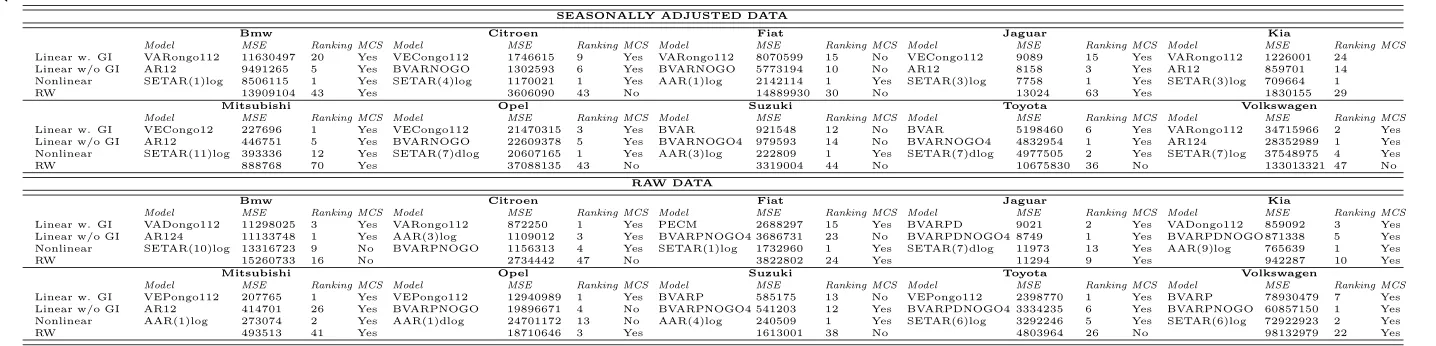
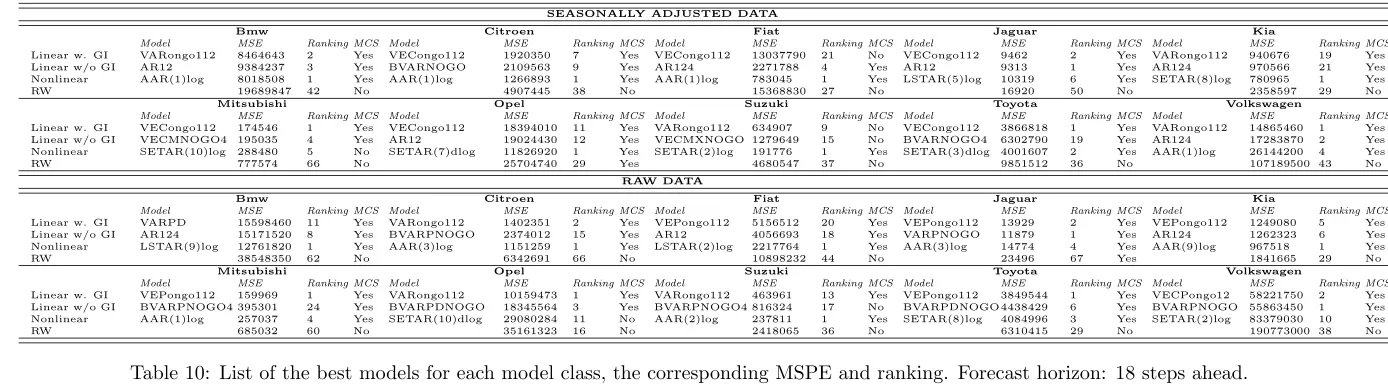
The top three models in terms of the MSPE for each forecasting horizon and each car brand are
reported in Table 19 for seasonally-adjusted data and in Table 21 for raw data. A summary of the
models included in the MCS is reported in Table 20 for seasonally-adjusted data and in Table 22 for raw
data.
In general, nonlinear models are very competitive, thus confirming past literature dealing with car
sales forecasting (see Da, Engelberg, and Pengjie (2003), Kunhui, Qiang, Changle, and Junfeng (2007),
Br¨
uhl, Borscheid, Friedrich, and Reith (2009), Hulsmann, Borscheid, Friedrich, and Reith (2012)).
Par-ticularly, parsimonious AAR and SETAR models involving only a few lags are often ranked among the
top models in terms of MSPE. Moreover, AAR models with log-prices performed very well for
medium-and long-term forecasts, similarly to what was found in Fantazzini medium-and Fomichev (2014) when
forecast-ing the real price of oil. However, nonlinear models were difficult to estimate, and specifications with
a large number of lags failed to converge. Particularly, the LSTAR proved to be the most challenging
and computationally intensive (see Franses and Dijk (2000) for a discussion of this issue). The results of
the MCS confirm this evidence and most of the models included at the 10% level are nonlinear, whereas
the only selected linear models are mostly Google-based. This evidence therefore seems to suggest that
Google data may explain a good portion of the nonlinearity displayed by sales data.
In the case of raw data, nonlinear models are less competitive than linear models, particularly for
forecasting horizons up to 12 steps ahead, whereas Bayesian VAR models and bivariate linear models
including car sales and GIs are often the top ranked models across most of the car brands. However, for
long-term forecasts, more than half of the models included in the MCS are nonlinear, while the remaining
selected models are mainly bivariate Google-based models.
SEASONALLY ADJUSTED DATA
Bmw Citroen Fiat Jaguar Kia
Model MSE Ranking MCS Model MSE Ranking MCS Model MSE Ranking MCS Model MSE Ranking MCS Model MSE Ranking MCS
Linear w. GI BVAR 7255188 36 Yes VARD 1937867 4 Yes VARongo112 11439630 10 Yes VADongo112 7409 22 Yes VARongo112 1220217 18 Yes Linear w/o GI AR12 6080991 4 Yes VARDNOGO 2054348 6 No BVARNOGO 11763929 11 Yes AR12 6913 11 Yes AR12 1036132 12 Yes Nonlinear AAR(7)dlog 5698093 1 Yes LSTAR(3)log 1688104 1 Yes SETAR(2)log 9458281 1 Yes SETAR(5)log 6478 1 Yes AAR(4)log 909397 1 Yes
RW 9073312 54 Yes 2534232 36 No 13839395 26 Yes 8907 61 Yes 1406331 28 Yes
Mitsubishi Opel Suzuki Toyota Volkswagen
Model MSE Ranking MCS Model MSE Ranking MCS Model MSE Ranking MCS Model MSE Ranking MCS Model MSE Ranking MCS
Linear w. GI VECongo112 285910 1 Yes VECongo112 16265040 1 Yes VARongo112 1206941 9 Yes VECongo112 4040621 1 Yes VARongo112 60790600 2 Yes Linear w/o GI VECMNOGO4 484285 32 Yes VECMXNOGO 21934786 6 No VECMXNOGO 1233267 10 Yes VECMXNOGO 5429724 3 Yes AR124 58970200 1 Yes Nonlinear SETAR(11)log 347695 3 Yes AAR(2)log 24373967 9 No SETAR(3)log 812440 1 Yes AAR(1)log 5653546 6 Yes AAR(1)log 71730620 9 No
RW 577041 62 Yes 36590894 40 No 1760865 27 No 7663277 29 No 94350150 36 No
RAW DATA
Bmw Citroen Fiat Jaguar Kia
Model MSE Ranking MCS Model MSE Ranking MCS Model MSE Ranking MCS Model MSE Ranking MCS Model MSE Ranking MCS
Linear w. GI VADongo112 9546849 1 Yes VARongo112 913022 3 Yes VARongo112 1225557 1 Yes BVARPD 7852 1 Yes BVARPD 731755 1 Yes Linear w/o GI BVARPDNOGO10099266 2 Yes BVARPNOGO 763696 1 Yes BVARPNOGO 2874716 13 Yes BVARPDNOGO4 8209 2 Yes BVARPDNOGO753717 3 Yes Nonlinear AAR(8)log 17435149 24 No AAR(3)log 1121818 6 No LSTAR(2)log 2615865 2 Yes AAR(3)log 12342 30 No AAR(9)log 828305 6 Yes
RW 21780883 62 No 3800014 70 No 9377139 62 No 15886 90 No 1218423 33 No
Mitsubishi Opel Suzuki Toyota Volkswagen
Model MSE Ranking MCS Model MSE Ranking MCS Model MSE Ranking MCS Model MSE Ranking MCS Model MSE Ranking MCS
Linear w. GI VEPongo112 193905 1 Yes VEPongo112 11342673 1 Yes BVARP 523703 12 Yes VEPongo112 3433042 2 Yes VEPongo112 48248128 2 Yes Linear w/o GI BVARPDNOGO322456 26 Yes BVARPNOGO 15033303 5 No BVARPNOGO4 380224 10 Yes VECMXPNOGO4 3333000 1 Yes BVARPNOGO 45734023 1 Yes Nonlinear LSTAR(3)log 234530 2 Yes SETAR(9)dlog 31266013 29 No SETAR(2)log 269229 1 Yes SETAR(1)dlog 4165033 6 Yes SETAR(4)log 72437319 12 No
[image:18.792.77.778.95.280.2]RW 319260 24 Yes 34959425 38 No 1244803 34 No 5758188 30 No 153257703 63 No
Table 8: List of the best models for each model class, the corresponding MSPE and ranking. Forecast horizon: 6 steps ahead.
SEASONALLY ADJUSTED DATA
Bmw Citroen Fiat Jaguar Kia
Model MSE Ranking MCS Model MSE Ranking MCS Model MSE Ranking MCS Model MSE Ranking MCS Model MSE Ranking MCS
Linear w. GI VARongo112 11630497 20 Yes VECongo112 1746615 9 Yes VARongo112 8070599 15 No VECongo112 9089 15 Yes VARongo112 1226001 24 Linear w/o GI AR12 9491265 5 Yes BVARNOGO 1302593 6 Yes BVARNOGO 5773194 10 No AR12 8158 3 Yes AR12 859701 14 Nonlinear SETAR(1)log 8506115 1 Yes SETAR(4)log 1170021 1 Yes AAR(1)log 2142114 1 Yes SETAR(3)log 7758 1 Yes SETAR(3)log 709664 1
RW 13909104 43 Yes 3606090 43 No 14889930 30 No 13024 63 Yes 1830155 29
Mitsubishi Opel Suzuki Toyota Volkswagen
Model MSE Ranking MCS Model MSE Ranking MCS Model MSE Ranking MCS Model MSE Ranking MCS Model MSE Ranking MCS
Linear w. GI VECongo12 227696 1 Yes VECongo112 21470315 3 Yes BVAR 921548 12 No BVAR 5198460 6 Yes VARongo112 34715966 2 Yes Linear w/o GI AR12 446751 5 Yes BVARNOGO 22609378 5 Yes BVARNOGO4 979593 14 No BVARNOGO4 4832954 1 Yes AR124 28352989 1 Yes Nonlinear SETAR(11)log 393336 12 Yes SETAR(7)dlog 20607165 1 Yes AAR(3)log 222809 1 Yes SETAR(7)dlog 4977505 2 Yes SETAR(7)log 37548975 4 Yes RW 888768 70 Yes 37088135 43 No 3319004 44 No 10675830 36 No 133013321 47 No
RAW DATA
Bmw Citroen Fiat Jaguar Kia
Model MSE Ranking MCS Model MSE Ranking MCS Model MSE Ranking MCS Model MSE Ranking MCS Model MSE Ranking MCS
Linear w. GI VADongo112 11298025 3 Yes VARongo112 872250 1 Yes PECM 2688297 15 Yes BVARPD 9021 2 Yes VADongo112 859092 3 Yes Linear w/o GI AR124 11133748 1 Yes AAR(3)log 1109012 3 Yes BVARPNOGO4 3686731 23 No BVARPDNOGO4 8749 1 Yes BVARPDNOGO871338 5 Yes Nonlinear SETAR(10)log 13316723 9 No BVARPNOGO 1156313 4 Yes SETAR(1)log 1732960 1 Yes SETAR(7)dlog 11973 13 Yes AAR(9)log 765639 1 Yes
RW 15260733 16 No 2734442 47 No 3822802 24 Yes 11294 9 Yes 942287 10 Yes
Mitsubishi Opel Suzuki Toyota Volkswagen
Model MSE Ranking MCS Model MSE Ranking MCS Model MSE Ranking MCS Model MSE Ranking MCS Model MSE Ranking MCS
Linear w. GI VEPongo112 207765 1 Yes VEPongo112 12940989 1 Yes BVARP 585175 13 No VEPongo112 2398770 1 Yes BVARP 78930479 7 Yes Linear w/o GI AR12 414701 26 Yes BVARPNOGO 19896671 4 No BVARPNOGO4 541203 12 Yes BVARPDNOGO4 3334235 6 Yes BVARPNOGO 60857150 1 Yes Nonlinear AAR(1)log 273074 2 Yes AAR(1)dlog 24701172 13 No AAR(4)log 240509 1 Yes SETAR(6)log 3292246 5 Yes SETAR(6)log 72922923 2 Yes
RW 493513 41 Yes 18710646 3 Yes 1613001 38 No 4803964 26 No 98132979 22 Yes
Table 9: List of the best models for each model class, the corresponding MSPE and ranking. Forecast horizon: 12 steps ahead.
[image:18.792.74.792.302.475.2]SEASONALLY ADJUSTED DATA
Bmw Citroen Fiat Jaguar Kia
Model MSE Ranking MCS Model MSE Ranking MCS Model MSE Ranking MCS Model MSE Ranking MCS Model MSE Ranking MCS
Linear w. GI VARongo112 8464643 2 Yes VECongo112 1920350 7 Yes VECongo112 13037790 21 No VECongo112 9462 2 Yes VARongo112 940676 19 Yes Linear w/o GI AR12 9384237 3 Yes BVARNOGO 2109563 9 Yes AR124 2271788 4 Yes AR12 9313 1 Yes AR124 970566 21 Yes Nonlinear AAR(1)log 8018508 1 Yes AAR(1)log 1266893 1 Yes AAR(1)log 783045 1 Yes LSTAR(5)log 10319 6 Yes SETAR(8)log 780965 1 Yes
RW 19689847 42 No 4907445 38 No 15368830 27 No 16920 50 No 2358597 29 No
Mitsubishi Opel Suzuki Toyota Volkswagen
Model MSE Ranking MCS Model MSE Ranking MCS Model MSE Ranking MCS Model MSE Ranking MCS Model MSE Ranking MCS
Linear w. GI VECongo112 174546 1 Yes VECongo112 18394010 11 Yes VARongo112 634907 9 No VECongo112 3866818 1 Yes VARongo112 14865460 1 Yes Linear w/o GI VECMNOGO4 195035 4 Yes AR12 19024430 12 Yes VECMXNOGO 1279649 15 No BVARNOGO4 6302790 19 Yes AR124 17283870 2 Yes Nonlinear SETAR(10)log 288480 5 No SETAR(7)dlog 11826920 1 Yes SETAR(2)log 191776 1 Yes SETAR(3)dlog 4001607 2 Yes AAR(1)log 26144200 4 Yes
RW 777574 66 No 25704740 29 Yes 4680547 37 No 9851512 36 No 107189500 43 No
RAW DATA
Bmw Citroen Fiat Jaguar Kia
Model MSE Ranking MCS Model MSE Ranking MCS Model MSE Ranking MCS Model MSE Ranking MCS Model MSE Ranking MCS
Linear w. GI VARPD 15598460 11 Yes VARongo112 1402351 2 Yes VEPongo112 5156512 20 Yes VEPongo112 13929 2 Yes VEPongo112 1249080 5 Yes Linear w/o GI AR124 15171520 8 Yes BVARPNOGO 2374012 15 Yes AR12 4056693 18 Yes VARPNOGO 11879 1 Yes AR124 1262323 6 Yes Nonlinear LSTAR(9)log 12761820 1 Yes AAR(3)log 1151259 1 Yes LSTAR(2)log 2217764 1 Yes AAR(3)log 14774 4 Yes AAR(9)log 967518 1 Yes
RW 38548350 62 No 6342691 66 No 10898232 44 No 23496 67 Yes 1841665 29 No
Mitsubishi Opel Suzuki Toyota Volkswagen
Model MSE Ranking MCS Model MSE Ranking MCS Model MSE Ranking MCS Model MSE Ranking MCS Model MSE Ranking MCS
Linear w. GI VEPongo112 159969 1 Yes VARongo112 10159473 1 Yes VARongo112 463961 13 Yes VEPongo112 3849544 1 Yes VECPongo12 58221750 2 Yes Linear w/o GI BVARPNOGO4 395301 24 Yes BVARPDNOGO 18345564 3 Yes BVARPNOGO4 816324 17 No BVARPDNOGO4438429 6 Yes BVARPNOGO 55863450 1 Yes Nonlinear AAR(1)