Munich Personal RePEc Archive
Assessing classical input output
structures with trade networks: A graph
theory approach
Halkos, George and Tsilika, Kyriaki
Department of Economics, University of Thessaly
July 2016
Online at
https://mpra.ub.uni-muenchen.de/72511/
Assessing classical input output structures with trade networks:
A graph theory approach
George E. Halkos and Kyriaki D. Tsilika
Laboratory of Operations Research, Department of Economics, University of Thessaly
Abstract
We present data structures from multiregional multisectoral trade activities from the perspective of networks. To illustrate our approach we make use of trade patterns taken from three classical input-output models. Unlike other conventional approaches by which networks statistics are evaluated, here, emphasis is given on recovering the structure architecture of interrelations in the input-output model. By self-explanatory visual outputs we display the interaction of the trading partners, the number of trade links and the density of interrelations. Connectivity and density are quantified by evaluating the node degrees. Our network approach traces the feedback loops among regions and activities. Some global structural properties are also examined. Programming in Mathematica allows for the creation of iterative schemes explaining aspects of the nature of trade and the evolution of spatial trading/production cycles in growing trading systems. Mathematica’s environment enables interactive visual schemes and infinite number of experiments.
Keywords: Trade data visualization; trade networks; Mathematica-based computations; graph theory.
1. Introduction
Multi-region, multi-sector classical models are traditionally described in their compact forms by recursive formulas and by using matrix notations (Batten and Martellato 1985; Hitomi at al. 2000; Sargento 2009; Munroe et al. 2007; Wixted et al.
2006). Several papers even use snapshots of the associated trade patterns (Hitomi et al. 2002; McNerney et al. 2013; Halkos and Tsilika, 2015, 2016).
Since the trade network representation has been proposed in the analysis of trade interdependencies (see indicatively Smith and White 1992; McFadzean and Tesfatsion, 1999; Wilhite 2001; Serrano et al., 2007; Garlaschelli and Loffredo, 2005;
Kim and Shin, 2002; McFadzean et al. 2001; Amman et al. 2003; Alkemade et al. 2002), a network approach using elements from graph theory in Mathematics can
restore structural information embodied in their topology (Chow, 2013; Fagiolo et al., 2008; Fagiolo et al., 2013; Wei and Liu 2012, Benedictis and Tajoli, 2011; Garlaschelli & Loffredo, 2005).
Graph models have been deeply integrated into the input-output analysis and were treated between others by Studer et al. (1984), Olsen (1992), Lantner and
Carluer (2004), McNerney (2009), Blöchl et al. (2011), Fedriani and Tenorio (2012), Garcia Muñiz (2013), McNerney et al. (2013), Montresora and Marzettib (2009), Cerina et al. (2015). Kaveh (2013) among others, having considered a great variety of
applications using graphs, highlights graphs’ contribution in representing a system so that its topology can clearly be understood.
In this conceptual direction, multiregional input-output models are depicted as graphs made up of vertices (also called nodes) and edges, representing traders and
Each vertex V stands for a regional activity (or sector or industry). Edges E represent
significant trade relationships.
To make theory into computational practice, classical trade models proposed by Isard (1951), Chenery, Moses (Chenery et al. 1953, Moses 1955), Leontief (1953),
Riefler and Tiebout (Riefler and Tiebout 1970) are employed. We create a three-paradigm presentation that allows for a variety of extensions to the whole IO framework. Computations and graph modelling are performed in the environment of
one of the most popular computer algebra systems (CASs), Mathematica1. Our programming ideas result in automatic creation of graphs of interregional intersectoral
input-output models, with the only input required be the number of regions and the number of sectors. The evaluation of certain graph metrics for increasing network sizes provides information for the network formation and evolution. Graph-based
classification and its practical interpretation set directions for policy making.
All computer codes are given in section 3, being accesible to the wide community
of Mathematica users. Section 2 of the paper briefly presents the mathematical framework used and, section 4 concludes the paper.
2. Basic notions and fomulations
Assuming m regions and n sectors in interregional trade models, nm×nm
intersectoral and interregional trade flows occur. Technical coefficient matrix T is a
block matrix composed by nm×nm elements with m2submatrices Tkl containing the coefficients for n traded commodities.In the general case of m regions and n sectors, matrix T has the following sub-matrix structure:
mm m m m m T T T T T T T T T T 2 1 2 22 21 1 12 11 (1) kl
T is an n× n matrix. The coefficient tijkl indicates the fraction of the total
production of sector i supplied to the jth sector in region l that has produced and shipped from region k.
For the Leontief model, sub matrices Tkl of the global trade table T (1) are written in full as follows
l k t t t T kl n kl kl kl
,for 0 0 0 0 0 0 2 1
and Tkl Onn for k l (2)
Par example, the Leontief interregional trade matrix table for 10 regions, 26 sectors is defined as
10 , 10 26 10 , 10 1 1 , 1 26 1 , 1 1 0 0 0 0 0 0 0 0 0 0 0 0 t t t t T (3)
For Chenery-Moses model sub matrices Tkl of the global trade table T (1) are written in full as follows (for a detailed analysis see Hitomi et al. 2000, p. 518)
As similar example, the Chenery-Moses interregional trade matrix table for 10
regions, 26 sectors is defined as
10 , 10 26 1 , 10 26 10 , 10 1 1 , 10 1 10 , 1 26 1 , 1 26 10 , 1 1 1 , 1 1 0 0 0 0 0 0 0 0 t t t t t t t t T (5)
For Riefler-Tiebout model sub matrices Tkl of the global trade table T defined in (1) are written in full as follows
l k t t t t t t t t t T kl nn kl n kl n kl n kl kl kl n kl kl kl
,for
2 1 2 22 21 1 12 11
and k l
t t t T kl n kl kl kl
,for
0 0 0 0 0 0 2 1 (6)
where ti is the trade coefficient of sector i.
The Riefler-Tiebout interregional trade matrix table for 10 regions, 26 sectors is defined as (Yamano and Hitomi 2005)
10 , 10 26 , 26 10 , 10 1 , 26 1 , 10 26 10 , 10 26 , 1 10 , 10 1 , 1 1 , 10 1 10 , 1 26 1 , 1 26 , 26 1 , 1 1 , 26 10 ,1 1 1 ,1 26 , 1 1 , 1 1 , 1 0 0 0 0 t t t t t t t t t t t t T (7)
otherwise 0 e of % 1 e or , e of % 1 e if 1 i ij ij j ij ij ij a (8)where eij is the exports from i to j (Chow, 2013).
The adjacency matrix for a graph will have dimensions n×n, where n is the number of vertices. A symmetric adjacency matrix results in an undirected graph. An
undirected edge is interpreted as two directed edges with opposite directions. In the three models under study the associated adjacency matrices are symmetric.
Though much useful information for trading interactions is gained by matrix representations and tabular visualization techniques, feedback loops2 and global connectivity patterns are not obvious from a trade coefficient matrix or an adjacency
matrix. A sophisticated approach to measure the impact of loops and regional feedbacks by Lantner and Carluer (2004) relies on matrix algebra and its application
requires several mathematical skills. In this study, computer output with dynamic content is created to present the formation and evolution of trading patterns and feedback loops, with images.
3. Computer codes / Illustrative examples
In graph theory terminology, two vertices (nodes) u and v form an edge of the
graph if {u,v}E. If {u,v}E implies that {v,u}E, then G is an undirected graph.
Otherwise it is a directed graph. The graphs presented in sections 3.1-3.3 are undirected, since their associated adjacency matrices are symmetric.
2 The study and analysis of the interregional trade flows in interregional economic activities often
3.1 The case of Leontief model
Leontief interregional trade model having 3 regions with 4 sectors each is presented by a graph consisting of 12 nodes {i, j}: the first index corresponds to the ith region and the second index corresponds to the jth sector. The Leontief trade structure
results in a scheme with twelve vertices that are linked to themselves. This scheme practically represents self-flows or transactions between firms of the same sector.
To create the Leontief trade model with 3 regions having 4 sectors each with graphs, the codes in Mathematica are:
multileontiefmatrix[i_, j_] := ArrayFlatten[
Table[If[n == m, DiagonalMatrix[Table[1, {j}]], SparseArray[{}, {j, j}]], {n, i}, {m, i}]]
AdjacencyGraph[Flatten[Table[{i, j}, {i, 1, 3}, {j, 1, 4}],
1],multileontiefmatrix[3, 4], VertexLabels -> "Name",
ImagePadding -> 30]
and j corresponds to the number of sectors) of the multileontiefmatrix programmed
function within Mathematica’s matrix graph constructor AdjacencyGraph.
In the case where only interregional and/or intersectoral interactions are of our interest, self-flows can be ignored. The graph scheme without illustrating self-loops
can be also created. Below, an iterative scheme of a 3-region Leontief trade pattern with growing number of activities is generated:
GraphicsGrid[ Partition[
A main measure in the study of social structures is the vertex (node) degree for
a vertex V which counts the number of edges incident to V. An edge is incident to a vertex whether it is an in-edge or an out-edge.
In this study, we evaluate the degree of a node ni in order to quantify the trading
activity of the node. For the aforementioned Leontief example with 3 regions having 4 sectors each, the node degrees are calculated below:
VertexDegree[AdjacencyGraph[multileontiefmatrix[3, 4]]] {2, 2, 2, 2, 2, 2, 2, 2, 2, 2, 2, 2}
In the Leontief graph model all nodes have the same degree (each self-loop counts for two trading activities).
Mathematica tests whether two Leontief graphs are isomorphic3. Roughly
speaking, graph isomorphism is a property to certify the structural equivalence of two graphs (see also García Muñiz, 2013). By the following codes, Leontief graphs with
symmetric number of regions and sectors (i, j) are proved to be isomorphic: IsomorphicGraphQ[AdjacencyGraph[multileontiefmatrix[3,5]], AdjacencyGraph[multileontiefmatrix[3, 5]]]
True
3.2 The case of Chenery-Moses model
Chenery Moses interregional trade model having 3 regions with 4 sectors each corresponds to a graph consisting of 12 nodes {i, j}: the first index corresponds to the
ith region and the second index corresponds to the jth sector. The undirected edges
stand for a bilateral trading activity. The graph model consists of four 3-regular graphs4. In other words, four separate trading systems act together.
3 Two graphs are called isomorphic if they have the same number of nodes and the adjacency is
preserved (Kaveh, 2013).
4 A graph is called regular if all its nodes have the same degree. If the degree is k then it is a k-regular
To create the Chenery-Moses trade model with 3 regions having 4 sectors each
with graphs, the codes in Mathematica are:
multicmmatrix[i_,j_]:=ArrayFlatten[Table[If[nm,DiagonalMatrix
[Table[1,{j}]],DiagonalMatrix[Table[1,{j}]]],{n,i},{m,i}]] AdjacencyGraph[Flatten[Table[{i, j}, {i, 1, 3}, {j, 1, 4}], 1], multicmmatrix[3, 4], VertexLabels -> "Name", ImagePadding -> 30]
The relevant output5 is
For a network description of the trading scheme from Chenery-Moses model with 10 regions having 10 sectors each, the code and the corresponding output in
Mathematica are:
5 The text boxes are added by the authors in the MS Word processor and are not part of Mathematica’s
output.
Interregional intrasectoral feedback loop concerning the first sector
Interregional intrasectoral feedback loop concerning the forth sector
Interregional intrasectoral feedback loop concerning the second sector
AdjacencyGraph[multicmmatrix[10, 10]]
Mathematica provides the choice to generate a graph without connecting
self-joined nodes (self-loops). The practical value of such a scheme is to present the
trading activities among different nodes. The dialog in Mathematica consists of the following input and output:
GraphPlot[multicmmatrix[10, 10]]
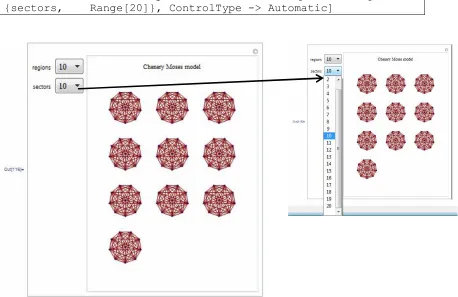
A visual output with controllers added to the number of regions and the
number of sectors is presented in Figure 1. The selection of the number of regions and sectors is made from a dedicated drop down list. The code to generate the dynamic scheme is:
Manipulate[GraphPlot[multicmmatrix[regions, sectors],
[image:13.595.86.544.206.503.2]PlotLabel -> "Chenery Moses model"], {regions, Range[20]}, {sectors, Range[20]}, ControlType -> Automatic]
Figure 1: Snapshots from the dynamic output of Chenery Moses trading network
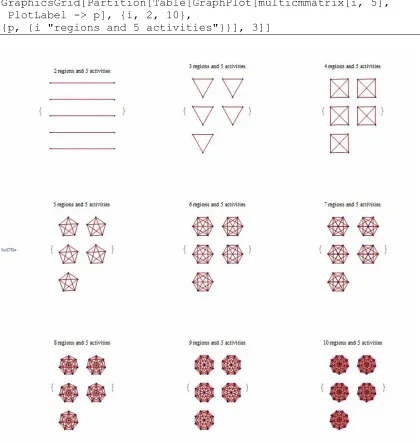
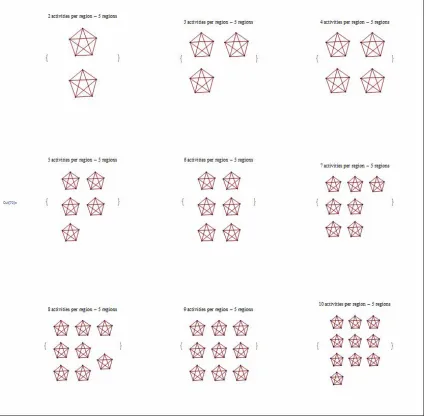
The codes below generate sequences of Chenery-Moses graphs, by following an additive rule for the number of regions or the number of sectors (activities). The
automatic creation of an assigned title per graph, containing the exact number of regions and sectors (activities), is also programmed. The images enable the user realize the intensity of interactions when varying the number of regions (Figure 2) or
GraphicsGrid[Partition[Table[GraphPlot[multicmmatrix[i, 5], PlotLabel -> p], {i, 2, 10},
[image:14.595.89.509.76.519.2]{p, {i "regions and 5 activities"}}], 3]]
Figure 2:
Mathematica output: Chenery-Moses trading network sequence with varying the number of regions
GraphicsGrid[Partition[
Figure 3:
Mathematica output: Chenery-Moses trading network sequence with varying the number of activities
All graphical outputs presented can be reproduced for any case of
Chenery-Moses model, with the desired number of regions and sectors. The only input that needs to be defined is the arguments [i, j] (i corresponds to the number of regions and
j corresponds to the number of sectors) of the multicmmatrix programmed function
within the routines.
To quantify the trading activity of a node we evaluate the degree of a node ni. For
below (we realize that in the Chenery-Moses graph model, all nodes have the same
degree):
VertexDegree[AdjacencyGraph[multicmmatrix[3, 4]]] {4, 4, 4, 4, 4, 4, 4, 4, 4, 4, 4, 4}
The above output’s interpretation is that each one of the 12 traders is involved in 4
trading activities; each self-loop counts for two trading activities. VertexDegree[AdjacencyGraph[multicmmatrix[10, 10]]]
{11, 11, 11, 11, 11, 11, 11, 11, 11, 11, 11, 11, 11, 11, 11, 11, 11, 11, 11, 11, 11, 11, 11, 11, 11, 11, 11, 11, 11, 11, 11, 11, 11, 11, 11, 11, 11, 11, 11, 11, 11, 11, 11, 11, 11, 11, 11, 11, 11, 11, 11, 11, 11, 11, 11, 11, 11, 11, 11, 11, 11, 11, 11, 11, 11, 11, 11, 11, 11, 11, 11, 11, 11, 11, 11, 11, 11, 11, 11, 11, 11, 11, 11, 11, 11, 11, 11, 11, 11, 11, 11, 11, 11, 11, 11, 11, 11, 11, 11, 11}
The above output’s interpretation is that each one of the 100 traders is involved in 11 trading activities.
By the following Mathematica codes we prove empirically that when we increase
the number of activities, the degree of each node (i.e. the number of partners per trader) does not increase. In the next graphical output we plot the number of activities
versus the vertex degree, for a Chenery-Moses model with 5 regions. ListPlot[Table[{k,
VertexDegree[AdjacencyGraph[multicmmatrix[5, k]]][[1]]}, {k,
2, 10^2}], AxesLabel -> {"number of activities", "vertex
On the contrary, the number of regions and the number of partners per trader
are growing analogously. In the next graphical output we plot the number of regions versus the vertex degree, for a Chenery-Moses model with 5 activities.
ListPlot[Table[{k,
VertexDegree[AdjacencyGraph[multicmmatrix[k, 5]]][[1]]}, {k, 2,100}], AxesLabel -> {"number of regions", "vertex degree"}]
By the following Mathematica codes we prove empirically that the degree of
each node (i.e. the number of partners per trader) is the number of regions i plus 1. For an indicative case of a Chenery-Moses model with 5 activities per region, when plotting the number of regions versus the number of trading relationships per trader
and the number of regions versus the number of regions plus 1 in the same axis system, the two scatterplots coincide.
ListPlot[{Table[{k,
VertexDegree[AdjacencyGraph[multicmmatrix[k, 5]]][[1]]}, {k,
2, 10^2}], Table[{k, k + 1}, {k, 2, 10^2}]}, AxesLabel ->
Using a graph-based classification, the Chenery-Moses graph model with i
-regions is an i+1-regular graph.
3.3 The case of Riefler-Tiebout model
Riefler-Tiebout interregional trade model having 3 regions with 4 sectors each corresponds to a graph consisting of 12 nodes {i, j}: the first index corresponds to the
ith region and the second index corresponds to the jth sector. The undirected edges
stand for a bilateral trading activity. The graph model forms a 7-regular graph. The codes to create the Riefler-Tiebout model with 3 regions and 4 sectors are6:
multirtmatrix[i_, j_] := ArrayFlatten[Table[If[n == m, 1, DiagonalMatrix[Table[1, {j}]]], {n, i}, {m, i}]]
AdjacencyGraph[Flatten[Table[{i, j}, {i, 1, 3}, {j, 1, 4}], 1], multirtmatrix[3, 4], VertexLabels -> "Name", ImagePadding -> 30]
6 The text boxes are added by the authors in the MS Word processor and are not part of Mathematica’s
output.
Intraregional intersectoral feedback loop concerning the second region
Intraregional intersectoral feedback loop concerning the first region
Mathematica provides the choice to generate a graph without connecting
self-joined nodes:
GraphPlot[multirtmatrix[10, 10]]
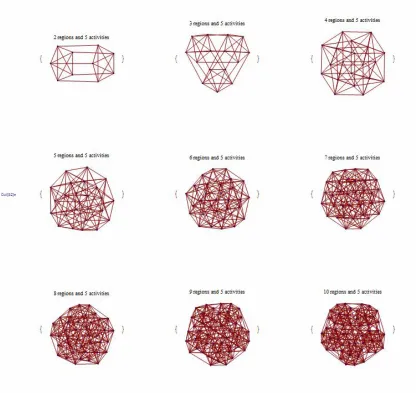
The codes below generate sequences of Riefler-Tiebout graphs by following an
additive rule for the number of regions (figure 4). The automatic creation of an assigned title per graph containing the exact number of regions and activities, is also programmed. By this approach, the complex nature of the structure architecture and
the intensive interrelationship of the entities emerge.
Figure 4:
Mathematica output: Riefler-Tiebout trading network sequence with varying the number of regions
The codes below generate a version of a graph for Riefler-Tiebout model with
controls added to allow interactive manipulation of the number of regions and the number of sectors. The following images enable the user realize the complexity of the trading structure when adding regions and/or sectors to a Riefler Tiebout trading
system (see indicatively the alterations between Figure 5 and Figure 6). Manipulate[GraphPlot[multirtmatrix[regions, sectors],
PlotLabel -> "Riefler Tiebout model"], {regions,
Figure 5: A screen shot of the dynamic image of Riefler Tiebout trade network consisting of 4 regions having 4 sectors each.
Figure 6: A screen shot of the dynamic image of Riefler Tiebout trade network consisting of 5 regions having 9 sectors each.
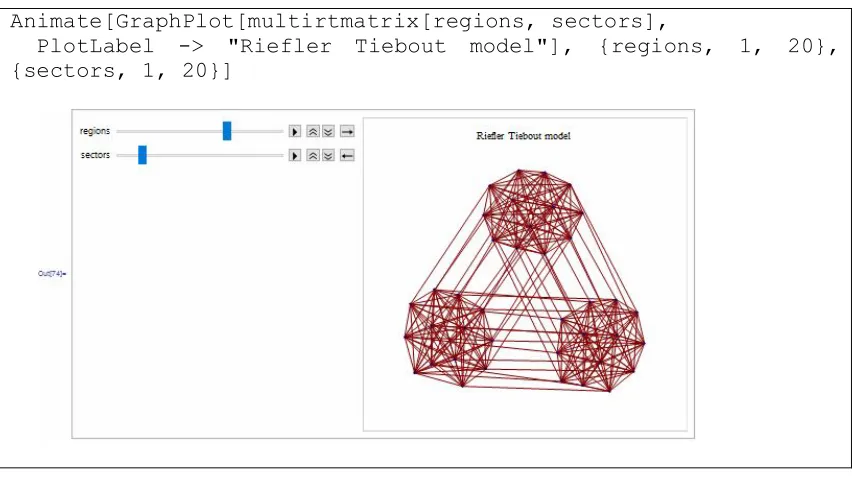
The codes below permit visualization of the formation and evolution of
Riefler-Tiebout trade network by means of real-time animations.
Animate[GraphPlot[multirtmatrix[regions, sectors],
PlotLabel -> "Riefler Tiebout model"], {regions, 1, 20}, {sectors, 1, 20}]
All graphical outputs presented can be reproduced for a Riefler-Tiebout model with any number of regions and sectors. The only input that needs to be defined is the
arguments [i, j] (i corresponds to the number of regions and j corresponds to the number of sectors) of the multirtmatrix programmed function within the routines.
Mathematica also verifies that a Riefler-Tiebout graph is connected7:
[image:21.595.85.512.334.578.2]
ConnectedGraphQ[AdjacencyGraph[multirtmatrix[3, 5]]] True
and performs graph matching. In Riefler-Tiebout case, graphs with symmetric number of regions and sectors (i, j) are proved to be isomorphic:
IsomorphicGraphQ[AdjacencyGraph[multirtmatrix[3, 5]], AdjacencyGraph[multirtmatrix[5, 3]]]
True
To quantify the trading activity of a node we evaluate the degree of a node ni. For the aforementioned Riefler-Tiebout example with 3 regions having 4 sectors each and the example with 10 regions having 10 sectors each, the node degrees are calculated
below (we realize that in the Riefler-Tiebout graph model all nodes have the same degree):
VertexDegree[AdjacencyGraph[multirtmatrix[3, 4]]] {7, 7, 7, 7, 7, 7, 7, 7, 7, 7, 7, 7}
The above output’s interpretation is that each one of the 12 traders is involved in 7 trading activities; each self-loop counts for two trading activities.
VertexDegree[AdjacencyGraph[multirtmatrix[10, 10]]]
{20, 20, 20, 20, 20, 20, 20, 20, 20, 20, 20, 20, 20, 20, 20, 20, 20, 20, 20, 20, 20, 20, 20, 20, 20, 20, 20, 20, 20, 20, 20, 20, 20, 20, 20, 20, 20, 20, 20, 20, 20, 20, 20, 20, 20, 20, 20, 20, 20, 20, 20, 20, 20, 20, 20, 20, 20, 20, 20, 20, 20, 20, 20, 20, 20, 20, 20, 20, 20, 20, 20, 20, 20, 20, 20, 20, 20, 20, 20, 20, 20, 20, 20, 20, 20, 20, 20, 20, 20, 20, 20, 20, 20, 20, 20, 20, 20, 20, 20, 20}
The above output’s interpretation is that each one of the 100 traders is involved in 20
trading activities.
By the following Mathematica codes we prove empirically that the degree of each node (i.e. the number of partners per trader) is the sum of the number of regions i
trader and the number of regions versus the sum of regions and sectors in the same
axis system, the two scatterplots coincide. ListPlot[{Table[{k,
VertexDegree[AdjacencyGraph[multirtmatrix[5, k]]][[1]]}, {k,
2, 10^2}], Table[{k, 5 + k}, {k, 2, 10^2}]}, AxesLabel ->
{"number of activities", "vertex degree"}]
Using a graph-based classification, the Riefler-Tiebout graph model with i
-regions and j-sectors is an i+j-regular graph.
4. Discussion and conclusions
Our computerized graph-based approach creates functions for network description of the trading scheme for classical IO models. Our codes provide a
passage from tabular formats of mathematical formulation to graphical formats of network analysis. Dedicated routines create visual versions of networks displaying classical IO trade models with graphs. Static and dynamic images recover the global
structure of trade interactions. The proposed approach enables the user present, understand and consider the impact of the model size on the intensity of trading
interactions and/or the density of the associated network.
for every IO model used, being the required input in the upcoming codes for visual
outputs. In a second step, selected built-in Mathematica functions generate plots of the associated graph. Graph drawing and graph programming commands and options result in advanced schemes of trade representations. Quantitative results are obtained
by built-in Mathematica functions which evaluate metrics and test graph properties for infinite cases of the classical models studied.
The main advantage of our schematic representation, compared with other visualization techniques, is the focus on trade-cycle loops. The relative findings from our illustrative examples bring out three different cases. The Leontief case study
reveals a trade structure with no trade-cycle loops among regions or among sectors (only self-loops are traced). The Chenery-Moses case study reveals a global trade
network with a number of autonomous8 intrasectoral networks equal to the sectors of the regions. There, interaction and connectivity involve part of the system (partial interconnectedness). The Riefler-Tiebout case study reveals a trading system
equivalent to one compact trade network (one connected graph) with trade ties among most its entities. In this case, interaction and connectivity involve the whole system
(global interconnectedness).
The practical interpretation of the node degree results is that in Chenery-Moses model an increase in the number of activities does not affect the network
density and gives no benefit to any trader of the system. On the contrary, an increase in the number of regions seems in benefit of all traders, since their trading activity
increases. In Riefler-Tiebout model, an increase in the number of both parameters, regions and activities, rises the network density. These results, along with the iterative
8 The set SN is autonomous if and only if there are not any edges from the vertex of N\S to a vertex
schemes which perform experiments with a comparative character, set some
directions for policy making.
Leontief and Riefler-Tiebout models with symmetric number of regions and sectors (i.e. models with i-regions and j-sectors and models with j-regions and i
-sectors) are isomorphic. This information permits the decision maker to manage the number of regions and sectors properly in order to control the network’s connectivity
and the distribution of commodities.
Last, the fact that the trade patterns of the three models under study result in regular graphs, means that traders of the same model deal with the same consequences
Appendix
The adjacency matrix associated with each one of the I-O models under study, is generated in Mathematica by dedicated programmed functions. The codes in
Mathematica are given below. In each matrix, entry 1 is used to indicate the fact that
two sectors are related and 0 that they are not.
multileontiefmatrix programmed function takes as arguments the number of
regions i and the number of sectors j that correspond in each region.
multileontiefmatrix programmed function generates the adjacency matrix of the Leontief model.
multileontiefmatrix[i_, j_] := ArrayFlatten[
Table[If[n == m, DiagonalMatrix[Table[1, {j}]], SparseArray[{}, {j, j}]], {n, i}, {m, i}]]
For example, by writing
multileontiefmatrix[3, 4] // MatrixForm the relevant output is
multicmmatrix programmed function takes as arguments the number of regions i
and the number of sectors j that correspond in each region. multicmmatrix
programmed function generates the adjacency matrix of the Chenery-Moses model.
multicmmatrix[i_,j_]:=ArrayFlatten[Table[If[nm,DiagonalMatrix
[Table[1,{j}]],DiagonalMatrix[Table[1,{j}]]],{n,i},{m,i}]]
For example, by writing
the relevant output is
multirtmatrix programmed function takes as arguments the number of regions i
and the number of sectors j that correspond in each region. multirtmatrix
programmed function generates the adjacency matrix of the Riefler-Tiebout model. multirtmatrix[i_, j_] := ArrayFlatten[Table[If[n == m, 1, DiagonalMatrix[Table[1, {j}]]], {n, i}, {m, i}]]
For example, by writing
References
Alkemade, F., Amman, H. & La Poutre, J., A. (2002). The Role of Information in an Electronic Trade Network. Computing in Economics and Finance, 376, Society for Computational Economics. Accessible at: https://ideas.repec.org/p/sce/scecf2/376.html
Amman, H., Alkemade, F., & La Poutre, H. (2003). Intermediaries in an Electronic Trade Network.
Computing in Economics and Finance, 6, Society for Computational Economics. Accessed from: https:// ideas.repec.org/p/sce/scecf3/6.html
Batten, D & Martellato, D. (1985). Classical versus modern approaches to interregional input-output analysis. The Annals of Regional Science, 19(3), 1-15. DOI: 10.1007/BF01294827
Benedictis, L.D. & Tajoli, L. (2011). The World Trade Network. The World Economy, 34(8), 1417-54. Blöchl, F., Theis, F. J., Vega-Redondo, F. and Fisher, E. O’N., (2011). Vertex centralities in input-output networks reveal the structure of modern economies. Physical Review E, 83(4), 046127. Chenery, H., Clark, P. G., & Cao Pinna, V. (1953). The structure and growth of the Italian economy,
Rome: U.S. Mutual Security Agency.
Cerina F., Zhu Z., Chessa A., Riccaboni M. (2015), World Input-Output Network. PLoS ONE 10(7): e0134025. doi:10.1371/journal.pone.0134025
Chow, W. (2013) An Anatomy of the World Trade Network. Available at
http://www.hkeconomy.gov.hk/en/pdf/An%20Anatomy%20of%20the%20World%20Trade%20 Network%20%28July%202013%29.pdf
Diestel, R., (2000). Graph Theory. Electronic Edition 2000. Springer-Verlag, New York.
Fagiolo, G., Reyes, J. and Schiavo, S. (2008), On the topological properties of the world trade web: A weighted network analysis, Physica A: Statistical Mechanics and its Applications, 387(15), 3868-3873, http://dx.doi.org/10.1016/j.physa.2008.01.050.
Fagiolo, G., Squartini, T. & Garlaschelli, D., (2013). Null models of economic networks: the case of the world wide web. Journal of Economic Interaction and Coordination, 8(1), 75-107.
Fedriani, E. M. and Tenorio, Á. F. (2012), Simplifying the input–output analysis through the use of topological graphs, Economic Modelling, 29(5), 1931-1937, http://dx.doi.org/10.1016/j.econ mod.2012.06.006
Garlaschelli, D. & Loffredo, M.I. (2005). Structure and evolution of the world trade network. Physica A: Statistical Mechanics and its Applications, 355(1), 138-44.
García Muñiz, A.S. (2013), Input–output research in structural equivalence: Extracting paths and similarities, Economic Modelling, 31, 796-803, http://dx.doi.org/10.1016/j.econ mod.2013.01.016
Halkos, G.E. & Tsilika, K. D. (2015). A Dynamic Interface for Trade Pattern Formation in Multi-regional Multi-sectoral Input-Output Modeling. Computational Economics, 46(4), 671-681. DOI 10.1007/s10614-014-9466-3.
Halkos, G.E. & Tsilika, K. D. (2016). Trading Structures for Regional Economies in CAS Software.
Computational Economics, DOI 10.1007/s10614-015-9515-6.
Hitomi, K., Okuyama, Y., Hewings, G. J. D., & Sonis M. (2000). The role of interregional trade in generating change in the regional economies of Japan, 1980#1990. Economic Systems Research, 12(4), 515-537.
Hitomi, K., Hewings, G. J. D., Yamano, N. and Ohkawara, T. (2002). Hollowing Out Process in Regional Economy: an Interregional Input-Ouput Analysis, CRIEPI REPORT Y01014. Available at http://criepi.denken.or.jp/en/publications/criepi_report/
Isard, W. (1951). Interregional and regional input-output analysis: A model of a space economy. The Review of Economics and Statistics, 33, 318-328.
Kim, S. & Shin, E.H. (2002). A Longitudinal Analysis of Globalization and Regionalization in International Trade: A Social Network Approach. Social Forces 81(2), 445-71.
Lantner, R. and Carluer, F. (2004). Spatial dominance: a new approach to the estimation of interconnectedness in regional input-output tables, TheAnnals of Regional Science 38, 451–467. DOI: 10.1007/s00168-003-0178-1
Leontief, W. (1953). Interregional Theory. In W. Leontief (Ed.), Studies in the structure of the American economy. New York: Oxford University Press.
McFadzean, D., Stewart, D. & Tesfatsion, L. (2001). A Computational Laboratory for Evolutionary Trade Networks. IEEE Transactions on Evolutionary Computation, 5(5), 546-560. DOI 10.1109/4235.956717.
McFadzean, D. & Tesfatsion, L. (1999). A C++ Platform for the Evolution of Trade Networks.
Computational Economics, 14, 109-134.
McNerney, J. (2009) Network Properties of Economic Input-Output Networks. IIASA Interim Report. IR-09-003. Available at http://pure.iiasa.ac.at/9145/. Accessed 25 June 2016.
McNerney, J., Fath B.D. and Silverberg G. (2013), Network structure of inter-industry flows, Physica A 392, 6427-6441.
Moses, L.N. (1955). The stability of interregional trading patterns and input- output analysis. American Economic Review, 45, 803-832.
Montresora, S. & Marzettib, G.V. (2009). Applying social network analysis to input–output based innovation matrices: an illustrative application to six OECD technological systems for the middle 1990s, Economic Systems Research 21(2), 129-149. DOI: 10.1080/09535310902940228 Munroe, D. K., Hewings, G. J. D. & Guo, D. (2007). The Role of Intraindustry Trade in Interregional
Trade in the Midwest of the US. In Russel Cooper, Kieran Donaghy, Geoffrey Hewings (eds.),
Globalization and Regional Economic Modeling, Advances in Spatial Science, pp. 87-105. Springer, Berlin Heidelberg.
Olsen, J.A. (1992). Input-output models, directed graphs and flows in networks, Economic Modelling, 9(4), 365 - 384, http://dx.doi.org/10.1016/0264-9993(92)90019-X
Riefler, R. & Tiebout, C. M. (1970). Interregional input-output: an empirical California-Washington model, Journal of Regional Science, 10, 135-152.
Sargento, A. L. M. (2009). Introducing input-output analysis at the regional level: basic notions and specific issues. Regional Economics Applications Laboratory. Discussion Paper, University of Illinois REAL 09-T-4. Available at http://www.real.illinois.edu/d-paper/09/09-t-4.pdf. Accessed 25 June 2016.
Serrano, M.A., Boguna, M. & Vespignani, A. (2007). Patterns of dominant flows in the world trade web. Journal of Economic Interaction and Coordination, 2(2), 111-124.
Smith, D.A. & White, D.R. (1992). Structure and Dynamics of the Global Economy: Network Analysis of International trade 1965-1980. Social Forces, 70(4), 857-93.
Sonis, M., Oosterhaven, J. & Hewings, G. J. D. (1993). Spatial Economic Structure and Structural Changes in the EC: Feedback Loop Input–Output Analysis. Economic Systems Research, 5(2), 173-184, DOI: 10.1080/09535319300000016
Sonis, M., Hewings, G.J.D. and Gazel R. (1995). An examination of multi-regional structure: Hierarchy feedbacks and spatial linkages. The Annals of Regional Science 29, 409–430.
Sonis, M. and Hewings G.J.D. (2001). Feedbacks in input-output systems: Impacts, loops and hierarchies. In: Lahr M, Dietzenbacher E, Input-output analysis: Frontiers and Extensions. Palgrave, London.
Studer, K. E., Barboni, E.J., Numan, K.B., (1984), Structural analysis using the input-output model: With special reference to networks of science, Scientometrics, 6(6), 401-423.
Wilhite, A., (2001). Bilateral Trade and «Small-World» Networks. Computational Economics, 18(1), 49-64.
Wixted, B., Yamano, N. & Webb, C. (2006). Input-Output Analysis in an Increasingly Globalised World: Applications of OECD's Harmonised International Tables. OECD Science, Technology and Industry Working Papers, 2006/07, OECD Publishing. Available at
http://dx.doi.org/10.1787/303252313764 Accessed 25 June 2016.