warwick.ac.uk/lib-publications Manuscript version: Published Version
The version presented in WRAP is the published version (Version of Record).
Persistent WRAP URL:
http://wrap.warwick.ac.uk/126474
How to cite:
The repository item page linked to above, will contain details on accessing citation guidance from the publisher.
Copyright and reuse:
The Warwick Research Archive Portal (WRAP) makes this work by researchers of the University of Warwick available open access under the following conditions.
Copyright © and all moral rights to the version of the paper presented here belong to the individual author(s) and/or other copyright owners. To the extent reasonable and
practicable the material made available in WRAP has been checked for eligibility before being made available.
Copies of full items can be used for personal research or study, educational, or not-for-profit purposes without prior permission or charge. Provided that the authors, title and full
bibliographic details are credited, a hyperlink and/or URL is given for the original metadata page and the content is not changed in any way.
Publisher’s statement:
Please refer to the repository item page, publisher’s statement section, for further information.
1
UK Summary Report on IEA Heat Pump Technology Collaboration Programme (TCP) Annex 43: Thermally Driven Heat Pumps
January 2019
Prof. R.E. Critoph Dr S.J. Metcalf School of Engineering University of Warwick
2
Contents
1. Introduction 1
2. Overview of Annex and Tasks 3
3. Progress and Conclusions of Annex Tasks 4
3.1 Task A: Country reports 4
3.2 Task B: Technology Transfer: 7
3.3Task C: Field test and performance evaluation 7 3.4Task D: Market potential study and technology roadmap 8
3.4.1 Simulation of impact 8
3.4.2 Sorption Pair Database 12
3.4.3 Technical state of the art, industrial developments 13
4. Summary and future prospects: where are gas heat pumps going? 15
1
1. Introduction
The context and rationale for the UK’s involvement in the IEA Heat Pump Programme lies in its commitment to reducing Greenhouse Gas (GHG) emissions as laid down in the Climate Change Act 2008 [1]. The route to achieving the target of at least 80% by 2050 when compared to 1990 levels is laid out in policy documents including the Clean Growth Strategy [2]. It notes that heating in
buildings and industry accounted for 32% of total UK emissions in 2015 and that to meet carbon budget objectives ‘the UK will need to nurture low carbon technologies, processes and systems that are as cheap as possible’. More specifically the Strategy supports a number of measures including innovation programmes to develop new energy efficiency and heating technologies to enable lower cost low carbon homes.
The UK total GHG emissions in 2016 was 466 Mt of which 374 Mt were CO2[3]. 55 Mt of the
emissions were from Domestic Gas Boilers amounting to 15% of UK CO2 and 12% of total GHGs (Fig.
1). Part of the solution to decarbonising heat is the use of heat pumps in individual homes. A heat pump uses energy (commonly electricity but in this case natural gas) to heat a house with more than 100% ‘efficiency’ by pulling in heat from the ambient air or the ground. Air source machines are
[image:4.595.80.522.345.499.2]easier to install than ground source systems and have lower capital cost, since they do not require a ground loop or borehole. Gas heat pumps (GHP) (Fig. 2) are designed as direct replacements for gas boilers, but have 30-40% less fuel consumption, running costs and emissions.
Fig. 1: CO2 emissions (Mt) by end use, 2016 Fig. 2: Principle of the Gas Heat Pump (GHP)
In order for a complete move to electric heat pumps to occur, the electrical grid and distribution system would require significant upgrade. Fig. 3 illustrates the scale of the problem. The peak heat load is estimated to be approximately 170 GW, so assuming electric heat pumps at the coldest period of the winter to have a COP (Heat out over Electricity in) of 2.5 around 68 GW of extra electricity capacity would be needed. The present peak electricity load is approximately 60 GW. The required infrastructure upgrades would be significant to meet these additional peak electricity loads. Whilst some of this could be mitigated by heat storage, the extra load presented by Electric Vehicle (EV) charging could make the problem worse. Some scenarios include the possibility of
‘decarbonising the gas grid by substituting natural gas with low carbon gases like biogas and hydrogen’ [2] in which case the gas grid is likely to have a role to play up to 2050 , and gas heat pumps could have a role to play in reducing carbon emissions throughout this period. The gas grid may be partially or wholly replaced with bio-methane or renewably produced hydrogen, and gas heat pumps would have a role in reducing the amount of sustainably produced gas required.
Energy Supply 111
Business 62 Transport 120
Residential 66 Other 16
18%
32%
30%
16%
4%Natural gas
Ambient air
2
There will be a need for both gas and electric heat pumps for a long time, but the exact mix will depend on the quantity and source of future low carbon electricity. Both technologies are needed to ensure flexibility to adapt to an uncertain future.
With this background in mind, in 2013 the UK joined the International Energy Agency (IEA) Heat Pump Annex 43, Fuel Driven Heat Pumps. The IEA Heat Pump Programme (HPP) Annexes work by task sharing, with each participant country covering its own costs plus those of the coordinator. The participants define common goals and work plan, etc. that are approved by the Executive Committee (ExCo) of the HPP. The ExCo nominates national institutions to carry out the tasks, funding them as deemed appropriate. The UK commissioned the University of Warwick to participate in Annex 43 commencing July 2013 for an anticipated 4 years. The participating countries were additionally:
• Germany - Operating Agent (Fraunhofer ISE)
• Italy (CNR-ITAE, Messina)
• Austria (AIT)
• France (Engie)
• USA (ORNL)
The reasons for initiating the Annex were:
• The market for fuel driven heat pumps was rising
• Emerging technology was just starting to enter the market
• The need for quality assurance measures
• The need to optimize the best system configurations for different applications
• The need for standards on test procedures
• The need for common understanding of field tests
• To present a common set of recommendations
The scope was fuel driven sorption heat pumps for residential and light commercial heating (e.g. < 50 kW), with dual purpose heating/cooling allowed but not cooling-only systems.
The goals were to identify:
[image:5.595.182.412.68.290.2]• easy and sustainable market entrance and deployment mechanisms
3
• market barriers and opportunities
• the potential markets and importance in future energy systems and appropriate market supporting measures
2. Overview of Annex and Tasks
The work programme was split into four tasks:
Task A: Generic systems and system classification (Fraunhofer Institute for Solar Energy Systems ISE)
It was necessary for the purposes of comparing sorption systems to categorize and classify them by heat source, type of heat distribution (Low temperature radiators, underfloor heating etc) and by the fuel used. In addition, the safety and other regulations applying to different types in different countries needed to be compared. This information was to be compiled, together with status and market prospects in a series of Country Reports and then combined in a deliverable at the end of the Annex.
Task B: Technology transfer (Warwick)
Warwick facilitated the knowledge transfer between partners and also developers /
manufacturers prepared to share their experience. The purpose was to inform Task D below as well as disseminating via national meetings and reports.
Task C: Field test and performance evaluation (Polimi)
Measurement/monitoring procedures and standardisation (e.g. how to cope with different fuel quality, system boundaries, aux. energy etc.) was an important issue to be addressed. The work from the IEA Annex 34 (Thermally Driven Heat Pumps for Heating and Cooling, 2009-2012) and Task 44 (Solar and Heat Pump Systems 2010-2013), was to be continued and standards extended to seasonal performance factors at the system level. Procedures were to be established in cooperation with IEA SHC Task 48 (Quality Assurance & Support Measures for Solar Cooling Systems). This activity was to be backed up with laboratory testing and field trials.
Task D: Market potential study and technology roadmap (CNR-ITAE)
• Simulation study to evaluate different technologies in different climate zones, different building types and building standards
• Combine with market data and actual building stock for technology roadmap (Warwick/Delta-EE input for UK)
Task E: Policy measures and recommendations, information
• Dissemination
• List of workshops - recommendations in final report
• Workshops for planners, installers and decision makers
4
3. Progress and Conclusions of Annex Tasks 3.1 Task A: Country reports
The individual reports for the UK, Germany, Austria, Italy, USA, Korea will be publicly available on the Annex website [5] from May 2019 and will be included in the Annex Final Report. DeltaEE produced the country report for the UK in June 2014 – the first for any of the participating countries and is summarised as follows:
Position as of 2014: The vast majority of the UK domestic building stock uses a single system for space heating and hot water production. The UK market is dominated by gas boilers, which make up 85% of the installed base of heating systems. Further breaking down gas boiler sales, wall-hung gas combi boilers (for space heating and hot water production, and which generally have no water tank) are becoming the dominant type. They make up around half of the installed base of gas boilers, but are increasing their share, and are sold in the highest numbers per year. Heat pumps and other renewable technologies account for less than 2% of the market. ASHP (air/water type) is by far the dominant type of heat pump. Hybrids (air/water HP combined with gas boiler) are emerging in the UK market and sales are expected to increase significantly in the next few years. One domestic scale gas absorption heat pump is available in the UK [Update from original report, 9].
Market Drivers:
• The most important market driver for heat pumps in the UK should have been the
Renewable Heat Incentive (RHI) but gas heat pumps were not included. The scheme began in 2014 and as of August 2018, some 32,000 air source electric heat pumps have been included in the scheme [6].
• Tightening building regulations were only seen to play a minor role in the uptake of heat pumps in the UK new build segment over the coming years.
• Utilities in the UK are involved further down the value chain of the heating sector than in many other countries – and are taking steps into heat pumps which could drive market growth.
• Reducing running costs for their tenants and meeting carbon reduction targets are two of the main drivers for the installation of heat pumps in the social housing sector.
• Cost of electricity versus gas favours gas technologies
• Gas costs a quarter of the price of electricity in the UK, which makes electric heat pumps struggle to compete on the gas grid. Projections are for electricity prices to increase faster than gas prices. This creates a major opportunity for low carbon gas technologies including gas heat pumps, which can have a strong economic case against gas boilers in a sector where many other renewables struggle.
• Limitations of the electricity grid can favour gas technologies. On the residential level most customers in the UK are supplied with single-phase electricity. As a result, the grid has little capacity to connect large loads – an issue which could create challenges with electric heat pump installation.
5
• Drivers specific to the non-domestic sector but additional to those above include; limitations of the electricity grid, meeting new build regulations, achieving running cost savings
(retrofit) and recommendations from trusted companies.
Market Barriers
• The upfront cost for heat pumps is an important barrier for heat pumps both on and off-gas – especially given that there is no “culture” of investing in heating systems in the UK.
• Heat pumps are still considered as a new and risky technology by a wide section of the public.
• Quality does not yet permeate the whole UK heat pump value chain, e.g. there is insufficient end-user education about how to operate their heat pump and under or over sizing of heat pumps by installers/specifiers.
• There is a need to further develop the sales and distribution networks for fuel driven heat pumps. Ultimately, for fuel driven heat pumps to reach their potential, a greater number of sales channels must be created, and there is need for an increasing number of qualified heat pump installers.
• UK homes are small in comparison to most other European nations (except the Netherlands which is comparable) – there are challenges with finding space for large systems and storage tanks.
• The average size of new build UK homes is one of the smallest in Europe. Further, unlike homes in e.g. Germany, UK homes rarely have basements and heating systems are typically installed within the living space.
• There is an increasing preference for instantaneous hot water rather than a hot water storage tank [7]. Many new builds do not have a hot water storage cylinder and many existing homes have had the cylinder removed and the space repurposed. There is not as yet a heat pump that can deliver instantaneous domestic hot water (DHW).
National legislation and subsidy/incentive programs
Gas Absorption Heat Pumps are currently defined in European performance standard EN 12309 which sets the criteria for performance testing of the systems. In the UK, the Microgeneration Certification Scheme (MCS) also provides standards for quality of performance for gas heat pumps which are based on the current European standard.
The Renewable Heat Incentive (RHI) currently supports electrically driven heat pumps for both domestic and non-domestic buildings, however gas heat pumps are currently not included within this scheme.
Influence of housing stock
6
Typically ~3,000 kWh is hot water demand which has not changed throughout the time of this project. There is almost no cooling demand. The heat distribution in the UK building stock is dominated by high flow temperature radiator systems, running at 70°C and above – creating a challenge for heat pumps. In addition, the typical operating patterns of UK heating systems differ from those in many other countries in Europe – instead of keeping the home at a relatively stable temperature, customers in the UK tend to use their heating systems in “bursts”. Such an operation strategy is not well suited for a heat pump and could reduce performance, but gas heat pumps suffer fewer limitations than electric ones in this respect.
Conclusions
• There is significant opportunity for fuel driven heat pumps in the UK.
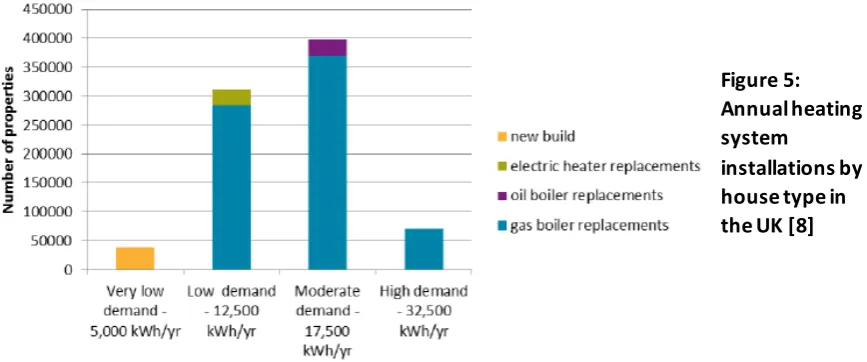
• Current sales in the domestic sector are at zero, but this could exceed 30,000 per year by 2025 [8].
• A product which is small and compact, can reach high flow temperatures, and can make savings against a gas boiler, will have a significant impact on the UK, the biggest domestic gas heating market in Europe.
• Government intervention is necessary in order to stimulate the market, based on our understanding of the economic proposition which GHP can provide today combined with knowledge of the many market barriers which exist. An incentive such as the RHI could go some way to overcoming some barriers by making the economic proposition more positive. However, a RHI alone will not overcome other barriers.
• A marketing & awareness-raising campaign is essential, which reaches across the value chain, to overcome the low awareness and poor perception from end-users, installers and building industry professionals.
• Manufacturers will invest in advancements to the technology and supply chain once they have the confidence that policy makers are serious about supporting gas HP on a level playing field with other renewables, and once marketing and awareness-raising campaigns start to increase customer and installer pull for the technology.
• Special attention should be paid to the building services professionals responsible for specifying new heating/cooling systems. This is the critical point in the value chain in commercial buildings, where a decision for a GHP could be made - but in most cases is not.
• Incentive scheme design should ensure the possibility exists for 3rd party ownership of
[image:9.595.84.518.75.256.2]renewable systems – to allow for alternative business models which can reduce upfront
Figure 5: Annual heating system
7
costs. (Update from original report – the RHI now includes Assignment of Rights allowing a 3rd party to receive the RHI and providing the heating system at low or zero cost).
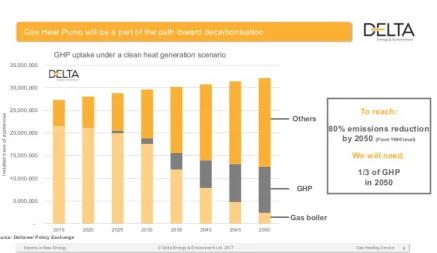
Delta-EE provided additional information and updates in December 2017 [9]. The report concluded that a possible route to achieve the 2050 emissions target included approximately one third of the thirty million heating appliances in 2050 as gas heat pumps (Figure 6). This only looks at an 80% reduction in emissions from buildings, however it should be noted that further reductions may be necessary to accommodate other sectors that are more difficult to decarbonise. The challenge is the poor predicted economics with poor payback times despite good lifetime costs. Reducing first cost is key and early adopters / innovators will remain vital to uptake in the UK. High growth is possible but for the customer economics to improve the UK needs:
1. Mandating of additional measures at heating system install/replacement. 2. Increased utility engagement.
3. New business models and routes to market to emerge.
[image:10.595.83.521.290.543.2]4. Increased engagement & support from network operators.
Figure 6: GHP uptake to 2050 3.2 Task B: Technology Transfer
Warwick produced reports e.g. Gas driven heat pumps: market potential, support measures and barriers to development of the UK market [10], and at National Heat Pump Team meetings [11, 12, 13]. Further Technology Transfer activities such as workshops overlap Task E and are listed below and a joint paper on technical developments across the whole Annex is currently being coordinated by CNR-ITAE.
3.3 Task C: Field test and performance evaluation
8
heat pump performance has been advanced. ISE and Polimi carried out round-robin tests on the Vitosorp 200-F (Viessmann) and achieved excellent agreement in their results, which also agree with field test data provided by Viessmann. The testing protocols used have been published [16] and submitted to the standards authorities to update EN12309. A new field test procedure has been put to Annexes 43 and 48 and is available on the website [17].
Warwick subcontracted Kiwa to carry out dynamic tests on a Robur 38 kW water-ammonia absorption heat pump. Kiwa have a test bed that can simulate a dynamic heating load in a repeatable way. This enables repeatable comparisons between, as was done in this study, a condensing boiler, an air source electric heat pump and a gas heat pump. The Kiwa report [18] was instructive but not conclusive. The Robur 38 kW machine tested was the only one on the market and it would have been useful to have tested the ‘half-size’ Robur K18 which was not available then. Two house sizes and different heating patterns (once and twice per day) were used. The gas heat pump could only be tested with the large house size and the electric heat pump with the small house. The results were inconclusive in that the complexities of control etc. are crucial and the production of domestic hot water was not included, but the difficulties of obtaining meaningful comparisons and the reasons for differences between declared performance and field-testing were highlighted [18].
3.4 Task D: Market potential study and technology roadmap 3.4.1 – Simulation of impact
Polimi [19] carried out simulations of the ammonia-water heat pump developed in the Heat4U project (now available as the Robur K18) using their validated TRNSYS model. The climates used were for Helsinki, Strasbourg and Athens. Warwick adapted the model and used data for the UK (Birmingham climate and housing stock based on the Cambridge Housing Model [20] to evaluate the effectiveness of these heat pumps in reducing emission levels in the UK. The study is still to be published but a summary of the methodology, results and conclusions is as follows.
Housing types
The three house types modelled were Terraced (solid wall), Semi-Detached and Detached (post construction filled cavity), which were chosen by calculating average values from the Cambridge Housing Model [20].
Climate and Heating Control Strategy
The chosen location was Birmingham, and the model was built in TRNSYS which includes Meteonorm weather data. Two heating control strategies were modelled: Twice per day and all-day. For the twice per day heating control the internal set temperature was maintained between 6am-8am and 5pm-10pm. For the all-day heating control, the internal set
temperature was maintained from 8am to 10pm. The internal set temperature was 20°C. The EU standard tapping profile No. 2 (100 litres per day) was taken for the Domestic Hot Water (DHW) consumption.
Heating Systems
Five heating systems were modelled for comparison and are detailed in the table below.
No. Heating System Capacity
1 Condensing Boiler 12 kW
2 GHP 18 kW
9
4 15 kW Electric HP + Auxiliary Electric Heater 15 kW
5 9 kW Electric HP + Auxiliary Electric Heater 9 kW
Modelled Heating Systems
The GHP capacity was 18 kW as per the Robur K18 and with a turndown ratio of 5:1. In anticipation that 18 kW may be slightly oversized, a half capacity 9 kW machine with condensing boiler backup was also modelled for comparison. It was assumed that this machine would have the same Gas Utilisation Efficiency (GUE, the ratio of heat output to gas input) and half the parasitic electrical power requirement of the 18 kW machine.
Two electric heat pumps: 15 kW and 9 kW were also modelled for comparison on the basis of running costs and CO2 emissions. Backup was considered to be provided by direct electric
heating.
The heat emitters were considered to operate at the EU standard ‘high’ temperature with 55°C supply temperature for both the GHP and electric heat pump. This is generally sufficient for standard radiators fitted to UK houses, since a heat pump would operate at a lower output over a longer period of time than a boiler, which would tend to cycle on and off frequently. For houses where the radiators are undersized this can often be remedied by replacing type 11 (1 radiator panel and 1 set of convection fins ) and 21 (2 radiator panels and 1 set of convection fins) radiators with types 22 (2 radiator panels and 2 sets of convection fins ) and 33 (3 radiator panels and 3 sets of convection fins).
The EU standard tapping profile No. 2 (100 litres per day) was taken for the Domestic Hot Water (DHW) consumption utilising a hot water cylinder.
Model
The modelling was carried out by Politecnico di Milano (POLIMI) using TRNSYS and is described in Scoccia et al [19]. It includes modelling of the thermal mass of the building structure and contents.
Results
The tables below show the results for the twice per day and all-day heating control. The gas price was taken as 2.8 p kWh-1 and the electricity price 12.4 p kWh-1. The latest BEIS
conversion factors (July 2018) were used for the gas and electricity CO2 emissions at 0.18396
kg CO2e/kWh and 0.28307 kg CO2e/kWh, respectively.
Model Results: Twice per Day Heating Control (CB=Condensing Boiler, GHP=Gas Heat Pump, EHP=Electric Heat Pump, AEH=Auxiliary Electric Heater)
Building
Type Size Sim Code GUE/COP Heat Delivered
[kWh] Gas Used [kWh] Used [kWh] CO2 [kg]Electricity Fuel Cost [£]
% Heat Delivered by
HP Heat Pump GUE/COP
CB 12 kW 1.1 0.892 31640 35466 243 6593 £ 1,023 0
-Detached GHP 18 kW 2.1 1.37 31619 23059 827 4476 £ 748 100 1.37 GHP+CB 9+12 kW 4.1 1.26 31663 25163 1135 4950 £ 845 78 1.45
CB 12 kW 6.1 0.9 18120 20124 181 3753 £ 586 0
-Semi-Detached GHP 18 kW 7.1 1.37 18141 13214 541 2584 £ 437 100 1.37 GHP+CB 9+12 kW 9.1 1.31 18131 13867 785 2773 £ 486 88 1.43 CB 12 kW 11.1 0.904 22050 24390 220 4549 £ 710 0 -GHP 18 kW 12.1 1.37 22076 16113 676 3156 £ 535 100 1.37 Terraced GHP+CB 9+12 kW 14.1 1.33 22061 16531 917 3301 £ 577 89 1.43 EHP+AEH 15 kW 15.1 2.4 22046 0 9187 2601 £ 1,139 94 2.66 EHP+AEH 9 kW 16.1 2.09 21999 0 10517 2977 £ 1,304 80 2.85
10
Model Results: All Day Heating Control (CB=Condensing Boiler, GHP=Gas Heat Pump, EHP=Electric Heat Pump, AEH=Auxiliary Electric Heater)
The electric heat pump was only modelled for the terraced house, so the charts below show the CO2 emissions and running cost comparison for the terraced house with twice per day
heating control. The results are not significantly different for the all-day heating control.
Annual CO2 Emissions for Terraced House with Twice per Day Heating Control
Annual Fuel Cost for Terraced House with Twice per Day Heating Control Building
Type Size Sim Code GUE/COP Heat Delivered
[kWh] Gas Used [kWh] Used [kWh] CO2 [kg]Electricity Fuel Cost [£]
% Heat Delivered by
HP Heat Pump GUE/COP
CB 12 kW 1.2 0.898 33983 37858 268 7040 £ 1,093 0
-Detached GHP 18 kW 2.2 1.38 34034 24708 901 4800 £ 804 100 1.38 GHP+CB 9+12 kW 4.2 1.3 34006 26166 1234 5163 £ 886 84 1.45 CB 12 kW 6.2 0.908 19247 21201 203 3958 £ 619 0 -Semi-Detached GHP 18 kW 7.2 1.37 19257 14017 584 2744 £ 465 100 1.37 GHP+CB 9+12 kW 9.2 1.34 19256 14407 831 2886 £ 506 92 1.43 CB 12 kW 11.2 0.907 23556 25965 239 4844 £ 757 0 -GHP 18 kW 12.2 1.38 23571 17149 710 3356 £ 568 100 1.38 Terraced GHP+CB 9+12 kW 14.2 1.38 23564 17349 977 3468 £ 607 91 1.43 EHP+AEH 15 kW 15.2 2.56 23556 0 9206 2606 £ 1,142 96 2.76 EHP+AEH 9 kW 16.2 2.3 23505 0 10211 2890 £ 1,266 85 3.01
Heating Control: Once per day. 8am-10pm Plant 0 1 2 3 4 5 To nne s C O2 pe r A nnum
CO
2Emissions
CB 18 kW GFHP 9 kW GFHP 15 kW EHP 9 kW EHP
0 200 400 600 800 1000 1200 1400 Fue l C os t pe r A nnum
Running Cost
11
Analysis
The results show that an 18 kW GHP with 5:1 turndown ratio performs well in all 3 house types, giving a seasonal GUE of 1.37-1.38 and a fuel cost saving of between 25 and 27% compared to a condensing boiler. However, a 9 kW machine with condensing boiler backup could provide more than 80% of the demand via the heat pump and still save 18-20%. If a 9 kW machine were introduced at significantly lower capital cost than an 18 kW machine, then its payback time would be shorter. The conclusion is therefore that a machine in the region of 10 kW would be ideal for the UK market.
The running cost of the GHP is around half that of the electric heat pump at current electricity prices. Electricity grid CO2 emissions are relatively low at the present time which
means that the electric heat pump has 18% lower CO2 emission than the GHP. GHP CO2
emissions are 31-32% lower than a condensing boiler. Potential Effect on UK CO2 Emissions
Two theoretical deployment scenarios for GHPs are considered: The first assumes that the market will saturate at a 70% share of gas heating appliances annual sales after
approximately 12 years (the rest of the market remaining as condensing boilers). The second assumes that after 7 years on the market, the cost of GHPs reaches the point where
legislation requiring their use is introduced, in much the same way as was carried out for condensing boilers replacing non-condensing boilers.
Scenarios for GHP Market Sales Share
Current CO2 emissions from domestic gas fired heating systems are around 55 Mt per
annum, compared to around 80 Mt in 1990. The figure below shows firstly what happens if the status quo is maintained (blue line) of replacing boilers with condensing boilers (current mean UK boiler efficiency obtained from the Cambridge House Model and an assumed boiler lifetime of 15 years). Emissions would reach around 49 Mt by 2040 if all boilers were by then condensing.
0% 10% 20% 30% 40% 50% 60% 70% 80% 90% 100%
2025 2030 2035 2040 2045 2050
M
ar
ke
t S
ha
re
12
Potential Domestic Gas Heating Appliance CO2 reductions
By replacing boilers with GHPs, the figure shows that CO2 emissions could reach a minimum
of 34 Mt by around 2045, representing a 6% reduction in overall UK CO2 emissions compared
to today and a 4% reduction compared to the status quo scenario. This is a major impact for just a single technology. However, in order to meet the requirement for near zero emissions from buildings in 2050, it would be necessary to partly or fully decarbonise the gas grid and to improve insulation levels.
Conclusions
Modelling has shown that a GHP could achieve an annual Gas Utilisation Efficiency of around 1.38 in UK homes and save between 25 and 27% in fuel costs compared to a condensing boiler. The ideal machine capacity for minimum payback time is likely to be in the region of 10 kW.
3.4.2 – Sorption Pair Database
There was an original intention to expand on the work of Annex 34 and produce a sorption pair database confirmed by round-robin tests [21]. Annex 34 of the IEA Heat Pump Programme, entitled ‘Thermally Driven Heat Pumps for Heating and Cooling’ ran from 2009 to 2012. Its scope was the use of thermally driven heat pumps and chillers in domestic and small commercial buildings and
industrial applications. One work package aimed to set up an adsorbent materials database and to devise standardised testing methods that could be used in many laboratories. In order to develop improved systems it is essential to have reliable data on (in particular) the adsorption characteristics of a whole range of existing and novel solid adsorbents with refrigerants such as water, methanol, ethanol or ammonia. The challenge was to standardise testing methods and produce a robust database of results for different sorbent pairs. This was evaluated by round-robin tests of the same materials in different laboratories, ISE (Germany) and CNR-ITAE (Italy). Within Annex 43 it was hoped both to increase the number and type of water sorbents within the database and to extend the coverage to adsorption of other sorbates such as methanol and ammonia. Warwick carried out tests on ethanol with six different adsorbents and the results were confirmed by CNR-ITAE. It was not possible to do round robin tests on ammonia adsorbate pairs since Warwick was the only laboratory
0 10 20 30 40 50 60 70 80
2025 2030 2035 2040 2045 2050
CO
2 E
m
iss
io
ns
(M
t pe
r a
nnum
)
Year
13
equipped to work with ammonia. Given the very large number of carbons, silica gels, zeolites, etc. that can be used as adsorbents it did not seem useful to round-robin test many more adsorbents unless ones with particularly good properties arose.
However, access to even a single source of data on many more pairs is very useful to the community. ORNL has expanded and released its own database and simulation packages ‘SorpPropLib’ and ‘SorpSim’. The property library now has adsorption as well as absorption pairs. The two packages are being linked as described in Ref. 22. A screenshot (below) illustrates the absorption modelling abilities of SorpSim.
3.4.3 Technical state of the art, industrial developments
Warwick contributed updates on its own research activities, state of the art and market analysis in [10-13, 25].
There was considerable exchange of technical information on projects within the partner countries, which was very useful in being able to follow the trends in R&D over the period, and it is worth summarising here.
The industrial/manufacturing situation is:
• Prior to the start of the Annex, Robur (Italy) had the only real sorption system on the market: a 38 kW ammonia water heat pump with good performance and GUE [23]. There was information from field trials in a number of commercial installations but it has too high a power rating for domestic use.
• Prior to the annex, Robur had field-tested an 18 kW machine under the EU ‘Heat4U’ project and limited data on the results were made available. The unit is now commercially available [24], retailing at c. £9k in the UK.
14
and burns gas in boiler mode when it is too cold. The savings on a gas boiler are around 10-20% over a year when installed well and in favourable conditions, which is not enough to be justified economically. The product is no longer marketed and Vaillant now offers a gas hybrid heat pump.
• Viessmann (Germany) had a very similar product to the Vaillant machine [25] but after several years of development, they abandoned the work [26] and it is no longer marketed. The main reasons were changes in the supply chain and focus on electrical heat pumps, but also the capital cost compared to savings which under current conditions made the product economically unattractive.
• Viessmann also had a lower TRL absorption machine under development that used
absorption of ethanol refrigerant with an organic solvent [25]. Potentially, this was a good product with GUE > 1.4, air source and very compact. Unfortunately, it was also cancelled along with the adsorption machine, despite being an interesting mid-term prospect.
• Stiebel Eltron (Germany) also worked on a water-zeolite adsorption heat pump [27] together with Fahrenheit (formerly SorTech) and Fraunhofer ISE. Currently no further development is known. In general there is a strong focus on electric heat pumps specifically in Germany, also due to larger shares of renewable electricity in the grid compared to other European
countries.
• BoostHeat (France) have been developing a ‘thermal compressor’ (not a sorption device) for nearly five years [28, 29]. It uses carbon dioxide as a working fluid with heat input at high temperature (600°C) from a gas flame. Predicted performance (also proven in prototype measurements) is good at a GUE of 1.75 (gross, -10/55°C) in a 20 kW unit. A 20 kW machine was launched in 2018 for sale in France, Germany, Belgium and Switzerland at a cost of €14,300 for the unit and an estimated installed cost of €18,000. The size is 1850x600x880 mm indoor unit and 1020x1130x500 mm outdoor unit [28].
• Stone Mountain (USA) are developing a range of water ammonia absorption heat pumps (3
kW for DHW up to 30 kW) for the US market under DoE contracts [30]. They have a track record in the technology, which is broadly similar to Robur’s. However unlike Robur they are not a manufacturer but an R&D company. The US perspective emphasises minimum capital cost, similar to the approach needed in the UK.
• Salt-X (Sweden), previously ClimateWell, use water – salt and ammonia – salt adsorption reactions for refrigeration and heat pumping. They are developing two concepts. The first is a DHW heater in which a water-salt unit has achieved a GUE of 1.15 and an ammonia version is expected to achieve 1.27 [31]. The second concept, working with ORNL in the USA and Fraunhofer ISE in Germany is a residential space heating and DHW unit expected to have a GUE of 1.25. They hope to go to market via Rheem in the USA.
• Bosch (Germany) developed an 18 kW ammonia water absorption heat pump over several
years, carried out field trials and were very close to market with manufacturing routes and suppliers established when the project was cancelled in 2018 [32]. This was a great disappointment to the community, who regarded their involvement as vital to the
15
helpful, since existing suppliers can be more easily motivated to participate in something, which will initially only have small volumes.
• Ariston Thermo (Italy) have entered the ammonia – water heat pump area in the last two years but have the benefit of experienced personnel. They are developing a 10 kW unit (suitable for UK) with a GUE of 1.5 (net, 7/55°C) and projected mass production (105/year) of
€3,000. If successful, this could prove disruptive to the gas boiler market.
When the Annex began it seemed perfectly reasonable that by the end there would be reports on field trials and demonstrations of many products and testing protocols etc. were devised. Potential systems to be tested included those by Vaillant, Viessmann, Stiebel Eltron and Bosch. Unfortunately their demise meant that only Robur machines are on the market and they had no great incentive to fund trials after the Heat4U project. This led to plans for field trials being shelved.
Research institute / university research
There are active research projects at the Fraunhofer ISE in Freiburg, CNR-ITAE in Messina, Polimi in Milan and Warwick. Both ISE and CNR-ITAE are locked into water-adsorption technology, which presents challenges for gas heat pumps. ISE are looking at research ideas such as evaporating water out of antifreeze solution or from thin films at <0°C (also at the Technical University of Berlin in Li-Br absorption) or niche applications such as ventilation waste heat recovery where the source
temperature is reasonably high. On appliance level, both Fraunhofer ISE and Politecnico di Milano are able to perform standard rating measurements on all types of Gas Driven Heat Pumps and discussion is ongoing about e.g. enhancing/adapting EN12309. CNR-ITAE are only researching air conditioning applications.
At Warwick, where the goal is an air source heat pump to replace the gas boiler, work continues on an ammonia-carbon heat pump as part of the BEIS Low Carbon Heating Technology Innovation Fund to take the system from TRL 6 to TRL 8. In addition, they are working on a lower TRL (2-3) concept which also uses ammonia but in a ‘resorption’ cycle in which the ammonia combines chemically with two salts. The potential advantages are higher efficiency plus much greater simplicity, leading to low capital cost.
Universities in Regensburg, Berlin and Nuremburg are carrying out research projects on absorption cycles using an alcohol refrigerant with organic solvents, similar to the cancelled Viessmann project. Whilst still low TRL they might possibly give good GUE (1.4 net) in a compact domestic ammonia-free air source heat pump.
4. Summary and future prospects: where are gas heat pumps going?
16
More generally, a view needs to be taken on the role of gas heat pumps in the transition to a zero carbon future. There is a window of opportunity for gas plus technologies: gas heat pump,
condensing boiler plus solar, or hybrids (condensing boiler plus electric heat pump), before the energy transition reaches its goal of full decarbonisation. These gas plus solutions address problems such as seasonality of heating, energy storage and distribution before the building stock develops towards / into “nearly zero carbon”; a prerequisite to reach the goal but with uncertain timeline. The extent of this window of opportunity is important to know, particularly for manufacturers, since it determines whether their investment is justified – is there enough time for payback of
investments, developing further generations, “having a business model”?
Encouragement and incentive for potential manufacturers and suppliers enters the realms of energy and industrial policy where a number of other factors might sway the case for development and make the case for government intervention. These factors, that do not form a part of the manufacturers’ decision making processes, include:
1. By cutting energy use by up to 60% compared to a conventional boiler alternative sources of low carbon energy e.g. sustainable biomethane may become viable.
2. Gas heat pumps would be compatible with hydrogen in any repurposed gas grid.
3. At present, the consumer with access to gas can expect a 40% reduction in fuel bills with a gas heat pump rather than a gas boiler. With current gas and electricity prices it would cost the consumer more to heat their home with an electric heat pump rather than with a gas boiler. However, whilst gas prices remain relatively low the high excess capital costs of new technologies result in long payback times leading the consumer to remain with a gas boiler and make it challenging to tackle the very large GHG emissions associated with individual gas boilers, 12% of total UK GHG emissions in 2016 [2].
4. In the short-term gas heat pumps can still provide a significant reduction in cumulative carbon emissions.
5. The technology promotes user familiarity with heat pumps and might enable a switch to an electric heat pump in the medium to long term when gas and electricity prices get closer. 6. In a rapid transition to all electric heat pumps combined with equally rapid transition to all
electric vehicles, the electricity grid and distribution system will need major time and investment in order to meet the new loads on it – eventually reaching the order of 2 to 3 times its present size (in the case of the UK, refer to page 1). Much more efficient use of gas in the existing network will mitigate the stresses on the infrastructure and allow more time for the investment cost to be found.
References
1. Climate Change Act 2008, https://www.legislation.gov.uk/ukpga/2008/27 2. Clean Growth Strategy: executive summary, updated 16 April 2018,
https://www.gov.uk/government/publications/clean-growth-strategy/clean-growth-strategy-executive-summary#fnref:1
3. BEIS, Provisional UK greenhouse gas emissions national statistics 2017,
17
4. S.D.Watson, K.J.Lomas, R.A.Buswell; Decarbonising domestic heating: What is the peak GB demand? Energy Policy, Volume 126, March 2019
https://www.sciencedirect.com/science/article/pii/S0301421518307249#f0050
5. IEA Annex 43 Country Reports, available after the conclusion of the annex at
https://annex43.org/
6.
https://www.ofgem.gov.uk/environmental-programmes/domestic-rhi/contacts-guidance-and-resources/public-reports-and-data-domestic-rhi (As of August 2018)
7. Jason Palmer, Ian Cooper (2013) United Kingdom housing energy fact file, DECC 8. IEA Annex 43 UK Country Report, available after the conclusion of the annex at
https://annex43.org/
9. UK Country Report : Role of GHP https://annex43.org/internal-documents/meetings/joint-
ehpa-gashp-wg-8th-annex-43-meeting-brussels-06-07-december-2017/presentations/pres02_d-ee_ghs_ehpa/view
10.R.E. Critoph, Gas driven heat pumps: market potential, support measures and barriers to development of the UK market, November 2013
https://assets.publishing.service.gov.uk/government/uploads/system/uploads/attachment_ data/file/341749/Gas_Driven_Heat_Pumps_UK_Market_Report_FINAL.pdf
11.Introduction to Annex 43: Fuel driven sorption heat pumps for residential and small scale commercial heating applications, IEA National Teams Meeting for the UK Heat Pump Industry, DECC, 18th August 2014
http://www.i-
stute.org/Other%20files/Presentations/Bob%20-%20Annex%2043%20and%20state%20of%20art%20-%20DECC%20-%20August%202014.pdf
12.Fuel driven sorption heat pumps For residential and small scale commercial heating applications IEA National Teams Meeting for the UK Heat Pump Industry, DECC, 23rd September 2015 http://www.i-stute.org/Other%20files/Presentations/Bob%20-
%20Annex%2043%20and%20state%20of%20art%20-%20DECC%20-%20September%202015.pdf
13.Fuel driven sorption heat pumps for residential and small scale commercial heating applications, IEA National Teams Meeting for the UK Heat Pump Industry, BEIS, 20th September 2016 http://www.i-stute.org/Other%20files/Presentations/Bob%20-
%20Annex%2043%20and%20state%20of%20art%20-%20BEIS%20-%20September%202016.pdf
14.http://www.heat4u.eu/en/final-results-nov-2014.html
15.T. Toppi, M. Aprile , Marco Guerra , Mario Motta, Experimental characterization of a newly developed air-source water ammonia gas absorption heat pump for residential applications, International Sorption Heat Pump Conference, Maryland, March 31-April 3, 2014
16.Evaluation of EN 12309 and VDI 4650 -2test and calculation methods: First Results of the Round Robin Test on Viessmann Vitosorp 200-F J. Singler, B. Nienborg, I. Malenkovic (ISE) P. N. Melograno, S.Ambrosini ( Politechnico di Milano) EHPA WG GHP Meeting, Frankfurt, July 6th, 2016
17.P Schossig et al, Seasonal performance evaluation of gas heat pumps with different working pairs under varying boundary conditions, International Sorption Heat Pump Conference, Tokyo 2017
18.Comparative testing of a gas absorption heat pump on the dynamic test rig, Kiwa, March 2014
https://assets.publishing.service.gov.uk/government/uploads/system/uploads/attachment_
18
19.Absorption and compression heat pump systems for space heating and DHW in European
buildings: Energy, environmental and economic analysis, Rossano Scoccia, Tommaso Toppi, Marcello Aprile, Mario Motta, Journal of Building Engineering, 2018.
20.Cambridge Housing Model
www.gov.uk/government/publications/cambridge-housing-model-and-user-guide
21.Report on state of the database of sorption materials as inherited from annex 34 with provisional plans for expansion and improvement
https://assets.publishing.service.gov.uk/government/uploads/system/uploads/attachment_
data/file/341752/Gas_Driven_Heat_Pumps_Sorption_Materials_FINAL.pdf
22.Z Yang, M Qu, K Glusenkamp, O Abdelaziz, ‘Updates of the Sorption System Simulation Program (SorpSim)’, International Sorption Heat Pump Conference 2017, Tokyo, Japan 23.‘Robur – Integrated heating and cooling solutions with Absorption Heat Pumps powered by
natural gas and renewable energies’, Robur S.p.A.
http://www.robur.com/documenti_prodotto/ROBUR_ABSO_EN_2013_07_c-20130715090407.pdf Downloaded 25 July 2013
24.https://www.robur.com/downloads/2957/499/ROBUR_K18-5-2016_UK.pdf accessed
06/09/2018
25.R.Critoph, State of the art in gas driven heat pumps, 2014 http://wrap.warwick.ac.uk/97394/
26.ADOSO – Gas Adsorption Heat Pump with a Crystalline Zeolite Heat Exchanger and a Novel Evaporator-condenser Device,
https://www.ise.fraunhofer.de/en/research-projects/adoso.html
27.Personal communication, Professor Belal Dawoud
28.https://fr.boostheat.com/
29.‘boostHEAT, A global Player for energy’ presented 9th Annex meeting, Stockholm, 2018
30.Presentation at 7th Annex meeting Las Vegas 2017, Michael Garrabrant
31.SaltX Gas-Driven Sorption Heat Pump, presented by Corey Blackman at the 9th Annex
meeting, Stockholm, 2018

![Figure 3: Half-hourly GB domestic heat demand in 2010. [4]](https://thumb-us.123doks.com/thumbv2/123dok_us/9427307.447281/5.595.182.412.68.290/figure-half-hourly-gb-domestic-heat-demand.webp)