warwick.ac.uk/lib-publications
Manuscript version: Author’s Accepted Manuscript
The version presented in WRAP is the author’s accepted manuscript and may differ from the
published version or Version of Record.
Persistent WRAP URL:
http://wrap.warwick.ac.uk/106736
How to cite:
Please refer to published version for the most recent bibliographic citation information.
If a published version is known of, the repository item page linked to above, will contain
details on accessing it.
Copyright and reuse:
The Warwick Research Archive Portal (WRAP) makes this work by researchers of the
University of Warwick available open access under the following conditions.
Copyright © and all moral rights to the version of the paper presented here belong to the
individual author(s) and/or other copyright owners. To the extent reasonable and
practicable the material made available in WRAP has been checked for eligibility before
being made available.
Copies of full items can be used for personal research or study, educational, or not-for-profit
purposes without prior permission or charge. Provided that the authors, title and full
bibliographic details are credited, a hyperlink and/or URL is given for the original metadata
page and the content is not changed in any way.
Publisher’s statement:
Please refer to the repository item page, publisher’s statement section, for further
information.
Uniform Color Space based High Dynamic Range
Video Compression
R. Mukherjee
1, 4, K. Debattista
1, T. Bashford-Rogers
2, M. Bessa
3, 4and A. Chalmers
11
University of Warwick, UK
2University of the West of England, UK
3
Universidade de Tr´as-os-Montes e Alto Douro, Portugal
4INESC TEC, 4200-465 Porto, Portugal
Abstract—Recently, there has been significant progress in the
research and development of High Dynamic Range (HDR) video technology and state-of-the-art video pipelines are able to offer a higher bit depth support to capture, store, encode and display HDR video content. In this paper, we introduce a novel HDR video compression algorithm which uses a perceptually uniform color opponent space, a novel perceptual transfer function to encode the dynamic range of the scene and a novel error minimization scheme for accurate chroma reproduction. The proposed algorithm was objectively and subjectively evaluated against four state-of-the-art algorithms. The objective evaluation was conducted across a set of 39 HDR video sequences, using the latest x265 10-bit video codec along with several perceptual and structural quality assessment metrics at 11 different quality levels. Furthermore, a rating-based subjective evaluation (n=40) was conducted with six sequences at two different output bitrates. Results suggest that the proposed algorithm exhibits the lowest coding error amongst the five algorithms evaluated. Additionally, rate-distortion characteristics suggest that the proposed algo-rithm outperforms the existing state-of-the-art at bitrates ≥0.4
bits/pixel.
I. INTRODUCTION
The capability of High Dynamic Range (HDR) video to capture, store and display a much larger magnitude of real-world lighting with floating point precision requires signifi-cantly higher storage and transmission costs when compared to Low/Standard Dynamic Range (LDR/SDR) video. Thus, several HDR video compression algorithms have been pro-posed which transform floating point RGB frames to file formats suitable for LDR video codecs. The resultant files are subsequently encoded into compressed HDR video streams.
Existing HDR video compression algorithms can be clas-sified into two broad groups. The first group follows the
non-backward compatible approach that produces a single
video stream using the higher bit-depth support (typically 10-12 bits) provided by modern video codecs. The second
group follows the more conventional backward compatible
approach that produces at least two 8-bit legacy video streams, typically termed as base and residual streams, such that both streams can be encoded and decoded using legacy hardware and at least one stream can be played back using legacy
hardware/software video players. Previous evaluations [1] have
shown that the first approach facilitates high-fidelity HDR video reconstruction with lower storage and transmission
re-quirements compared to thebackwardcompatible algorithms.
In this paper, we introduce a novelnon-backward
compati-ble HDR video compression algorithm which uses the
state-of-the-art perceptually uniformIntensity, Protan and Tritan(IPT)
color opponent space [2], a novel perceptual transfer function
with an analytical solution (henceforth labeled as PATF) and a novel quantization error minimization function (EMF) to non-linearly encode achromatic and chroma components, respec-tively. The proposed PATF and EMF in conjunction is able to achieve superior HDR video reconstruction performance compared to existing solutions. A visual description of the
algorithm’s overall work-flow is shown in Figure1.
The proposed algorithm has been comprehensively eval-uated against four state-of-the-art published and/or patented
non-backwardcompatible HDR video compression algorithms
using both objective and subjective quality assessment tech-niques. The objective evaluation was conducted using a set
of 39 HDR video sequences and the x265 codec [3] (an
HEVC [4] implementation) at 11 different quality levels where
the compression performance (image reconstruction quality and transmission requirements) of the five algorithms were evaluated against several energy difference, structural and perceptual quality assessment (QA) metrics generating a set of
generalized rate-distortion (RD) characteristics (see SectionV
for details). Additionally, a rating-based subjective evaluation was also conducted at two different output bitrates and the correlation between objective and subjective evaluation results
were also computed (see SectionVIIfor details).
The primary contributions of this work are; a) a novel
non-backward compatible HDR video compression algorithm
which uses a combination of IPT color opponent space, a novel
non-linear analytical PATF to encode theintensityinformation
and a novel EMF to non-linearly encode the chroma informa-tion b) a generic framework (modular structure) to plug-in existing contrast sensitivity based PTFs inside the algorithm to map real-world intensity values to luma and finally; c) a comprehensive objective and subjective evaluation of the proposed algorithm against existing state-of-the-art solutions.
II. RELATED WORK
RGB (normalized) XYZ
LMS IPT
Color space conversion HDR video
storage
Non-linear chroma encoding Perceptual transfer function
HDR
frames In
te
n
si
ty
C
h
rom
a
Non-linear Chroma Luma
Subsampled YUV frame
.yuv file
[image:3.612.55.549.57.135.2]Encoded bit stream
Fig. 1: An overall work-flow of the proposed HDR video compression algorithm.
performance of the proposed algorithms using dedicated or modified HDR image/video quality evaluation metrics as well as rating-/ranking-/pairwise-comparison-based psychophysical experiments, respectively. In this section, we provide a brief overview of some of the significant works conducted on the proposal and evaluation of existing HDR video compression algorithms.
A. Existing HDR video compression algorithms
As mentioned in Section I, a number of HDR video
com-pression algorithms following either the non-backward
com-patible approach or the backward compatible approach have
been proposed to date. In this section we briefly discuss four
state-of-the-art non-backward compatible algorithms which
are relevant to the context and have been used later to compare and contrast the performance of the proposed algorithm.
1) Perception based HDR video encoding (hdrv): Mantiuk
et al. [5] proposed the first non-backward compatible algorithm
(hdrv) which extends the MPEG-4 encoder to accommodate
HDR video content. The algorithm maps linear RGB or XYZ
channels, to an 11-12 bit perceptually uniform luma spaceLp
using a transfer function and 8-bit chroma channels, u0 and
v0, similar to LogLuv encoding [6]. Additionally, it extends
the Discrete Cosine Transform (DCT) by encoding sharp contrast edges in the spatial, rather than frequency domain. As opposed to the original work which assumes a luminance
range ofY∈(10−5,108] cd/m2, the sequences considered in
this work were within the range of Y∈(10−5,104] cd/m2.
Thus, the modified implementation in this work uses a 10-bit look-up table (LUT) to map the physical luminance to
integer luma Lp space. Also, the DCT extension was deemed
redundant due to the progress made in video codecs since 2004.
2) Temporally coherent luminance to luma (fraunhofer):
Garbas and Thoma [7] proposed an HDR video compression
algorithm by modifying the Adaptive LogLuv algorithm [8]
and adding temporal coherence to minimize flickering
arte-facts. The algorithm maps linear RGB values to Lu0v0 color
space by converting physical luminance to 12-bit luma and
adjusting the chroma information into 8-bit u0 andv0 similar
to LogLuv encoding [6]. Temporal coherence was added by
deriving the scale and offset parameters. Additionally, an aux-iliary stream stores the meta-data information which is used during reconstruction. Due to the flexibility of the adaptive
logarithmic transform [8], it was fairly straightforward to adapt
this algorithm for 10-bit encoding.
3) Perceptual signal encoding (PQ): Miller et al. [9]
proposed an Opto-Electronic Transfer Function (OETF) [10]
based compression algorithm where the OETF is based on
Barten’s contrast sensitivity function (CSF) [11]. The
algo-rithm maps input pixel values V∈[0.005,104] cd/m2 to a
10-bit perceptually quantized uniform space. The OETF works on normalized signal values thus providing the flexibility to convert, scale and discretize at any desired bit depth. In this work, the implementation was modified for 10-bits and the maximum value (normalization factor) of each frame is stored as auxiliary meta-data required during HDR reconstruction.
4) Hybrid log-gamma encoding (bbc-hlg): Borer et al.
[12] proposed another OETF based compression algorithm
(bbc-hlg) using a Hybrid-Log-Gamma transform. This OETF
is a combination of the De-Vries-Rose relationship [13] and
a logarithmic transfer function applied to a normalized and scaled linear floating point values. The OETF maps relative
pixel valuesV∈(0,12] to a signalS∈[0,1]. This algorithm
also provides the flexibility of scaling and discretization and was adapted for 10-bit encoding in this work.
B. Evaluation of HDR video compression algorithms
Typically HDR video compression algorithms were devel-oped in isolation or only partially compared with each other.
A preliminary work was conducted by Koz et al. [14] where
the two different approaches to HDR video compression i.e.
thenon-backward andbackwardcompatible approaches were
compared against each other. However, this work does not provide a comprehensive objective and subjective evaluation
of individual algorithms. To that end, Mukherjee et al. [1]
conducted a comprehensive evaluation of six compression algorithms (following either of the two approaches) and
con-cluded thatnon-backwardcompatible algorithms deliver
supe-rior reconstruction quality compared tobackward compatible
algorithms at feasible output bitrates. However, this work does
not consider the recently proposed standards PQ [9] and
bbc-hlg [12]. Hanhart et al. [15] conducted an evaluation of nine
compression algorithms submitted in response to the CfE and concluded that the submitted proposals can noticeably improve the standard HDR video coding technology and QA
metrics such as PSNR-DE1000, HDR-VDP-2 and PSNR-Lx
can reliably detect visible difference between the reference and reconstructed frames. Similar evaluations were also conducted
by Dehkrodi et al. [16], Rerabek et al. [17] and Narwaria et
al. [18].
III. BACKGROUND
A. Color spaces
HDR data is generally stored in linear RGB format which
has a high correlation in-between the channels [19]. To
mini-mize the effect of pixel manipulation on one channel affecting the others, RGB pixel values are typically converted to
luma-chroma color spaces such asY CbCrorY u0v0whereu0 andv0
represent uniform chromaticity scales. Also, for efficient com-pression purposes perceptual uniformity is desirable where the perceived difference in-between two colors is equal to the
Euclidean distance between them [19]. Although the CIE-XYZ
space can be used, it is not perceptually uniform and contains imaginary primaries with a large number of values which do not correspond to realizable colors leading to an inefficient use
of available bit-depth [19]. Therefore, existing algorithms [5],
[7], [9], [12] have used luma-chroma spaces as stated earlier.
However, these color spaces are again not perfectly uniform. Thus, to address both the essential and desirable properties,
the RGB data can be converted to device independent hue,
saturation and lightness (HSL) color opponent spaces such
as CIELAB/LUV [20]. However, further research [21] have
confirmed issues with hue compressibility in CIELAB/LUV. Thus, the proposed algorithm uses the IPT color opponent
space proposed by Ebner and Fairchild [22] which maintains
the perceptual uniformity of CIELAB/LUV and mitigates the hue compressibility issues. Further details about the usage of
IPT is discussed later in Section IV-B.
B. Perceptual Transfer Functions (PTFs)
In HDR video compression, a transfer function (TF) is ideally a reversible function which maps a range of input
pixel values Ri to a range of output code values Ro such
that Ro is suitable for video encoding. HDR pixel values are
typically stored in floating point formats which are unsuitable for existing codecs limited to 14-bit integer representation
[23]. Moreover, most commercial video codecs [3] are limited
to a 10-bit representation only. Thus, a TF (say f(·)) maps
Ri ∈(10−5,108] cd/m2 to a codec suitable n−bit integer
representation Ro ∈ [0,2n −1], such that f : Ri → Ro.
Such an operation however can cause banding artefacts which can be perceived by the human eye. Thus, to ensure that banding artefacts are not visible several TFs derived from
previous psychophysical studies [24] have been proposed to
date [25] taking into account the contrast sensitivity of the
HVS at varying luminance. To simplify explanation, we focus
on luminanceY to luma Lmapping only in this section such
that f :Y →L.
Based on the psychophysical data, a function f−1(·) i.e.
f−1 : L → Y can be created such that an integer range
L∈[0,2n−1]can be mapped to the physical luminance range
Y∈(10−5,108]where the difference between two successive
code values∆L(Li−Li−1)when mapped to∆Y (Yi−Yi−1)
is below the human perception threshold as shown in Figure
2. Such a function is known as a threshold vs intensity (t.v.i)
function. The t.v.i function along with the input and output
boundary value conditions can be used to derive a TF, also known as a Perceptual Transfer Function (PTF). Such a PTF (P T F : Y → L), used for compression related purposes
in luma due to rounding Maximum quantizaton error
~ 0.5 dy/dL
in luminance due to rounding Maximum quantization error
0.5 0.5
Luminance
Luma code values L
[image:4.612.320.557.56.224.2]Y
Fig. 2: Quantisation error in luma code values expressed in
terms of luminance such thaterror<1 JND [26].
should ideally satisfy three conditions such that a) the output
units L should be expressed in integers as that simplifies
video compression b) a unit distance inLcorrelates with the
Just Noticeable Difference (JND) which simplifies control of distortions for lossy compression algorithms and c) a
half-unit distance in L should be ideally below 1 JND which
ensures that the maximum quantization errors due to rounding
operation are not noticeable [26].
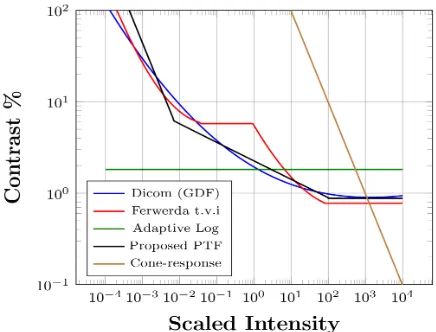
Fig. 3: A log-linear plot of five perceptual transfer functions (including a novel proposed PTF).
In this work, we have considered four widely used PTFs in conjunction with the proposed algorithm to non-linearly encode the scaled intensity channel values as described later
in section IV-C. This includes the Adaptive LogLuv TF [8],
the DICOM standard Grayscale Display Function [27], thet.v.i
proposed by Ferwarda et al. [28] with Ward’s modification
[29] and the cone response model [30]. Here, we discuss the
characteristics of each PTF and their usability in compression. 1) Adaptive Logarithmic TF: The adaptive logarithmic
transform, proposed by Motra and Thoma [8], is a modification
[image:4.612.317.559.366.554.2]into n−bit code values. A logarithmic PTF (see Figure 3) exhibits conservative quantization at lower luminance and coarser quantization at higher luminance pixel values. This can be attributed to the shape of the curve where a steeper
curve results in a finer quantization [26]. However, previous
psychophysical experiments have shown that the contrast de-tection thresholds of the HVS at scotopic and mesopic ranges are higher than at photopic luminance ranges. Therefore, the use of a logarithmic TF results in an inefficient usage of
available bit depth [26].
2) Grayscale Display Function: The Digital Imaging and Communications in Medicine (DICOM) standard Grayscale
Display Function (GDF) [27] is a polynomial fit derived
from Barten’s CSF experiments [11], which maps the input
luminance Y ∈ [0.05,4000] cd/m2 to a 10-bit perceptually
uniform JND space. Although the GDF is suitable for existing
high-fidelity commercial HDR displays [31], it is limited to
4000 cd/m2 and future displays might exceed the encoding capabilities of this function. Also, the GDF exhibits
exceed-ingly coarse quantization below 1000cd/m2and redundantly
conservative quantization for higher luminance values which renders it unsuitable for accurate scotopic and mesopic lumi-nance preservation.
3) Ferwarda’s t.v.i based PTF: Ferwarda et al. [28]
pro-posed another t.v.ifunction which takes into account the
non-linear response of rods and cones separately. The proposed
function models input luminance Y ∈[10−6,109) cd/m2 to
a JND space for rods and cones separately. The responses can be further approximated (by curve fitting) to create a
single function as shown by Ward in [29]. However, thist.v.i
function is based on data from 18 subjects, and the detection thresholds are higher for low luminance values and banding artefacts might be visible because the authors used a pulsating target on a constant background and perception thresholds are higher for transient stimuli compared to static stimuli
[29]. Therefore, Ward [29] proposed a modification where the
threshold luminances are divided by a factor of nine which brings the function in better agreement with the Barten model
and yet preserves detail below 10−2cd/m2.
4) Global Cone Response Model: The final PTF in con-sideration was the Global Cone Response Model (GCRM)
[30] primarily targeted to model the HVS response at
pho-topic levels. The shape of GCRM (see Figure 3) indicates a
conservative preservation of high luminance values at the cost of lower luminance values.
In addition to the mentioned functions, several other PTFs have also been proposed to date. A detailed overview and derivation of several PTFs along with their effect on the
visibil-ity of contouring artefacts are given in [25], [26], respectively.
As stated earlier, the algorithm proposed in this work uses the IPT color opponent space where the intensity channel is subsequently scaled and non-linearly mapped to a JND
space by means of a PTF (see Section IV-C for details).
To that end, we tested the encoding performance of the four mentioned PTFs in conjunction with the rest of the proposed algorithm and based on the results, a novel TF was proposed to incorporate the advantages of existing PTFs while mitigating some of their issues. The proposal of a novel TF (PATF),
specifically designed forintensitychannel encoding is one of
the major contributions of this work.
IV. OVERVIEW OF THE PROPOSED ALGORITHM
The three major contributions of the proposed algorithm are; a) the usage of the IPT color opponent space, b) the proposal of a novel PTF with a straightforward analytical solution to
perceptually encode the intensity channel information and c)
proposal of a novel error minimization function (EMF) to accurately preserve the chroma information. Both the PTF and EMF, described in this section has been optimized for 10-bit encoding. In this section, we provide a detailed overview of the proposed algorithm and also outline the details of the novel PTF along with the details of the EMF.
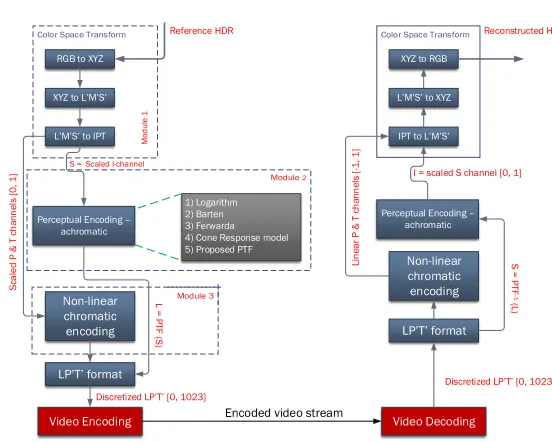
A. Overall data-flow
RGB to XYZ
Perceptual Encoding – achromatic
1) Logarithm 2) Barten 3) Ferwarda 4) Cone Response model 5) Proposed PTF XYZ to L M S
L M S to IPT
LP T format
Video Encoding S ca le d P & T ch an n el s [0 , 1
] S = Scaled I-channel
Discretized LP T [0, 1023]
XYZ to RGB
Perceptual Encoding – achromatic
Non-linear chromatic encoding L M S to XYZ
IPT to L M S
LP T format
Video Decoding I = scaled S channel [0, 1]
S = PT F -1 (L )
Discretized LP T [0, 1023]
Encoded video stream
[image:5.612.317.593.258.479.2]Reconstructed HDR Reference HDR Li n ear P & T ch an n el s [-1 , 1 ] M od u le 1 Non-linear chromatic encoding L = PT F ( S )
Fig. 4:Schematic diagram of the proposed algorithm and framework.
Note:Modular breakdown is not shown in schematic clarity.
The proposed algorithm can be broadly classified into three modules. The first module normalizes and performs color space transform of input HDR frames (linear RGB) to
perceptually uniform IPT color opponent space (see Figure4
and Section IV-B). The second module extracts the intensity
channel information from the resultant IPT frames and linearly
scales theintensityinformation according to the requirements
of a chosen PTF. Subsequently, the scaled intensity values
are perceptually encoded to JND scaled luma code values
using the chosen PTF (see Figure 4 and Section IV-C). The
third module extracts the chroma components from IPT and
applies the EMF (see Figure 4 and Section IV-D) to
non-linearly encode the chroma components. Finally, the luma and chroma components are merged and passed to the video codec for encoding. On the decompression side, the encoded video stream is decoded and decompressed to reconstruct the HDR frames by reversing the data flow. The algorithm also
uses meta-data information (see Section IV-E) to accurately
reconstruct the HDR frames. The overall data-flow is visually
B. Module 1: Color space transform
The psychophysical experiments conducted by Ebner and Fairchild demonstrated that perceptually uniform color spaces such as CIELAB and CIELUV have hue compressibility issues
[19], [21]. To mitigate the limitations of CIELAB/LUV, the
algorithm converts the input HDR frame (in linear RGB) to the IPT color opponent space. This transforms input data into a perceptually uniform space for ease of image manipulation, facilitates de-correlation of the light and color information for compression purposes and finally exploits the advantages of CIELAB/LUV without affecting the hue changes that occur when compressing chroma along the lines of compressed hue
[19]. A brief outline of the color space transformation is given
in Algorithm 1, the details of which are described in [19].
Algorithm 1 ColorConvert(hdr)
1: ν←max(hdr)//get normalization factor
2: rgbnorm← hdrν //normalization
3: XY Z←[REC.709]×rgbnorm//rgb to xyz
4: LM S←[HP E]×XY Z //xyz to lms
5: L0M0S0← |LM S|0.43 //lms spectral sharpening
6: IP T ←[IP T Conv]×L0M0S0 //lms to ipt
7: P ←IP T(x, y,2) //extract the2nd channel
8: T ←IP T(x, y,3)//extract the 3rd channel
9: Pscale←
P−min(P)
max(P)−min(P) s.tP ∈(0,1]//P scaling
10: Tscale← maxT(−Tmin)−min(T)(T) s.tT ∈(0,1]//T scaling
11: IP Tout←I(x, y,1), Pscale, Tscale //scaled IPT space
In Step 4, HPE refers to the Hunt-Pointer-Estevez
fun-damentals [32] and the metadata includes the normalization
factorν along with the minimum and maximum pixel values
of the P and T channels prior to scaling.
C. Module 2: Perception based intensity encoding
Module 2 extracts the intensitychannel fromIP Tout. The
intensityinformation when linearly scaled and discretized for 10-bit encoding exhibits visible contouring artefacts due to rounding errors. Thus, to minimize the quantization errors,
the scaledI0 channel can be perceptually encoded by any one
of the four mentioned PTFs such that the resultant luma space
satisfies the properties mentioned in SectionIII-B. Since I∈
(0,1], it can be scaled to any range, suitable for a chosen PTF.
The linear scaling operation is performed by a multiplying
factor ψfollowed by the application of the PTF as shown in
equation 1.
For instance, ifI∈(0,1],f(·)is the chosen PTF (say GDF)
andL is the 10-bit JND quantized luma then the scaling and
JND mapping operation is given as:
I0=I·ψ such thatI0∈[0.05,4000]
∴L=f(I0)such thatL∈[0,1023] (1)
1) Evaluation of existing PTFs: In order to evaluate and
determine the intensity encoding efficiency of each PTF as
well as to evaluate the reconstruction quality of the algorithm
upon the application of the specific PTF, the scaledI0channel
is encoded using each of the four existing PTFs (one at a time). The rest of the data flow remains unchanged (see Figure
4). Subsequently, the reconstruction quality of the proposed
algorithm is determined using the evaluation methodology
described later in SectionV-B. The mean RD characteristics
(averaged across 39 HDR video sequences) across a set of different quality levels determines the overall HDR recon-struction quality of the algorithm when using each of the four
PTFs. This indirectly indicates theintensitychannel encoding
efficiency of each PTF.
The RD characteristics discussed later in Section VIshow
that amongst the existing PTFs, the algorithm demonstrates the best reconstruction quality using either GCRM or the
PTF based on modified Ferwarda’s t.v.i. However, both PTFs
have certain issues as mentioned in SectionIII-B. To mitigate
these issues, this paper also proposes a novel PTF which incorporates the advantages of both along with the added advantage of a straightforward analytical solution.
2) Design of the proposed PTF (PATF): Following
rec-ommendation REC 1886 [33], the proposed PATF has been
designed as a three-part analytical solution such that f(·) :
I0 −→ L. The conditional equation 2 bears similarity to
sRGB-non-linearity with linear and power function segments
with an additional logarithmic segment to encode high
inten-sityvalues.
L=
a·I0 ifI0< Is0;
b·I0(1
c)+d ifI0∈[Is0, Ip0);
e·log10(I0) +f ifI0∈[Ip0, Ih0];
(2)
Similarly, f−1(·)can be formulated as in equation3.
I0=
L
a ifL < Ls;
(L−d
b )
c ifL∈[L
s, Lp);
10(L−ef) ifL∈[L p, Lh];
(3)
The boundary value conditionsI0was assumed to be similar
to [9]. Therefore, I ∈ (0,1] is scaled by ψ such that I0 ∈
[10−5,104]. Also, the JND quantizedL∈[0,1023]. The goal
of the PATF is to facilitate a conservative quantization
through-out the range of I0 for low-, mid- and high-intensity values.
Since the shape of GCRM shows bias towards preservation
of high-intensity regions, it was taken out of consideration.
Amongst the existing PTFs, the shape of Ferwarda’st.v.ibased
PTF was a close fit to the model proposed in Daly’s VDP [26],
[34] for the power segment and also a close fit to Barten’s
CSF based PTF for the logarithmic segment. Therefore, the
analytical solution was initially fitted to Ferwarda’st.v.i(with
Ward’s modification) using non-linear regression techniques
for initial calculation of the interval boundariesIs0 andIp0.Ih0
was always fixed to104 as the upper bound of the intensity,
considered in this work. This not only produced the initial
interval boundaries and the co-factors of equation 2, it also
ensured that the fitted solution adheres to the conditions shown
in Figure 2. Finally, Ls and Lp are computed using the
co-factors and interval boundaries. Similar to Ih0,Lh was again
Since the PATF is a piecewise-nonlinear model, it is
im-portant to enforce C0 continuity at the intervals bounds I0
s
and Ip0. Also, a luminance to luma plot (in semi-log scale)
as shown in Figure 3 is unable to decipher contrast jumps
and discontinuities which might result in visible contouring
artefacts. Therefore, using a Contrast vs. Intensity (c.v.i)
plot [29], the function was tested for contrast jumps and
discontinuities and the parameters in equation2were adjusted
to eliminate visible contouring artefacts especially at low-intensity regions. A c.v.i plot can also be used to indirectly
measure the effectiveness of the bit-depth allocation inL.
Re-plotting the c.v.iwith the PATF’s modified co-factors showed
that the bit-depth allocation was not optimal. Thus, a second round of optimization was performed on both the boundary values and co-factors to ensure optimal bit-depth allocation.
The final co-factors of the PATF are given in Table I.
a= 2285.712 b= 224.174 c= 5.000
d=−67.100 e= 263.500 f =−31.000
Is0 = 0.007 Ip0 = 100.000 Ih0 = 10000.000
[image:7.612.328.546.50.216.2]Ls= 16.000 Lp= 496.000 Lh= 1023.000
TABLE I: Co-factors used for the proposed PATF.
The interval boundaries of the final configuration,I0
s, Ip0 and
I0
h(as used in equation2) represent the scaledintensitychannel
values where the HVS exhibits linear, power and logarithmic
response [25]. Correspondingly, thec.v.iplot ensured that the
JND space L was divided into three blocks with optimal
bit-depth allocation within intervals where L ∈ (0, Ls),
L ∈ [Ls, Lp) and L ∈ [Lp, Lh] such that each block can
facilitate a conservative quantization of low-, mid- and high-intensityregions. Also, when the proposed PTF is plotted with
a semilog plot (I0vs.L) and compared with the existing PTFs,
the shape of the curve shows the following characteristics:
• In the low-intensity regions, the curve exhibits a more
conservative quantization than exhibited by the PTF
based on modified Ferwarda’s t.v.i while not as
conser-vative as a logarithmic PTF.
• In the mid-intensityregions, the curve exhibits a similar
quantization to the modified Ferwarda’s t.v.i.
• In the high-intensityregions, the curve exhibits a
conser-vative quantization similar to Barten’s CSF based PTF.
Furthermore, the bit-depth allocation effectiveness was tested against existing EOTFs and found to be a close fit with
the PQ algorithm [9]. Thec.v.i plot is given Figure 5. For a
further confirmation, the PATF and its inverse were rigorously tested as a part of the proposed algorithm. Results obtained from the evaluation demonstrate that the performance of the proposed algorithm using the PATF is better than the existing
PTFs (see Figure 7).
D. Module 3: Error minimization function (EMF)
Similar to Module 2, this module extracts the chroma
information (P & T channels) from IP Tout and performs
a non-linear encoding which minimizes quantization errors frequently encountered in video compression. Typically,
non-linear encoding is performed by a power function, sayλ <1.0
Fig. 5: Comparative Contrast vs. Intensity plot of the proposed PTF compared to existing PTFs and EOTFs used in other algorithms.
applied to the input values such that more bits are allocated to lower magnitudes where perceptual differences are more visible thus minimizing the quantization errors.
To encode chroma information, existing algorithms such
as hdrv and fraunhofer encode the chroma channels using
the procedure similar to LogLuv [6]. Although, the proposed
algorithm uses the IPT color space which introduces a de-gree of non-linearity during conversion from the LMS cone excitation space to IPT, direct scaling and discretization of the chroma channels to 10-bit integer representation leads to rounding error based visible contouring artefacts. Therefore, we introduce a further non-linear encoding step to the P and T channels by deriving the most appropriate power value(s) which when applied to the chroma information minimizes the quantization errors during discretization.
The EMF is an optimization function which minimizes the difference between discretized floating point values such that
P,T∈[0,1023]and their nearest integer calculated via a floor
operation. The power valueλis derived as follows:
Letλbe the power value to be used for non-linear encoding,
n be the targeted bit depth (10 in this case), Pinp ∈ (0,1]
be the input channel and Pout ∈ [0,1023] be the output
discretized channel. The application of the power function can
be formulated as in equation4.
Pout=
j
(Pinp)λ·(2n−1)
k
(4)
where the power function λis computed via an optimization
pass, where each step of the optimization replicates the quan-tization and de-quanquan-tization steps, evaluates different values
of λ ∈ (0,1] such that the difference between 10-bit scaled
floating point values and its nearest integer representation is
minimal as shown in equation5.
argmin λ
1
M N
N
X
j=1
M
X
i=1
(Pinp)λ·(2n−1) (2n−1)
!λ1
−Pinp
(5)
[image:7.612.321.562.683.724.2]resolu-tion, respectively. Upon application of the power values to the
chroma channels, theλvalues applied to each chroma channel
is then stored as metadata and used later during reconstruction. In our implementation, the search for the optimal value of
λ∈[0,1]was run in a straightforward uniform search with a
step size of0.02which reduces the number of trials, albeit at
the cost of minuscule precision loss. The optimization takes
≈1 second per frame using a single thread on an Intel Xeon
24 core workstation with a clock frequency of 2.6 GHz and 32 GB of RAM. Better optimization techniques, such as gradient descent, could be employed to speed up this process, and will be investigated in future work.
E. Module 4: Metadata information
As a result of frame normalization, intensity scaling, chroma scaling and non-linear encoding of chroma channels, the proposed algorithm produces metadata information containing the scaling information of the intensity channel, the minimum and maximum values of the chroma channels prior to scaling and finally the power values applied to each chroma channel. This data is then stored in the form of a look-up table (LUT) for each frame and the final LUT is stored as a secondary metadata stream. A visual description of the LUT along with additional information is given in the supplementary material.
V. OBJECTIVE EVALUATION OF COMPRESSION ALGORITHMS
The proposed algorithm was evaluated against four
state-of-the-art compression algorithms (see Section II-A for details)
using 39 HDR video sequences across a range of energy-difference, structural and perceptual QA metrics. Each se-quence was encoded at 11 different quality levels (output bitrates) controlled by the quantization parameter (QP) of the codec. Here, we briefly discuss the evaluation methodology and the materials required to conduct the objective evaluation.
A. Materials
The materials used for this evaluation were the five
compres-sion algorithms including the four mentioned in Section II-A,
the 39 HDR video sequences which represent a wide variety of scenes and overall dynamic range, seven QA metrics including
the perceptual and structual QA metrics and the x265 [3] video
codec.
[image:8.612.48.299.623.714.2]B. Objective evaluation method
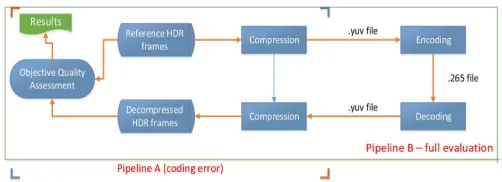
Fig. 6: Schematic diagram of the evaluation methodology. Pipeline ‘A’ is
used to evaluate coding errors and Pipeline ‘B’ is used to evaluate rate-distortion characteristics.
The evaluation method can be classified into two parts. In
Pipeline A (see Figure 6), the reference HDR frames from
each of the 39 sequences were compressed using the five algorithms creating intermediate codec suitable files (labeled as HDRVs). Subsequently, the HDRVs are decompressed using the decompression part of the algorithms to reconstruct the HDR frames. The reference and reconstructed HDR frames are then evaluated using the objective QA metrics. In video compression, the results obtained by this procedure compute the coding errors produced by each algorithm which deter-mines compression quality without the external influence of the codec.
Pipeline B, extends Pipeline A and introduces the x265
codec. The HDRVs are passed to the codec which encodes the frames into a raw video stream which is subsequently decoded and decompressed to reconstruct the HDR frames.
For a comprehensive evaluation at different quality levels, 150 frames from each of the 39 sequences were compressed using the five algorithms producing HDRVs which were sub-sequently 4:2:0 sub-sampled (typical for video compression) and then encoded at 11 different quality levels by controlling the QP of the codec. The encoding profile of the x265 video
codec was main444-10and the QP values were set such that
QP ∈ [0,5,10, ...,50], where QP = 0 represents lossless
encoding andQP = 50represents a highly lossy compression.
The group of pictures (GOP) sequence was I-B-B-B-P with
an intra-frame period of 30 and all sequences were encoded with a single-pass encoding scheme.
The reference and reconstructed HDR frames were evalu-ated against a set of QA metrics and results obtained were first averaged over the number of frames (per sequence) followed by a cumulative average over 39 sequences. The averaged results are then used to plot the mean Rate Distortion (RD) graphs which exhibit the overall performance of the algorithms. However, the mean RD graphs do not provide the complete picture since there is a significant variation in image reconstruction quality and bitrates required to encode the variety of scenes. Therefore, the obtained raw data was used to plot interpolated RD graphs of type a) variation in image quality (with 95% confidence interval) at fixed bitrates
∈[0.2,2]bits/pixel (bpp) and b) variation in bitrates at fixed
quality levels. A combination of mean and interpolated RD plots facilitates an in-depth understanding of the compression performance.
VI. OBJECTIVE EVALUATIONRESULTS
In this section, we present three sets of results obtained from the objective evaluation.
A. PTF evaluation results
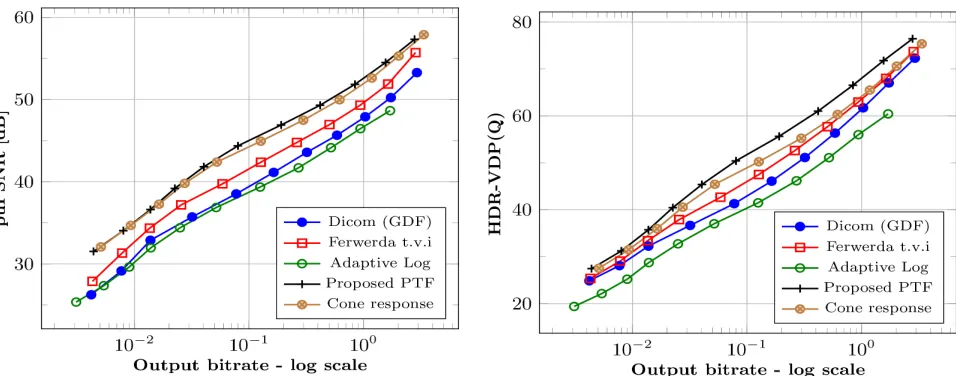
The first set of results shown in Figure 7 demonstrate the
overall HDR reconstruction quality of the proposed algorithm with the five PTFs (one at a time), evaluated against the set of 39 HDR sequences following the evaluation method mentioned
in Section V-B - Pipeline B. The mean RD characteristics
(a) Mean RD characteristics exhibited by each of the five PTFs: puPSNR -higher is better
[image:9.612.70.548.53.241.2](b) Mean RD characteristics exhibited by each of the five PTFs: HDR-VDP(Q) - higher is better
Fig. 7: Rate Distortion characteristics of proposed algorithm with five different PTFs - averaged over 39 sequences. This evaluation followsPipeline B
shown in Figure6.
B. Overall objective evaluation results
With the performance of the PATF established, we now present the two sets of results which demonstrate the cod-ing errors and the mean RD characteristics of the proposed algorithm when used in conjunction with the PATF and EMF.
The coding error results presented in Table II and RD
char-Metrics Algorithms
hdrv fraunhofer pq bbc-hlg proposed puPSNR [dB] 64.4542 70.5541 69.7689 58.3398 72.7814 puSSIM 0.9997 0.9999 0.9999 0.9982 1.0000 HDR-VDP(Q) 89.2398 91.9987 92.3235 82.0000 93.5157 HDR-VQM 0.9984 0.9964 0.9974 0.9957 0.9975
TABLE II: Coding error of five algorithms - averaged over 39 sequences.
This evaluation followsPipeline Amentioned in Figure6.
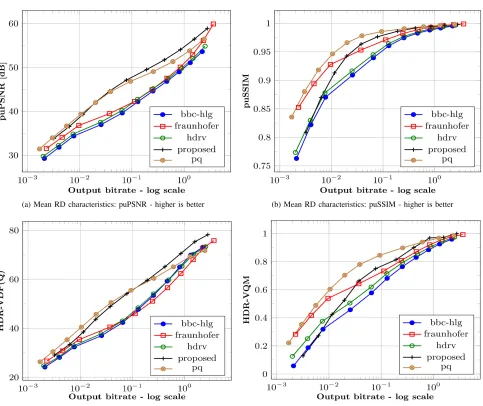
acteristics presented in Figure 8 demonstrate the comparative
compression performance of the evaluated algorithms. Although several metrics were used, we present the most relevant results obtained from perceptual and structural metrics
such as puPSNR [35], puSSIM [36], HDR-VDP [37] and
HDR-VQM [38] as the predicted results have a high to
very high correlation with subjective evaluation [1], [15],
[39]. The remaining results including the interpolated RD
characteristics for fixed quality (variation in bitrate) and fixed bitrate (variation in quality) are given in the supplementary materials.
VII. SUBJECTIVE EVALUATION
In addition to the objective results, a subjective quality assessment experiment was conducted at two different quality levels. This section provides a brief outline of the
subjec-tive evaluation. Design: For the purpose of the subjective
experiments, six sequences were short listed from the set of 39 sequences such that the sequences represent a variety of capturing techniques and a wide dynamic range. The selected sequences were compressed and decompressed using all five algorithms, including the proposed at the two designated qual-ity levels. The design of the experiment involved participants
seeing all six sequences for all algorithms. The ground truth was shown followed by a clip encoded and decoded by one of the candidate algorithms and the participants were asked to rate the clip based on its similarity with that of the ground
truth. The first independent variablealgorithmswas composed
of the five candidate algorithms:hdrv,franhofer,pq,bbc-hlg
and theproposed. This was a within-participants independent
variable as all participants had the opportunity to view all
algorithms. The second independent variable quality was a
between-participants variable and consisted of two conditions
Q1 andQ2 corresponding to the quality setting of 0.09 bpp
(≈6Mbps) and 0.24 bpp (≈15Mbps); the latter corresponds
to the 10-bit settings recommended for online streaming and the former as lower quality than recommend 8-bit streaming chosen to stress test the algorithms. Six sequences used in the experiment were randomly displayed to the participants. The
dependent variablescorewas a value from 1 to 10. Participants
were asked to allocate score to each scenario computed for
each algorithm for a total of 30 clips ranked per participant.
The question asked was “Rate the quality of decoded video
sequences, on a scale of 1 to 10, based on their similarity to the uncompressed video sequence”.
Materials: A SIM2 HDR display [31] with a peak
lumi-nance rating of 4,000 cd/m2 along with an LG 22” LED
display with peak luminance rating of 300 cd/m2 and a
computer with a solid state drive for quick loading of HDRVs was used for both experiments. All clips were prepared using a similar methodology to the objective experiments.
Participants: A total of 40 participants in two mutually
exclusive groups of 20 participants (age∈[22,51]), randomly
allocated to one of the quality conditions volunteered for
the experiments. All participants had normal or corrected to normal vision with no color blindness.
Analysis and Results:Inductive results were analyzed
us-ing a factorial 2 (quality)×5 (algorithms) repeated measures
ANOVA, with the scores averaged across all the scenarios
insignif-(a) Mean RD characteristics: puPSNR - higher is better (b) Mean RD characteristics: puSSIM - higher is better
[image:10.612.68.551.46.452.2](c) Mean RD characteristics: HDR-VDP(Q) - higher is better (d) Mean RD characteristics: HDR-VQM (RGB)
Fig. 8:Mean RD characteristics of the five algorithms averaged across 39 sequences. This evaluation followsPipeline Bmentioned in Figure6.
icant F(1,38) = 0.005, p = 0.945, while the main effect of algorithm was significant, F(2.008, 76.318) = 108.394 ,
p < 0.01 (with Greenhouse Geiser corrections applied as
Mauchly’s test of Sphericity was violated p < 0.05). Since
qualitywas insignificant, results were collapsed acrossquality
for further pairwise comparisons. Table III demonstrates the
results including means. The groupings in the results show
groups ofalgorithmsfor which the scores were not considered
significantly different, in particular the proposed and pqand
similarlypqandfraunhofer. There was statistically significant
difference between theproposedandfraunhofer. The last two
algorithms e.g.hdrv andbccform a group of their own
indi-cating statistically significant difference. Kendall’s co-efficient of Concordance W which provides a value agreement amongst the participants choices with 0 being complete disagreement and 1 complete agreement was relatively high at 0.68 and significant at p <0.01.
In addition to the mean rankings given in Table III, the
objective results of the six short-listed sequences at the specified bitrates were correlated with the subjective results
using Pearson’s correlation; see TableIV. As can be seen the
TABLE III: Subjective mean ranks with Kendall W, averaged across the
two experiments.
correlation is quite strong and is significant at p <0.05 for
all results and demonstrates a strong relationship between the objective and subjective results. Further correlation results are given in the supplementary materials.
puPSNR puSSIM HDR-VDP(Q) HDR-VQM Subjective puPSNR - 0.977‡ 0.974‡ 0.989‡ 0.954† puSSIM 0.977‡ - 0.919† 0.990‡ 0.990‡ HDR-VDP(Q) 0.974‡ 0.919† - 0.960‡ 0.910† HDR-VQM 0.989‡ 0.990‡ 0.960‡ - 0.985‡ Subjective 0.954† 0.990‡ 0.910† 0.985‡
-TABLE IV:Pearson’s correlation between objective and subjective results.
† denotes significance atp <0.05level and‡denotes significance atp <
[image:10.612.314.577.644.701.2]VIII. DISCUSSION
In this section, we combine the objective and subjective results and analyze the overall performance of the proposed algorithm against the state-of-the-art solutions.
The mean results in Figure 7 suggest that the PATF
fa-cilitates superior image reconstruction than existing PTFs.
Amongst the established PTFs, GCRM and Ferwara’s t.v.i
based PTF produces similar encoding results while the
log-arithmic TF [8] exhibits the least desired performance. The
superior performance of the PATF can be attributed to the
balanced quantization of scaled intensity values where the
PATF facilitates a finer quantization in the darker regions as well as maintaining the conservative quantization for high-intensityregions.
The overall performance of the proposed algorithm as
shown in Table II demonstrate that the proposed algorithm
(with the PATF) exhibits the smallest coding error amongst the five algorithms as evaluated by structural and perceptual
QA metrics. Whilebbc-hlgdemonstrates the maximum coding
error, the coding error performance of fraunhofer and pq is
quite similar to the proposed algorithm.
The mean RD characteristics of puPSNR and HDR-VDP
in Figure 8 indicate that overall the proposed algorithm
out-performs existing solutions atbitrates≥0.4 bpp. However, it
can also be observed from Figure8that the proposed algorithm
sometimes fails to outperform existing algorithms such as pq
andfraunhoferat low bitrates i.e.bitrates<0.4 bpp. This is primarily because the algorithm relies on an analytical solution for luminance compression as opposed to a smooth non-linear
PTF used bypqandfraunhofer.
Also, Figure 8c shows that overall both pq and bbc-hlg
perform marginally better atbitrates<0.4 bpp. The puSSIM
results in Figure8bdemonstrate that the structural
reconstruc-tion of both pq and the proposed algorithm are very similar
to each other. Overall, the objective results indicate that the performance of the proposed algorithm is at par or better than existing solutions.
Finally, the subjective evaluation mean ranks given in Table
IIIindicate that the proposed algorithm performs slightly better
than existing solutions. Moreover, the correlation results given
in TableIVindicate a high to very high correlation between the
perceptual/structural QA metrics and subjective results. The correlation within the objective metrics is also quite strong.
Furthermore, the correlation results in TableIVare analogous
to the objective results presented in Figure 8.
IX. LIMITATIONS
A limitation of the proposed algorithm is that the
nor-malization factor mentioned in Algorithm 1 is the maximum
pixel value of the HDR frame; this may cause issues with a single aberrant high luminance pixel. The tested scenes did not feature any such cases. However, since the algorithm is intended for generic usage, an alternative normalization factor can be computed by considering the top select percentage, for example top 5%, of the frame values or the median value of the frame luminance.
Another limitation of this study is that all five algorithms have been modified/optimized for 10-bit encoding, sufficient
for a luminance range of L∈[10−4,104] cd/m2. Although
this does not significantly degrade the output quality, a 12-bit optimization can accommodate a much larger range of
L∈[10−4,108] cd/m2. The only modification required to
the proposed algorithm, in this case, is the re-computation of the PATF cofactors by changing the luminance and luma boundaries, respectively.
X. CONCLUSION ANDFUTUREWORK
In this paper, we have proposed a novel HDR video compression algorithm optimized for 10-bit encoding. The algorithm uses the IPT uniform color opponent space, a novel PATF providing better image reconstruction than existing PTFs and a novel EMF for accurate chroma preservation. Objective evaluation results demonstrate that the proposed algorithm performs at par or better than the four published and/or patented state-of-the-art algorithms. The proposed algorithm can also use existing PTFs albeit at the cost of reconstruction quality.
Future work also includes further refinement of the PATF and EMF to further reduce quantization errors. Moreover, the
use of other color spaces such as Lαβ for the color space
transform phase can be also be explored as well as adapting
curves per scenario [40]. Furthermore, the algorithm can
also be further evaluated across other HDR video sequences
especially those processed with the BT.2020 primaries [41]
at higher bit-depths such as 12- and 14-bits/pixel/channel when optimized codec support becomes available. Finally, the objective and subjective evaluations can also be extended using two recently developed quality assessment metrics using eye-tracking data such as the no-reference metric proposed in
[42] and spatiotemporal correlation data using eye tracking
as proposed in [43]. However, their suitability for HDR video
content also needs to be verified before they can be used to evaluate the HDR video compression algorithms.
XI. ACKNOWLEDGEMENT
The authors would like to thank Technicolor SA for the “Seine” footage, University of T¨ubingen and Stuttgart Media University for providing with some the HDR video sequences
[44] used in this work. This work is partially funded by
EP-SRC EP/K014056/1with Jaguar Land Rover: “PSi Theme 7:
Visualization and Virtual Experience”. Debattista was partially supported by a Royal Society Industrial Fellow (IF130053), for whose support we are most grateful.
REFERENCES
[1] R. Mukherjee, K. Debattista, T. Bashford-Rogers, P. Vangorp, R. Man-tiuk, M. Bessa, B. Waterfield, and A. Chalmers, “Objective and sub-jective evaluation of high dynamic range video compression,” Signal
Processing: Image Communication, vol. 47, pp. 426–437, 2016.
[2] F. Ebner and M. D. Fairchild, “Development and testing of a color space (ipt) with improved hue uniformity,” inColor and Imaging Conference, vol. 1998, pp. 8–13, Society for Imaging Science and Technology, 1998. [3] V. Organization”, “The x265 video codec.” https://www.videolan.org/
developers/x265.html.
[4] G. J. Sullivan, J.-R. Ohm, W.-J. Han, and T. Wiegand, “Overview of the high efficiency video coding (hevc) standard,” IEEE Transactions
on circuits and systems for video technology, vol. 22, no. 12, pp. 1649–
1668, 2012.
[5] R. Mantiuk, G. Krawczyk, K. Myszkowski, and H.-P. Seidel, “Perception-motivated high dynamic range video encoding,” in ACM
SIGGRAPH 2004 Papers, SIGGRAPH ’04, (New York, NY, USA),
[6] G. W. Larson, “Logluv encoding for full-gamut, high-dynamic range images,”Journal of Graphics Tools, vol. 3, no. 1, pp. 15–31, 1998. [7] J.-U. Garbas and H. Thoma, “Temporally coherent luminance-to-luma
mapping for high dynamic range video coding with H.264/AVC,” in
Acoustics, Speech and Signal Processing (ICASSP), 2011 IEEE
Inter-national Conference on, pp. 829–832, May 2011.
[8] A. Motra and H. Thoma, “An adaptive logluv transform for high dy-namic range video compression,” in2010 IEEE International Conference
on Image Processing, pp. 2061–2064, Sept 2010.
[9] S. Miller, M. Nezamabadi, and S. Daly, “Perceptual signal coding for more efficient usage of bit codes,”SMPTE Motion Imaging Journal, vol. 122, pp. 52–59, May 2013.
[10] F. Dufaux, P. Le Callet, R. Mantiuk, and M. Mrak,High Dynamic Range
Video: From Acquisition, to Display and Applications. Academic Press,
2016.
[11] P. G. Barten, “Physical model for the contrast sensitivity of the human eye,” in SPIE/IS&T 1992 Symposium on Electronic Imaging: Science
and Technology, pp. 57–72, International Society for Optics and
Pho-tonics, 1992.
[12] T. Borer and A. Cotton, “A “display independent” high dynamic range television system,” September 2015.
[13] S. S. Stevens, “On the psychophysical law.,” Psychological review, vol. 64, no. 3, p. 153, 1957.
[14] A. Koz and F. Dufaux, “A comparative survey on high dynamic range video compression,” inSPIE Optical Engineering+ Applications, pp. 84990E–84990E, International Society for Optics and Photonics, 2012.
[15] P. Hanhart, M. Rerabek, and T. Ebrahimi, “Towards high dynamic range extensions of HEVC: subjective evaluation of potential coding technologies,” inSPIE Optical Engineering+ Applications, 2015. [16] A. Banitalebi-Dehkordi, M. Azimi, M. T. Pourazad, and P.
Nasiopou-los, “Compression of high dynamic range video using the HEVC and H.264/AVC standards,” inHeterogeneous Networking for Quality, Reliability, Security and Robustness (QShine), 2014 10th International
Conference on, pp. 8–12, Aug 2014.
[17] M. Rerabek, P. Hanhart, P. Korshunov, and T. Ebrahimi, “Subjective and objective evaluation of hdr video compression,” in9th International Workshop on Video Processing and Quality Metrics for Consumer
Electronics (VPQM), no. EPFL-CONF-203874, 2015.
[18] M. Narwaria, M. Perreira Da Silva, and P. Le Callet, “Study of high dynamic range video quality assessment,” vol. 9599, pp. 95990V– 95990V–13, 2015.
[19] E. Reinhard, E. A. Khan, A. O. Akyz, and G. M. Johnson, Color
imaging: fundamentals and applications. AK Peters, Ltd., 2008.
[20] M. D. Fairchild,Color appearance models. John Wiley & Sons, 2013. [21] F. Ebner and M. D. Fairchild, “Finding constant hue surfaces in color space,” inPhotonics West’98 Electronic Imaging, pp. 107–117, International Society for Optics and Photonics, 1998.
[22] F. Ebner and M. D. Fairchild, “Development and testing of a color space (ipt) with improved hue uniformity,” inColor and Imaging Conference, vol. 1998, pp. 8–13, Society for Imaging Science and Technology, 1998. [23] T. Wiegand, G. J. Sullivan, G. Bjontegaard, and A. Luthra, “Overview of the h. 264/avc video coding standard,”IEEE Transactions on circuits
and systems for video technology, vol. 13, no. 7, pp. 560–576, 2003.
[24] O. M. Blackwell and H. R. Blackwell, “Ieri: Visual performance data for 156 normal observers of various ages,”Journal of the Illuminating
Engineering Society, vol. 1, no. 1, pp. 3–13, 1971.
[25] M. I. Sezan, K.-L. Yip, and S. J. Daly, “Uniform perceptual quantization: Applications to digital radiography,” IEEE Transactions on Systems,
Man, and Cybernetics, vol. 17, no. 4, pp. 622–634, 1987.
[26] R. Mantiuk, K. Myszkowski, and H.-P. Seidel, “Lossy compression of high dynamic range images and video,” inElectronic Imaging 2006, pp. 60570V–60570V, International Society for Optics and Photonics, 2006.
[27] M. Mustra, K. Delac, and M. Grgic, “Overview of the DICOM standard,”
inELMAR, 2008. 50th International Symposium, vol. 1, pp. 39–44, Sept
2008.
[28] J. A. Ferwerda, S. N. Pattanaik, P. Shirley, and D. P. Greenberg, “A model of visual adaptation for realistic image synthesis,” inProceedings of the 23rd annual conference on Computer graphics and interactive
techniques, pp. 249–258, ACM, 1996.
[29] G. Ward, “Defining dynamic range,” inACM SIGGRAPH 2008 Classes, SIGGRAPH ’08, (New York, NY, USA), pp. 30:1–30:3, ACM, 2008. [30] R. A. Normann, B. S. Baxter, H. Ravindra, and P. J. Anderton,
“Photore-ceptor contributions to contrast sensitivity: applications in radiological diagnosis,”IEEE transactions on systems, man, and cybernetics, no. 5, pp. 944–953, 1983.
[31] SIM2 Multimedia, “SIM2 HDR47.” http://www.sim2.com/HDR/ hdrdisplay/hdr47e s 4k.
[32] Y. Nayatani, K. Hashimoto, K. Takahama, and H. Sobagaki, “A nonlinear color-appearance model using est´evez-hunt-pointer primaries,” Color
Research & Application, vol. 12, no. 5, pp. 231–242, 1987.
[33] B. Series”, Reference electro-optical transfer function for flat panel
displays used in HDTV studio production. Radiocommunication sector
of ITU, 03 2011.
[34] S. J. Daly, “Visible differences predictor: an algorithm for the assess-ment of image fidelity,” inSPIE/IS&T 1992 Symposium on Electronic
Imaging: Science and Technology, pp. 2–15, International Society for
Optics and Photonics, 1992.
[35] T. O. Aydın, R. Mantiuk, and H.-P. Seidel, “Extending quality metrics to full dynamic range images,” inHuman Vision and Electronic Imaging XIII, Proceedings of SPIE, (San Jose, USA), pp. 6806–10, January 2008. [36] Z. Wang, A. C. Bovik, H. R. Sheikh, and E. P. Simoncelli, “Image quality assessment: from error visibility to structural similarity,”IEEE
Transactions on Image Processing, vol. 13, pp. 600–612, April 2004.
[37] M. Narwaria, R. K. Mantiuk, M. P. Da Silva, and P. Le Callet, “HDR-VDP-2.2: a calibrated method for objective quality prediction of high-dynamic range and standard images,” Journal of Electronic Imaging, vol. 24, no. 1, p. 010501, 2015.
[38] M. Narwaria, M. P. D. Silva, and P. L. Callet, “HDR-VQM: An objective quality measure for high dynamic range video,” Signal Processing:
Image Communication, vol. 35, pp. 46 – 60, 2015.
[39] P. Hanhart, M. V. Bernardo, M. Pereira, A. M. G. Pinheiro, and T. Ebrahimi, “Benchmarking of objective quality metrics for hdr image quality assessment,”EURASIP Journal on Image and Video Processing, vol. 2015, no. 1, p. 39, 2015.
[40] K. Debattista, “Application-specific tone mapping via genetic program-ming,” inComputer Graphics Forum, vol. 37, pp. 439–450, Wiley Online Library, 2018.
[41] I.-R. Recommendation, “BT-2020 “parameter values for ultra-high def-inition television systems for production and international programme exchange”,”International Telecommunication Union, Geneva, 2012. [42] P. K. Podder, M. Paul, and M. Murshed, “Qmet: A new quality
assessment metric for no-reference video coding by using human eye traversal,” in 2016 International Conference on Image and Vision
Computing New Zealand (IVCNZ), pp. 1–6, Nov 2016.
[43] P. K. Podder, M. Paul, and M. Murshed, “A novel quality metric using spatiotemporal correlational data of human eye maneuver,” in 2017 International Conference on Digital Image Computing: Techniques and
Applications (DICTA), pp. 1–8, Nov 2017.

![Fig. 2: Quantisation error in luma code values expressed interms of luminance such that error < 1 JND [26].](https://thumb-us.123doks.com/thumbv2/123dok_us/9431053.448757/4.612.317.559.366.554/fig-quantisation-error-values-expressed-interms-luminance-error.webp)