warwick.ac.uk/lib-publications
Original citation:
Orsino, Antonino, Guo, Weisi and Araniti, Giuseppe. (2017) Multi-scale mobility models in
the forthcoming 5G era : a general overview. IEEE Vehicular Technology Magazine .
Permanent WRAP URL:
http://wrap.warwick.ac.uk/94301
Copyright and reuse:
The Warwick Research Archive Portal (WRAP) makes this work by researchers of the
University of Warwick available open access under the following conditions. Copyright ©
and all moral rights to the version of the paper presented here belong to the individual
author(s) and/or other copyright owners. To the extent reasonable and practicable the
material made available in WRAP has been checked for eligibility before being made
available.
Copies of full items can be used for personal research or study, educational, or not-for profit
purposes without prior permission or charge. Provided that the authors, title and full
bibliographic details are credited, a hyperlink and/or URL is given for the original metadata
page and the content is not changed in any way.
Publisher’s statement:
© 2017 IEEE. Personal use of this material is permitted. Permission from IEEE must be
obtained for all other uses, in any current or future media, including reprinting
/republishing this material for advertising or promotional purposes, creating new collective
works, for resale or redistribution to servers or lists, or reuse of any copyrighted component
of this work in other works.
A note on versions:
The version presented here may differ from the published version or, version of record, if
you wish to cite this item you are advised to consult the publisher’s version. Please see the
‘permanent WRAP url’ above for details on accessing the published version and note that
access may require a subscription.
The forthcoming fifth generation (5G) mobile wireless system is likely to lead to an increasingly heterogeneous data demand pattern, including a small number of high data-rate mobile broadband links and a large number of low data-rate Internet-of-Things (IoT) applications. Aspects which govern seamless mobility between different access-technologies, cell tiers, cell sectors, and frequency bands will be sensitive to the mobility model of the people, their devices, and the machines. An understanding about how such entities will play a fundamental role in the future standardization and exploiting of the 5G technologies. In this article, we provide a comprehensive and general overview about existing mobility models useful to characterizing movements patterns across multiple distance and populations scales. In doing so, all the models are critically discussed, providing strengths and weaknesses. Finally, open issues and critical design choices are highlighted to serve as guidelines for future research in this topic.
Introduction
The growing demand of a fully mobile and connected
wireless ecosystem is driving the telecoms operators towards
the hard task of managing existing services and planning new ones to meet the tremendous growth in both the traffic density and the number of connected devices. It is evident nowadays that the mobile/cellular ecosystem is evolving to something that is highly dynamic and flexible. This regards not only the networks infrastructure and equipment but also the actors that take part over the system landscape. Indeed, whereas in current mobile network vehicle play the dominant role when talking about mobility, in future fifth generation of cellular networks (5G) systems the difference about what is “mobile”, part of the infrastructure, and end-user it will become more and more blurred. In fact, the advent of the Internet of Everything (IoE)
paradigm and new wireless technologies1, e.g.,
device-to-device (D2D) communications, mmWave, LiFi, there is the need of a deep rethinking about what will be the impact of mobility on the system performance. Indeed, 5G has been identified as the key standard to overcome the increasingly
1 Ericsson, ”5G Radio Access”, White paper, April 2016.
large demands of new multimedia services, applications, and connectivity. Therefore, the launch of a 5G standard will need to provide higher performance benefits, such as: greater throughput, lower latency, ultra-high reliability, higher connectivity, and higher mobility tolerance. In addition to an envisaged high density deployment, where different types of network nodes and wireless standards are deployed within the same area, a fundamental rethink about the design of the mobility management and its application to the future 5G scenarios is needed. Is it expected, indeed, that the exploitation of the enhanced capability of the network devices jointly with the context applications (and information), that they could provide, will play a fundamental role in the mobility modelling over the future 5G systems.
State of mobility
Human mobility modelling and prediction has applications in several areas including transportation, telecommunications, crowd control, urban planning, commerce, and epidemiology. Over the past decade, two factors have significantly influenced the need to better understand human mobility. The first factor is that, increasingly, humans are simply travelling more. For example, in the United Kingdom, the average commuting distance between home and work has increased by an average of 10% over the past 10 years (Office for National Statistics 2014). The second factor is that user-centered services are becoming more important. This has arisen partly due to the increasing availability of personal information, as well as a recognition that services can be tailored to suit certain individual needs. Mobility affects a wide range of mobile network service provisioning mechanisms, such as handover and small-cell deployment [1,2]. Hence, modeling human mobility is a general and critical part of improving a wide range of services.
There exist many known and unknown factors that influence our movement, including the final destination of a user, his/her route selection, and the mode of transport [3]. Factors such as congestion, financial and family imposed restrictions, as well as unexpected events make mobility prediction on an individual basis challenging. Nonetheless,
Multi-Scale Mobility Models in the
Forthcoming 5G Era: A General
Overview
Antonino Orsino, Tampere University of Technology
Weisi Guo, University of Warwick
there exists general models for mobility at various distance and population scales that we can use for engineering applications. Prior to 2007, the data sets available for mobility research were limited. Macroscopic studies (typically at or national scale) were confined to utilizing either telecommunication Call-Data-Records (CDRs) or government Census Data. Whilst both data sets offered wide geographic and demographic coverage, they both lacked the temporal resolution required for high precision spatial or temporal applications [4,5]. For example, census data is taken on a yearly basis, and only reveals where people live and how they travel to work. On the other hand, CDR data sets prior to 2007 were mainly from voice calls and text message interactions, which means the temporal resolution varies between minutes to hours and the spatial resolution is limited
to the coverage area of a base station (~km2). Nevertheless,
even this is adequate for understanding human mobility on a metropolitan scale, fine-grain microscopic models of statistical significance cannot be derived. It is also worth mentioning that other novel methods of tracking human movement include tracking financial transactions [6], and as with CDR data, these methodologies generally require strong industrial collaboration and the results are often biased towards intensive users of these data generating mechanisms.
Finally, also traffic engineering2 addresses techniques and
methods to achieve the safe and efficient movements of people and goods on roadways. In particular, these models in the past mainly focused on the vehicular-side of mobility but in the recent years evolved their analysis also to other fields such as drone, pedestrian, and robot/machine mobility. Nevertheless, models from traffic engineering solutions are often difficult to scale or too complicated to tune when come to understand the performance of 5G system through simulations. For this reason, we believe that statistically traceable and easily tunable models may represent a good trade-off in characterizing mobility of devices (or different scales) and, at the same time, not compromising too much the realism of the scenario considered. As an example, in future mobile/cellular network will be addresses problematics related to unmanned vehicles and micro movements of the users (e.g., by considering mmWave communications). In such cases, we fell that models provided by traffic engineering will be difficult to tune in order to characterize the impact that those 3D mobile patterns or human movements may have on the system performance.
Contribution and organization
Driven by these challenges and needs, in this work we propose a general overview of different mobility models that can be used at various scales. Multi-scale mobility modeling is
not new to literature [7], but its importance is particularly
prominent in new 5G and IoT services, and we highlight their developments as well as connections to specific radio
2 “Road Safety Fundamentals”. Ithaca, NY, Cornell Local Roads
Program. September 2009.
engineering technologies. In particular, we focus our analysis on three main scales that is expected to be of interest in the future modelling of user and network mobility for the future
fifth generation wireless network (i.e., 5G), namely: (i)
Macro-scale, (ii) Micro-scale, and (iii) Device-scale environments. Our main objective is to explore and analyse current mobility models available in literature and that may be suitable in characterize devices' movements at various levels of environment-scales. In doing this, we also pointed out what are the limits of these models and which are the current and future challenges that the academic and industry communities should face during the next years.
The structure of the paper is organized as follows. After describing the need of mobility support in the 5G system in Section II, we divide mobility prediction models into different distance and population scales: macroscopic (Section III), microscopic (Section IV), and user-centric models (Section V). Finally, in Section VI we provide a comprehensive discussion about the lessons learned and the open challenges.
The mobility support in the 5G Era
The exponential growth of "smart" devices with enhanced capabilities and applications and the rapid increase of new multimedia services demand over the wireless and cellular infrastructure is expected to represent one of the biggest challenges in the 5G standardization process during the next years. The concept of the Internet-of-Everything (IoE) in the 5G era, where end-users (i.e., represented by machines but also humans) and network entities (i.e., network nodes either fixed or mobile) are connected "anywhere", "anytime", and to "anything", will represent a depth revolution in the way wireless/cellular communications takes place in supporting new immersive multimedia applications and services requiring ambitious requirements, e.g., ultra-low latency and high throughput.
The problem of mobility support and providing high performance in almost all kind of environments is also stated in
the consensus on the requirements3 for 5G systems as
illustrated below in these 5G criteria:
1. 10000x more traffic through the cellular
infrastructure.
2. 10-100x more devices connected.
3. latency below 1ms.
4. single link data rates up to 10 Gpbs.
5. 10 − 100× reduction in cost of deployment.
6. Mobility support and always-on connectivity of users
that have high throughput requirements.
7. Mobility support for high speed transport (up to 500
km/h).
In fact, 10,000 times more traffic will need to be carried through all mobile broadband technologies at some point between 2020 and 2030. Further, the need for more capacity goes hand-in-hand with access to more spectrum on higher carrier frequencies. However, jointly with these demanding improvements to be achieved on the performance-side, it will result extremely important to ensure a mobility support even for velocities that nowadays cause strong degradation on the system performance (e.g., from 350 km/h to 500 km/h).
Indeed, the support of such high mobility will help not only network operator to deploy a more efficiency and performing cellular infrastructure, but also end-user that may be able to experience a more “reliable” and “always available” network connectivity. Based on these requirements, it will be extremely challenging to manage an increment of 10000x of the traffic demand driven by 10 to 100x more devices and to provide an efficient mobility support by guaranteeing adequate levels of connectivity and performance. What is really clear, instead, is that the knowledge and characterization of user movements will play a key role in reaching the aforementioned goals. In doing this, 5G technologies are expected to cope efficiently with all degrees of mobility by providing "mobility on demand" based on each device's and service's needs. On one hand, the starting point should be guaranteed a mobility support at least the same level as the current 4G technology - that is the baseline. On the other hand, there is the ambitious challenge to support mobility at speeds that reach up to 500 km/h (e.g., high speed trains and airplanes).
Therefore, the concept of applying basic mobility models to self-organising-networks (SONs) was proposed in [4]. In recent years, the popularity of smartphones has led to the availability of more accurate large-scale mobility data at a
higher and more controlled spatial-temporal resolution. Novel
techniques have also been proposed for really small-scale localizations (e.g., indoor environment or restricted outdoor area due to fairs, concerts or events) opening the possibility of mapping human movement not only in buildings and other close spaces, but also in really small-delimited areas driven by the surrounding environment [8]. As a result, we have witnessed a renewed interest in mobility modelling in the research community. Furthermore, the growing complexity and multi-dimensional challenges faced by cellular network operators regarding the upcoming 5G technologies and applications has meant that there is an increasing need for mobility prediction algorithms in mobility related services. In the next sections of this work, we provide a comprehensive insight about the possible mobility models useful to characterize user's movements at different network area scales.
Macro-scale environment
Gravity model
A widely used universal mobility model is the gravity model (entropy maximization interaction model), which is typically applied to model metropolitan zones. It originated from more than 50 years ago [9], and argues the following: (i)
the number of people travelling between two locations i and j is
proportional to the number of possible people to contact in the two locations, and (ii) the number decreases as some function of the distance separating the two locations. Alternatively, the gravitational law set out below can be argued from either an entropy maximization perspective or from a simpler statistical argument [9]. The law assumes the number of people travelling
per unit time (flux, 𝑇"#) between two locations (i and j) is
dependent on both the populations (P) of i and j, and the
distance 𝑑"# between them, i.e., 𝑇"#∝ 𝑃"𝑃#/𝑑"#(, where 𝜎
denotes an adjustable independent variable of distance based on specific data. It has been successfully applied to various
metropolitan scenarios. Typically, the value 𝜎 is lower for
long-distance mobility (i.e., 𝜎 = 0.59 for global shipping
[image:4.558.292.515.339.485.2]routes, and 𝜎 = 1-2 for railways and highways [9]).
Figure 1London commuter data for number of people traveling from a London borough to the central City of London. The red circles reflect the number of commuters travelling to and from the City of London (borough) and the population density of an area is shown in a color gradient by post code area.
Even if this can be considered as a seminal model, we can identify a number of deficiencies. Firstly, there should be a
threshold for the flux 𝑇"#. For if the population of one location
becomes infinity, the model cannot be used in practice. Secondly, the predictability of this gravity model is limited, as the data for both the population at the locations and the specific
traffic conditions are required to tune the parameter 𝜎 [10].
Parameter the free radiation model
home to work), in [10] the authors show that the flux is independent of key parameters in the job market, namely: (i) benefits of the job, (ii) the number of jobs available at the
location, and (iii) the number of people 𝑁+. Hence, unlike the
gravity model, the radiation model is parameter-free. The
average flux 𝑇"# is predicted by:
𝑇"# = 𝑇" 𝑃"𝑃#
(𝑃"+ 𝑠"#)(𝑃"+ 𝑃#+ 𝑠"#)
where 𝑇" = 𝑃" (𝑁+/𝑁) denotes the total number of commuters
transferring from i to j, and N is the total number of people in
the country. The parameter 𝑠"# denotes the population within a
[image:5.558.47.270.227.386.2]circle of radius 𝑟"# that is centred around the location i.
Figure 2Commuter number prediction based on population size and distance of travel. The parameters used are α4= α5= 1 and f(r4,5) = r4,5: [9]. In particular, α4 and α5 are adjustable exponents referred to positions “i” and “j”, whereas f(r4,5) is a deferred function based on the distance r4,5 between the two locations.
Applications & limits of macroscopic models
Macroscopic mobility models are suitable for
understanding statistically aggregated commuter patterns, and this is useful for planning base station and mobile relays for to meet 5G criteria 6 and 7 (see earlier). Being able to predict changes to large-scale human mobility patterns due to continuous urbanization, new transport and cities emerging, allows preemptive scoping and construction of the necessary wireless infrastructure.
Whilst the gravitational and radiation laws have largely been applied to distances of around 100km, we demonstrate the accuracy of the gravity law at the local urban scale (3-50km).
We apply it to London commuter data4, and examine the
number of commuters going to the central borough (City of London) from other boroughs in London. Fig. 1 shows the London commuter data for number of people traveling from a
4 Mobility data from Datashine Commute:
http://commute.datashine.org.uk/
London borough to the City of London borough (centre of map). The population density by post code area is also
visualized as a reference5. From the visual data, we can see that
population centres near the destination (centre of the map) have a high number of commuters compared to distant boroughs. This fits the logic of the aforementioned gravity law, i.e., commuting distance in the denominator dominates the flux. From the data, we found a strong correlation between the gravity law for commuting distances greater than 3km (as shown by the blue circle symbols in Fig. 2). For distances less than 3km, the data from nearby areas could not be fitted to the gravity model (red cross symbols). We speculate that the commuters walk to work and local microscopic mobility models are more appropriate than macroscopic metropolitan ones.
Micro-scale environment
Whilst macroscopic models can adequately describe how large numbers of people move between metropolitan zones or between cities, these laws breakdown as we approach walking distance scales (i.e., below 3km). Furthermore, the laws only quantify movement between locations, but not the journey details (i.e., stoppages and activities that happened along the way). Therefore, there is a need for microscopic scale mobility models for individuals, in order to add resolution and precision. In order to produce more spatially and temporally fine-grain studies than those found in the previous section, data from connecting to Wi-Fi access points or GPS data are a popular source of research. These studies often sacrifice coverage (i.e., a small location area) for modelling accuracy.
Figure 3Illustration of microscopic mobility model parameters.
5 Data courtesy of ONS:
http://data.london.gov.uk/dataset/land-area-and-population-density-ward-and-borough
Previous Direction
Step Size, Δr Step Duration,Δt
New Angle, ϕ
New Direction
Hotspot
Attraction Gravitational Acceleration, g Previous Position
-1, yi-1)
Current Position (xi, yi)
[image:5.558.289.514.458.600.2]Lèvy movement models
Historically, microscopic models on human and animal movement have been based on random walk (RW) or random way point (RWP) models. As illustrated in Fig. 3, primitive RW models assume that people are uniformly distributed and at certain time intervals, change their direction according to a
random uniform angle 𝜑 change and proceed to travel at a
velocity v that is randomly uniformly distributed between two
values. The time between a speed and direction change
generally follows an exponential distribution: 𝛥𝑡 ∼ 𝛥𝑡 𝑒𝑥𝑝(𝛥𝑡)
[11]. More environment specific RW models also exist for telecommunication system testing. For example, the European Telecommunications Standards Institute (ETSI) defines more discrete RW models for outdoor pedestrian and vehicular environments (UMTS TR 30.03). These models restrict the angle change to be along orthogonal vectors in order to mimic the Manhattan city model. More empirically derived RW models were later derived. These were not derived using the big mobile data sets we have today, but rather from pain-staking human observation of individual entities. For example, the Lèvy flight (LF) model, which has been shown to apply to
humans [6], is one where the random walk step size 𝛥𝑟 follows
a power-law distribution:
ℙ 𝛥𝑟 ∼ 𝛥𝑟 C(DEF)
where the β exponent is typically smaller than 2. A
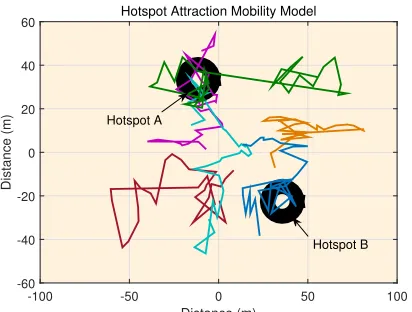
demonstration of the resulting movement pattern is shown in Fig. 4(a) for seven people's movement. This model is consistent with human movement, i.e., each person has a finite and small probability of travelling a long distance in a single step. More recently, rich CDRs have been used to improve upon the previous LF model to derive a truncated Lèvy flight (TLF)
model [3], with step size truncation parameters rH and κ (see
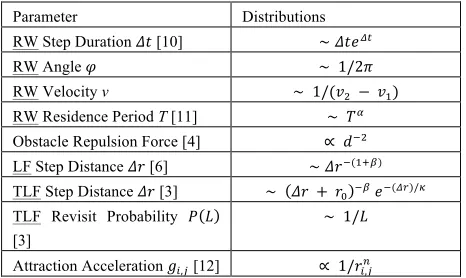
Table 1).
Parameter Distributions RW Step Duration 𝛥𝑡 [10] ∼ 𝛥𝑡𝑒JK
RW Angle 𝜑 ∼ 1/2𝜋
RW Velocity v ∼ 1/(𝑣: − 𝑣D)
RW Residence Period T [11] ∼ 𝑇P
Obstacle Repulsion Force [4] ∝ 𝑑C:
LF Step Distance 𝛥𝑟 [6] ∼ 𝛥𝑟C(DEF)
TLF Step Distance 𝛥𝑟 [3] ∼ 𝛥𝑟 + 𝑟HCF 𝑒C(JQ)/R
TLF Revisit Probability 𝑃 𝐿
[3]
∼ 1/𝐿
Attraction Acceleration 𝑔",# [12] ∝ 1/𝑟",#U Table 1 Microscopic mobility parameter models
Correlated models
More enhanced RW models add boundary conditions and Markov models to correlate the movement of individuals or groups of individuals. A summary of different microscopic
mobility parameters and their models is summarized in Table 1. In terms of boundary conditions, collision avoidance is often considered to mimic how individual movement interacts with other individuals and obstacles. In order to avoid colliding with other individuals, a small circle zone is defined around each individual and overlap of the zones is avoided [4]. As for obstacle avoidance, a repulsive force is created, with a vector that is normal to the obstacle's surface. The force of the
repulsion is proportion to the inverse square of the distance d to
the obstacle [4].
In terms of correlated movement for individuals, the likelihood of moving between zones is biased according to a
personalized Markov model. For example, in
telecommunications, people in one base station (BS)'s coverage area will be assigned transition probabilities to migrate to other BS. Unlike uncorrelated RW models, in this case each new destination is correlated with the previous movement pattern, such that the overall trajectory of movement is smoother than those shown in Fig. 4(a). This will avoid the sharp speed
changes (VW KVK → ∞ ) and sharp angular changes (VZ KVK → ∞)
produced by uncorrelated RW models, which fits close to real observations. For example, vehicular correlated models will
add either the stop-turn-and-go or the slowdown-before-turn
modifications to existing RW models. Both of the modifications assign a high probability to low initial velocity at the start of every direction change [11]. This can be achieved by decoupling the two random events, i.e., changing speed occurs before the change in direction. The time between a speed or a direction change commonly follow an exponential distribution [11]. In terms of group correlated movement, each individual also adapts its own velocity and direction to those of neighboring individuals. Typically, a visibility range is defined, and a weighting rule is created to weight the influence of the neighbors [4].
In terms of location based correlation, another observed feature of human mobility is that most people travel only between certain locations [12]. This can make the final destination easier to predict, and a model called Self-Similar Least-Action Human Walk (SLAW) shows that reinforced machine learning can achieve accurate predictions [12]. For
each person, let L represents the descending rank of popularity
of the location to the person (i.e., L=2 represents the second
most visited location). It was found in [3] that the probability
of revisiting a location is 𝑃 𝐿 ∼ 1/𝐿, which is independent of
the absolute number of locations or the number of visits. That is to say, most people dedicate their time to a very few locations, whilst spending a small time roughly uniformly divided between a large set of different locations. Decomposing the model into different classes according to the transportation modes was conducted in [13] using GPS datasets. The analysis found that when the movement is decomposed into individual transportation modes, the step
sizes 𝛥𝑟 can be approximated by a log-normal distribution
[image:6.558.34.267.491.630.2]when the ensemble of all movement modes still exhibits the power-law distribution. This highlights the importance of gathering more accurate movement data for microscopic movement modeling.
Applications of microscopic models
Microscopic mobility models are suitable for predicting small number of users’ movement over a small area (e.g. single cell coverage). This is important for aspects of RRM within a sector and load balancing between sectors. Real-time data can drive parameter updates of the aforementioned microscopic models and complement state-of-the-art machine learning algorithms (e.g. stochastic Q-learning and deep learning) methods to improve resource allocation to meet the previously mentioned 5G criteria 1 and 2 of higher throughput and device number support.
(a)Example of the Lèvy flight (LF) mobility model with power-law step distribution (β=2).
[image:7.558.47.254.254.408.2](b)Example of the hotspot attraction with Lèvy flight (LF) mobility model with power-law step distribution (β=2). The gravitational attraction parameters are c4\c5]=20 and n=1.5.
Figure 4Examples of microscopic mobility traces.
Device-scale environment
It has recently been understood that proximity connections among two nearby devices (i.e., identified as Device-to-Device
Communications -- D2D) and autonomous flying
robots/drones, have the potential to quickly deploy dedicated communication networks, thus bringing access supply to where the demand actually is. Facilitated by miniaturization and cost reduction of electronic components, users' smartphones (but also small objects or devices) and unmanned aerial vehicles (UAVs) equipped with wireless transceivers may soon lay the foundation for truly dynamic Radio Access Network (RAN) solutions. Owing to their agility and mobility, rapidly deployable D2D relays and drone small cells will be particularly useful in 5G networks during unexpected and temporary events, such as concerts and fares, but also in daily life situations where there are unpredictable (or not) access demand fluctuations.
Based on this, even if microscopic models may be useful to characterize the mobility that either the users and this new concept of "mobile" infrastructure could have, there is the need to go deeper in the investigation of which mobility models could be suitable for scenarios where the given are of interest is particularly small and defined as "user-centric". These scenarios are related not only to outdoor environments but also to indoor areas where users (or devices) move under restrict daily hotspots. In such scenarios, there is a lack of accurate indoor and outdoor positioning systems and the lack of automated contextualization inside buildings. Existing research has largely focused on a very limited set of premises [5], [14]. The increasing number of smart-wearable devices with inertia sensors can provide a pathway to mining large amounts of movement data [8], but large-scale capability is lacking in understanding when are we truly in restricted area of interest, and what the context of these environments (i.e., topology and why we are there).
Hotspot gravitational model
[image:7.558.50.256.450.606.2]For generally small-scale indoor and outdoor areas, where layout and architecture do not play a major impact in the human movements, an interesting model in describing the mobility is discovered in [13] where people are attracted towards certain hotspots. Similar to the pursuit-based or group mobility models, the hotspot gravitational model adds an extra acceleration vector to existing RW models. As illustrated in
Fig. 3, the gravitational acceleration 𝑔",# of a person i moving
towards a hotspot j was found in [12] to be governed by 𝑔",# =
𝑐"_𝑐#`/𝑟",#U, where 𝑐"_ defines the tendency for the person to
move towards access points (behavioral), 𝑐#` defines the
strength of the hotspot signal, and 𝑟",# denotes the
separation distance with exponent n. Fig. 4(b) shows the
resulting Lèvy flight (LF) mobility model modified by the
hotspot attraction model in [13] with parameters 𝑐"_𝑐#`= 20 and
n=1.5 for six people's movements. Compared to outdoor
Distance (m)
-800 -600 -400 -200 0 200 400
Distance (m)
-500 -400 -300 -200 -100 0 100 200 300
400 Random Walk Mobility Model
Distance (m)
-100 -50 0 50 100
Distance (m)
-60 -40 -20 0 20 40
60 Hotspot Attraction Mobility Model
Hotspot A
microscopic models, the hotspot model offers greater flexibility in tuning human and devices (e.g., drones, sensors) movements to event-motivated movement, which is more representative of particularly small-scale motions.
Preferred route model
For restricted areas that have physical features which significantly impact on the mobility model, a more deterministic mobility model is needed, based on personal preferences and tasks. In [14], a Preferred Route Indoor Mobility Model (PRIMM) is proposed, which is inspired by the observation that people tend to move driven by some event and to reach the destination along the most accustomed path. In terms of implementation, people can move from one location to another when a task needs to be completed or an event have been triggered. Each regular event is assigned a time-dependent probability. Hidden Markov Models (HMMs) are used to generate the sequence of events that determines the transit state of mobility pattern, while a Hidden Markov Events (HME) will be used to determine the event duration. In such a case, events are classified according to resident events (person remains stationary to complete a task) and flight events (person moves to another location to start a task), both of which are modeled
by a truncated power-law distribution [12]. Compared to outdoor correlated mobility models, such as SLAW [12], PRIMM can model the motion feature in indoor environments by introducing personalized HMMs to use event triggers at various time states and predict the preferred indoor route.
Lessons learned and open challenges
In this article, we have surveyed the current human mobility models across three different distance and population scales, as well as examined what are the future challenges that have to be faced in order to have comprehensive models suitable for the forthcoming 5G wireless networks. We note that even our discussions were mainly focused on the pedestrian (or low intensity of mobility) cases, most or the models may be tuned to characterize other type of movements related to e.g., vehicles, drones, or trains. In particular, by changing the value of the alpha parameter in the Lèvy flight model (e.g., alpha equal to 1), we can generate paths with presence of large “jumps” that may be useful to characterize vehicle movements in transitions from urban to suburban scenario. Also, RW models can be used to characterize other types of mobility. In fact, if the third dimension of those model is considered, it becomes easy to model drone movements over
Open challenges Key issues Expectedbenefits
New mobility models for 5G systems
• Real time information from the deployed
devices to increase accuracy and precision
• Exploiting new technologies proper of the
upcoming 5G networks
Improved understanding of mobility and network processes
Managing mobility in 5G-grade IoT scenarios
• Understanding the effect of mobility in 5G
system targeting the IoT market.
• Merging 5G multi-connectivity with
heterogeneous mobility
Provide a reliable and secure connection “anywhere”, “anytime”, and to “any” device.
Tunable models
• Identification of common features in group of
environments
• Presence of tunable parameters given by the
network, social, and environment aspects
Tunable framework to be used with different environments and network deployments
Mobility models linked with connectivity and sociality
• Jointly use of connectivity, sociality, and
mobility tiers in an effective way
• Find an easy way to link all the environment
tiers
Fully characterization of direct relationships among the social interactions, users’ movements and the connectivity options
Softwares and tools availability
• Implementation of a complete and free-to-use
frameworks for mobility
• Availability of network emulators able to link
connectivity procedures on underlying mobility models
General and complete frameworks useful for implementing mobility in wireless/cellular networks
Common standard for the
[image:8.558.41.520.65.375.2]traces • Availability of a common standard either for the mobility models and real traces Promotion of an easy data exchange among researchers for cross-comparisons
random (i.e., in case of random walk model) and predefined paths (i.e. in case of random waypoint). Of course, for the case of large-scale movements is meaningless to consider different types of mobility since the described models include somehow all of them.
What we learned for our general overview, is that at the macroscopic distance scale (i.e., 10-100km), we found that gravitational laws can adequately describe how large number of people move between metropolitan areas. We used commuter data in London to show that those gravitational laws breakdown as we approach walking distances (i.e., below 3km). At the microscopic scale, where walking dominates human movement, we reviewed different Lèvy flight models. It was found that whilst uncorrelated models are useful as a general model, location and past-movement correlated models can remove irregularities such as sharp direction changes. Having a look at a more in-depth scale where the increasing number of devices, "smart" object and flying vehicles (e.g., drones) are starting to be part of the future 5G scenarios, we noticed the lack of research in this area due to the difficulty of collecting large-scale and accurate indoor and outdoor location data. Based on this, we reviewed two recent mobility models that may be on interest in such a case, one based on gravitational attraction to hotspots and the other based on event triggered preferential route learning through HMMs. Both research outputs have shown that users' movements are much more sensitive to environmental structural restrictions and events than in large-scale movements. This remains an open area of research and an encompassing universal mobility model for such restricted area of interest remains absent.
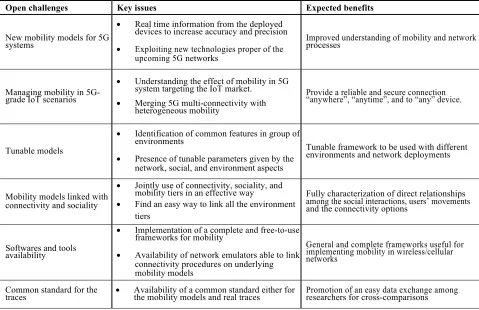
Many other challenges relevant to the mobility support in future 5G networks definitely require deeper analysis. Some of them uniquely arise for mobility model standardization, whereas others are exacerbated in networks protocols and regulations. The most relevant issues are addressed below and summarized in Table 2. We discuss these open challenges in detail below.
New suitable mobility models for the 5G Era
More accurate information and position tools may be derived by the even more increase deployment of smartphones and "smart" devices. Although existing mobility models are able to provide a good understanding of users' behavior is different environments, the randomness of specific scenarios and situation make these models difficult to apply. As an alternative solution, real time information from the devices deployed in the area of interest should be gathering towards a central unit that will be able to manage efficiently some network processes such as, the radio resource allocation, handover procedures, and network selection when considering a dense environment including different tiers of connectivity and network access nodes.
Managing mobility in 5G-grade IoT scenarios The explosion of devices connected to internet has been dubbed the Internet of Things (IoT). In particular, these devices are not just connected to the human hand, but may belong to cars, infrastructure, and, more generally, by the overall environment that is surrounding us. As a matter of fact, connectivity support for mobility is particularly important for IoT devices moving at slow, medium, or high speeds over a certain geographical area. Ironically, while mobility models have been routinely used in the evaluation of human-centric communications technologies, such as mobile ad-hoc and legacy cellular networks, the effects of mobility in mobile 5G systems that are targeting the IoT market are much less understood. For applications with “loose” delay constraints, where network topology may change over the time-scale of single packet delivery, the per-user throughput can increase dramatically when nodes are mobile rather than static. Following this assumption, a possible solution may be to explore the enhancements offered by a set of innovative 5G technologies in practical IoT contexts and, most importantly, understand how effects such as mobility and multi-connectivity influence the communications performance in terms of
availability and reliability. Along this line, it is worth noticing
to remark that when thinking about IoT mobility is not only related to static or semi-static environments. In fact, nowadays the deployment of sensors and actuators is spreading along many field such as factory automation, automotive, aeronautical, and smart grid. As an example, in the automotive industry higher transmission rates and lower transfer delays of today’s wireless systems coupled with decisive capacity enhancements promised by the emerging 5G mmWave cellular, are expected to support growing densities of automotive mMTC devices, up to 200 items per vehicle by 2020.
Tunable models for “Any” environment
Nowadays the availability of mobility traces is not useful to describe a wide group of scenarios that can be grouped under unique "classes" due to their common features and network deployment. It is difficult, indeed, to generalize the result obtained from real-trace that more often give us a picture of a very specific situation like, for instance, movements within a campus, conference, office, or urban area. To overcome these issues, future mobility models for 5G scenarios should identify the common features in group of environments by proposing a general solution where researchers can play with tunable parameters dealing with the social contacts, geographic area, applications, services, and network deployment. We believe, that this problem will be tackled more and more effectively with the increasing availability of mobility traces extracted from the future 5G heterogeneous environments.
data analytics and IoT control (e.g., Microsoft Azure and InterDigital oneM2M) can make this feasible and desirable. These centralized services ensure greater guarantee in uniform service provisioning in 5G, as well as higher security and reliability in experience.
Merging the Connectivity, Sociality, and Mobility Tiers
Concerning future 5G scenario, we observe that physical layer connections, network level associations, and social network level relationships are all inter-connected to each other [15]. For instance, social aspects among the users may be of particularly interest to understand the patterns that users could have in the evolution of the time. Therefore, an open problem is to find a way to integrate and merge the use of connectivity, sociality, and mobility tiers in an effective way to characterize the evolution of the overall deployed system. As for tunable mobility models, further investigations are needed to characterize which are the common properties and distinct features for each specific 5G networks scenarios. In such a way, it will way easier to characterize the direct relationships among the social interactions, users' movements and the connectivity options driven by the surrounding environments. More specifically, the influence of the connectivity options in a deployed scenario, (i.e., with the presence of obstacles (e.g., buildings, hills, green areas) on human sociality and mobility patterns has not been studied yet.
Software and tools for simulations
Looking at the literature, it is evident that there is a lack of available and complete tools (i.e., in particular open source or free) able to provide a general framework useful for implementing mobility in wireless/cellular networks. Concerning the simulation tools that will be implemented for testing future 5G performance, there is a concrete need of mobility and network emulators that are able to fully characterize the connectivity procedures and processes in environments on an underlying mobility model (i.e., either through models or real traces). Even some tools are already available in literature, mainly they focus on the transmissions and the protocol stack procedures without taking a fully consideration mobility aspects. In such a case, we want to point out that more attention should be dedicated in the development of a more adaptable mobility models by integrating not only those derived from the analytical methods but also the ones available through measurements and real traces.
Standardization of trace formats
Although many real traces are available on the web and in
literature (e.g., the CRAWDAD6 repository), most of them do
6 CRAWDAD repository: http://crawdad.org
not follow a common standard. Based on this, more often "ad-hoc" scripts are needed to convert them into various formats to make them more suitable in the development of system level simulators. Therefore, to overcome this issue the research community should converge in a common standard able to promote an easy data exchange among researchers for cross-comparisons thus increasing, in this way, also the visibility of their work and the collaborations among different international groups.
References
[1] X. Ge, J. Ye, Y. Yang, Q. Li, "User Mobility Evaluation for 5G Small Cell Networks Based on Individual Mobility Model," in
IEEE Journal on Selected Areas in Communications, vol. 34, no. 3, pp. 528-541, March 2016.
[2] T. Wang, W. Jia, G. Xing, and M. Li, “Exploiting Statistical Mobility Models for Efficient Wi-Fi Deployment,” IEEE Transactions on Vehicular Technology, vol. 62, Jan. 2013. [3] M. Gonzalez, C. Hidalgo, and A. Barabasi, “Understanding
individual human mobility patterns,” Nature, vol. 453, Jun. 2008. [4] F. Legendre, V. Borrel, M. D. de Amorim, and S. Fdida,
“Reconsidering microscopic mobility modeling for self-organizing networks,” IEEE Network, vol. 20, Jan. 2007. [5] L. Subrt, P. Pechac, O. Hrstka, V. Micka, and J. Vokrinek,
“Novel Mobility Model for Indoor Conference Scenarios,” in
IEEE European Conference on Antennas and Propagation (EUCAP), 2014.
[6] D. Brockmann, L. Hufnagel, and T. Geisel, “The scaling laws of human travel,” Nature, vol. 439, 2006.
[7] J. Kraaier “Modeling User Mobility for the Simulation of Wireless Ad Hoc Access Networks”, Cuvillier Verlag, 2008 [8] Z. Yang, C. Wu, Z. Zhou, X. Zhang, X. Wang, and Y. Liu,
“Mobility Increases Localizability: A Survey on Wireless Indoor Localization using Inertial Sensors,” ACM Computing Surveys, vol. 47, Apr. 2015.
[9] M. Barthelemy, “Spatial networks,” Physics Reports, vol. 499, no. 1, pp. 1–101, 2011.
[10] F. Simini, M. Gonzalez, A. Maritan, and A. Barabasi, “A universal model for mobility and migration patterns,” Nature, vol. 484, Apr. 2012.
[11] C. Bettstetter, “Smooth is Better than Sharp: A Random Mobility Model for Simulation of Wireless Networks,” in ACM International Workshop on Modeling, Analysis and Simulation of Wireless and Mobile Systems, 2001.
[12] K. Lee, S. Hong, S. Kim, I. Rhee, and S. Chong, “SLAW: Self-Similar Least-Action Human Walk,” IEEE/ACM Transactions on Networking, vol. 20, Apr. 2012.
[13] Z. Du, P. Hong, and K. Xue, “Hotspot Gravitation Mobility Model,” IEEE Communications Letters, vol. 16, Feb. 2012. [14] L. Ning, Z. Wang, and Q. Guo, “Preferred Route Indoor Mobility
Model for Heterogeneous Networks,” IEEE Communications Letters, vol. 18, May 2014.

![Figure 2 Commuter number prediction based on population size and distance of travel. The parameters used are α4 = α5 = 1and f(r4,5) = r4,5: [9]](https://thumb-us.123doks.com/thumbv2/123dok_us/9431229.448833/5.558.289.514.458.600/figure-commuter-number-prediction-population-distance-travel-parameters.webp)