Varian's
620/f
with VORTEX:
capable of bigger things.
Our 620/f with VORTEX is a hardware/ software combination that can take on the big boys and beat them at their own game. For a lot less.
The 620/f is the 750 nsec member of Varian's 620 Family. Powerful and versa-tile, it's the minicomputer definition of "FAST." VORTEX is the real-time oper-ating system built to match the capabil-ities of the 620/f. Put them together and you've got the most potent combination ever offered in the minicomputer market! But the payoff is in dollars. Compare the 620/f with VORTEX to the XDS Sigma 3. In equivalent configuration-Theirs: $85,000 on up. Ours: $48,000. And you sacrifice nothing.
How about flexibility? Our minimum memory requirement matches theirs exactly; but we have dynamic repartition-ing of memory and "load & go" capability, two things they overlooked. In the back-ground we've got automatic checkpoint/ restart, a more powerful Job Control Lan-guage, and a macro assembler to boot! We have 20 rotating memory device partitions
• I n
nl n'l
..
I n I n...
CIRCLE 1 ON READER CARD
to their 6. Most important, we have com-plete file protection where they have none at all.
The number of access methods to rotat-ing memory device shows us with 4. They, a mere 2. We have the advanced queued I/O while they are still working with chained.
NEW TAllY
PRINTER TERMINAL
100 lines per minute,
install it, forget it.
Line after line. Month after
month. Copy after copy. Good
environment or bad. The new
Tally line printer consistently
gives you crisp, multi-copy
printout without downtime.
Without
worrY:'.~::~tb~vt
a~justme~ts.
I
nitiar,9,~"st,()r}}:~~$i.
I
nstallatlons have proven ..
I~?· "The most·reliableimpadt"
printer tohitthe market. Ever.
I~~-lffi QJ~n
r{t@
[~~r~:
:~
:~~~~xLbib
1
~I
lJiit"'1 ilt;~I~) 1~!JiI!I'I~Hrilill!H iHI~ li~HW;.j'i"~lli[~( It;;l'l~'t,::) IW~., ril,\·~!ilht!llil.il 1!lot~I~!-j.:1 iHI~ li'h'~W)"I!1 ~~H!lili.li.i.t!/I'I;" ,mll'lil, \'N~"" ,ilot-il!/.I:I!' ""il'l!1 'elil~'/
iHlil,.i:' i~,~!Ji"leHil!ll4'" 'hr.',llth'; '(t, ;je,l:k lit;!'l!· iHI:lil iiij(:, I~t;~i~~ :1eI' IH~ lil:f,,'1~'1
;~I:jiil~-{Ol (~hll~l~ It{iili'il~til':Iil i~~. It'!~iell:HOJ '.{e/i·,I!Hihl' '1i!-'H;III:iHe'.!-' "I',jj(:II:
,1!-'1:I<:-'it:w~ l!l~t?lil ':,iml!JIr~!1 ~11!l;Hilil:I~~ Itleliil!I'll:j' ilit:.i; I,'N*' '~I!lIrI:~~11 '.~Jjel~I'lil:(ill~"1 ,el!},.i!lt~i'Ii.1'N~i ~1il!11~:I!HHii:t!II!\r/ ~,i!:l(!I:l' 1!IW Ihl'iell"I~!;iWH:' ,.jelill!,'i(:I· 'II'
~I'il ~HWliil!l1 ;~i) lilW:li ,i!,iW~~ll/it!l!m:li"I:J'\~)
'---,
Today we're not Number 1 or 2 . . . we're flying ahead of them. We've got all competitors frustrated in the clouds announcing blue sky paper tigers. Why? Only Modular Compu-ter Systems is delivering a family of 16-bit computers supported by fam-ily compatible software and I/O equipment that soar upward and downward from computer to com-puter. Instead of outdated patching, all elements of the MODCOMP family have been designed together to work together ... specifically for real-time measurement, control, communications and on-line inform-ation processing requirements.
Here's the best:
D MODCOMP I taking off at $2,500, climbing to the MODCOMP II and to the- MODCOMP III with multipro-cessor con fig urations up to $300,000. D Never been beaten by any 16-bit computeron a benchmark and always rated first in price/performance. D Six language processors and three operating systems including a 'real' real-time monitor with foreground/ middleground/background . . . and a re-entrant FORTRAN IV run-time package (and it's all been delivered). D Unique ability to address and manipulate bits • . • bytes, words, doublewords and files.
D Architecture for the 1970's with 800 nanosecond full cycle time up-gradable to 400 nanoseconds, 15 general purpose registers, 182 in-structions, mul1i-port memory and user available microprogramming.
o
65K words, of core directly ad-dressable . . . standard software operates anyplace in memory.D Fastest I/O throughput and most flexible interrupt structure. D Hardware interfaces and soft-ware work interchangeably on all computers.
D Modular design enables use of lower-cost, higher-performance components as they become avail-able . . . assuring continued low prices and high performance while extending customer investments in software development.
These are only a few of the reasons why ,repeat business to many of our industry's most sophisticated users has consistent-ly averaged more than 40 percent of our order volume. Examples of why sophis-ticated users have turned to MODCOMP are almost as varied as the applications themselves.
Advanced Real-Time
Software
A large, multi-computer user required all of his process control programs to be written in FORTRAN, operating under a real-time executive. His reasons: short-age of programmers having real-time as-sembly language experience; and attain-ing a level of machine independence. The manufacturer selected a MODCOMP III supported by the MAX III foreground/ middleground/background software system. His extensive acceptance tests included the execution of mUltiple FORTRAN coded foreground tasks and concurrent background operations.
Measuring Capability
Another industrial customer was faced with two tough measuring problems. He had a wide range of analog signals, vary-ing from millivolts full scale to volts fullscale. He also needed to resolve micro volt signals having common mode vOlta'ge of 500 volts. He chose a MODCOMP system with a Wide Range Analog Input Subsystem because it met his measure-ment and processing requiremeasure-ments.
Broad Range OEM
A large midwestern manufacturer needed inexpensive computers to function in smaller systems jobs and as remote pro-cessors. For medium and large jobs, more powerful CPU's were required. The man-ufacturer selected Modular because all these computer requirements could be supplied by one vendor. This earned them better OEM prices ... their software and hardware interfacing people concentrated on learning only 'one' machine.
Custom Engineering
and Programming
A MODCOMP II system was selected for an automated test application by
a
major engine manufacturer because Modular supplied the special control and display panels plus application programs for the test stands. This willingness to accept total system responsibility is a key differ-ence between Modular and other mini-computer companies.If you want the best, call Modular ... or at least write today for our encompassing booklet on the MODCOMP family.
Modular Computer Systems, Inc. 2709 North Dixie Highway, Fort Lauderdale, Florida 3330.8 phone: 305/563-4392
JANUARY, 1972
volume 18 number 1
This issue 110,647 copies
departments
Look Ahead
7
Calendar
15
Letters to the Editor
19
Editor's Readout
27
News in Perspective
53
Hardware
72
Software & Services
85
Literature
91
People
95
Poem
104
Books
105
The Forum
107
I ndex to Advertisers
113
January, 1972
D A
T AJv4lFl TI
iii
N®
28 Where Go the Computer People-Up, Down, or Out?
MILT STONE. In this first article of a series, a DATAMATION
contributing editor begins the interpretation of information gathered by the staff from thousands of questionnaires and hundreds of personal interviews-showing the personal attitudes that will shape the future of computer-based careers.
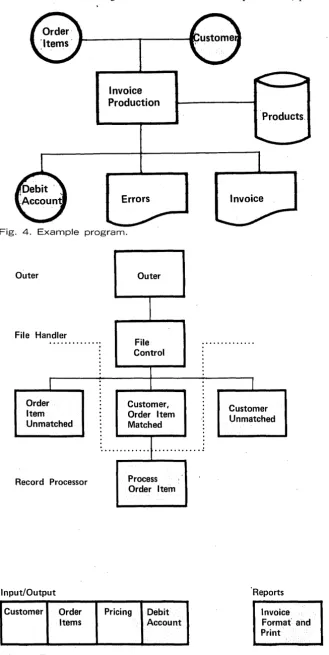
34 Modular Programs: Defining the Module
ALAN COHEN. That modularity is a useful tool is common
knowledge, yet few seem to know how to use it. A new approach sheds light on the practical problems facing programmers who are attempting to develop modular programs.
39 The FJCC
Gone were the mainframers, software houses, and time-sharing outfits, while attendance was down substantially. Changes are in the wind.
45 1971: Anything Could Happen (and Did)
TOM MC CUSKER and w. DAVID GARDNER. As the year
un-folded, IBM bared its teeth, RCA took a dive, and the world's fastest growth industry was stunted.
51 The Railroads:
Salvation Through Computers?
Report on a conference concerned with falling profits and the threat of government intervention.
53 News In Perspective
RCA users generally were reassured when Univac agreed to buy the RCA customer base and industry observers were calling the buy a smart move on Univac's part. This month's individual Univac-user negotiations should give a good indication of just what it is that Univac has bought. User and industry reactions to the acquisition are examined. 107 The Forum: Exit-Without Flourishes
LOUIS' B. MARIENTHAL. There must be a better way-even
for going out of business-than the one RCA chose. About the Cover
As we start the New Year with a look at where computer people are going, our art director's design reflects the frag-mented image we see so far. Articles to come will pull the
picture together. Photos by Gene Ford
4
REDUCE
TERMINAL
DOWNTIME
How much terminal downtime
can you stand? You have a choice
with DATA-SCREENTM Terminals!
• Five minutes or less if you maintain a set of replacement PCB's·
• About 24 hours if you use TEC's exchange plan. You call, we air mail replacements immediately. * (* Return defective parts for low cost exchange)
TEC's CRT Terminals are uniquely modular, providing
1
easy access to three major subassemblies: 1) video mon-itor; 2) logic cards and cage; 3) power supplies and all neatly wired to multi-pin connectors.We didn't plan our terminals for easy repair - that's a
2
3
might to prevent it, something will probably failsome-O 0
by-product of good design. And, unfortunately, try as we where in one of our terminals, someday. Easy, low cost replacement of modules or cards gets a DATA-SCREENTM Terminal back on-line, fast, fast, fast! That cures head-aches, too.DATA-SCREENTM Terminals are available in 10 models, buffered and conversational, covering parallel, serial, polling and TTY compatible and TTY replacement interfaces.
Can we tell you more?
E
Call (602) 297-1111 or write:
1
t
TEe Incorporated, 9800 North Oracle Road ~L~
Tucson, Arizona 85704 ~~~ORPORATEO
LEASE
CIRCLE 29 ON READER CARD
complete computer systems,
peripheral equipment and
software
Scientific Leasing Inc. (Sci Lease) offers both standard systems and specialized configurations of large-scale installations and mini-computers ,to meet your specific EDP requirements. Individual units or groups of peripheral, terminal, data preparation and communications gear-and appropriate software· -_are also included within
the comprehensive Scientific Leasing plans. ALL new equipment, with warranty in force, offered by ANY manufacturer, may be leased.
By using our long-term flexible lease plans con-siderable savings can be realized over manu-facturer's own rental plans. By working with Scientific Leasing you profit from the resources and experience only to be found witllin a pro-fessional organization which specializes in tech-nical equipment leasing.
For further details, we invite your inquiry.
scilease
SCIENTIFIC LEASING INC.
77 MEADOWGATE, WETHERSFIELD, CONNECTICUT 06109 TELEPHONE (203) 529-2220
CIRCLE 8 ON READER CARD
DRTRMRTICN@
EDITORIAL STAFF Editor
Managing Editor Senior Associate Editors Associate Editors
Copy Editor Assistant Editors
Robert B. Forest Edward K. Yasaki William J. Rolph Tom McCusker Richard A. McLaughlin Edith D. Myers Janet Eyler
Michael William Cashman Alma O'Steen
Special Features Editor Angeline Pantages New England Editor W. David Gardner Washington Editor
Southwestern Editor European Editor Australian Editor Contributing Editors
Editorial Adviser Technical Consultant
EDITORIAL OFFICES
Phil Hirsch Robert F. Alexander Pearce Wright Frederick A. Bland Howard Bromberg, Philip H. Darn, Louis B. Marienthal, Milton M. Stone. F. G. Withington. Paul Armer. Michael A. Duggan Robert L. Patrick Lowell Amdahl
Headquarters: 94 S. Los Robles Ave., Pasadena. CA 91101. Phone: (213) 681-8486; Eastern: 35 Mason St.. Greenwich. CT 06830. (203) 661-5400; 19 Marlborough St.. Boston. MA 02116. (617) 267-9414; 9805 Singleton Dr .• Bethesda. MD 20034. (301) 530-7271; Southwestern: 2711 Cedar Springs. Dallas. TX 75201. (214) 744-0161. Foreign: 65, Hill Road. Chelmsford. Essex. England; 322. Park Regis. Park St.. Sydney. NSW 2000. Australia.
GRAPHIC DESIGN & PRODUCTION Art & Production
Director Cleve Marie Boutell Production Manager Marilee Pitman
CIRCULATION
35 Mason Strret, Gre.enwich. CT 06830 Circulation Director
Circulation Manager Marketing Research Director
Publisher Associate Publisher
Suzanne A. Ryan Mae Van Rennes
Douglas DeCarlo
Gardner F. Landon James M. Morris
Circulation audited
by Business Publications
I-I::t.!i
AuditMember. American Business Press, Inc.
tp
DATAMATION is pub-lished monthly on or about the first day of every month by Tech-nical Publishing Company,1301 South Grove Ave .• Bar-rington, Illinois 60010; Arthur L. Rice. Jr .• President; Gardner F. Landon. Executive Vice President. Executive. Circulation and Advertising offices. 35 Mason Street, Greenwich. CT 06830 (203) 661~5400. Editorial offices, 94 So. Los Robles Avenue. Pasadena, CA 91101. Pub-lished at Chicago. III.DATAMATION is circulated without charge by name and title to certain qualified individuals who are employed by companies involved with automatic information han-dling equipment. Available to others by subscription at the rate of $18 annually in the U.S. and Canada. Reduced rate for qualified students. Foreign subscriptions are on a paid basis only at a rate of £12.50 annually. Sole agent for all subscriptions outside the U.S.A. and Canada is J. B. Tratsart. Ltd. 154 A Greenford Road. Harrow. Mid-dlesex HA13QT England. No subscription agency' is authorized by us to solicit or take orders for subscrip-tions. Controlled circulation paid at Columbus. OH and Form 3579 to be sent to Technical Publishing Company, P.O. Box 2000. Greenwich, CT 06830. Copyright 1972, Technical Publishing Company. Microfilm copies of DATAMATION may be obtained from University Micro-films. A Xerox Company, 300 No. Zeeb Road. Ann Arbor. Michigan .48106. Printed by Beslow Associates, Inc.
GA introduces nine great new minicomputers in two related families. They work harder, act faster, learn quicker.
SPC-16 Family- The Power Leaders
(Quantity of 10 price $2,923)*
The all-new SPC-16 family are the power leaders. These 16-bit minis feature four times the processing power of any other minis you can buy. They're available in an SPC-16/40, /60, /80 series that features integral input/output and memory expansion to 16K for most systems applications " .and in an SPC-16/45, /65, /85 series featuring external I/O and 4K memory expandable to 64K for the "bare bones" OEM buyer or for larger
systems requiring extra memory and I/O capacity. All six models are fully hardware and software cO.mpatible with each other and with existing SPC-16's.
SPC-12 Family- The Price Leaders
(Quantity of 10 price $2,205)*
The all-new SPC-12 family are the price leaders. Three ultracompact models - the SPC-12/20, /15 and /10 - are available with standard 4K memory expandable to 16K and in I/O capacities to 19 minicontrollers. With fully compatible computer, I/O, interface and Real Time Executive modules, an SPC-12 system can be quickly and easily assembled to solve just about any industrial automation
* Ask AbOllt Our Big New Discount and Easy-Buy OEM Policies.
January, 1972 CIRCLE 20 ON READER CARD
problem. At a bedrock price. Send today for descriptive literature on ourtwo new families of "smart minis." We've tried to put our power/price story in plain English.
General Automation, Inc.
@
Anaheim, California 92805 1055 South East Street!i7
a
(714) 778-4800 TWX 910-591-1695JL 'We Make The Smart Minis'
6
BURROUGHS
ANNOUNCES
and DELIVERS
the
IE)
~J(Q)([J)
SYSTEMS
Burroughs new B 4700 Systems are being delivered nolV. Powerful systems. Easy to program and manage. Uniquely responsive to changing business conditions.
With fast new circuitry coupled to a superior system design and mature software. (*B 4700 COBOL program throughput is twice or more that of Burroughs B 3500, long considered the out-standing system in its class. FORTRAN programs run up to 20 times faster.)
With the added power of two, three or four processors all sharing one fully-protected data base. Up to 80 input/output channels. Parallel multipro-graming (each processor runs many jobs concurrently). Data
October 11, 1971
M~. James A
V~ce Presid' MCCUllough BurrOughs ent and Grou
'BurrOughs ;~rpOration p executive Detroi t, Mic~f;an
48232
communica nons pre-processors. Operator display consoles. Im-proved peripheral units.
With virtual memory ability to simplify programing. Burroughs Master Control Pro-gram for system self-manage-ment. Priority scheduling. On-the-spot reconfiguration. Con-version without reprograming or even recompilation for B 2500 and B 3500 users. Conversion software to help others take this major step up.
With total modularity for sys-tem expansion a t any time with-out reprograming. To fit growing workloads. New applications. Constantly changing conditions.
CIRCLE 9 ON READER CARD
Read what one B 4700 user has to say . . . then contact your Burroughs representative. He's ready now with the systems you need now and for the dynamic . years ahead.
Johnson Service Company since 1885 has offered a one-source responsibility for the world's automation needs ... design, manufacture, instal-lation and service'" from 114 branch offices in the United States and Canada.
Look Ahead
UNIVAC PLANS SPECTRA EMULATOR
Univac's,take-over of the RCA rental base
(pag~
53)
m~y
be an
even better deal for Univac than first met the eye.
Its sales
are said to be in, the deep do1drums--still onryfive or six
orders for the 1110, and the 9700 won't be delivered for many
months.
So, the RCA deal meets Univac's need for immediate
growth.
We know it wasn't planned that way, but" the 9700 could
have been designed to convert the RCA line. The 9700 has
emulation capability, and we hear Univac has a team working on
development of an emulator for the Spectra line.
UNIVAC HAS KEY/DISC BUSINESS PLANS TOO
Overshadowed, by its big deal to acquire RCA's computer customers
were Univac's quiet negotiations last month for the customer
base of Redcor Corp., the ailing Canoga Park, Calif., data entry
firm.
Gould and Addressograph Hu1tigrapn were also in the
running; but Redcor was said to favor a Univac offer under which
it would manufacture KeyLogic key-to-disc systems for Univac and
turn over the customer base and a sales and service staff of 75.
Terms were under negotiation at press time. Despite the
imminent demise of an activity that represented 80% of its sales,
'I
the company last month still answered the phone with a cheery
"Merry Christmas, Redcor."
Elsewhere in data 'entry, we heard Mohawk Data Sciences will
announce a numeric document reader in June. The plan is to hang
it to the 2400 system. MDS' major interest in acquiring some
of the RCA pieces, incidentally, is to get its hands on ocr
equipment under development at RCA.
THE COMPUTER INDUSTRY'S PENTAGON PAPERS--ALMOST
In the private antitrus't suits against IBM, the written
depositions being taken from 2,700 firms have provoked
controversy, confusion, and delay.
In November eight of these
firms--Burroughs, Honeywell, Digital Equipment Corp., NCR,
Computer Design Corp., Memory Systems, Inc., Unicorn Sys'tems, Inc.,
and Wy1e Labs--requested a stricter protective order from the
St. Paul Court. They contended tnat attorneys and some experts
outside
I~Man4 the other litigants would ,be the
o~esto analyze
the data.
But the court disagreed, saying if it is to have
"meaningful significance" a limited number of IBM' (15), Control
Data (10),. and Greyhound Computer (10)pe,rsonne1
5hou~d~
'be
permitted td evaluate it.
Presiding Judge Philip Neville didn't say anything about
letting a reporter see the material.
In December, a Business
Week correspondent in routine search of data> on the suits was
inadvertently shown to the "protected" room where more than 1,500
depositions were filed.
He wasn't aware of his treasure, so
little harm was done, although at this writing his notes hadn't
been subpoenaed.
The fact that the room wasn't under lock and
key has made corporations leery of the whole process. None
contacted, however, had decided on any
~ction.Look Ahead
every form imaginable,
With the
court~srefusal to authorize
payment for preparing the questionnaires, one company has merely
sent annual reports, saying, "It's all there.
Find it."
Undoubtedly, it will take months to sort and analyze the data.
When the parties are through, everyone wonders what will become
of the personnel that have been privy to it all. Quipped one
computernik:
"Well, they used to bury the Pharaoh's architect
in the tomb."
USERS OF 1655 PLEASED WITH THE 3330
Users of 370/l65s report that the IBM 3330 disc drive, just now
going to customers, is working well with "no downtime to speak
of" and that the change from 23l4s to 3330s "is transparent."
But its high speed (transfer rate of BOOKB/second) is causing
some problems for 155 users.
One thinks the l55's HASP spooling
module will have to be changed to keep up with the 3330 speed.
Another user may have solved the problem by incorporating ASP
(Attached Support Processor) into his
as,
even though the
machine is not running with another 370.
ASP incorporates a
spooling module and this user is happy with the result.
A CHRISTMAS PRESENT FOR INTRANET COMPUTING
It was a merry Christmas at Intranet Computing Corp., Los
Angeles, and the firm's hopes for a happy new year are high.
The company, which filed Chapter XI bankruptcy proceedings
shortly before ,Christmas 1970, went into court last Dec. 15 with
commitments for $500,000 which more than funded a "plan of
arrangement" that officially removed it from the bankruptcy
roles. Actually, $285,000 would have done it, but company
principals said they felt more comfortable with the larger
amount, the bulk of which came from S.A. King of D.H. Blair Co.;
Robert Philip, Richland, Wash., publisher; Sam Volpenteste,
head of the Tri-City Nuclear Industrial Council of Richland; and
a large computer peripheral manufacturer which invested $100,000
and also signed an exclusive worldwide marketing and maintenance
agreement with Intranet.
Once primarily a time-sharing company,
the main business of Intranet-as-revived is the production of
disc systems to replace Fastrands.
RUMORS AND RAW RANDOM DATA
IBM's high purchase-to-lease ratio on the 370 line isn't
deterring buys, it seems.
We hear $575 million worth of 370s
were purchased in the second half, mostly by banks and insurance
companies ..• Automatic :Data Processing has been talking to
Computer Sciences Corp. about Infonet, after breaking off t'alks
to buyout ITT Data Services' s.ervice bureau operation.
CSC
isn't planning to can the service, but certainly would like to
unload it, we hear ... Some 15 time-sharing firms are bidding.on a
GSA contract to be let next April for remote dp services.
The
order possibly will be worth more than $1 million a month •.. Jim
Schallerer, industry savant and entrepreneur, has set up a
,consulting firm in Pebble Beach, Calif., to investigate the
possibilities of trade with Red China.
He has joined a trade
Exp-a~d
your
PDP-'5 memory
for half the cost.
TheDMS-15
Add-on
Core Memory
o
Makes the PDP-15 an exceptionally attractive processor for medium scale applicationsD Utilizes the ECOM Series F Mini-MassJj) Magnetic Core Memory System (hundreds in use to date)
o
Available in SK to 12SK words, in increment? of 4K of 1S-bit memoryo
800 nanosecond full cycle timeo
Can be intermixed with DEC" memory unitso
Completely compatible with all PDP-15 peripheralso
90 day parts and labor guarantee, 6 month full service contractDimensional Systems has combined the fast. economical field proven, ultra-reliable ECOM Series F Mini-Mass Magnetic Core Memory System produced by Standard Memories, with its· own newly developed Synchronizing Interface to create this sensationally priced package.
To get the memory extension you need for half the price you thought you'd have to pay ... or to get twice the memory for the money you have available ... call, write or wire Dimensional Systems, Incorporated, 393 Totten Pond Road, Waltham, Massachusetts 02154, (617)890-5533, TVVX 510/223-0411.
® Registered trademark of Digital EqUipment Corporation
dimensional systems
STANDARD
MEMORIES
A subsidiary of astmsystems. Inc INC 0 R P 0 RAT E 0
Congratulate
yourself. You iust
found abette __
4800BP5
Mo
The Paradyne M-48. A new 4800 bps modem that gives you the features and performance you need-at a price you can afford.
The M-48 offers an ultra-low error rate on poor quality unconditioned or dial-up lines. A powerful all-digital automatic/adaptive equalizer. A bidirectional 150 bps second-ary channel. Continuous line quality monitoring. Loop-back testing of both local and remote modem from one end. Two 2400-bps channel multiplexing. To say nothing of ease of installation, operation,
and'main-tenance. All
for less than most so-called competitive modems.
Congratulate yourself. You've discov-ered The Outperformer.
[})ff)CPff)ciJ-V
w
@
CORPORATION
P.O. Box 5144 2040 Calumet Street Clearwater, Florida 33518 Telephone (813) 442-5126
The reason mos1
.
, .
companies cant gtve
you
is because theyre sn1al]
We make and market more kinds of
computers than any other computer
com-pany in the world.
Big computers. Middle size computers.
And small computers.
And our Logic Products Group can hook
them up to anything you want them hooked
up to (in the trade we call it "interfacing"), to
do whatever job you want them to do.
Because we make all the parts and
pieces it takes to do it ourselves.
Like genuine Digital Equipment
Corporation modules (including special
modules) plus labs, wire wrap service,
engi-neers, designers, logic people, seminars we
set up for you and your people in your area,
cabinets, cables, hardware, assembled logic
arrays, terminals, etc.
The reason most small computer companies coot give you big
small computer
big
computer
support
computer companies.
We'd be happier if everybody in the
world bought all their computers from us.
But, if you don't and you don't know
how to hook their's up when it does finally
arrive, and they don't have anybody to run
over and help you, we do.
And we will.
You see, we're big enough that it's no
big deal to do it.
And we're bright enough to know that
if
we hook your computer up properly even
if
it isn't ours, you'll think we're nice guys and
come to us first when it comes time to buy
your second. (617) 897-5111 (Ext. 2785).
Digital Equipment Corporation,
Maynard, Massachusetts 01 754
~DmDDmD
computer support is because they're small computer companies.
Univac
1700
keypunches.
Over
1500/0
faster in basic
punch and print speeds.
Better, faster card production
begins with something basic:
ma-chine speed.
UNIVAC® 1700 Keypunches are
over 15070 faster in punch and print
speeds than their competition.
47 cols/sec as against the 129's
18 cols/ sec.
.
This is one of the many
advan-tages that UNIVAC 1700 Keypunches
have over rival machines, and a
Univac representative will be glad to
explain them to you.
If you'd like to improve card
production with a cost savings, call
your local Univac representative and
ask. for a presentation at your
con-venIence.
There are more than 37 ,000 UNIVAC 1700's installed or on order around the world.
UNIVAC
+SPE~Y~I\C
Calendar
- .. ~. ' .... -r-~-~::r·-r~-~' ,~.", .. ,~-""~-""'''''~':x:r''= - ":7!-r.----.. -'-.... ~-- ..~"-EVENT/SPONSOR DATE LOCATION CONTACT COST
FEB.
ADAPSO 34th Management Conference 17-18 : Dallas J. L. Dreyer $80, members
and 2nd Conference on Software ADAPSO $120, others
551 Fifth Ave. New York, NY 10017
--- ---.-
.~.----AMA 18th Annual Systems Management New York City Conf. Info. Coordinator $150, members
Conference American Management Assn. $175, others
135 W. 50th St. New York, NY 10020
ACM SIGGRAPH Symposium 7-10 Pittsburgh Dr. John D. Canter $75
on Computer Graphics in Medicine Point Park College Students free
201 Wood St.
Pittsburgh, PA 15222
I EEE I NTERCON 20-23 New York City William J. Hilty $7, members
IEEE $10, others
345 E. 47th St. $3, students New York, NY 10017
APRIL
IIA 4th National Meeting 10-12 New York City Information Industry Assn. $100, members 1025 15th St., NW $150, others Washington, DC 20005
NCS 9th Annual Meeting and Technical 17-19 Chicago Numerical Control Society $110, members
Conference 44 Nassau St. $140, others
Princeton, NJ 08540
MAY
Spring Joint Computer Conference 16-18 Atlantic City AFIPS $20, members 210 Summit Ave. $50, others Montvale, NJ 07645
ASM 25th International Systems Meeting 21-24 Miami Beach Assn. for Systems Mgt. $125, members 24587 Bagley Rd. $175, others Cleveland, OH 44138
JUNE
Society for Information Display 6-8 San Francisco Lewis Winner $30, members
International Symposium 152 W. 42nd St. $40, others
New York, NY 10036 $2, students Conference on Computers in the 12-14 Atlanta Dr. John W. Hamblen $35, facu Ity
Undergraduate Curricula Southern Reg. Educ. Board $75, others
130 6th St., NW Atlanta, GA 30313
Summer Simulation Conference of the 13-16 San Diego O. P. Hall, Jr. $50, members
Simulation Conf. Board TRW Systems, M/S 01/2060 $55, others
One Space Park $25, students Redondo Beach, CA 90278
10th Annual Conf. of the ACM SIG on Toronto Fred A. Gluckson $45, members
Computer Personnel Research EDP Systems Dept. $55, others
National Bank of Detroit Detroit, ~ I 48226
It's the Teletype® model 38. And its capabilities go far beyond the wide format aspect of operation.
The new model 38 line design in-corporates many of the things that made the Teletype model 33 so popu-lar: It's a modular line. Exceptionally reliable. Extremely economical; costs very little for all of its capabilities. It's really a logical extension of the model 33 design concept and is sys-tem compatible with it.
16
Right! It's a new
low-cost, wide-platen
data terminal
••• the important differences
m.01el Ja prints I 132 charaeter llne
Generates III 128 ASCII code combinations
Prints In two eolors 11 dellrecf
PRINTS IN UPPER and. loYer east
AccePts standard ,4.-7/8-,an-toU eoaputer stocl<
••••••••••••••••••••••••••••••••••• and doesn"t cost Very rouchll!!
The model 38 prints 132 characters per/line at 10 characters per inch. This wide format enables you to send .and receive data using the same fan-fold computer paper stock used in your computer room. So you can move the data generated by your computer to any number of re-mote locations across the nation without time-consuming reformat-ting problems.
The model 38 generates all 128 ASCII
code combinations. You can print the full complement of 94 standard graphics, including upper and lower case alphabet characters. And it provides all the functional control necessary for easier operation. If you would like to input computer data in red and receive output data
Olters I v.riet)' ot tnterhea options On a price pertorunee basis you \lon·t flM • better bUY!
in black, or vice versa, the Teletype 38 terminal has this capability, too.
As
you can see, the 38's format flexi-bility makes it easierto get your data in and out of the computer. And it broadens your on-line capabilities as well.••• the line is complete
The Teletype 38 terminal is available in receive-only, keyboard send-re-ceive and automatic send-resend-re-ceive configurations. Which means all of the reports, forms, and tabular mate-rial you generate can be moved
instantly to all office, plant, ware-house, and sales locations that need the data using a terminal that best fits system requirements. Saving val-uable time, and providing more effi-cient and profitable operation .
• • • plug to plug compatibility
The model 38 is available with several interface options, operating at 10 char-acters per second (110 baud).
MODEL FSK AUDIO TONE SWITCHED NETWORK
38 DAA
W/MODEM SYSTEM 10 CHAR. I SEC.
The terminal can be equipped with a built-in modem with simple two-wire audio tone output which connects directly to the data access arrangement. '
DATA COMMUNICATIONS
equipment for on-line, real-time proc,essing
MODEL CURRENT OR DATA SWITCHED OR PRIVATE LINE
38 EIA INTERFACE SET SYSTEM 10 CHAR./SEC.
CURRENT OR
MODEL EIA INTERFACE MINI-COMPUTER OR OTHER 38 10 CHAR. / SEC INSTRUMENTATION
A second interface option is really two options in one. The set is equipped with both a voltage interface that conforms with EIA Standard RS-232-C and a cur-rent interface of 20 or 60 mao
This means you can readily fit the model 38 into just about any switched net-work, private line or time-sharing system going without special "black box" engineering. Or use it to add maximum input/output capabilities to your mini-computer at a realistic price.
MULTI-POINT PRIVATE LINE SYSTEM
USING STUNTRONIC™CONTROLLER C
0
I
I
10 CHAR. / SECI
L N T
S.C S.C S.C I R
I I I N 0 E L
MODEL MODEL MODEL L E
38 38 38 R
You call even use the model 38 in multi-point "selective calling" systems by adding a Teletype Stuntronic™ station controller .
LOCAL
MODEL READ-WRITE 4210
MAG 38 10 CHAR. / SEC.
TAPE
. . . automatic send-receive operation up to 2400 words per minute
r--For systems requiring higher speed capabilities, the model 38 can be used with the Teletype 4210 mag-netic tape data terminal. This com-bination provides on-line speeds up to 240 characters per second. The 4210 uses compact 3" x 3" x 1" mag-netic tape cartridges that hold up to 150,000 characters of data. Tape recording, editing, and correction functions are extremely simple.
DATA VOICE GRADE CHANNEL SET SEND / RECEIVE UP TO
240 CHAR. / SEC.
If you are generating heavy-data loads in a teleprocessing or remote batch processing system, the on-line time saving aspects of this terminal combination are exceptionally dramatic. It is also possible to send or receive data on-line with the model 38 at 100 wpm using the optional built-in modem, if required.
So take a close look at this new wide-platen terminal offering. If you would 'like more information on the model 38, or any other part of the total line of Teletype data communications equipment, write: Teletype Corpo-ration, 5555 Touhy Ave., Dept. 81-29, Skokie, Illinois 60076.
We would like to be of service.
T E L E T Y P E
machines that make data move
f
H :'
Teletype is a trademark registered in the U. S. Pat. Office
LJ-rl\TE:
()
I
How do you tell the president
you need bigger computers
again?
There's no longer a need for that recurring
con-frontation between computer professionals and the
executive suite. The reason: Collins C-System lets
you keep the system you have-including other
manufacturers' computers-and add modular
incre-ments of hardware and software as your needs
expand.
The C-System, a communication-oriented
com-puter system, provides complete network
manage-ment, including line control, format conversion,
queuing, routing, system alarms and status, logging,
and traffic accounting and reporting.
The connectability feature of the C-System lets
any processor communicate with any other
con-nected mass storage element. It lets processors
work together as a single system and execute your
total work load, sharing files and utilizing a
com-mon pool of peripherals.
Let us show you how Collins C-System can
extend your present processing capabilities without
extensive system redesign. Contact Collins Radio
Company, Dept. 300, Dallas, Texas 75207. Phone:
(214) 235-9511.
~~
COLLINS
~
COMMUNICATION I COMPUTATION I CONTROL
Letters
GIS terrible
Sir:
Thanks for the outstanding article in 15 October (p. 20) about "GIs."
We have been trying to use GIS since November 1969 in a TP mode, and it
still does not work as sold!
Minimum 68K for every GIS job, horrendous QTAM-GIS interface prob-lems, poor documentation from "Big Daddy," etc., etc., ad frustratum.
Many thanks to Kreger and Nathan-son, and DATAMATION.
NAME WITHHELD
A tlanta, Georgia
Multics alive in Waltham
Sir:
As much as I am, as ever, titillated by his musings, I have to take issue with that peripatetic savant, the good Doc-tor Grosch (Forum, Nov. 1, p. 71), in one minor aspect at least.
In the process of berating unwork-able systems born from tackling undo-able jobs, Herb has cast the Multics system into the same wallow where lie SAGE, BUICCS, and other dinosaurs; waiting to be pickled in tar.
This is a bad case of miscasting. Multics has proved in commercial use to be a practical, highly usable tool for systems programming-the primary activity for which it was designed. Here at the Honeywell Information Systems facility in Waltham, the Honeywell 645/ Multics system is op-erational, in the full sense of the word, and is being further enhanced for pro-duction of advanced systems software. A second system is scheduled to be installed in the Honeywell Bull facility in Paris early next year-in the mean-time, Paris programmers use the Wal-tham facility by long distance line.
By any definition today Multics is a workable system. In looking at its his-tory, one has to recall that it was ini-tially a research project, frankly in-tended to push the state of the art. There was no compromise with the ambitious objectives in order to meet schedule constraints. Under such cir-cumstances it is not surprising that there were delays and periods of less than optimum performance. The fact remains that the resulting system, whatever its parentage and formative years, is maturing into an effective tool.
There are those today who believe that operating systems are too massive and incur too much overhead for the benefit received. Well, there are some efficient operating systems today; but there is room for substantial improve-ment, in general, both in performance
January,
1972and in capability. And certainly if such systems are achieved, the work of de-veloping Multics will have contributed many important influences.
RICHARD H. HILL
Waltham, Massacllllsetts
Rosin's bag
Sir:
As the first customer for the Nanodata Corp. QM-l computer, I am pleased to see the recognition you are giving this machine (Nov. 1, p. 32).
r
support everything you said about QM -1, with one important exception.My group and I have participated in the design of the machine only in the capacity of potential users. We are not interested in designing hardware sys-tems; merely in using them. We sub-mitted a set of requirements rather than "specifications," and the ideas realized in QM-l have arisen in Nano-data, not in our university.
Furthermore, I have no connection with any· company, including Nano-data, except as a customer. I am on neither the technical nor managerial staff of the firm, I do not consult for them, and
r
don't even own a single share of their stock.Finally, I want to express publicly my gratitude to the National Science Foundation for supporting our work, which includes funding our acquisition of QM-l.
R. F. ROSIN
State University of New York at Buffalo
Amherst, New York
Common error
Sir:
Dr. Siegel's article on the WATFOR compiler (Nov. 15, pp. 22-26) was most enjoyable (perhaps its title should have been "What for WATFOR"). It brought to mind a harrowing experi-ence I had in conjunction with the debugging of a 4,000 FORTRAN state-ment nonlinear circuit analysis and op-timization program (related to my PhD dissertation at UC Berkeley).
Briefly, an error in duplicating a COMMON card caused a variable (say N) to be undefined in some subrou-tine. N was used as a switch, and, depending on its sign, different code would be executed. Since memory was not initialized (CDC 6400), the pro-gram would run perfectly on some runs and bomb on others (with the same data!).
The experimental evidence clearly indicated the type of error to expect, but to pinpoint the bug in a 4,000-card program, where the error was not de-tected by the compiler, was something else again. After 10 days' work, several nightmares, mounds of computer
print-out, and much valuable cpu time lost, the problem was resolved.
WATFoR-wherc were you when I needed you?
PAUL M. Russo
Princeton, New Jersey
Garbage value
Sir:
I enjoyed reading Stan Siegel's article on the W AT FOR compiler. In his discus-sion of the way that IBM System/360 FORTRAN compilers handle undefined variables (p. 23), it should be noted that none of these compilers sets an
initial value for a variable.
In FORTRAN output under these compilers, a true zero reports as 0.0 regardless of format specification. Also note that in the example labeled HO, the value of Y is a negative zero. The garbage value of an unassigned varia-ble is determined by whatever last oc-cupied the storage location instructions in the compiler, data from the previous job, or whatever. In the case of large programs, this problem can create some particularly insidious bugs. ANTHONY R. ABERNETHY
Tulsa, Oklahoma
Needed: new personnel
Sir:
In "Needed: A New Planning Frame-work" (Dec. 1, p. 37), Mr. Cosgrove states that any aggressive programming development group will need to find a way to use the talents of prima donna programmers. It is statements such as this which lower the quality of the programming profession.
What we need are professionals, not prima donnas. A professional finds out what has to be done, and does it to the best of his ability with consideration for the system environment and the overall corporate goals. He does not shift problems due to his personal idio-syncrasies onto his manager. He tends to be known for the quality of his work rather than his oddities.
A prima donna programmer is like a machine that can do everything, but cannot be found, cannot be started, is usually doing something else, and con-sumes exorbitant energy and resources. Who needs them!
JON A. MEADS
Beaverton, Or.egon
What cut?
Sir:
Assuming the integrity of the author, M r. Young's reference to data entry error rates (Oct. 15, p. 31) is sufficient to make the intended point that the error rate was cut to 4% of its original level.
However, Mr. Young, like the vast
20
DUO 360/370 shrinks
OS manpower conversion costs up to 90%.
Going from DOS to OS is a battle.
For one thing, programmer
man-hours are monstrously inflated by the need
to reprogram everything from DOS. With
DUO 360/370 you get OS
results
A
without reprogramming.
"
For another, OS test time is
an obstacle. DUO cuts it by as
much as 90%.
And in the conversion,
departmental morale suffers
heavily. DUO removes the pressure,
by removing the need to reprogram
everything at once.
What is DUO 360/ 370?
Some kind of knight in shining
armor?
If you're captured in the OS
conversion process, it is. Because
DUO permits most DOS object
programs to fully access OS
facilities
without reprogramming.
Your DOS
supervisor is not needed. And that makes
DUO unique in the marketplace.
It's been in operation at blue chip
companies across the nation for over a year
now. Try DUO 360/370 free, on your own
computer, and prove it for yourself.
Simply call me, Director of Special
Products, (214) 638-7555, or write.
r---I
I
Gentlemen: I'm interested in a free trialI
of DUO 360/370 on my equipment.I
D send me more informationI
D have someone call to set up my testI
Name _ _ _ _ _ _ _ _ _\\ Title Firm _ _ _ _
\ Address, _ _ _ _ _ _ _ _ _
I
City I State Zip _ _ _I
Phone _ _ _ _ _ _ _ _ _I
computer technology inc.
a subsidiary ofI
UNIVEASrry COMPUTING COMPANY/ 7200 North Stem mons Freeway / P. O. Box 47911
I Dallas, Texas 75247
L __________________
~letters _ _
_
majority of authors touching on the subject of data entry error rates, uses such nebulous terminology that the cited data are of limited value to those readers who are interested in error rates per se. Statements such as ". . . we had about 5.0% reject rate . . . " prompt this reader to ask 5.0% of what? It is conceivable that the author is referring to keystrokes, columns, data fields, or logical records (e.g., card images). Also, what is the rela-tionship of "reject rate" to total error rate?
There is so little information gen-erally available on data entry error rates that authors would be doing their profession a servIce if they were more definitive in their references. Because of variations in the average number of keystrokes per logical record, maxi-mum value would probably be achieved by limiting these references to per cent of either keystrokes or col-umns in error (a single omitted or added keystroke normally resulting in several succeeding columns being in error).
RALPH W. ZIMMER
Lafayette, Indiana
Read between the lines
Sir:
The statement made by Frank Cary in his interview with DATAMATION (Nov. 1, p. 26) regarding facilities manage-ment seems extraordinary. In 11 years as an IBM employee and customer, I have never heard of a situation in which IBM backed away from innova-tion because "it's difficult to justify to a board of directors."
Certainly Mr. Cary's memory is not so short as to forget the time when it was difficult to justify a "million dollar accounting machine" to a board of directors. We in the facilities manage-ment business fully recognize the diffi-culty in getting our message across.
We feel, as I am sure Mr. Cary would upon reflection, that innovative solutions to problems of efficient utili-zation of computer technology have been one of the strengths of our indus-try. The problem of how to best utilize the data processing dollar is frequently resolved through the facilities manage-ment concept.
KENNETH A. PARKER
Houston, Texas
Living legends
Sir:
After all these years it would seem that documentation would have come to be understood as the natural byproduct of every step in the system development
January, 1972
cycle. Although B. Menkus (Sept. 15, p. 30) and Thomas B. Sanborn (Nov. 15, p. 18) are to be commended in their belief that a "program is defective where documentation is lacking," the idea that "you haven't finished until you've done the paper work" is one reason why documentation is resisted. Some of my colleagues and I have increased our effectiveness by harvest-ing the. documentation at the milestone at which it most naturally occurs. Documentation is not an historical archive; originally it is active com-munication among users, analysts, management, and programmers. Each customary item of documentation has no validity unless it has served to com-municate between two or more people. Our documentation is then processed by a very adept documentation section which is pleased to see it trickle in instead of deluging them, and they consequently do a better job.
I believe that if a project supervisor finds it necessary to have his pro-grammer do much hated "back docu-mentation," he has failed to adequately manage his project in the first place. FRANK P. REYNOLDS, CDP
Occidental Life Insurance Company of California
Los Angeles, California
Premeditated display
Sir:
Mr. Showalter's welcome article on display systems (Nov. 15, p. 28) listed prospective display users from the board of directors down to the fore-man but made no explicit mention o.f the vitally important data analysis function. Data analysis is the discipline which extracts information from (usually multivariate) data and thus provides the objective basis for deci-sion-making and prediction, whether models are involved or not.
The point missed by virtually every-one is that the display, in conjunction with appropriate software, is the only means by which complex data bases can be thoroughly explored and hence understood. Contemporary systems which partially enable such exploration are OLPARS (Rome Air Development Center) and PROMENADE (Stanford Research Institute).
Why does such an oversight persist? I believe that it is simply because spe-cialists in display engineering, opera-tions research, mathematical statistics, and management information are un-consciously bounded by the curricula, journals, etc., of their respective fields. In view of the powerful, computer-oriented methods published in the last few years, anyone who continues to use, for example, linear regression as the analytical tool for predicting has the burden of showing why a linear
method was chosen and why a global solution is preferred. By mapping the data onto a suitably chosen plane for display, he could decide by inspection whether a single linear regression solu-tion were adequate. Extending from this example, data analysis research and exploration properly precede the choice of methods for management in-formation systems, whether or not these systems make use of displays. GEORGE A. BUTLER
Menlo Park, California
Tiny as zero
Sir:
I agree with Mr. Lafon (Nov. 15, p. 36) that dividing by zero is often "log-ical, desirable, and practical." I do it all the time.
Instead of putting up with the indig-nity of testing for a zero divisor and jumping around, I have a parameter called TINY, which I arbitrarily set to 8-24 . Relative to the other numbers, TINY is, for all practical purposes, zero. TINY is added to those denominators which can legitimately equal zero, in which case the numerator is merely divided by TINY.
If the denominator is not equal to zero, TINY is so tiny· that it doesn't affect the result (assuming that the denominator does not equal minus TINY). In fact, TINY can initialize or be added to variables which are used as denominators, so that your program will never blow after division by zero -unless you want it to.
FRED FOLDVARY
Berkeley, California
Something for nothing
Sir:
It is late at night, and I just finished reading "The Fallacy in the Fallacy." It must be later than I think, because Mr. Lafon made sense.
In fact, my computer has been tell-ing me this all the time. It keeps saying "+0, 0, and -0." I just never under-stood that the middle term in this prag-madox is nothing, while the other two terms are zero.
Let's hear more from Mr. Lafon. D. G. HAMLIN, CDP
Portland, Oregon
Impradox
Sir:
My praises to Mr. Lafon. His article was thoroughly delightful in both phrasing and philosophy.
I, too, have often instructed com-puters to divide by <tn expression whose value has sooner or later been zero. In 100% of these instances, the times when the denominator actually
(Continued on page 101)
Mie ..
op"OU ..
Omminn
is ou .. oa1iidoo.
Tho JODD
mokosi1i
i .... osistiblo.
22 CIRCLE 16 ON READER CARD
Microprogramming is on the move. The pace is fast, the result inevitable. It will soon become the dominant concept in the small computer market. And Microdata
leads the way.
We put the concept to work in the Micro 1600, a new mini which gives you all the benefits of microprogramming. Greater speed. Better use of core. Programming simplicity. A broader application base. Architecture which can be changed. The 1600 also achieves a new dimension in modular expandability for mini com-puters. It accommodates up to 16K words of high-speed control memory, 65K bytes of core memory and several input/output
interface modules.
Just pick the combination of hardware, software and firmware that does the job best. Then expand as the need arises. Growth from the minimum
configura-tion to the maximum takes place with-in a swith-ingle 1600 enclosure.
Price for the Micro 1600, the mini on the move, starts under $5,000. Send for a four-page bulletin and a copy· of our new 352 page Microprogram-ming Handbook.
Microdata _ _
Microdata Corporation
~
n
644 East Young StreetSanta Ana, Calif. 92705 (714) 540-6730
nd
yn
CFI Memories has built a quality reputation in the OEM market. Now we are building the same reputation with you.
We offer highest quality packs and cartridges, at attractive sales and lease rates, local service in all major markets, and we can provide packs and cartridges for all kinds of systems, re-gardless of their "special" characteristics.
CFI Memories belongs in your future. May we show you why?
Disc Packs . ... our only business.
January, 1972 CIRCLE 34 ON READER CARD
ks
I
~=~ ~= ~
I
Memories, Inc.
1 4 3 2 A L L E C S T R E E T ANAHEIM, CALIFORNIA 92805
To expedite (714) 776-8571
24
Phase I
ay1969
Inforex introduces 8 keystation .
shared processor system for
$120
a month- per keystation.
System 1301
• Lowest shared processor keystation cost
• First full record CRT display
• First totally integrated shared processor system
We also developed the most advanced data entry
soft-ware available, including true background communications
and printer support.
Shipments began in March, 1970. Today we have
installed over 5000 System 1301 keystations, more than any
other shared processor key-to-disc manufacturer. And
ship-ments continue to grow.
'one year lease, including maintenance.
21 North Avenue, Burlington, Mass.01803
Phase II
December
1971
January, 1972
Inforex introduces
16
keystation
shared processor system for
$101
a month- per keystation.
System 1302
• Lowest shared processor keystation cost
• Improved data management capability
• Expandable capacity
Inforex Systems 1301 and 1302 are a completely
com-patible family. No operator retraining. System 1301 can be
expanded to 1302 performance as growth requires. Choose
either System 1301 or 1302 for your best price/performance/
backup mix with rentals as low as $101 a month per
keystation.
System 1301 System 1302 1-8 Keystations 1-16 Keystations
Disc 5,000@ 18,000 @
Capacity 125 characters 125 characters (user
records) 10,000@ 36,000@
61 characters 61 characters
20,000@ 72,000@
29 characters 29 characters
Contact your locallnforex representative for full
speci-fications and delivery. Offices in twenty-one U.S. cities,
Canada, Germany, France, Switzerland, Netherlands and
Italy. Distribution outlets in United Kingdom, Scandinavia,
Israel, South America and Australia, with more to come.
*one year lease, including maintenance.
P;IINFOREXI
21 North Avenue, Burlington, Mass.0180~
I'---j.----~.
~
/~
I
t I
I
I
1 _
-1
I , - - - ,
, , J
I ' ,
I ' I
1/
'
L'
LI
Picture your terminal
(even if it's IBM)
with our $3,300
graphic plotter.
At last, everybody can see their
time-share data plotted in smooth, clear gnrphs. Hewlett-Packard's Model 7200 Graphic Plotter will add a new visual dimension to any terminal in the busi-ness. Now, even if you're partial to
IBM's 2741, you can have instant graphic solutions to every
type
of en-gineering or mathematical problem.. There's no special operation or programming knowledge needed. You control the program. Plot numerical data in points, lines, curves, circles, ellipses, bar graphs or
pie
charts. Or, manipulate and expand computer dataand plot in finished graphic form. You get smooth lines-not the staircase drawn by the incremental recorder.
Use the HP 7200 simultaneously with your time-share terminal or silence the terminal and use tpe plotter alone. Because it goes to work when the data comes in, there's no time lag.
Simple manual controls allow you
to set the graph limits to fit any pre-printed grid. HP's Autogrip electro-static holddown firmly grips any graph paper up to llx 17 inches.
You can arrange to add a graphic plotter to your existing time-share
terminal by contacting Hewlett-Packard. Buy it at $3,300. Rent it. Lease it. Or lease to buy.
We can matCh a 7200 with any EIA ASCII terminal in the business ... or even IBM's 2741. So now, everybody can be the arty type. For details, contact Hew lett -Packard, .Palo Alto, California 94304; Europe: 1217 Meyrin-Geneva, Switzerland .
HEWLETTW&PACKARD
January,
1972Editor's
Readout
One
MoreTime
We want to make a belated apology for causing the gruesome recession that has had our industry by the throat now for 18 months.
You may not have known an apol-ogy was due. But it's pretty apparent that DATAMATION caused the fall-back by going semimonthly in Au-gust of 1970. You'll have to admit that since then things have been just awful.
However, we have good news: Be-ginning now, DATAMATION is a monthly magazine once more. And we've used the return to a friendly and familiar frequency as an excuse to make a few changes here and there.
We'll let you discover them for yourself, but here's a hint: we've tried to make DATAMATION easier to read, pleasanter to look at. We want to help you get more information faster, to grasp key points and concepts rap-idly, to find what is interesting and/ or useful to you sooner than before. In the meantime, we plan to con-tinue to offer timely, penetrating in-terpretation and analysis of impor-tant industry events.
It seems to us that analysis and in-terpretation is more important these days than the gosh-geewhiz-what's-happening-now approach. The indus-try has slowed down, after all.
More relevant perhaps, is that it is always more important to know why things happen and how they will affect us than merely to keep
up-dated.
But because the markets, the tech-nology, the pace of our advancement is sti II relatively brisk, it's vital to be able to anticipate future direction as well as to understand what brought us to the current brink.
There's another angle: maybe it's more important to try to take advan-tage of the technology we have than to try to blindly race ahead. Perhaps we ought to spend more time perfect-ing current applications, improvperfect-ing our programs and projects . . . and our ability to predict how much time and money they will cost us.
Maybe we should spend more time trying to figure out just what it is' we ought to do with computers instead of automating for the sake of auto-mating, for the sake of progress, for the sake of God knows what.
Well, we didn't want to get too phil-osophical. But it does seem to us the industry has-until recently-moved a bit too swiftly. And maybe the slow-down gives us an excuse to think a little longer, harder, and smarter about what it is we are doing and why. We hope so. And we hope that our new monthly format and its content will not only help you keep abreast of the technology (at whatever pace), but help you know how others around you are making do with the technol-ogy at hand. That's what we're going to try to do, at least. We figure you'll let us know if we let you down.
-Robert B. Forest