FEBRUARY
1962
•
Vol. XI -
No. 2
computers
and
automation
COMPUTERS,
TEACHING
MACHINES
,
AND
PROGRAMMED
LEARNING
.
I mplications of
Automatic
Data Processing
on the
Engineering
2
GET RESULTS AND RELAXATION
... DIVIDENDS FROM
STATISTICAL'S
DATA-PROCESSING
""/
0
-/""
When data-processing problems put the pressure on you, you'll find the "safety valve" you need at ST ATISTICAL. A wealth of experience is always ready to go to work for you here. Behind every assignment is a searching understanding of management problems and solutions ... gained in serving America's top companies since 1933.From this experience comes the consistently-high quality service you would expect from America's oldest and largest independent data-processing and computer service. Sophisticated methods. Responsible personnel. The latest electronic equipment. Coast-to-coast facilities. Advantages like these add up to "know-how" and "show-how" that can not be acquired overnight.
This experience-in-depth service is available to you day or night. A call to our nearest data-processing and computer center will bring.
you the results you want ... and relaxation.
III
. . Established 1933
TABULATING CORPORATION
NATIONAL HEADQUARTERS
104 South Michigan Avenue-Chicago
3,Illinois
OFFICES IN PRINCIPAL CITIES - COAST TO COAST
~I/
.
/r~ THE STATISTICAL MARK OF EXCELLENCE
COMPUTERS and AUTOMATION for February, 1!Hi:!
~
of I=
sior mel
extE
soh niql qua
war
of I
cou inf(
mal ava
T
ve., [nco )iv., 3 /
ky.,
i &
~
/
41
sual 6,
ew,
rp.,
1 &
ago
16,
ng-16,
962
t.
How to telephone a payroll
You can send an entire company payroll, a day's volume of orders, stacks of waybills, inventories-almost any kind or amount of business data-by telephone today.
You simply use Bell System DATA·PHONE service.
This new service takes machine data from punched cards or tapes and sends it over telephone lines in a special tone language. At the other end, the data is received in exactly its origi na I form.
Transmission is super-fast. For example: payroll data for thousands of employees can be sent in minutes. And the DATA-PHONE call costs no more than a regular telephone call.
Think-how DATA.PHONE service could speed up your data handling, how it could cut your costs and improve your service to customers. Then reach for your phone. Call your Bell Telephone Business Office-and one of our Communications Consultants will bring you the complete DATA.PHONE story.
BELL TELEPHONE SYSTEM
COMPUTERS
and
AUTOMATION
COMPUTERS AND
Dpi.TA
PROCESSORS,
APPLICATIONS, AND IMPLICATIONS,
AND THEIR CONSTRUCTION,
INCLUDING AUTOMATION
Volume XI
Number 2
FEBRUARY,
1962
Established September, 195 1
EDMUND C. BERKELEY Editor PATRICK J. McGoVERN Assistant Editor MOSES M. BERLIN Assistal1t Editor NEIL D. MACDONALD Assistant Editor
SYDNEyST ARR Art Director
CONTRIBUTING EDITORS
ANDREW D. BOOTH
NED CHAPIN JOHN W. CARR, III
ALSTON S. HOUSEHOLDER PETER ·KUGEL
ADVISORY COMMITTEE
MORTON M. ASTRA HAN
HOWARD T. ENGSTROM GEORGE E. FORSYTHE
RICHARD W. HAMMING ALSTON S. HOUSEHOLDER
HERBERT F. MITCHELL, JR.
SALES AND SERVICE DIRECTOR
PATRICK J; McGOVERN
815 Washington St. Newtonville 60, Mass.
DEcatur 2-5453
ADVERTISING REPRESENTATIVES
Los Angeles 5 WENTWORTH F. GREEN
439 So. Western Ave. DUnkirk 7-813 5
San Francisco 5 605 Market St.
A. S. BABCOCK
YUkon 2-3954
Elsewhere PATRICK J. McGOVERN
815 \Vashington St. DEcatur 2-5453 . Newtonville 60, Mass.
COMPUTERS and AUT011A nON is published monthly at
315 Washington St., Newtonville 60, Mass., by Berkeley Enter-prises, Inc. Printed in U.S.A.
SUBSCRIPTION RATES: United States, $15.00 for 1 year,
$29.00 for 2 years, including the June Directory issue; Canada, add 50c a year for postage; foreign, add $1. 5
°
a year for post-age. Address all Editorial and Subscription Mail to Berkeley Enterprises, Inc., 815 Washington St., Newtonville 60, Mass. ENTERED AS SECOND CLASS MATTER at the Post Office at Boston, Mass.POSTMASTER: Please send all Forms 3579 to Berkeley Enter-prises, Inc., 815 \Vashington St., Newtonville 60, Mass. Copyright, 1962, by Berkeley Enterprises, Inc.
CI lANGE of ADDRESS: If your address changes, please send us
both your new address and your old address (as it appears on the magazine address imprint), and allow three weeks for the change
to be made.
Computers, Teaching Machines,
and Programmed Learning:
The Computer-Assisted School System,by DON D. BUSHNELL .
A Decision Structure for Computer-Based Teaching 6
Machines, by RICHARD D. SMALLWOOD 9
Computer Teaching Machine Project: PLATO on ILLIAC, by DONALD L. BITZER and
PETER G. BRAUNFELD 16
Teaching Machines and Programmed Learning-Roster of Organizations and What They Are Doing, by PATRICK
J.
McGOVERN . 33FRONT COVER
Working with Computer-Controlled
Teaching Machine. 1, 6,44 ACROSS THE EDITOR'S DESK
ARTICLES
Computer Marketing Trends-Some Comments, by NORMAN STATLAND .
Implications of Automatic Data Processing on the Engineering Profession, by DICK H. BRANDON READERS' AND EDITOR'S FORUM
Reliability Record, by PHYLLIS HUGGINS
Conference on Self-Organizing Systems, May 1962, by MARSHALL C. YOVITS.
Application No. XXX
Who's Who in the Computer Field-Cumulative Edition, 1962 .
Calendar of Coming Events . REFERENCE INFORMATION
Who's Who in the Computer Field (Supplement) Books and Other Publications .
New Patents
INDEX OF NOTICES
Advertising Index
Computer Directory and Buyers' Guide Glossary of Computer Terms.
Manuscripts .
Reference and Survey Information Who's Who Entry Form.
see Oct., see Nov., see Oct., see Oct.,
page page page page 21 18 48 44 44 44 44 45 51 54 56 54 31 50 30 31 53
CO~1PUTERS al/d AUTOMATION for february, 1962
3,009, and Gre LilT tive :L009, and Var fore
/ A
iste]
:1,009,
N ..
A (
5
T.
,
.
enee-New m. icott, Y. /
1
ap-nan
i-own,
'a. /
Jtion
and tion,
). of
lign-
\lew-idge,
~ula
lin-~eles,
Co.,
:or a
field,
Llenl-
aint-
Elee-voie,
L Y. (ork,
, Pa. ~mp
Ltion
CO:\I:\IEI~CI.AT .. INF()I~:\I.A-''l'H)::\" IL\.:\"])J .. I::\"G
Our client, a leader in the Commercial Information Handling Systems field, is seeking several creative minded individuals at the Ph.D. level who are interested in advancing the state of the art in one or more of the following areas:
Reliability Analysis and Prediction Electrophysics Display Techniques Optical Maser Technology Photo·lnformation Processing Solid·State Memory Development Microwave Data Transmission Polymer Chemistry Synthesis Linear Programming and Queueing Theory
Complex Systems Integration Diagnostic Programming Techniques Control Logic, Buffering & Arithmetic Solid Logic and Thin Films Advanced Circuit Analysis Magnetic Device Analysis Advanced Systems Planning Magnetic Recording Surfaces Piping and Heat Exchange
Salaries are open to $25,000
In addition, we are seeking individuals with interest and experience in Advanced Pro-gramming Technology for assignments in N. Y. C. and Boston.
Compiler Writing Language Analysis Artificial Language
Construction
Non-Numerical Mathematics on Computers
System Design (Both Hardware and Programming)
Game PlayIng on Computers Symbolic Logic
List Processing Techniques Information Retrieval
Symbol Manipulation Artificial Intelligence Operations Research Automatic Programming
If you seek analytical stimulation, creative leeway and an environment which encourages both - write for personal interview, including a complete resume of your background.
MR. DWIGHT L. GREENLAND
Executive Vice President
Hi\"~IILTON ~TITT~f.t\"N ASSOCI.l~TES
Management Consultants
551 Main St., East Orange, N. J.
Our client is an equal opportunity employer
The Computer-Assisted School
System
Don D. Bushnell Automated Education Project System Development Corporation
Santa Monica, Calif.
The System Development Corporation has con-ducted an active program of research in automated education for the past three years. Initial experiments were performed with an instructional system con-trolled by a Bendix G-15 computer. \;\Tith this com-puter-based teaching machine, various branching tech-niques were studied with some six hundred students acting as experimental subjects.
More recently a new facility, designated CLASS (Computer-Based Laboratory for Automated School Systems), has permitted members of the Automated Education Project staff at SDC to broaden their scope of research. The investigations have included both experimentation with optimum sequences of educa-tional materials for individual student instruction, and development of a computer-assisted school sys-tem which makes individualized education feasible. The new laboratory, a part of the general purpose Systems Simulation Research Laboratory at SDC, utilizes a Philco 2000 computer to provide high-speed data-processing assistance to many parts of a simulated educational system.
CLASS permits simultaneous automated instruction to twenty students in either an individual or group mode of study. In the individual mode, CLASS oper-ates in much the same way as the Bendix-based system.
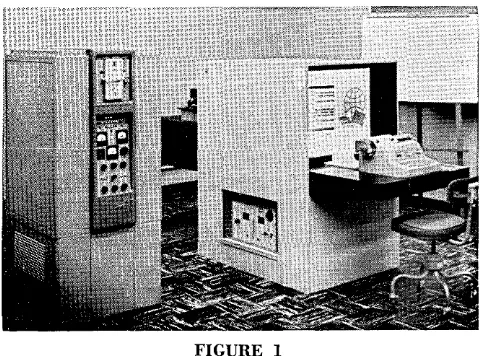
Adaptive Control over the Individual Student The first teaching system used by the SDC staff is shown in Fig. 1. The Bendix computer, operating under program control, transmits instructions to a Random-Access slide Projector (RAP) Model 600 for the selection of one of six hundred slides held in stor-age. The sequence of slides seen by the student is determined on the basis of the student's response to a single question, or to several questions, or on the basis of the time interval between presentation of material and response. The student receives feedback messages through the computer-controlled typewriter keyboard or by means of addi tional slides.
Prior to an experimental run, the G-15 is pro-grammed for its teaching functions by input of a per-forated paper tape. The instructions on this tape represent decisions in regard to type and sequence of educational "items" to be selected for each student on I he basis of his overt learning behavior.
The G-15 sends four signals of four bits each to the Projector Adapter; three of these signals set the step-ping switches which record the computer's instruction to Ihc RAP GOO. The first signal clears the relay regis-IeI' o[ any previous information. In addition to these signals, there is an interlocking feedback control which prevcnts changing of instructions while the system is in operation. It takes the G-15 about G jl 0 of a second 6
to transmi t to the RAP 600 the full command for a slide selection.
A sample teaching machine lesson used with the Bendix G-15 is given in Appendix 1. Although actual lessons are longer and generally more complex than this one, this sample does illustrate a number of im-portant facets of the lesson design. Some of the in-structional items branch the student to remedial paths designed to correct particular errors. At two points in this lesson, decisions are made on the student's cum-ulative error tallies. At these points, additional in-structional items are given to the student if he is experiencing difficulty in learning the material. At the end of the lesson, a self-evaluation item is pre-sented to students who have made at least one error. This gives the student the choice of deciding whether or not he needs more instruction.
The CLASS Facility
Use of the Philco 2000 computer in the new labora-tory enables the researchers to teach twenty students in several modes of automated instruction-an indi-vidual mode, a group mode, or a mixed mode in which some students study independently while others work in small groups. Except for classroom space limita-tions in our laboratory, the Philco 2000 could instruct some three hundred students in the individual mode with each student seeing a different sequence of in-structional materials adapted to his particular needs. In the group mode, this number of students instructed could be 900.
For individual instruction, a manually operated film
FIGURE 1 "\
The first experimental computer-based teaching machine used ' . ' by the Automated Education Project at SOC for research in auto-instruction is shown here. On the left is the Bendix G- 15 Computer and on the right, the teaching machine unit which houses a random access slide projector, rear-view projection screen, and an alpha-numerir. typewriter tied to the computer.
COMPUTERS and AUTOMATION for February, 19G2
1> ubi tion
Rei
AVI
off, Th root proxi
using the I
whid
Corn:
Kit Inc / ]
A math parar
chem STA< cedm
porta
speed tures
How. 1m Ro
nic of ice! setl Fol lure I descr: form; techn given
arc (
sirabi concl
Rein. L.
En:
gm int Pn
65!
Tn
dame
ment to es chim comr parts
Anal
the I
form pute] card of a
Two
Cadi chine
Optil
Pracl lator
Char
mt
of
Wi
Nt
pp Tl
who tions Ihe over the; ics i of d term one; inec]1 c1udi lions conc(
outli
symb
[image:6.615.303.551.526.704.2]
COll-I Me-st 42
inted,
and
maxi-into
I arc: ,a
IiLy-
Tech-Total and
ning. uring
neral apter
tality
l'S for '-Hill New
, pp,
pro-real
busi-n abusi-n
~ au-~ San ,tems
Inst.,
men- 'Pro-; the
ful-pters rans-ing,"
etc.
com-7070
ughs
sary,
and
vood
pp,
usses
sys-ning
)ters ity." ning
fre-Ither
Case
Re-ity,"
De-les,"
and
x.
Ar-~y &
New
pp,
nen-:uits
hich
doc-[his
'ork-~ven
.nal-i of lues, lude text
Ref-1962
viewer serves as the output source. A student, work-ing independently, makes multiple-cho,ice response~
on the response unit keyboard (see the front cover of this issue). The computer is programmed to analyze these responses, signal the correct answer on the re-sponse keyboard, and instruct the student where to proceed next by way of a four-digit read-out panel on the response unit.
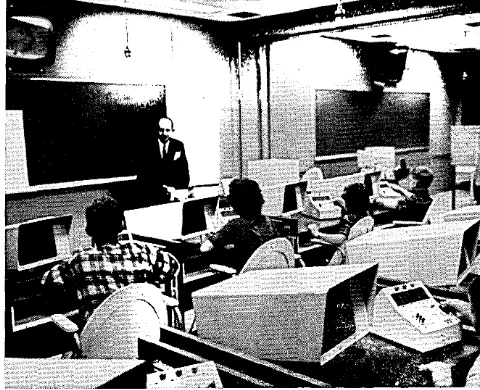
Automated or semiautomated group instruction can be effected by using the RAP 600 or teacher-controlled audio-visual projectors for generating a common stim-ulus display over the large closed-circuit TV screens in the classrooms. As seen in Fig. 2, students in CLASS are learning in the group mode.
The teacher will have five sources of information available with which to watch and check student learn-ing behavior or call up information on individual or group performance. These components are: (1) a teacher's console with automatic alarm lights, corre-sponding to each student station, alerting the teacher to students who are not meeting predetermined criteria programmed in the computer; (2) a read-out panel, similar to the student response device, making it pos-sible for the instructor to monitor a specific student; (3) a remote-control panel for sequencing and con-trolling audio-visual materials; (4) a film viewer for following the educational program; and (5) an edu-cational data display, generating performance or his-torical data directly from the computer memory drum.
To study the application of data processing methods in other school functions, special areas are available in CLASS for administrative and counseling functions. A teletype unit in the counseling office will aid the counselor in preparing daily scheduling programs and conducting interviews, and will generate displays to aid the teacher in classroom management. Automatic referrals will bring students to the counselor before serious educational problems are encountered.
For administrators, a 900-line-a-minute high-speed printer, operated either on-line or off-line, wi~l supply immediate information on the state of academIc knowl-edge of each student. Less urgent reports necessary for scheduling, curriculum planning, budgeting and lo-gistics can be retrieved when the computer is not se-lecting and analyzing instructional programs.
A 'real-time switch and storage transducer, which permits coupling human inputs to and outputs from the computer, has been developed by SDC engineers. This machine is capable of recording in the computer some 4,000 input signals ten times a second. The ma-chine also permits distribution of 4,000 output signals to the simulation area every 1/10 second. A plugboard for rearranging the receptor and effector connections to computer memory locations is also included.
Programming for CLASS
Computer programs written for this project fall into two broad categories: the lesson assembler and the instruction control program. The lesson assem-blers resemble, in both structure and function, the typical computer compiler-assembler. The instruction control program, called i\f ell Lor :WOO, has many of the characteristics of the usua I process control programs.
Lesson assembly programs for CLASS are designed to generate a magnetic tape that contains a complete
COMPUTERS and AUTOMATION for February, 1962
FIGURE 2
Students in CLASS are learning French in a group mode of automated instruction. The teacher, Gerald Newmark, sequences the educational items presented to the students via the closed-circuit TV system and the students respond to questions in French about the pictures shown. The computer records and analyzes student responses and presents displays to the teacher in real time.
description of the teaching machine's program. The assembled tape, when read into the computer, will store in the memory, the codes of the instructional items, the codes of counters to be used for tallying the number of student errors per teaching concept, a Illl teachi ng i nsl rue! ions.
The teaching- ('()nlrol program will be designed to ('onll'Ol the inpllI/()UIPlIt functions, process teaching 1'01Ilincs, ;Ind rec()rd Ihe results of instruction.
'l'IlC prilllary language to be used for the CLASS C()lIlpUler program will be JOVIAL, a general-purpose programming language initiated at SDC. It is a read-able and concise language, utilizing self-explanatory English words and the familiar nota tions of algebra and logic. It has been found especially suitable for problems requiring an optimulll balance between data storage and program execution time.
Besides, JOVIAL is a machine-independent pro-gramming l'anguage and can serve as a m~ans of realiz-ing a stated process on a llulllber of dIfferent com-puters.
The Future School Systelll and New Technology CLASS development has recognized that the most practical and immediate need for a computer in our educational systems is probably to automate paper-work, a prosaic function in school, but we foresee the future role of the computer in education to be more than that of bookkeeper. The evidence for this pro-jection lies in some of the recent developlllcnls in
COIll-puter technology:
(1) The computer-based Icaching- llIaciline \Vi~I,1
the potential for handling individual studel~t dd-ferences in learnillg ra Ie, background, and apu tude;
(2) Informa t ion reI rieval syst~ms, i.e., automa~ed
library services utilizing abstractmg and translatmg machines;
(3) Computer programs for aiding management
[image:7.620.330.570.114.309.2]MICRO-ENCAPSULATION MAGNETICS THIN FILMS OPERATIONS
OPTICS LOGIC & CIRCUITRY' MECHANICS DIGITAL SYSTEMS
DOD
THE NCR 450 CONTROL AND PROOF MACHINE
N
cn
offers a wide range of opportunities for experienced scientists and engineersintere~t{'d in commercially oriented
projects or adnlllced military electronic development. Current work encompasses a broad field of activity including semi conductor research, low temperature physics, micro-electronics, photochromics, advanced electronic systems development. high frequency communications, and operations research studies related to
complex business and financial systems. Previous efforts of NCR research and de-velopment have resulted in new products such as: NCR (no carbon required) Paper, 'the highly successful Electronic Data Processing Systems, and other items for the electronic and business machine industries. Rapid growth has caused open-ings at all levels of experience and educa-tion and provide opportunity for technical or administrative growth.
THE NATIONAL CASH REGISTER COMPANY,
THE NCR 315 COMPUTER
Send letter of application and resume to: T. F. Wade, Technical Placement, G 5, The National Cash Register Company, Dayton 9, Ohio.
An equal opportunity employer.
ELECTRONIC DATA PROCESSING ADDING MACHINES • CASH REGISTERS
ACCOUNTING MACHINES NCR PAPER (No CARBON REQUIRED)
- - - _ ..
8 CO~IPUTERS ([1/d AUTOMATIO~ for February, 1962
IN
Wh
BaSi
A
an
DIRI
Th
ers' ( June
ANI
the 1
Roster Roster to t Surve] Surve] Descri Surve]
Surve~
and Auton List Comp
Ma(
Over Appli( Comp Rostel Cor Robot Teach
GLO~
SIC
defini
~ BACI
For excep 1960,
BE B
AUG
SUB~ U.~
add 1
e1sewl
BUU
Th to comi!
Nun Simul Subsc
7 or r
4 t(
3
2
For ( side
$1.5(
C
815
If nl
IE
)N.,
will ttive the date 28, :om-ving may per) free the heir -ho's
edi-tries -ho's
l? ....
dis-this -ho's
uto-reet,
1962
and decision-making activities in schools paralleling those in business which supply periodic economic forecasts, balance budgets, and plan financial strat-egies;
(-1) New techniques for processing educational data such as real-time registration and scheduling programs, counselor and teacher data displays, auto-mated diagnostic interviews, and testing routines. The application of the digital computer to eduGt-tional functions holds the potential of an importan t technological breakthrough in a field that has been remarkably resistant to change. With more students to teach, fewer teachers, and an increasing portion of
',_I
the working population to retrain, educators are being pressed in the direction of automation.
The question whether school systems can afford the large general-purpose computers currently being mar-keted would in many instances have to be answered in the negative. But the development of the special-pur-pose computer with multiprocessing, time-sharing ca-pabilities is on the horizon. It would be short-sighted
to delay the rcscarch until the hardware is available. As new uses arc cxplored and computers are designed with educatiollal functions in view, many school sys-tems will joill thosc pioneers who have already made the leap into thc modern technological world.
A Decision Structure for
Computer-Based
Teaching Machines
Richard D. Smallwood
Research Laboratory for Electronics Massachusetts Institute of Tcchnolo~y
Camhrid~t~ ;{9, Mm;~.
111 the teaching machine field, although onc hcars statements that "the devices problem has bccn soh'cd," it would appear that the tremendous spccd alld vcrsa-tility of modern day computers can nevcrthcless hc used most profitably.
A great deal of the current research in the develop-Illent of new educational techniques has been in thc area of teaching machines. l\IIost of the contributors in this area up to now have been psychologists inter-csted in applying their theories of the psychology of learning to new teaching techniques.
Now, the opportunity for contribution by the de-signers and programmers of computers is fast ap-proaching.
Basically, present day teaching machinesl,~, 3
pre-sent a subject to a student in short increments-each increment being followed by a question. These increments (hereafter referred to as "information blocks" or just "blocks") may be anywhere from a sentence to a paragraph in length and may contain pictures, diagrams, and even auditory information. They are presented to the student in long sequences called teaching machine programs (not to be confused with computer programs); these sequences are con-structed in such a way that 'the student is led in an easy and straightforward way to eventual mastery of the subject matter.
The advantages of present-day teaching machines,
1. Crowder, N. A., "Automatic tutoring- by Illcans of intrinsic pro-g-ramming-," Chapter X in AutulIlatic Teac/till/!, by Galantcr (cd), John Wilcy & Sons, N. Y., 1959.
2. Lumsdainc, A. A., and Glascr, R., T('lIcltill/!, .llllr-hi/u's IIlIti
1''-0-grarn111ed Learning: A SOll'-Cl~ nooll, Dcp!. of A udio- Visual Instruct ion,
National Educational Association, 1!/(iO.
3. Smallwood, R. D., ,-III/O/llII/l'll /I/.\/nlclio/l Decisiun Systellls, ScD. Thesis, Electrical Eng-inccring- Dcpt., ~I.I.T., Cambridgc, ~rass., !W
October 1961.
COMPUTERS and AUTOMATION for February, 1962
illclllde sclf-paccd instruction and immediate
evalua-I iOIl for I he sllIdcnt of his answers to the questions, ele.; bill thc illlportant thing to remcmber is that we are first alld foremost interested in the development of tcchniqucs that will "teach better." Since one of thc best tcaching methods that we know today is the human tutor, a logical approach to automated instruc-tion is to try to simulate as many properties of a human tutor as possible; and indced, this is the crite-rion commonly uscd to dcscribe the advantages and indicate thc vast potcn tia I of teaching machines. Two very importallt propcrtics of the human tutor, how-ever, arc prcsenl in only a very limited degree in the teaching machines currcntly in vogue; these are adapt-ability to thc studcn t and systematic improvement with expcricncc.
Student Adaptability
A dcsirable feature of any tutor or teaching ma-chine is that it be able to react to differences among students and adapt its presentation to the individual learning characteristics of each student. For the tutor or machine to do this implies a decision process that uses some known past history of the student to de-cide which presentation of the material is likely to be best for him; and this dccision proccss is no less important for a teaching machinc than for a 111101'.
thc tcaching program; a structure for such a decision process is the subject of this paper.
Systematic Improvement with Experience When a tutor is good, we expect him to become better at his job as he teaches more and more students. The same property is a desirable one for a teaching machine. At the present time this property is avail-able in teaching machines only through the improve-ments that the researchers make in their teaching " chine programs. Improvements in the teaching ma-chine programs are, of course, desirable, but a method for systematic improvements in the quality of the branching decisions is also needed. A good teaching machine should be capable of improving its decision processes as it "learns" more about the effects that are caused by the decisions. Thus, we should like for the next tutoring decision to depend not only on the present student's past responses, but also on other available information including the responses of all past students; in other words, the teaching decision system should be an adaptive system.
Structure
The class of teaching machines proposed here is based on a particular structure; the elements of this structure are: (1) an ordered set of concepts; (2) a general branching network; (3) a model for estimating probabilities of responses.
1. An Ordered S{~t of Concepts
Every educator, no matter whether he is a teacher or a writer of teaching machine programs, must have
Sample
Path No.1 2.
a set of goals. This is list of things that he is trying to teach successfully to his students. We shall call these things concepts, although a very broad definition of the word concept is intended.
Generally, the educator will also arrange these con-cepts in some reasonable order so that he can teach the concepts to the students in sequence. Therefore, we shall assume that the subject matter to be taught has been decomposed into an ordered set of concepts. The question of measurement also arises: How shall we find out whether or not a student understands a concept? For this purpose we shall assume that there exists a set of test questions for each concept being taught. Answering the test questions correctly is con-sidered to be equivalent to understanding the concept. These test questions will be given to each student at the end of his instruction on the concept to determine how well he has absorbed the subject matter and how well he understands the concept.
2. The General Branching Network
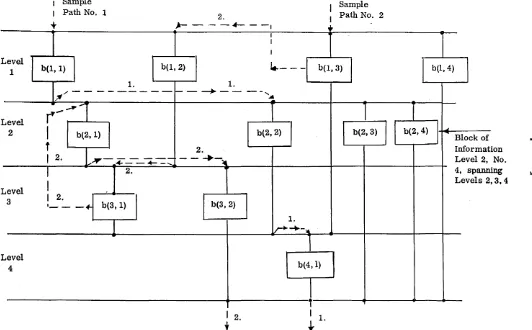
In order to provide a high branching capacity in the class of teaching machines discussed here, a large network of information blocks (see Fig. I) is assumed to exist for each concept to be taught. Each block contains information or material that one might want to present to a student during the course of the instruc-tion.
Each block is identified by two numbers i and j. The first number i specifies the level or rank of the block in the sequence of concepts to be taught. The second number j is a serial number that identifies
Sample Path No.2
~ - ---~ - - I
Level 1
Level 2
Level 3
Level 4
1.
2.
1 _
-1.
-~---2.
--~-
1..---1.
Block of Information Level 2, No. 4, spanning Levels 2,3,4
9
---~~---,---~~---~~--~~--10
I 2.
,
It 1 .
FIGURE I-A diagram of a sample of a general branching network of blocks of information of various spans. Wrong answers take the learner out to the left. Right answers take him through the entire span.
[image:10.613.35.567.402.732.2]ob-use.
e In
nnel sup- low-ries, ade- pon-lres. onal
leer-the this This
· .
/ lrgmr..
/ elphi1 grp
r Dig ~YU,
ation
f '35,
, MP
AMP
lrado
.. /
engr
. '61,
· .
/oston
res,
f '21,
Bldg,
Dal-\'M / ~es in lction
·
.
/(BS), rBA),
pora-·orate lains, lathn Ins
~gmg, NY
;6,
-1962
the block among alternatives explaining that infor-mation. Thus block b(3,2) is block no. 3 in level and no. 2 in manner of explaining. Some blocks may span more than one level; in this case, the level number denotes the first of the levels spanned by the block. In Fig. 1 the branching network shows in Path I and Path 2 how two students have progressed through the branching network. In general, students start at the first level and travel downward through the blocks as they learn more and more about the subject ma-terial. Generally the same material will be contained in sequences of blocks spanning the same l~vels; for example in Fig. 1, b(I,3), [b (1,1), b (2,1), b (3,1)], [b(I,I), b (2,2)], and [b (1,2), b (3,1)] will all contain the same information. The presentations, of course, will be different; for example b(I,3) would present the information in a much more condensed form than [b(l,l), b (2,1), b(3,1)J. Alternate presentations of the same material are also illustrated as in b(2,3) and h(2,4) of Fig. 1.
Test Questions
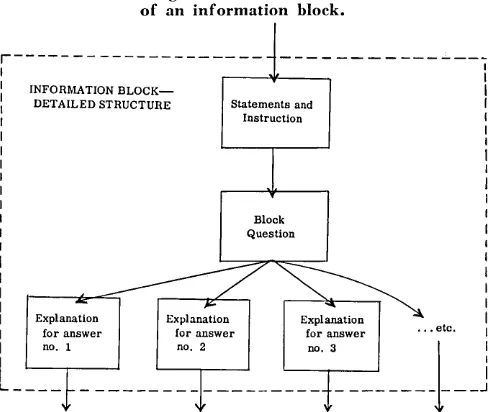
At the end of each block there will be a question for the student. These questions can be used either as reinforcing agents for conditioning student behav-ior or as tests to determine the student's comprehen-sion of the information. The answers to each of these block questions are classified into a finite number of exhaustive alternatives so that every answer can be recognized by the teaching machine. Furthermore, it is desirable that the student be told whether or not he has answered the question correctly. (One can also use this opportunity to explain to the student his likely error if he missed the question.) For this reason each information block will generally have a fine or more detailed structure similar to that shown in Fig. 2.
Student Procedure
The procedure for a student taking the course will consist of many cycles of the following two steps:
1. If the student is at level i, the teaching machine will decide which of the several blocks leaving this level to present to the student.
2. After reading the information in the block that is presented to him, the student will answer the ques-tion at the end of the block. If his answer is correct, it is assumed that he has absorbed the material in the block satisfactorily; and thus, he will be placed at the terminal level of the block and Step 1 repeated. If he does not answer the question correctly, then the stu-dent will be placed at some level less than (or perhaps equal to) the terminal level of the block in order to clear up the misunderstanding that caused him to miss the question.
Thus, we see that a student will wend his way through the network of blocks proceeding from the first level to the last with the teaching machine decid-ing at each level what block to present to the student. The student's level at the end of each block is deter-mined by his answer to the block; that is, we shall as-sume that a function v(i,j,k) is given along with the branching network, and the function is equal to the level of a student if he gives the kth answer to block b(i,j).
In Fig. 1 the dotted lines show two possible paths
COMPUTERS a1/d AUTOMATION for February, 1962
FIGURE 2-A diagram of the more detailed structure of an information block.
r- -- - --- - - ---
----I I
I I
I INFORMA TlON BLOCK- I
I DETAILED STRUCTURE Statements and I
Instruction I
I I
Block Question
I Explanation Explanation Explanation
I for answer for answer for answer ... etc.
I
I
I
I
I
l ___
OO~
1 _ _ _ _ _ _ _~~2
_ _ _ _ _ _ _ _ : 3_---J--j
that students might take through the array. Path 1 represents a student who has given all correct answers to the block questions, while the student of Path 2 has missed block questions at b(I,3) and b(3,I).
In any practical application there will be one of these networks of blocks for every concept to be taught. Although the emphasis in this paper is on the de-cision-making aspect of teaching machines, the im-portance of the actual contents of the information blocks can hardly be overstated. On the other hand, the illcorpora tioll of a decision mechanism into a teachillg machine call make the improvement of the block cOlltellts easier through the relative evaluation of alternative presentations of the course material.
3. A Response Probability Estimation Model In order to decide which of the possible blocks the student should receive, it is necessary for the teaching machine to investigate many paths that the student might take. Each of these paths must be weighted with the probability that the student will indeed take that path. This requires a model (see Reference 3) that will estimate the probability, p(i,j,k), that the student will respond with the kth answer to the ques-tion at the end of b(i,j).
There is a question here of just what is meant by these probabilities. Here the probability p(i,j,k) that a student with a certain known past history will give the ktlt answer to block b(i,j) will be defined as the fraction of students out of an infinite population of students with the same identical past history who would give the kth answer to block b(i,j).
The problem, then, is to find mathematical models that will use the past history of the student correctly to estimate the true values of p(i,j,k) as defined above. The particular elements of a student's past history that will be used in this estimation are part of the
model. These models will formulate an abstract
de-scription of the process whereby a student's past his-t.ory determines the value of the abstract probability defined above. As with allY mathematical model, the model's description of the process is entirely abstract, and the value of the model is determined by how well this abstract description conforms to the n:(/I w()rld
j)l"()CCSS being simulated by the ll)odel.
[image:11.612.332.576.47.253.2]"''".-~
In general one would expect the probabilities to be closer to 0 and 1 as the past history of the model in-cludes more and more pertinent details about the stu-dent. Unfortunately, as the number of such detai1s increases, it becomes more difficult to use them cor-rectly and the complexity of the computations also in-creases. Thus, one must face the eventual trade-off between high uncertainty in the true probabilities on one hand, and inaccurate prediction and complex computations on the other.
"V\Te see here an example of how the teaching ma-chine will be able to improve its decision process with experience. As the number of students that the device has taught increases, the errors in the probability esti-mates due to lack of information will generally de-crease and the decision process of the machine will become more accurate.
Decision Criterion
In makillg the decision, the computer must have some cri Lerion (or utili ty function) to use for deciding which of several alternate paths through the "blocks" of subject matter is to be selected for teaching to the learner. The particular criterion chosen will depend, in general, on the opinions and goals of the educator using it. Some possible criteria that might be used are:
nil 1 1
U = - , L
=
-(na -n\J), or R = --(na -n\J)N N NT
where nil and na are the number of test questions for tha t concept that the student answered correctly be-fore and after taking the presentation of the material represented by the path; N is the number of test ques-tions for that concept; and T is the time for the stu-dent to read and respond to the material in the path.
An Actual Demonstration
In order to illustrate the structure presented here and to study its potential advantages, a preliminary teaching system containing an example of each of the preceding elements was developed. 'Vhen one con-siders what is potentially attainable within the struc-ture, the system described here will appear rather unsophisticated-and indeed, it is. Nevertheless, the teaching system was applied to instruct 20 students, and indicated that is was capable of distinguishing among students, making different decisions for stu-dents with different past histories. Furthermore, the system also changed its decision process with experi-ence.
The physical device was composed of three inter-connected pieces of equipment: (1) a microfilm reader; (2) an electric typewriter; and (3) the IBM
709 digital computer at the M.LT. Computation Center. The array of information blocks was stored on microfilm; and the microfilm reader was connected to the computer so that it could select any particular frame of the microfilm and display it to the student.
The illst rllction process for the system consisted of the followi Ilg steps:
1. After giving the student some brief instructions
Oil t he operation of the microfilm reader and
type-writer, the computer decided what block to present
to the student first and then cycled the microfilm forward to the frame that contained the desired block.
Each of these blocks contained a paragraph or so of information about the course, followed by a question that tested the student's comprehension of the in-formation.
2. The student wrote his answer to the block ques-tion on an answer pad; then he advanced the micro-film reader forward one frame to where a list of possible answers to the question was displayed. (In each case, of course, one of the alternatives was a catch-all for any answer not listed.) Next to each of these possible answers was a number; the student entered the number next to his answer into the type-writer an"d then punched the "carriage return" key.
3. Upon sensing the carriage return, the computer advanced the microfilm to a frame that explained to the student whether or not he had answered the ques-tion correctly; if he had not, this frame also attempted to explain to him where he had gone wrong. While the student was digesting this explanation, the com-puter calculated the next block that the student should receive. When finished reading the explana-tion to his last answer, the student was instructed to punch the "carriage return" on the typewriter.
4. The computer then advanced the microfilm to the next block and the process was repeated until the studen t finished the instruction on a particular con-cept and arrived at the test question(s). The test questions were given to the student in the same way as the blocks; the only difference was that all students
received the same test questions.
5. At the end of the instruction the student's re-sponses were used to update the parameters needed by the system's decision process.
The computer program for this teaching system used approximately 5000 of the 32,000 registers available on the M.LT. 709.
Content of the Sample Teaching System
It may be of some interest to report what was the actual content of the material taught. This was a miniature (or finite) geometry expressed in the follow-ing statements:
Postulate 1. There is
a
point.Postulate 2. Every line is a set of exactly two points.
Postulate 3. Every point lies on exactly two lines. Postulate 4. For every line there are exactly
three parallel lines.
Definition 1. If a point P belongs to a set L,
then P lies on L, and L contains P. Definition 2. Two lines are parallel if and only if there is no point that lies on both.
The outcome of the teaching system was for the stu-dent to be able to demonstrate two theorems:
Theorem 1. There are exactly six points. Theorem 2. There are only two models.
(One of the models is a hexagon, with the convention of the points being the vertices and the lines running along the edges of the hexagon, and stopping at the vertices; the other model is two separate triangles, with the same convention.)
This particular subject was chosen because it is short, simple, and relatively unknown.
COMPUTERS and AUTOMATION for February, 1962
Vo
"\IV
data and auto] ing. panel exter lapse exarr
Cll
Po
I
Elc
Tl autOl sign, versa fanta phen force (whi ever tools this,
In comr
that can ore, ~ of
h.esc So-day and
1n-~s a ry.
ech-mly )me
esti-and 5 to
rom
and mil-rIta I
ab-ltIy.
per-md.
in-ines one
nits nds lare
ex-and
ac- >cu-
,lat-er's
1962
The best way to test new equipment is to put it into actual use. But how can the performance of advanced airborne guidance systems be evaluated without spend-ing millions of dollars in production and Right test of equipment? How can the effect of possible design changes be determined? How much can systems and equipment be improved before over-all performance be-comes subject to diminishing returns?
Scientists have been exploring these questions-and many more-at the Simulation Laboratory of the IBM Space Guidance Center in Owego, N. Y. For example, they constructed mathematical and logical models of every factor in a major B-52 air strike. Into an IBM computer went simulation data on enemy missiles, radar, fighter defenses, as well as detailed weather and terrain data and complete aircraft performance parameters. After more than 1200 simulated battles were "fought" inside the
SIMULATION:
.... , ...• ';y':~'" ;
computer, the scientists had the answers to their questions.
The IBM people doing simulation studies such as this have extremely varied backgrounds, mathematics, phys-ics, engineering. But they ha\1~ in common-the ability to "see" physical problems in mathematical terms and to solve them by machine computation. For people with this ability IBM offers the advantages of advanced tech, nical facilities and widely experienced associates.
If you are interested in one of the areas in which IBM is making important advances-semiconductors, micro waves, simulation, magnetics, superconductivity, or many others-we'd like to hear from you. IBM is an Equal Opportunity Employer. Write to:
Manager of Technical Employment
IBM Corporation, Dept. 5390
590 Madison Ave., N. Y. 22, N. Y.
IBM
®
1200 air battles inside a computer
The teaching system usually (but not always) pre-sented a paragraph of information, and offered usually
(but not always) three answers, of which only one was the right answer. In other words, it was like the scrambled book of Norman Crowder (see Reference 1).
Equipment Limitations
Due to equipment limitations, only one student at a time was taught by the teaching system described above. This was a tremendously inefficient use of computer time, since the calculation of each decision required less than one second of computer time. A student took from 1 to 6 minutes to complete a block with 2.5 minutes a typical time. Hence, we see that over ~)9 per cent of the computer time was spent waiting for the student to answer a question or finish reading an explanation. The answer to this inef-ficiency is either to allow the computer to teach many students at once, or to allow some one else the use of the computer during the idle time. A time-sharing system is currently under development at M.l.T. that will provide this latter solution to the problem. The former solution is the natural one for the computer-in-a-school situation.
The response probabilities for this teaching system were estimated by a simple intuitive lllodeJ3 that esti-mated p (i,j,k) as a function of: 0, the fraction of correct responses by the student in the past; rfJij(k), the fraction of students taking b (i,j) in the past who have responded with the ktll answer; and a, the frac-tion of correct responses by students to all quesfrac-tions in the past.
The course covered two concepts containing 12 and 13 levels and 25 and 27 information blocks, respec-tively. The entire course used 224 frames of micro-film.
Twellty students took the course as taught by the teaching system. The average instruction time was 53.0 minutes with a range from 33 to 75 minutes. The total fraction of correct responses was 0.753 with a range from 0.529 to 0.938.
There were many instances in which the computer made different decisions for students with different past histories (for this simple system the entire past history of the student was con tained in 8, the fraction of correct responses in the past).
Analysis of Results
These results indicate that the teaching system de-scribed in this' paper can (1) make quantitative decisions in its presentation of the course material to students so that different students, depending on their past performance, receive different presentations, and (2) change this decision process with experience. We have not proved, of course, that this teaching machine is a better machine than any other; we have not even proved that the changes mentioned above are changes for the better. At this point one must rely on his illtuitioll to convince himself that a system capable of makillg systematic changes in its presentation of lllaleriaI and in its internal decision process must be a pOlel1tially better teaching device than one without I hesc advantages.
On the debit side of the ledger there are some practical disadvantages that should be mentioned
concerning the implementation of an extensive teach-ing system along the lines of the above comments. First there is the problem of storage space in the com-puter. While it is true that the teaching of many subjects to many students would indeed tax the core storage requirements of most computers, it should be possible to employ auxiliary storage such as magnetic tapes and drums to solve that problem (at a slight reduction in speed). This compromise plus the tech-nical advances in the future plus the possible ad-vantages to be gained from a mass-produced, special-purpose tea~hing-decision computer should adequately solve this problem.
Cost
A more serious problem is the cost of such a teach-ing system: First of all there is the cost of the com-puter; but when one considers the reduction (in dollars per instruction hour per student) that should be achievable with special-purpose, mass-produced computers capable of teaching many students at once, the cost restrictions from this source become less severe.
A more significant chunk of the cost dollar will go toward the writing of the information blocks. This is admittedly a tougher job for the system discussed here than for the usual straight-line teaching machine programs, since there arc two to three times as many blocks to write. However, the computer may be able to help with this problem-first, by providing relative evaluations of alternate presentations of material (as in b(2,3) and b(2,4) of Figure 1), and secondly, by spotting situations in which the addition of blocks to
the branching networks may be advantageous. On the other hand, if, after all is said and done, computers are the only way to do the required job, then the economics of the problem may have to be subordinated to educational necessity.
The structure defined above has two further appli-cations other than general classroom instruction. First, teaching systems using this structure could be used for the evaluation of teaching machine programs. As an example, one could use the teaching system to find a preferred pa th through the branching network and then use this preferred path in simplier, less expensive teaching machines.
Secondly, this class of teaching machines could find valuable applications in the area of educational re-search. Through the use of the wide versatility in the controlled situation enforced by the system, it should be possible to conduct research into important edu-cational problems, such as: What are the important measurements that should be made in the educational situation? How can the data for a particular student be used most effectively in teaching decisions? What is the best simple decision mechanism that one can use in an inexpensive teaching machine?
Acknowledgment
This paper is a short summary of work submitted in partial fulfillment of the requirements for the degree of Doctor of Science in the Electrical Engineer-ing Department of the Massachusetts Institute of Technology. The computer work was done at the lVLl.T. Computation Center.
COMPUTERS and AUTOMATION for February, 1962
:. I :
I
iii
t."':
'·:.:.:.··.·.···.~.:.·.···.·.·:·
.. ··.··.·I~ .. ~ .... ~ ... ~
L;"" ,
.. ""'1
•.. '.:. : ••... : . . . !:: . • . .
I
I
\.sso-New Dir., Llters :010.; [nst.,
~nce,
-1.
J.
leve- 1edi-.orial ;lein, ., E.
and and
Wes-man,
e on Mr. Inc., ltion row, nical
~rno,
. the lery,
:ech-)nICS
lerts,
, Ill.
::. & con-:ncy,
Ex-Elec.
Ie & lelm,
o
E.t. In
:ago,
·ans-
leer-IRE
~nce,
1962
Technical Information Series #2 160·A Input·Output
NEW CONTROL DATA 160·A COMPUTER
Desk Size Computer with Large Computer Capabilities
In most computer evaluations, the flexibility and capa-bility of the computer to handle input-output operations is of special importance. No other small scale computer on the market today has the input-output features that are standard on the Control Data 160-A Computer.
For example, the 160-A exchanges data with input-output devices at any rate up to 70,000 12-bit words per second. The 160-A also has the capability of buffering data while computing ... or while the operator manually enters data (whether the computer program is running or stopped). This input-output flexibility is combined with the following 160-A features:
• Internal and external INTERRUPT
• 8192 words of magnetic core storage (expansible to 16,384; 24,576; or 32,768 words)
6.4 microseconds ••••• memory cycle time 12.8 microseconds ••••• basic add time
15.0 microseconds ••••• average execution time
• Flexible repertoire of 130 instructions
• External multiply-divide unit (optional)
• Completely solid state
• Low power requirements: 16 amps, 110 volt, 60 cycles
CONTROL DATA
COMPUTER DIVISIONCORPORATION 501 PARK AVENUE, MINNEAPOLIS 15, MINNESOTA
COMPUTERS and ;\ UT()~L\TIO~ for February. 1%2
There arc two input-output channels in the 160-A: a
bufler c/1lI1l1ll'1 and a non-buffer channel called the
nor-m{/l C/UIIl II cl. Both can be used simultaneously for any combination of input-output operations.
During an input-output operation via the normal channel, computation is halted temporarily while the operation is carried out. However, once an input-output operation is initiated on the buffer channel, the 160-A either continues computation or performs some other
I/O operation on the normal channel.
The Control Data 350 Paper Tape Reader and the
BRPE-ll Teletype Paper Tape Punch-standard equip-ment on the 160-A-are connected to the normal channel and are not buffered. Other peripheral devices can be connected either to the normal channel or buffer channel.
When a peripheral device is connected to the normal channel, data is transmitted between the 160-A and the peripheral device via the normal channel only. However, when it is connected to the buffer channel, data can be transmitted between the 160-A and the peripheral device via either the buffer or normal channels. In this case, the normal channel is utilized at any time the buffer channel is not engaged.
A desk-size computer, the Control Data 160-A has the speed, capability, and flexibility of many large-scale computers. For more detailed information write for Publication No. B 12-61.
",'
COMPUTER TEACHING MACmNE PROJECT:
PLATO ON ILLIAC
Donald L. Bitzer and Peter G. Braunfeld
University of Illinois Coordinated Science Laboratory
Urbana, Ill.
A certain teaching machine developed at this lab-oratory has been named PLATO, standing for "Pro-grammed Logic for Automatic Teaching Operations."
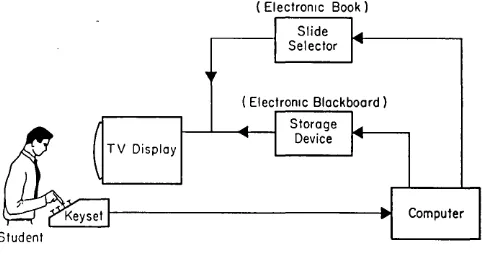
It is a device for teaching a- number of students individually by means of a single, central, high-speed, general-purpose digital computer, in this case the lLLIAC, the University of Illinois automatic com-puter. The general struct~re of PLATO is indicated in l'ig. 1. For simplicity, only one student is repre-sented in the diagram. The central clement of PLATO is the high-speed digital computer.
Each student communicates with the computer by means of his own keyset, which can be provided with up to G1 keys representing a full complement of alpha-numeric characters. When asked to answer questions posed to him by the machine, the student's answers may thus take such varied forms as numerals, alge-braic expressions, and words or phrases.
Special keys enable the student to control the pres-entation of material to him by the machine. The machine communicates with each student by means of closed-circuit -television. Material is presented in two different ways:
(I) The machine presents static textual material by commanding an electronic switch to connect the video output of the appropriate slide to the appro-priate student's display.
(2) Dynamic non-textual material, or material fur-nished in the course of instruction (such as student answers), is written by the machine on the student's
TV display tube by means of an intervening buffer storage tube.
For multiple, student operations, a keyset, television display, and intermediate output buffer storage device
(Electronic Book)
Student
Fig. I General organization of PLATO equipment.
Iii
are provided for each student. The central computer and slide selector, however, need not be duplicated; they serve all students on a time-shared basis.
It appears to be important in multiple-student op-erations, to require the condition that no student shall be aware of any other student's existence. To meet this condition, we are requiring the computer to re-spond to any student's request within 200 milliseconds.
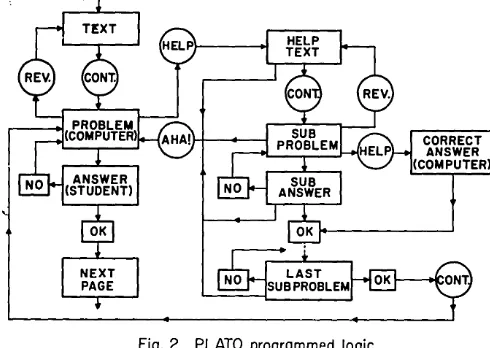
The general logic by which instruction takes place is indicated by Fig. 2.
Textual material is presented on a sequence of slides. \Vhen the student has finished reading a given slide, he may proceed to the next slide by pushing the "continue" button on his keyset. Similarly, if he de-sires to review ,material contained on a previous slide, he may do so by pushing "reverse." On certain slides, questions arc posed to the student. He cannot "con-tinue" beyond such a slide until he has successfully answered all the questions theron. As the student types in his answer, the machine displays it-charac-ter by characit-charac-ter-in the space provided for the answer on the slide. As soon as the student indicates to the machine that he has completed his answer, the ma-chine responds by indicating "OK" or "NO," depend-ing on the correctness of the answer. The student may continue to punch in revised answers until the machine indicates that the answer is correct.
H the student indicates to the machine that he needs help in answering the question-by pushing the "help" button-the machine jumps to a "HELP" sequence appropriate to that question. In this se-quence, further relevant textual material, if necessary, is presented, and the original question is broken up into a series of "easy" subquestions, designed to lead the student stepwise to the solution of the main ques-tion. A student need not complete a help sequence. At any point in the help sequence, he may indicate to the machine his desire to be confronted once again with the original troublesome question by pushing the "aha" button. As indicated in Fig. 2, failure to answer this question properly, leads to a return to the help sequence at the point it was broken off. In the case where a student should feel it necessary to ask for help for a question posed in the help sequence, the machine itself will provide him with the appropriate correct answer to that question.
The important features of the machine are:
1. The material is presented to every student in a standard, objective fashion.
COMPUTERS and AUTOMATION for February, 1%2
c
Feb.
Hi M'
Ec Feb.
fo
tOJ
m:
OJ Feb.
tr<
IR
Al Feb.
an co
T(
sit Feb.
fe Pa
La Feb.
Se
N,
ci,
H
Feb.
W
In
Ba
Feb.
of
M
va sil Mar.
H
tic
te
Sy 12 Mar. tic Pr
Tc Be
Mar. va
o
Cl N
Mar. sel
ta
YI
Apri R: G
ta
B(
Apri
Sc M
U
B;
[image:16.613.41.282.603.730.2]---. the nine
1 the
per- con-:cl by
)
-pring puter ; Feb-please ay be
52
ofin the . field, Wh-o's
l little
y, 1962
• can multi-processing make all components of your
computer system work full time for you?
• can your Jobs run simultaneously in any
combina-tion even though your programs are written to run by
themselves?
• can you feed new Jobs into the system any time
without interfering with programs in process?
II
can you add a second central processor to the
sys-tem and thus get true parallel processing without
reprogramming?
• can you have automatic scheduling, memory
allo-cation, error checking, and routine control functions
without the inefficiencies of conventional operating
systems?
A Burroughs B 5000 is your answer to all these
questions. Take multiple processing. We define it
as "priority processing on a time-sharing basis."
This is the way the B 5000 is normally used. When
you want to feed in another job, the B 5000 does
not need additional instructions for sequencing and
scheduling. It has its own master control program
that does scheduling automatically. The
program-mer doesn't even have to specify the components
to be used. He just feeds in the new program. Any
time. Usually while other jobs are processing. The
master control will integrate it into the work load
and see that the components operate at maximum
efficiency. The human error factor in scheduling is
virtu,ally eliminated.
.
\COMPUTERS and AUTOMATION for February, 1962
And your work load can't outgrow the B 5000.
It's the only computer on the market that can
accommodate a second central processor. A new
processor can be linked in any
time-without costly
reprogramming. Thus equipped, the B 5000 can
solve several problems absolutely simultaneously;
this is
true parallel processing.
You see our master control program wasn't patched
up to fit the computer. We designed the computer to
fit a carefully thought-out master control. This is the
secret of the built-in operating system's unmatched
flexibility and efficiency. It does all the things we
mentioned in our 5th question and also permits
the addition of new equipment and programs.
Another thing: The B 5000 can process programs
written in COBOL or ALGOL-but that's a story
in itself.
If
you would like the details on
all the
advantages of this remarkable computer, just write
Burroughs and ask for a copy of
The B
5000Concept, Burroughs Corporation, Detroit 32, Mich.
Burroughs-TM