warwick.ac.uk/lib-publications
Original citation:Kunar, Melina A., Thomas, Sally V. and Watson, Derrick G. (2017) Time-based selection in complex displays : visual marking does not occur in multi-element asynchronous dynamic (MAD) search. Visual Cognition .
Permanent WRAP URL:
http://wrap.warwick.ac.uk/86256
Copyright and reuse:
The Warwick Research Archive Portal (WRAP) makes this work by researchers of the University of Warwick available open access under the following conditions. Copyright © and all moral rights to the version of the paper presented here belong to the individual author(s) and/or other copyright owners. To the extent reasonable and practicable the material made available in WRAP has been checked for eligibility before being made available.
Copies of full items can be used for personal research or study, educational, or not-for profit purposes without prior permission or charge. Provided that the authors, title and full bibliographic details are credited, a hyperlink and/or URL is given for the original metadata page and the content is not changed in any way.
Publisher’s statement:
This is an Accepted Manuscript of an article published by Taylor & Francis in Visual Cognition on 30 March 2017, available online: http://dx.doi.org/10.1080/13506285.2017.1306006
A note on versions:
The version presented here may differ from the published version or, version of record, if you wish to cite this item you are advised to consult the publisher’s version. Please see the ‘permanent WRAP url’ above for details on accessing the published version and note that access may require a subscription.
Time-based selection in complex displays: Visual Marking does not occur in
Multi-Element Asynchronous Dynamic (MAD) search
Melina A. Kunar1, Sally V. Thomas2and Derrick G. Watson1
(1) University of Warwick
(2) University of Oxford
Department of Psychology, The University of Warwick, Coventry,
CV4 7AL, UK
Email: [email protected]
Running Title: Time-based selection in complex displays
Abstract
In visual search, a preview benefit occurs when half of the distractor items (the preview set)
are presented before the remaining distractor items and the target (the search set). Separating
the display across time allows participants to prioritize the search set, leading to increased
search efficiency. To date, such time-based selection has been examined using relatively
simple types of search displays. However, recent research has shown that when displays
better mimic real-world scenes by including a combination of stationary, moving and
luminance-changing items (Multi-element Asynchronous Dynamic - MAD - displays)
previous search principles reported in the literature no longer apply (Kunar & Watson, 2011).
In the current work we examined time-base selection in MAD search conditions. Overall the
findings illustrated an advantage for processing new items based on overall RTs but no
advantage in terms of search rates. In the absence of a speed-accuracy trade-off no preview
Introduction
People continually search the visual world. Using laboratory experiments, scientists
have been able to study attentional mechanisms that enable people to filter out irrelevant
information in order to prioritize more important stimuli. One example of such filtering has
been uncovered using thepreview search paradigmwhich has shown that observers are able
to ignore currently visible information and direct their attention to new items that appear at a
later point in time – time-based selection (Watson & Humphreys, 1997).
Watson and Humphreys (1997) investigated time-based selection by asking
participants to search through items comprising of a conjuction of features to find a particular
target. In their Full Element Baseline (FEB) participants searched for a blue H (target) among
blue As and green Hs (distractors). They found that, similar to previous findings, people were
relatively inefficient at searching through the display for a target item and produced relatively
steep RT x set size search slopes (Treisman & Gelade, 1980). Importantly, in their
experiment they also included apreview conditionin which the same display was split into
two parts. In this condition, participants first previewed half of the distractor items (green Hs)
for 1000 ms. After this, the other half of the distractors (blue As) and the blue H target item
were added to the display (the search set). Importantly, although the final display of the
preview condition was identical to that of the FEB, search for the target was more efficient
than in the FEB. Furthermore, search in the preview condition was as efficient as when only
the blue items (the search set) were presented alone. This improvement in search efficiency
was termed thepreview benefitand indicated that people were able to ignore old, irrelevant
stimuli and instead pay attention to new stimuli that appeared in the display.
There have been several accounts proposed to explain why the preview benefit
occurs. First, Watson and Humphreys (1997) suggested that the old items were inhibited or
Visual marking occurred in a top-down, resource limited fashion with the need for active
attention (e.g., Emrich, Ruppel, Al-Aidroos, Pratt & Ferber, 2008; Kunar, Shapiro &
Humphreys, 2006; Olivers & Humphreys, 2002; Braithwaite et al., 2005; Kunar, Humphreys
& Smith, 2003a; Watson & Kunar, 2010; von Mühlenen, Watson, & Gunnell, 2013; Zupan,
Watson, Blagrove, 2016). Second, Donk and Theeuwes (2001) argued that the luminance
onsets associated with the presentation of the new items captured attention automatically and
thus there was no role for the inhibition of pre-existing elements. Third, Jiang, Chun and
Marks (2002) suggested that by presenting the old and the new items at different times they
formed two temporally distinct groups and attention could be applied to either group. Finally,
recent work has shown that inhibition of small numbers of old items might rely on visual
work memory (VWM) processes with larger numbers using a different inhibitory mechanism
(Emrich, Al-Aidroos, Pratt & Ferber, 2010; Dube, Basciano, Emrich & Aidroos, 2016).
Several studies have since suggested that these different mechanisms most likely work
together to produce the preview effect depending on the particular stimulus properties present
(e.g., Kunar, Shapiro & Humphreys, 2006; von Mühlenen, Watson, & Gunnell, 2013).
To date, research investigating time-based selection using the preview benefit has
considered conditions in which all of the display items were either stationary (e.g., Watson &
Humphreys, 1997; Kunar et al., 2003a; Olivers & Humphreys, 2002) or moving (e.g., Kunar
et al., 2003b; Watson & Humphreys, 1998; Watson, 2001). However, in the real-world,
search often takes place in much more complex scenes that can contain both stationary items
and moving items. Furthemore, items can appear and disappear through occlusion, scenes can
contain many items, and one cannot always be certain of the exact shape or properties of the
target object. For example, imagine a security guard searching through CCTV footage of a
busy airport, looking for ‘someone carrying a large bag’. Here the scene is both busy,
Recently, Kunar and Watson (2011) developed a Multi-element Asynchronous
Dynamic (MAD) search display to investigate basic search principles in more complex
displays which were designed to better mimic some aspects of search in the real world. MAD
search displays contained a relatively large number of search items, some of which were
stationary and some of which were moving. Furthermore, half of the items disappeared and
re-appeared from view, by blinking/fading off and on during the trial and multiple targets
were defined. The results showed that with this more complex display, very different search
findings were found compared to what was expected based on findings from research using
traditional search paradigms. For example, previous research suggested that search for a
moving target should be relatively efficient (Abrams & Christ, 2003, Franconeri & Simons,
2003; McLeod et al., 1988). Pinto, Olivers & Theeuwes (2008) also found efficient search for
a moving target among blinking distractor items (see also Pinto et al., 2006, for search tasks
using other types of dynamic displays). However, in MAD search moving targets were found
less efficiently than stationary targets (Kunar & Watson, 2011; Kunar & Watson, 2014).
Furthermore, previous studies found that items exhibiting luminance onsets captured
attention (Yantis & Jonides, 1984). However, in MAD search luminance onsets did not
capture attention (Kunar & Watson, 2011; Kunar & Watson, 2014). Miss error rates were
also high (30-40%), in comparison with standard laboratory based visual search tasks which
usually produce relatively low rates (5-10%, Wolfe, 1998). It seems that with these more
dynamic and complex scenes, search principles that have been inferred from previous work
no longer hold.
The main aim of the present work was to determine to what extent time-based
selection is effective in MAD search conditions which we assessed using the preview search
paradigm. On the one hand we might expect that a preview benefit will occur because
(e.g., Watson & Humphreys, 1997) and moving (Watson & Humphreys, 1998; Watson, 2001,
Kunar et al., 2003) stimuli. On the other hand given that many ‘standard’ search principles do
not seem to hold with MAD displays we might expect that the efficiency of preview search
would also be compromised.
The vast majority of previous preview studies have typically used relatively standard
set sizes of up to 16 items (but see Jiang, Chun, & Marks, 2002a). However, the work on
MAD search has used larger set sizes of between 16 to 32 items. Therefore in the present
work we assessed preview search in both low (4, 8, 16 items) and high (16, 24, 32) density
displays. Experiments 1a and 1b presented MAD displays in which the target was either
present or absent (as in Kunar & Watson, 2011, 2014). Experiments 2a and 2b used a target
discrimination task in which the target was always present. Experiments 1a and 2a used low
density displays Experiment 1b and 2b used high density displays.
Experiment 1a and 1b: Target Present-Absent MAD Preview Search
Method
Participants
Forty-nine participants (thirty-one women), aged 18 to 35 years (M =21.31,SD=3.5)
were recruited from the University of Warwick. All participants had normal or corrected to
normal vision. Twenty-four participants (14 women) completed Experiment 1a and
twenty-five participants (17 women) completed Experiment 1b.
Stimuli and procedure
Displays were generated and responses recorded by custom written computer
programs. Stimuli were white letters of the alphabet (average luminance 14.9 cd/m2,)
displayed on a black background (Figure 1). Participants were asked to search for a letter
wider than the other consonants). The target was present on 50% of trials. When present, the
target was equally likely to be any of the five vowels and only one target was presented per
trial, following previous MAD methodology (Kunar & Watson, 2011).
---Figure 1 about here
---In each display, 50% of the items were stationary. The other 50% moved randomly in
any direction, passing over one another transparently and rebounding off the edges of an
invisible box (14.5 degrees x 14.5 degrees). Moving items were randomly assigned speeds
between 1.9 and 3.3 degrees/second (from a viewing distance of 57 cm). Across the
stationary/moving items, half of the stimuli changed luminance as well, such that they faded
gradually and continually between a luminance value of 38.2 cd/m2and 0.7 cd/m2and back
again over 1-3 seconds without ever completely offsetting. The luminance changes were out
of phase preventing stimulus grouping based on synchronized luminance changes. Items
continued moving and/or blinking until participants responded. The target was equally likely
to be moving and/or blinking.
There were two experimental conditions – theFEBcondition and thepreview
condition. In the FEB condition, participants were presented with a central fixation dot for
1000ms before all the search stimuli were presented simultaneously. In the preview
condition, participants were presented a fixation dot for 1000ms followed by half of the
distractors for 1000ms. After this time the remainder of the distractors and the target (when
present) were added to the display. Participants were asked to indicate if the target was
present or absent by pressing the lettermfor target present trials orzfor target absent trials as
quickly but as accurately as possible. The search display remained visible until participants
240 preview trials. Reaction times (RTs) and error rates were recorded. No feedback was
given for either correct or incorrect responses. Participants were given a block of practice
trials before each condition.
Results
Trials with RTs shorter than 200ms or longer than 10s were removed as outliers (less
than 0.2% of the data). Figure 2 shows the mean correct RTs for all conditions. RTs for
correct trials were entered into a mixed 2 (Condition: FEB vs Preview) x 2 (Target presence:
Present vs Absent) x 3 (Set Size: Number of display items) 1 x 2 (Density: low vs high)
ANOVA with Density as a between-subjects factor and the remainder as with-subject factors.
All four main effects were significant; RTs were shorter in the preview condition than
in the FEB condition, F(1,47) = 16.7, p<.01; were shorter when the target was present than
when it was absent,F(1,47) = 221.3,p<.01; were shorter overall in the low density condition
than in the high density condition,F(1,47) = 34.7,p<.01, and increased with set size,F(2,94)
= 250.4, p<.01. All the two-way interactions with Density were significant (all Fs > 12,
ps<.01) apart from the Condition × Density interaction (F<1). Unsurprisingly, there was a
significant Target presence × Set-size interaction, F(2,94) = 111.4, p<.01; RTs increased
more with set size on target absent trials than on target present trials. There was also a
significant Condition × Target presence interaction, F(1,47) = 12.7, p<.01; the difference
between target present and absent trials was greater in the FEB condition than in the Preview
condition. Of most interest was a significant Condition × Set Size interaction, F(2,94) = 9.4,
p<.01; RTs increased more with increasing set size in the FEB condition than in the Preview
1For this analysis we treated the three set-sizes of the low density (4, 8, 16 items) and high density (16, 24, 32
condition, illustrating the presence of a preview benefit. The three way Target x Set size x
Density interaction was significant, F(2, 94) = 3.3, p < 0.05. As there was a significant
three-way Condition × Set Size × Target presence interaction, F(2,94) = 4.3, p<.05, we analysed
the data in two further ANOVAs, with factors of Condition × Set Size × Density for absent
trials and present trials respectively. None of the other three way or four way interactions
were significant (all Fs < 1.4, ps > 0.2).
Absent trials.There was a main effect of Condition, F(1,47) = 16.2,p< .01, Density,
F(1,47) = 30.9, p < .01, and Set-size, F(2,94) = 206.7, p < .01; RTs were shorter in the
preview condition, shorter in the low density condition and increased with set-size. There was
a significant Set Size × Density interaction,F(2,94) = 8.7,p< .01; RTs increased more across
set size in the High density condition compared to the Low density condition. Of most
interest was a significant Condition × Set Size interaction, F(2,94) = 9.0, p < .01; RTs
increased more with set size in the FEB condition compared to the Preview condition,
indicating a preview benefit. Neither the Condition × Density interaction (F < 1), nor the
three-way interaction,F(2,94) = 1.4,p= 0.26, were significant.
Present trials. There was a significant main effect of Condition, F(1,47) = 14.9, p <
.01, Density,F(1,47) = 37.4,p< .01, and Set size,F(2,94) = 220.9,p< .01. RTs were shorter
overall in the preview condition, shorter overall in the Low density condition, and increased
with Set size. There was also a significant Set Size × Density interaction,F(2,94) = 19.2,p<
.01; RTs increased more across set size in the High density condition compared to the Low
density condition. Importantly, the Condition × Set Size interaction was significant,F(2,94) =
3.2, p < .05; RTs increased more with set size in the FEB condition than in the Preview
condition, indicating the presence of a preview benefit. Neither the Condition × Density, nor
---Figure 2 about here
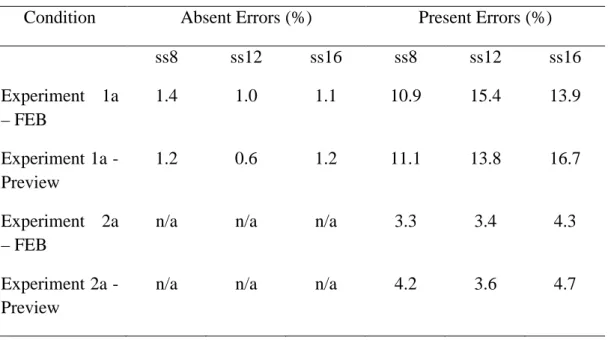
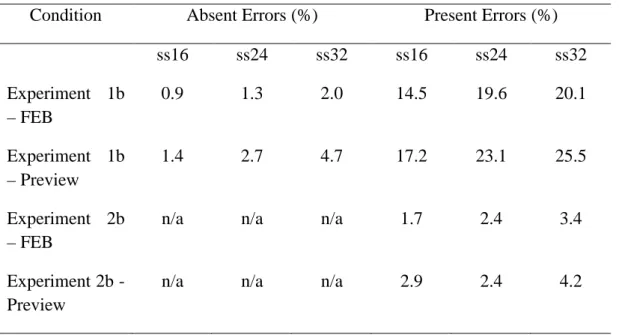
---Error rates for all conditions are shown in Tables 1 and 2. A mixed analysis of
variance (ANOVA) on percentage error rates showed that all four main effects were
significant. The overall error rate was greater in the preview condition than the FEB
conditionF(1,47) = 4.7,p< .05, on present than on absent trials,F(1,47) = 96.6,p< .01, and
in the High density condition than the Low density condition, F(1,47) = 4.6, p < .05. Errors
also increased as set size increased,F(2,94) = 21.6, p < .01. The Target presence x Set size
interaction was also significant, F(2,94) = 14.8, p < .01; errors increased more over set size
for target present trials compared to target absent. However, of most relevance was a
significant Condition x Set Size interaction, F(2,94) = 3.5, p < .05; errors increased more
with set size in the preview condition than in the FEB condition. No other interactions
reached significance (allFs < 3.7,ps > 0.05).
---Tables 1 and 2 about here
---Discussion
The main aim of Experiment 1 was to determine the effectiveness of time-based
selection under MAD search conditions. In terms of search efficiency the results were
somewhat mixed. The significant Condition × Set Size interaction in both the RT and the
error rate data suggests the presence of a speed accuracy trade-off. RTs increased less with
set size in the preview condition compared to the FEB but errors increased more. One
relatively conservative search strategy. That is, in this complex search task when participants
were uncertain if the target was there or not they were biased to respond absent after an
incomplete search of the display (see also Chun & Wolfe, 1996). If high miss errors are due
to a conservative search strategy, then we would expect that they should reduce in MAD
search when it is known that the target is always present. Removing this speed-accuracy
trade-off will give us better insight as to whether a preview benefit occurs in these more
complex search environments. Accordingly, to address this issue in Experiments 2a and 2b
we used a discrimination task in which the target was always present rather than a
present-absent task.
Experiment 2a and 2b: Target Discrimination in MAD Preview Search
Method
Participants
Forty-two participants (twenty-six female) aged 18 to 25 (M =20.5,SD=1.4) were
recruited from the University of Warwick. All participants had normal or corrected-to-normal
visual acuity. Twenty-six participants (17 female) completed the low density condition and
16 participants (9 female) completed the high density condition.
Stimuli and procedure
The stimuli and procedure were similar to those of Experiment 1 except that all
stimuli were surrounded by the outline of a white box (1.2° x 1.2°) which had a small gap
(0.2o) midway on either the left or right side. The boxes remained visible throughout the
display and did not blink on and off. However, they moved with the targets and distractors if
the stimuli were moving. Participants were asked to report whether the placeholder around
respectively. Previous work has shown that the addition of placeholders to the display does
not interfere with MAD search (Kunar & Watson, 2011). Unlike Experiment 1, the target was
present on all trials. Participants completed 240 full element baseline trials and 240 preview
trials.
Results
RTs shorter than 200ms or longer than 10s were removed as outliers (less than 0.3%
of the data). Mean correct RTs are shown in Figure 3. The data were analysed using a mixed
2 (Condition: Preview vs FEB) × 3 (Set-size) × 2 (Density: High vs Low) ANOVA, with
Condition and Set-size as within-subject factors, and Density as between-subject. All three
main effects were significant. RTs were shorter overall in the preview condition than the FEB
condition, F(1,40) = 20.4, p < .01, were shorter in the Low density than the High density
displays,F(1,40) = 21.8,p< .01, and increased with set-size,F(2,80) = 326.3, p< .01. There
was a significant Set Size x Density interaction, F(2,80) = 9.7, p < .01; RTs increased more
across set size in the High density condition compared to the Low density condition.
However, of most interest, the Condition × Set Size interaction was not significant,F(2,80) =
2.2, p = 0.12, providing no evidence of a preview benefit. No other interactions were
significant (allFs>1.1,ps < 0.3).
---Figure 3 about here
---Examining error rates (Tables 1 and 2) showed that overall, errors increased with
= 0.14, nor of Density, F(1,40) = 1.3,p = 0.26. None of the interactions were significant (all
Fs < 1,ps> 0.4).
Discussion
The main aim of Experiment 2 was to examine time-based selection in MAD search
conditions when the target was always known to be present in the field. We predicted that by
providing a clear end point to search (because the target was always present) target-miss error
rates should be substantially lower than those of Experiment 1. With regard to this point,
there was a clear reduction in the number of errors made, from 16.9% in Experiment 1 to
3.5% in Experiment 2. Hence, as predicted, having the target present on all trials led to a less
conservative search strategy. However, of most interest was the extent to which a preview
benefit occurred in these low miss-error rate conditions. Considering the search slopes, there
was no evidence at all for a reliable difference in the slopes between the preview and FEB
conditions. Nevertheless, as in Experiment 1, there was a reliable difference in overall RTs
between the preview and FEB conditions; with shorter RTs in the preview condition than in
the FEB condition.
General Discussion
Previous work has shown that people are able to prioritize the selection of visual
stimuli such that old, irrelevant objects can be ignored or suppressed, and new stimuli
prioritized – the preview benefit. This benefit has been shown to occur using a wide range of
stimuli (e.g., Watson & Humphreys, 1997; Watson & Humphreys, 1998; Kunar et al., 2003b;
Kunar & Humphreys, 2006; Osugi et al., 2010; Fenske et al., 2004). In the current work we
examined whether such time-based selection is possible in more complex MAD search
real-world tasks and settings. Of note, previous work has shown that many established search
principles do not hold in MAD displays and so it is important to establish whether time-based
selection is also compromised in such displays. Our results showed that in the absence of a
speed-accuracy trade off a preview effect did not occur in MAD search.
Before we consider the results further, it is worth considering how the present study
links with previous findings of the preview benefit in terms of motion changes. A robust
preview benefit has been shown with both stationary stimuli (e.g., Watson & Humphreys,
1997), and moving stimuli (Watson & Humphreys, 1998; Watson, 2001). With stationary
stimuli it does not seem to matter whether there is a feature difference (such as color)
between the old and the new stimuli (Theeuwes, Kramer & Atchley, 1998, Olivers, Watson
and Humphreys, 1999, Kunar et al., 2003, but see also Donk, 2017). However, with moving
stimuli the picture is more complex. Watson and Humphreys (1998) showed that a robust
preview benefit occurred with linearly moving, wrap-around displays in which stimuli were
presented behind a virtual window. That is, stimuli moved down the screen and when they
reached the bottom of a window they scrolled off bit-by-bit and then re-emerged at the top of
the window bit-by-bit. Kunar et al. (2003) showed similar results in a condition where the
moving stimuli never disappeared from the display but simply changed their direction on
reaching the edge of the screen. Importantly, in both these experiments the old-previewed
stimuli were green and the new stimuli were blue. When a similar experiment was run with
monochromatic stimuli (Olivers, Watson and Humphreys, 1999) there was no preview
benefit. Watson and Humphreys (1998) proposed that for a preview benefit to occur in these
displays moving stimuli were suppressed via the application of inhibition at the level of
However, Watson (2001) showed later that a preview benefit could be obtained even
with moving stimuli that were all the same color provided that the local spatial relationships
remained constant. This was examined by using displays that rotated globally around the
center of the screen. With this type of motion, the absolute position of the stimuli change but
their relative locations do not. Watson (2001) suggested that this relative position constancy
allowed the visual system to develop a spatial template of the preview items which was
linked to a rotational transform and allowed inhibition to be maintained on the previewed
items (see also Kunar, Humphreys, Smith & Hulleman, 2003). With linearly moving,
wrap-around displays, this was not possible because the relative spatial relationships between the
old stimuli in the preview display were not constant over time. Thus a fixed spatial
representation of the old items could not be developed.
Given this, what might we expect in terms of MAD search performance? On the one
hand, in MAD search, the preview items did not maintain fixed relative positions. That is,
half the preview items were moving in different directions at different velocities and changed
direction at different times. In addition, half of the preview items were stationary. Therefore,
based on the findings from Watson (2001) and Olivers, Watson and Humphreys (1999) we
might expect that the full set of old/preview stimuli would not be able to be ignored. This is
because it would not be possible to develop a spatially stable representation in order to
co-ordinate the application of inhibition to the previewed items. However, an alternative
explanation for why linearly moving, monochromatic wrap-around displays did not produce a
preview benefit in Olivers, Watson and Humphreys (1999) is that when items re-appeared at
the top of the virtual window they were perceived as perceptually new objects (Yantis &
Gibson, 1994). This could have then abolished any inhibition applied to those items, just as
for attention (Watson & Humphreys, 2002; Osugi et al., 2010, Kunar & Humphreys, 2006).
Thus, it remains possible that moving preview stimuli can, in fact, be successfully suppressed
even if their relative spatial locations change, provided that they do not change in a way that
suggests they become perceptually new objects during the preview period.
Of note, in the MAD displays presented here, unlike with wrap-around displays, none
of the old items ever completely disappeared and re-appeared somewhere else. Hence there
was no opportunity to perceive the previewed items as forming perceptually new objects
throughout the preview period. It is thus possible that we could have obtained a robust and
full preview benefit in the MAD search conditions. In addition, half of the display items were
stationary in our MAD preview display and hence we might also expect that these old
stationaryitems could still be suppressed because they maintained a fixed position in space.
If this were the case, then we would expect to find at least partial preview benefit with
approximately a quarter of the display items being suppressed. However, the findings were
not consistent with either of these two possibilities with no evidence to support the existence
of even a partial preview benefit.
Explaining the lack of a preview benefit: Theoretical Implications
Theoretically, the results can be explained by the luminance onset capture, temporal
grouping and the visual marking account of the preview benefit. According to the onset
capture account new items are prioritized because the luminance onsets generated by their
appearance capture attention automatically (Donk & Theeuwes, 2001, Agter & Donk, 2005;
Belopolsky, Theeuwes, & Kramer, 2005; Donk, 2006; Donk & Theeuwes, 2001, 2003; Donk
& Verburg, 2004). In the present work, having transient displays in terms of moving and
produced by the appearance of the new items. This would lead to a reduction of the preview
effect. The temporal grouping account (Jiang, Chun, & Marks, 2002a) likewise might explain
the lack of preview effect if the presence of the moving and blinking stimuli disrupted the
ability to temporally group the displays into old and new sets. The current data do not refute
either the onset or the temporal grouping accounts. However, note that for these accounts we
would have to make a couple of assumptions. Specifically, we would have to assume that the
gradual and continuous fading of the ‘blinking’ stimuli and/or the motion of the moving
stimuli produced sufficiently strong luminance-change signals to compete with the abrupt
luminance onsets associated with the onset of the new items (at previously empty locations).
The data can also be explained by the inhibitory visual marking account (Watson &
Humphreys, 1997). In respect to this account one possibility is that that the changes in
luminance and motion of the preview items continually attracted attention and this interfered
with the development of an inhibitory template for even the stationary items. Another
possibility is that developing an inhibitory template towards the previewed items in more
complex displays takes longer than the 1000ms allowed in the present work. Earlier work
suggested that with stationary stimuli, a preview duration of approximately 400ms is needed
to obtain a full preview benefit (e.g., Watson & Humphreys, 1997). In contrast, when the
locations of the stimuli were more difficult to encode (as is the case with stimuli that are
iso-luminant with their background) a longer preview duration (3000ms) was needed for a
preview benefit to emerge (Braithwaite, Hulleman, Watson & Humphreys, 2006). If, as
seems likely, coding and tracking the locations of stimuli in MAD search conditions is more
difficult than in simpler displays, it is possible that a preview benefit might emerge even in
It is also possible that the lack of preview benefit with MAD displays represents a
strategic decision to intentionally not apply inhibition to the old items. According to the
inhibitory visual marking account participants can apply or withhold inhibition in a flexible
manner depending on task goals (Watson & Humphreys, 2000). Recent work using relatively
simple displays (Zupan, Watson & Blagrove, 2015), showed that participants will by default
intentionally supress irrelevant stimuli in the preview period when looking for new items.
However, there was also evidence that they reduced the extent to which they would inhibit
previewed items when there was little benefit to be gained on the majority of trials. In the
present work there would be a clear benefit to suppressing the previewed stimuli given the
difficulty of the search. However, it is possible that the perceived effort involved in
suppressing stimuli in the more complex MAD search conditions biased people away from
applying inhibition. In this way participants might have strategically withheld the application
of inhibition. The current data cannot separate these differing possibilities but it would be
worth establishing whether strategic choice, timing or capacity limitations account for the
lack of successful time-based selection in MAD search conditions.
Search slopes versus overall RTs
The best indicator of the extent to which old stimuli can be de-prioritized is based on
search slopes as this indicates the number of items considered during the search process.
However, in both experiments we did find an overall reduction in RTs in the preview
condition relative to the FEB condition. Thus although there was no slope-based preview
benefit, there was nonetheless an advantage in terms of the overall time it took participants to
respond correctly (see also Humphreys et al., 2004, for examples of preview benefits based
on overall RTs). Given the present set-up it is difficult to determine the exact cause of this
onset of the search display (see Watson & Humphreys, 1997, for further discussion of this
possibility). Another possibility is that a fixed and small number of preview items could be
inhibited (perhaps via a VWM inhibitory mechanism; Emrich, Al-Aidroos, Pratt & Ferber,
2010) which reduced the number of items searched in the preview condition by a fixed
number. Either way the present results suggest a small overall preview advantage but provide
little evidence for the exclusion of multiple preview items typically observed in earlier
preview studies. For now, however, as was the case for other established search principles,
our data suggest that time-based selection might not be as effective in real-world conditions
as might be expected from prior research. Determining the exact cause of the compromised
time-based selection in MAD search conditions (either capacity or strategic) will be a useful
References
Abrams, R. A., & Christ, S. E. (2003). Motion Onset Captures Attention. Psychological
Science, 14(5), 427-432.
Agter, F., & Donk, M. (2005). Prioritized selection in visual search through onset capture
and color inhibition: Evidence from a probe-dot detection-task. Journal of
Experimental Psychology: Human Perception and Performance, 31(4), 722–730
Belopolsky, A. V., Theeuwes, J., & Kramer, A. F. (2005). Prioritization by transients in
visual search.Psychonomic Bulletin & Review, 12(1), 93–99.
Braithwaite, J.J., Hulleman, J., Watson, D.G. & Humphreys, G.W. (2006) Is it impossible to
inhibit isoluminant items or does it simply take longer? Evidence from preview
search.Perception & Psychophysics, 68,290-300.
Braithwaite, J. J., Humphreys, G. W., Watson, D. G., & Hulleman, J. (2005). Revisiting
preview search at isoluminance: New onsets are not necessary for the preview
advantage.Perception & Psychophysics, 67(7), 1214-1228.
Chun, M.M. & Wolfe, J.M. (1996) Just Say No: How Are Visual Searches Terminated
When There Is No Target Present?Cognitive Psychology,30, 39-78
Donk, M. (2006). The preview benefit: Visual marking, feature-based inhibition, temporal
segregation, or onset capture?Visual Cognition, 14(4-8), 736–748.
Donk, M. (2017). Subset selective search on the basis of color and preview.Attention,
Perception & Psychophysics, 79(1), 85–99
Donk, M., & Theeuwes, J. (2001). Visual marking beside the mark: Prioritizing selection by
abrupt onsets.Perception & Psychophysics, 63(5), 891–900.
Donk, M., & Theeuwes, J. (2003). Prioritizing selection of new elements: Bottom-up versus
Donk, M., & Verburg, R. C. (2004). Prioritizing new elements with a brief preview period:
Evidence against visual marking.Psychonomic Bulletin & Review, 11(2), 282–288.
Dube, B., Basciano, A., Emrich, S.M., & Al-Aidroos, N. (2016). Visual working memory
simultaneously guides facilitation and inhibition during visual search. Attention,
Perception, and Psychophysics, available online.
Emrich, S. M., Al-Aidroos, N., Pratt, J., & Ferber, S. (2010). Finding memory in search:
The effect of visual working memory load on visualsearch. Quarterly Journal of
Experimental Psychology, 63, 1457–1466.
Emrich, S. M., Ruppel, J. D. N., Al-Aidroos, N., Pratt, J., & Ferber, S. (2008). Out with the
old: Inhibition of old items in a preview search is Working Memory in Preview
Search Limited, Perception & Psychophysics, 70, 1552–1557.
Fenske, M.J., Raymond, J.E., & Kunar, M.A. (2004). The affective consequences of visual
attention in preview search.Psychonomic Bulletin and Review, 11, 1055-1061.
Franconeri, S. L., & Simons, D. J. (2003). Moving and looming stimuli capture attention.
Perception & Psychophysics, 65(7), 999-1010.
Humphreys, G.W., Kyllinsbæk, S., Watson, D.G., Olivers, C.N.L., Law, I. & Paulson, O.
(2004) Parieto-occipital areas involved in efficient filtering in search: A time course
analysis of visual marking using behavioural and functional imaging procedures.
Quarterly Journal of Experimental Psychology, 57A, 610-635.
Jiang, Y., Chun, M. M., & Marks, L. E. (2002a). Visual marking: Dissociating effects of
new and old set size. Journal of Experimental Psychology: Learning, Memory, and
Cognition, 28, 293–302.
Jiang, Y., Chun, M. M., & Marks, L. E. (2002b). Visual marking: Selective attention to
asynchronous temporal groups. Journal of Experimental Psychology: Human
Kunar, M. A., & Humphreys, G. W. (2006). Object-based inhibitory priming in preview
search: Evidence from the “top-up” procedure. Memory & Cognition, 34(3),
459-474.
Kunar, M. A., Humphreys, G. W., & Smith, K. J. (2003). History matters: The preview
benefit in search is not onset capture.Psychological Science, 14(2), 181-185.
Kunar, M. A., Humpreys, G. W., & Smith, K. J. (2003). Visual change with moving
displays; More evidence for color feature map inhibition during preview search.
Journal of Experimental Psychology: Human Perception and Performance, 29(4),
779-792.
Kunar, M. A., Humphreys, G. W., Smith, K. J., & Hulleman, J. (2003). What is marked in
visual marking?: Evidence for effects of configuration in preview search. Perception
and Psychophysics, 65,982-996.
Kunar, M. A., Shapiro, K. L., & Humphreys, G. W. (2006). Top-up search and the
attentional blink: A two-stage account of the preview effect in search. Visual
Cognition, 13(6), 677-699.
Kunar, M. A., & Watson, D. G. (2011). Visual Search in a Multi-Element Asynchronous
Dynamic (MAD) World. Journal of Experimental Psychology: Human Perception
and Performance, 37(4), 1017–1031.
Kunar, M. A. & Watson, D. G. (2014). When Are Abrupt Onsets Found Efficiently in
Complex Visual Search?: Evidence from Multi-Element Asynchronous Dynamic
Search. Journal of Experimental Psychology: Human Perception and Performance,
40,232-252.
McLeod, P., Driver, J., & Crisp, J. (1988). Visual search for a conjunction of movement and
Olivers, C. N., & Humphreys, G. W. (2002). When visual marking meets the attentional
blink: More evidence for top-down, limited-capacity inhibition. Journal of
Experimental Psychology: Human Perception and Performance, 28(1), 22–42.
Osugi, T., Kumada, T., & Kawahara, J. (2010). Visual marking survives graphical change if
meaning is retained.Attention, Perception, & Psychophysics, 72(8), 2144-2156.
Pinto, Y., Olivers, C., & Theeuwes, J. (2006). When is search for a static target among
dynamic distractors efficient?Journal of Experimental Psychology: Human
Perception and Performance, 32,59–72.
Pinto, Y., Olivers, C. N. L., & Theeuwes, J. (2008). Selecting from dynamic environments:
Attention distinguishes between blinking and moving.Perception & Psychophysics,
70,166–178.
Treisman, A. M., & Gelade, G. (1980). A feature-integration theory of attention. Cognitive
Psychology, 12(1), 97–136.
Watson, D. G. (2001). Visual marking in moving displays: Feature-based inhibition is not
necessary.Attention, Perception, & Psychophysics, 63(1), 74-84.
Watson, D.G., Braithwaite, J.J. & Humphreys, G.W. (2008). Resisting change: The
influence of luminance changes on visual marking and the preview benefit.
Perception & Psychophysics, 70,1526-1539.
Watson, D.G., & Humphreys, G.W. (2002). Visual marking and visual change. Journal of
Experimental Psychology: Human Perception and Performance, 28,379-395.
Watson, D. G., & Humphreys, G. W. (1997). Visual marking: Prioritizing selection for new
objects by topdown attentional inhibition of old objects. Psychological Review,
Watson, D. G., & Humphreys, G. W. (1998). Visual marking of moving objects: A role for
top-down feature-based inhibition in selection.Journal of Experimental Psychology:
Human Perception and Performance, 24(3), 946–962.
Watson, D.G. & Humphreys, G.W. (2000). Visual marking: Evidence for inhibition using a
probe-dot paradigm.Perception & Psychophysics, 62,471-481.
Watson, D.G. & Humphreys, G.W. (2005). Visual Marking: The effects of irrelevant
changes on preview search.Perception & Psychophysics, 67,418-434.
Watson, D.G., Compton, S., & Bailey, H. (2011). Visual Marking: The influence of
temporary changes on time-based visual selection. Journal of Experimental
Psychology: Human Perception & Performance, 37,1729-1738.
Wolfe, J. M. (1998). Visual Search. In H. Pashler, Attention(Vol. 1, pp. 13-73). University
College London Press.
Yantis, S. & Gibson, B. (1994). Object continuity in apparent motion and attention.
Canadian Journal of Experimental Psychology, 48,182-204.
Yantis, S., & Jonides, J. (1984). Abrupt visual onsets and selective attention: Evidence from
visual search. Journal of Experimental Psychology: Human Perception &
Performance, 10(5), 601-621.
Zupan, Z., Watson, D.G., Blagrove, E. (2015). Inhibition in time-based visual
selection: Strategic or by default? Journal of Experimental Psychology: Human
Table 1. Percentage of errors as a function of condition and set size (ss) for the Low Density
conditions of Experiments 1a and 2a
Condition Absent Errors (%) Present Errors (%)
ss8 ss12 ss16 ss8 ss12 ss16
Experiment 1a
– FEB
1.4 1.0 1.1 10.9 15.4 13.9
Experiment 1a -Preview
1.2 0.6 1.2 11.1 13.8 16.7
Experiment 2a
– FEB
n/a n/a n/a 3.3 3.4 4.3
Experiment 2a -Preview
Table 2. Percentage of errors as a function of condition and set size (ss) for the High Density
conditions of Experiments 1b and 2b
Condition Absent Errors (%) Present Errors (%)
ss16 ss24 ss32 ss16 ss24 ss32
Experiment 1b – FEB
0.9 1.3 2.0 14.5 19.6 20.1
Experiment 1b – Preview
1.4 2.7 4.7 17.2 23.1 25.5
Experiment 2b – FEB
n/a n/a n/a 1.7 2.4 3.4
Experiment 2b -Preview
Figure Captions
Figure 1. Example displays for the Preview condition of Experiment 1. The FEB condition
was identical but without the Preview screen. Arrows represent moving items. Stimuli
surrounded by stars represent items that fade on and off. The target (if present) was a vowel.
Figure 2. Mean RTs for Experiment 1a and 1b as a function of set-size and condition. FEB =
Full-element baseline, PRE = Preview, Low = Low density (8 to 16 items), High = High
density (16 to 32 items). Search slope values (in ms/item) are shown in the parentheses.
Figure 3. Mean RTs for Experiment 2a and 2b as a function of set-size and condition. FEB =
Full-element baseline, PRE = Preview, Low = Low density (8 to 16 items), High = High