..June 1
We've made a great computer
a lot better.
Varian's new 620/L has a dramatic price/performance ratiothatgives more computer in less space at lower cost. The 620/L is an advanced design of the reliable, field-proven (over 1300 installed worldwide), systems-oriented 620/i computer.
Priced at only $7700, the 620/L has an 8K, 16-bit, high-perform-ance memory that can be expanded to 32K inexpensively. Each 4K memory increment is$2300. What's
more, if you don't need 8K, you'll find the basic 4K, 16-bit 620/L very attractive at $5400!
The 620/L is small, so small that when fully expanded-a 32,768-word system with all main frame options and up to eight peripheral controllers-fits into just 21 inches of rack height.
The 620/L is 100% I/O-and soft-ware-compatible with the 620/i, and new peripherals and software have been, added. All peripherals,
software, and application packages (developed for earlier 620 models), as well as the 620/L itself, are off-the-shelf.
You know us. You know that when we say we have something better, we can prove it. Talk to the big com-pany in small computers.
~varian
~
data machines
The Big Company in Small Computers
U.S. Sales Offices: Downey (213-927-1371), San Diego (714-298-9292), San Francisco (415-968-9996), Calif.lWashington (301-773-6770), D.C.lChicago (312-692-7184), III./Waitham (617-899-8055), Mass.lDetroit (313-645-9950), Mich.lMinneapolis (612-926-6571), Mi nn.l Albuq uerque (505-298-5570), N. Mex.lNew Rochelle (914-636-8118), Rochester (716-586-3273), N.Y.lFort Washington (215-643-2355), Pa.lDalias (214-231-5145), Houston (7t3-781-0105), Tex/Canada: Malton, Ontario (416-677-9303~. Other offices worlrlwidelVarian Data Machines, a Varian subsidiary, 2722 Michelson Drive, Irvine, California 92664. Telephone 714/833-2400.·
June 1, 1971
Tally Corporation 8301 South 180th Street Kent, Washington 98031 (phone 206-251-5500)
Tell me more about saving my company money by moving more data for less.
Name Title
Company Phone
Address
City State Zip
DATAMATIlaN®
JUNE 1,1971
volume 17 number 11
departments
Calendar
7
Letters to the Editor
11
Look Ahead
19
Perspective
49
News Scene
56
Hardware
69
Software
74
People
76
World Roundup
81
Index to Advertisers
82
The Forum
83
June 1, 1971
ENERAL
24 Sports and EDP .. .
It's a New Ballgame
J. GERRY PURDY. There are more uses for
com-puters in sports than dreamed of in your philos-ophy, Horatio. And many of them are already hard at
it!
34 TRADAR: Death of a Retailer's Dream
RICHARD M. PETERSEN. A howling,
foot-stomp-ing success in October, canceled in December-what DID happen to GE's retail Wunderkind? Here's the story as seen by one who was involved.
38
Commitment ... the Unreachable Star?
GEORGE GLASER. The data processing
depart-ment that concerns itself with increasing company profits won't have to beg for management "involvement."
45
IIA and Proprietary Rights
A Conference Report.
DMMENTARV
49
Perspective
The city and county of Los Angeles are getting the most for their computing dollars. The city's Data Processing Service Bureau says it is saving the city many times its budget. Both are central-ized and aiming at total information systems.
83
The Forum: Computer Ecology
T. M. AMES. Convenience, speed, and economy
are the usual justifications for innovations in data processing. It is time to add ecological responsi-bility to the list.
About the Cover
Seymour Leichman's Fate Takes a Hand captures the old mystique of supernatural intervention in America's favorite pastimes. But fate may be about to take a bleacher seat as computers and proba~ bility wizards combine to broaden the field of operations for coaches and players alike. The lithograph is reproduced here courtesy of Ken-nedy Galleries, Inc., New York.
4
CIRCLE 42 ON READER CARD
SCANNING MICROFILM
Digitizing of line drawings
-technical illustrations
From Aperture Cards to Magnetic Tape-Compressed or Uncompressed to Your Format Requirements. Text Interspersion
-Point Raster 4096 x 3072
DATA
DISSEMINATION
SYSTEMS INC.
A Subsidiary of the Signal Companies, Inc
4763 EI Segundo Blvd. Hawthorne, California 90250 Phone (213) 644A425
CIRCLE 34 ON READER CARD
DATAMATION®
.JUNE
~J 197~volume 17
number 11
This issue
110,632
copies
EDITOR
ROBERT B. FOREST
EDITORIAL STAFF
Managing Editor Senior Associate Editors Associate Editors Copy Editor
Assistant Editors Special Features Editor Eastern Editors New England Editor Washington Editor Midwestern Editor Southwestern Editor European Editor Australian Editor Contributing Editors
Editorial Adviser Technical Consultant
EDWARD K. YASAKI WILLIAM J. ROLPH, TOM McCUSKER AUBREY DAHL, RICHARD A. McLAUGHLIN, EDITH D. MYERS, JOHN T. WATERHOUSE JANET EYLER MICHAEL WILLIAM CASHMAN ALMA O'STEEN ANGELINE PANTAGES JOHN WESSLER, F. BARRY NELSON W. DAVID GARDNER PHIL HIRSCH LAWRENCE RAGAN ROBERT F. ALEXANDER PEARCE WRIGHT FREDERICK A. BLAND HOWARD BROMBERG, ROBERT V. HEAD, PHILIP H. DORN, LOUIS B. MARIENTHAL,
MILTON M. STONE, F. G. WITHINGTON, PAUL ARMER, ROBERT P. BIGELOW ROBERT L. PATRICK LOWELL AMDAHL
EDITORIAL OFFICES
HEADQUARTERS: 94 S. Los Robles Ave., Pasadena, Calif. 91101, Phone: (213) 681·8486; EASTERN: 35 Mason St., Greenwich. Conn. 06830, (203) 661·5400; 19 Marlborough St., Boston, Mass. 02116, (617) 267·9414; 9805 Singleton Dr., Bethesda, Md. 20034. (301) 365·8671; MIDWESTERN: 407 S. Dearborn st., Chicago, III. 60605, (312) 922·8245; SOUTHWESTERN: 2711 Cedar Springs, Dallas, Texas 75201, (214) 744·0161. FOREIGN: 65, Hill Road, Chelmsford, Essex, England; 322, Park Regis, Park St., Sydney, NSW 2000, Australia.
GRAPHIC DESIGN
AND PRODUCTION
Art & Production Director CLEVE MARIE BOUTELL Production Manager MARILEE PITMAN Production Assistants GLORIA J. FASANA, LOUISE T. O'CONNOR
CIRCULATION
35 Mason Street Greenwich, Conn. 06830 Circulation Manager MarKeting Research Director
PUBLISHER
GARDNER F. LANDON
ASSISTANT PUBLISHER
JAMES M. MORRIS
Circulation audited by ~ Business Publications Audit ~
MAE VAN RENNES DOUGLAS DeCARLO
..
'"-'AS"", Member, American
-..~ Business Press, Inc.
tp
DATAMATION is published twice monthly on or about the first and fifteenth day of every month by Technical Publishing Company, 1301 South Grove Ave., Barrington, Illinois 60010; Arthur L. Rice Jr., Presi· dent; Gardner F. Landon, Executive Vice President. Executive, Circu· lation and Advertising offices, 35 Mason Street, Greenwich, Conn. 06830 (203) 661·5400. Editorial offices, 94 So. Los Robles Avenue,· Pasadena, California 91101. Publish~d at Chicago. III.DATAMATION is circulated without charge by name and title to certain qualified individuals who are employed by companies involved with automatic Information handling .equlpment. Available to others by subscription at the rate of $25 annually In the U.S. and Canada. Reduced rate for qualified stUdents. Foreign subscriptions are on a paid basis only at a rate of $38 annually. No subscription agency is authorized by us to solicit or take orders for subscriptions. Controlled circulation paid at Columbus, O. and Form 3579 to be sent to Technical Pub· lishing Company, P.O. Box 2000, Greenwich, Conn. 06830. Copyright 1971, Tech· nical Publishing Company. Microfilm copies of DATAMATION may be obtained from UniverSity Microfilms, A Xerox Company, 300 North Zeeb Road, Ann Arbor, Michigan 4 8 1 0 6 .
-Printed by Beslow Associates, Inc.
We're pleased to add a new name to the computer tape field. Media ... the computer tape with the lifetime guar~l.n
tee and the promise of 48-hour delivery. Our guarantee means that with proper care and maintenance, Media tape will outlive your present computer installa-tion.
We've been involved in improving the quality of computer tape for almost 12 years now. We've been rehabilitating the other guy's tape for so long that we know everything that can go wrong with it. And Media has made sure that the common errors (and even some
un-Introd
the new
common ones) won't happen to us. So sure, in fact, that we've guaranteed our Fel 3200 tape for a lifetime, and backed it in writing.
Media magnetic tape breaks the time barrier in both directions. It gets to you fast, and it lasts a lifetime.
For complete details on our lifetime guarantee write or call today:
Media, a division of General Kinetics Incorporated
11425 Isaac Newton Square Reston, Virginia 22070 (703) 471-7522
Media Computerlllpe
The
first
to
offer
you
a
.1
June 1, 1971 CIRCLE 15 ON READER CARD
computer
tape from
medlD
A DIVISION OF GENERAL KINETICS INC.
@3mTI
DATE EVENT/SPONSOR LOCATION CONTACT COST
~
June 11 Fifth Conference on
I
Stony Brook, NY Computing Center $15
Advancesin Computing
June 22-25 DPMA Conference & Exposition
June 24-25 ADAPSO 32nd
Management Conference
I
July 19-21 1971 SummerComputer
I
Simulation Conference
i
t
I
Aug. 3-5 ACM'71 National Conf.
I
1Aug. 23-28 IFIP Congress 71
Aug. 24-27 Western Electronic Show and Convention
I
This terminal can be
equipped to "carryon"
automatically-at any hour
and without an operator. It
can transmit data, or receive
data at high speed from a
computer and print at night
to be ready for the next day.
Ask about Unattended
Operation capability.
Houston Montreal Boston Chicago ljubljana, YugoslaviaSan Francisco
Novar Corporation • 2370 Charleston Road Mountain View, Calif. 94040 • (415) 964-3900 Offices In Principal Cities
(iji:i4
InFORmATiOn
SYSTE;Nnl~
CIRCLE 38 ON READER. CARD
June 1, 1971
SUNY at Stony Brook Stony Brook, NY 11790
DPMA
505 Busse Highway Park Ridge, Il60068
ADAPSO 551 Fifth Ave. New York, NY 10017
Donald H. Niesse McDonnell Automation Dept. K676, Box 516 St. Louis, MO 63166
!
I
AI HawkesI
Computer Horizons 53 W. Jackson Blvd.I Chicago, IL 60604
t
I
I
IFIP Congress 71 Box 4197
i New York, NY 10017
I
WESCONi
3600 Wilshire Blvd.
(
r Los Angeles, CA 90010
$90, members $115, others
$80, members $100, others
$50, members
:0; $55, others $25, students
j
I
$35, members $60, others $10, students $60 $20, studentsI
I
$5C
A
L
E
N
D
A
R
SEMINAR
Data
Communications in
Computer Systems
PLACE-Dartmouth College, Kiewit Computation Center, Hanover, New Hampshire WHEN-July 7th, 8th, and 9th, 1971 FEATURES-Transmitting techniques • Trans·
mitting without MODEMS • MODEMS • Network systems • Data flow in the Dart· mouth Time Sharing System • Communica. tions programming • Terminals • Bell Tele-phone interface • Future developments
LECTURERS-DR. THOMAS E. KURTZ, Director, Kiewit DR. ROBT. F. HARGRAVES, Assoc. Dir., Kiewit DR. PAUL SHANNON, Pres., Digital Systems MR. ROBT. F. BREWSTER, VP, Digital Systems MR. THOMAS E. BYRNE, Assist. Dir., Kiewit MR. EUGENE A. FUCCI, Assist. Dir., Kiewit FEES-Tuition, food, and lodging $250.
Vacation plan for families available. Registration July 6th, 3 to 5 pm; July 7th, 8:30 to 9:30 am. in Kiewit Computation Cen' ter. Registration fee $25 due July 1st, non· returnable but counted toward seminar tui. tion. Mail registration fee to, and get addi-tional information from Mr. Eugene A. Fucci, Kiewit Computation Center, Dartmouth Col-lege, Hanover, N. H. 03755
CIRCLE 8 ON READER CARD
· We don't have a crystal ball. And rarely resort to mystic means in recommend-ing what terminal should be used for a particular data communications appli-cation.
Some of the things, we at Teletype look at, that make the job a little easier are these:
Distribution
Urgency of message Frequency of use
Volume Language Accuracy
The diagram below demonstrates how you can fit a number of Teletype
termi-REGIONAL OFFICE
r/
13:L~ ~
DEPARTMENT!
EH
ACCOUNTING DEPARTMENT
8-B
COSTACCOUNTING
8-B
BILLING§---8
PAYROLL
8
nals into a system based on function and usage requirements. Magnetic tape makes the speed and language of vari-ous te'rminals compatible. In this hypo-thetical case we use one computer program, one major line control proce-dure, one computer port. one type of data set per link. And deliver greater data through-put per on-line dollar. Using terminals that offer the best capabilities within each station's com-munication situation.
Using Teletype magnetic tape data ter-minals, combined with various Teletype keyboard send-receive sets, you obtain
STANDARD SPEED LINK.
MEDIUM SPEED LINK
COMPUTER
STANDARD SPEED LINK
... try
a
Teletype®
37
... and look
into mag tape!
some unique system flexibility. And the on-line time saving aspects of operation are really dramatic. Magnetic tape data terminals can keep data flowing on-line at up to 2400 wpm.
In the example shown, the manufacturer has linked sales, engineering, account-ing and inventory control departments to a central office computer. As well as manufacturing plants, warehouse and regional offices. He's covered all critical data points with a common medium speed link, using a variety of terminals. Magnetic tape data terminals make it possible.
)
MANUFACTURING PLANT -I
~
~7---0
MT: MAGNETIC TAPE DATA TERMINALS
Routine aspects of the system are main-tained in standard speed links. Branch offices are tied into the regional office terminals on standard speed networks. Regional offices batch routine branch office data on one magnetic tape. Trans-mit the data to the central office proces-sor at one time. Saving a number of additional computer port requirements.
Since data generated at manufacturing plants is urgently needed, but volume is low, low-cost model 33 terminals are used here. The warehouse data volume is higher, but not complex, so a heavy-duty model 35 is working here.
Volume requirements are heaviest in the accounting department. Cost ac-counting, payroll, billing and invoice payment functions generate data all day long. Here magnetic tape is pre-pared off-line at various terminals. And an on-line stand-alone magnetic tape terminal is used to transmit data to and receive data from the central processor.
Sales and engineering departments are equipped with Teletype 37 terminals. But for different reasons.
model 33 series: An extremely low-cost 100 wpm terminal line. Uses ASCII. The most widely used terminal in time-sharing systems today.
Inktronic® data terminals: A unique electronic, solid state terminal. Prints up to 1200 wpm. Forms characters through electrostatic deflection (no typebox). ASCII compatible.
DATA COMMUNICATIONS
equipment for on-line, real-time processing
This terminal offers engineering people some unique format flexibility. Half-line and full-line forward and reverse line feed can be used to communicate com-plex equations and engineering formu-lae to the processor. It is possible to add special graphic engineering symbols to the normal compliment of letters, numbers and punctuation marks found in the typebox (up to 32).
The sales department uses the model 37 for order processing. It has on-line vertical and horizontal tab set control, and form feed platen (optional) which makes data transmission and reception on multiple copy business forms easy and economical.
At the inventory control point, this man-ufacturer has an urgent need to obtain printed page copy of large volumes of inventory items. Magnetic tape is used to feed data to the processor and a Teletype Inktronic® KSR set receives data and prints page copy on-line up to 1200 words per minute.
As you can see, Teletype's modular terminal design allows you to use
vari-model 35 series: A rugged, heavy-duty line of 100 wpm terminals. Uses ASCII. '
magnetic tape data terminals: Use compact reusable tape cartridges. Operate on-line at up to 2400 wpm, and connect "locally" to lower speed Teletype terminals using ASCII.
ous units as building blocks to meet the m 0 s t de man din g s y s t em nee d's.
Teletype also has the station and error control accessories necessary for more efficient and economical data commu-nications operations. Since cost is a very important part of the mix, Teletype offers greater terminal capabilities on a price/performance basis than any other man ufactu rer.
If you're involved in designing a tele-processing, time-sharing, remote batch or computer switched system; looking into a multi-point private line, point-to-point private line or switched data com-munications network; talk to Teletype about terminals. For ideas, equipment and understanding. you'/I find no better source. Anywhere.
Teletype data communications equip-ment is available in send-receive capa-bilities of up to 2400 words per minute. If you would like specific information about any of the equipment described here, write: Teletype Corporation, Dept. 81-16,5555 Touhy Ave., Skokie, III. 60076.
model 37 series: One of the most versatile heavy-duty terminal lines going. Generates all 128 characters of ASCII. Operates at 150 wpm. Prints in upper and lower case.
Stuntronic™ accessories: Electronic solid state terminal logic devices offering many control options. Such as, automatic station control, error detection and correction capabilities.
Teletype is a trademark registered in the U.S. Pat. Office
T E L E T Y P E
machines that make data move
'H'
Garrett has a new
family of minimum
weight, highly
flexible MOS/ LSI
general purpose
computers - the
"ADAPT" series.
10
The first application of the "ADAPT" G. P. Computer
concept has been the air inlet control system for the
Navy's F-14. It meets all the requirements of
MIL-E-5400, Class 2 and is in quantity production.
Some of its obvious advantages are the direct result
of MOS/LSI technology. Models in the "ADAPT"
series weigh as little as 8 pounds, measure
4114"
X7" x 8", and run on 20 watts of MIL-STD-704
power. At low cost. With high reliability. No cooling
is required.
Even more remarkable is the flexibility of the
"ADAPT" series, achieved through
• microprogramming
• bus orientation
• the "bit-slice" building block concept.
The basic building
blocks consist of six custom
MOS/LSI devices, used repetitively
to tailor a task-oriented processor for your
application with a minimum of non-recurring cost.
Garrett has a family of MOS/LSI general purpose
computers; and you can learn more about them with
a phone call or letter.
Contact: Sales Manager, Garrett AiResearch
Electronic Systems, 2525 West 190th Street,
Torrance, California 90509
AiResearch Manufacturing Co.
one of The Signal Companies
[l]
•
LETTERS
Source panned
Sir:
I read with interest your comment in the April 1 "Look Ahead" section:
"One source says IBl\I has 100 peo-ple doing nothing but protecting the .3.3.30."
It is appropriate that "yellow jour-nalism" be printed on yellow paper. Printing irresponsible and untrue
9rivell~~~ that and a.ttributing it to a source IS most unfaIr.
1 have observed that it's traditional in the industry to take a "cheap sh~t" at IBl\I whenever one can. At
DATA-~IATION, it's become almost a com-pulsion!
L. M. GOTTLIEB
Greenwich, Connecticut
We print only responsible and true drivel.
Make believe
Sir:
In reference to the item "McCracken on Tour with Anti-Am,! Ploy" (April 1, p. 46), I support the ABl\I and believe it will work!
\VILLIA~1 A. BOCCHIl\'O
Fairleigh Dickinson University Englell;ood Cliffs, New Jersey
SHARE takes stock
Sir:
In reference to "At Last: Standards for Keyhoards" by C. P. Ancona, S. M. Garland, and
J. J.
Tropsa (March 1, pp. 32-36), I wish to point out that in March of 1968 SHARE Inc. (then known as SHARE) issued a position paper entitled "Functional Specifications for Type-writer-Like Time-Sharing Termi-nals." That paper included a key-board layout which differs signifi-cantly from, and is, in our opinion, superior to the layouts being pro-posed for standardization by A1\"S1.Further, I would like to observe that the aforementioned paper was forwarded to BEl\IA as the sponsor of hoth X3 and X4, the A1\"SI committees concerned in the matter of keyboard standardization. It is our understand-ing that the X3 System Advisory
June 1, 1971
Committee directed the attention of the Keyboard Subcommittee to this paper with a strong recommendation that it he considered. To our knowl-edge this request was ignored; cer-tainlv we never saw a critical evalua-tion ~f the paper.
This SHARE position paper has been published in its entirety in
Computing Surveys, March 1970,
pp.5-31.
E. D. CALLENDER
President, Share Inc.
New Y ark, New York
Dolotta good
Sir:
I read with interest the article en-titled "At Last: Standards for Key-boards" by Ancona, Garland, and Tropsa in your March 1 issue (pp .
.32-36) .
The two keyboard layouts de-scribed in that article may indeeu become A1\"SI standards some dav, hut
good standards they will never l;e.
This article points up quite clearly what is wrong with ANSI: It is, by its
very nature, an organization of
man-ufacturers (as opposed to users) of
various systems, devices, and sundry gadgets. (Note, in passing, the affili-ations of the three authors of this article.) Thus, A1\"SI's vested interest is in standardizing the status quo, and its motto might well be "Tradi-tion is better (whenever it is
cheaper) than improvement."
The article is a good example of_ that attitude: Note, for instance, that the first criterion it gives for a good keyboard arrangement is that it sl.lOt!!d "facilitate . sim~?l!city of
dc-sign (my emphasIs). Ease of
oper-ation" (ditto) comes second. "Sim~
plicity of design," I assume, stands for "simplicity of design of the device driven by the keyboard," since any keyboard layout, pCI' SC, is as simple
to design as any other. This ordering of priorities directly leads to a pro-posed standard which sanctifies that abortion kllown as "logical hit pair-ing." "Logical bit pairing" should be read as "that electrical or electronic indication of upper/lower case shift which is cheaper to implement, even if it makes the keyboard harder to use and less compatible with ac-cepted usage." This concept is in fact so bad that, as a palliative, we see the authors proposing a second (slightly less undesirable) standard layout side by side with the first one.
This raises the interesting question as to whether two (or more?) equiva-lently acceptable but diHerent stan-dards for the same thing are hetter than one. By following this line of reasoning, we could standardize, say, 127 different ASCII codes (calling one of them EBCDIC, for good measure), and coincidentally give everyone their very own preferred logical hit pairing. In passing, note that one of the two proposed layouts has 47 printing keys, and the other 48. How this fits in with the 44-kev Selectric mechanism which is fast becoming a
de facto standard I do not know, nor
wish to speculate upon.
The proposed standards exhibit a fair dose of chauvinism: no provision appears for the so-called "National Usage" keys (there are many alpha.; bets which contain 27, 28, or 29 let-ters, or which have various accents, \ such as the cedilla) .
There are a few additional prob-lems with the proposed layouts. For instance, placing both the left and right square brackets (or both the left and right braces) on the same key is an invitation to typographical disasters, since it forces the typist to map a relationship which is naturally left-right into an up-down relation-, ship. Locating the minus sign in low-"" er case and the plus sign in uppet'" case makes poor sense from a pro! grammer's point of view. In the same vein, an enormous amount of case shifting will be required in any pro-gramming application with either
The Victor
2-Step-Now you can side-step five of the seven steps it takes to prepare compatible computer input under conventional data collection systems. It's your shortest route to compatible computer input.
No more batching, coding, keypunching, verifying, editing and merging, and retrieving error listings. With our Victor Series 800 all you do is prepare your source document on our console. It handles all the intermediate steps for
you-au toma ticall y. Right up
to actual data processing. What's more, our Series 800 gives you built-in flexibility. It's a stand-alone computer creating hard copy documents needed for your accounting and billing operations (payroll checks, invoices, accounts payable) while at the same time it transmits data to a pooled magnetic tape unit.
How did we do it? It's simple enough. With the Victor
Series 800, we simplified. Each console
*
has a true internal programable memory.It pre-edits, formats, field checks and error checks all da ta entered and then transmitted to the pooled magnetic tape unit. In order to save you space, time and, last but not least, money. Right now and in the long run.
To see how the Victor "2-step"
can put more fun (and profit) in your life, call or write for a demonstration.
Victor Comptometer
Corporation, Computer Division, 3900 N. Rockwell St.,
Chicago, Illinois 60618.
~VICTDR
t ... ..
COMPUTERS
*Up to 16 consoles can be feeding data into one pooled magnetic tape unit at one time.
Letters ...
layout.
To summarize, then, the proposed standards are unacceptable because: 1. They disregard user needs when these needs conflict with manufacturers' vested inter-ests.
2. There is one too many of them. 3. They are incomplete.
4. They are unnatural and cum-bersome.
Finally, let me propose a motto for ANSI and other standardization bod-ies:
"vVhen matching men and ma-chines, be sure to match machines to men, rather than vice versa." DR. T. A. DOLOTTA
Princeton, New Jersey
Mustn't point
Sir:
Unqualified statements to the effect that documentation, per se, is good serve us no better than statements to the effect that a "quick little pro-gram" will set everything right. Some managers operate on the principle that a certain amount of inefficiency is a good thing, while an uncertain amount is bad-even though the un-certain amount of inefficiency is sub-stantially less than the certain amount. Such managers are liable to use documentation as a club rather than a tool, wrapping their people in red tape and pointing to the elegance of everything surrounding what is actually a trivial, obsolete, or non-functioning program. There are a va-riety of subenvironments in a pro-gramming shop, and what is priate for one problem is not appro-priate for another. vVe need more judgment, not more rules.
R. A. BAKER
Houston, Texas
ICL to pay
Sir:
In the edition dated 1st April 1971, your World Roundup notes refer to the computer procurement policy of the U.K. Government and to its effect on ICL. Though we would not wish to attach too much significance to the date of your notes, there would appear to be some misinterpretation of the actual situation, particularly as reflected by your comments C:1\,price performance . ' : : : . - ' ; '.
A year ago, in evidence
t~the
June 1, 1971
House of Commons Select Commit-tee, J\lr. E. R. Nixon, J\lanaging Di-rector of IBM (UK) Ltd., speculated as follows, "For IB~r to achieve an order or for any other non-British company to achieve an order we have to be either 25% hetter or we have to be unique in some way and provide a facility which ICL cannot provide, and in some cases that is the case."
The policy actually applied by the previous Government was stated in evidence by the Civil Service De-partment on 11 th ~Jay 1970. \Vhere tenders were invited the policy was "to evaluate the tenders objectively; and to award the contract on the merits of the evaluation, allowing preference in favour of any British machine provided that there is no undue price differential as compared with overseas supplies, that the Brit-ish machine is technically suitable and that no undue delay is involved." There was no mention of a 25% preference and the only occasion that such a figure was referred to was in
the context of the IB~I evidence. This year, the present Government has reviewed its policy towards com-puters and in a statement to the Se-lect Committee, Sir John Eden said, "vVe feel it is unnecessary to continue for computers made in Britain a price preference which in fact has played no part in practice in enabling Brit-ish firms to win Government con-tracts. Because the prices of British made machines have proved to be fully competitive we see no point in continuing that."
I trust that these comments will help to clarify at least this element of the present U.K. position.
P. V. ELLIS
Assistant Managing Director, ICL London, England
Penney Candy
Sir:
Two of the letters (that of Walter Penney and that of Candy Wilmot and Tom Allen) in the April 1 issue contained surprising comments about the cartoon on p. 50 of the Feb. 1 issue.
Moreover, the editorial comment on these letters indicates that the car-toon achieved its impact through a typographical error.
Personally, as a long time reader of both DATA~IATIO:\ and MAD maga-zines, and also, hy default, as a WASP
(with very little sting, hopefully), 1
thought the cartoon achieved a ra-ther high point in satiric humor hy pointing its harh at the semi-literate, though probably college-trained, executive.
(Yes, I am a college graduate, my-self.) Yours for more satire,
VICTOR E. \VHITTIER
DeWitt, Michigan
Hold your tongue
Sir:
The April 1 issue of DATAJ\lATIO:\ was the first issue that I've enjoyed in a long time.
Some imagination and thought went into these tongue in cheek or not so tongue in cheek stories. It would be delightful if more thought, imagination and fewer words went into more of the articles written for
DATA~LATION.
DO:\ALD C. TUCKER
Denver, Colorado
Borderline case
Sir:
Re the letter from Denis Hill in the April 1 issue (p. 12), sabotage from our 51st state is upon us!
vVhy "introduce random errors" when the cornerstone, yea, the gene-sis of data processing is accuracy
(ask any ex-unr' er about "speed, ac-curacy and flexibility").
Back to your FLQ and other more visible forms of sabotage, Mr. Hill, lest we petition !\1r. Trudeau to in-voke the \Var ~leasures Act against insertion of random errors in census data!
BERNARD A. McILHANY
Atlanta, Georgia
Put 'em up
Sir:
I would like to add mv name to what I hope is a growing list of names re-sponding to your April 1 issue chal-lenge for supporters of AB::\L As a 15-year veteran of computing and aero-space, I believe in A13::\f -as a valid tactical risk, and as a useful strategic defensive weapon. When so much of our defensive posture is built around the threat of using offensive weapons,
it is reassuring and hopeful that the strictly defensive ABM can also play a role.
ROBERT GLASS
Kent, 1Vashington
•
WITH
YOUR
Getting the run-around
from data e.ntry?
Most data entry devices capture data. And not much more. The result is the
data entry run-around. Back and forth through all the steps you now use
to prepare data for the computer.
At Data Action we consider computer input a direct, one-way process.
INSCRIBERS ~ EDITOR
TYPESCRIBES I ~ I
COMPUTER PROCESSING
The Data Action
System-THE SYSTEM -prepares data
from creation until you
address your master file.
It
does away with machines and
operators for verifying input
data. You make one trip to your computer because the data is right.
Unlike most conventional data preparation equipment, the Data Action
Editor handles all editing and validating off-line. More reliably. Expensive
pre-processing runs are eliminated. For the first time, your computer can
devote all its energies to the job it was designed for-data processing.
Two basic data entry units are available for preparing data-the
Data Action 150 Inscriber and the 220 Typescribe, depending on your needs.
Each offers all the advantages of key-to-tape. The Inscriber is for a central
keying pool. The Typescribe can be used anywhere.
It
captures data at its
source, so simply, that any typist can use it.
It records data on tape
as the operator types hard copy.
Before you invest in any data preparation system call on Data Action.
We'll show you how the system can save 50% of your data preparation costs
by providing one-way data entry.
Contact your nearest Data Action Sales Office. Or write; DATA ACTION,
Dept. B9071, 4445 West 77th St., Minneapolis, Minn. 55435 Phone 612/920-9200.
1~Il1I!J
"'"
~-,..
CIRCLE 27 ON READER CARD
. IT'S 1980. AND THE
KIDS ARE GOING OUT TO PLAY.
16
That's the way things will look ten years from now. Unless we figure out a way to make this country livable. At this minute, 15,000 ideas for fighting air pollution are await-ing patent approval. I de as from chemists, from engineers, from doc-tors, from businessmen.
Problem-solving ideas are found in the American business press. In its editorial pages and in its advertising pages, too.
And American business and professional men act upon the ideas they find in their favorite business magazines. That's what makes the business press such a potent adver-tising medium.
That's what makes itTheAmer-ican Edge. For more information,
write us at ABP.
The American Edge is that competitive . edge the business
publications give you. When you read them. When you advertise in them.
THE AMERICAN EDGE:
THE AMERICAN BUSINESS PRESS
205 East 42nd Street, New York, New York 10017
The American Business Press (ABP) is an association of over 500 publications serving business. industrial and professional audiences.
18
Burroughs COMMUNICATES
with remote peripheral controllers and data concentrators
with inquiry
I
display terminals and systems with data collection and inquiry devices for industry and financeand with
on-line magnetic tape encoders
audio response systems
electronic data sets and expanders
plus
a wide choice of communications-oriented central computers
and high performance disk files, in-depthsupport and experience.
Whatever your business, one company-Burroughs-has everything
you need to make your business better
through responsive data communications.
COMPUTER, COMPUTER?
WHAT COMPUTER?
PRIVATE LINE USERS
OFFERED BULK RATES
SOME USERS DO WELL
WITH PACKAGE SALES
HOW TO SURVIVE
EXTINCTION
The Phoenix chapter takes seriously the Assn. for
Computing Machinery's national drive to curb the
"blame the computer" syndrome.
When the Allen Piano
and Organ Co. ran a radio spot claiming they were
overinventoried because of a computer error and were
having a sale, the chapter wrote a letter offering to
correct the problem free--on condition that if the
error turned out to have been made by a human the
company would mention this in future advertising.
Allen Piano and Organ says it will think twice before
blaming a computer in future advertising, but they
won't take up the offer in the letter written by ACM's
Bob Berner.
They don't use a computer.
AT&T is informally proposing a new bulk rate which
would enable virtually all private telephone line users
to pool their requirements and thereby cut telephone
costs by as much as 80%.
The proposal follows the FCC
1970 Telpak decision, allowing other than federally
regulated users to share line requirements at lower
bulk rates under the Telpak package.
Telpak users
are fighting that decision in court.
They probably
will object to the new offer. A spokesman for one
large Telpak customer said a settlement is possible if
AT&T will give a slightly better price break and a
shorter channel lease period to customers using more
than 30 voice·-grade channels (four years is the
minimum currently proposed for this group).
Sales of proprietary software packages, a difficult
business to date, is increasingly becoming good
business for computer users themselves.
It's estimated
some 80 of Fortune's top 500 actively market packages.
At the recent American Bankers Assn. conference, First
Wisconsin Bank of Milwaukee said it has had 45 sales
recently of seven banking products; 31 were for a
$35K trust package that cost $350K to develop.
Lincoln National Bank, Syracuse, has sold 10 of its
$25K programs for one-statement banking.
It cost
$lOOK to develop.
No one answers the phone at Telefile Computer Corp.
in Newton, Mass., these days for good reason.
As a
result of a business fielding play that makes
Tinkers-to-Evers-to-Chance look like bush league stuff,
BRYANT DISC COATING
IS CRASH RESISTANT
SO THERE!
SIGNS OF THE TIMES
RUMORS AND
RAW RANDOM DATA
kept IDS', and the whole shebang is now in Santa Ana.
IDS, in effect, acquired a company that acquired it,
and all that's left of Telefile is its name.
Officers
of the new Telefile and most directors are former IDS
people.
The oxide coating Bryant Computer Products applies to
its large discs soon will contain a chemical agent
that makes the discs resistant to head crashes.
The
firm says discs tested withstood periodic touchdowns
of around 12 msec at a time without losing data.
Touchdowns of up to 10 minutes' duration wiped out
data, but there was no damage to either the discs or
heads and lost data merely was written back in.
Bryant calls the oxide "Marc 5" for magnetic abrasion
resistant coating. The "5" is for a five-year
guarantee for discs so coated.
It will license Marc 5
to makers of both large discs and the smaller disc
packs.
In the previous issue, Computer Machinery Corp. was
referred to as "runner-up" to Inforex among makers of
keyboard data entry systems.
Although the latter has
shipped more systems to date, CMC points out that the
value of its shipments to date far exceeds those of
Inforex.
Right on.
As of March 31, the total value
of CMC's shipments was more than $23.6 million.
More than 10% of computer installations in Southern
California have closed down in the last year, says
KLH Assoc., San Francisco publishers of installation
censuses.
Of 850 sites listed in last year's count,
excluding the federal government, 88 have been withdrawn
from 1971's. Consolidations, out-migration, and
bankruptcies are blamed for this. And a year ago, 60%
said they had spare time available on their machines,
but this year it's closer to 80-90%.
Still, a
significant number of new listings in '71 are service
bureaus.
Although interest is high among computer exhibitors,
organizers of the Western Electronic Show and
Convention this August in San Francisco have pulled
out of the Cow Palace to the more modest confines of
Brooks Hall where exhibit space is limited to 750
booths. Wescon has accommodated more than 1,000
booths since 1960 ••• Allen-Babcock Computing, the Los
Angeles time-sharing company, is delaying until
October taking delivery on a 370/155 which was to have
been installed in Palo Alto last April (see Dec. 1,
1970, p. 17).
"Contractual obligations" are blamed
for the delay ••• At press time in May, word was that
UCC has "official" FCC approval of its Datran digital
network.
Public word may be out before mid-June, but
delays may stem from the "enormous writing job"
SYSTEM 2400,
Data-Satellite Configuration.
SYSTEM 2400 edits input, edits output,
sorts and merges, reformats
and prints, transmits and receives.
This is Mohawk Data Sciences'
SYSTEM 2400
Peripheral Processor
in its full data-satellite
configura-tion. (Because it's modular, you
could design more complex systems
if you needed to.) It can take care of
all your utility needs off-line.
SYSTEM 2400
is capable of
concur-rent I/O operation. It can edit, test,
detect, list and correct errors, sort,
collate, block and unblock, print,
and transmit at up to 9600 bps.
With up to 32K bytes available,
SYSTEM 2400
can take all the small jobs off
your main frame, even when some of those small jobs have gotten pretty big.
We devised a new language to run the 2400. It's so simple that most anyone
in the world can learn it in three days. Which means you can use your
pro-grammers where they belong ... on main frame jobs.
SYSTEM 2400
is somethi11g like a maxi-channel, and something like a
mini-computer. Except that it does more than either. And because we make
every-thing in the system ourselves, it costs less, too. You can configure it to start as
low as $600. So while you're taking a load off your computer, you can take one
off your EDP budget, too.
Truly, peripherals have come of age. Mohawk Data
SYSTEM 2400.
Data-Editor Configuration Data-Printer Configuration Data-Communicator Configuration Data-C'Dnverter Configuration Data-Sorter/Collator Configuration
Mohawk Data Sciences Corp.
.
Herkimer, New York
24
$cheduling, simulating,
~c.outing,
scorekeeping -
the
comp~ter
may soon
bE;! doing it all -
~xcept
setting the
recor~s
Sports and
EDP
•
•
~
Is it possible that some future Super Bowl will have a computer picking the winningG
play? Today the rules! actually forbid the . use of computers during the game, but many football teams-both college and professional-are using computers to analyze the play tendencies in the previous games of themselves and their oppo-nents.The application of computers to athletics is de-veloping quite rapidly. Almost every sport has seen some application of computers besides having the front office running off a mailing list for ticket re-quests. These applications have been for the sport itself, either to gather and analyze data about oppo-nents or to analyze and model one's own sport.
But, you may ask, "Why computers in athletics anyway? What effect can they have on human per-formance?" Besides the economic benefits, there are three good reasons why computers and computer people are getting involved in athletics:
1. Entertainment. Athletics are fun; people enjoy both participating in and watching sports, which means computer people can easily enjoy applications in 'this area.
2. More information. Computers can make the sport more interesting since it provides more informa-tion to everyone involved (assuming GIGO isn't in-volved) .
3. Improved performance. Computers can improve the athletic performance and quality by providing more information in less time than with other methods.
It should be made quite clear at the start that computers or their output are not going to take the place of people in any sport. Rather, computers sim-ply provide a way to organize and analyze the
avail-1. Rule 1, Sec. 2, Article 9 of the NCAA Official Rules states: "Television replay or monitor equipment are prohibited at the side lines,press box, or other locations adjacent to the playing field for coaching purposes during the game." Section (E) 01
Article X (Prohibited Conduct) of the NFL Rules states: "No club, nor any coach, representative or employee thereof, shall use or employ any mechanical or other equipment or device in connection with the staging or playing of any game . . . " A check with both the NFL and the NCAA confirms that these rules include not being able to use computers in any form during the progress of a game.
able information so that it can be put to the best possible advantage of the athlete.
There are many different types of systems which have been developed for athletics. Functionally, they may be grouped into the following five categories:
1. Statistical tabulations. This is perhaps the sim-plest type of system, since programs are written to read various inputs and generate tables of summary information. Most of the football play analysis pro-grams fall under this category. Another example is the generation of baseball statistics. Many of the reports to be made in the 1972 Olympic Games will be simple reports listing results, usually for the press.
2. Statistical analysis. This type of system is similar to the one aQove ~xcept that more mathematical analysis is performed. A program which evaluates data about athletics and tries to rank them according to some order is an example. Many of the professional football teams have rankings of eligible college play-ers made each year for "the draft which make heavy use of statistical analysis.
3. Information retrieval systems. In this type of system, a data base is created which contains infor-mation about the sport and/or athlete. The program works like other retrieval systems in that jt allows the user to ask various questions and receive answers. There has been a system developed 'for rowing by J AM CO, Inc. that can retrieve information about any
oarsman that is contained in the data base; e.g., what international championships he has rowed in and what success he has had.
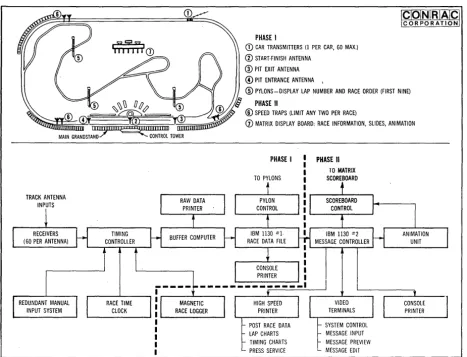
4. Real-time systems. This type of system employs a computer in real-time during an athletic event, to either monitor the competition itself and/or give in-forrp.ation concerning its progress. A good example here is the system curr~ntly being employed at the Ontario Motor Speedway, where an IBM" 1130 actually monitors each car on every lap and posts the current order on displays for the spectators.
5. Modeling. This type of system incorporates per-haps the most complicated mathematical and com-puter science aspects of the five, just as modeling in other fields can be and usually is quite complicated. The system which the author has been working on to
•
a
Ne\N BallgalT1e
model track rurining tn~ining is an example. A pro-gram which might try to optimize the sequence of plays to be used in a football game would be another. With the functional areas now deRned, the remain-der of the article is devoted to describing the actual systems which have been developed.
Football play analysis. One of the most widespread applications of computers to athletics has been in football play a.nalysis systems. Simply put, these sys-tems generate statistical summaries and analyses of the plays of a given football game. The output is examined by the coaches to Rnd tendencies of a
team.
Coaches maylook at summaries of another team's offense and/or defense, or they may look at the same kind of summaries of their own team. If a consistent ten-dency is found by a program, then presumably whoever exam-ines the· output will recognize that tendency; i.e., Team A's coaches may examine their own team from the previous week ( s ) , just as the next opponent (Team B) may also recognize those same tendencies upon examination of Team A's play data.
Football play analysis programs are cur-rently being used by many of the pro teams; College teams, to some extent, are also developing or have developed similar systems. Trying to ob-tain information about these systems requires tact and persistence. The teams that do have these programs usually don't like to admit it, and when they do, they guard descriptions about the program as if they made all the differ-ence between winning and losing.
June 1, 1971
by J. Gerry Purdy
Some of the universities that have developed or are developing play analysis programs are Kent State, Univ. of Pennsylvania, Univ. of Tennessee, Dart-mouth, usc, UCLA, Washington, and Stanford. Un-doubtedly, many other college teams have or are in
the process of developing play analysis programs. Most typical play analysis systems simply read in the play information which has been RIled out by the coach on a keypunch form. The program then sorts by
26
Sports and edp . . .
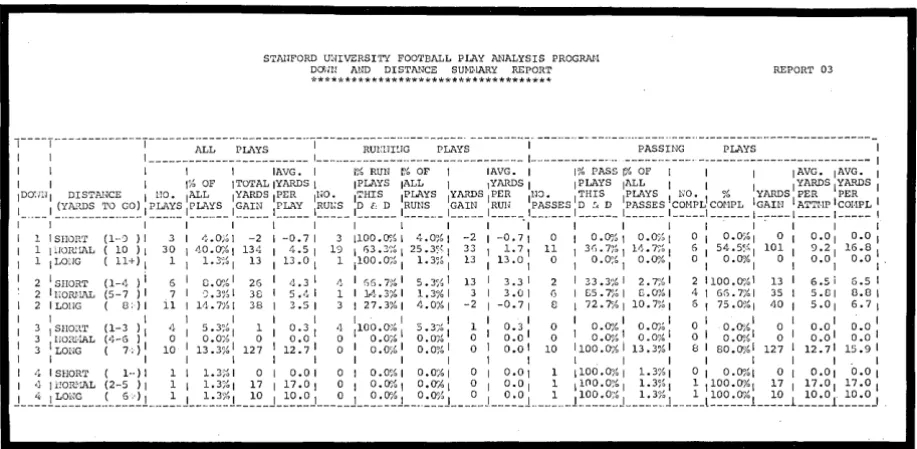
field position, formation, and down and distance. '. Various reports are then generated summarizing the running and passing play tendencies. (An example output of the Stanford system is given in Fig. 1.) One of the most important aspects of a football play analysis program is organization of the output infor-mation. Too many systems generate literally hundreds of pages of output, making the analysis a difficult task for the coach.
One of the first organizations that developed play analysis programs for profit was the recently dis-banded Computer Applications, Inc., in Maryland. William vVitzel did most of the programming for a system employed by the Washington Redskins in 1966. His contact with Washington was Coach Ed Hughes, now head coach for the Houston Oilers. Washington no longer uses Witzel's system, but the Oilers do. Witzel has been involved with other sys-tems that are currently being used by the Chicago Bears, Dallas Cowboys, San Francisco 4gers, and the Atlanta Falcons. A published cost estimate says the system by Witzel runs $7,200 initially and about $150 per week to actually run it at a local service bureau. An article by WTitzel:.! describes his system for play analysis and scouting of prospective college players for the pro draft (discussed below) .
More recently, two new systems have been devel-oped. The first of these is Sam Huff's Computerized Scouting System, developed and marketed by Jack Frease of Penn. Scout Corp. Frease uses an IBM Porta-Punch Card (also used in the IBM-developed
Voto-. even down to the high school levelVoto-. Their output looks similar to other typical play analysis programs, but is of a more general nature. The coach who desires to have specialized Olitput for his staff alone can't be helped here.
The other new approach has been made by Dr. Frank Ryan, great quarterback for the Cleveland Browns in the '60s and now with the Washington Redskins. Ryan's concept was to develop a general-ized report generating system, where the user com-poses commands to generate desired reports from the existing data base. His system, called PROBE, was jointly developed between Chi Corp. of Cleveland and Ryan Computer Services. The unusual feature of this system is that it is easily adapted' to applications other than football. In fact, their first paying customer was a brokerage firm in Cleveland, which composes commands to generate analyses of stocks.
The programming of Ryan's system involved 10 to 12 people during 1970, was coded in ALGOL 60, and is running on a Univac 1108. To use PROBE one defines a data base with a syntax called DENOTES.
Data is then keypunched and read into the data base according to the DENOTES definitions. Commands to
generate the desired reports .are then accepted. The commands key off terms such as COORDINATE (gen-erate an x-y plot), DISPLAY (histograms), LIST
(straight lists with sorted fields), and FIELD (boxed off areas with occurrences in respective areas) .
The application of the PROBE system to football
play analysis (called PRO-PROBE) is currently being
STAI1FORD UNIVERSITY FOOTBALL PLAY ANALYSIS PROGRAl-l
DOI/!! AIID DISTA..'lCE SUHHARY REPORT REPORT 03
** ** * *** * ** ** ***** * ** ************ ***
I----T-.--.--- .. ---T--- .. -~~~---~~~~---·-I--··----;~~;~~;~----~~~s -··---··1 ----.--.-.--.. --... -~~~~~;;-.-.--~~~~ ...
---1 1 _________________ .. ______ '- _____________ . _______________ ... __ 1 _____________ ·· _____ .... ___ . -. _________________________ _ 1 1 1 1 IAVG. 1 1% RUN F,s OF 1 IAVG. I 1% PASS J% OF I I I I AVG. IAVG. I I I 1% OF I TOTAL IYARDS I I PLAYS IALL I IYARDS I IPLAYS IALL I . I I I YARDS IYARDS
IDo~ml DISTAI,CE I llO. ALL IYARDS PER INO. THIS PLAYS YARDS PER NO. THIS PLAYS NO. % YARDS PER PER 1 _____________ . ____ .. ________ ... __ .. ____ 1 _____ 1 I (YARDS TO GO) I PLAYS : PLAYS IGAIN IpLAy RUllS ID [, D IRUlIS _____ 1 ______ 1 ____ .. _ 1 IGAIN IRut1 _____ 1 _____ 1 IpASSES ID _______ 1 ______ 1 [< D IpASSES ICOHPLICOI-lPL IGAIN IATTl.1P ICOI.1PL ______ 1 _____ 1 ______ 1 _____
1---I I I I I 1 I I I I -I I I I I ' I ' I I
I snORT (1---»1 3 I 4.0;61 -21-0.71 31100.0%1 t,.O%1 -2 I -0.71 a I 0.0%1 0.0%1 a I 0.0%1 a I 0.01 0.0 lilOR:lAL(10)1 3011\0.0%113414.51 19 I fi3.3%1 25.3;';1 33 1 1.7 1 11 131i.7~611-1.7'61 6154.5;:;110119.2116.8 I LOLJG (11+)1 1 I 1.3%1 13 113.01 1 1100.0;61 1.3%1 13 1 13 • 0 1 0 0.0%1 0 • 0%1 0 I 0.0%1 0 I 0.0
1 0.0 2 I snORT (1_4)i Ii I o.~sl 26 I 4.3 1 ~,166.7%1 5.3%1 13 I 3.31 33.3%1 2.7%1 21100.~sl 13 I 6.5; 6.5 2 INOR/1AL (5-7)1 7 I -).3%1 30 5.t.1 1 11-1.3%1 1.3%1 3 I 3.01 Ii 85.7%1 8.W61 4 165.7%1 35 I 5.81 8.8 I 21LOllG ( 8 ; ) 1 11 114.7%1 38 3.51 3 I 27.3%1 ~<.O%I -2 1-0.71 8 72.7%110.7%1 6 175.0%1 40 I 5.01 6.71
:SllOP,T (1-3): ,> 5.3~6: 1 0.3: '1 :100.Oi6:
5.3/6:
:
0.3: 00.0"10: 0.016:
a I 0.0%: a 0.0: 0.01l~g~J~iAL ~4-~:ll
191~:~~1 12~ 1~:~1
g Ig:g~1 g:g;~1
I g:gl 19110g:g~i 1~:~~1 ~: 8g:g~1 12~ 1~:~1 l~:g:
I I I I I I I I I I I I I I I I
I 4 I SHORT (1--)1 1 I 1.3%1 a I 0.01 a I 0.0%1 0.0%1 a I 0.01 1 1100.0%1 1.3%1 a I 0.0%1 0 I 0.01 0.01 I ,1 li!ORl'lAL (2-5)1 1 I 1.3%1 17 I l7.01 a I O.~GI 0.0%1 0 I 0.0 1 1 1100.0%1 1.3%1 1 1100.0"10 1 17 117.0117.°1
J __
~_l!::~~l~____
~___
~~~l.. ___
:_L_:.::~J__
:~_J_:~.:~L__
~_J__
~.:~:L_?.:~:J___
~_J __ ~.:~J___ .. : ____
l:~~.:~:~J__
::.~~6J_..
_=_l:~~.:~:l__
:~_l_=~.:~L=~.:~J Fig. 1. Stanford football play analysis program output.matic system for election voting). Frease's system accepts up to 40 columns of information in a fixed format. This simplicity allows him to offer the system to a wide range of potential customers for a small cost-$20 to $65 per game depending on the number of reports genera ted. Each coach has to transform his terminology into that of the input form (sometimes a real difficulty), but the cost factor makes it attractive
2. Witzel, William L., "Computer Programs in Professional Foot-ball," Modern Data, February 1968.
employed by the \Vashington Redskins. Vince Lom-bardi believed in the usefulness of computer analysis and managed to have Ryan traded to Washington to work on his play analysis system. Lombardi also served as a vice-president of Ryan Computer Ser-vices.
Another football play analysis system that has been accepted by a number of teams is the Computer Stat program of Apex Data Services and headed by Joe Guardino in Los Angeles. They handle the play
[image:28.615.63.522.399.624.2]