warwick.ac.uk/lib-publications
Original citation:
Hoad, Kathryn and Kunc, Martin. (2017) Teaching system dynamics and discrete event simulation together : a case study. Journal of the Operational Research Society.
Permanent WRAP URL:
http://wrap.warwick.ac.uk/87975
Copyright and reuse:
The Warwick Research Archive Portal (WRAP) makes this work by researchers of the University of Warwick available open access under the following conditions. Copyright © and all moral rights to the version of the paper presented here belong to the individual author(s) and/or other copyright owners. To the extent reasonable and practicable the material made available in WRAP has been checked for eligibility before being made available.
Copies of full items can be used for personal research or study, educational, or not-for-profit purposes without prior permission or charge. Provided that the authors, title and full
bibliographic details are credited, a hyperlink and/or URL is given for the original metadata page and the content is not changed in any way.
Publisher’s statement:
“This is a post-peer-review, pre-copyedit version of an article published in Journal of the Operational Research Society. The definitive publisher-authenticated version Hoad, Kathryn and Kunc, Martin. (2017) Teaching system dynamics and discrete event simulation together : a case study. Journal of the Operational Research Society is available online at
https://doi.org/10.1057/s41274-017-0234-3
Note on versions:
The version presented here may differ from the published version or, version of record, if you wish to cite this item you are advised to consult the publisher’s version. Please see the ‘permanent WRAP URL’ above for details on accessing the published version and note that access may require a subscription.
Teaching System Dynamics and Discrete Event Simulation together: A case
study
Kathryn Hoad
Assistant Professor of Operational Research and Management Science Operational Research and Management Science Group
Warwick Business School The University of Warwick
CV4 7AL, Coventry, UK Email: [email protected]
Martin Kunc1
Associate Professor of Operational Research and Management Science Operational Research and Management Science Group
Warwick Business School The University of Warwick
CV4 7AL, Coventry, UK Email: [email protected]
1 Corresponding author
Accepted for Publication in the
Abstract
System Dynamics (SD) and Discrete Event Simulation (DES) follow two quite different
modeling philosophies and can bring very different but, nevertheless, complimentary insights
in understanding the same ‘real world’ problem. Thus learning SD and DES approaches
require students to absorb different modeling philosophies usually through specific and
distinct courses. We run a course where we teach model conceptualization for SD and DES
in parallel and, then, the technical training on SD and DES software in sequential order. The
ability of students to assimilate, and then put into practice both modeling approaches, was
evaluated using simulation-based problems. While we found evidence that students can
master both simulation techniques, we observed that they were better able to develop skills at
representing the tangible characteristics of systems, the realm of DES, rather than
conceptualizing the intangible properties of systems such as feedback processes, the realm of
SD. Suggestions and reflections on teaching both simulation methods together are proposed.
1. Introduction
Among a variety of simulation modeling tools, system dynamics modeling (SD) and discrete
event simulation (DES) are the two most widely used tools to model and simulate business
problems (Jahangirian et al, 2010). Both simulation techniques are useful to model and
compare the performance of a system among various alternatives. However, they have
different views of the world. DES is suitable for problems in which variables change in
discrete time by discrete steps (Brailsford and Hilton, 2001) and can be conceptualized as a
system of queues and activities. It is usually used to solve operational/tactical problems over
a relatively short time scale considering the effect of random events (Brailsford and Hilton,
2001; Tako and Robinson, 2009). SD is a continuous, usually deterministic, modeling
technique aimed at understanding the broad performance of systems which are
conceptualized as systems of stock and flows affected by feedback processes (Sterman,
2000). SD is usually employed for strategic problems where there is a global and medium to
long term perspective (Kunc and Morecroft, 2007a). SD does not focus on specific attributes
of the individual entities in the system, as does DES, but on the causal structure, feedback
loops, responsible for the overall performance of the system (Morecroft, 2015).
Scholars, e.g. Tako and Robinson (2010) and Morecroft and Robinson (2014), suggest
the approach to modeling is very different among SD and DES modelers. However, their use
will continue to grow (Pidd, 2014) and in some cases employed together in hybrid SD-DES
models (Sadsad et al,2014). Despite the differences in the modeling methodologies, users’
experience indicates DES and SD can reflect a problem situation with equal validity
(Akkermans, 1995) and there are no significant differences in term of the models’ capability
of helping users to understand and communicate the problem (Tako and Robinson, 2009).
There is also very little significant difference of the user’s opinions of the different software
(1995) assertion that clients are usually indifferent to the simulation language being used.
Thus, both DES and SD can be useful to understand and solve problem situations from users’
perspectives.
Moreover, Morecroft and Robinson (2014) suggest that in some situations it may even
be wise to build both types of model, “since both give important and possibly differing
insights” in terms of deterministic complexity or constrained randomness, which are present
in the real world. Consequently, modelers should be able not only to apply both methods in
order to offer the most suitable solution for the problem situation but also know when to
complement them.
While mastering these two simulation methods requires the development of different
techniques and skills as well as an understanding of two different modeling philosophies
(Morecroft and Robinson, 2014; Rotaru et al, 2014), it may be useful for students to apply
them together in the same course to appreciate their usefulness and usability. Additionally, it
may not be possible to teach them in separate courses due to lack of resources. Consequently,
our research motivation is to understand the issues and benefits of teaching SD and DES
methods together. So the objective of our research is to contribute to future developments in
the area of simulation teaching based on the experience gained with this course.
We start by reviewing the existing literature on the comparison of the two simulation
methods and on the teaching of these two methods, to highlight the differences and
similarities in skills, techniques and modeling philosophy. Our research method is a case
study based on our experience in one course. We recognize this approach has some
limitations but, unfortunately, we were not able to teach this course again in this format due
to unforeseen issues related with resource availability. We briefly explain the course structure
before analyzing the performance of 80 students, who were taking our course during their
involved a similar amount of content regarding DES and SD, as well as a modeling
assessment using both simulation methods. As such, it allows us to investigate (empirically
using both quantitative and qualitative data) the ability of students to assimilate and then put
into practice these two different modeling approaches.
2. A comparison of SD and DES Modeling Processes
There are various opinions published in the literature regarding the differences and
similarities between DES and SD modeling methods, however, there appears to be a general
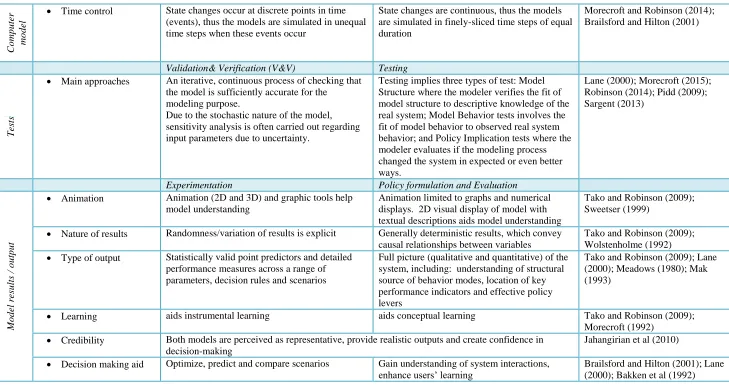
agreement as to the main differences between these two simulation methods. Table 1
contains a summary of different views comparing SD and DES methods.
DES modeling is usually used to solve operational/tactical problems over a relatively short
time scale (Brailsford and Hilton, 2001; Tako & Robinson, 2009). Whereas, SD is usually
employed for problems where there is a strategic, global and medium to long term
perspective (Sterman, 2000). In terms of length of the modeling processes, Meadows (1980)
and Tako and Robinson (2010) indicate that SD modelers devote much more time to
conceptualizing the system than DES modelers. The stochastic nature of DES requires an
understanding of probability, random sampling and uncertainty that the deterministic SD
model does not. However, SD requires an ability to conceptualize causal structures and
feedback loops, responsible for the overall performance of the system, that DES does not
require (Morecroft, 2015). Regarding the outputs from the modeling process, Meadows
(1980) points out that DES models provide a wide range of quantitative outputs in the form of
statistical distributions. On the other hand, SD models intend to provide patterns of behaviors
of a system in the simulation period (qualitative and quantitative).
6
Aspect of model/method DES Process SD Process Illustrative Bibliography
Real world (problem) Problem articulation (boundary selection)
Mo
d
el
sco
p
e Problems studied Operational, tactical, over relatively short time
scale
Strategic, over a relatively long (to medium) time scale
Tako and Robinson (2009); Sweetser (1999); Morecroft (1992)
Purpose of model To solve operational/tactical issues and aid operational decision making
To aid strategic thinking and policy decision making
Morecroft (2015); Kunc and Morecroft (2007a)
Conceptual modeling Dynamic hypothesis
Mo d el str u ctu re
Perspective Narrow focus, analytic, emphasis on detail complexity.
Wider focus, general and abstract systems, holistic, emphasis on dynamic complexity.
Tako and Robinson (2009); Baines et al.(1998)
Nature of model Models are (usually) stochastic Models are (usually) deterministic Morecroft and Robinson (2014)
Modeling variability Randomness is a vital element of system performance which dictates the system behavior
Randomness is not normally important to system performance. Structure leads to system behavior
Tako and Robinson (2009); Morecroft and Robinson (2014)
System representation System represented as a network of queues and activities
System represented as a series of stocks and flows
Brailsford and Hilton (2001)
Level of detail Distinct individual entities (that can be tracked through the system), each processing attributes (characteristics) that can determine what happens to that entity (i.e. decisions and activities).
Homogenized entities treated as a continuous quantity, continuous policy pressures and emergent behavior
Lane (2000)
Model elements Physical, tangible and some information Physical, tangible, judgmental and information links
Morecroft (2007)
Nature of relationships Many are linear Many are non-linear Morecroft and Robinson (2014)
Feedback effects Feedback is implicit. Models are open loop structures with less interest in feedback.
Feedback is explicit. Models are closed loop structures based on causal relationships and feedback effects.
Brailsford and Hilton (2001); Sweetser (1999); Coyle (1985)
Modeling of activity durations
Durations are sampled from probability
distributions for each entity, and the modeler has almost unlimited flexibility in the choice of these functions.
Dwelling (delay) times in stocks are usually modeled as exponential with limited flexibility to specify other functions
Morecroft and Robinson (2014); Sterman (2000)
7 C o mp u ter mo d el
Time control State changes occur at discrete points in time (events), thus the models are simulated in unequal time steps when these events occur
State changes are continuous, thus the models are simulated in finely-sliced time steps of equal duration
Morecroft and Robinson (2014); Brailsford and Hilton (2001)
Validation& Verification (V&V) Testing
Tes
ts
Main approaches An iterative, continuous process of checking that the model is sufficiently accurate for the
modeling purpose.
Due to the stochastic nature of the model, sensitivity analysis is often carried out regarding input parameters due to uncertainty.
Testing implies three types of test: Model Structure where the modeler verifies the fit of model structure to descriptive knowledge of the real system; Model Behavior tests involves the fit of model behavior to observed real system behavior; and Policy Implication tests where the modeler evaluates if the modeling process changed the system in expected or even better ways.
Lane (2000); Morecroft (2015); Robinson (2014); Pidd (2009); Sargent (2013)
Experimentation Policy formulation and Evaluation
Mo d el resu lts / o u tp u t
Animation Animation (2D and 3D) and graphic tools help model understanding
Animation limited to graphs and numerical displays. 2D visual display of model with textual descriptions aids model understanding
Tako and Robinson (2009); Sweetser (1999)
Nature of results Randomness/variation of results is explicit Generally deterministic results, which convey causal relationships between variables
Tako and Robinson (2009); Wolstenholme (1992)
Type of output Statistically valid point predictors and detailed performance measures across a range of parameters, decision rules and scenarios
Full picture (qualitative and quantitative) of the system, including: understanding of structural source of behavior modes, location of key performance indicators and effective policy levers
Tako and Robinson (2009); Lane (2000); Meadows (1980); Mak (1993)
Learning aids instrumental learning aids conceptual learning Tako and Robinson (2009); Morecroft (1992)
Credibility Both models are perceived as representative, provide realistic outputs and create confidence in decision-making
Jahangirian et al (2010)
Decision making aid Optimize, predict and compare scenarios Gain understanding of system interactions, enhance users’ learning
[image:8.842.68.797.69.455.2]Brailsford and Hilton (2001); Lane (2000); Bakken et al (1992)
8 3. Experiences in teaching SD and DES
In SD, there are two routes to teach: one is a stand-alone course, e.g. courses at MIT and
University at Albany - State University of New York, and the other is to embed SD into other
courses which provide a contextual aspect to SD, e.g. a master program for sustainable
resource management (Biber and Kasperidus, 2004) or a course on supporting strategic
planning which combines different methodologies: visioning, scenario planning, SD and
balanced scorecard (Kunc, 2012).
Courses in SD usually teach the use of SD in two modes: using models or developing
models (Kunc, 2012). Using models is based on the use of simulations and microworlds
where the execution of already built simulation models is central to the experience obtained
by the student. Two famous examples are People Express (Sterman, 1988) and the story of
the rise and fall of People Express (Senge, 1990), which combine a case and its microworld.
Rieber (2006) suggests the use of microworlds allows active construction of knowledge
through their experience but not clear explanations of the underlying drivers. Developing
models is an approach employed for conceptual development of SD since students have to
articulate the problem and question the elements and causal relationships related to the
problem (Kunc, 2012). The models are transparent boxes where the underlying simulation
model can be directly accessed (Kunc and Morecroft, 2007a). However, modeling implies
specific training and a large amount of time, even using user-friendly software and students
may not develop a conceptual understanding of the structure of the problem because they
rush to action (simulating the model) (Booth Sweeny and Sterman, 2000). Typically, SD
courses in management areas tend to use text books by Sterman (2000) for the technical
9 In terms of evaluating the acquisition of skills by students, research in SD focus on
the use of graphs for explaining behavior over time, identification of feedback loops using
causal loop diagrams or verbal descriptions, interpretation of the results observed in the base
case simulation in terms of feedback structure and validation with the reference mode
(historical performance of the key variables), discussion of the policies implemented and the
results obtained in terms of feedback structure, and adequate use of graphs (time series) to
depict the predominant feedback processes (Kunc, 2012, Booth Sweeny and Sterman, 2000)
In DES there seems to be increasing interest in education, for example da Silva et al
(2014), Kress et al (2010), Garcia and Centeno (2009), and Tag and Krahl (2007), which
describe approaches to improve discrete event education in diverse environments: industry,
academia and diverse levels: high school, undergraduate and graduate. Similar to SD, DES is
taught stand-alone or embedded in diverse subjects such as engineering, physics,
mathematics, business and healthcare (Kress et al, 2010). Differently than SD, DES has a
varied set of books on simulation modeling, e.g. Law (2007) and Robinson (2014), which
define the typical class topics: modeling process, software, model analysis, validation and
verification, and experimentation. In terms of class structure, students tend to learn DES by
developing small models based on single and multiple-servers and queues (da Silva et al,
2014), for example Born and Stalh (2004) explain how during the first two hours of a
simulation course they gradually build up a model of a simple one server system where
customers arrive at random and wait for service on a first come first served basis. To answer the question ‘What should students know by the end of a DES course?’ Charles Standridge
(Freimer et al. 2004) states simply that they should know how to do a simulation project. A
simulation project includes being able to identify the application areas of DES, understand
the simulation project process, know how to model system components (e.g. work stations,
10 Scheduling, Activity Scanning, Process-Based Simulation Approaches - Robinson (2014, pp
25-35), understand various verification and validation methods, be able to design, execute
and analyze simulation experiments, model input data appropriately and use an appropriate
commercial simulation software (Freimer et al., 2004; Stahl 2007; Standridge et al, 2005; Jain
2014). Stalh (2007) is another advocate of getting students using software and stresses that
students can only get an idea of the potential and limitations of simulation by doing some
actual simulation modeling.
In terms of evaluating the acquisition of skills by students, research in DES focus
predominantly on assessment of student’s built computer models (in commercial or other
software), as well as whether students are able to justify their assumptions and simplifications
(Friemer 2004), show an appreciation of the stochastic nature of the model (Born and Stahl
2004) and carry out basic analysis of simulation results (Standridge et al., 2005).
4. Research Method
Our case study was performed with a course teaching both SD and DES and evaluating the
understanding of the methods through observing the assessments of 80 students taking an
operations research-based master program in a UK-based university. The use of results from
course is a common research method in studying simulation methods (Kunc, 2012). We
analyze the marks and content of the final assessed reports from these students in order to
gain insight into how well they were able to assimilate and put into practice the newly taught
skills, techniques and modeling philosophies of these two modeling approaches.
4.1 Student cohort characteristics
The background and education level of the students involved are similar. All are over the age
11 quantitative skills but without professional experience. All students take the same core
modules in the first term: Business Statistics, Management Science and Operational
Research Techniques, Spreadsheet (Excel) Modeling, Foundations of Management and
Analytical Consulting. This Simulation module runs in term 2.
4.2 The simulation taught module
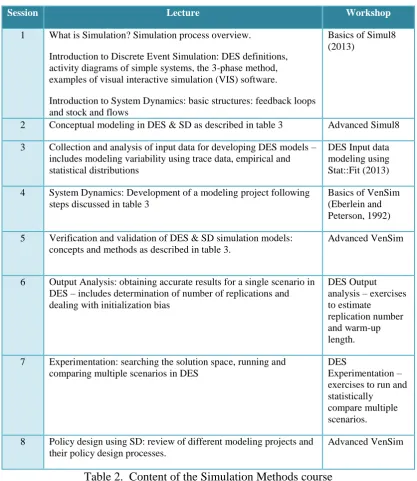
The students took a 32-hours (contact time) teaching module including 16-hours of computer
lab tutorials. The course runs over 8 weeks and the aims of the course are to:
appreciate the use of discrete event and system dynamics simulation in organizations;
be able to design a conceptual model of a system;
learn how to use simulation software and to code simple system models;
be able to source and use data in simulation models;
understand how to experiment and use simulation models to meet objectives.
The module was designed to put the same amount of emphasis on both simulation methods
taught. The content of the course was divided as evenly as possible between DES and SD
covering all the steps of the modeling process and offering the opportunity to define and code
models using Simul8 (DES software) and Vensim (SD software). DES was timetabled one
more lecture than SD because students need more absorption time to learn the statistical
analysis procedures in the experimental phases of DES, which are not employed in SD .
However, in practice, the lectures varied in length from week to week from 1.5 to 3 hours,
which resulted in an equal sharing of the actual time spent in lectures on the two methods.
The lab sessions were shared between DES and SD in the ratio 5:3, mainly due to the
perceived extra complexity of the stochastic components of the DES model, however,
students were also expected to work on the assigned SD and DES tasks in their own time. See
12
Session Lecture Workshop
1 What is Simulation? Simulation process overview.
Introduction to Discrete Event Simulation: DES definitions, activity diagrams of simple systems, the 3-phase method, examples of visual interactive simulation (VIS) software.
Introduction to System Dynamics: basic structures: feedback loops and stock and flows
Basics of Simul8 (2013)
2 Conceptual modeling in DES & SD as described in table 3 Advanced Simul8
3 Collection and analysis of input data for developing DES models – includes modeling variability using trace data, empirical and statistical distributions
DES Input data modeling using Stat::Fit (2013)
4 System Dynamics: Development of a modeling project following steps discussed in table 3
Basics of VenSim (Eberlein and Peterson, 1992)
5 Verification and validation of DES & SD simulation models: concepts and methods as described in table 3.
Advanced VenSim
6 Output Analysis: obtaining accurate results for a single scenario in DES – includes determination of number of replications and dealing with initialization bias
DES Output analysis – exercises to estimate
replication number and warm-up length.
7 Experimentation: searching the solution space, running and comparing multiple scenarios in DES
DES
Experimentation – exercises to run and statistically
compare multiple scenarios.
8 Policy design using SD: review of different modeling projects and their policy design processes.
[image:13.595.89.507.94.576.2]Advanced VenSim
Table 2. Content of the Simulation Methods course
The rationale for teaching both methods together can be observed in the following discussion.
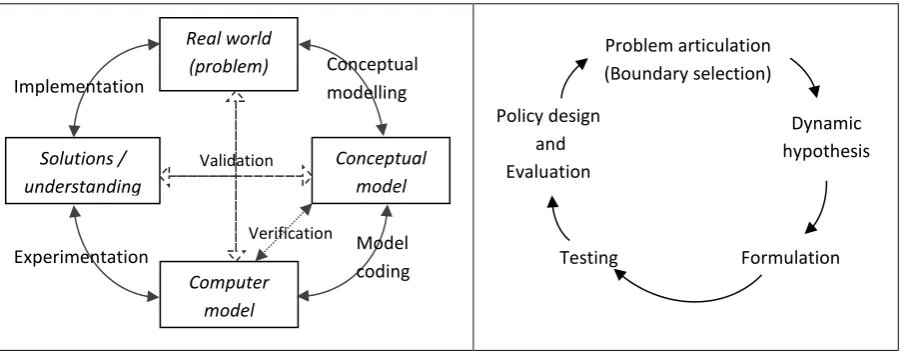
Although many differences do exist between SD and DES , the modeling processes for each
method (as suggested in Robinson (2014) and Sterman’s (2000) text book, and displayed in
Figure 1) have obvious similarities. At first, the real world problem or system has to be
13 data/information is collected and coding creates the computer model. Validation and
verification is performed to identify differences between the conceptual model and the model
coding as well as to be sure that the coded model represents adequately the real world.
Experimentation using the model generates potential solutions to the real world problem and
understanding about the system structure and behavior. Finally, the solutions may be
implemented in the real world system. Table 3 summarizes the modeling processes followed
by each method in more detail. It can be seen from both the diagrams (figure 1) and table
summary (table 3) that there are some obvious correspondences between the key stages of the
modeling process, though the terminology and detail of how the stages are carried out may
differ. Based on these considerations, we decided to run the course teaching both methods in
[image:14.595.69.524.374.551.2]parallel (in the conceptualization steps) and in series (in the technical dimension).
Figure 1. DES (left – Robinson, 2014 p65) and SD (right – Sterman, 2000 p87 ) modeling processes
Solutions / understanding
Computer model
Conceptual model Real world
(problem)
Implementation
Experimentation
Conceptual modelling
Model coding
Validation
Verification
Problem articulation (Boundary selection)
Dynamic hypothesis
Formulation Testing
14
DES SD
Conceptual Modeling: is the process to develop an understanding of the real world problem, determine the objectives of the model, design the conceptual model and collect and analyze the data required (Robinson, 2014). Therefore, a“…conceptual model is a non-software specific description of the computer simulation model (that will be, is or has been developed), describing the objectives, inputs, outputs, content, assumptions and simplifications of the model” (Robinson, 2014, pp. 77)
Problem articulation: involves defining the problem as perceived by the actors in the system and the purpose of the model. An important aspect of this process is to address a specific problem in a simple way without mirroring an entire system in detail. The usual components are reference modes (patterns of behavior of key variables) and time horizon (identify the distance in time of the causes and effects) (Sterman, 2000)
Formulating a Dynamic Hypothesis: implies the development of an explanation of the dynamics characterizing the problem in terms of feedback processes and the stock and flow structure of the system. The main objective is to focus the modeler and the client on specific structures: endogenous explanation of the phenomena and clear model boundaries using causal loop diagrams, stock and flow maps and policy structure diagrams (Sterman, 2000; Morecroft, 2015)
Model coding: consists of translating the conceptual model into a computer model
using specialized simulation software (Robinson, 2014)
Formulation: involves transforming the dynamic hypothesis into a formal model with equations, parameters and initial conditions using specialized software (Sterman, 2000)
Validation and Verification (V&V): are the processes to ensure that the model is valid for the objectives of the modeling project. Verification involves the evaluation of the computer model to be sure it is sufficiently accurate with respect to the
conceptual model. Validation consists of confirming that the model is sufficiently accurate for the purpose of the modeling project. (Robinson, 2014; Sargent, 2013)
Testing: implies the assurance that the model replicates the dynamic hypothesis and reference modes. There are multiple tests such as replicating historical behavior, verifying that each variable is related to real world concepts, checking model consistency and observing the response of the model to sensitive tests and extreme conditions (Sterman, 2000; Morecroft, 2015))
Experimentation: is performed to obtain an understanding and/or to find solutions
to the problem that originates the modeling project. It involves “what-if” analysis, learning from the results and making changes to the model variables (parameter values, decision rules, model structure, type/number of resources, etc...) until there are sufficient accurate and robust results (Robinson, 2014)
Policy design and evaluation: corresponds to the stage where the modeler and the client design and evaluate policies for improvement. The usual tasks include changing the value of
parameters and the development of new structures (feedback processes, stocks and flows, delays) and decision rules (ways of managing stocks and flows). Robustness and sensitivity tests are performed to validate the responses under alternative scenarios (Sterman, 2000). Since this stage is usually performed with the client, there is an implicit assumption that clients will implement the policies. On the other hand, Morecroft (2015) suggests that the model may be implemented only as a tool for learning.
Implementation: implies three potential outcomes: one is to implement the solution in the real world, second is to transform the model as a decision support tool, and the third outcome is to employ the model as a learning tool (Robinson, 2014)
15 4.3 Simulation module assessment
The course was assessed via one individual assignment divided into two parts. Part one
covered the DES modeling method and counted for 50% of the total mark. Part two covered
the SD method and provided the other 50% of the total mark.
For part one of the coursework the students had to develop a DES model based on a
fast-food restaurant. The students were given a layout of the restaurant (in the form of a
drawn floor plan), opening times, customer arrival rates (both for customers on foot and for
cars using the drive through facility), input data for number of customers in customer groups,
number of service points and tables etc. along with respective service times (probability
distributions), number/type of resources, and some basic financial information. They were
requested to use the model to investigate one or more aspects of the restaurant's operations,
for instance: the number of service points, the number of staff required and the design of staff
jobs and rosters, the number of tables required, the effects of changes in demand. The
students were asked to write a report that would contain descriptions/explanations of the
modeling process undertaken, from the conceptual modeling phase right through to
experimentation. Students were also specifically reminded to clearly state their
objective(s)/aim(s) as well as their conclusions and recommendations and to interpret their
simulation results in the business context. This assignment is in line with previous
assignments testing DES modeling skills in students (Robinson and Davies, 2010).
For part two of the coursework the students had to develop an SD model related to a
fast-food company. To highlight the differences in the modeling techniques, we encouraged
students to take the strategic perspective of the fast-food business rather than the operational
view of the DES case. They were requested to use the model to investigate one or more
16 on the number of clients? What is the impact of external factors on the profitability of the
company? and to simulate the future size of the company in 5 years’ time. In this case,
students needed to research for the data required to build the model from diverse sources
including the DES model. The students were asked to write a report that outlined: the
conceptual model in terms of problem articulation and dynamic hypothesis, the formulation, model testing and policy design (through ’what-if’ and decision rules experimentation and a
discussion of the recommendations). This assignment is in line with previous assignments
testing SD modeling skills in students (Kunc, 2012).
It should be noted that due to this imposed difference of perspective between the two
assignment parts (Part 1: operational problem, Part 2: strategic problem), this may lead to a
difference in structural complexity of each problem set. The DES model tackled an arguably
more structured operational problem, where the SD model tackled a less structured strategic
problem. This difference in structural level of the two parts of the assignment therefore
should also test the ability of the students to tackle problems with differing levels of structure
as part of the development of their modeling skills.
The assignments were marked by four separate markers. The marks were analyzed separately
for each part of the assessment to test whether there was any significant difference in
performance for each modeling method. All students attempted both parts of the assignment.
The marking was calibrated1 and found to have no significant inconsistency across the two
1
17 assessment parts; we are reasonably confident that any differences in performance between
the two parts of the assignment can be attributed to the differences in development of skills
related to the two simulation methodologies, including the ability to tackle problems with
different levels of structure.
In terms of qualitative evaluation of the assessments, the students’ reports were re-read and
the common errors or omissions were catalogued and described by each marker. These
common weaknesses in the modeling processes were then organized systematically into
categories that corresponded with the modeling process for each simulation method as
described in figure 1. This categorization was done to highlight the general strengths and
weaknesses exhibited by the students in different parts of the modeling process. By
categorizing these strengths and weaknesses by where they lay (in which stages) in the
overall modeling process we obtained further insights of the development of the students’
modeling skills for each simulation method. These insights were then further categorized
according to the mark bands that the analyzed reports fell into in order to investigate whether
students showed strength or weakness across all modeling process phases or whether some
other patterns might emerge.
5. Findings
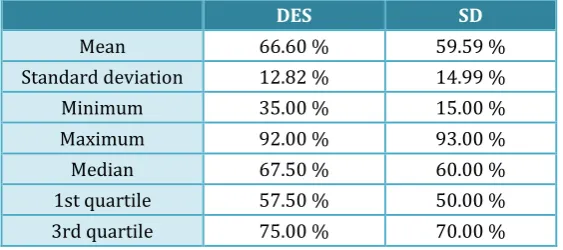
A summary of the marks awarded for both parts of the assessment can be seen in Table 4.
The data seems to be approximately normal using the Shapiro-Wilks normality test (p =
0.249). As a result, analysis of means for paired or matched data was deemed appropriate.
The paired samples t-test shows a significant difference in performance for the two parts of
the assessment (p < 0.001), with the marks for the DES part being significantly higher on
average. There is also a positive correlation for the paired samples (0.406, p < 0.001 –
18 tailed test). This implies that, in general, students who did well in the assignment for one
method did similarly well in the other method.
DES SD
Mean 66.60 % 59.59 %
Standard deviation 12.82 % 14.99 %
Minimum 35.00 % 15.00 %
Maximum 92.00 % 93.00 %
Median 67.50 % 60.00 %
1st quartile 57.50 % 50.00 %
[image:19.595.158.440.128.253.2]3rd quartile 75.00 % 70.00 %
Table 4. Summary of student marks for the course assignment
However, this masks some interesting patterns that can be more easily analyzed when the
marks are categorized into four categories (fail, average, merit and distinction) and the band
for each method compared for each student. Less than three students (4%) failed both the
DES and SD parts of the assessment. On the opposite side, 17 (21%) students obtained
distinction marks for both parts of the assessment. Approximately 40% gained marks that fell
in similar mid-range categories for both methods. The rest of students (35%) performed either
better in DES than SD (most of them) or better in SD than DES. Although, stronger students
generally appear to perform well in both methodologies and the weaker students poor in both,
there also appear to be some other trends/patterns amongst these report marks.
In terms of qualitative evaluation of the assessments, a brief list of the observations is
19 Stages in modelling DES/SD
Conceptual Modeling/ Problem articulation and formulating dynamic hypothesis: Students seemed to understand and articulate more structured, tangible elements of a system such as entities and activities in DES easier than abstract concepts such as feedback loops in SD. However, students still struggled with a lack of clear thinking within the DES modeling method. If they were not able to choose and clearly define one or more objectives they also often struggled to adequately define the conceptual model since these two processes are integrally linked.
Model coding/ Formulation: Almost all errors in DES model coding were due to misunderstanding or mishandling the quantitative input data information provided. Therefore these types of errors highlighted some inadequacies in reasonably basic statistics and data handling skills. Some of the same mathematical/logical inadequacies may have contributed to poor SD model coding with an obvious lack of understanding of the fundamental SD structures of stocks, flows and feedback loops.
The focus on model coding experienced by the DES lecturer in communications with students, may reflect the conceptualization of simulation as ‘software engineering’ (Robinson, 2002) where the focus is on accurate representation developed by a team of modelers compared with simulation as a ‘process of social change’ where the focus is on problem understanding, high-user involvement through a continuous conceptual modeling process. Simulation as a process of social change is usually the realm of SD models. Therefore, the technical solution may be a key focus for students in both modeling tools.
Validation and Verification (V&V)/ Testing: The DES work, despite the caliber of the rest of the modeling processes, was dominated by a lack of adequate Validation and Verification. This appears strange since a large number of students attempted to use DES techniques to validate the SD model. Some students applied sensitivity analysis to test the SD input parameter values as would be usual in DES, though they failed to apply it in the more appropriate setting of the DES modeling task. No student thought of using sensitivity analysis to check estimated inputs or assumptions in DES. Students appeared to consider Validation and Verification impossible or not relevant due to how the DES part of the assignment was structured. The evidence suggests a lack of understanding of what Validation and Verification is supposed to accomplish and how it is utilized in both SD and DES modeling.
Experimentation/Policy formulation: Weak students displayed a lack of clarity in both SD policy design and DES experimentation method. Within DES, the
successfulness of the experimentation phase was often correlated with how well defined the objectives had been. There was also a lack of appreciation of the importance of variability within DES with some students failing to run replications and many students failing to display estimates of variability (e.g. standard deviation, confidence intervals) with respect to mean results. Again, though, students did employ the DES approach to the SD policy formulation phase, running the model multiple times and displaying distributions as sensitivity analysis of a policy.
It is likely that some of the failings within the DES phase were due to a lack of statistical knowledge and understanding as the use of any formal statistical analysis was very mixed, as was any attempt at using experimental design or ‘optimization’ techniques. The failings within this phase of the SD modeling cycle, is perhaps more likely due to a fundamental lack of understanding of the aim of this type of modeling study.
Solutions and understanding/Policy evaluation: For both modeling methods, students often struggled to put the model results/insights in context and to sensibly discuss recommendations in the ‘real’ business setting. Some students seemed to simply not realize it was a necessary part of the modeling process. Within DES there was generally little correlation between the ability to articulate results within the business context and skill levels within the rest of the modeling processes. The relationship was stronger for SD modeling since an inability to conceptualize and formulate feedback processes would logically also impede the ability to discuss any insights generated by the model in terms of such feedback processes
20 6. Discussion
We divide this discussion into two main aspects: learning and development of students’ skills and
limitations to our study.
From the data, we can observe there is a clear trend that students are able to manage both
simulation techniques when exposed to them simultaneously within such a learning environment
(80% of students gained marks that fall simultaneously in similar categories for both techniques).
Thus, students can understand principles of operational (as employed in DES) and strategic (as
employed in SD) simulation. They have the ability to conceptualize entities and the activities
existing in a tangible system, such as a fast-food restaurant, while they can visualize feedback
processes not clear in terms of time and space in an intangible system, such as a fast-food business.
Therefore, we can infer teaching both methods simultaneously in the same course is possible.
On the other hand, there is another clear trend that students appear to be able to develop
DES modeling skills easier than SD modeling skills. This could be for a number of reasons. For
example it may be that DES can be portrayed in a more structured way than SD; it focuses more on
the representation of tangible characteristics of a (known) system which is simpler to understand for
students; or strategic perspectives require a profound knowledge of the business and industry that
only experienced modelers can have. Another reason is students may not recognize feedback loops
when they analyze their SD simulation models since linear thinking is pervasive for novice
modelers (Kunc, 2012; Morgan et al. 2011).
One particularly interesting finding is that no student attempted to use SD principles within
the DES modeling assignment but many fell back on DES principles/techniques to produce the SD
modeling assignment. This issue suggests that DES learning might have dominated SD learning
within the course structure. Since roughly equal time was afforded to both methodologies, and the
21 students found the modeling SD subject matter (feedback structures) less clear to absorb than the
DES method. Issues with lack of understanding of feedback processes have been widely
documented in SD literature (Sterman, 2000; Kunc, 2012). However, some of the behaviors
observed in DES modeling can be employed in SD, e.g. multiple experiments with a certain
variable or sensitivity analysis as indicated in policy design and evaluation step (see table 3). While
it is not usually employed in SD modeling, sensitivity analysis is accepted (Sterman, 2000, page
104) and performed when the policies to test with the SD model do not have a unique value, (e.g.
Kunc and Kazakov (2013) evaluated the impact on healthcare costs of different percentages of
co-payment for medicines during policy evaluation).
The SD community can extract some lessons from this case study. For example, DES
methods can provide detailed, operational views to high level SD models. Teaching SD in a
combined course implies more attention on identifying and analyzing the feedback loops existing in
the model both in model conceptualization but also in policy formulation and evaluation.
Likewise, the DES community can also learn some lessons from this case. Some students
appeared to struggle to clearly construct and express their modeling objective(s) and since this
failing can have serious consequences upon the caliber and success of the rest of the simulation
project it is advisable that this problem formulation skill is given more emphasis in teaching. There
was also an apparent lack of appreciation for the crucial role of validation and verification which
needs to be addressed since this could also have serious consequences for the validity of any
simulation project. The lack of adequate statistical understanding and skills in simulation students
is something that perhaps simulation modules cannot be expected to completely fill on their own.
This leads to an argument for compulsory statistical modules, within courses that also offer
simulation modules, which provide a more in-depth understanding of the basic statistical principles
and key statistical analysis skills. Regarding the matter of students not fully appreciating the value
22 business problem situation; this lecturer did find that in a subsequent undergraduate DES module,
where she really drummed home this important point both in large bold type in lecture slides and in
given examples, this part of the assignment (similar to that given in this case study) was done well
almost across the whole cohort. This implies that adequate emphasis and explanation of this point
can lead to the desired results.
6.2 Study Limitations
Like any study involving students (e.g. Robinson and Davies, 2010), there are a series of limitations
on our findings. This is the result of one cohort of students so it may be subject to issues of
selection. However, the skills of the students involved are similar to previous years. It would be
interesting to replicate this study over more years and in different institutions to more robustly infer
the impact of such a teaching format on the acquisition of simulation skills by students. An
additional aspect is the structure of the course and its delivery. In that sense, we don’t believe there
is any substantial impact since the content is similar to other DES courses (Robinson and Davies,
2010) or embedded SD course (Kunc, 2012). Variations in terms of time available for the course,
software employed, order of the methods taught could possibly generate more robust courses. We
should note that the qualitative results are based on the researchers’ interpretation of students’
writing of their modeling process. Thus, subjectivity is involved in the analysis of the results and
conclusions similar to other studies related to modeling processes (Tako and Robinson, 2010; Kunc
and Morecroft, 2007b). An aspect is the time employed to develop each model, for which we only
had anecdotal evidence rather than hard evidence. It is possible that students focused their time to
develop the DES model, as they perceived it involving more technical complexity, rather than
conceptualizing the SD model, reducing the time employed to this important stage in SD and
affecting their performance. Future research should consider variations in the type of assessment
23 Another possible aspect affecting the behavior of students in the assignment could have been the
design of the assessment especially in terms of the use of the model once it has been constructed.
Potentially, the use of a similar problem, as it has been done by Morecroft and Robinson (2014),
can generate different outcomes in terms of performance in the assessment and the evaluation of
teaching both methods simultaneously.
7. Conclusions
This case study is the first reported study on teaching two simulation methods concurrently. The
results of this study may help to extend the possibility of more interconnections between two large
simulation communities and the development of hybrid models (Sadsad et al, 2014) in the future. It
is clear that students can learn both simulation techniques and thus can assimilate differing
paradigms and the necessary differing skill sets. They are able to acquire the skills to conceptualize
entities and activities existing in a tangible system as well as the skills necessary to visualize the
less tangible feedback processes. However, students seem to be able to develop DES modeling
skills easier and with less teaching time than SD modeling skills. We also found a weakness in
their ability to appreciate the links in the simulation modeling cycle (as portrayed in figure 1) which
lead to skipping some stages in the modeling process. The extensive focus on the coding of the
model may influence the importance given to the other stages in the modeling process. Due to the
differences in the two modeling paradigms, this weakness may affect their ability to understand and
construct effective SD models more than for DES models. Less structured SD problems may be a
greater challenge in conceptual modeling than more structured DES problems. However, the
development of conceptual modeling skills is key to enriching the engagement of stakeholders
within the modeling process, which is often a deficiency in DES modeling and a core skill in the
24 Friedman et al. (2007) found different preferences for system thinking tools according to the
learning style of the students. Thus, faculty may consider variety in learning options (model
development and using models) which can increase variety in learning outcomes leading to more
effective learning processes including the difficult process of identifying feedback loops.
Implementing this idea will imply that students should have more opportunities to co-produce parts
of lessons by their selection of different ways of learning simulation, such as using microworlds or
ready-developed models (for students who prefer to try rather than analyze), developing models (for
students who prefer to internalize the structure of the model), simply understanding model
structures or developing them from verbal descriptions, since all these methods can support learning
in socio-economic systems (Maier and Größler, 2000). Thus, while it is important that quantitative
systems thinking skills are widespread, we have to consider that there will be different levels of
expertise across people. Thus, future research may consider the impact on learning of different
teaching methods to identify the best combination.
It is our conclusion therefore that more emphasis should be given on helping students develop a
deeper understanding of the links between the various stages of the modeling process. More time to
assimilate and practice the modeling methodologies, especially model conceptualization, can
enhance learning and understanding, as well as more practice in visualizing the conceptually
25 8. References
Akkermans, H. A. 1995. Modeling with Managers. Participative Business Modeling for Effective Strategic Decision-Making, PhD thesis, Technische Universiteit Eindhoven.
Biber P and Kasperidus HD. 2004. Integrated modeling approaches and system dynamics in education related to sustainable resource management, forestry and land use management. In Proceedings of the 22nd System Dynamics Conference, Oxford, UK
Booth Sweeney L and Sterman J. 2007. Thinking about systems: student and teacher conceptions of natural and social systems. System Dynamics Review 23(2–3): 285–312
Born R.G and Stahl I. 2004. WEBGPSS: The first two hours of simulation education, In
Proceedings of the Winter Simulation Conference, eds. R.G. Ingalls, M.D.Rossetti. J.S.Smith
and B.A. Peters.2066-2074, Vol.2, Piscataway, New Jersey: Institute of Electrical and Electronics Engineers, Inc.
Brailsford S.C. and Hilton N.A. 2001. A comparison of discrete event simulation and system dynamics for modelling healthcare systems, Proceedings from ORAHS 2000, Glasgow, Scotland, ed. J. Riley, 18-39.
Coyle, R. G. 1985. Representing Discrete Events in System Dynamics Models: A theoretical Application to Modeling Coal Production. Journal of the Operational Research Society 36(4): 307-318.
da Silva, T. M. P., de Assis Rangel, J. J., Shimoda, E., and do Nascimento, J. R. (2014). Discrete event simulation to build simulators for teaching. Journal of Simulation, 8(4), 325-334.
Eberlein, R.L. and Peterson, D.W. 1992. Understanding models with Vensim™, European Journal of Operational Research, 59: 216-219
Freimer M, Roeder, T.M, Harmonosky C.M, Schruben L.W, Standridge C.R and Stahl I. (2004). You are going to teach simulation – now what? Tips and strategies. Proceedings of the Winter Simulation Conference, eds. R.G. Ingalls, M.D.Rossetti. J.S.Smith and B.A. Peters.2057-2065, Vol.2,
Piscataway, New Jersey: Institute of Electrical and Electronics Engineers, Inc.
Friedman S, Cavaleri S, Raphael M. 2007. Individual learning style and systems tool preferences. In Proceedings of the 25th System Dynamics Conference, Boston, MA.
Garcia, H., and M.A. Centeno. 2009. S.U.C.C.E.S.S.F.U.L.: a framework for designing discrete event simulation courses. In Proceedings of the 2009 Winter Simulation Conference, eds. M. D. Rossetti, R. R. Hill, B. Johnson, A. Dunkin and R. G. Ingalls, 289-298. Piscataway, New Jersey: Institute of Electrical and Electronics Engineers, Inc.
26 Jahangirian, M., T. Eldabi, A. , L.K.Stergioulas and T.Young. 2010. Simulation in manufacturing
and business: A review. European Journal of Operational Research, 203: 1-13.
Jain S, (2014) Teaching of Simulation at Business Schools, In Proceedings of the Winter Simulation Conference, eds. A. Tolk, S.Y. Diallo, I.O Ryzhov, L.Yilmaz, S.Buckley and J.A.
Miller,.3684-3695, Piscataway, New Jersey: Institute of Electrical and Electronics Engineers, Inc.
Kress, R., Cemerlic, A., Kress, J., and Varghese, J. (2010, December). Discrete event simulation class for engineering graduate students. In Proceedings of the Winter Simulation Conference, eds. B. Johansson, S. Jain, J. Montoya-Torres, J. Hugan, and E. Yücesan,.344-352, Piscataway, New Jersey: Institute of Electrical and Electronics Engineers, Inc.
Kunc, M. 2012. Teaching strategic thinking using system dynamics: lessons from a strategic development course. System Dynamic Review, 28: 28–45.
Kunc, M., and Morecroft, J. 2007a. System dynamics modeling for strategic development. In O’Brien, F and Dyson, R Supporting Strategy: Frameworks, Methods and Models, John Wiley and Sons, Chichester, 157-89.
Kunc, M.H. and Morecroft, J.D.W., 2007b. Competitive dynamics and gaming simulation: lessons from a fishing industry simulator. Journal of the Operational Research Society, 58(9), pp.1146-1155.
Lane, D.C. 2000. You just don’t understand me: Models of failure and success in the discourse between system dynamics and discrete event simulation. Working Paper 00.34:26: London School of Economics and Political Sciences.
Law, A.M. 2007. Simulation Modeling and Analysis, 4th ed. McGraw-Hill.
Maier FH, Größler A. 2000. What are we talking about? A taxonomy of computer simulations to support learning. System Dynamics Review 16: 135–148.
Morecroft, J.D., 1992. Executive knowledge, models and learning. European Journal of Operational Research, 59(1):9-27
Morecroft, J. D. 2015. Strategic Modelling and Business Dynamics, A feedback systems approach 2nd edition. John Wiley and Sons Ltd, West Sussex, England.
Morecroft, J. D. W. and Robinson, S. 2014. Explaining Puzzling Dynamics: A comparison of System Dynamics and Discrete-Event Simulation, In, Brailsford, S.C., Churilov, L. and Dangerfield, B. (eds.) Discrete-Event Simulation and System Dynamics for Management Decision Making. United Kingdom, John Wiley & Sons, 165-198.
27 Pidd, M. 2004. Computer Simulation in Management Science, 5th ed. Wiley
Pidd, M. 2009. Tools for Thinking: Modeling in Management Science, 3rd Chichester, Wiley Pidd, M. 2014. The ways forward: A personal view of system dynamics and discrete-event
simulation. In Brailsford, S.C., Churilov, L. and Dangerfield, B. (eds.) Discrete-Event
Simulation and System Dynamics for Management Decision Making. United Kingdom, John Wiley & Sons, 318-336
Rieber L.P. 2006. Multimedia learning in games, simulations and microworlds. In Mayer R.E. (ed.) The Cambridge Handbook of Multimedia Learning, Cambridge University Press: Cambridge,
UK.; 549–568.
Robinson, S. 2002. General concepts of quality for discrete-event simulation. European Journal of Operational Research. 138, 103-107
Robinson, S. 2014. Simulation: the practice of model development and use, Palgrave, Macmillan. Robinson, S. and R. Davies. 2010. An investigation of the effect of educational background on
performance in simulation studies. Journal of the Operational Research Society, 61: 1685-1693. Rotaru, K, Churilov, L, and Flitman, A (2014) Philosophical positioning of discrete‐event
simulation and system dynamics as management science tools for process systems: A critical realist perspective In, Brailsford, S.C., Churilov, L. and Dangerfield, B. (eds.) Discrete-Event Simulation and System Dynamics for Management Decision Making. United Kingdom, John
Wiley & Sons, 165-198.
Sadsad, R., McDonnell, G., Viana, J., Desai, S.M., Harper, P. and Brailsford, S. 2014 Hybrid modelling case studies. In, Brailsford, S.C., Churilov, L. and Dangerfield, B. (eds.) Discrete-Event Simulation and System Dynamics for Management Decision Making, United Kingdom, John Wiley & Sons,.295-317.
Sargent, RG, 2013, Verification and validation of simulation models, Journal of Simulation. 7, 12-24
Senge PM. 1990. The Fifth Discipline: The Art and practice of the learning organization. Doubleday Currency: New York.
Simul8 Corporation 2013: http://www.simul8.com/
Standridge C.R., Johansson B, Centeno M A and Stahl I (2005) Introducing Simulation across the Disciplines, Proceedings of the Winter Simulation Conference, eds. M.E. Khul, N.M.Steiger. F. B. Armstrong and J.A. Joines.2274-2279, Piscataway, New Jersey: Institute of Electrical and Electronics Engineers, Inc.
28 Stahl I, (2007) Teaching Simulation to Business Students - Summary of 30 Years’ Experience,
Proceedings of the Winter Simulation Conference, eds. S.G.Henderson, B. Biller, M.-H. Hsieh,
J. Shortle, J.D. Tew and R.R. Barton. 2327-2335, Piscataway, New Jersey: Institute of Electrical and Electronics Engineers, Inc.
Sterman JD. 1988. People Express Management Flight Simulator. Microworlds: Cambridge, MA. Sterman, J. 2000. Business dynamics: systems thinking and modeling for a complex world,
Irwin/McGraw-Hill: Boston; London.
Sweetser, A. 1999. A Comparison of System Dynamics and Discrete Event Simulation, Proceedings of 17th International Conference of the System Dynamics Society and 5th Australian and New Zealand Systems Conference, Wellington, New Zealand.
Tag, P., and D. Krahl. 2007. Beyond the university: simulation education on the job. In Proceedings of the 2007 Winter Simulation Conference, ed . B. Biller, M.-H. Hsieh, J. Shortle, J. D. Tew, and
R. R. Barton, 2357-2361. Piscataway, New Jersey: Institute of Electrical and Electronics Engineers, Inc.
Tako, A.A. 2015. Exploring the model development process in discrete-event simulation: Insights from six expert modellers, Journal of the Operational Research Society 66: 747-760.
Tako, A.A. and S. Robinson. 2009. Comparing discrete-event simulation and system dynamics: Users‘ perceptions. Journal of the Operational Research Society 60: 296-312.
Tako, A.A. and Robinson, S. 2010. Model Development in Discrete-Event Simulation and System Dynamics: An Empirical Study of Expert Modelers. European Journal of Operational
Research, 207: 784-794.
Tako, A.A. and Robinson, S. 2012. The Application of Discrete-Event Simulation and System Dynamics in the Supply Chain Context. Decision Support Systems, 52 (4): 802-815. Wolstenholme, E.F., 1992. The definition and application of a stepwise approach to model