Proceedings of the 12th European Workshop on Natural Language Generation, pages 82–89,
An Alignment-capable Microplanner for Natural Language Generation
Hendrik Buschmeier,Kirsten BergmannandStefan Kopp Sociable Agents Group, CITEC, Bielefeld University
PO-Box 10 01 31, 33501 Bielefeld, Germany
{hbuschme, kbergman, skopp}@TechFak.Uni-Bielefeld.DE
Abstract
Alignment of interlocutors is a well known psycholinguistic phenomenon of great rel-evance for dialogue systems in general and natural language generation in particular. In this paper, we present the alignment-capable microplanner SPUD prime. Us-ing a primUs-ing-based model of interactive alignment, it is flexible enough to model the alignment behaviour of human speak-ers to a high degree. This will allow for further investigation of which parameters are important to model alignment and how the human–computer interaction changes when the computer aligns to its users.
1 Introduction
A well known phenomenon in dialogue situations is alignment of the interlocutors. An illustrative example is given by Levelt and Kelter (1982), who telephoned shops and either asked the question “What time does your shop close?” or the
ques-tion“At what time does your shop close?”. The answers were likely to mirror the form of the ques-tion. When asked “At what . . . ?”, answers tended to begin with the preposition ‘at’ (e.g., “At five o’clock.”). Conversely, when asked “What . . . ?”, answers tended to begin without the preposition (e.g., “Five o’clock.”). Similar alignment phenom-ena can be observed in many aspects of speech pro-ductioninter aliain syntactic and lexical choice.
Pickering and Garrod (2004) present the inter-active alignment modelbringing together all align-ment phenomena of speech processing in dialogue. According to this model, human language com-prehension and production are greatly facilitated by alignment of the interlocutors during conversa-tion. The process of alignment is explained through mutual priming of the interlocutors’ linguistic rep-resentations. Thus, it is automatic, efficient, and
non-conscious. A stronger claim of the authors is that alignment — in combination with routines and a dialogue lexicon — is a prerequisite for fluent speech production in humans.
Alignment effects also occur in human–com-puter interaction. Brennan (1991) and Branigan et al. (in press) present evidence that syntactic structures and lexical items used by a computer are subsequently adopted by users. For this reason, alignment is an important concept for natural lan-guage human–computer interaction in general, and for dialogue systems with natural language gener-ation in particular. Integrating ideas from the in-teractive alignment model into the microplanning component of natural language generation systems should be beneficial for several reasons. First, mi-croplanning may become more efficient since the subsets of rules or lexical items in the dialogue lexicon that have been used before can be prefer-entially searched. Second, due to self-alignment, the output of the system can become more con-sistent and therefore easier to understand for the user. Finally, mutual alignment of user and dia-logue system might make the conversation itself more natural and, presumably, cognitively more lightweight for the user.
In this paper we present a computational model for parts of the interactive alignment model that are particularly important in the context of natural language generation. We describe how this model has been incorporated into the existing SPUDlite
2 Related Work
Computational modelling is an important method-ology for evaluating and testing psycholinguistic theories. Thus, it is certainly not a new idea to implement the interactive alignment model compu-tationally. Indeed, a call for “explicit computational models” is made as early as in the open peer com-mentary on Pickering and Garrod’s (2004) paper.
Brockmann et al. (2005) and Isard et al. (2006) present a ‘massive over-generation’ approach to modelling alignment and individuality in natural language generation. Their system generates a huge number of alternative sentences — up to 3000 — and evaluates each of these sentences with a trigram model consisting of two parts: a default language model computed from a large corpus and a cache model which is calculated from the user’s last utterance. The default language model is learly interpolated with the cache model, whose in-fluence on the resulting combined language model is determined by a weighting factorλ∈[0,1]that controls the amount of alignment the system exhib-its.
Purver et al. (2006) take a more formal approach. They use an implementation of the Dynamic Syn-tax formalism, which uses the same representations and mechanisms for parsing as well as for genera-tion of natural language, and extend it with a model of context. In their model, context consists of two distinct representations: a record of the semantic trees generated and parsed so far and a record of the transformation actions used for the construction of these semantic trees.Re-useof semantic trees and actions is used to model many dialogue phe-nomena in Dynamic Syntax and can also explain alignment. Thus, the authors declare alignment to be a corollary of context re-use. In particular, re-use of actions is assumed to have a considerable influ-ence on alignment in natural language generation. Instead of looking through the complete lexicon each time a lexical item is chosen, this kind of lex-ical search is only necessary if no action — which constructed the same meaning in the given con-text before — exists in the record. If such an action exists, it can simply be re-used, which obviously leads to alignment.
A completely different approach to alignment in natural language generation is presented by de Jong et al. (2008), whose goal is to make a vir-tual museum guide more believable by aligning to the user’s level of politeness and formality. In
order to achieve this, the virtual guide analyses sev-eral features of the user’s utterance and generates a reply with the same level of politeness and formal-ity. According to the authors, lexical and syntactic alignment occur automatically because the lexical items and syntactic constructions to choose from are constrained by the linguistic style adopted.
Finally, Bateman (2006) advocates another pro-posal according to which alignment in dialogue is predictable for it is an inherently social activity. Following the social-semiotic view of language, Bateman suggests to model alignment as arising from register and microregister. More specifically, in his opinion priming of a linguistic representation is comparable with pre-selecting a microregister that must be considered when generating an utter-ance in a particular social context.
The approaches presented above primarily focus on the linguistic aspects of alignment in natural language generation. The work of Brockmann et al. (2005) and Isard et al. (2006) concentrates on the surface form of language, Bateman (2006) sees alignment arising from social-semiotic aspects, and Purver et al. (2006) are primarily interested in fit-ting alignment into a formal linguistic framework. In this paper we adopt a more psycholinguistic and cognitive stance on alignment. Pickering and Gar-rod (2004) propose that low-level priming is the basic mechanism underlying interactive alignment. Here, we propose that computational modelling of these priming mechanisms also opens up an inter-esting and new perspective for alignment in natural language generation.
3 A Priming-based Model of Alignment
We are interested here in those parts of the inter-active alignment model that are most relevant for microplanning in natural language generation and it is out of our scope to model all the facets and details of direct/repetition priming in the alignment of linguistic representations. For instance, exact timing effects are likely to be not even relevant as, in an actual system, it does not matter how many milliseconds faster the retrieval of a primed lexical item is in contrast to the retrieval of an item that is not primed. For this reason we adopt an ideal-ised view, in which priming of linguistic structures results from two basic activation mechanisms:
Temporary activation This kind of activation
Permanent activation This kind of activation should increase by a certain quantity and then maintain the new level.
These two mechanisms of priming are in ac-cordance with empirical findings. Branigan et al. (1999) present evidence for rapid decay of activa-tion of primed syntactic structures, whereas Bock and Griffin (2000) report evidence for their long(er) term activation. In any case, Reitter (2008) found both types of priming in his analysis of several corpora, with temporary activation being the more important one. The assumption that both mechan-isms play a role in dialogue is also supported by Brennan and Clark (1996) whose terminology will be followed in this paper: temporary priming will be called ‘recency of use effects’ and permanent priming will be called ‘frequency of use effects’.
Reitter (2008) assumes the repetition probability of primed syntactic structures to depend logarith-mically on the distance between priming and usage. Here, recency of use effects are modelled by a more generalexponential decayfunction, modified to meet the needs for modelling activation decay of primed structures:
ta(∆r) =exp
−∆r−1 α
, (1)
∆r∈N+;
α>0; ta∈[0,1]
ta(∆r)is the temporary activation value of a
lin-guistic structure depending on the distance ∆r
between the current timeT and the timerat which the structure was primed. The slope of the function is determined by the parameterα. Additionally, the function is shifted right in order to yield an activa-tion value of 1 for∆r=1. This shift is due to the
assumption of discrete time steps with a minimal distance of 1. A plot ofta(∆r)with different values
forα is given in Figure 1a.
Using exponential decay to model temporary ac-tivation appears to be a sensible choice that is often used to model natural processes. The advantage of this model of temporary activation lies in its flexib-ility. By changing the slope parameterα, different empirical findings as well as variation among hu-mans can be modelled easily.
Next, a mathematical model for frequency of use effects is needed. To prevent that frequency effects lead to an ever increasing activation value, a max-imum activation level exists. This is also found in Reitter’s (2008) corpus studies, which indicate that
0 0.2 0.4 0.6 0.8 1
1 3 5 7 9 11 13 15
Temporary Activation ta(
!
r
)
Recency Distance !r (a)
" = 1
2 4 8 16
0 0.2 0.4 0.6 0.8 1
1 3 5 7 9 11 13 15
Permanent Activation pa(
f
)
Frequency Counter f (b)
[image:3.595.313.520.67.394.2]! = 1 2 4 8 16
Figure 1: Plots of the mathematical functions that model recency and frequency effects. Plot (a) dis-plays temporary activation depending on the re-cency of priming. Plot (b) shows permanent activ-ation depending on the frequency count. Both are shown for different values of the slope parameter α respectivelyβ.
the frequency effect is inversely connected to the recency effect. Here, we model recency effects with a generalexponential saturationfunction, modified to meet the requirements for modelling permanent activation of linguistic structures:
pa(f) =1−exp
−f−1
β
, (2)
f∈N+;
β>0; pa∈[0,1]
The most important point to note here is that the permanent activation valuepa(f)is not a function of time but a function of the frequency-counter f
shifted right in order to get an activation value of 0 for f =1. A plot of equation (2) with different slope parameters is given in Figure 1b. Similar to the advantages of the model of temporary activa-tion, this model for frequency effects is very flex-ible so that different empirical findings and human individuality can be expressed easily.
Now, both priming models need to be combined for a model of alignment. We opted for a weighted linear combination of temporary and permanent activation:
ca(∆r,f) =ν·ta(∆r) + (1−ν)·pa(f), (3)
0≤ν≤1; ca∈[0,1]
Different values ofνallow different forms of align-ment. With a value of ν =0.5 recency and fre-quency effects are equally important, with a value ofν=1 alignment depends on recency only, and with a value ofν=0 alignment is governed solely by frequency. Being able to adjust the influence of the different sorts of priming on alignment is crucial as it has not yet been empirically determ-ined to what extent recency and frequency of use affect alignment (in Section 5.2 we will exploit this flexibility for matching empircial data).
In contrast to the models of alignment presented in Section 2, the computational alignment model presented here will not only consider alignment between the interlocutors (interpersonal- or other-alignment), but also alignment to oneself (intra-personal- orself-alignment). Pickering et al. (2003) present results from three experiments which sug-gest self-alignment to be even more important than other-alignment. In our model, self-alignment is accounted for with the same priming-based mech-anisms. To this end, four counters are attached to each linguistic structure:
• ∆rs: recency of use by the system itself
• ∆ro: recency of use by the interlocutor
• fs: frequency of use by the system itself
• fo: frequency of use by the interlocutor
The overall activation value of the structure is a linear combination of the combined activation valueca(∆rs,fs)and the combined activation value
ca(∆ro,fo)from equation (3):
act(∆rs,fs,∆ro,fo) =
λ·(µ·ca(∆rs,fs) + (1−µ)·ca(∆ro,fo)),
(4)
0≤λ,µ ≤1; act∈[0,1]
Again, by changing the factorµ, smooth interpola-tion between pure self-alignment (µ=1) and pure other-alignment (µ=0) is possible, which can ac-count for different empirical findings or human individual differences. Furthermore, the strength of alignment is modelled with a scaling factorλ, which determines whether alignment is considered during generation (λ >0) or not (λ =0).
4 The Alignment-capable Microplanner
SPUDprime
The previously described priming-based model of alignment has been implemented by extending the integrated microplanning system SPUD lite
(Stone, 2002). SPUDlite is a lightweight Prolog re-implementation of the SPUD microplanning sys-tem (Stone et al., 2003) based on the context-free tree rewriting grammar formalism TAGLET. Not only the microplanner itself, but also the linguistic structures (the initial TAGLET trees) are represen-ted as Prolog clauses.
SPUDlite carries out the different microplan-ning tasks (lexical choice, syntactic choice, refer-ring expression generation and aggregation) at once by treating microplanning as a search problem. Dur-ing generation it tries to find an utterance which is in accordance with the constraints set by its input (a grammar, a knowledge base and a query). This is done by searching the search space spanned by the linguistic grammar rules and the knowledge base until a goal state is found. Non-goal search states are preliminary utterances that are extended by one linguistic structure in each step until a syntactically complete utterance is found which conveys all the specified communicative goals. Since this search space is large even for relatively small grammars, a heuristic greedy search strategy is utilised.
Our alignment-capable microplanner SPUD
primeextends SPUDlitein several ways. First, we altered the predicate for the initial TAGLET trees by adding a unique identifier ID as well as counters for self/other-recency/frequency values (rs, fs,ro
and fo; see Section 3). The activation value of an
from the knowledge base. Secondly, it is retrac-ted from the knowledge base. Finally, the clause is (re-)asserted in the knowledge base with up-dated recency and frequency information. As a welcome side effect of this procedure, primed ini-tial trees are moved to the top of the knowledge base and — since Prolog evaluates clauses and facts in the order of their appearance in the knowledge base — they can be accessed earlier than unprimed initial trees or initial trees that were primed longer ago. Thus, in SPUDprimerecency of priming dir-ectly influences the access of linguistic structures.
Most importantly, the activation values of the ini-tial trees are considered during generation. Thus, in addition to the evaluation measures used by SPUD
lite’s heuristic state evaluation function, the mean activation value
act(S) = ∑
N
i=1actti(∆rsti,fsti,∆roti,foti) N
of theNinitial trees{t1, . . . ,tN}of a given search
stateSis taken into account as a further evaluation measure. Hence, when SPUDprimeevaluates (oth-erwise equal) successor search states, the one with the highest mean activation value is chosen as the next current state.
5 Evaluation
In order to find out whether our priming-based alignment model and its implementation work as intended, we evaluated SPUDprimeon a corpus that was collected in an experiment designed to investigate the alignment behaviour of humans in a controlled fashion (Weiß et al., 2008). The part of the corpus that we used consists of eight recor-ded and transcribed dialogues between two inter-locutors that play the ‘Jigsaw Map Game’, a task in which different objects have to be placed cor-rectly on a table. Speakers take turns in explaining each other where to place the next object in re-lation to the objects that are already on the table. Each speaker has to learn a set of name–object rela-tions before the game, such that both use the same names for all but three objects. Due to this precon-dition, both speakers use the same lexical referring expressions for most objects and the speaker’s lex-ical alignment behaviour for the differently named objects can be observed easily.
In our evaluation, we concentrate on the gener-ation of nouns by simulating the uses of the three differently learned nouns in the eight dialogues
from the perspective of all sixteen interlocutors. In each test, SPUD prime plays the role of one of the speakers talking to a simulated interlocutor who behaves exactly as in the real experiment. With this test setup we examined, first, how well SPUDprimecan model the alignment behaviour of a real speaker in a real dialogue context and, second, whether our model is flexible enough to consistently emulate different speakers with differ-ent alignmdiffer-ent behaviour.
In order to find the best model (i.e., the best parameter set{α,β,µ,ν}) for each speaker, we simulated all tests with all parameter combinations and counted the number of mismatches between our model’s choice and the real speaker’s choice. To make this exhaustive search possible, we limit the set of values for the parameters α and β to {1,2,4,6,8,10,14,18,24,30}and the set of values for the parameters µ and ν to {0,0.1,0.2, ...,1}, resulting in a total of 112×102=12100 different
parameter sets. Since we want to investigate align-ment,λ is constantly set to 1.
5.1 An Illustrative Example
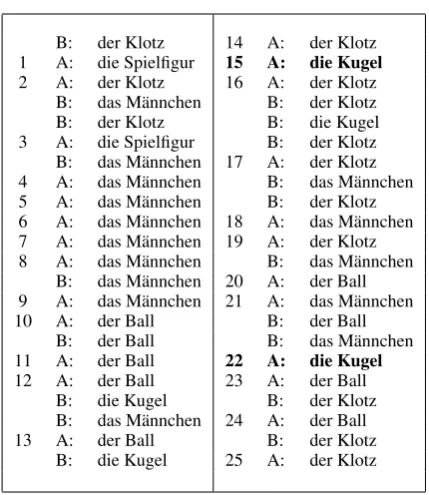
To illustrate our evaluation method, we first present and discuss the simulation of one particular dia-logue (from the Jigsaw Map Game corpus) from the perspective of participant (A). Before the exper-iment started, both interlocutors learned the name– object relations ‘Raute’ (rhombus), ‘Ring’ (ring), ‘Schraube’ (bolt) and ‘W¨urfel’ (cube), additionally participant (A) learned ‘Spielfigur’ (token), ‘Ball’ (sphere) and ‘Block’ (cuboid) and participant (B) learned ‘M¨annchen’ (token), ‘Kugel’ (sphere) and ‘Klotz’ (cuboid). In our simulation, we focus on the use of the differently learned names (the targets) and not on the other names (non-targets). Table 1 shows the sequence of target nouns as they oc-curred in the real dialogue (non-targets omitted).
For each parameter set{α,β,µ,ν}the dialogue is simulated in the following way:
• When participant (A) used a referring non-targetnoun in the dialogue, self-priming of the corresponding rule(s) in SPUDprime’s knowledge base is simulated (i.e., the recency and frequency counters are increased).
• When participant (A) used a referringtarget
B: der Klotz 14 A: der Klotz 1 A: die Spielfigur 15 A: die Kugel 2 A: der Klotz 16 A: der Klotz
B: das M¨annchen B: der Klotz B: der Klotz B: die Kugel 3 A: die Spielfigur B: der Klotz B: das M¨annchen 17 A: der Klotz 4 A: das M¨annchen B: das M¨annchen 5 A: das M¨annchen B: der Klotz 6 A: das M¨annchen 18 A: das M¨annchen 7 A: das M¨annchen 19 A: der Klotz 8 A: das M¨annchen B: das M¨annchen
B: das M¨annchen 20 A: der Ball 9 A: das M¨annchen 21 A: das M¨annchen
10 A: der Ball B: der Ball
B: der Ball B: das M¨annchen 11 A: der Ball 22 A: die Kugel 12 A: der Ball 23 A: der Ball
B: die Kugel B: der Klotz B: das M¨annchen 24 A: der Ball
13 A: der Ball B: der Klotz
[image:6.595.74.289.56.304.2]B: die Kugel 25 A: der Klotz
Table 1: Sequence of referring target nouns used by participants (A) and (B) in our example dialogue.
is the noun used in the actual dialogue (match) or not (mismatch).
• When participant (B) used a referring noun (target or non-target), priming of the corres-ponding rule(s) in SPUDprime’s knowledge base is simulated.
The evaluation measure for a specific parameter set is the number of mismatches it produces when simulating a dialogue. Thus the parameter set (or rather sets) which produce the least number of mis-matches are the ones that best model the particular speaker under consideration. For participant (A) of our example dialogue the distribution of para-meter sets pproducingmmismatches is shown in Table 2. Four parameter sets produce only two mis-matches (in phrase 15 and 22; cf. Table 1) and thus our priming-based alignment model can account for 92% of the target nouns produced by speaker (A). However, it must be noted that these two mis-matches occur at points in the dialogue where the alignment behaviour of (A) is not straightforward. At target noun 15, both interlocutors have already used the name ‘Ball’ and then both switch to ‘Ku-gel’. The mismatch at target 22 is a special case: (A) used ‘Kugel’ and immediately corrected himself to ‘Ball’, the name he learned prior to the experiment.
It seems as if the task instruction, to use the learned nouns, suddenly became prevalent.
m 0 1 2 3 4 5
#p 0 0 4 833 3777 2248
m 6 7 8 9 10 . . .
[image:6.595.318.517.61.113.2]#p 3204 1105 478 148 294 0 Table 2: Number of parameter setspleading tom
mismatches for participant (A) in dialogue 7.
5.2 Simulation Results
To evaluate our alignment-capable microplanner, we simulated the noun production for each of the interlocutors from the experiment. One dialogue has been excluded from the data analysis as the dialogue partners used nouns that none of them had learned in the priming phase. For each of the re-maining 14 interlocutors we varied the parameters α,β,µ andνas described above to identify those parameter set(s) which result in the least number of mismatches.
Each interlocutor produced between 18 and 32 target nouns (N=14, M=23.071, SD=3.936). Our simulation runs contain between 0 and 19 mis-matches overall (N=169400, M=6.35, SD=3.398). The minimal number of mismatches for each speaker simulation ranges between 0 and 6 (N=14, M=2.286, SD=1.684). That is, our model can sim-ulate a mean of 89.9% of all target nouns (N=14, M=.899, Min=.667, Max=1.000, SD=.082), which is an improvement of 24.6% on the baseline con-dition (alignment switched off), where 65.3% of the target nouns are generated correctly (N=14, M=.653, Min=.360, Max=1.000, SD=.071). As already illustrated in Section 5.1, mismatches typic-ally occur at points in the dialogue where the align-ment behaviour of the interlocutor is not straight-forward.
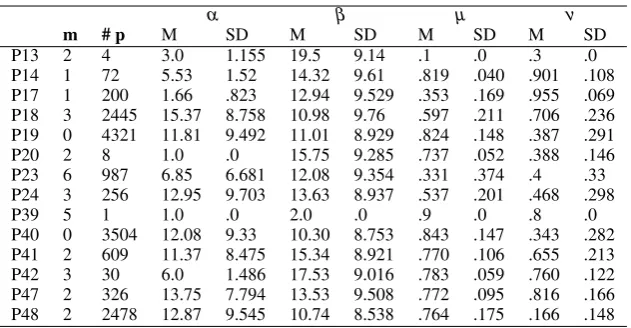
As displayed in Table 3 the parameter assign-ments resulting in least mismatches differ consid-erably from speaker to speaker. However, there are some remarkable trends to be observed in the data. As concerns the parameter µ, which determines the combination of self- and other-alignment, the majority of values are in the upper range of the interval [0,1]. For 8 of 14 speakers the mean is above 0.7 with relatively low standard deviations. Only for one speaker (P13) the meanµ is below 0.3. Thus, the parameter values indicate a consider-able tendency toward self-alignment in contrast to other-alignment.
res-α β µ ν
m # p M SD M SD M SD M SD
P13 2 4 3.0 1.155 19.5 9.14 .1 .0 .3 .0
P14 1 72 5.53 1.52 14.32 9.61 .819 .040 .901 .108 P17 1 200 1.66 .823 12.94 9.529 .353 .169 .955 .069 P18 3 2445 15.37 8.758 10.98 9.76 .597 .211 .706 .236 P19 0 4321 11.81 9.492 11.01 8.929 .824 .148 .387 .291 P20 2 8 1.0 .0 15.75 9.285 .737 .052 .388 .146 P23 6 987 6.85 6.681 12.08 9.354 .331 .374 .4 .33 P24 3 256 12.95 9.703 13.63 8.937 .537 .201 .468 .298
P39 5 1 1.0 .0 2.0 .0 .9 .0 .8 .0
[image:7.595.142.458.60.224.2]P40 0 3504 12.08 9.33 10.30 8.753 .843 .147 .343 .282 P41 2 609 11.37 8.475 15.34 8.921 .770 .106 .655 .213 P42 3 30 6.0 1.486 17.53 9.016 .783 .059 .760 .122 P47 2 326 13.75 7.794 13.53 9.508 .772 .095 .816 .166 P48 2 2478 12.87 9.545 10.74 8.538 .764 .175 .166 .148
Table 3: Mean parameter values for those simulation runs which result in a minimal number of mismatches for each speaker.
ults are less revealing. For two speaker simulations (P13 and P48) the meanνis 0.3 or lower, for an-other four speaker simulations the meanνis above 0.7. That is, our model produces good matching be-haviour in adopting different alignment strategies, depending either primarily on frequency or recency, respectively. All other simulations, however, are characterised by a meanν in the medium range along with a relatively high standard deviation.
6 Conclusion
In this paper, we introduced a priming-based model of alignment which focusses more on the psycho-linguistic aspects of interactive alignment and mod-els recency and frequency of use effects — as pro-posed by Reitter (2008) and Brennan and Clark (1996) — as well as the difference between intraper-sonal and interperintraper-sonal alignment (Pickering et al., 2003; Pickering and Garrod, 2004). The presented model is fully parameterisable and can account for different empirical findings and ‘personalities’. It has been implemented in the SPUDprime micro-planner which activates linguistic rules by changing its knowledge base on-line and considers the ac-tivation values of those rules used in constructing the current utterance by using their mean activation value as an additional feature in its state evaluation function.
We evaluated our alignment model and its im-plementation in SPUDprimeon a corpus of task-oriented dialogue collected in an experimental setup especially designed for alignment research. The results of this evaluation show that our priming-based model of alignment is flexible enough to sim-ulate the alignment behaviour of different human
speakers (generating target nouns) in the experi-mental setting. It should be noted, however, that our model tries to give a purely mechanistic ex-planation of lexical and syntactic choice and that it, therefore, cannot explain alignment phenomena that are due to social factors (e.g., politeness, rela-tionship, etc.), audience design or cases, in which a speaker consciously decides whether to align or not (e.g., whether to use a word or its synonym). While the evaluation has shown that our model can repro-duce human alignment behaviour to a high degree, it remains to be investigated which influence each parameter exerts and how exactly the parameters vary across individual speakers.
Nevertheless, the development of the alignment-capable microplanner is only one step in the dir-ection of an intuitive natural language human– computer interaction system. In order to reach this goal, the next step is to combine SPUDprimewith a natural language understanding system, which should ideally work with the same linguistic rep-resentations so that the linguistic structures used by the interlocutor could be primed automatically. This work is underway.
more resonant and more sociable (Kopp, 2008) if it aligned to users during conversation? The work presented here provides a starting point for the investigation of these questions.
Acknowledgements– This research is supported
by the Deutsche Forschungsgemeinschaft (DFG) in the Center of Excellence in ‘Cognitive Interaction Technology’ (CITEC) as well as in the Collabor-ative Research Center 673 ‘Alignment in Commu-nication’. We also thank Petra Weiß for making the ‘Jigsaw Map Game’ corpus available and three anonymous reviewers for their helpful comments.
References
John A. Bateman. 2006. A social-semiotic view of interactive alignment and its computational instanti-ation: A brief position statement and proposal. In Kerstin Fischer, editor, How People Talk to Com-puters, Robots and Other Artificial Communication Partners, SFB/TR 8 Report No. 010-09/2006, pages 157–170, Bremen, Germany.
J. Kathryn Bock and Zenzi M. Griffin. 2000. The per-sistence of structural priming: Transient activation or implicit learning? Journal of Experimental Psy-chology: General, 129(2):177–192.
Holly P. Branigan, Martin J. Pickering, and Alexan-dra A. Cleland. 1999. Syntactic priming in written production: Evidence for rapid decay. Psychonomic Bulletin & Review, 6(4):635–640.
Holly P. Branigan, Martin J. Pickering, Jamie Pearson, and Janet F. McLean. in press. Linguistic alignment between people and computers. Journal of Pragmat-ics.
Susan E. Brennan and Herbert H. Clark. 1996. Conceptual pacts and lexical choice in conversa-tion. Journal of Experimental Psychology: Learn-ing, Memory, and Cognition, 22(6):1482–1493.
Susan E. Brennan. 1991. Conversation with and through computers.User Modeling and User-Adapt-ed Interaction, 1(1):67–86.
Carsten Brockmann, Amy Isard, Jon Oberlander, and Michael White. 2005. Modelling alignment for af-fective dialogue. InProc. of the Workshop on Adapt-ing the Interaction Style to Affective Factors at the 10th Int. Conf. on User Modeling.
Markus A. de Jong, Mari¨et Theune, and Dennis Hofs. 2008. Politeness and alignment in dialogues with a virtual guide. In Proc. of the 7th Int. Conf. on Autonomous Agents and Multiagent Systems, pages 207–214.
Amy Isard, Carsten Brockmann, and Jon Oberlander. 2006. Individuality and alignment in generated dia-logues. In Proc. of the 4th Int. Natural Language Generation Conf., pages 25–32.
Stefan Kopp. 2008. From communicators to reson-ators – Making embodied conversational agents so-ciable. In Proc. of the Speech and Face to Face Communication Workshop in Memory of Christian Benoˆıt, pages 34–36.
Willem J. M. Levelt and Stephanie Kelter. 1982. Sur-face form and memory in question answering. Cog-nitive Psychology, 14(1):78–106.
Martin J. Pickering and Simon Garrod. 2004. Toward a mechanistic psychology of dialogue. Behavioral and Brain Sciences, 27(2):169–226.
Martin J. Pickering, Holly P. Branigan, and Janet F. McLean. 2003. Dialogue structure and the activ-ation of syntactic informactiv-ation. InProc. of the 9th Annual Conf. on Architectures and Mechanisms for Language Processing, page 126.
Matthew Purver, Ronnie Cann, and Ruth Kempson. 2006. Grammars as parsers: Meeting the dialogue challenge. Research on Language and Computation, 4(2–3):289–326.
David Reitter. 2008. Context Effects in Language Pro-duction: Models of Syntactic Priming in Dialogue Corpora. Ph.D. thesis, University of Edinburgh.
Matthew Stone, Christine Doran, Bonnie Webber, To-nia Bleam, and Martha Palmer. 2003. Microplan-ning with communicative intentions: The SPUD sys-tem. Computational Intelligence, 19(4):311–381.
Matthew Stone. 2002. Lexicalized grammar 101. In
Proc. of the ACL-02 Workshop on Effective Tools and Methodologies for Teaching Natural Language Processing and Computational Linguistics, pages 77–84.
Petra Weiß, Thies Pfeiffer, Gesche Schaffranietz, and Gert Rickheit. 2008. Coordination in dialog: Align-ment of object naming in the Jigsaw Map Game. In