Annotating Spoken Dialogs: from Speech Segments to Dialog Acts and
Frame Semantics
Marco Dinarelli, Silvia Quarteroni, Sara Tonelli, Alessandro Moschitti, Giuseppe Riccardi∗
University of Trento 38050 Povo - Trento, Italy
{dinarelli,silviaq,moschitti,riccardi}@disi.unitn.it, [email protected]
Abstract
We are interested in extracting semantic structures from spoken utterances gener-ated within conversational systems. Cur-rent Spoken Language Understanding sys-tems rely either on hand-written seman-tic grammars or on flat attribute-value se-quence labeling. While the former ap-proach is known to be limited in coverage and robustness, the latter lacks detailed re-lations amongst attribute-value pairs. In this paper, we describe and analyze the hu-man annotation process of rich sehu-mantic structures in order to train semantic statis-tical parsers. We have annotated spoken conversations from both a human-machine and a human-human spoken dialog cor-pus. Given a sentence of the transcribed corpora, domain concepts and other lin-guistic features are annotated, ranging from e.g. part-of-speech tagging and con-stituent chunking, to more advanced anno-tations, such as syntactic, dialog act and predicate argument structure. In particu-lar, the two latter annotation layers appear to be promising for the design of complex dialog systems. Statistics and mutual in-formation estimates amongst such features are reported and compared across corpora.
1 Introduction
Spoken language understanding (SLU) addresses the problem of extracting and annotating the meaning structure from spoken utterances in the context of human dialogs (De Mori et al., 2008). In spoken dialog systems (SDS) most used models of SLU are based on the identification of slots
(en-∗
This work was partially funded by the European Com-mission projects LUNA (contract 33549) and ADAMACH (contract 022593).
tities) within one or more frames (frame-slot se-mantics) that is defined by the application. While this model is simple and clearly insufficient to cope with interpretation and reasoning, it has sup-ported the first generation of spoken dialog sys-tems. Such dialog systems are thus limited by the ability to parse semantic features such as predi-cates and to perform logical computation in the context of a specific dialog act (Bechet et al., 2004). This limitation is reflected in the type of human-machine interactions which are mostly di-rected at querying the user for specific slots (e.g. “What is the departure city?”) or implementing simple dialog acts (e.g. confirmation). We believe that an important step in overcoming such limita-tion relies on the study of models of human-human dialogs at different levels of representation: lexi-cal, syntactic, semantic and discourse.
In this paper, we present our results in address-ing the above issues in the context of the LUNA research project for next-generation spoken dialog interfaces (De Mori et al., 2008). We propose models for different levels of annotation of the LUNA spoken dialog corpus, including attribute-value, predicate argument structures and dialog acts. We describe the tools and the adaptation of off-the-shelf resources to carry out annotation of the predicate argument structures (PAS) of spoken utterances. We present a quantitative analysis of such semantic structures for both human-machine and human-human conversations.
2 Annotation model
Our corpus is planned to contain 1000 equally partitioned Human (HH) and Human-Machine (HM) dialogs. These are recorded by the customer care and technical support center of an Italian company. While HH dialogs refer to real conversations of users engaged in a problem solving task in the domain of software/hardware troubleshooting, HM dialogs are acquired with a Wizard of Oz approach (WOZ). The human agent (wizard) reacts to user’s spontaneous spoken re-quests following one of ten possible dialog scenar-ios inspired by the services provided by the com-pany.
The above data is organized in transcrip-tions and annotatranscrip-tions of speech based on a new multi-level protocol studied specifically within the project, i.e. the annotation levels of words, turns1, attribute-value pairs, dialog acts, predicate argu-ment structures. The annotation at word level is made with part-of-speech and morphosyntac-tic information following the recommendations of EAGLES corpora annotation (Leech and Wilson, 2006). The attribute-value annotation uses a pre-defined domain ontology to specify concepts and their relations. Dialog acts are used to annotate in-tention in an utterance and can be useful to find relations between different utterances as the next section will show. For predicate structure annota-tion, we followed the FrameNet model (Baker et al., 1998) (see Section 2.2).
2.1 Dialog Act annotation
Dialog act annotation is the task of identifying the function or goal of a given utterance (Sinclair and Coulthard, 1975): thus, it provides a comple-mentary information to the identification of do-main concepts in the utterance, and a dodo-main- domain-independent dialog act scheme can be applied. For our corpus, we used a dialog act taxonomy which follows initiatives such as DAMSL (Core and Allen, 1997), TRAINS (Traum, 1996) and DIT++ (Bunt, 2005). Although the level of granu-larity and coverage varies across such taxonomies, a careful analysis leads to identifying three main groups of dialog acts:
1. Core acts, which represent the fundamen-tal actions performed in the dialog, e.g.
re-1A turn is defined as the interval when a speaker is active,
between two pauses in his/her speech flow.
questing and providing information, or exe-cuting a task. These include initiatives (often called forward-looking acts) and responses (backward-looking acts);
2. Conventional/Discourse management acts, which maintain dialog cohesion and delimit specific phases, such as opening, continua-tion, closing, and apologizing;
3. Feedback/Grounding acts,used to elicit and provide feedback in order to establish or re-store a common ground in the conversation.
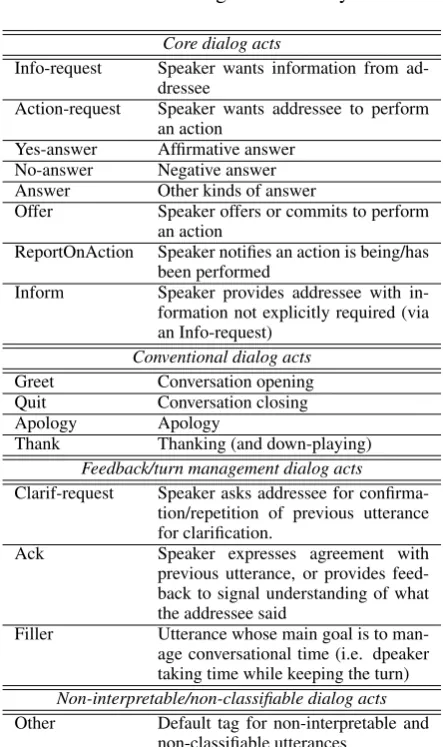
[image:2.595.306.528.290.664.2]Our taxonomy, following the same three-fold partition, is summarized in Table 1.
Table 1: Dialog act taxonomy
Core dialog acts
Info-request Speaker wants information from ad-dressee
Action-request Speaker wants addressee to perform an action
Yes-answer Affirmative answer No-answer Negative answer Answer Other kinds of answer
Offer Speaker offers or commits to perform an action
ReportOnAction Speaker notifies an action is being/has been performed
Inform Speaker provides addressee with in-formation not explicitly required (via an Info-request)
Conventional dialog acts
Greet Conversation opening
Quit Conversation closing
Apology Apology
Thank Thanking (and down-playing)
Feedback/turn management dialog acts
Clarif-request Speaker asks addressee for confirma-tion/repetition of previous utterance for clarification.
Ack Speaker expresses agreement with previous utterance, or provides feed-back to signal understanding of what the addressee said
Filler Utterance whose main goal is to man-age conversational time (i.e. dpeaker taking time while keeping the turn)
Non-interpretable/non-classifiable dialog acts
Other Default tag for non-interpretable and non-classifiable utterances
of utterances and at the same time would be able to generalize them. Its small number of classes is meant to allow a supervised classification method to achieve reasonable performance with limited data. The taxonomy is currently used by the sta-tistical Dialogue Manager in the ADAMACH EU project (Varges et al., 2008); the limited number of classes allows to reduce the number of hypoth-esized current dialogue acts, thus reducing the di-alogue state space.
Dialog act annotation was performed manually by a linguist on speech transcriptions previously segmented into turns as mentioned above. The an-notation unit for dialog acts, is the utterance; how-ever, utterances are complex semantic entities that do not necessarily correspond to turns. Hence, a segmentation of the dialog transcription into ut-terances was performed by the annotator before dialog act labeling. Both utterance segmentation and dialog act labeling were performed through the MMAX tool (M¨uller and Strube, 2003).
The annotator proceeded according to the fol-lowing guidelines:
1. by default, a turn is also an utterance;
2. if more than one tag is applicable to an ut-terance, choose the tag corresponding to its main function;
3. in case of doubt among several tags, give pri-ority to tags incoredialog acts group;
4. when needed, split the turn into several ances or merge several turns into one utter-ance.
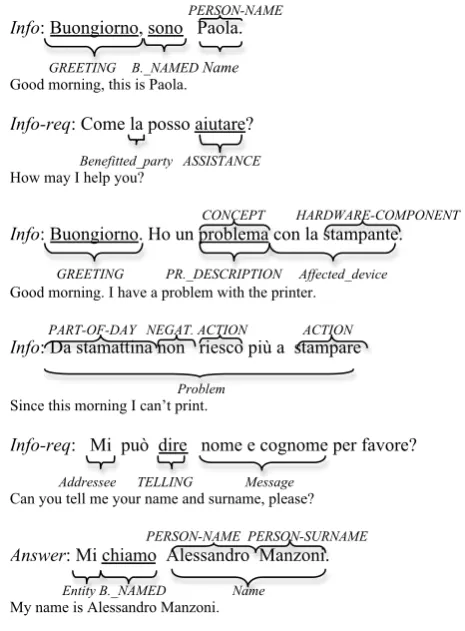
Utterance segmentation provides the basis not only for dialog act labeling but also for the other semantic annotations. See Fig. 1 for a dialog sam-ple where each line represents an utterance anno-tated according to the three levels.
2.2 Predicate Argument annotation
We carried out predicate argument structure an-notation applying the FrameNet paradigm as de-scribed in (Baker et al., 1998). This model comprises a set of prototypical situations called frames, the frame-evoking words or expressions calledlexical unitsand the roles or participants in-volved in these situations, calledframe elements. The latter are typically the syntactic dependents of the lexical units. All lexical units belonging to the same frame have similar semantics and show
PERSON-NAME
Info: Buongiorno, sono Paola.
GREETING B._NAMED Name Good morning, this is Paola.
Info-req: Come la posso aiutare?
Benefitted_party ASSISTANCE How may I help you?
CONCEPT HARDWARE-COMPONENT
Info: Buongiorno. Ho un problema con la stampante.
GREETING PR._DESCRIPTION Affected_device Good morning. I have a problem with the printer.
PART-OF-DAY NEGAT. ACTION ACTION
Info: Da stamattina non riesco più a stampare
Problem Since this morning I can’t print.
Info-req: Mi può dire nome e cognome per favore?
Addressee TELLING Message Can you tell me your name and surname, please?
PERSON-NAME PERSON-SURNAME
Answer: Mi chiamo Alessandro Manzoni.
[image:3.595.302.535.62.378.2]Entity B._NAMED Name My name is Alessandro Manzoni.
Figure 1: Annotated dialog extract. Each utterance is preceded by dialog act annotation. Attribute-value annotation appears above the text, PAS an-notation below the text.
the same valence. A particular feature of the FrameNet project both for English and for other languages is its corpus-based nature, i.e. every el-ement described in the resource has to be instanti-ated in a corpus. To annotate our SDS corpus, we adopted where possible the already existing frame and frame element descriptions defined for the En-glish FrameNet project, and introduced new def-initions only in case of missing elements in the original model.
Figure 1 shows a dialog sample with PAS an-notation reported below the utterance. All lexi-cal units are underlined and the frame is written in capitals, while the other labels refer to frame el-ements. In particular,ASSISTANCE is evoked by the lexical unitaiutareand has one attested frame element (Benefitted party), GREETING has no frame element, and PROBLEM DESCRIPTION andTELLINGhave two frame elements each.
Figure 2: The annotation process
Audio file
Turn segmentation & Transcription
Utterance segmentation
POS tagging Domain attribute
annotation
PAS annotation
Dialog Act annotation Syntactic parsing
attribute-value and DA annotation are carried out on the segmented dialogs at utterance level, PAS annotation requires POS-tagging and syntac-tic parsing (via Bikel’s parser trained for Italian (Corazza et al., 2007)). Finally, a shallow manual correction is carried out to make sure that the tree nodes that may carry semantic information have correct constituent boundaries. For the annotation of frame information, we used theSaltotool (Bur-chardt et al., 2006), that stores the dialog file in TIGER-XML format and allows to easily intro-duce word tags and frame flags. Frame informa-tion is recorded on top of parse trees, with target information pointing to terminal words and frame elements pointing to tree nodes.
3 Quantitative comparison of the
Annotation
We evaluated the outcome of dialog act and PAS annotation levels on both the human-human (henceforth HH) and human-machine (HM) cor-pora by not only analyzing frequencies and occur-rences in the separate levels, but also their interac-tion, as discussed in the following sections.
3.1 Dialog Act annotation
Analyzing the annotation of 50 HM and 50 HH dialogs at the dialog act level, we note that an HH dialog is composed in average by 48.9±17.4 (standard deviation) dialog acts, whereas a HM dialog is composed of 18.9±4.4. The difference between average lengths shows how HH sponta-neous speech can be redundant, while HM dialogs are more limited to an exchange of essential infor-mation. The standard deviation of a conversation
in terms of dialog acts is considerably higher in the HH corpus than in the HM one. This can be ex-plained by the fact that the WOZ follows a unique, previously defined task-solving strategy that does not allow for digressions. Utterance segmentation was also performed differently on the two corpora. In HH we performed 167 turn mergings and 225 turn splittings; in HM dialogs, only turn splittings (158) but no turn mergings were performed.
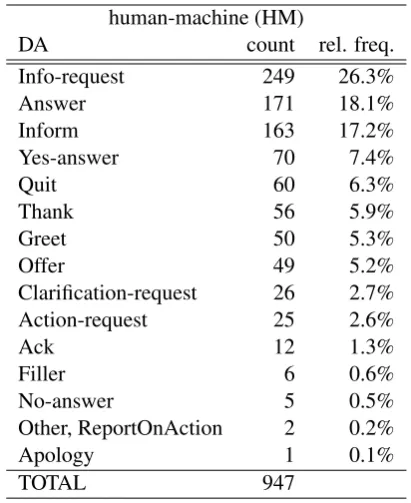
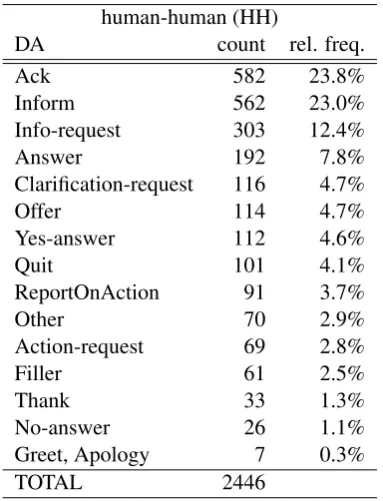
[image:4.595.313.519.274.526.2]Tables 2 and 3 report the dialog acts occurring in the HM and HH corpora, respectively, ranked by their frequencies.
Table 2: Dialog acts ranked by frequency in the human-machine (HM) corpus
human-machine (HM)
DA count rel. freq.
Info-request 249 26.3%
Answer 171 18.1%
Inform 163 17.2%
Yes-answer 70 7.4%
Quit 60 6.3%
Thank 56 5.9%
Greet 50 5.3%
Offer 49 5.2%
Clarification-request 26 2.7%
Action-request 25 2.6%
Ack 12 1.3%
Filler 6 0.6%
No-answer 5 0.5%
Other, ReportOnAction 2 0.2%
Apology 1 0.1%
TOTAL 947
From a comparative analysis, we note that:
1. info-request is by far the most common dia-log act in HM, whereas in HH ack andinfo share the top ranking position;
2. the most frequently occurring dialog act in HH, i.e.ack, is only ranked 11th in HM;
3. the relative frequency ofclarification-request (4,7%) is considerably higher in HH than in HM.
Table 3: Dialog acts ranked by frequency in the human-human (HH) corpus
human-human (HH)
DA count rel. freq.
Ack 582 23.8%
Inform 562 23.0%
Info-request 303 12.4%
Answer 192 7.8%
Clarification-request 116 4.7%
Offer 114 4.7%
Yes-answer 112 4.6%
Quit 101 4.1%
ReportOnAction 91 3.7%
Other 70 2.9%
Action-request 69 2.8%
Filler 61 2.5%
Thank 33 1.3%
No-answer 26 1.1%
Greet, Apology 7 0.3%
TOTAL 2446
as expected in a troubleshooting system. How-ever, the bigram info-request answer, which we expected to form the core of a task-solving dia-log, is only ranked 5th in the HH corpus, while 5 out of the top 10 bigram types contain ack. We believe that this is because HH dialogs primarily contain spontaneous information-providing turns (e.g. several info info by the same speaker) and acknowledgements for the purpose of backchan-nel. Instead, HM dialogs, structured as sequences of info-request answers pairs, are more minimal and brittle, showing how users tend to avoid re-dundancy when addressing a machine.
Table 4: The 10 most frequent dialog act bigrams
human-machine (HM) human-human (HH)
info-req answer ack info
answer info-req info ack
info info-req info info
info-req y-answer ack ack
sentence beginninggreet info-req answer
greet info info info-req
info quit info-req y-answer
offer info ack info-req
thank info answer ack
y-answer thank quitsentence end
3.2 Predicate Argument annotation
We annotated 50 HM and 50 HH dialogs with frame information. Differently from the English FrameNet database, we didn’t annotate one frame per sentence. On the contrary, we identified all lexical units corresponding to “semantically rele-vant” verbs, nouns and adjectives with a syntac-tic subcategorization pattern, eventually skipping the utterances with empty semantics (e.g. dis-fluencies). In particular, we annotated all lexical units that imply an action, introduce the speaker’s opinion or describe the office environment. We introduced 20 new frames out of the 174 iden-tified in the corpus because the original defini-tion of frames related to hardware/software, data-handling and customer assistance was sometimes too coarse-grained. Few new frame elements were introduced as well, mostly expressing syntactic re-alizations that are typical of spoken Italian.
Table 5 shows some statistics about the cor-pus dimension and the results of our annotation. The human-human dialogs contain less frame in-stances in average than the human-machine group, meaning that speech disfluencies, not present in turns uttered by the WOZ, negatively affect the se-mantic density of a turn. For the same reason, the percentage of turns in HH dialogs that were manu-ally corrected in the pre-processing step (see Sec-tion 2.2) is lower than for HM turns, since HH di-alogs have more turns that are semantically empty and that were skipped in the correction phase. Be-sides, HH dialogs show a higher frame variabil-ity than HM, which can be explained by the fact that spontaneous conversation may concern mi-nor topics, whereas HM dialogs follow a previ-ously defined structure, designed to solve soft-ware/hardware problems.
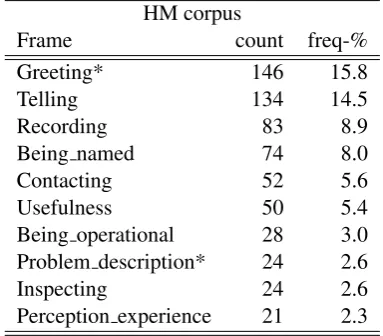
Tables 6 and 7 report the 10 most frequent frames occurring in the human-machine resp. human-human dialogs. The relative frame fre-quency in HH dialogs is more sparse than in HM dialogs, meaning that the task-solving strategy fol-lowed by the WOZ limits the number of digres-sions, whereas the semantics of HH dialogs is richer and more variable.
rel-Table 5: Dialog turn and frame statistics for the human-machine (HM) resp. human-human (HH) corpus
HM HH
Total number of turns 662 1,997
Mean dialog length (turns) 13.2 39.9 Mean turn length (tokens) 11.4 10.8
Corrected turns (%) 50 39
Total number of annotations 923 1951 Mean number of frame
annota-tions per dialog
18.5 39.0
Mean number of frame elements per frame annotation
1.6 1.7
evant to model the general semantics of the di-alogs we are approaching. The most frequent frame group comprises frames relating to infor-mation exchange that is typical of the help-desk activity, including Telling, Greeting, Contacting, Statement, Recording, Communication. Another relevant group encompasses frames related to the operational state of a device, for example Be-ing operational,Change operational state, Oper-ational testing,Being in operation.
The two groups also show high variability of lexical units. Telling, Change operational state and Greeting have the richest lexical unit set, with 11 verbs/nouns/adjectives each. Arriving andAwarenessare expressed by 10 different lexi-cal units, whileStatement,Being operational, Re-movingandUndergo change of operational state have 9 different lexical units each. The informal nature of the spoken dialogs influences the com-position of the lexical unit sets. In fact, they are rich in verbs and multiwords used only in collo-quial contexts, for which there are generally few attestations in the English FrameNet database.
[image:6.595.320.512.102.270.2]Similarly to the dialog act statistics, we also analyzed the most frequent frame bigrams and trigrams in HM and HH dialogs. Results are reported in Tables 8 and 9. Both HH bigrams and trigrams show a more sparse distribution and lower relative frequency than HM ones, implying that HH dialogs follow a more flexible structure with a richer set of topics, thus the sequence of themes is less predictable. In particular, 79% of HH bigrams and 97% of HH trigrams occur only once (vs. 68% HM bigrams and 82% HM trigrams). On the contrary, HM dialogs deal with
Table 6: The 10 most frequent frames in the HM corpus (* =newly introduced)
HM corpus
Frame count freq-%
Greeting* 146 15.8
Telling 134 14.5
Recording 83 8.9
Being named 74 8.0
Contacting 52 5.6
Usefulness 50 5.4
Being operational 28 3.0
Problem description* 24 2.6
Inspecting 24 2.6
Perception experience 21 2.3
Table 7: The 10 most frequent frames in the HH corpus (* =newly introduced)
HH corpus
Frame count freq-%
Telling 143 7.3
Greeting* 124 6.3
Awareness 74 3.8
Contacting 63 3.2
Giving 62 3.2
Navigation* 61 3.1
Change operational state 51 2.6
Perception experience 46 2.3
Insert data* 46 2.3
Come to sight* 38 1.9
a fix sequence of topics driven by the turns uttered by the WOZ. For instance, the most frequent HM bigram and trigram both correspond to the opening utterance of the WOZ:
Help desk buongiornoGREETING, sonoBEING NAMED Paola, in cosa posso esserti utileUSEFULNESS?
(Good morning, help-desk service, Paola speaking, how can I help you?)
3.3 Mutual information between PAS and dialog acts
[image:6.595.313.518.326.494.2]Table 8: The 5 most frequent frame bigrams
human-machine (HM) freq-%
Greeting Being named 17.1
Being named Usefulness 15.3
Telling Recording 12.9
Recording Contacting 10.9
Contacting Greeting 10.6
human-human (HH) freq-%
Greeting Greeting 4.7
Navigation Navigation 1.2
Telling Telling 1.0
[image:7.595.77.287.87.258.2]Change op. state Change op. state 0.9 Telling Problem description 0.8
Table 9: The 5 most frequent frame trigrams
human-machine (HM) freq-%
Greeting Being named Usefulness 9.5 Recording Contacting Greeting 5.7 Being named Usefulness Greeting 3.7 Telling Recording Contacting 3.5 Telling Recording Recording 2.2
human-human (HH) freq-%
Greeting Greeting Greeting 1.6 Greeting Being named Greeting 0.5 Contacting Greeting Greeting 0.3 Navigation Navigation Navigation 0.2 Working on Greeting Greeting 0.2
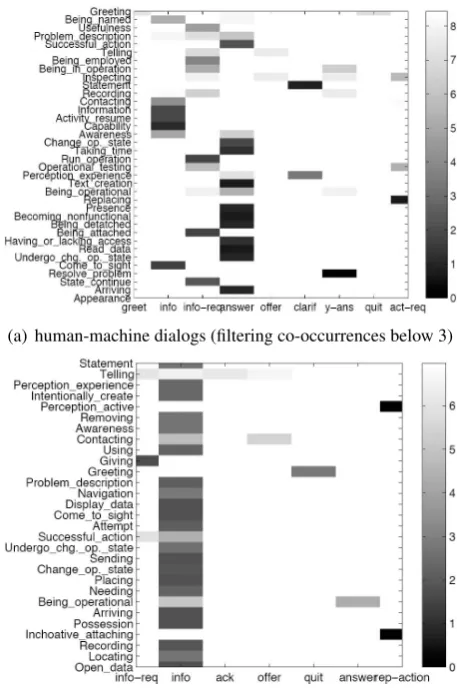
of the co-occurrences of dialog acts and PAS. We noted that each PAS tended to co-occur only with a limited subset of the available dialog act tags, and moreover in most cases the co-occurrence hap-pened with only one dialog act. For a more thor-ough analysis, we computed the weighted condi-tional entropy between PAS and dialog acts, which yields a direct estimate of the mutual information between the two levels of annotation2.
2
LetH(yj|xi)be the weighted conditional entropy of
ob-servationyj of variableY given observationxi of variable
X:
H(yj|xi) =−p(xi;yj)log
p(xi;yj)
p(xi)
,
wherep(xi;yj) is the probability of co-occurrence ofxiand
yj, andp(xi)andp(yj) are the marginal probabilities of
oc-currence ofxiresp.yjin the corpus. There is an obvious
re-lation with the weighted mutual information betweenxiand
yj, defined following e.g. (Bechet et al., 2004) as:
wM I(xi;yj) =p(xi;yj)log
p(xi;yj)
p(xi)p(yj)
.
(a) human-machine dialogs (filtering co-occurrences below 3)
(b) human-human dialogs (filtering co-occurrences below 5)
Figure 3: Weighted conditional entropy between PAS and dialog acts in the HM (a) and HH corpus (b). To lower entropies correspond higher values of mutual information (darker color in the scale)
Our results are illustrated in Figure 3. In the HM corpus (Fig. 3(a)), we noted some interesting associations between dialog acts and PAS. First, info-reqhas the maximal MI with PAS like
Be-ing in operationand Being attached, as requests are typically used by the operator to get informa-tion about the status of device. Several PAS de-note a high MI with theinfo dialog act, includ-ing Activity resume, Information, Being named, Contacting, and Resolve problem. Contacting refers to the description of the situation and of the speaker’s point of view (usually the caller). Be-ing named is primarily employed when the caller introduces himself, whileActivity resumeusually refers to the operator’s description of the
sched-Indeed, the higher isH(yj|xi), the lower iswM I(xi;yj).
[image:7.595.77.286.298.470.2]uled interventions.
As for the remaining acts,clarifhas the high-est MI withPerception experienceandStatement, used to warn the addressee about understanding problems and asking him to repeat/rephrase an ut-terance, respectively. The two strategies can be combined in the same utterance, as in the utter-ance: Non ho sentito bene: per favore ripeti cer-cando di parlare pi`u forte. (I haven’t quite heard that, please repeat trying to speak up.).
Theanswertag is highly informative with Suc-cessful action, Change operational state, Becom-ing nonfunctional, BeBecom-ing detached, Read data. These PAS refer to the exchange of infor-mation (Read data) or to actions performed by the user after a suggestion of the system (Change operational state). Action requests (act-req) seem to be correlated toReplacingas it usu-ally occurs when the operator requests the caller to carry out an action to solve a problem, typically to replace a component with another. Another fre-quent request may refer to some device that the operator has to test.
In the HH corpus (Fig. 3(b)), most of the PAS are highly mutually informative with info: in-deed, as shown in Table 3, this is the most fre-quently occurring act in HH except forack, which rarely contain verbs that can be annotated by a frame. As for the remaining acts, there is an easily explainable high MI betweenquit andGreeting; moreover, info-req denote its highest MI with Giving, as in requests to give information, while rep-actiondenotes a strong co-occurrence with
Inchoative attaching: indeed, interlocutors often report on the action of connecting a device.
These results corroborate our initial observation that for most PAS, the mutual information tends to be very high in correspondence of one dialog act type: this suggests the beneficial effect of in-cluding shallow semantic information as features for dialog act classification. The converse is less clear as the same dialog act can relate to a span of words covered by multiple PAS and generally, several PAS co-occur with the same dialog act.
4 Conclusions
In this paper we have proposed an approach to the annotation of spoken dialogs using seman-tic and discourse features. Such effort is crucial to investigate the complex dependencies between the layers of semantic processing. We have
de-signed the annotation model to incorporate fea-tures and models developed both in the speech and language research community and bridging the gap between the two communities. Our multi-layer annotation corpus allows the investigation of cross-layer dependencies and across human-machine and human-human dialogs as well as training of semantic models which accounts for predicate interpretation.
References
C. F. Baker, C. J. Fillmore, and J. B. Lowe. 1998. The Berkeley FrameNet Project. InProceedings of ACL/Coling’98, pages 86–90.
F. Bechet, G. Riccardi, and D. Hakkani-Tur. 2004. Mining spoken dialogue corpora for system evalu-ation and modeling. InProceedings of EMNLP’04, pages 134–141.
H. Bunt. 2005. A framework for dialogue act specica-tion. InProceedings of SIGSEM WG on Represen-tation of Multimodal Semantic Information.
A. Burchardt, K. Erk, A. Frank, A. Kowalski, S. Pad´o, and M. Pinkal. 2006. Salto - a versatile multi-level annotation tool. InProceedings of LREC 2006, pages 517–520, Genoa, Italy.
A. Corazza, A. Lavelli, and G. Satta. 2007. Anal-isi sintattica-statistica basata su costituenti. Intelli-genza Artificiale, 4(2):38–39.
M. G. Core and J. F. Allen. 1997. Coding dialogs with the DAMSL annotation scheme. In Proceed-ings of the AAAI Fall Symposium on Communicative Actions in Humans and Machines.
R. De Mori, F. Bechet, D. Hakkani-Tur, M. McTear, G. Riccardi, and G. Tur. 2008. Spoken language understanding: A survey. IEEE Signal Processing magazine, 25(3):50–58.
G. Leech and A. Wilson. 2006. EAGLES recommen-dations for the morphosyntactic annotation of cor-pora. Technical report, ILC-CNR.
C. M¨uller and M. Strube. 2003. Multi-level annotation in MMAX. InProceedings of SIGDIAL’03.
J. M. Sinclair and R. M. Coulthard. 1975. Towards an Analysis of Discourse: The English Used by Teach-ers and Pupils. Oxford University Press, Oxford.
D. Traum. 1996. Conversational agency: The TRAINS-93 dialogue manager. In Proceedings of TWLT 11: Dialogue Management in Natural Lan-guage Systems, pages 1–11, June.