THE
ECONOMIC
EXECUTIVE
RESEARCH INSTITUTE
BOARD i96o-6i
J. J. MCELLICOTT, M.A., LL.D.
President of the Institute G. O’BRIEN, D.LITT., LITT.D.
Chairman of the Executive Board. C. S. ANDREWS, B.COMM., D.ECON.SC.,
Chairman, Coras Iompair ]~ireann. J. P. BEDDY, M.COMM.~ D.ECON.SC.,
Chaimaan and Managing Director, The Industrial Credit Company Ltd.
J. BUSTEED, M.COMM.,
Professor, Department of Economics, University College, Cork. S. R. DENNISON, M.A.,
Professor, Department of Economics, Queens University, Belfast. G. A. DUNCAN, S.F.T.C.D.,
Professor of Political Economy, Trinity College, Dublin. R. C. GEARY, D.SC.,
Director, The Economic Research Institute. %¥. A. HONOHAN, IVLA., F.I.A.,
President, Statistical and Social Inquiry Society of Ireland.
M. D. MCCARTHY, M.A., VH.D.,
Director, Central Statistics Office. C. K. MILL, B.A., D.SC.,
Joint Managing Director, Arthur Guirmess Son & Company (Dublin) Ltd.
D. NEVIN,
Research Officer, Irish Congress of Trade Unions. L. O’BuACHALLA, M.COMM.,
Professor, Department of Economics, University College, Galway. J. C. TONGE,
Federation of Irish Industries. T. WALSH, D.SC.,
Director, An Foras Talfintais. T. K. V~HITAKER, M.SC. (ECON.),
Secretary, Department of Finance. GERALD WILSON,
Governor, Bank of Ireland, Dublin.
This paper has been accepted for publication by The Economic Research Institute. The Author is a Research Officer on the staff of the Institute.
Short
Term Economic Forecasting and
its Application in Ireland
by
Alfred Kuehn
IIIII IIIII IlUl IIIII IIIII I!11 M M III IIII
PART I.--METHODS
Foreword
nations out of the depression, and it also played a fundamental role in the organisation of the war economy and post-war adjustment. Because of the " New Economics " and the many improvements Applied economic research--of which economic contributed by scholars provoked by its impact on forecasting forms a part--is a relative newcomer in their thinking, economic analysis is now much more the social sciences. Although, in a general sense useful in formulating economic policy than it was relevant economic thinking at all times has been in the nineteen twenties. Specifically for business based on the perception of the living economy--and activity analysis and short term prediction a range time and again economists have built models from of fairly satisfactory techniques is now available to their experience as administrators, bankers or land- the analyst.
lords--the fact that statistical evidence of the kind Today, forecasts are based on a thorough analysis needed was only scantily available prohibited the of all major variables which influence the path of development of applied economic research in a really development. With the aid, and inside the frame-systematic manner. Only towards the close of the work, of the national accounts--an analytical tool nineteenth century did the statistical equipment of developed during the second world war--all major economists improve appreciably, and it was not constituents of aggregate demand (consumer until the nineteen-twenties that the majority of demand, government demand, investment demand, economic research institutes came into being, exports) and of aggregate supply (labour, capital, Research then was mainly concerned with the technical progress, raw materials) as well as monetary analysis of what came to be known as the " business conditions are projected into the future and checked cycle ", i.e. the more or less violent recurrence of for consistency. In many countries this is done economic crises. Literally hundreds of statistical in regular quarterly intervals, correcting previous series were being scrutinised for their usefulness as forecasts, if necessary, in the light of more recent barometers in predicting the direction of economic iniormation.
activity. The work of Mitchell in the United States Of course, even the new methods are still far from of America and--to a degree--of Wagemann in perfect. Since the demand situation in itself only Germany are well known examples of this practice, reflects the moods and desires of human beings,
Business cycle analysis by " barometer tapping" every forecast is bound by its underlying assump-became somewhat disreputable when it failed to tions regarding the behaviour of economic subjects foresee the great depression of the late nineteen in the market place. For a free or open economy the twenties and early thirties which brought economic forecaster cannot guarantee that they will perform ruin and personal tragedy to a multitude. Although as predicted. Moreover, it is the sole object of it is still practised, at its best it has become auxiliary economic forecasting in such an economy to provide to theoretically better founded methods of analysis sufficient information as to afford the very
oppor-,and prediction, tunity to those in the market place to alter their
The change was effected mainly with the discovery plans either in their own interest or--in the case of of the multiplier principle, and new insights into the government--in the interest of the nation. A macro-economic equilibrium associated with the further reason why economic forecasts do not name of John Maynard Keynes. The " New always interpret the signals heralding the shape of Economics ", as this school of thought was called, the future accurately is that in many cases these are made its contribution in assisting the major industrial not clear enough to allow for only one answer.
Last but not least, forecasts depend on sufficient information about the different variables which have to be brought together to form a picture of the economy. These data are usually unrelated informa-tion or time series about the various sub-sectors and branches of the economy and have to be translated into macro-economically consistent terms. There-fore, the more extensive and the more up-to-date statistics or information supplied from official sources or by private concerns, the more reliable--other things being equal forecasts will turn out.
The following paragraphs discuss the application of modern methods of short term economic fore-casting to the Irish economy as envisaged by the recently established Economic Research Institute. At this stage the statements attempt no more than staking the terrain and providing a rough survey. As familiarity with the techniques and sources of infbrmation grows improvements will be made. It is hoped that ultimately a method will be developed from which a reasonably accurate up-to-date quantitative appraisal of the state of the national economy and its’prospects in the short run can be made.
In Part 2 of the study the experimental model sketched below will be applied in making a forecast of the national accounts for the year i96i. While, strictly speaking, as a forecast it appears much too late, it should be kept in mind that at the moment of writing the available statistics on which the figures
are based relate generally to the first half of the year,1 and the first oJ~cial estimates of the major national account variables for I96I will not be available for another six months. It is planned that for future years the first forecast will appear in the January
of the year of reference with subsequent reappraisals every three months.
The National Accounts As a Tool for
Analysis and Projection
Developed during the second world war and improved in the post war period national book-keeping has become a universally adopted tool for economic activity analysis. In making use of accounting identities it presents the national economy in quantitative terms from different angles and thereby reveals important structures and properties. The national product, i.e. the combined effort of the community in the procurement of goods and services is shown in four different breakdowns : (I) value added by types of industry, incomes ((2) gross and (3) net of tax) by factor
groups, and (4) final demand. More recently financial transaction accounts have been added in some countries, showing gross transactions rather
XAt present the forecaster is seriously hampered by the time-lag in the publication of many official statistical series. Itwould be highly desirable to improve the time schedule of official statistics, as well as perhaps to introduce such important
series as monthly indices of industrial production and retail sales, though the author is aware of the considerable difficulties
with which the official statisticians in Ireland have to cope.
GROSS NATIONAL PRODUCT OF IRELAND 1958
£ million £ million
L
(x) Value added : (2) Gross income :
Agriculture ... I20"5 Income (gross of tax) of factors of
Industry ... 122"2 production ... 446 "4
Services, etc ... 203 "7 Net income from abroad .. 33 "4
Rest of World ... 33 "4 Indirect taxes ... 97:9
Indirect taxes ... 97 "9 ¯ less Subsidies ... ,I4"7
less Subsidies ... --14"7 Depreciation ... 31.6
Depreciation ... 31.6
Gross national product .. 594"6 Gross national product .. 594"6
(3) Net income : (4) Expenditure :
Income (net of tax) of factors of Personal consumption .... 456"3 production ... 427"8 Public authority consumption .. 63 "5 Net income from abroad .. 33 "4 Gross fixed investment .... 80"8 Income transfers (including net Addition to stocks .... --5"0
income of public authorities) .. 1o1.8 Exports ...¯ .. 220"6
Depreciation .. .. .. 3x .6 Imports ... --22I .6
than net. The table shows how gross national product may be regarded as aggregations of macro-economic variables in different ways.
The four accounts presented indicate the flow of goods and services from their source to their final use. Gross output less input of materials, indirect taxes and depreciation allowances yields value added by major branches of the economy and/or individual industries. Value added is then distributed among the factors of production, i.e. labour, capital, and land ownership. The third account depicts the redistribution of income by the State : the incomes of factors are shown net of tax, also shown are state pensions, dole and relief payments. The major object of this account is to disclose the disposable incomes of what might be called the working class, of entrepreneurs, and of the State. The final account reveals how the disposable incomes are spent on consumer goods and investment.
These identities come to life when modern economic theory is applied to them. It can be shown how the different accounts interact on one another. The relationships are generally taken to be functional, i.e., rather than one or several variables determining the value of the other variables each and every variable is capable of influencing the others. However, the influences which prevail at different times show a certain regularity, and for practical purposes of short period analysis the economist is able to identify them. In the following paragraphs an attempt is made to show some of the relevant relationships for Ireland, though the dis-cussion is by no means exhaustive.
Ireland derives a very large share of its gross national product directly or indirectly from agri-culture. One fifth of the national product is produced by the farming sector, and another fifth comes from an industry processing domestic raw materials of agricultural origin to a considerable extent. This specialisation, which is the result of a combination of geographical, political and econ-omic influences, renders the country heavily dependent on foreign trade.
The Value of Total Trade (Exports plus Imports) as a Percentage of Gross National Product in Selected
European Countries in 1959
Per Cent. Netherlands ... 93 "8
Norway ... 83 "7
Ireland ... 65 "5
Denmark ... 65¯ I
Belgium ... 63 .8
Switzerland Austria ..
Sweden ..
Germany .. United Kingdom
Italy ..
France ..
Per cent 61.2 ,5I’3 5I’I 44 "9
38 "4 28.2 26.8
The imports of items such as mineral raw materials, investment and consumer durable goods, and luxury goods which are procured insufficiently from domestic sources are paid for with the agri-cultural surplus and, to a lesser degree, with the proceeds of the tourist industry and of manufactur-ing exports.
From the foregoing discussion it is clear that the key variables to economic conditions in Ireland are export demand and--to some extent--the limita-tions imposed by the weather. As exports are mainly going to the United Kingdom--in 196o this country alone bought 62 per cent. of total Irish domestic exports--economic conditions and pros-pects there are of importance to Ireland. Of course, the influence of the British economy on Ireland is not confined to foreign trade alone. The close association for centuries has led to extensive British capital formation in Ireland and to financial trans-actions between tile monetary sectors of the two countries beyond the scope of those usually prevailing between sovereign nations.
Thus, the assets of Irish banks held " elsewhere " (mainly in Britain) amount to £280 million or 5° per cent. of their total assets ; similarly external liabilities are approximately one-third of total liabilities. The commercial inter-relationships are manifold; British concerns hold the controlling interest in a large segment of Irish industry. Furthermore, there is a free and sizeable flow of labour between the two countries. While Ireland’s contribution to this exchange by far oumumbers Britain’s, the United Kingdom nevertheless supplies a substantial share of nmnagerial and technical talent in the Republic. For these reasons it can be expected that the larger and more highly developed economy of Great Britain will set the pace for the smaller and less developed Irish economy. Or, in other words, any efforts by Ireland to influence its own economic progressqas matters stand now--will have to take into account conditions and opinions prevailing in Great Britain.
economic conditions in other parts of the world. Agricultural products--which comtitute the major part of Irish exports--have to be disposed of in buyers markets and against protective practices abroad. Where protection is absent, competition from other primary producing countries is keen. The repercussions of business fluctuations and financial conditions in other countries will be felt in Ireland partly by a rise or drop in direct export demand from those countries and partly by a change in exports to Britain, because economic conditions and economic policy in the United Kingdom--being one Of the great "trading :nations and financial centres of the world "-~-depend, in turn, very much on international developments.
Investment demand--in other countries more often than not the cause of business fluctuations--as yet is not a dominating propelling agent in the Irish economy¯ Fixed capital¯formation in rdlation to gross national product is well below investment activity in other European countries¯ For example, while Norway, Sweden, Austriai -the ’Netherlands and Germany in x959 saved approximately a quarter or more of their currently earned income in order to expand production ¯facilities, in ?Irelarid only one seventh of the national product was devoted to this purpose. Furthermore, a consider-able part of new equipment :has robe imported, so that the types of investment which make the main contribution to economic growth in Ireland in the short run are constructional work andadditions to live-stock.
Consumer demand at this stage of economic development canbe expected to follow,rather than lead production. Because 0fa relatively low average per capita income and therefore a high .propensity to consume, marked fluctuations in the spending and saving¯habits of the majority :of~theipopulation are not likely to occur.
Government consumption of goods arid services is mainly self-sustaining, and in the ~paat ’§bowed a fair amount of stability. ’While,-by’defifiition,~ it raises national product :and income :th’rou~h :p~iy-ments for services it does little~toincregse:the!’flow of goods to the economy except:by:a:n6t veryeasily ascertainable redistribution ’effect. ~One "shofild expect a certain stabilising influen’ce ~from qt as government current expenditure d6es ~n6t~fluettiate in accordance with revenue receipts. The:emlSloy-ment opportunity afforded~by public’expendittire~is, of course, considerable, :andany ~hange in’govern-ment economic principles may ~have ~far ~’reaehing effects on the national~ economy.
6
,The Share of Gross ,Domestic ,Fixed Capital Formation in Gross National :Product 4n Selected
European Countries ;in ~i959
Per cent¯
Norway ¯. Netherlands.¯ Germany .. Austria ..
Sweden ..
Italy ..
Greece ¯ ¯
Denmark ..
France ¯ ¯
Belgium .. United Kingdom Ireland ..
¯ ¯ ,°
29 "3 23 "5 23 "2 22.8 22"1 2o.9 20.5 x8.4 ~I7"5 i6.6
I3"9
,The Data
Estimating output and ,final demand and projecting :it, into ,the’-future:is a complex ~operation. :As ’eaCh :table’ of ~the :national .accounts :is :being ~built :up--production, ;distribution of :i’neomes and expenditure ~of~gross .~national ~product--information will be ~ cross~hedked :and ::put to the:teat :of .con-sistency with ,the other ,tables. :It ,,is ~erucial, :that .information :should ?be ,as exhaustive-~as :possilSle.
,’Yet, -as :has :been ~stated above, :much of ~the qn-fformation ~needed cannot .be obtained :as ,~early .as desired. Related :data if :available ~are ;therefore :substituted, and much depends on :the ingenuity of the analyst 4n :ferreting ,:out supplementary :informatiOn ,wlikh ,can "give him :a ~elue ,as :to the !likely :behavlour ;ofihis variables.
:In Ireland, as ~in ,other countries, the official
¯ estimates by :the tCentral :, Statistics ~,Offiee ,of "the
:national accounts ’;are :.:provisional ffor ~a :period of ~aboUt~two years in:-retrospeet; ~,wken ;accounts are : revised they :are ~known",to differ :at ,:times substan-tially from :the earlier :estimates. rtoduetion :data ~are mot -collected ~ery :frequently-~while,
agricultural gross output of pigs and the value of pigs received at bacon factories (one of the series) the former can be estimated, with a fair amount of accuracy. Correlation also exists between the output of cattle and exports of beef and cattle. Allowing for supplementary information such as the change in stocks, cattle output and its probable trend can be approximated.
Although, industrial production data are available on a quarterly basis for two reasons their use for
current assessments of the economy is limited.
Firstly, they are not available for a considerable length of time after the period to which they refer and secondly, the quarterly index of industrial production averaged for a year differs in no pre-dictable way from the production index based on the yearly census returns. The difficulty can be overcome to some extent by substituting export data for products of certain industries and checking for consistency of employment and productivity data.2
Information about final demand is more straight-forward. Thus, the most dynamic part of final demand, exports, is well under observation: trade statistics are available in great detail and on a monthly basis. There is, however, a time lag of about three to four months before the latest figures become accessible. Other sources of information are the forecasts of economic activity in Great Britain and the world economy at large which are prepared at various institutions abroad. This, of course, merely places the responsibility for the accuracy of the forecast on the foreign source without necessarily increasi~ng the probability of being right,z
Government consumption of goods and services can be forecast with the help of the proposed budget. A further guide to public current expendi-ture in Ireland is the time series of Exchequer expenditure which is available monthly.
For obvious reasons consumer demand and per-sonal income are closely related, information about one therefore reveals information about the other. Forecasts of production, employment, and wage claims put forward can be synthesised to provide
forecasts of consumer demand.
2However, as productivity data are not found independently the cheek can be merely one of plausibility. It seems inevitable that, sooner or later, the expanding economy of the Republic will require a similarly expanding statistical egverage including
above all monthly series of industrial activity.
8A frank appraisal of the accuracy of various forecasting models and practices in Britain has recently been furnished bY the National Institute of Economic and Social Research, eL R. R. Neild and E. A. Shirley : An Assessment of Fore~asts, i959-i96o, National Institute Economic Review, May x96x.
In, Ireland, investment demand is largely identi-fiable from comparatively few sources of information. Present trends are revealed by planned government and state enterprise capital outlay, by activity of the building trades, by imports of capital goods, and by increases or decreases of herds of cattle.
Overall economic activity can be assessed by an observation of banking statistics. As financial flows accompany the exchange of goods and services at all stages the former reflect production trends. Financial statistics are also more up-to-date than statistics of commodity transactions; this makes them especially welcome for current analysis.
Business statistics usually deal with the past and by themselves reveal nothing about the future, there are few exceptions to this, for example statistics about orklers placed which give an indication of production to come (though, in Ireland, these would be meaningful for only a relatively small fraction of industry). But, aside of this, the fore-caster must apply to social phenomena what are in es8ence mechanical devices in order to make these statistics tell the future. He observes past trends and performances and, if no other evidence is available which points to the contrary, assumes their continuation. Often enough he finds himself frustrated by ensuing changes of which he had no forewarning. However, in recent years statistical sampling methods have been developed which deal with anticipations and opinions rather than past happenings. They are now fairly widely used in market research and, in some instances, for in-dicating general business trends. Where they are applied for macro-economic analysis they have helped to overcome the lack of advance information about imminent changes of trends. By revealing their expectations of, say, future sales, business men will give an indication of policy regarding employ-ment, investment in stocks and capital and so forth. Inquiries are carried out and are conducted by telephone, by letter or by personal interview. The sample size depends on the information required but usually does not exceed 3,000 in number, in other words it constitutes only some fraction of one per cent. of any total over 3oo,ooo.
The economy of this method is obvious. While sampling can be and often is applied in statistics to obtain an approximation of past data its main value lies in the application of the underlying principles for forecasting purposes. Without the possibility of drastically limiting the number being interviewed, the time needed to carry out a poll would be so long as to render the return obsolete.
Research Institute proposes to initiate a similar inquiry into the expectations of business men and farmers in Ireland. Because of the expenses involved it ~ould be impossible at this stage to conduct an
elaborate enquiry on the basis of about 2,ooo to 3,ooo interviews. Instead, it is hoped that other institutions would cooperate in the course of dis-charging their regular duties and help obtain the information needed.
As regards industry, plans are well advanced to set up a panel of correspondents invited from among well-informed business men who will pass their judgment on branches of industry with which they are intimately acquainted. The proposed industry and farm sample enquiry should greatly enhance the ability to predict the course of the Irish economy.
PART 2.--THE IRISH ECONOMY IN 1961
In the foreword it has been pointed out that this paper is intended primarily to provide a preliminary survey of the methods to be used in economic analysis and short term forecasting in Ireland. However, notwithstanding the present lack of detailed studies into the significance of various factors governing economic activity in Ireland an attempt shall be made here to predict the probable development of the national product and its com-ponent parts for the year 1961.
The task is, perhaps, somewhat easier than the ultimate one, which is to predict economic develop-ment.in Ireland twelve months in advance. Margins of error are smaller because the period is shorter about which speculation becomes necessary. It may be well to recall, however, that definite knowledge about the first half of the year is still limited and the advantage of forecasting in September therefore is not as great as it may seem.
Before estimating final demand and production in quantitative terms a general picture of prevailing economic conditions abroad and at home shall be drawn as only in the light of these can an appraisal of the data and future projections be made. World Economy
The United States of America has emerged from the recession, and all available facts point to an expansion, in the remaining months of 1961. Increased consumer spending and investment demand have caused a rise in new orders and pro-duction in industry and stocks are considered to be inadequate. The determination to strengthen
8
armaments in view of the tense international political situation over Berlin and other issues will add force to the upswing. While the immediate impact of the improvement of business conditions in the United States on the Irish economy cannot readily be ascertained except, perhaps, in the case of direct trade, there is no doubt that in a general way it will contribute to economic conditions in Ireland through the reactions caused in the world economy. ~
The prospects in Great Britain, Ireland’s im-mediate neighbour and biggest trade partner, are less favourable at present. Although, in the first
quarter of 1961 final expenditure on goods and services was up by 5 per cent. over the level of the first three months of 196o and capital formation
at home was rising by almost IO per eent.u accompanied by a generally optimistic feeling in the business community pointing towards a good yearl trade balance and balance of payments difficulties
did not permit activity to continue at this rate. While the current balance became negative actually a year and a half ago, conditions grew worse in the third and fourth quarter of 196o. As there were no signs of a noticeable improvement in the balance of payments situation during the first six months of 1961, in July measures to curb expenditure have been taken by the British government. Although, it is too early to assess their impact on the national income of Britain for 1961, and consequently the effect on the demand for Irish made goods, it seems likely that demand for Irish exports to Britain will slacken to some degree in the second half of 1961 and possibly early in 1962.
Even in the absence of measures restricting demand it seems likely that exports of cattle and beef to England would not continue at their present high rate of growth. In Britain, slaughterings, sales by butchers, and consumer incomes have not risen nearly as much as imports of cattle and beef from Ireland, during the first half of 1961. As there seems to be no ground for the assumption that the share of Ireland in total British imports of livestock and livestock products has increased permanently, sooner or later an adjustment must occur.
4Because of its size the economy of the United States of America influences the economies of its smaller trading
partners to a great extent. Even a mild recession in the United
States might mean a relatively large reduction in demand experienced by primary producing countries, which in turn
will reflect in their balance of payments position. To carry
the line of deduction even further it may be pointed out that
a weakening foreign exchange position of the overseas Commonwealth countries because of a recession in. the
Whether the economic restrictions embarked upon in Britain will be allowed to continue sufficiently long to reduce effective demand is, of course, another question. The slight reduction in the Bank rate early in October may indeed point to the contrary; although, officially it has been denied that the adjustment of the rate of interest should be interpreted as a deviation from the restrictive course. Furthermore, the likelihood of entering the Common Market, which will give rise to higher investment demand, and also the possibility of increasing defence commitments in a new arms race may cause merely a shift in the composition of total demand rather than a curtail-ment of its overall growth.
Economic conditions in the rest of Western Europe--generally speaking--are still favourable; however, of late growth which had been more or less universal throughout the Continent during the summer is showing a varied pattern. For example, while in Italy the rate of expansion is slightly accelerating, in the Netherlands and in Germany, it has considerably slowed down. Whether this will indeed seriously affect the position of Ireland in these Markets remains yet to be seen. It would probably require more than a temporary reduction in the Continental rate of expansion to halt the upward trend of Irish exports to this area.
ireland
The forces causing an increase of gross national product in 196o by 4 per c ent.--a very high increase if judged by past performances of the economy--are still present in 1961. Demand for agricultural products, especially livestock and beef has been rising and export demand for manufactured goods has on the whole been a stimulus to increase industrial production and employment. The prospects of steadily rising output and revenue in industry aided by a firm commitment of the government to a policy of industrial development and balanced economic growth have created a more favourable attitude towards net investment. Further-more, capacity of plant and labour supply allow still further increases of production.
Financing investment has been aided this year by two factors, one, government measures to relieve the burden of direct taxation on incomes, and the other, a relatively weak impact of wage rounds, though substantial claims are pending.
In April the standard rate of income tax had been reduced by ten per cent. In introducing his measure the Minister for Finance estimated that this would
free approximately £1"2 million in revenue. A substantial part of this sum, remaining in the hands of the sector of the public most likely to save, should have been available for additional private invest-ment. Rough calculations indicate that the effect of higher hourly wage rates and the reduction of hours in the standard work week leading to increased overtime payments as well as a rise in the number employed will add to the wages bill of the nation approximately £18 million for the whole of 1961. This would in effect be much less than the expected increase of gross national product and should leave a larger proportion of the additional income available for capital expansion.
In August the discount rate of the Central Bank in Ireland was raised from 9 ~4z~ per cent. to 6y~ per15 cent. following the increase of Bank rate in Great Britain from 5 per cent. to 7 per cent. At the time of writing at 6~ per cent. it is still substantially higher than in the summer. As commercial lending rates were raised similarly borrowing by the public has become dearer. With dearer money in Ireland and in the United Kingdom--where a large part of this country’s traditional investors are domiciled--private investment in Ireland may be adversely affected and some capital outlay may now be postponed until easier borrowing terms can be obtained. The policy of dearer money may also affect the flow of short-term funds to enterprises. The financing of stocks of materials, trading stocks, and current operations will be somewhat less easy under the higher interest rate, which might depress demand and employment within the Republic itself apart from the repercussions to be expected from the curtailment of demand in Great Britain. However, the effect on total cost of the higher rate for borrowing should not be exaggerated.
Agriculture
The decisive factor in cattle sales is the demand exercised by traders from Great Britain. With the bovine tuberculosis regulations in force, sales of store cattle to England continuously declined since the summer of 1959. On the other hand, sales of fat cattle increased to a similar degree. When gradually the Irish farming community increased its attested herds, demand for Irish stores rose again,b It might very well be, therefore, that later in the year the demand for fat cattle will not be sustained. The present rate of increase in sales of cattle for export is approximately 34 per cent. This rate of growth, because of a possible reduction in demand in Britain, might not be maintained, but the rising demand by other countries would counteract this sufficiently to warrant forecasting an overall increase Of cattle sales by 3° per cent. for the year 196I.
While the number of cattle sold have gone up, prices were slightly lower on average from January to August of this year compared with the same period in 196o. When the subsidy for fat cattle was reduced in August, this was reflected immedi-ately in lower prices at the Dublin Cattle Market. However, since then prices have tended to regain the level previous to the reduction in the subsidy. The statistics available indicate that average prices in 1961 will almost certainly be somewhat loWer than in 196o. Consequently the value of total cattle sold for export--dead or alive--will increase by less than 3° per cent. as indicated by physical volume of trade alone. It seems probable that it will be in the region Of 25-27 per cent.
Estimated Number of Cattle Exported
Thousand
Cattle (Live) .... Meat (Cattle equivalent)
TOTAL ....
Janualr--June
196o 196I
231 328
i6o 196
391 524
sit should be interesting to probe into the complexities of cattle production and turnover in the economies of Great Britain and Ireland combined. Great Britain depends to a considerable extent on the supply of store and fat cattle from Ireland. When Irish store cattle were forced partly out of the market by new health regulations in Britaifi regarding bovine tuberculosis, fat cattle had to fill the gap at the British meat counter. With more attested stores available demand also rose. Likewise, this year, because of an early grass season British farmers had sold their cattle early and are now in need of replenishing their herds. It appears therefore that store cattle from Ireland are now in demand as well as fat cattle and beef.
IO
Prices for Cattle at Fairs and at Dublin Market
1956=1oo
i96o January February March April May June July August
Average 1961 January February March April
May June July August
Average
Store Cattle
124 124. I27 122 122 116 113 118 i2i
io6 112 I32 I28 I25 1I4 II8 125 12o
Fat Cattle (Fairs)
118 118 II9 I25
i2o II5 115 112 118
115 Ii8 I27 12o 124 I18 IO9 12o II9
Fat Cattle (Dublin)
126 125 124 13o 126 1.22 117 114. 123
II3 II7 I33 13I I22 I!3 Ill lO6 II8
The demand for other livestock and livestock products including those of the dairy industry has been high also. Because of a good grass season the supply of milk for industrial use during January-August 1961 as indicated by creamery butter production increased approximately by 12 per cent. over the same period last year. The number of pigs received at bacon factories increased by 13 per cent.
It seems likely that milk production for the entire year 1961 will be substantially higher than in 196o, although the increase from month to
1956
1957
1958
I959
196o
Jan. 196o
Feb. ,,
Mar. ,,
Apr, ,,
May ,,
June ,,
July ,,
Aug. ,,
Average
Jan. 1961
Feb. ,,
Mar. ,,
Apr. ,,
May ,,
June ,, July ,,
Aug. ,,
Average
Creamery Butter Production
cwt. (ooo)
(monthly av.)
,9 ,, ¯ ¯ ,, ,, ¯ ¯
¯ ° ¯° ¯ °
¯ ° ¯ °
°. ¯ ¯ ¯ ° ¯° ¯ °
71 ’7
8i "4
77 "9 64"5
75 "5
9.2
I0’9 23 "7
53.6 ii3.2
I34"8
138.1
132’3
77"o
12"4
13 "6
33 "3
72.8
135"o
146.2
141 "o
136"5
86 "4
The demand for pigs in Ireland mainly depends on the numbers offered for sale because of an exist-ing price guarantee to bacon factories¯ The production cycle of pigs has a length of approxi-mately six months, which makes it possible to estimate total sales in the second half of the year from the number of pigs on farms in June. The Central Statistics Office has estimateds that in June 1961 stocks of pigs were I I per cent. higher than in June 196o. Prices should be only marginally more favourable this year ; on the basis of this the value of total output of pigs in 1961 is estimated to be about 15 per cent. up.
6Ireland, Crops and Livestock, 1961--i June, Preliminary statement for 1961 and comparisons with 196o, Central Statistics Office, Dublin, September x96L
Pigs received at Bacon Factories
Numbers (ooo)
1956 1957 1958 1959 196o Jan. 196o Feb. ,, Mar. ,, Apr. ,,
May ,,
June ,, July ,, Aug. ,,
Average Jan. 1961 Feb. ,, Mar. ,, Apr. ,,
May ,,
June ,, July ,, Aug. ,,
Average
(monthly av.)
,, ,9
75.28 93 .oo 113"95 98"17 lO8.19 87.21 95 "55 lOl .66 86 "75 97 "75 lO3’64 113.Ol 14o’43 lO3"25 II3"33 lO8"77 II4’4I lO2’71 116"63 115"73 12o"25 137"58 116.18
No statistics have been published yet on the output of crops in 1961 the reason for this being that the harvest is still going on. A forecast of crop output therefore has to be based mainly on general observations. According to the Department of Agriculture’s Farm Bulletin,7 early potatoes of excellent quality have brought average yields. Forecasts for main crop potatoes indicated that yields would be better than 196o. The yield of barley was slightly above average while the yield of wheat is expected to be normal.8 Oats, according to this source, would have below average yields.
The Central Statistics Office9 estimates that the acreage of wheat declined by 4 per cent. or I6,OOO acres in 1961. The acreage of oats was less by 56,ooo acres. On the other hand, there was an increase in acreage of malting barley by 3,000 acres and of other barley by 34,ooo acres. As weather conditions, on the whole, were not unfavourable, it is estimated on the basis of this general
~Farm Bulletin, Department of Agriculture, July and
September I96I.
SHowever, this is seriously in doubt in view of the recent announcement that 40 per cent. of the wheat harvest might be unmillable.
information that crop output will increase in 196i by approximately 2 per cent.
Estimated Value of Livestock on Farms
£ million
Change 1962/I961
Per cent.
1958 1959 196o 196I change
196o/61
[-Iorses ... ¯ .... 2.6 2.6 3"5 3"5
Cattleand Calves ... 50"1 49"6 55"o 68.8
+25
Cattle hides .. ... O’I O’I O’I O’I
Milk :
Consumed by persons ... 12"7 12"9 13"5 13"5
Used in In’dustry ... ¯ 21 "6 i9.6 24"1 26"5 +io
Farmers’ Butter ...
5’7
6.1 6"8 6’8Buttermilk ... 0"5 0.5 0"5 0"5
Sheep and Lambs ... 8"6 8.0 9"5 9"0
-5
Wool ... 2"5 3.2 3"5 3"5
Pigs ... 21"9 20"2 2o.8 24.0 +15
Poultry ... 5"0 3"9 4.2 4-2
Eggs ... IO’5 9"5 8.5 9.0
+6
Other livestock products ... 0"I O’I O’I 0"I
Total livestock and livestock products .. 141 "9 136"3 15o’1 169"5 +i3
Crops and Turf ... 37 "8 45"2 44"8 45 "5 +2
Gross Value of Agricultural Output .. 179"7 I8I"5 I94’9 215"0 -{-IO
Value of change in livestock numbers .. +3"2 ~-II’O --0"5 --8"0
Value of farm materials ... 37"i 36"o 34’6 37"o +7
Net Value of Agricultural Output .... 145.8 156"3 159.8 . 17o.o +6 x January
1961
I January 1962 Cattle ..
Sheep ..
Pigs ..
Poultry ..
TOTAL
--9.8
-1- I’O
+o’8
162.817.8 8"6 2"6 191"8
153 .o 18"8 9"4 2"6
--8"0
I83"8
On the basis of these forecasts for major agri-cultural items, total agriagri-cultural output in 1961 at current prices will be approximately £2I5 million. As changes in livestock numbers between the first
of January of each year and the value of changes in livestock numbers according to the official estimates show a fairly close relationship, it can be estimated that in 196i the value of the reduction in livestock numbers will be approximately £8 million. The value of farm materials does not fluctuate very much from year to year and with somewhat higher prices expected for this year it is being assumed that farm materials purchased will be slightly higher than in i96o and will amount to approxi-mately £37 million. Deducting changes in livestock numbers and the value of farm materials from gross output one arrives at a value of £i7o million for net agricultural output. This constitutes an increase of £xo million or 6 per cent. over 196o.
Industry
Provisional statistics of industrial production in the first half of 1961 indicate that the momentum of growth in the manufacturing sector generated in 1959 is still quite strong. The quarterly index of production of manufacturing industries during the
ESTIMATED OUTPUT OF AGRICULTURAL PRODUCTS £ million
Sources : Estimated Gross and Net Agricultural Output in x96o, Central Statistics Office, Dublin ;
Research Institute.
March quarter rose to I23.5 and during the June quarter to I31.2 (I953=IOO), which represents increases of more than 8 and 9 per cent. respectively over the corresponding periods in i96o. This indicates that the trend of growth of production which had slowed from IO per cent. in the first quarter of 196o to 5 per cent in the fourth quarter of I96O is again accelerating. Nearly all major industries producing transportable goods took part in the expansion ; in those cases where production declined it was more than made up by the perfor: mance of other industries in the same group. For example, although in comparison to the first quarter last year the assembly of motor vehicles decreased by 19 per cent. and that of other vehicles by 6 per cent. the group " metal and engineering " of which vehicle assembly forms a part increased its produc-tion by 9 per cent. This was due mainly to an increase in electrical engineering of 42 per cent, and in the manufacture of non-electrical machinery of 3 t per cent. ; but the remaining industries in this group also expanded their production to a
considerable degree during the first quarter.
MANUFACTURING INDUSTRY INDEX OF PRODUCTION
(unrevised series)
1957 I958 I959 I96O I961
Ist 2nd 3rd 4th
quarter quarter quarter quarter 94"2
IOO"7 1°3 "5 II3"9 I23"5
99"9
IO4"3 II2"O
I2O"3
I3I’2
97"6 lOO"7
I12"0
ii9.o
lO9"8 xII"7 I2O"7 126"7
PERCENTAGE INCREASE OF PRODUCTION OVER
SAME QUARTER IN PREVIOUS YEAR
ist [ 2nd 3rd 4th
quarter quarter quarter quarter
958 6.9 4"4 3.2 i.7
959 2-8 7"4 II’2 8.1
960 IO’O 7"4 6"3 5.0
96I 8"4 9.i
Source: Quarterly Industrial Inquiry, Central Statistics Office, Dublin.
PERCENTAGE INCREASE IN INDUSTRIAL PRODUCTION OVER SAME QUARTER IN PREVIOUS YEAR
I96O/59 I96I/6O
ist 2nd 3rd 4th ist 2nd
quarter quarter quarter quarter quarter quarter Coal, Turf ... 79 "7 --I2"I --31"6 12"5 --I4"3 9"9 Stone, Slate, Gravel .... 24 "4 21"4 7"4 --4"4 2o’7 I4"I Miscellaneous Mining .... 28’9 72"7 37"9 27"3 57"2 --8"8
Bacon Factories .... 1.9 O’I i3.i io.3 i2.3 II"4
Meat other than bacon .. 20"2 --9 "5 --I.5 9’2 8.i 67"9
Fish ... 52"6 --2"2 --25"7 23"I 15"5 31o’o
Grain Milling ... --3.6 --4.2 3.1 II’6 5"6 9"6
Bread, Biscuits ... --5.8 --4.8 --5"3 --I9"5 --o.I --2"9
Sugar ... --34.0 --5 I’3 --76.1 --9.2 36.4 93 "4
Cocoa, Chocolate, Sugar Confect. 1-4 2"I 7"3 3"I 1°"7 9"o
Creamery Butter, Cheese .. 1.9 --i3.o o.I 2.8 4’2 19"6
Fams, Preserves ... 7"9 9’3 19.1 38.9 26.o 13"6
Margarine, Cooking Fats .. 9.8 22.7 lO’5 4"3 3"3 --9"5
Miscellaneous Food Preparations lO2.9 61 "2 --5"2 --22"3 --35"1 --36-9
Malting ... 14"9 --14.4 --55"0 --25"9 2.2 76.6
Brewing ... 9"3 4"3 I3"I 4.8 5"7 13"2
Distilling ... 2.6 16"4 o --I5"3 --2"2 --0"9
Mineral Waters ... --2 "4 0.3 --13"9 1"9 --1"5 --15.8
Tobacco ... 7.0 0.7 --0.7 o’I 5"0 3"7
Wood and Cork (except
Furni-ture) ... 11"6 I2"I 12"3 2"2 II’8 5"5
Brushes and Brooms .... --3"4 7"9 45"7 3’° I I’7 0"1
Furniture ... --2.5 --4’9 --io.7 --16"3 II’6 --5’I
(Table continued overleaf)
PERCENTAGE INCREASE IN INDUSTRIAL PRODUCTION OVER SAME QUARTER IN PREVIOUS YEAR
Continued from page x3
Jute, Canvas, Rayon .. Linen and Cotton .. Made-up Textile Goods Woollen and Worsted ..
Clothing : Men’s and Boys’ ,, Shirtmaking
,, Women’s and Girls’ ,, Miscellaneous Hosiery ... Fellmongery .... Leather Goods .... Boot and Shoe .. .. Glass, Pottery .... Printing, Publishing .. Paper, Paper Products Vehicles, Motor ..
,, Other .... Metal Trades .... Machinery : Electrical
non-Electrical Railroad Equipment .. Ship and Boat Building Soap Detergents .. Chemicals, Drugs .. Oils, Paints, Polishes .. Fertilisers ....
Cement ... Structural Clay Products,
Asbestos ... Miscellaneous Manufacturing .. Transportable Goods Industry
xst quarter I7"0 36"7 63 "4 21 ’9 9.8 14"6 I7"I 7"4 3"9 4"7 12"3 6.5 --2.6 --i.i 23"1 39"8 --20"2 7"9 20"8 lOO.8 --23"2 26"1 8"0 24"3 8.5 I8"4 15"3 8.7 59"2 11"3 196o 11959 2nd quarter 12"6 36"7 53"2 41 "3 --o’6 14"3 5.0 3"7 4"3 --3 "4 18.2 --2.7 13 "2 1.4 14"3 20"8 --17"7 3"7 4"5 IOI "5 --22"9 37"9 MI"5 9"2 1"6 37 "4 2o.8 4"9 42"2 6.0 3rd quarter I0"8 37"6 34"I 25 "4 5.0 IO’I 8"8 2"I 16"6 11"5 --7 "4 --0"2 I9"3 --6"2 9"8 18.9 --2"0 3"2 16.3 91 "4 --27"2 26 "8 --6.6 22"1 1"4 --18.9 8"4 --2.9 7’2 4"2 4th quarter 22"I 32’0 28.6 21 "2 4"1 II"4 9"0 3’5 I2"3 15"8 3"3 23 "9 6"1 --9"9 9"2 --5"3 --5 "9 6.9 16.9 91 "9 --9"7 48"3 --30"0 8"I 4’0 30"4 --9"5 --8’2 5"2 5"0 I9611196o ist quarter 14"1 3"8 --I7"5 0"6 --7 "9 7"4 9.8 4"2 21 "2 I4"0 --18.3 21 "5 25"7 6"0 --2"6 --19.2 --5"7 I6"4 42"3 3o.6 12"6 24.6 19"7 5.1 I8"8 44"8 I8"7 --2"7 II "4 8"2 2nd quarter 28 "2 --8"1 --25"9 --3 "4 --1’6 --4.2 9"1 5"9 25"o 22"9 --34.0 25’9 6"7 4"6 4"9 -z. 12"2 26"I 13"7 31~.I 37"5 -68.6 I6"5 23 "3 10"8 18"2 I4"9 --28.6 --9"3 I3"5 9"I
Source : Quarterly Industrial Inquiry, Central
The statistics of goods exported which can be roughly linked with particular industries support the trend indicated by the index of industrial production. While exports of the class " Other raw materials and manufactured goods " in the first six months of this year compared with last year rose only by a moderate 4 per cent. exports of a wide range of manufactured goods taken by themselves increased considerably more. For example, although exports of "Ores and Metals " decreased by x4 per cent. exports of metal manu-factures increased by 48 per cent., and exports of
" Cutlery, Hardware and Machinery" increased by 24 per cent. Exports of textiles, clothing and footwear and leather manufacture also showed substantial increases.
Statistics Office, Dublin.
On the other hand, exports of vehicles were lower than in the first six months of 196o due mainly to a big reduction in automobile assembly10 and trade in used cars as well as a decline in the disposal of aircraft by the national airline. The decrease in exports of oils and chemicals, etc., can be traced to the crude oil refining industry; exports of petroleum products during the first six months of the current year were only 69 per cent. of the amount
shipped during January-June I96O;tl other main exports in this group showed an improvement.
t0 ttThese facts incidentally may show up the less desirable
aspects of large enterprises under foreign control in a small developing country. As production decisions by these concerns
are being taken with regard to world wide operations, production
in subsidiary plants may fluctuate in no predictable way, upset-ting, because of their relative importance, the balance of payments
and revenue receipts in the country in which they are based.
It
is of course extremely hazardous to predict current prices is estimated to rise by 9--1o per cent. solely on the basis of the production and export The output of electricity, gas and water--in short data for the first half of 1961 what the pro- of total energy production--is expected to rise in duction of Irish industry will be in the entire accordance with overall economic activity. An year. Past trends--while helpful--do not provide indication that this will be the case is given by the the full answer, especially in the case of an industrial figures published on the monthly output of ESB community only beginning to think in terms of Generating Stations. According to this sourcegrowth, during the first eight months in 1961, 1,495 million
A useful check is therefore an appraisal of employ- KWh were generated against 1,413 million KWh ment and productivity data. In manufacturing ill the same period 196o, which constitutes an
industry employment in the first half of 1961 was increase of 6 per cent.
higher by 5,2oo persons or 3"5 per cent. than in the The building industry has been doing rather well first half of 196o. If past trends cart be relied upon this year, if the impressions formed by people productivity could be expected to rise by 4--5 per looking for homes to buy are any guide. Generally, cent. The increase in employment in manufacturing in spite of rising prices builders had no difficulty industry and the productivity gains combined would in disposing of standard type houses. Purchases of mean that the volume of:production will rise by ap- better type houses and luxury homes also increased. proximately 8 percent. Asprices are slightly higher According to the statistics of State-aided housing in 1961 net product of manufacturing industry at schemes however, which cover the greater part of
DOMESTIC EXPORTS OF SELECTED COMMODITIES
~OOO
January-June 196o
FOOD, DRINK, TOBACCO ...
Beef, fresh, frozen ... Bacon ...
Butter, creamery ... Beer ...
OTHER RAW MATERIALS AND MANUFACTURED
GOODS ...
Ores and Metals ... Metal unwrought and wrought .. Metal manufactures ... Cutlery, Hardware, Implements, Machinery
21,813 5,655 2,085 367 3,185
21,721 2,220
872 213
1961 29,636
7,898 3,258 2,650 3,487
and Electrical goods .... Vehicles ....
Motor cars, new Aircraft and parts Textiles .... Clothing and Footwear Hides, Skins, Leather ¯ Paper and Cardboard
Oils, Fats, Fertilisers, Chemicals, Colours, Perfumery ...
Petroleum products ... Medical products ... Oils and Eats ...
1,663 2,053 678 62o 4,932 2,560 1,565 1,268 2,323 1,669 80 158
22,683 1,915 573 315 2,064
424 68 55 6,o5o 3,338 1,871 1,2I3
1,845 I,I59 lO6 265
Percent. increase Jam-June I961/196o 35"9 39’7 56’3 622.i 9"5
4"4 --13.7 --34"3 47"9 24"I --79"3 --9o.o --9I’I 22’7 30"4 19.6 --4"3 --20.6 --30"6 32’5 67 "7
Source : "Trade Statistics," Central Statistics Office, Dublin.
construction of private homes, from January to August 1961 the total number of new houses built was not higher than in the corresponding period last year. Construction of commercial buildings and public Construction will conceivably be higher than last year but owing to lack of statistical information it is difficult to predict by how much; The average number of building workers in the first half of this year in comparison to the first six months of 196o increased by more than 2,5oo persons. Taking this
as a rough indication of production trends--as productivity increases in the building trades can be assumed to be negligible--it is estimated that total building and construction will increase in volume by 4 per cent. Since prices in a seller’s market have tended to go up, net output at current prices will probably be higher by 8--1o per cent. in 1961 as compared to 196o.
The combined effect of the increases in output of transportable goods industries, power supply, and construction should be an increase of the gross
national product of the industrial sector by approxi-mately 9 per cent. at current prices, andby 7 per cent. at real terms.
Services
Service-type industries and public administration together are a significant segment of the national economy of Ireland ; they provide employment for 6o per cent. of the total working population outside agriculture. However, with the exception of public administration and defence, for which the govern-ment publishes yearly accounts and estimates, current information about this sector is scarce. Fore-casting would be extremely difficult were it not for the fact that this sector traditionally is one of the least dynamic. Ireland makes no exception to this Jule. The employment figures reveal that numbers at work are fairly stable for a considerable length of time. As there exists no agreed method for measuring productivity changes in this sector, it is
EMPLOYMENT, PRODUCTIVITY AND PRODUCTION IN MANUFACTURING INDUSTRY
Percentage change over quarter
Index 1958=1oo in previous year
I
Employment Productivity Production Employment Productivity Production 1958
i Quarter .. 98"7 98"6 97 "3
2 Quarter .. 99"2 1oi’4 lOO’6
3 Quarter .. 100"5 97"o 97"5
4 Quarter .. IOI’6 lO2.8 lO4"4
Year . ¯ IO0"O IO0"O I00"0
1959
1 Quarter .. lOO"9 97’0 97"9 2"2 --1"6 o.6
2 Quarter .. I02"0 I°3’9 IO6"O 2"8 2"5 5"4
3 Quarter .. lO3"5 IO2"4 lO6.O 3"0 5"6 8.7
4 Quarter .. 105"1 lO8"7 114’2 3"4 5"7 9"4
Year . ¯ 102"8 lO3"2 I06"Z 2"8 3’2 6.1
196o
I Quarter .. IO3"7 lO4’O 107’8 2"8 7’2 IO’l
2 Quarter .. lO4"3 I09"I I13"8 2"3 5"0 7"4
3 Quarter .. IO5"2 107"0 II2"6 1"6 4"5 6"2
4 Quarter .. io7-8 III’2 119"9 2"6 2"3 5"0
Year .. I05"3 1o7.8 II3"5 2"4 4"5 7’0
1961
1 Quarter .. lO7"2 I09’o 116.8 3"4 4"8 8"3
2 Quarter .. I08"2 IX4"7 124.1 3"7 5"1 ...9"I
generally assumed that these are insignificant and can therefore be ignored. Output at current prices increases with the increases in numbers employed and with the rises in remuneration of employees.
It is assumed here that in i96i the increase in net output of all services combined will be in the region of 6 per cent.
Capital expenditure
Investment in fixed capital assets will reach an all-time high level in I96r. This, at least, seems to be indicated by imports of capital goods and output data for the building industry. A further indication that investment demand is expanding is to be found in the increased amount of funds allotted to capital
expansion by the State. According to expenditure budgeted in the Public Capital Programme, govern-ment and State enterprise capital outlay will be substantially higher in I96i. The Programme calls for an increase of nearly £5 million in the fiscal year i96r/1962. In addition to funds made available by the State, business men will find themselves with increased net profits in i96r. On the average, earnings will rise faster than cost, the income tax rate, too, will be lower. The combined result of this should be a rise of undistributed profits and of savings out of entrepreneurial income.
Construction will probably rise by 8 per cent. or £4 million, according to the estimates of output for the building industry¯ So far as equipment is concerned an analysis of import data indicates a probable increase of transport equipment--mainly aeroplanes and rolling stock--by £ff million. Agricukural machinery should increase by approxi-mately £r million, and other equipment--including the machinery needed for industrial expansion--can be expected to rise by £5 million. It expansion--can
therefore be assumed that total investment in machinery will be increased by £Io million or 25 per cent. Total fixed capital formation will be £IO6 million in I96r which is an increase of 15 per
cent. over i96o.
INVESTMENT IN FIXED CAPITAL ASSETS £ MILLION, AT CURRENT PRICES
Construction .... Equipment ....
Transport equipment Agricultural ,,
Other ,,
TOTAL ...
Construction .... Equipment .... Transport equipment Agricultural ,,
Other ,,
TOTAL ...
i95___[
4635 I4 4 x7 8i
I95__29
49 36 I4 4 18 85
196.____~° __
52
40
I4 4
22
92 I96I
56 50 18 5 27 io6
change
+3 I +3 + 4
+i[ +4
+io
o o +4
0 0 ~- I
+41
+7 ÷I4
Sources : x958-x959 National Income and Expenditure
I959, Central Statistics Office, Dublin; I96O--6I estimate Economic Research Institute
National Product and Expenditure12
The sum total of the preceding discussion clearly indicates a further improvement in the performance of the Irish economy¯ It appears that I96r, too,
X2The national accounts data used here are those compiled by the Central Statistics Office, Dublin and published in
National Income and Expenditure I959, and Economic Statistics,
Stationery Office, Dublin. For I959 and x96o certain amend-ments have been made by the present writer in order to allow for recent revisions in the official estimates of agricultural output. The officially revised national accounts, which were not available at the time of writing, may be expected to differ slightly from those used in this study. However, this would not invalidate the forecast for 196 I, which is mainly concerned with the rate and magnitude of changes in the variables¯ ESTIMATED NUMBER OF PERSONS AT WORK IN MAIN BRANCHES OF NON-AGRICULTURAL ECONOMIC
ACTIVITY x956 TO i96o Thousand
Mining and Manufacturing .. Construction ... Electricity, gas, water .... Service industries .... Public administration and defence
I957 I958 I959 I96o x96I I956
¯ . 200
.. 82
.. I2
.. 385
¯ . 39
.. 718
I94
75
I2
383 39
I95
65
I2
38i 39
I98
6r
I2
38z 39
202
63
II
384 39
207 66
II
386 39
TOTAL .... 703 692 692 699 709
will be a year of substantial increase in the national product and income. Thus, the moderate growth achieved for the first time in 1959 and repeated in 196o, Should be sustained.
Gross national product at current prices is estimated to total £697 million. Compared to i96o the increase will be £43 million or 6.6 per cent. Of this agriculture will add £8 million. The biggest single contribution, however, will come from industry, which is estimated to produce £i3 million more over 196o.
Public administration and other domestic sectors will add another £ 13 million to the national product, emigrants’ remittances and other factor income from abroad are expected to rise by £3 million.
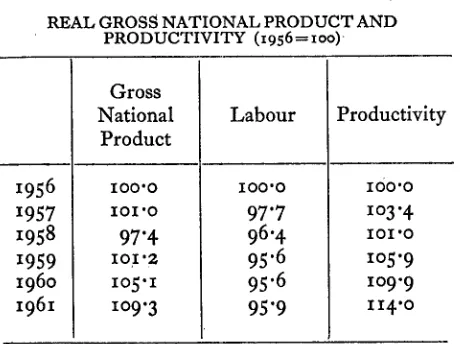
Partof the increase will be due simply to higher prices and gross national product in real terms is expected to rise only by 4 per cent., the same as in 1959 and 196o.
The increase in the real national product will be accompanied by a rise~ in overall productivity by more than 3 per cent., and an increase of the total labour force by less than I per cent. It is estimated that the number at work in the economy will rise by approximately 3,000 persons, which would be the net effect of a reduction of employment in agri-culture and an increase of employment in the non-agricultural sector, mainly in manufacturing and construction.
GROSS NATIONAL PRODUCT
1956 1957 1958 1959 196o 1961
At current prices
At constant (i953) prices
£ million
556"5 576"8 594"6 628’0 654.0 697’0
529"9 535"1 516:i 536.0 557"0 579’0
Rising earnings will stimulate personal expendi-ture. While in 196o £489 million was spent on consumer goods and services in i96I this should come to about £525 million. Public authorities current expenditure is expected to rise by £z million to £71 million. Gross domestic fixed capital formation will be much higher than in any year before. The value of increased fixed investment will be £14 million and should bring the total to
£1o6 million. 18
REAL GROSS NATIONAL PRODUCT AND PRODUCTIVITY (1956=Ioo)
Gross
National Labour Productivity Product
1956 I00"0 IO0"O I00’0
1957 I01"0 97"7 lO3 "4
1958 97"4 96"4 I01 "0
1959 IO!’2 95’6 1°5"9
196o IO5"I 95’6 lO9"9
1961 lO9"3 95’9 ii4.o
Movements in stocks of agriculture and of the non-agricultural sector of the economy will probably cancel out to a large extent this year. While stocks of merchandise, materials and unfinished products should be up by at least £io million, the value of physical changes in livestock on farms is expected to be down by £8 million.
Total exports of goods and services ,in 1961, thanks to an increase in external demand for Irish products and an increase in the tourist trade are estimated to rise by £32 million to £287 million. On the other hand, increased consumer expenditure and additions to stocks in step with the expansion of output should make for a rise of imports by £38 million to £294 million. Consequently the balance of payments is expected to show a deficit of £7 million.
Concluding Remarks
[image:18.600.316.547.34.206.2]In this exercise care has been taken to present an estimate not only of the gross national product total but also of major variables in the national economy. This procedure provides a system of checks, since ,the value of each individual variable must lend itself to rational explanation. However, in spite of the detail thus displayed, not all of the variables can be estimated with the same degree of confidence. This is especially true of personal expenditure andsavings. While personal expendi-ture has been estimated tO amount to £525 million, it would have been equally justifiable to put this figure several million pounds higher or lower.
generally about the trends of savings, imports and exports, it is still large enough to affect seriously the accuracy of estimates for relatively small values, such as the trade deficit, which will hardly exceed £io million either way, or private savings, which at present come to between £50 and £60 million. As for the trade deficit, the margin of error could
easily be in the region of 25 per cent., while for savings it may reach io per cent.
However, in setting out these estimates of all the relevant variables in the accounts a certain amount of confidence is being expressed that the data will be close enough to reality to allow an appraisal of the current state of affairs in the economic life of Ireland.
NET NATIONAL PRODUCT AT FACTOR COST BY SECTOR OF ORIGIN AND GROSS NATIONAL PRODUCT AT CURRENT PRICES
~o increase
£ million* % increase
f
1956 1957 1958 1959 196o I96I I957/56 I958/57 1959/58 I96o/59 1961/6o Personal Expenditure .. 426"9 436" I 456"3 465 489 525 2"2 4"6 1"9 5"2 7’4
Public Authorities current
expenditure .... 62"4 61’2 63"5 66 69 71 --1"9 3"8 3’9 4’5 2"9
Fixed Capital Formation 89.0 77"2 8o.8 85 92 io6 --13.3 4"7 5"2 8"2 I5"2
Stocks ... --7"4 --6.9 --5.o +2I +7 +2
Exports ... 194"4 217"8 220"6 23° 255 "87 12"0 1.3 4"3 lO"9 12"5
Less Imports .... 208.8 208.6 221"6 239 256 294 --0"1 6"2 7"9 7"1 14"8 Gross National Product 556"5 576"8 594"6 628 654 697 3"6 3"1 5"6 ,4"1 6.6
1956 1957 1958 1959 196o I96I I957/56 I958]57 1959/58 196o/59 1961/6o Agriculture ....
Industry ... Distribution, Transport
Other Domestic ..
Public Administration .. Stock Appreciation .., Rest of World ....
II9"6 121"3 67"1 84"1 4o’8 --7.o 28.7 131"8 117"2 66-1 86"0 41"7 --7"6 31’8 --8.6 4’3 3"2 6"o 4.6 5.0 12o’5 122"2 68.2 91,2 43"6 +0"7 33"4 13o 133 71 96 45 +i 32 6"0 9"o 5"4 7.0 4"3 8’6 134 144 74 I00 47 --I 35 142 157 78 IO7 49 38 I0"2 --3"4 --i.5 2.3 2"2 10"8 7"9 8"8 4"1 5"3 3"2 --4"2 3"I 8"3 4"2 4"2 4"4 9"4 National Income ..
Plus Taxes on Expend. Less Subsidies ..
454"6 91"3 --17.3 467"0 95"0 --15"8 479"8 97"9 --14"7 508 lO3 --16 533 lO6 --19 571 IIO --20 2"7 4.i --8"7 2"7 3"I --7"0 5"9 5"2 8"8 4"9 2’9 i8.8 7"I 3"8 5’3 Net National Product at
Market Prices .. Depreciation .... 528"6 27"9 546"2 30"6 563"0 3I’6 62o 34 661 36 595 33 6.6 5"9 3"3 9"7 5"7 4"4 3"I 3"3 4"2 3’O
4"I [ 6"6
I
Gross National Product 556"5 576"8 594’6 628 654 697 3"6 3"1 5"6
*Sources : 1956-1958 Central Statistics Office, Dublin ; 1959-1961 estimate Economic Research Institute.
EXPENDITURE ON GROSS NATIONAL PRODUCT AT CURRENT PRICES
*Sources : 1956-1958 Central Statistics Office, Dublin ; I959-I96i estimate Economic Research Institute.
GROSS DOMESTIC PHySIcAL CAPITAL FORMATION AT CURRENT PRICES
Fixed Capital
Dwellings ....
Roads ... ..
Other Construction .. Transport Equipment. ~.. Agric. Machinery - .. Other Equipment .. Total Fixed Capital
Formation ....
Change in Stocks
Livestocks .... Other Stocks 2. .. Total Value of Change in
Stocks ¯ ., ¯ .. Total Gross Domestic
Capital Formation ..
34"6 31"1
" 13"4 I 11"6 2"8 4"4 16"7 ] 14"3
89"o I 77"2 --0"4. ¯ --o.i --7"0 ¯ --6"8 --7"4 [--6"9
81"6I 70"3
£ million* 1958 " 1959
¯ 9’9 II
4"4
31"1 3
14’0 14
4"2 17’2 I~ 80.8 " 85
+3"2 +ii
--8.2 +1o
--5.0 +2I
75"8 lO6
196--~ i 96.---~
II I I2
3g
36
141
18
g
92 IO6
+-;o
+7 +2
99 ] lO8
m
I957/56 --31’2
--8"9
--IO’I
--13"4 57"I --14"4 --13’3
--13’8
% increase
1958/57 I959/58 196o/59 I96I/6O
~I5"4 II’I o.o 9.1
7"3 " 13"6 o:o 20.0 o’o [ 6"1
I. 9"1 I 5"6<
20"7 o’o o.o 28’6
--4"5 I-4"81 o,o I 25.o 2o’3 4"7 2z’2 z2"7
4’7 5"2 8.2 15’2
7.8 I 39.8 -6.6 I 9.1
*Sources : 1956-1958 Central Statistics Office, Dublin ; 1959-1961 estimate Economic Research Institute.
SAVINGS AND CAPITAL FORMATION
£ million* % increase
I959/58 I96I/6O
’rivate Savings .. 43"8 50"4 ;55 I5’I --3I’7 59"9 3’6 O’O
;overnment savings .. 2"5 6’i ;8 144’o 32"8 --1’2 --12"5 14"3
?otal Savings
(before adjustment for
stock appreciation) .. 46.3 56"5 42"5 63 64 22"0 --24’8 48.2 1"6 1"6 tdjustment for stock
appreciation .... --7"0 --7"6 ’" "+o’7 mI
?otal Savings .... ¯39’3 48"9 43"2
+g
63 24"4 -- II ’7 ¯48’I --1.6 --4.8)epreciation .... 27’9 30"6 31"6 33 34 9’7 3"3 4"4 3.0 5"9
~’et Foreign
Disinvestment .. +14"7 ,--9.2
I ~1.o
+9 +i )omestie physical"Capital Formation .. 81"6 70’3 75"8 1:O6 99
I --~[3"8
7’8 39"8 --6.6 9.1
q
*Sources : 1956-1958 Central Statistics Office, Dublin ; 1959-1961 estimate Economic Research Institute. ,
DISPOSABLE.PRIVATE INCOME AND SAVING .
.-National Incomet .. Government trading
Income .... National Debt Interest ,Other Transfer Income Private Income.. Taxes on Income Disposable Private Income .. Personal Expenditure .. Private Savings ..
£ million* 1956
i4¯~2
1957 1958 I959 I96O 1961
461.6 474" 6 479" i 5o7 534 571
--12"5 --13.6 --14"5 --15 --i6 --17 ~5"5 16’o X7 17 ~8
~4o:3 43"9 43"8
:,5
47go
5o3"6 520"4 524’4 554 584 622 ~32"9 ~3"9 33"7
?4
38 40 470"7 486"5 490"7 520 546 582 42o’9 436"145364~. ~46555
489 .5~3
43’8 50"4 57 57
increase
1957/5.6 1958/57 ~ 196°/59 .I96I/6°
.i
6"98’8 - 6’6 I
" 3’4" 6"7 6’3
8 1-21 271¯441 64
__ 3.____~oI --’6
I
.9 I i1._____~8m 5’3/ 0
6otI
6.646
"1
15"1 , "1 --31"7 "l 59"9 / 3"6 I o.o
*Sources : I956-I958 Central Statistics Office, Dublin; i959=i96i _estimate Economic Research Institute. #Before
adjusmaent for stock appreciation.