TESLA: Translation Evaluation of Sentences with
Linear-programming-based Analysis
Chang Liu1 and Daniel Dahlmeier2 and Hwee Tou Ng1,2
1Department of Computer Science, National University of Singapore 2NUS Graduate School for Integrative Sciences and Engineering
{liuchan1,danielhe,nght}@comp.nus.edu.sg
Abstract
We present TESLA-M and TESLA, two novel automatic machine translation eval-uation metrics with state-of-the-art perfor-mances. TESLA-M builds on the suc-cess of METEOR and MaxSim, but em-ploys a more expressive linear program-ming framework. TESLA further exploits parallel texts to build a shallow seman-tic representation. We evaluate both on the WMT 2009 shared evaluation task and show that they outperform all participating systems in most tasks.
1 Introduction
In recent years, many machine translation (MT) evaluation metrics have been proposed, exploiting varying amounts of linguistic resources.
Heavyweight linguistic approaches including RTE (Pado et al., 2009) and ULC (Giménez and Màrquez, 2008) performed the best in the WMT 2009 shared evaluation task. They exploit an ex-tensive array of linguistic features such as parsing, semantic role labeling, textual entailment, and dis-course representation, which may also limit their practical applications.
Lightweight linguistic approachessuch as ME-TEOR (Banerjee and Lavie, 2005), MaxSim (Chan and Ng, 2008), wpF and wpBleu (Popovi´c and Ney, 2009) exploit a limited range of linguis-tic information that is relatively cheap to acquire and to compute, including lemmatization, part-of-speech (POS) tagging, and synonym dictionaries.
Non-linguistic approachesinclude BLEU (Pap-ineni et al., 2002) and its variants, TER (Snover et al., 2006), among others. They operate purely at the surface word level and no linguistic resources are required. Although still very popular with MT researchers, they have generally shown inferior performances than the linguistic approaches.
We believe that the lightweight linguistic ap-proaches are a good compromise given the current state of computational linguistics research and re-sources. In this paper, we devise TESLA-M and TESLA, two lightweight approaches to MT eval-uation. Specifically: (1) the core features are F-measures derived by matching bags of N-grams; (2) both recall and precision are considered, with more emphasis on recall; and (3) WordNet syn-onyms feature prominently.
The main novelty of TESLA-M compared to METEOR and MaxSim is that we match the N-grams under a very expressive linear programming framework, which allows us to assign weights to the N-grams. This is in contrast to the greedy ap-proach of METEOR, and the more restrictive max-imum bipartite matching formulation of MaxSim. In addition, we present a heavier version TESLA, which combines the features using a lin-ear model trained on development data, making it easy to exploit features not on the same scale, and leaving open the possibility of domain adapta-tion. It also exploits parallel texts of the target lan-guage with other lanlan-guages as a shallow semantic representation, which allows us to model phrase synonyms and idioms. In contrast, METEOR and MaxSim are capable of processing only word syn-onyms from WordNet.
The rest of this paper is organized as follows. Section 2 gives a high level overview of the eval-uation task. Sections 3 and 4 describe TESLA-M and TESLA, respectively. Section 5 presents ex-perimental results in the setting of the WMT 2009 shared evaluation task. Finally, Section 6 con-cludes the paper.
2 Overview
We consider the task of evaluating machine trans-lation systems in the direction of translating the
source languageto the target language. Given a
reference translationand asystem translation, the
goal of an automatic machine translation evalua-tion algorithm such as TESLA(-M) is to output a score predicting the quality of the system transla-tion. Neither TESLA-M nor TESLA requires the source text, but as additional linguistic resources, TESLA makes use of phrase tables generated from parallel texts of the target language and other lan-guages, which we refer to aspivot languages. The source language may or may not be one of the pivot languages.
3 TESLA-M
This section describes TESLA-M, the lighter one among the two metrics. At the highest level, TESLA-M is the arithmetic average of F-measures between bags of N-grams (BNGs). A BNG is a multiset of weighted N-grams. Math-ematically, a BNG B consists of tuples(bi, bWi ), where each bi is an N-gram and bWi is a posi-tive real number representing its weight. In the simplest case, a BNG contains every N-gram in a translated sentence, and the weights are just the counts of the respective N-grams. However, to emphasize the content words over the function words, we discount the weight of an N-gram by a factor of 0.1 for every function word in the N-gram. We decide whether a word is a function word based on its POS tag.
In TESLA-M, the BNGs are extracted in the tar-get language, so we call thembags of target lan-guage N-grams(BTNGs).
3.1 Similarity functions
To match two BNGs, we first need a similarity measure between N-grams. In this section, we define the similarity measures used in our exper-iments.
We adopt the similarity measure from MaxSim assms. For unigramsxandy,
• If lemma(x) =lemma(y), thensms= 1.
• Otherwise, let
a=I(synsets(x)overlap with synsets(y))
b=I(POS(x) =POS(y))
where I(·) is the indicator function, then sms = (a+b)/2.
The synsets are obtained by querying WordNet (Fellbaum, 1998). For languages other than En-glish, a synonym dictionary is used instead.
We define two other similarity functions be-tween unigrams:
slem(x, y) =I(lemma(x) =lemma(y))
spos(x, y) =I(POS(x) =POS(y))
All the three unigram similarity functions general-ize to N-grams in the same way. For two N-grams x=x1,2,...,nandy=y1,2,...,n,
s(x, y) = (
0 if∃i, s(xi, yi) = 0 1
n
Pn
i=1s(xi, yi) otherwise
3.2 Matching two BNGs
Now we describe the procedure of matching two BNGs. We take as input the following:
1. Two BNGs, X andY. Theith entry in X isxi and has weightxWi (analogously foryj andyjW).
2. A similarity measure,s, that gives a similar-ity score between any two entries in the range of 0 to 1.
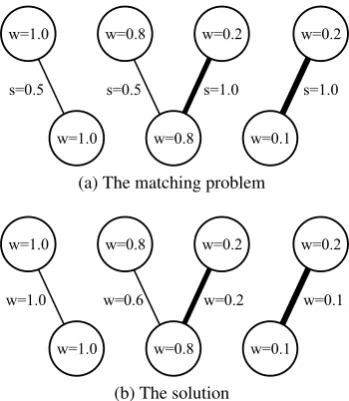
Intuitively, we wish to align the entries of the two BNGs in a way that maximizes the overall simi-larity. As translations often contain one-to-many or many-to-many alignments, we allow one entry to split its weight among multiple alignments. An example matching problem is shown in Figure 1a, where the weight of each node is shown, along with the similarity for each edge. Edges with a similarity of zero are not shown. The solution to the matching problem is shown in Figure 1b, and the overall similarity is0.5×1.0 + 0.5×0.6 + 1.0×0.2 + 1.0×0.1 = 1.1.
Mathematically, we formulate this as a (real-valued) linear programming problem1. The vari-ables are the allocated weights for the edges
w(xi, yj) ∀i, j
We maximize
X
i,j
s(xi, yj)w(xi, yj)
subject to
w(xi, yj) ≥ 0 ∀i, j
X
j
w(xi, yj) ≤ xWi ∀i
X
i
w(xi, yj) ≤ yjW ∀j
w=1.0 w=0.8 w=0.2 w=0.1
w=1.0 w=0.8 w=0.1 w=0.2
s=0.5 s=0.5 s=1.0 s=1.0
(a) The matching problem
w=1.0 w=0.8 w=0.2 w=0.1
w=1.0 w=0.8 w=0.1 w=0.2
w=1.0 w=0.6 w=0.2 w=0.1
[image:3.595.95.270.60.261.2](b) The solution
Figure 1: A BNG matching problem
The value of the objective function is the overall similarityS. Assuming Xis the reference andY is the system translation, we have
Precision = PS
jyjW
Recall = PS
ixWi
The F-measure is derived from the precision and the recall:
F = Precision×Recall
α×Precision + (1−α)×Recall
In this work, we setα = 0.8, following MaxSim. The value gives more importance to the recall than the precision.
3.3 Scoring
The TESLA-M sentence-level score for a refer-ence and a system translation is the arithmetic av-erage of the BTNG F-measures for unigrams, bi-grams, and trigrams based on similarity functions smsandspos. We thus have3×2 = 6features for TESLA-M.
We can compute a system-level score for a ma-chine translation system by averaging its sentence-level scores over the complete test set.
3.4 Reduction
When everyxWi andyjW is 1, the linear program-ming problem proposed above reduces toweighted bipartite matching. This is a well known result; see for example, Cormen et al. (2001) for details.
This is the formalism of MaxSim, which precludes the use of fractional weights.
If the similarity function is binary-valued and transitive, such as slem and spos, then we can use a much simpler and faster greedy matching procedure: the best match is simply
P
gmin(
P
xi=gx
W i ,
P
yi=gy
W i ).
4 TESLA
Unlike the simple arithmetic average used in TESLA-M, TESLA uses a general linear com-bination of three types of features: BTNG F-measures as in TESLA-M, F-F-measures between bags of N-grams in each of the pivot languages, calledbags of pivot language N-grams(BPNGs), and normalized language model scores of the sys-tem translation, defined as n1logP, where n is the length of the translation, and P the language model probability. The method of training the lin-ear model depends on the development data. In the case of WMT, the development data is in the form of manual rankings, so we train SVMrank
(Joachims, 2006) on these instances to build the linear model. In other scenarios, some form of re-gression can be more appropriate.
The rest of this section focuses on the genera-tionof the BPNGs. Their matching is done in the same way as described for BTNGs in the previous section.
4.1 Phrase level semantic representation
Given a sentence-aligned bitext between the target language and a pivot language, we can align the text at the word level using well known tools such as GIZA++ (Och and Ney, 2003) or the Berkeley aligner (Liang et al., 2006; Haghighi et al., 2009). We observe that the distribution of aligned phrases in a pivot language can serve as a se-mantic representation of a target language phrase. That is, if two target language phrases are often aligned to the same pivot language phrase, then they can be inferred to be similar in meaning. Similar observations have been made by previous researchers (Bannard and Callison-Burch, 2005; Callison-Burch et al., 2006; Snover et al., 2009).
the phrasesgood morningandhelloare unrelated even with a synonym dictionary, but they both very often align to the same French phrasebonjour, and we conclude they are semantically related to a high degree.
4.2 Segmenting a sentence into phrases
To extend the concept of this semantic repretation of phrases to sentences, we segment a sen-tence in the target language into phrases. Given a phrase table, we can approximate the probability of a phrasepby:
P r(p) = PN(p)
p0N(p0)
(1)
whereN(·)is the count of a phrase in the phrase table. We then define the likelihood of seg-menting a sentence S into a sequence of phrases
(p1, p2, . . . , pn)by:
P r(p1, p2, . . . , pn|S) =
1
Z(S)
n
Y
i=1
P r(pi) (2)
where Z(S) is a normalizing constant. The seg-mentation ofSthat maximizes the probability can be determined efficiently using a dynamic pro-gramming algorithm. The formula has a strong preference for longer phrases, as every P r(p) is a small fraction. To deal with out-of-vocabulary (OOV) words, we allow any single wordwto be considered a phrase, and if N(w) = 0, we set N(w) = 0.5instead.
4.3 BPNGs as sentence level semantic representation
Simply merging the phrase-level semantic rep-resentation is insufficient to produce a sensible sentence-level semantic representation. As an ex-ample, we consider two target language (English) sentences segmented as follows:
1. ||| Hello , ||| Querrien ||| . |||
2. ||| Morning , sir . |||
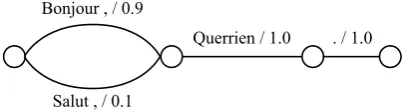
A naive comparison of the bags of aligned pivot language (French) phrases would likely conclude that the two sentences are completely unrelated, as the bags of aligned phrases are likely to be completely disjoint. We tackle this problem by constructing a confusion network representation of the aligned phrases, as shown in Figures 2 and
Bonjour , / 0.9
Salut , / 0.1
[image:4.595.315.520.62.118.2]Querrien / 1.0 . / 1.0
Figure 2: A confusion network as a semantic rep-resentation
Bonjour , monsieur . / 1.0
Figure 3: A degenerate confusion network as a se-mantic representation
3. A confusion network is a compact representa-tion of a potentially exponentially large number of weighted and likely malformed French sentences. We can collect the N-gram statistics of this ensem-ble of French sentences efficiently from the confu-sion network representation. For example, the tri-gramBonjour , Querrien2would receive a weight of0.9×1.0 = 0.9in Figure 2. As with BTNGs, we discount the weight of an N-gram by a factor of 0.1 for every function word in the N-gram, so as to place more emphasis on the content words.
The collection of all such N-grams and their corresponding weights forms the BPNG of a sen-tence. The reference and system BPNGs are then matched using the algorithm outlined in Section 3.2.
4.4 Scoring
The TESLA sentence-level score is a linear com-bination of (1) BTNG F-measures for unigrams, bigrams, and trigrams based on similarity func-tionssmsandspos, (2) BPNG F-measures for un-igrams, bun-igrams, and trigrams based on similar-ity functions slem and spos for each pivot lan-guage, and (3) normalized language model scores. In this work, we use two language models. We thus have 3 ×2 features from the BTNGs, 3 ×
2×#pivot languagesfeatures from the BPNGs, and 2 features from the language models. Again, we can compute system-level scores by averaging the sentence-level scores.
5 Experiments
5.1 Setup
We test our metrics in the setting of the WMT 2009 evaluation task (Callison-Burch et al., 2009). The manual judgments from WMT 2008 are used
as the development data and the metric is evalu-ated on WMT 2009 manual judgments with re-spect to two criteria: sentence level consistency and system level correlation.
The sentence level consistency is defined as the percentage of correctly predicted pairs among all the manually judged pairs. Pairs judged as ties by humans are excluded from the evaluation. The system level correlation is defined as the average Spearman’s rank correlation coefficient across all translation tracks.
5.2 Pre-processing
We POS tag and lemmatize the texts using the fol-lowing tools: for English, OpenNLP POS-tagger3 and WordNet lemmatizer; for French and German, TreeTagger4; for Spanish, the FreeLing toolkit (Atserias et al., 2006); and for Czech, the Morce morphological tagger5.
For German, we additionally perform noun compound splitting. For each noun, we choose the split that maximizes the geometric mean of the fre-quency counts of its parts, following the method in (Koehn and Knight, 2003):
max
n,p1,p2,...,pn " n
Y
i=1
N(pi)
#n1
The resulting compound split sentence is then POS tagged and lemmatized.
Finally, we remove all non-alphanumeric tokens from the text in all languages. To generate the lan-guage model features, we train SRILM (Stolcke, 2002) trigram models with modified Kneser-Ney discounting on the supplied monolingual Europarl and news commentary texts.
We build phrase tables from the supplied news commentary bitexts. Word alignments are pro-duced by the Berkeley aligner. The widely used phrase extraction heuristic in (Koehn et al., 2003) is used to extract phrase pairs and phrases of up to 4 words are collected.
5.3 Into-English task
For each of the BNG features, we generate three scores, for unigrams, bigrams, and trigrams re-spectively. For BPNGs, we generate one such triple for each of the four pivot languages supplied, namely Czech, French, German, and Spanish.
3
opennlp.sourceforge.net 4
www.ims.uni-stuttgart.de/projekte/corplex/TreeTagger 5ufal.mff.cuni.cz/morce/index.php
System correlation
Sentence consistency
TESLA 0.8993 0.6324
TESLA-M 0.8718 0.6097
ulc 0.83 0.63
maxsim 0.80 0.62
[image:5.595.315.519.62.162.2]meteor-0.6 0.72 0.50
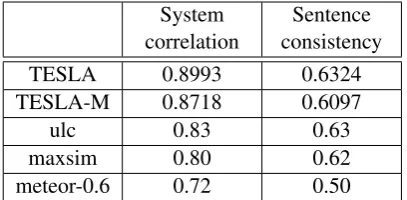
Table 1: Into-English task on WMT 2009 data
Table 1 compares the scores of TESLA and TESLA-M against three participants in WMT 2009 under identical settings6: ULC (a heavy-weight linguistic approach with the best per-formance in WMT 2009), MaxSim, and ME-TEOR. The results show that TESLA outperforms all these systems by a substantial margin, and TESLA-M is very competitive too.
5.4 Out-of-English task
A synonym dictionary is required for target lan-guages other than English. We use the freely avail-able Wiktionary dictionary7 for each language. For Spanish, we additionally use the Spanish WordNet, a component of FreeLing.
Only one pivot language (English) is used for the BPNG. For the English-Czech task, we only have one language model instead of two, as the Europarl language model is not available.
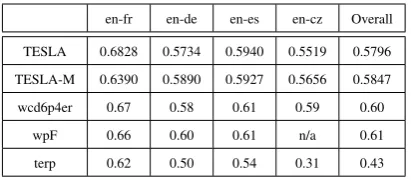
Tables 2 and 3 show the sentence-level consis-tency and system-level correlation respectively of TESLA and TESLA-M against the best reported results in WMT 2009 under identical setting. The results show that both TESLA and TESLA-M give very competitive performances. Interestingly, TESLA and TESLA-M obtain similar scores in the out-of-English task. This could be because we use only one pivot language (English), compared to four in the into-English task. We plan to inves-tigate this phenomenon in our future work.
6 Conclusion
This paper describes TESLA-M and TESLA. Our main contributions are: (1) we generalize the bipartite matching formalism of MaxSim into a more expressive linear programming framework;
6The original WMT09 report contained erroneous results. The scores here are the corrected results released after publi-cation.
en-fr en-de en-es en-cz Overall
TESLA 0.6828 0.5734 0.5940 0.5519 0.5796
TESLA-M 0.6390 0.5890 0.5927 0.5656 0.5847
wcd6p4er 0.67 0.58 0.61 0.59 0.60
wpF 0.66 0.60 0.61 n/a 0.61
terp 0.62 0.50 0.54 0.31 0.43
Table 2: Out-of-English task sentence-level con-sistency on WMT 2009 data
en-fr en-de en-es en-cz Overall
TESLA 0.8529 0.7857 0.7272 0.3141 0.6700
TESLA-M 0.9294 0.8571 0.7909 0.0857 0.6657
wcd6p4er -0.89 0.54 -0.45 -0.1 -0.22
wpF 0.90 -0.06 0.58 n/a n/a
[image:6.595.79.285.61.151.2]terp -0.89 0.03 -0.58 -0.40 -0.46
Table 3: Out-of-English task system-level correla-tion on WMT 2009 data
(2) we exploit parallel texts to create a shallow se-mantic representation of the sentences; and (3) we show that they outperform all participants in most WMT 2009 shared evaluation tasks.
Acknowledgments
This research was done for CSIDM Project No. CSIDM-200804 partially funded by a grant from the National Research Foundation (NRF) ad-ministered by the Media Development Authority (MDA) of Singapore.
References
J. Atserias, B. Casas, E. Comelles, M. González, L. Padró, and M. Padró. 2006. Freeling 1.3: Syn-tactic and semantic services in an open-source NLP
library. InProceedings of LREC.
S. Banerjee and A. Lavie. 2005. METEOR: An auto-matic metric for MT evaluation with improved
cor-relation with human judgments. InProceedings of
the ACL Workshop on Intrinsic and Extrinsic Eval-uation Measures for Machine Translation and/or Summarization.
C. Bannard and C. Callison-Burch. 2005.
Paraphras-ing with bilParaphras-ingual parallel corpora. InProceedings
of ACL.
C. Callison-Burch, P. Koehn, and M. Osborne. 2006. Improved statistical machine translation using
para-phrases. InProceedings of HLT-NAACL.
C. Callison-Burch, P. Koehn, C. Monz, and
J. Schroeder. 2009. Findings of the 2009
Workshop on Statistical Machine Translation. In
Proceedings of WMT.
Y.S. Chan and H.T. Ng. 2008. MAXSIM: A maximum similarity metric for machine translation evaluation. InProceedings of ACL.
T. Cormen, C.E. Leiserson, R.L. Rivest, and C. Stein,
2001.Introduction to Algorithms. MIT Press,
Cam-bridge, MA.
C. Fellbaum, editor. 1998. WordNet: An electronic
lexical database. MIT Press, Cambridge, MA.
J. Giménez and L. Màrquez. 2008. A smorgasbord of
features for automatic MT evaluation. In
Proceed-ings of the Third WMT.
A. Haghighi, J. Blitzer, J. DeNero, and D. Klein. 2009. Better word alignments with supervised ITG
mod-els. InProceedings of ACL-IJCNLP.
T. Joachims. 2006. Training linear svms in linear time. InProceedings of KDD.
P. Koehn and K. Knight. 2003. Empirical methods for
compound splitting. InProceedings of EACL.
P. Koehn, F.J. Och, and D. Marcu. 2003. Statistical
phrase-based translation. In Proceedings of
HLT-NAACL.
P. Liang, B. Taskar, and D. Klein. 2006. Alignment by
agreement. InProceedings of HLT-NAACL.
F.J. Och and N. Ney. 2003. A systematic comparison
of various statistical alignment models.
Computa-tional Linguistics, 29(1).
S. Pado, M. Galley, D. Jurafsky, and C.D. Man-ning. 2009. Robust machine translation evaluation
with entailment features. In Proceedings of
ACL-IJCNLP.
K. Papineni, S. Roukos, T. Ward, and W.-J. Zhu. 2002. BLEU: A method for automatic evaluation of
ma-chine translation. InProceedings of ACL.
M. Popovi´c and H. Ney. 2009. Syntax-oriented eval-uation measures for machine translation output. In Proceedings of WMT.
M. Snover, B. Dorr, R. Schwartz, L. Micciulla, and J. Makhoul. 2006. A study of translation edit rate
with targeted human annotation. InProceedings of
AMTA.
M. Snover, N. Madnani, B. Dorr, and R. Schwartz. 2009. Fluency, adequacy, or HTER? Exploring dif-ferent human judgments with a tunable MT metric. InProceedings of WMT.
A. Stolcke. 2002. SRILM - an extensible language