Using fMRI activation to conceptual stimuli to evaluate methods for
extracting conceptual representations from corpora
Barry Devereux
Centre for Speech, Language and the Brain Department of Experimental Psychology
University of Cambridge
Colin Kelly & Anna Korhonen Computer Laboratory University of Cambridge
{ck329,alk23}@cam.ac.uk
Abstract
We present a series of methods for deriv-ing conceptual representations from corpora and investigate the usefulness of the fMRI data and machine learning methodology of Mitchell et al. (2008) as a basis for evaluat-ing the different models. Within this frame-work, the quality of a semantic model is quan-tified by its ability to predict the fMRI ac-tivation associated with conceptual stimuli. Mitchell et al. used a manually-acquired set of verbs as the basis for their semantic model; in this paper, we also consider automatically ac-quired feature-norm-like semantic representa-tions. These models make different assump-tions about the kinds of information avail-able in corpora that is relevant to represent-ing conceptual knowledge. Our results in-dicate that automatically-acquired representa-tions can make equally powerful predicrepresenta-tions about the brain activity associated with the stimuli.
1 Introduction
Mitchell et al. (2008) presented a novel approach for predicting human brain activity associated with con-ceptual stimuli. This approach represents a useful development for interdisciplinary researchers inter-ested in lexical semantics, for several reasons. Most broadly, it is useful in testing the hypothesis that distributional properties of words in corpora can re-veal important information about the meanings of words. A strong version of this hypothesis (i.e. that children in part learn the meaning of concrete con-cept words from co-occurring words in discourse
that they are exposed to) has formed the basis of one class of probabilistic cognitive models of con-ceptual representation (Andrews et al., 2005; An-drews et al., 2009; Steyvers, 2010). Furthermore this approach is useful for testing hypotheses about the kind of co-occurring information that is useful for representing conceptual semantics. In Mitchell et al.’s work (2008), for example, they adopt the po-sition that the meaning of concrete concepts is en-coded in the brain with information associated with basic sensory and motor activities (such as actions involving changes to spatial relationships and phys-ical actions performed on objects).
At a more technical level, Mitchell et al.’s fMRI activation data1give researchers developing
feature-based models of conceptual representation an im-portant benchmark for evaluation. For these re-searchers, a key problem is the lack of a reason-able “gold standard” against which the quality of the representations generated by a computational model may be evaluated. Previous research has adopted two main approaches to evaluation. Firstly, some models – especially those aiming to extract repre-sentations composed of psychologically meaningful semantic feature units, such as Baroni et al. (2009) – have been evaluated against features gathered in large scale property norming studies (e.g. McRae et al. (2005)).2 By comparing the system output against features elicited by people, this kind of
eval-1
fMRI data measures changes in oxygen concentrations in the brain. These changes are tied to cognitive processes.
2
In property norming studies, a group of human subjects are asked to cite features which come to mind for a given concept. These features are compiled by frequency (with a minimum fre-quency cut-off) to generate a list of features for each concept.
uation aims to test the psychological validity of com-putational methods. Furthermore, it allows a fine-grained analysis of performance, for example by re-vealing the classes of features (part-of, taxonomic, etc) which a given model is particularly good at ex-tracting (Baroni et al., 2008).
However, property norms come with important caveats. One problem is that they tend to over-represent informative or salient information about concepts whilst under-representing other kinds of features. For example, participants report that camels have humps, but not that camels have hearts, even though all participants are likely to have both pieces of information accessible in their representa-tion of the conceptCAMEL. If a model is successful in extracting these less salient features, there is no way of evaluating their correctness using property norms. A related issue is that participants can only report verbalizable features, which may not repre-sent the total sum of their conceptual knowledge (Murphy, 2002; McRae et al., 2005).
A second problem with using property norms as the basis of evaluation is that there is often no direct lexical match between feature terms appearing in the system output and the norms. Feature norms are typ-ically normalized such that near-synonymous prop-erties (e.g.is endangered,is an endangered species,
is almost extinct, etc., for WHALE) given by differ-ent participants are mapped to the same feature la-bel (e.g.is endangered). As a consequence, a model may correctly extract endangered for WHALE, but other lexical forms of the same feature will not match any feature in the norms. One solution to this is to create an expansion set for each feature which includes its synonyms (Baroni et al., 2008). How-ever, this is only a partial solution because lexical variation in features is not limited to synonyms.
A second approach to evaluating semantic mod-els uses classification or similarity data. For exam-ple, Andrews et al. (2009) evaluated their models by calculating cosine similarity scores between seman-tic representations and using these similarity scores to predict behavioral data which are contingent on the semantic similarity between pairs of concepts (e.g. lexical substitution errors, semantic priming latencies, word-association norms, etc). Although this approach is psychologically motivated, it evalu-ates a set of extracted features more indirectly than
comparison with norm data. In computational lin-guistics, a similarly indirect evaluation method is to cluster the extracted representations. This approach avoids the difficulties in evaluating individual fea-tures; however it only allows consideration along one dimension of the data, namely the similarity be-tween pairs of concepts.
fMRI data such as the Mitchell et al. (2008) dataset offers an advancement over both of these evaluation techniques. Unlike, for example, prop-erty norming data, fMRI data offers direct insight into how the brain is functioning in response to given stimuli. Its multidimensional nature makes it eas-ier to inspect what aspects of meaning a particular model is performing strongly or weakly on, and al-lows for better control of experimental variation. Fi-nally, it avoids the two major issues associated with property norms, which we outlined above.
This paper is structured as follows. In the next section, we briefly describe the models which we used to extract conceptual representations for the 60 concepts in the Mitchell et al. (2008) dataset. In Section 3, we outline our experimental objectives, and the framework we adopt for testing our seman-tic models. In Section 4, we present the results of our evaluation, which indicate above chance perfor-mance for each of the models. Finally, we exam-ine the differences between models by investigating for which concepts prediction of the fMRI activity is poorest, and discuss these differences with respect to the differing assumptions made by the methods.
2 Semantic models
We consider four different semantic models in this paper, which are described briefly below. These models were selected as we were interested in the various kinds of knowledge (part-of-speech, syntac-tic, and semantic) in corpora available to the extrac-tion process, and the extent to which the use of these types of knowledge can affect the quality of the ex-tracted conceptual representations.
2.1 Mitchell verb-based semantic model
relevant to a target concept’s representation can be estimated from the concept word’s frequency of co-occurrence with 25 sensory-motor verbs (eat, ma-nipulate,push, etc) in a very large corpus. Our reim-plementation of this method used the co-occurrence statistics provided by Mitchell et al.3 which were extracted from the Googlen-gram corpus consisting of 1 trillion words of web text.
2.2 SVD model
Secondly, we implemented a co-occurrence-based Singular Value Decomposition (SVD) model based on the one described by Baroni and colleagues (Ba-roni and Lenci, 2008; Ba(Ba-roni et al., 2009). This model combines aspects of both the HAL (Landauer et al., 1998) and LSA (Lund and Burgess, 1996) models in constructing representations for words based on their co-occurrences in texts. A word-by-word co-occurrence matrix was constructed for our corpus, storing how often each target word co-occurred with each context word. The set of context words consisted of the 5,000 most frequent content words (i.e. words not occurring in a stop-list of func-tion words) appearing in the corpus. The set of target words consisted of the 60 concept terms appearing in the fMRI dataset, supplemented with the 10,000 most frequent content words in the corpus (with the exception of the top 10 most frequent words). For calculating co-occurrence frequency between target and context words, the context window was defined by sentence boundaries: two words were considered to co-occur if they appeared in the same sentence4.
Following Baroni and Lenci (2008), the dimen-sionality of the target-word × context-word co-occurrence matrix was reduced to 150 columns by singular value decomposition. That is, the singu-lar value decomposition of the co-occurrence matrix was computed and the 150 left singular vectors that accounted for most of the variance, multiplied by the corresponding singular values, were used as the 150-dimensional representation of each target term.
Sim-3
http://www.cs.cmu.edu/˜tom/science2008/ semanticFeatureVectors.html
4
In Baroni et al.’s implementation a context window of 5 (Baroni and Lenci, 2008) or 20 (Baroni et al., 2009) words either side of the target word was used instead; we chose a sentence-based context window as it is analogous to the context used in our experimental method (described in the following section).
ilarity between pairs of target words was calculated as the cosine between their vectors, and for each of the 60 concept words in the experimental stimuli we chose the 200 most similar target words to act as the feature terms extracted by the model. The corpus used with this model was the British National Cor-pus (BNC) (Leech et al., 1994).
2.3 Novel extraction method
Finally we implemented a novel extraction method, which aims to extract property-norm-like, psy-chologically meaningful features from corpus data (Kelly et al., 2010). The method aims to extract se-mantically unconstrained feature triples of the form
concept-relation-feature , wherefeatureis a feature (either noun or adjective) of the target concept and
3 Experiment
As mentioned above, we are primarily interested in using the fMRI data to evaluate the quality of the different methods for extracting conceptual repre-sentations from corpora (rather than being interested in investigating methods for predicting fMRI activa-tion). We make no attempt to build on the method described by Mitchell et al. (2008), although there are likely to be many interesting avenues through which that method could be extended.5We therefore
followed the Mitchell et al. methodology as closely as possible, using the same multiple regression train-ing and leave-two-out cross-validation paradigms as presented in their paper and supporting online ma-terial. The only parameter that we varied was the extraction method (and corpus) that was used to gen-erate the feature-vectors associated with the 60 con-cepts that were used during the training phase. The quality of the predictions generated for the concepts using each semantic model can therefore be adopted as an index of model performance.
The Mitchell et al. method uses co-occurrence with a specific set of 25 manually selected verbs (eat, push, etc) that are the same for each concept. This results in 25-dimensional feature vectors for in-put into training. However, for both the SVD model and our triple extraction models there are noa pri-oriconstraints on the number of unique features that can be extracted for the concepts. For these mod-els, we selected the top 200 features associated with each concept; therefore, across all 60 concepts in the Mitchell et al. dataset, there are thousands of unique features extracted which are used in the concepts’ representations. To ensure that the linear regres-sion model for each method would be fitted using the same number of free parameters during training (thereby maximizing the comparability of the dif-ferent methods), we reduced the dimensionality of the generated feature spaces for the SVD method and the two triple-extraction methods using Prin-cipal Components Analysis (PCA). The concept×
feature extraction frequency matrices for the three models were submitted to PCA, and the first 25 com-ponents (i.e. those comcom-ponents which best
charac-5For example, the method currently makes the simplifying
assumption that the activity in neighbouring voxels is indepen-dent.
Triples (weighted) SVD
PCA1 PCA2 PCA1 PCA2 Highest-valued concepts
horse house coat butterfly cat apartment skirt cow
cow dog shirt ant
dog igloo pants bee
beetle car dress lettuce
Lowest-valued concepts
knife pants car desk
door coat watch arm
hammer dress horse chair
saw skirt dog knife
[image:4.612.315.539.63.254.2]chisel shirt fly leg
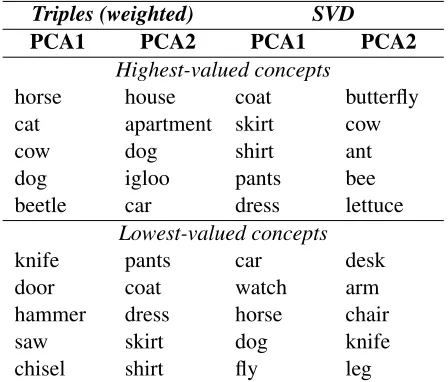
Table 1: Highest- and lowest-valued concepts for the first two components for the SVD and weighted triple-extraction methods.
terized the variance of the original features) for each model were selected. In the case of the SVD model, these 25 dimensions explained 77.7% of the vari-ance in the original 3,061-dimensional vectors. For our unweighted extraction method, the 25 extracted components explained 63.0% of the original 5,525 dimensions; for the weighted method the compo-nents explained 71.5% of the original 6,567 dimen-sions.
It is interesting to consider the kind of seman-tic information that is being captured by the resul-tant PCA components. In particular, the compo-nents appear to capture meaningful distinctions be-tween stimuli. For example, the first PCA com-ponent for our weighted triple extraction method can be interpreted as the concepts’ degree of “an-imalness” (animal stimuli have high values on this component). Table 1 presents the five highest and lowest-valued concepts for the first two components for the SVD model and the weighted triple extrac-tion model. Concepts which overlap with respect to a specific set of semantic properties tend to have high or low values on a given dimension, indicating that that component is capturing a specific cluster of co-occurring semantic features. For example, PCA1 for SVD can be interpreted as “has features associ-ated with clothing”.
Method Feature Type POS Syntax Semantics
Mitchell 25 verbs no no no
SVD tuples (content-words) yes no no
[image:5.612.93.528.63.133.2]triple-extraction method (unweighted) feature-triples yes yes no triple-extraction method (weighted) feature-triples yes yes yes
Table 2: Comparison of the information available to each model.
et al. model and our models is that while Mitchell et al. posit that certain sensory-motor function verbs can act as important features of concepts, our models instead place more importance on intrinsic semantic features.
Finally, Table 2 gives a summary comparison of the different models, in terms of whether or not each uses part of speech (POS) data, syntactic informa-tion (i.e. GRs), and semantic filtering (Secinforma-tion 2.3).
It should be noted that the BNC corpus (used with the SVD model and our triple-extraction method) is 10,000 times smaller than the corpus from which the Mitchell et al. feature vectors are derived. As such the semantic representations we extract with our method need to make better use of the data avail-able in the corpus if they are to compete with the verb-based features used by Mitchell et al.’s method.
4 Results
The accuracy for each of the four methods was eval-uated using a leave-two-out validation paradigm. There are 1,770 possible pairs of concepts that can be drawn from the set of 60 concept stimuli. Train-ing was performed separately for each participant and for each of the 1,770 held-out pairs. Given a particular participant and held-out pair, for each voxelv we fit the activation at that voxel to the set of 58 training items with multiple linear regression, using as predictor variables the elements of the 25-dimensional feature vectors associated with each of the 58 concepts. Training therefore yields a set of 25 β-coefficients, which can be used to generate a prediction for the activation yv of voxel v for the held-out wordwusing the equation
yvpred =
25 X
i=1
βv,ifi,w (1)
wherefi,wis theithelement of the feature vector for
wordw(see Mitchell et al. (2008) for details). Over all voxels, this method gives a prediction for the ac-tivation with respect to the held-out word wwhich can then be compared to the observed activation for that stimulus.
Rather than comparing the activity between pre-dicted and observed images using all voxels, we compared images using only the 500 most stable voxels for each participant. For each participant, the 500 most stable voxels were the voxels which gave the most consistent pattern of activation across the six presentations of all 60 stimuli (see Mitchell et al. (2008) for details).
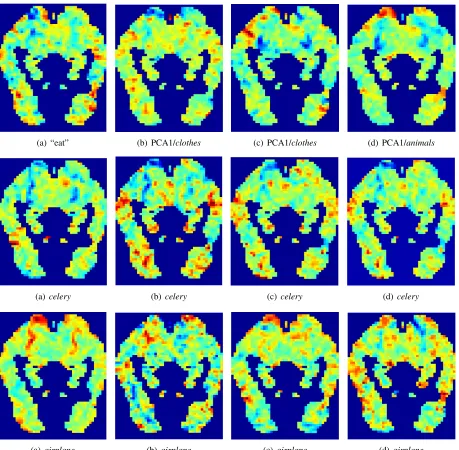
The top row of Figure 1 presents the learned co-efficients for one feature dimension for each of the four semantic models considered in our experiments (for these images, all voxels rather then the 500 most stable voxels are used). For the Mitchell et al. method, the coefficients presented correspond to the verbeat; for the other models the feature is the PCA component that explained the most variance in the original representations. We also present the pre-dicted images for the concepts CELERY and AIR -PLANE, calculated on the coefficients learned over the remaining 58 concepts. Importantly, for the Mitchell et al. method (column (a)), the learned co-efficients foreatand the predicted images forCEL -ERY and AIRPLANE agree with those reported by Mitchell et al. (2008, Figure 2 & online supplemen-tary material6).
We calculated similarity between predicted and observed images using both cosine and Pearson cor-relation and the 500 most stable voxels; we report the results using Pearson correlation here as this measure consistently gave slightly better accuracies
6
(a) “eat” (b) PCA1/clothes (c) PCA1/clothes (d) PCA1/animals
(a)celery (b)celery (c)celery (d)celery
[image:6.612.79.538.98.548.2](a)airplane (b)airplane (c) airplane (d)airplane
Figure 1: Learned coefficients on a selected feature dimension (top row) and predicted activation forCELERY(middle row) andAIRPLANE(bottom row) for four semantic models: (a) Mitchell et al. (2008), (b) SVD (c) triple extraction method (unweighted), and (d) triple extraction method (weighted). Warmer colours indicate higher values (i.e. larger
Method P1 P2 P3 P4 P5 P6 P7 P8 P9 Mean
Mitchell et al. (2008) 0.84 0.83 0.76 0.81 0.79 0.66 0.73 0.64 0.68 0.75
SVD 0.82 0.67 0.79 0.83 0.74 0.64 0.64 0.70 0.75 0.73
Triple-extraction (unweighted) 0.82 0.71 0.79 0.80 0.70 0.69 0.65 0.53 0.78 0.72 Triple-extraction (weighted) 0.82 0.72 0.76 0.83 0.73 0.65 0.68 0.51 0.76 0.72
Table 3: Accuracy results for the four semantic models.
for each of the four models (the results are very simi-lar using the cosine measure). Following Mitchell et al. (2008; supplementary material), a match score for each held out pair w1 and w2 was calculated
as the sum of the similarities between the correctly aligned predicted and observed images:
a=sim(w1pred, wobs1 ) +sim(wpred2 , wobs2 ) (2)
Similarly a mismatch score was calculated as
b=sim(w1pred, wobs2 ) +sim(wpred2 , w1obs) (3)
Cases where the match score is greater than the mis-match score (i.e. a > b) count as successes for the model (i.e. the model correctly identifies the two predicted images). Otherwise there is a failure by the model (i.e. the model identifies the observed im-age forw1as beingw2and vice-versa).
Table 3 presents the results of the leave-two-out cross-validation evaluation, giving the propor-tion (across all 1,770 pairs) of predicted images for the held-out pairs that were correctly matched to the observed images.7 The original Mitchell et al. (2008) model has the best mean performance, al-though across the nine participants, there is no sig-nificant difference in accuracy between any of the models (|t(8)| < 1.49, p > 0.17, for all pairwise paired t-tests between Mitchell et al. (2008), SVD, and weighted triple extraction).
That there is no difference between the perfor-mance of the Mitchell et al. (2008), SVD and triple
7Our results for the Mitchell et al. (2008) method are
simi-lar, though not identical, to those reported in that paper (where the reported mean accuracy across all participants is 0.77, using cosine similarity). Our implementation of the method for select-ing the 500 most stable voxels yields slightly different voxels from those obtained by Mitchell et al. (2008; see supplemen-tary material). In any case, the same set of 500 voxels for each participant were used for generating the results of each model presented here, and so we do not believe that this discrepancy affects comparison of the different models.
extraction methods is surprising, given the different kinds of information that are available to the dif-ferent models. In particular, the models that auto-matically acquire very general and semantically un-constrained feature-based representations perform as well as the model which uses a set of manually-selected sensory-motor verbs, even though the rep-resentations generated for these models are derived from 10,000 times less corpus data.
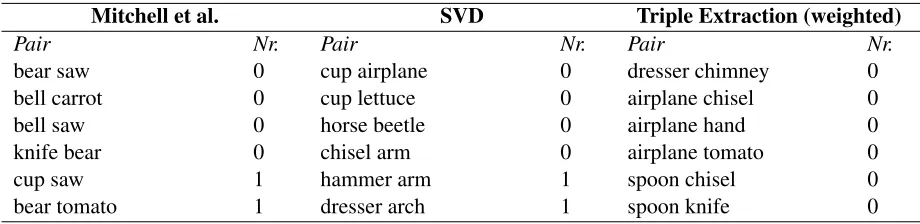
As mentioned in our introduction, an advantage of evaluating against the fMRI dataset is that this multi-dimensional data allows us to investigate strengths and weaknesses of different models in a way which is not possible using similarity or clustering-based evaluation. As a very simple investigation of spe-cific differences in model performance, we present in Table 4 the pairs of concepts for which each of the models performs most poorly on. The Mitchell et al. (2008) method appears to do poorly on pairs of con-cepts where a constituent word can be ambiguous with respect to its part-of-speech (e.g. SAW,BEAR). This is not surprising, given that part-of-speech data is not available in the Google n-gram corpus used with this method. The performance of the Mitchell et al. method might therefore be improved signifi-cantly by applying heuristics to the n-gram data to make inferences about the correct part-of-speech of instances of words likeSAWandBEAR. For the SVD and weighted triple extraction methods, which both use the BNC corpus, there is some evidence that the models are performing poorly for relatively low frequency words8 (e.g. CHISEL), words which are semantically ambiguous as nouns (e.g. ARM), and pairs which are semantically similar (e.g.SPOON& KNIFE). This suggests that the SVD and triple ex-traction methods may perform better with a larger and more diverse corpus.
8
Mitchell et al. SVD Triple Extraction (weighted)
Pair Nr. Pair Nr. Pair Nr.
bear saw 0 cup airplane 0 dresser chimney 0
bell carrot 0 cup lettuce 0 airplane chisel 0
bell saw 0 horse beetle 0 airplane hand 0
knife bear 0 chisel arm 0 airplane tomato 0
cup saw 1 hammer arm 1 spoon chisel 0
[image:8.612.75.535.62.174.2]bear tomato 1 dresser arch 1 spoon knife 0
Table 4: Leave-out pairs for which each model performs least accurately, across the nine participants.Nr.= the number of participants for which this leave-out pair was correctly matched.
5 Conclusion
The fMRI dataset and training and evaluation methodology presented by Mitchell et al. (2008) gives researchers an interesting new framework with which to evaluate the quality of feature-based con-ceptual representations extracted from corpora. This framework avoids some of the problems inherent in evaluating extracted representations against a “gold standard” based on participant-generated property norms. It also provides a rich multi-dimensional dataset through which the strengths and weaknesses of extraction methods can be identified.
We have applied this evaluation framework to four feature extraction methods which use different sources of information available in corpora to extract conceptual representations. Surprisingly, in spite of their major differences, we did not find any signifi-cant difference in performance between the models. This finding has interesting theoretical implica-tions, given that previous research has suggested that aspects of meaning defined by sensory-motor verbs may have a somewhat distinctive role to play in predicting the fMRI activation associated with conceptual stimuli (Mitchell et al., 2008). Our re-sults suggest that general feature-based representa-tions of concepts, which place no a priori distinc-tion on sensory-motor properties, may be equally capable of predicting activation to conceptual stim-uli. This highlights the potential for the Mitchell et al. method to be used to inform both distributed and sensory-motor accounts of conceptual represen-tation (e.g. McRae et al. (1997), Cree et al. (2006), Tyler et al. (2000), Tyler & Moss (2001), Moss et al. (2007), Martin & Chao (2001)), as well as pro-viding a benchmark with which to assess semantic
model development. In a similar vein, Murphy et al. (2009) used a dependency-parsed corpus yielding verb co-occurrence statistics to predict EEG9 activa-tion patterns with significant accuracy.
The training and evaluation framework presented by Mitchell et al. (2008) represents just one point in a large space of possibilities for using computa-tional modelling to predict human brain activity as-sociated with conceptual stimuli. In these initial ex-periments, we have chosen to follow the Mitchell et al. approach as closely as possible, in order to maximize comparability with their results. In future work, we aim to investigate other methods for train-ing and evaluation, other corpora and other sources of imaging data. Furthermore, we aim to use the evaluation results from such work to inform the de-velopment of our extraction method.
Acknowledgments
Our work was funded by the EPSRC grant EP/F030061/1, and the Royal Society University Research Fellowship, UK. We thank Mitchell et al. (2008) and McRae et al. (2005) for making their data publically available.
References
Mark Andrews, G. Vigliocco, and D. Vinson. 2005. Integrating attributional and distributional informa-tion in a probabilistic model of meaning representa-tion. In Timo Honkela et al., editor, Proceedings of AKRR’05, International and Interdisciplinary Confer-ence on Adaptive Knowledge Representation and
Rea-9
soning, pages 15–25, Espoo, Finland: Helsinki Uni-versity of Technology.
Mark Andrews, Gabriella Vigliocco, and David Vinson. 2009. Integrating experiential and distributional data to learn semantic representations. Psychological Re-view, 116(3):463–498.
Marco Baroni and Alessandro Lenci. 2008. Concepts and properties in word spaces. From context to mean-ing: Distributional models of the lexicon in linguis-tics and cognitive science (Special issue of the Italian Journal of Linguistics), 20(1):55–88.
Marco Baroni, Stefan Evert, and Alessandro Lenci, edi-tors. 2008. ESSLLI 2008 Workshop on Distributional Lexical Semantics.
Marco Baroni, Brian Murphy, Eduard Barbu, and Mas-simo Poesio. 2009. Strudel: A corpus-based semantic model based on properties and types. Cognitive Sci-ence, pages 1–33.
E. Briscoe, John Carroll, and Rebecca Watson. 2006. The second release of the RASP system. In Proceed-ings of the Interactive Demo Session of COLING/ACL-06, pages 77–80.
George S. Cree, Chris McNorgan, and Ken McRae. 2006. Distinctive features hold a privileged status in the computation of word meaning: Implications for theories of semantic memory. Journal of Experi-mental Psychology. Learning, Memory, and Cognition, 32(4):643–58.
Colin Kelly, Barry Devereux, and Anna Korhonen. 2010. Acquiring human-like feature-based conceptual repre-sentations from corpora. In Brian Murphy, Kai min Kevin Chang, and Anna Korhonen, editors, Proceed-ings of the NAACL-HLT Workshop on Computational Neurolinguistics, Los Angeles, USA.
T.K. Landauer, P.W. Foltz, and D. Laham. 1998. An in-troduction to latent semantic analysis. Discourse Pro-cesses, 25:259–284.
G. Leech, R. Garside, and M. Bryant. 1994. CLAWS4: the tagging of the British National Corpus. In Pro-ceedings of the 15th conference on Computational linguistics-Volume 1, pages 622–628. Association for Computational Linguistics.
Kevin Lund and Curt Burgess. 1996. Producing high-dimensional semantic spaces from lexical co-occurrence. Behavior Research Methods, Instruments, and Computers, 28(2):203–208.
Alex Martin and Linda L. Chao. 2001. Semantic mem-ory and the brain: structure and processes. Current Opinion in Neurobiology, 11(2):194–201.
Ken McRae, Virginia R. de Sa, and Mark S. Seidenberg. 1997. On the nature and scope of featural representa-tions of word meaning. Journal of Experimental Psy-chology: General, 126(2):99–130.
Ken McRae, George S. Cree, Mark S. Seidenberg, and Chris McNorgan. 2005. Semantic feature production norms for a large set of living and nonliving things.
Behavior Research Methods, 37:547–559.
Tom M. Mitchell, Svetlana V. Shinkareva, Andrew Carl-son, Kai-Min Chang, Vicente L. Malave, Robert A. Mason, and Marcel A. Just. 2008. Predicting human brain activity associated with the meanings of nouns.
Science, 320(5880):1191–1195.
Helen E. Moss, Lorraine K. Tyler, and Kirsten I. Taylor. 2007. Conceptual structure. In M. Gareth Gaskell, ed-itor,The Oxford handbook of psycholinguistics, pages 217–234. Oxford University Press, Oxford, UK. B. Murphy, M. Baroni, and M. Poesio. 2009. Eeg
re-sponds to conceptual stimuli and corpus semantics. InProceedings of the Conference on Empirical Meth-ods in Natural Language Processing (EMNLP 2009), pages 619–627, East Stroudsburg, PA.
Gregory Murphy. 2002. The big book of concepts. The MIT Press, Cambridge, MA.
Mark Steyvers. 2010. Combining feature norms and text data with topic models. Acta Psychologica, 133(3):234–243.
Lorraine K. Tyler and Helen E. Moss. 2001. Towards a distributed account of conceptual knowledge. Trends in Cognitive Sciences, 5(6):244–252.