How to Avoid Burning Ducks:
Combining Linguistic Analysis and Corpus Statistics
for German Compound Processing
Fabienne Fritzinger and Alexander Fraser
Institute for Natural Language Processing University of Stuttgart
{fritzife, fraser}@ims.uni-stuttgart.de
Abstract
Compound splitting is an important prob-lem in many NLPapplications which must be solved in order to address issues of data sparsity. Previous work has shown that lin-guistic approaches for German compound splitting produce a correct splitting more often, but corpus-driven approaches work best for phrase-based statistical machine translation from German to English, a worrisome contradiction. We address this situation by combining linguistic analysis with corpus-driven statistics and obtain-ing better results in terms of both produc-ing splittproduc-ings accordproduc-ing to a gold standard and statistical machine translation perfor-mance.
1 Introduction
Compounds are highly productive in German and cause problems of data sparsity in data-driven sys-tems. Compound splitting is an important com-ponent of German to English statistical machine translation systems. The central result of work by (Koehn and Knight, 2003) is that corpus-driven approaches to compound splitting perform better than approaches based on linguistic analysis, and this result has since been confirmed by other re-searchers (Popovi´c et al., 2006; Stymne, 2008). This is despite the fact that linguistic analysis per-forms better in terms of matching a gold standard splitting. Our work shows that integrating these two approaches, by employing high-recall lin-guistic analysis disambiguated using corpus statis-tics, effectively combines the benefits of both ap-proaches. This is important due to the wide us-age of the Koehn and Knight approach in statisti-cal machine translation systems.
The splittings we produce are best in terms of both end-to-end machine translation performance
(resulting in an improvement of 0.59 BLEU and 0.84 METEOR over the corpus-driven approach of Koehn and Knight on the development test set used for WMT 20091) and two gold standard eval-uations (see section 4). We provide an exten-sive analysis of the improvements of our approach over the corpus-driven approach. The approach we have developed may help show how to im-prove previous approaches to handling compounds in such applications as speech recognition (e.g., (Larson et al., 2000)) or information retrieval (e.g., (Braschler and Ripplinger, 2004)).
The organization of the paper is as follows. Sec-tion 2 discusses previous work on compound split-ting for statistical machine translation. Section 3 presents approaches for compound splitting and also presents SMOR, the morphological analyzer that is a key knowledge source for our approach. Section 4 presents a comparison of compound splitting techniques using two gold standard cor-pora and an error analysis. Section 5 presents phrase-based statistical machine translation (SMT) results. Section 6 concludes.
2 Related Work on German Compound Splitting
Rule-based compound splitting for SMT has been
addressed by Nießen and Ney (2000), where GERTWOL was used for morphological analysis and the GERCGparser for lexical analysis and
dis-ambiguation. Their results showed that morpho-syntactic analysis could reduce the subjective sen-tence error rate.
The empirical approach of Koehn and Knight (2003) splits German compounds into words found in a training corpus. A minimal amount of linguistic knowledge is included in that the filler letters “s” and “es” are allowed to be intro-duced between any two words while “n” might be
1See Table 6 in section 5 for details.
dropped. A scoring function based on the aver-age log frequency of the resulting words is used to find the best splitting option, see section 3.2 for details. SMT experiments with additional knowl-edge sources (parallel corpus, part-of-speech tag-ger) for compound splitting performed worse than using only the simple frequency metric. Stymne (2008) varies the Koehn and Knight approach by examining the effect of a number of parameters: e.g. word length, scoring method, filler letters.
Popovi´c et al. (2006), compared the approach of Nießen and Ney (2000) with the corpus-driven splitting of Koehn and Knight (2003) in terms of performance on an SMTtask. Both systems yield similar results for a large training corpus, while the linguistic-based approach is slightly superior when the amount of training data is drastically re-duced.
There has recently been a large amount of in-terest in the use of input lattices in SMT. One use of lattices is to defer disambiguation of word-level phenomena such as inflection and compounds to decoding. Dyer (2009) applied this to German us-ing a lattice encodus-ing different segmentations of German words. The work is evaluated by using the 1-best output of a weak segmenter2on the training data and then using a lattice of the N-best output of the same segmenter on the test set to decode, which was 0.6 BLEUbetter than the unsegmented baseline. It would be of interest to test whether de-ferral of disambiguation to decoding still produces an improvement when used in combination with a high-performance segmenter such as the one we present, an issue we leave for future work.
3 Compound Processing
Previous work has shown a positive impact of compound splitting on translation quality of SMT
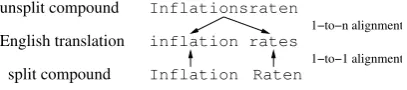
systems. The splitting reduces data sparsity and enhances word alignment performance. An exam-ple is given in Figure 1.
Previous approaches for compound splitting can be characterized as following two basic ap-proaches: the use of morphological analyzers to find split points based on linguistic knowledge and corpus-driven approaches combining large
2
The use of the 1-best output of the segmenter for German to English decoding results in a degradation of 0.3 BLEU, showing that it is worse in performance than the corpus-driven method of Koehn and Knight, which improves perfor-mance (see the evaluation section). However, this segmenter is interesting because it is language neutral.
Inflationsraten
English translation unsplit compound
inflation rates
Inflation Raten
split compound
[image:2.595.316.520.63.108.2]1−to−n alignment 1−to−1 alignment
Figure 1: Compound splitting enhances the num-ber of 1-to-1 word alignments.
amounts of data and scoring metrics.
We briefly introduce the computational mor-phology SMOR (section 3.1) and the corpus-driven approach of Koehn and Knight (2003) (sec-tion 3.2), before we present our hybrid approach that combines the benefits of both in section 3.3.
3.1 SMORMorphological Analyzer
SMOR is a finite-state based morphological ana-lyzer covering the productive word formation pro-cesses of German, namely inflection, derivation and compounding (Schmid et al., 2004). Word for-mation is implemented as a concatenation of mor-phemes filtered according to selectional restric-tions. These restrictions are based on feature deco-rations of stems and affixes encoded in the lexicon. Inflection is realized using inflection classes.
An abbreviated3 SMOR analysis of the word
Durchschnittsauto (“standard car”)4 is given in Figure 2 (a). The hierarchical structure of the word formation process is given in Figure 2 (b). Imple-mented with finite-state technology, SMOR is not able to produce this hierarchy: in our example it outputs two (correct) analyses of different depths and does not perform disambiguation.
3.2 Corpus-Driven Approach
Koehn and Knight (2003) describe a method re-quiring no linguistically motivated morphological analysis to split compounds. Instead, a compound is broken into parts (words) that are found in a large German monolingual training corpus.
We re-implemented this approach with an ex-tended list of filler letters that are allowed to
oc-3
We show analyses for nominative, and analyses for the other casesgenitive, ,dative, accusativeare left out as they are identical.
4
durch= “through”,schneiden= “to cut”,Schnitt= “(the) cut”,Durchschnitt= “average”,Auto= “car”
part-of-speech:<NN>/<V>(noun/verb) gender:<Neu>(neutrum)
analyze> Durchschnittsauto
Durchschnitt<NN>Auto<+NN><Neut><Nom><Sg>
durch<VPART>schneiden<V><NN><SUFF>Auto<+NN><Neut><Nom><Sg>
(a) SMORoutput format
Durchschnittsauto
Durchschnitt
schneiden Auto
durch
<NN> <NN> <NN> durchschneiden
<V> <V> <VPART>
[image:3.595.315.518.172.250.2](b) Morphological analysis
Figure 2: Morphological analysis ofDurchschnittsauto(“standard car”).
cur between any two parts (nen, ien, en, es, er, s, n) such as s in Inflationsrate (cf. Figure 1) and deletable letters (e, n), required for compounds such as Kirchturm = Kirche+Turm (“steeple”, “church+tower”). Filler letters are dropped only in cases where the part is more frequent without the letter than with it (an example is that the fre-quency of the word Inflation is greater than the frequency of the wordInflations); the same holds for deletable letters and hyphens (“-”). The min-imal part size was set to 3 characters. Word fre-quencies are derived from the true-cased corpus using case insensitive matching. In order to reduce wrong splittings, infrequent words (frequency ≤
3) are removed from the training corpus and a stop list was used5. These are similar choices to those found to be best in work by Stymne (2008).
The splitting that maximizes the geometric mean of part frequencies using the following for-mula6is chosen:
argmaxS( Q pi∈S
count(pi))
1
n
Figure 3 contains all splitting options of the corpus-driven approach forMinisterpr¨asident
(“prime minister”). As can be seen, the desired splitting Minister|Pr¨asident is among the options, but in the end Min|ist|Pr¨asident
(“Min|is|president”) is picked by the corpus-driven approach because this splitting maximizes the geometric mean score (mainly due to the highly frequent verb ist “is”). This is linguisti-cally implausible, and the system we introduce in the next section splits this correctly.
Even though this corpus-driven approach tends to oversplit it works well for phrase-based SMT
because adjacent words (or word parts) are likely
5The stop list contains the following units, which occur in the corpus as separate words (e.g., as names, function words, etc.), and frequently occur in incorrect splittings: adr, and, bes, che, chen, den, der, des, eng, ein, fue, ige, igen, iger, kund, sen, ses, tel, ten, trips, ung, ver.
6Taken from (Koehn and Knight, 2003):
S= split,pi= part,n= number of parts. The original word
is also considered, it has 1 part and a minimal count of 1.
Ministerprä Ministerpräsid Minister Mini Minis
Min ister ist
ter
Prä Präsid Präside Präsident
ent
sid sident
Figure 3: Corpus-driven splittings of Minis-terpr¨asident(“prime minister”).
to be learned as phrases. We will refer to the corpus-driven approach using the abbreviationcd.
3.3 Hybrid Approach
We present a novel approach to compound split-ting: based on linguistically motivated split points gained from SMOR, we search word frequencies in a large training corpus (the same corpus as we will use for the corpus-driven approach) in order to determine the best splitting option for a word (or to leave it unsplit). This approach needs no ex-plicit definition of filler letters or deletable letters, as this knowledge is encoded in SMOR.
In contrast to the corpus-driven approach de-scribed in the previous section, the hybrid ap-proach uses neither a minimal part size constraint, nor a stop-list. Instead, we make use of the linguis-tic knowledge encoded in SMOR, i.e. we allow the hybrid approach to split only into parts that can appear as free morphemes, such as stems and sep-aratable particles. An example isauf|gibt(“to give up”), where the particleauf may occur separated from the verb, as in Er gibt nicht auf (“he gives not up”). Bound morphemes, such as prefixes and suffixes cannot be split from the stem, e.g. verhan-delbar(“negotiable”) which consists of the prefix
ver-, the stemhandelnand the suffix-bar, is left unsplit by the hybrid approach.
For N-ary compounds (with N>2), we use not only the split points proposed by SMOR, but we
addi-(a) SMORsplitting options
Ministerpräsident
wählen Kampf Wahlkampf
Wahl Kampf
Minister Präsident
(b) Part frequencies
word part frequency
Kampf 30,546
Minister 12,742
Ministerpr¨asident 22,244 Ministerpr¨asidentwahl 111 Ministerpr¨asidentwahlkampf 1
Pr¨asident 125,747
Pr¨asidentenwahl 2,482
Pr¨asidentenwahlkampf 25
Wahl 29,255
Wahlkampf 23,335
(c) Log-based geometric mean scores
splitting option score
[image:4.595.113.484.80.276.2]Ministerpr¨asidentenwahlkampf 0 Ministerpr¨asident|Wahlkampf 10.04 Ministerpr¨asident|Wahl|Kampf 10.21 Ministerpr¨asident|w¨ahlen|Kampf 9.85 Minister|Pr¨asident|Wahlkampf 10.38 Minister|Pr¨asident|Wahl|Kampf 10.42 Minister|Pr¨asident|w¨ahlen|Kampf 10.15 Ministerpr¨asidentenwahl|Kampf 7.52 Minister|Pr¨asidentenwahl|Kampf 9.19 Minister|Pr¨asidentenwahlkampf 6.34
Table 1: Splitting options forMinisterpr¨asidentenwahlkampf (“election campaign of the prime minis-ter”) (a) with part frequencies derived from the corpus (b) and log-based geometric mean scores (c).
tionally search forAB|CandA|BC.
Even though SMOR lemmatizes along with
compound splitting, only the information about possible split points is used in our splitting ap-proach. The compound Beitrittsl¨ander (“ac-cession countries”), for example, is reduced to
Beitritt|Land by SMOR, but is retransformed to
Beitritt|L¨ander in our approach. This holds also for adjectives, e.g. firmeninterne “company-internal” which is split tofirma|interne(interneis the female form of the adjectiveintern) and verbs, such as the participle wasser|gebunden “water bound”, where the lemma isWasser|binden.
Hyphenated words can also be split with SMOR, as long as the rightmost part of the word is in its lexicon. However, the word parts which are to the left of hyphen(s) are left unanalyzed. The SMOR
analyses forNATO-Berichts(“NATO report”) and the nonsenseXYZabc-Berichts(“XYZabc report”) are given below:
analyze> NATO-Berichts
NATO-<TRUNC>Bericht<+NN><Masc><Gen><Sg>
analyze> XYZabc-Berichts
XYZabc-<TRUNC>Bericht<+NN><Masc><Gen><Sg>
Such Words where the rightmost part is unknown to SMOR are left completely unanalyzed by SMOR. Examples includeNATO-Berxchts(which is a typo ofNATO-Berichts) oral-Qaeda(a proper
name). If such words occurred less than 5 times in the training corpus, they were split at the hyphens. This procedure splits NATO|Berxchts, while it leavesal-Qaedaunsplit.
Table 1(a) shows the different splittings7 that SMOR returns for the ambiguous ad-hoc com-pound Ministerpr¨asidentenwahlkampf (“election campaign of the prime minister”). All of them are morphologically sound compounds of German.
The corpus frequencies of the parts provided by SMOR(and their recombinations) are given in
Ta-ble 1 (b). The average natural log frequencies of the SMORsplittings in Table 1 (c), with the recom-binations of their parts in the last three rows. We set the minimal frequency for each part to 1 (which gives a log frequency of 0) even if it was not seen in the training corpus.
Even though “prime” is not a literal transla-tion of Pr¨asident, the best splitting (out of the given options) is Minister|Pr¨asident|Wahl|Kampf
(“minister|president|election|campaign”). It is scored highest and thus chosen by the hybrid ap-proach.
For the purpose of SMT, we want to split com-pounds into parts that have a translational cor-respondent in the target language. To accom-plish that, it is often sufficient to consider the split at the highest linguistic analysis level. For
7
Ministerpr¨asident = “prime minister”, Wahlkampf = “election campaign”, Minister = “minister”, Pr¨asident = “president”,Wahl= “election”,w¨ahlen= “to elect”,Kampf
the example Durchschnittsauto (“standard car”) (cf. Figure 2 above), where the ideal split is Durchschnitt|Auto (“average|car”). Here, the deeper analysis ofDurchschnitt as a nominalisa-tion of the particle verbdurch|schneiden (“to cut through”) is not relevant. The same holds for Min-isterpr¨asidentenwahlkampf of Table 1, where in one of the splittingsWahlis further reduced to the verbw¨ahlen.
In order to prevent such analyses from be-ing picked, we investigate the use of restrictbe-ing SMOR’s splitting options to analyses having a min-imal number of component parts. On the other hand, there are many lexicalized compounds in German, that, besides being analyzed as a com-pound also appear as a free word stem in SMOR’s lexicon (e.g. bothGel¨andewagen“all-terrain vehi-cle” and Gel¨ande|wagen “terrain vehicle” are re-turned by SMOR). Therefore, we keep both vari-ants for our subsequent experiments: the con-strained version that uses only analyses with a minimal number of parts (and thus performs a more conservative splitting) is referred to assmc, while using all of SMOR’s analyses is namedsm. In addition to these, we use a constraint that splits only nouns. To do so, the text to be split was POS-tagged with TreeTagger (Schmid, 1994) to deter-mine the nouns in the context of the whole sen-tence. Splitting only nouns will be referred to as
@nnin the remainder of this paper.
Compared to the purely corpus-driven ap-proach, hybrid compound splitting substantially reduces the number of false splitting options, be-cause only splittings that are linguistically moti-vated are looked up in the training corpus. We will show that this restriction of splitting options enhances the number of correct splittings being picked. The purely corpus-driven approach con-siders the correct splitting in most cases, but often does not choose it because there is another higher scoring splitting option (cf. section 4.3).
The main shortcoming of the hybrid approach is its dependence on SMOR’s lexical coverage. SMOR incorporates numerous word formation rules and thousands of word stems (e.g. over 16,000 noun base stems), but our approach will leave all words unsplit that cannot be analyzed with SMOR. However, we will show in both the
gold standard evaluations (section 4) and the SMT
evaluation (section 5) that the recall of SMOR is sufficient to result in substantial gains over the
corpus-driven approach.
4 Gold Standard Evaluation
The accuracies of the compound splitting ap-proaches are evaluated against two hand-crafted gold standards: one that includes linguistically motivated split points (section 4.1), and one indi-cating compounds that were translated composi-tionally by a human translator (section 4.2). We found that the hybrid approach performs best for both. In section 5, we will show the impact of the different splitting approaches on translation per-formance, with the result that the hybrid approach outperforms the corpus-driven approach even for translation quality (in contrast to previous work, where the best system according to the gold stan-dard was not the best system for translation qual-ity). In order to better understand the divergent results of the splitting approaches, we perform a detailed error analysis in section 4.3.
The accuracy of compound splitting is mea-sured using the same terminology and metrics as described in (Koehn and Knight, 2003):
correct split: should be split and was split correctly
correct not: should not be split and was not
wrong split: should not be split but was split
wrong not: should be split but was not
wrong faulty (fty): should be split, but was split wrongly
precision: correctsplit+wrongf aultycorrectsplit+wrongsplit
recall: correctsplit+correctsplitwrongf aulty+wrongnot
accuracy: correct correct+wrong
The results of the following splitting approaches were investigated:
raw = baseline without splitting
cd = corpus-driven splitting
sm = hybrid approach using all SMORanalyses
smc = hybrid approach using the SMORanalysis with the minimal number of parts
@nn = split only nouns
The word frequencies required for all splitting ap-proaches were derived from the German monolin-gual language model training data (∼225 million tokens) of the shared task of the 2009 ACL work-shop on machine translation.
4.1 Linguistically Motivated Gold Standard
Correct Wrong Metrics split not split not fty prec. recall acc. raw 0 5073 0 1114 0 - 0.00% 81.99% cd 679 4192 883 120 313 36.21% 61.06% 78.73% sm 912 4534 541 35 165 56.37% 82.01% 88.02% sm@nn 628 4845 230 337 147 62.49% 56.73% 88.46% smc 884 4826 249 135 93 72.10% 79.50% 92.29%
[image:6.595.73.291.61.132.2]smc@nn 648 4981 94 380 84 78.45% 58.27% 90.98%
Table 2: Linguistically motivated gold standard: 6,187 distinct word types. Bold-face font indi-cates the best result of each column.
from the development set of the 2009 shared MT task. The most plausible split points were anno-tated by a native speaker of German, allowing for splits into word stems or particles, but not into bound morphemes such as prefixes or suffixes.
Splits were annotated at the highest word formation level only, see also Durchschnittsauto
in Figure 2 (section 3.1 above), where only the split pointDurchschnitt|Autowould be annotated in the gold standard. Another example is the complex derivative Untersuchungsh¨aftling
(“person being imprisoned on remand”), where the inherent word structure looks as follows: [Untersuchung+Haft]+ling (“[investi-gation+imprisonment]+being a person”). The splitting into Untersuchung|H¨aftling is semanti-cally not correct and the word is thus left unsplit in the gold standard. Finally, particles are only split if these can be used separately from the verb in a grammatically sound sentence, as is the case in the example mentioned in section 3.3,auf|gibt:
Er gibt nicht auf (“he gives not up”). In contrast, the particle cannot be separated in a past participle construction like aufgegeben: *Er gegeben nicht auf (“he given not up”), because in this example,
-ge- is an infix introduced between the particle and the verb in order to form the past participle form. Constructions of this kind are thus left unsplit in the gold standard.
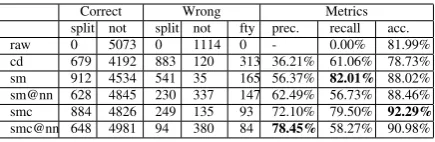
We found that 1,114 of the 6,187 types we in-vestigated were compounds, of which 837 were nouns. The detailed results are given in Table 2. Due to the fact that the majority of words should not be split, therawmethod reaches a considerable accuracy of 81.99%.
As can be seen from Table 2, 679 of the 1,114 compounds are split correctly by the corpus-driven approach (cd). However, the high number of wrong splits (883), which is the main shortcoming of the corpus-driven approach, leads to an accu-racy below therawsystem (78.73% vs. 81.99%).
Out of the variants of the hybrid approach, the less constrained one, sm achieves the high-est recall (82.01%), while the most constrained onesmc@nnhas the highest precision (78.45%). Thesmcvariant yields the most accurate splitting
92.29%. The higher precision of the@nn-variants comes from the fact that most of the compounds are nouns (837 of 1,114) and that these approaches (sm@nn, smc@nn) leave more words incorrectly unsplit than oversplit.
Note that the gold standard we presented in this section was measured on a few times during devel-opment of the hybrid approach and there might be some danger of overfitting. Therefore, we used an-other gold standard based on human translations to confirm the high accuracy of the hybrid approach. We introduce it in the next section.
4.2 One-to-one Correspondence Gold Standard
The one-to-one correspondence gold standard (Koehn and Knight, 2003) indicates only com-pounds that were translated compositionally by a human translator. Such translations need not al-ways be consistent: the human translator might decide to translate a compound compositionally in one sentence and using a different concept in an-other sentence. As a consequence, a linguistically correct split might or might not be considered cor-rect, depending on how it was translated. This is therefore a harsh metric.
We used data from the 2009 shared MT task8 for this evaluation. The first 5,000 words of the test text (news-dev2009b) were annotated manu-ally with respect to compounds that are translated compositionally into more than one English word. This is the same data set as used for the evalu-ation of SMT performance in section 5, but the compound annotation was done only after all SMT
experiments were completed, to ensure unbiased translation results. The use of the same data set fa-cilitates the comparison of the splitting approaches in terms of the one-to-one gold standard vs. trans-lation quality.
The results are given in Table 3. In this set, only 155 compounds with one-to-one correspondences are found amongst the 5,000 word tokens, which leads to a very high accuracy of 96.90% with no splitting (raw).
8http://www.statmt.org/wmt09/
Correct Wrong Metrics split not split not fty prec. recall acc. raw 0 4,845 0 155 0 —— 0.00% 96.90% cd 81 4,435 404 14 59 14,89% 52.60% 90.32% sm 112 4,563 283 8 34 26.11% 72.73% 93.50% sm@nn 107 4,677 169 15 32 34.74% 69.48% 95.68% smc 128 4,666 180 12 14 39,75% 83,12% 95,88% smc@nn 123 4,744 102 18 13 51.68% 79.87% 97.34%
Table 3: Evaluation of splitting approaches with respect to one-to-one correspondences.Bold-face
font indicates the best result of each column.
The corpus-driven approach (cd) splits 81 of the 155 compounds correctly (52.60% recall), but also splits 404 words that should have been left unsplit, which leads to a low precision of only 14.89%.
As can be seen from Table 3, all variants of the hybrid splitting approach, reach higher accuracies than the corpus-driven approach, and again, the most restrictive one (smc@nn) performs best: it is the only one that achieves a slightly higher accu-racy thanraw(97.34% vs. 96.90%). Even though the number of correct splits ofsmc@nn (123) is lower than for e.g. smc(with 128, the highest re-call 83.12%), the number of correct not splittings is higher (4,744 vs. 4,666).
Generally speaking, the results of both gold standards show that linguistic knowledge en-hances the number of correct splits, while at the same time it considerably reduces oversplitting, which is the main shortcoming of the corpus-driven approach. A detailed error analysis is pro-vided in the following section 4.3.
4.3 Error Analysis
4.3.1 Errors of the Corpus-Driven Approach
In gold standard evaluation, the purely corpus-driven approach exhibited a number of erroneous splits. These splits are not linguistically motivated and are thus filtered out a priori by the SMOR
-based systems. In the following, we give some examples for wrong splits that are typical for the corpus-driven approach.
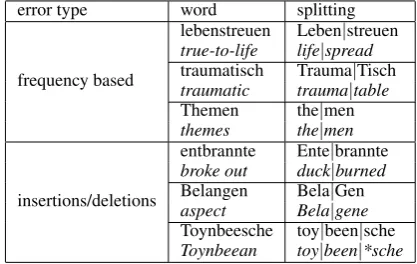
In Table 4 we divide typical errors into two cat-egories:frequency-basedwhere wrong splitting is solely due to higher frequencies of the parts from the wrong splitting andinsertions/deletionswhere filler letters or deletions of letters lead to wrong splittings of which the parts are again more fre-quent than for the correct splitting.
[image:7.595.311.520.93.225.2]The adjectivelebenstreuen(“true-to-life”) is the only true compound of Table 4. Its correct split is Leben|treuen (“life|true”). All other words in
Table 4 should be left unsplit.
error type word splitting
frequency based
lebenstreuen Leben|streuen
true-to-life life|spread
traumatisch Trauma|Tisch
traumatic trauma|table
Themen the|men
themes the|men
insertions/deletions
entbrannte Ente|brannte
broke out duck|burned
Belangen Bela|Gen
aspect Bela|gene
Toynbeesche toy|been|sche
Toynbeean toy|been|*sche
Table 4: Typical errors of the corpus-driven ap-proach. The only true compound in this table is
Leben|treuen(“life|true”).
The lookup of word frequencies is done case-insensitively, i.e. the casing variant with the highest frequency is chosen. This leads to cases liketraumatisch(“traumatic”), where adjec-tives are split into nominal head words (namely
Trauma|Tisch = “trauma|table”), which is impos-sible from a linguistic point of view. If, how-ever, Traumatisch occurs uppercased and is thus to be interpreted as a noun, the splitting into
Trauma|Tischis correct.
The splitting accuracy of the corpus-driven method is highly dependent on the quality of the monolingual training corpus from which word frequencies are derived. The examples Themen
(“themes”) andToynbeesche(“Toynbeean”) in Ta-ble 4 show how foreign language material from a language like English in the training corpus can lead to severe splitting errors.
In order to account for the lack of linguistic knowledge, the corpus-driven approach has to al-low for a high flexibility of filler letters, dele-tion of letters and combinadele-tions of both. The ex-amples in the lower part of Table 4 show that this flexibility often leads to erroneous splits that completely modify the semantic content of the original word. For example, the verb partici-ple form of “to break out”, entbrannte is split into Ente|brannte (“duck|burned”), because the corpus-driven approach allows to add an “e” at the end of each but the rightmost part. This transfor-mation is required to cover compounds like Kirch-turm(“church tower” (or also “steeple”)) that are composed of the words Kirche (“church”) and
Turm(“tower”).
compound determines the split of a word, even though the other part(s) are much less frequent. This is the case forBelangen (442 occurrences), where the high frequent Gen (“gene”, 1,397 oc-currences) leads to a splitting of the word, even though the proper nameBelais much less frequent (165 occurrences).
The case of Toynbeesche (which is a proper noun used as an adjective) shows that the corpus-driven approach splits everything into parts, as long as they are more frequent than the unsplit word. In contrast, all words that are unknown to SMORare left unsplit by the hybrid approach.
Finally, the corpus-driven approach often iden-tifies content-free syllables such as-sche(see last row of Table 4) as compound parts. These sylla-bles frequently occur in the training corpus due to syllabification, making them a prevalent source for corpus-driven splitting errors. Such wrong split-tings could be blocked by extending the stopword list of the corpus-driven approach. See footnote 5 in section 3.2, for the list of stopwords we used in our implementation.
Previous approaches to corpus-driven com-pound splitting used a part-of-speech (POS) tagger to reduce the number of erroneous analyses (e.g. (Koehn and Knight, 2003), (Stymne, 2008)): the word class of the rightmost (possible) part of the compound is restricted to match the word class of the whole compound, which is coherent to Ger-man compositional morphology. This constraint lead to higher accuracies in gold standard evalu-ations, but it did not improve translation quality in the experiments of Koehn and Knight (2003) and Stymne (2008), and therefore, we did not re-implement the corpus-driven approach with this POS-constraint. However, some of the errors pre-sented in this section could have been prevented if the POS-constraint was used: the erroneous splits
oflebenstreuenandtraumatischwere avoided, but for the splittings ofBelangenandentbrannte, the POS-constraint would not help. A more restrictive
POS-constraint proposed by Stymne (2008), al-lows splitting only into parts belonging to content-bearing word classes. This works for Belangen, but not forentbrannte. In the case ofThemenand
Toynbeesche, the output of a POS-tagger for the last part are not trustworthy, as these are not cor-rect German words: men belongs to foreign lan-guage material or it is a content-free syllable, such assche.
4.3.2 Errors of the Hybrid Approach
During the development of the hybrid splitting approach, we did an extensive gold standard eval-uation along the way, as described in section 4.1 above. The performance of the hybrid approach is limited by the performance of its constituents, namely the coverage of SMOR and the quality
of the corpus from which part frequencies are derived. In the gold standard evaluation, we distinguished three error categories: wrong split
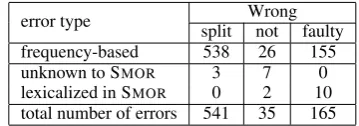
(should not be split but was), wrong not(should be split but was not) and wrong faulty (should be split, and was split, but wrongly). Table 2 (cf. Section 4.1) contains the results of the gold stan-dard we used as development set for our approach. In Table 5, we give a detailed distribution of the wrong splittings of the less constrained hybrid approachsm, into the following categories:
frequency-based: SMORfound the correct split, but a wrong split was scored higher
unknown to SMOR: lexeme or rule missing in SMOR
lexicalized in SMOR: lexeme exists in SMOR, but fully lexicalized (no splitting possible)
It can be seen from Table 5 that most of the errors are due to corpus frequencies of the component parts. An example is Nachteil (“disadvantage”), which is lexicalized in German, but can also be correctly divided (even though it is semantically less plausible) intonach|Teil(“after|part”), and as both of these parts are high frequent, Nachteilis split.
As the corpus-driven approach uses the same disambiguation component, there must be an over-lap of the frequency-based errors of the two ap-proaches.
error type Wrong
split not faulty frequency-based 538 26 155
unknown to SMOR 3 7 0
[image:8.595.325.505.554.617.2]lexicalized in SMOR 0 2 10 total number of errors 541 35 165
Table 5: Error analysis ofsm with respect to the gold standard in Table 2 above.
to correctly the compound intoPetri|Schale. There are a number of compounds in German that originally consisted of two words, but are now lexicalized. For some of them SMOR does not provide any splitting option. An example is
Sackgasse(“dead end street”) which contains the wordsSack(“sack”) andGasse(“narrow street”), where SMOR leaves the word unsplit (but not un-analyzed: it is encoded as one lexeme), while the corpus-driven approach correctly splits it.
5 Translation Performance
5.1 System Description
The Moses toolkit (Koehn et al., 2007) was used to construct a baseline PBSMT system (with de-fault parameters), following the instructions of the shared task9. The baseline system is Moses built exactly as described for the shared task baseline. Contrastive systems are also built identically, ex-cept for the use of preprocessing on the German training, tuning and testing data; this ensures that all measured effects on translation quality are at-tributable to the preprocessing. We used data from the EACL 2009 workshop on statistical machine translation10. The data include∼1.2 million par-allel sentences for training (EUROPARLand news),
1,025 sentences for tuning and 1,026 sentences for testing. All data was lowercased and tok-enized, using the shared task tokenizer. We used the English side of the parallel data for the lan-guage model. As specified in the instructions, sen-tences longer than 40 words were removed from the bilingual training corpus, but not from the lan-guage model corpus. The monolingual lanlan-guage model training data (containing roughly 227 mil-lion words11) was used to derive corpus frequen-cies for the splitting approaches.
For tuning of feature weights we ran Mini-mum Error Rate Training (Och, 2003) until con-vergence, individually for each system (optimiz-ing BLEU). The experiments were evaluated using BLEU(Papineni et al., 2002) and METEOR(Lavie and Agarwal, 2007)12. Tuning scores are calcu-lated on lowercased, tokenized text; all test scores are case sensitive and performed on automatically
9
http://www.statmt.org/wmt09/baseline.html
10
http://www.statmt.org/wmt09/translation-task. html
11
http://www.statmt.org/wmt09/ training-monolingual.tar
12The version of METEOR used is 0.7, we use “exact porter-stem wn-synonmy”, weights are “0.8 0.83 0.28”.
system tuning test test BLEU BLEU METEOR
raw 18.10 15.72 47.65
cd 18.52 16.17 49.29
sm 19.47 16.59 49.98
sm@nn 19.42 16.76 49.77
smc 19.53 16.63 50.13
[image:9.595.338.498.61.146.2]smc@nn 19.61 16.40 49.64
Table 6: Effects of compound splitting:
raw= without preprocessing,cd = corpus-driven,
sm = hybrid approach using all SMOR analyses,
smc= hybrid approach with minimal SMORsplits
*@nn= split only nouns.
bold-face= significant wrt.raw
underlined = significant wrt.cd
recapitalized, detokenized text.
5.2 Translation Results
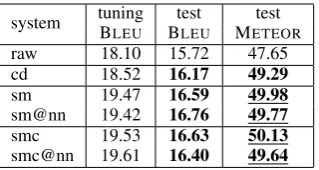
The BLEU and METEOR scores of our experi-ments are summarized in Table 6. Results that are significantly better than the baseline are bold-faced13. Underlining indicates that a result is sig-nificantly better than corpus-driven.
Compared to not-splitting (raw), the corpus-driven approach (cd) gains 0.45 BLEUpoints and +1.64 in METEOR for testing. All variants of the
hybrid approach (sm*) score higher thancd, reach-ing up to +0.59 BLEU compared tocd and +1.04 BLEU compared to rawfor sm@nn. In terms of METEOR, gains of up to +0.84 compared tocdand +2.48 compared toraware observable forsmc, all of them being significant with respect to both,raw
andcd. The smc variant of the hybrid approach yielded the highest METEORscore and it was also found to be the most accurate one when evaluated against the linguistic gold standard in section 4.1.
The restriction to split only nouns (@nn) leads to a slightly improved performance ofsm(+0.17) BLEU, while METEORis slightly worse when the
@nnconstraint is used: -0.21. Despite the fact that it had a high precision in the gold standard evalu-ation of section 4.1 above, smc, when used with the@nnconstraint, decreases in performance ver-sussmc without the constraint, because the @nn
variant leaves many compounds unsplit (cf. row “Wrong not”, Table 2), Secion 4.1).
5.3 Vocabulary Reduction Through Compound Splitting
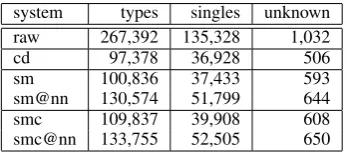
One of the main issues in translating from a com-pounding and/or highly inflected language into a morphologically less complex language is data sparsity: many source words occur very rarely, which makes it difficult to learn the correct transla-tions. Compound splitting aims at making the vo-cabulary as small as possible but at the same time keeping as much of the morphological information as necessary to ensure translation quality. Table 7 shows the vocabulary sizes of our translation ex-periments, where “types” and “singles” refer to the training data and “unknown” refers to the test set. It can be seen that the vocabulary is smallest for the corpus-driven approach (cd). However, as the translation experiments in the previous section have shown, thecdapproach was outperformed by the hybrid approaches, despite their larger vocab-ularies.
system types singles unknown
raw 267,392 135,328 1,032
cd 97,378 36,928 506
sm 100,836 37,433 593
sm@nn 130,574 51,799 644
smc 109,837 39,908 608
smc@nn 133,755 52,505 650
Table 7: Measuring Vocabulary Reduction for Compound Splitting.
6 Conclusion
We combined linguistic analysis with corpus-based statistics and obtained better results in terms of both producing splittings and statistical ma-chine translation performance. We provided an ex-tensive analysis showing where our approach im-proves on corpus-driven splitting.
We believe that our work helps to validate the utility of SMOR. The unsupervised morphology induction community has already begun to evalu-ate using SMT (Viripioja et al., 2007). Developers of high recall hand-crafted morphologies should also consider statistical machine translation as a useful extrinsic evaluation.
Acknowledgments
This work was supported by Deutsche Forschungsgemeinschaft grant “Models of Mor-phosyntax for Statistical Machine Translation”. We would like to thank Helmut Schmid.
References
Martin Braschler and B¨arbel Ripplinger. 2004. How effective is stemming and decompounding for Ger-man text retrieval? Information Retrieval, 7(3-4):291–316.
Chris Dyer. 2009. Using a maximum entropy model to build segmentation lattices for MT. In
HLT-NAACL’09: Proceedings of the Human Lan-guage Technology Conference of the North Ameri-can Chapter of the Association for Computational Linguistics.
Philipp Koehn and Kevin Knight. 2003. Empirical methods for compound splitting. InEACL ’03: Pro-ceedings of the 10th Conference of the European Chapter of the Association for Computational Lin-guistics, pages 187–193, Morristown, NJ, USA. As-sociation for Computational Linguistics.
Philipp Koehn, Hieu Hoang, Alexandra Birch, Chris Callison-Burch, Marcello Federico, Nicola Bertoldi, Brooke Cowan, Wade Shen, Christine Moran, Richard Zens, Chris Dyer, Ondrej Bojar, Alexan-dra Constantin, and Evan Herbst. 2007. Moses: Open source toolkit for statistical machine transla-tion. In ACL’07: Proceedings of the 45th Annual Meeting of the Association for Computational Lin-guistics, Demonstration Session, pages 177–180.
Martha Larson, Daniel Willett, Joachim K¨ohler, and Gerhard Rigoll. 2000. Compound splitting and lexi-cal unit recombination for improved performance of a speech recognition system for German parliamen-tary speeches. InICSLP’00: Proceedings of the 6th International Conference on Spoken Language Pro-cessing, pages 945–948.
Alon Lavie and Abhaya Agarwal. 2007. Meteor: An automatic metric for MT evaluation with high levels of correlation with human judgements. InACL’07: Proceedings of the 2nd Workshop on Statistical Ma-chine Translation within the 45th Annual Meeting of the Association for Computational Linguistics, pages 228–231.
Sonja Nießen and Hermann Ney. 2000. Improving SMT quality with morpho-syntactic analysis. In
COLING’00: Proceedings of the 18th International Conference on Computational Linguistics, pages 1081–1085. Morgan Kaufmann.
Franz Josef Och. 2003. Minimum error rate training in statistical machine translation. InACL’03: Proceed-ings of the 41st Annual Meeting of the Association for Compuational Linguistics, pages 160–167.
Kishore Papineni, Salim Roukos, Todd Ward, and Wei-Jing Zhu. 2002. Bleu: A method for automatic eval-uation of machine translation. InACL’02: Proceed-ings of the 40th Annual Meeting of the Association for Computational Linguistics, pages 311–318.
[image:10.595.95.269.352.428.2]words. InFinTAL’06: Proceedings of the 5th Inter-national Conference on Natural Language Process-ing, pages 616–624. Springer Verlag.
Helmut Schmid, Arne Fitschen, and Ulrich Heid. 2004. Smor: A German computational morphology covering derivation, composition and inflection. In
LREC ’04: Proceedings of the 4th Conference on Language Resources and Evaluation, pages 1263– 1266.
Helmut Schmid. 1994. Probabilistic part-of-speech tagging using decision trees. InProceedings of the International Conference on New Methods in Lan-guage Processing, pages 44–49.
Sara Stymne. 2008. German compounds in factored statistical machine translation. InGoTAL ’08: Pro-ceedings of the 6th International Conference on Nat-ural Language Processing, pages 464–475. Springer Verlag.