Levels of Certainty in Knowledge-Intensive Corpora:
An Initial Annotation Study
Aron Henriksson
DSV/KTH-Stockholm University
Sweden
[email protected]
Sumithra Velupillai
DSV/KTH-Stockholm University
Sweden
[email protected]
Abstract
In this initial annotation study, we sug-gest an appropriate approach for determin-ing the level of certainty in text, includdetermin-ing classification into multiple levels of cer-tainty, types of statement and indicators of amplified certainty. A primary evaluation, based on pairwise inter-annotator agree-ment (IAA) usingF1-score, is performed on a small corpus comprising documents from the World Bank. While IAA results are low, the analysis will allow further re-finement of the created guidelines.
1
Introduction
Despite ongoing efforts to codify knowledge, it is often communicated in an informal manner. In our choice of words and expressions, we implicitly or explicitly judge the certainty of the knowledge we wish to convey. This fact makes it possible to gauge the reliability of knowledge based on the subjective perspective of the author.
As knowledge is often difficult to ascertain, it seems reasonable to regard knowledge on a contin-uum of varying degrees of certainty, as opposed to a binary (mis)conception. This corresponds to the notion of epistemic modality: the degree of confi-dence in, or commitment to, the truth of proposi-tions (Hyland, 1998). Hedging is a means of af-fecting epistemic modality by qualifying proposi-tions, realized through tentative words and expres-sions such as possibly and tends to.
A holistic perspective on certainty—in which not only speculation is considered, but also signs of increased certainty—requires a classification into various levels. Applying such an approach to knowledge-intensive corpora, it may in due course be possible to evaluate unstructured, infor-mal knowledge. This would not least be valuable to organizational knowledge management
prac-tices, where it could provide a rough indicator of reliability in internal knowledge audits.
2
Related Research
The hedging concept was first introduced by Lakoff (1973) but has only really come into the spotlight in more recent years. Studies have mainly taken place in the biomedical domain, with Hyland’s (1998) influential work investigating the phenomenon in scientific research articles. Spec-ulative keywords and negations, along with their linguistic scopes, are annotated in the BioScope corpus by Vincze et al. (2008), which contains a large collection of medical and biological text (sci-entific articles and abstracts, as well as radiology reports). After several iterations of refining their guidelines, they report IAA values ranging from 77.6 to 92.37F1-score for speculative keywords (62.5 and 95.54F1-score for full scope). This cor-pus is freely available and has been used for train-ing and evaluation of automatic classifiers, see e.g. Morante and Daelemans (2009). One of the main findings is that hedge cues are highly domain-dependent. Automatic identification of other pri-vate states, including opinions, represents a sim-ilar task, see e.g. Wiebe et al. (2005). Diab et al. (2009) study annotation of committed and non-committed belief and show that automatic tagging of such classes is feasible. A different annotation approach is proposed by Rubin et al. (2006), in which certainty in newspaper articles is catego-rized along four dimensions: level, perspective, fo-cus and time. Similarly, five dimensions are used in Wilbur et al. (2006) for the creation of an an-notated corpus of biomedical text: focus, polarity, certainty, evidence and directionality.
3
Method
Based on previous approaches and an extensive lit-erature review, we propose a set of guidelines that
(1) incorporates some new features and (2) shifts the perspective to suit knowledge-intensive cor-pora, e.g. comprising organizational knowledge documents. Besides categorization into levels of certainty, this approach distinguishes between two types of statement and underscores the need to take into account words and expressions that add certainty to a proposition.
A small corpus of 10 World Bank documents— a publicly available resource known as Viewpoints (The World Bank Group, 2010)—is subsequently annotated in two sets by different annotators. The corpus is from a slightly different domain to those previously targeted and represents an adequate al-ternative to knowledge documents internal to an organization by fulfilling the criterion of knowl-edge intensity. The process is carried out in a Prot´eg´e plugin: Knowtator (Ogren, 2006). Pair-wise IAA, measured asF1-score, is calculated to evaluate the feasibility of the approach.
Statements are annotated at the clause level, as sentences often contain subparts subject to differ-ent levels of certainty. These are not predefined and the span of classes is determined by the an-notator. Furthermore, a distinction is made be-tween different types of statement: statements that give an account of something, typically a report of past events, and statements that express con-crete knowledge claims. The rationale behind this distinction is that text comprises statements that make more or less claims of constituting knowl-edge. Thus, knowledge claims—often less preva-lent than accounts—should be given more weight in the overall assessment, as the application lies in automatically evaluating the reliability of infor-mal knowledge. Assuming the view of knowledge and certainty as continuous, it is necessary to dis-cretize that into a number of intervals, albeit more than two. Hence, accounts and claims are cate-gorized according to four levels of certainty: very certain, quite certain, quite uncertain and very un-certain. In addition to the statement classes, four indicators make up the total of twelve. We in-troduce certainty amplifiers, which have received little attention in previous work. These are lin-guistic features that add certainty to a statement, e.g. words like definitely and expressions like without a shadow of a doubt. Hedging indica-tors, on the other hand, have gained much atten-tion recently and signify uncertainty. The source hedge class is applicable to instances where the
source of epistemic judgement is stated explicitly, yet only when it provides a hedging function (e.g. some say). Modality strengtheners are features that strengthen the effect of epistemic modality when used in conjunction with other (un)certainty indicators—but alone do not signify any polarity orientation—and may be in the form of vagueness (e.g.<could be>around that number) or quantity gradations (e.g. very<sure>).
4
Results
The corpus contains a total of 772 sentences, which are annotated twice: set #1 by one anno-tator and set #2 by five annoanno-tators, annotating two documents each. The statistics in Table 1 show a discrepancy over the two sets in the number of classified statements, which is likely due to diffi-culties in determining the scope of clauses. There are likewise significant differences in the propor-tion between accounts and claims, as had been an-ticipated.
Accounts Claims Set #1 Set #2 Set #1 Set #2
[image:2.612.340.496.324.365.2]726 574 395 393
Table 1: Frequencies of accounts and claims.
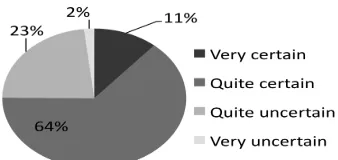
Despite the problem of discriminating between ac-counts and claims, they seem to be susceptible to varying levels of certainty. The average distribu-tion of certainty for account statements is depicted in Figure 1. As expected, an overwhelming ma-jority (87%) of such statements are quite certain, merely relating past events and established facts.
Figure 1: Average distribution of certainty in ac-count statements.
[image:2.612.333.505.498.582.2]Figure 2: Average distribution of certainty in knowledge claims.
As expected, the most common indicator is of hedging. Common cues include may, can, might, could, indicate(s), generally and typically. Many of these cues are also among the most common in the biomedical sub-corpus of BioScope (Vincze et al., 2008). It is interesting to note the fairly com-mon phenomenon of certainty amplifiers. These are especially interesting, as they have not been studied much before, although Wiebe et al. (2005) incorporate intensity ratings in their annotation scheme. There is agreement on words like clearly, strongly and especially.
Indicator Set #1 Set #2 Certainty amplifier 61 29 Hedging indicator 151 133
Source hedge 0 40
[image:3.612.110.279.37.117.2]Modality strengthener 9 122
Table 2: Frequency of indicators
To evaluate the approach, we calculate IAA by pairwiseF1-score, considering set #1 as the gold standard, i.e. as correctly classified, in relation to which the other subsets are evaluated. We do this for exact matches and partial matches1. For exact matches in a single document, the F1-score val-ues range from an extremely low 0.09 to a some-what higher—although still poor—0.52, yielding an overall average of 0.28. These results clearly reflect the difficulty of the task, although one has to keep in mind the impact of the discrepancy in the number of annotations. This is partly reflected in the higher overall average for partial matches: 0.41.
Certainty amplifiers and hedging indicators haveF1-scores that range up to 0.53 and 0.55 re-spectively (ditto for partial matches) in a single document. Over the entire corpus, however, the
1Partial matches are calculated on a character level while
exact matches are calculated on a token level.
averages come down to 0.27 for certainty ampli-fiers (0.30 for partial matches) and 0.33 for hedg-ing indicators (0.35 for partial matches).
Given the poor results, we want to find out whether the main difficulty is presented by having to judge certainty according to four levels of cer-tainty, or whether it lies in having to distinguish between types of statement. We therefore general-ize the eight statement-related classes into a single division between accounts and claims. Naturally, the agreement is higher than for any single class, with 0.44 for the former and 0.41 for the latter. A substantial increase is seen in partial matches, with 0.70 for accounts and 0.55 for claims. The results are, however, sufficiently low to conclude that there were real difficulties in distinguishing between the two.
Statement Type Exact F1 Partial F1
Account 0.44 0.70
[image:3.612.323.516.265.307.2]Claim 0.41 0.55
Table 3: Pairwise IAA per statement type, F1 -scores for exact and partial matches.
We subsequently generalize the eight classes into four, according to their level of certainty alone. The results are again low: quite certain yields the highest agreement at 0.47 (0.76 for partial matches), followed by quite uncertain at 0.24 (0.35 for partial matches). These numbers suggest that this part of the task is likewise difficult. The rise inF1-scores for partial matches is noteworthy, as it highlights the problem of different interpreta-tions of clause spans.
Certainty Level ExactF1 PartialF1 Very certain 0.15 0.15 Quite certain 0.47 0.76 Quite uncertain 0.24 0.35 Very uncertain 0.08 0.08
Table 4: Pairwise IAA per certainty level, F1 -scores for exact and partial matches
5
Discussion
[image:3.612.107.286.342.410.2] [image:3.612.323.513.489.557.2]probably. According to the guidelines, a single occurrence of either of these hedging indicators would normally render a statement quite uncer-tain. Giving freer hands to the annotator might be a way to evade this problem; however, it is not likely to lead to any more consistent annotations. Kilicoglu and Bergler (2008) address this by as-signing weights to hedging cues.
A constantly recurring bone of contention is presented by the relationship between certainty and precision. One of the hardest judgements to make is whether imprecision, or vagueness, is a sign of uncertainty. Consider the following exam-ple from the corpus:
Cape Verde had virtually no private sec-tor.
Clearly, this statement would be more certain if it had said: Cape Verde had no private sector. How-ever, virtually no could be substituted with, say, a very small, in which case the statement would surely not be deemed uncertain. Perhaps precision is a dimension of knowledge that should be ana-lyzed in conjunction with certainty, but be anno-tated separately.
6
Conclusion
There are, of course, a number of ways one can go about annotating the level of certainty from a knowledge perspective. Some modifications to the approach described here are essential—which the low IAA values are testament to—while oth-ers may be worth exploring. Below is a selection of five key changes to the approach that may lead to improved results:
1. Explicate statement types. Although there seems to be a useful difference between the two types, the distinction needs to be further explicated in the guidelines.
2. Focus on indicators. It is clear that indicators cannot be judged in an identical fashion only because they have been identified as signify-ing either certainty or uncertainty. It is not simply the number of occurrences of indica-tors that determines the level of certainty but rather how strong those indicators are. A pos-sible solution is to classify indicators accord-ing to the level of certainty they affect.
3. Discard rare classes. Very rare phenomena that do not have a significant impact on the
overall assessment can be sacrificed without affecting the results negatively, which may also make the task a little less difficult.
4. Clarify guidelines. A more general remedy is to clarify further the guidelines, including instructions on how to determine the scope of clauses; alternatively, predefine them.
5. Instruct annotators. Exposing annotators to the task would surely result in increased agreement, in particular if they agree be-forehand on the distinctions described in the guidelines. At the same time, you do not want to steer the process too much. Perhaps the task is inherently difficult to define in de-tail. Studies on how to exploit subjective an-notations might be interesting to explore, see e.g. Reidsma and op den Akker (2008).
In the attempt to gauge the reliability of knowl-edge, incorporating multiple levels of certainty becomes necessary, as does indicators of in-creased certainty. Given the similar rates of agreement on hedging indicators and certainty amplifiers (0.33 and 0.27 respectively; 0.30 and 0.35 for partial matches), the latter class seem to be confirmed. It is an existing and impor-tant phenomenon, although—like hedging indica-tors—difficult to judge. Moreover, a differentia-tion between types of statement is important due to their—to different degrees—varying claims of constituting knowledge. An automatic classifier built on such an approach could be employed with significant benefit to organizations actively man-aging their collective knowledge. The advantage of being aware of the reliability of knowledge are conceivably manifold: it could, for instance, be (1) provided as an attribute to end-users brows-ing documents, (2) used as metadata by search engines, (3) used in knowledge audits and knowl-edge gap analyses, enabling organizations to learn when knowledge in a particular area needs to be consolidated. It is, of course, also applicable in a more general information extraction sense: infor-mation that is extracted from text needs to have a certainty indicator attached to it.
References
Mona T. Diab, Lori Levin, Teruko Mitamura, Owen Rambow, Vinodkumar Prabhakaram, and Weiwei Guo. 2009. Committed belief annotation and tag-ging. In Proceedings of the Third Linguistic
Annota-tion Workshop, ACL-IJCNLP, pages 68–73, Suntec,
Singapore, August. ACL and AFNLP.
Ken Hyland. 1998. Hedging in Scientific Research
Ar-ticles. John Benjamins Publishing Company,
Ams-terdam/Philadelphia.
Halil Kilicoglu and Sabine Bergler. 2008. Recogniz-ing speculative language in biomedical research ar-ticles: a linguistically motivated perspective. BMC
Bioinformatics, 9.
George Lakoff. 1973. Hedges: A study in meaning criteria and the logic of fuzzy concepts. Journal of
Philosophical Logic, 2:458–508.
Roser Morante and Walter Daelemans. 2009. Learning the scope of hedge cues in biomedical texts. In
Pro-ceedings of the Workshop on BioNLP, pages 28–36,
Boulder, Colorado, June. Association for Computa-tional Linguistics.
Philip V. Ogren. 2006. Knowtator: a prot´eg´e plug-in for annotated corpus construction. In Proceedings of
the 2006 Conference of the North American Chapter of the Association for Computational Linguistics on Human Language Technology, pages 273–275,
Mor-ristown, NJ, USA. Association for Computational Linguistics.
Dennis Reidsma and Rieks op den Akker. 2008. Ex-ploiting ’subjective’ annotations. In HumanJudge
’08: Proceedings of the Workshop on Human Judge-ments in Computational Linguistics, pages 8–16,
Morristown, NJ, USA. Association for Computa-tional Linguistics.
Victoria L. Rubin, Elizabeth D. Liddy, and Noriko Kando. 2006. Certainty identification in texts: Cat-egorization model and manual tagging results. In
Computing Affect and Attitutde in Text: Theory and Applications. Springer.
The World Bank Group. 2010. Documents & Reports. http://go.worldbank.org/
3BU2Z3YZ40, Accessed May 13, 2010.
Veronika Vincze, Gy ¨orgy Szaarvas, Rich´ard Farkas, Gy ¨orgy M´ora, and J´anos Csirik. 2008. The bio-scope corpus: biomedical texts annotated for uncer-tainty, negation and their scopes. BMC
Bioinformat-ics, 9.
Janyce Wiebe, Theresa Wilson, and Claire Cardie. 2005. Annotating expressions of opinions and emo-tions in language. Language Resources and
Evalu-ation, 39:165–210.
J. W. Wilbur, A. Rzhetsky, and H. Shatkay. 2006. New directions in biomedical text annotation: definitions,
guidelines and corpus construction. BMC