‘How was your day?’
S. G. Pulman, J. Boye University of Oxford
M. Cavazza, C. Smith Teesside University
R. S. de la C´amara Telefonica I+D
Abstract
We describe a ‘How was your day?’ (HWYD) Companion whose purpose is to establish a comforting and supportive rela-tionship with a user via a conversation on a variety of work-related topics. The sys-tem has several fairly novel features aimed at increasing the naturalness of the interac-tion: a rapid ‘short loop’ response primed by the results of acoustic emotion anal-ysis, and an ‘interruption manager’, en-abling the user to interrupt lengthy or ap-parently inappropriate system responses, prompting a replanning of behaviour on the part of the system. The ‘long loop’ also takes into account the emotional state of the user, but using more conventional dialogue management and planning tech-niques. We describe the architecture and components of the implemented prototype HWYD system.
1 Introduction
As the existence of this workshop shows, there is a good deal of interest in a type of spoken language dialogue system distinct from the traditional task-based models used for booking airline tickets and the like. The purpose of these ‘social agent’ sys-tems is to be found in the relationship they can establish with human users, rather than on the as-sistance the agent can provide in giving informa-tion or solving a problem. Designing such agents provides many significant technical challenges, re-quiring progress in the integration of linguistic communication and non-verbal behaviour for af-fective dialogue (Andr´e et al. 2004). In this pa-per, we present the implementation of a Compan-ion Embodied ConversatCompan-ional Agent (ECA) which integrates emotion and sentiment detection with more traditional dialogue components.
2 From Dialogue to Conversation
Most spoken language dialogue systems are ‘task-based’: they aim at getting from the user values for a fixed number of slots in some template. When enough values have been found, the filled tem-plate is sent off to some back-end system so that the task in question - ordering a pizza, booking a ticket etc. - can be carried out. However, a so-cial Companion agent assumes a kind of conver-sation not necessarily connected to any immediate task, and which may not follow the conventions associated with task-driven dialogues, for exam-ple, the relatively strict turn-taking of task-based dialogue. In everyday life, many interhuman con-versations see one of the participants producing lengthy descriptions of events, without this corre-sponding to any specific request or overall con-versational purpose. Our objective was to sup-port such free conversation, whilst still obtaining meaningful answers from the agent, in the form of advice appropriate both to the affective and infor-mational content of the conversation. In order to balance the constraints of free conversation with those of tractability, we have deliberately opted for a single-domain conversation, in contrast with both small talk (Bickmore and Cassell, 1999) and ‘chatterbot’ approaches. Our HWYD domain in-volves typical events and topics of conversation in the workplace, ranging from the relatively mun-dane - meeting colleagues, getting delayed by traffic, project deadlines to rather more important -promotions, firings, arguments, office politics - de-signed to evoke stronger emotions and hence more affective dialogues.
However, our HWYD Companions retains some features of a typical task based system, in that each of these subtopics can be thought of as a task or information extraction template. Unfilled slots will drive the dialogue manager to question the user for possible values. When enough slots
are filled, the initiative will be passed to an ‘affec-tive strategy’ module, which will generate a longer response designed to empathise appropriately with the user over that particular topic.
3 System Overview and Architecture
The HWYD Companion integrates 15 different software components, covering at least to some degree all the necessary aspects of multimodal af-fective input and output: including speech recog-nition (ASR, using Dragon Naturally Speaking), emotional speech recognition (AA: the EmoVoice system (Vogt et al. 2008)), turn detection (ATT), Dialogue Act segmentation and tagging (DAT), Emotional modelling (EM), Sentiment Analy-sis (SA) (Moilanen et al. 2007), Natural Lan-guage Understanding (NLU), Dialogue Manage-ment (DM), user modelling and a knowledge base (KB/UM), an ‘Affective Strategy Module’ (ASM) generating complex system replies, Natu-ral Language Generation (NLG), Speech Synthe-sis (TTS), an avatar (ECA), and Multimodal con-trol of the ECA persona (MFM): gesture and fa-cial expression, supported by the Haptek anima-tion toolkit. Clearly the use of Naturally Speaking imposes on us speaker dependence, since the sys-tem needs training: in the scenario we have chosen this is in fact not too unrealistic an assumption, but this is merely a practical decision - we are not do-ing research on speech recognition as such in this project and so want to get as good a recognition rate as possible.
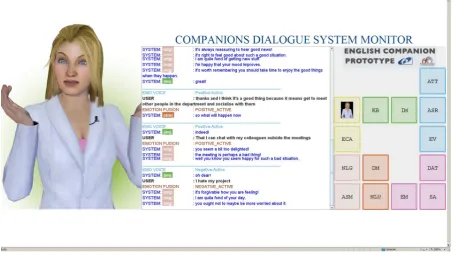
The software architecture of the prototype re-lies on the Inamode Framework developed by Telefnica I+D. Communication between modules follows a blackboard-like paradigm, in which cen-tral hubs broadcast any incoming message from any module to all of the other modules that are connected to it. Figure 1 below shows the system architecture, and Figure 2 shows one version of what is on the screen when the system is running.
4 Emotional Feedback Loops
Recognising and responding appropriately to dif-ferent emotions is an important aspect of a social agent. In our HWYD Companion, emotion and sentiment are used in two ways: firstly, to pro-vide immediate feedback to a user utterance (given that there will inevitably be some delay in the re-sponse from natural language and dialogue pro-cessing modules) and secondly to inform the more
extended responses given by the system when it has learned enough about the current sub-topic. There are two feedback loops: the ‘short loop’ (response time < 700 ms) provides an immedi-ate backchannel, and its main purpose is to main-tain contact and keep the communication alive and realistic. This is achieved by matching the non-verbal response (gesture, facial expression) of the avatar to the emotional speech parameters detected by EmoVoice prior to affective fusion (where the emotion detected from speech and the sentiment value detected from the corresponding text are merged: see below), and occasionally including an appropriate verbal acknowledgement, on a ran-dom basis to avoid acknowledging all user utter-ances. The short loop essentially aligns the ECA response to the user’s attitude, thus showing empa-thy. (We should also use SA for this, but currently processing speed is not fast enough).
The ‘major loop’ (response time<3000 ms) in-volves the ECA’s full response to the user utter-ance in terms of both verbal and non-verbal be-haviour. There are effectively two sources of sys-tem output: the dialogue manager engages with the user to find out what happened during their work day, and will ask questions, or drop into clarificatory sub-dialogues, gradually building up a complex event description along with an assess-ment of the prevailing emotions of the speaker. When sufficient information has been gathered, control is passed to an ‘affective strategy module’ which will produce a longer output, typically ad-vice or warning in response to the user’s recollec-tion of his daily events.
The system also includes an interruption man-ager which detects interruption and barge-in by the user, resulting in the immediate suspension of the current system utterance, triggering the process-ing of any content specific to the interruptprocess-ing ut-terance, and consequent replanning on the part of other modules to produce an appropriate response. Such an interruption is illustrated in Figure 1. The design of such an interruption manager in a sys-tem with so many separate modules is quite chal-lenging, in fact: the system is described further in Crook et al. (2010).
Figure 1:Overview of the System Architecture illustrating the information flow between modules.
[image:3.595.71.526.439.693.2]the user announces a company restructuring, but in a rather cheerful tone. Notice that some of the En-glish is a little strange: the generator produces a mixture of genuinely generated output along with some canned text.
User: I have just learnt that my department is going to be merged with the Barcelona one (EMOTION FUSION: POS-ITIVE ACTIVE)
System: You seem a bit too ecstatic! I’m doubtful that your workload could be maintained.
Every time the Companion has gathered suffi-cient information it will try to respond more glob-ally to the situation at hand. In the following ample (see also Figure 2), after the user has ex-pressed different sorts of concerns, the Companion picks on the latest (positive) information to sum-marise the few positive elements it picked from the conversation:
User: yes but one good thing anyway we had a new coffee machine arrived today (EMOTION FUSION: POSI-TIVE ACPOSI-TIVE)
System: it’s always reassuring to hear good news! It’s right to feel good about such a good situation. I am quite fond of getting new stuff. I’m happy that your mood improves. It’s worth remembering you should take time to enjoy the good things when they happen.
5 Emotional Modelling and Fusion
Two different modules analyse the emotional con-tent of user utterances: an emotional speech recog-nition system (EmoVoice (Vogt et al. 2008) which returns information indicating both the arousal and valence of the acoustic properties of the user’s speech as negative passive, negative-active, neu-tral, positive-active or positive-passive, and a text-based Sentiment Analysis module which operates on the utterance transcript after its recognition by the ASR module. The SA module operates in a compositional way and is able to classify lin-guistic units of any syntactic type: noun phrases, clauses, sentences etc. It is also able to assign a ‘strength’ of the sentiment expressed. In the current implementation it simply classifies clauses as either negative, neutral or positive. These two emotional inputs are then merged by a fusion pro-cedure, whose purpose is to provide an aggregate emotional category to be attached to the event de-scription template produced by the NLU and DM module. Essentially, the mechanism for affective fusion consists in overriding the valence category of EmoVoice with the one obtained by SA every
time the confidence score attached to EmoVoice is below a preset value (depending on the com-peting valence categories). Fusion is currently an underdeveloped module: for example, detecting mismatches between speech and language emo-tion and sentiment values could lead to the recog-nition of irony, sarcasm etc. (Tepperman et al. 2006). Saying an intrinsically negative thing in a positive and cheerful way, or the other way round, suggests that the speaker is trying for some special effect.
6 Natural Language Understanding and Dialogue Management
is further annotated with features encoding the head word, stem form, polarity, agreement fea-tures, relevant modifiers, etc. for later syntac-tic and semansyntac-tic processing. The NPs and VGs are represented as unification grammar categories containing information about the internal structure of the constituents.
The next stage applies unification based syn-tax rules which combine NP and VG chunks into larger constituents. These rules are of two types: most are syntactically motivated and are attempt-ing to build a parse tree from which main gram-matical relations (subject, object, etc.) can be recognised. These have coverage of the main syn-tactic constructs of English. But within the same formalism we add domain specific Information Extraction type patterns, looking out for particular constellations of entities and events relevant to the HWYD scenario, for example ‘argument at work between X and Y’, or ‘meeting with X about Y’. Processing is non-deterministic and so sentences will get many analyses. We use a ‘shortest path through the chart heuristic to select an interpre-tation. This is far from perfect, and we are cur-rently working on a separate more motivated dis-ambiguation module.
The final stage of processing before the Dia-logue Manager takes over is to perform reference resolution for pronouns and definite NPs. This module is based partly on the system described by Kennedy and Boguraev 1996, with the various weighting factors based on theirs, but designed so that the weights can be trained given appropriate data. Currently we are collecting such data and the present set of weights are taken from Kennedy and Boguraev but with additional salience given to the domain-specific named entity classes. Each referring NP gives rise to a discourse referent, and these are grouped into coreference classes based on grammatical, semantic, and salience properties.
The DM maintains an information state contain-ing all objects mentioned durcontain-ing the conversation, and uses this information to decide whether the objects referred to in the utterance are salient or not. The DM also uses type information to inter-pret elliptical answers to questions (System: ‘Who was at the meeting?’ User: ‘Nigel.’). After the user’s utterance has been interpreted in its dia-logue context and the information state has been updated, the dialogue manager decides on the ap-propriate response. If a new object has been
intro-duced by the user, the DM adds a goal to its agenda to talk about that object. For instance, if a new per-son is mentioned, the DM will ask questions about the user’s relation to that person, etc.
For each turn of the dialogue, the DM chooses which topic to pursue next by considering all the currently un-satisfied goals on the agenda and heuristically rating them for importance. The heuristics employed use factors such as recency in the dialogue history, general importance, and emo-tional value associated with the goal. We are cur-rently exploring the use of reinforcement learning with a reward function based on the results of SA on the users input to choose goals in a more natural way. The DM also has the option of invoking the ASM (described below) to generate an appropri-ate answer, in the cases where the user says some-thing highly emotive. Again, this is a decision that could involve reinforcement learning, and we are exploring this in our current work.
The joint operation of the NLU and the DM hence supports a kind of IE or task-specific template-filling: the content of the user’s utter-ances, prompted by questions from the DM, pro-vides the information necessary to fill a template to the point where the ASM can take over. The number of templates for domain events is signifi-cantly higher than in traditional IE or task-based dialogue systems, however, since the HWYD Companion currently instantiates more than 30 templates, and will eventually cover around 50.
7 Affective Dialogue Strategies
of the event reported by the user. For instance, various operators can emphasise or play down the event consequences ( emphasise-outcome-importance, emphasise-outcome-justification,
emphasise-outcome-warning) or comment on
additional factors that may affect the course of events (commend-enabler, reassure-helper). The planner uses a set of 25 operators, each of which can be in addition instantiated to incorpo-rate specific elements of the event. Overall this supports the generation of hundreds of signifi-cantly different influencing strategies.
8 Results and Conclusions
We have described an initial, fully-implemented prototype of a Companion ECA supporting free conversation, including affective aspects, over a variety of everyday work-related topics. The sys-tem has been demonstrated extensively outside of its development group and was regularly able to sustain consistent dialogues with an average du-ration exceeding 20 minutes. The Companion ECA recently won the best demonstration prize at AAMAS 2010,the 9th International Conference on Autonomous Agents and Multiagent Systems, Toronto, which is some subjective indication at least that its behaviour is of some interest outside of the project which developed it.
However, we have not yet systematically evalu-ated the ECA, although this task has begun (Webb et al. 2010). The question of evaluation for sys-tems like this is in fact a rather difficult one, since unlike task-based systems there is no simple mea-sure of success. In our current work we aim to conduct extensive trials with real users and via interview and questionnaires to get some useful measure of how natural and ‘companionable’ the system is perceived to be.
In other current work we are, as mentioned above, experimenting with reinforcement learning where the reward function is based on the emo-tion and sentiment detected in the user’s input. We are collecting data via Amazon’s Mechanical Turk and hope to be able to show how the ECA can de-velop different ‘personalities’ depending on how this reward function is defined. For example, we could imagine using simulated dialogues to pro-duce a Companion that was relentlessly cheerful, producing positive outputs whatever the input. Al-ternatively, we could produce a ‘mirror’ Compan-ion which simply reflected the mood of the user.
We could even produce a ‘misery loves company’ Companion which, instead of trying to cheer the user up when recognising negative sentiment or emotion, could reply in an equally negative man-ner.
Acknowledgements
This work was funded by the Companions project (http://www.companions-project.org) sponsored by the Euro-pean Commission as part of the Information Society Tech-nologies (IST) programme under EC grant number IST-FP6-034434. The EmoVoice system has been used courtesy of the Multimedia Concepts and Applications Group of the Uni-versity of Augsburg. Other contributors to the prototype de-scribed in this paper are Karo Moilanen, and from the COM-PANIONS consortium: David Benyon, Jay Bradley, Daniel Charlton, WeiWei Cheng, Morena Danieli, Simon Dobnik, Carlos Sanchez Fernandez, Debora Field, Mari Carmen Ro-driguez Gancedo, Jose Relano Gil, Ramon Granell, Jaakko Hakulinen, Preben Hansen, Sue Harding, Topi Hurtig, Oli Mival, Roger Moore, Olov Stahl, Markku Turunen, Enrico Zovato.
References
Andr´e, E., Dybkjr, L., Minker, W., and Heisterkamp, P. (Eds.), 2004, Affective Dialogue Systems Lecture Notes in Computer Science 3068, Springer.
Bickmore, T., and Cassell, J., 1999.Small Talk and Con-versational Storytelling in Embodied Interface Agents. Pro-ceedings of the AAAI Fall Symposium on Narrative Intelli-gence, pp. 87-92. November 5-7, Cape Cod, MA.
Bremond, C., 1973,Logique du R´ecit, Paris: Editions du Seuil.
Cavazza, M., Pizzi, D., Charles, F., Vogt, T. And Andr´e, E. 2009,Emotional input for character-based interactive sto-rytelling. International Joint Conference on Autonomous Agents and Multi-Agents Systems 2009, pp. 313-320.
Nigel Crook, Cameron Smith, Marc Cavazza, Stephen Pulman, Roger Moore, Johan Boye, 2010,Handling User In-terruptions in an Embodied Conversational Agent Proceed-ings of International Workshop on Interacting with ECAs as Virtual Characters, AAMAS 2010.
J¨onsson, A., And´en, F., Degerstedt, L., Flycht-Eriksson, A., Merkel, M., and Norberg, S., 2004, Experiences from combining dialogue system development with information ex-traction techniques, in: Mark T. Maybury (Ed), New Direc-tions in Question Answering, AAAI/MIT Press.
Kennedy and B. Boguraev, 1996,Anaphora for everyone: Pronominal anaphora resolution without a parser. Proceed-ings of the 16th International Conference on Computational Linguistics, Copenhagen, ACL, pp 113-118.
Moilanen, K. and Pulman, S. G. , 2007,Sentiment Compo-sition, Proceedings of the Recent Advances in Natural Lan-guage Processing International Conference (RANLP-2007), pp 378–382.
Nau, D., Ghallab, M., Traverso, P., 2004,Automated Plan-ning: Theory and Practice, Morgan Kaufmann Publishers Inc., San Francisco, CA.
J Tepperman, D Traum, and S Narayanan, 2006, ‘Yeah right’: Sarcasm recognition for spoken dialogue systems, In-terspeech 2006, Pittsburgh, PA, 2006.
Vogt, T., Andr´e, E. and Bee, N., 2008EmoVoice - A frame-work for online recognition of emotions from voice. In: Pro-ceedings of Workshop on Perception and Interactive Tech-nologies for Speech-Based Systems, Springer, Kloster Irsee, Germany, (June 2008).
Webb, N., D. Benyon, P. Hansen and O. Mival, 2010,