Exploring Sensorial Features for Metaphor Identification
Serra Sinem Tekiro˘glu University of Trento Fondazione Bruno Kessler
Trento, Italy
G¨ozde ¨Ozbal Fondazione Bruno Kessler
Trento, Italy
Carlo Strapparava Fondazione Bruno Kessler
Trento, Italy
Abstract
Language is the main communication device to represent the environment and share a com-mon understanding of the world that we per-ceive through our sensory organs. Therefore, each language might contain a great amount of sensorial elements to express the perceptions both in literal and figurative usage. To tackle the semantics of figurative language, several conceptual properties such as concreteness or imegeability are utilized. However, there is no attempt in the literature to analyze and bene-fit from the sensorial elements for figurative language processing. In this paper, we in-vestigate the impact of sensorial features on metaphor identification. We utilize an exist-ing lexicon associatexist-ing English words to sen-sorial modalities and propose a novel tech-nique to automatically discover these associ-ations from a dependency-parsed corpus. In our experiments, we measure the contribution of the sensorial features to the metaphor iden-tification task with respect to a state of the art model. The results demonstrate that sen-sorial features yield better performance and show good generalization properties.
1 Introduction
Languages include many lexical items that are con-nected to sensory modalities in various semantic roles. For instance, while some words can be used to describe a perception activity (e.g., to sniff, to watch, to feel), others can simply be physical phe-nomena that can be perceived by sensory receptors (e.g., light, song, salt, smoke). Common usage of
language, either figurative or literal, can be very dense in terms of sensorial words. As an example, the sentence “I heard a harmonic melody.” contains three sensorial words: to hear as a perception ac-tivity,harmonicas a perceived sensorial feature and
melodyas a perceivable phenomenon. The connec-tion to the sense modalities of the words might not be mutually exclusive, that is to say a word can be associated with more than one sense. For instance, the adjective sweet could be associated with both
tasteandsmell.
The description of one kind of sense impression by using words that normally describe another is commonly referred to as linguistic synaesthesia1. As an example, we can consider the slogans “The taste of a paradise” where the sense of sight is com-bined with the sense of taste or “Hear the big pic-ture” wheresightandhearingare merged. Synaes-thesia strengthens creative thinking and it is com-monly exploited as an imagination boosting tool in advertisement slogans (Pricken, 2008).
Synaesthesia is also commonly used in metaphors. Synaesthesic metaphors use words from one type of sensory modality, such as sight,
hearing, smell, taste and touch, to describe a concept from another modality. In conceptual metaphor theory, metaphor is defined as a system-atic mapping between two domains; namely target (or tenor) and source (or vehicle) domains (Lakoff and Johnson, 1980). Such mappings are asymmetric and might not correlate all features from the source domain to the target domain. Systematic studies on synaesthetic metaphors propose that there is a
1http://ahdictionary.com/
certain directionality of sense modality mappings. (Ullman, 1957), in a very early study, presented this directionality as a linear hierarchy of lower and higher sense modalities. In this hieararchy, modalities are ordered from lower to higher as touch, taste, smell, sound and color. Ullman (1957) proposes that lower modalities tend to occur as the source domain, while higher modalities tend to occur as the target domain. For instance, in the synaesthetic metaphor “soft light”, the target do-main ofseeingis associated with the source domain of touching, while the target domain of hearing
is associated with the source domain of tastingin “sweet music”. However, later studies (Williams, 1976; Shen, 1997) propose that the mapping in the synaesthetic metaphorical transfer is more complex among the sensory modalities. Williams (1976) constitutes a generalized mapping for the synaesthetic metaphorical transfer by means of the diachronic semantic change of sensorial adjectives. Having regard to the citation dates of adjective meanings from Oxford English Dictionary2 and Middle English Dictionary3, the regular transfer rules among the sensorial modalities are introduced. Several techniques for metaphor identification have been explored, including selectional preference violations (Fass, 1991; Neuman et al., 2013) or verb and noun clustering (Shutova et al., 2010; Birke and Sarkar, 2006; Shutova and Sun, 2013), super-vised classification (Gedigian et al., 2006; Mohler et al., 2013; Tsvetkov et al., 2014a). As well as the identification techniques, different cognitive proper-ties such as imageability (Broadwell et al., 2013; Tsvetkov et al., 2014a) and concreteness of the metaphor constituents (Neuman et al., 2013; Turney et al., 2011; Tsvetkov et al., 2014a), or lexical se-mantic properties such as supersenses (Hovy et al., 2013; Tsvetkov et al., 2014a) have been exploited.
While detecting and interpreting metaphors, im-ageability and concreteness features are generally utilized to identify the metaphorical transfer from a more concrete to a less concrete or from a more imageable to a less imageable word. However, in synaesthetic metaphors, the imageability or con-creteness levels of both tenor and vehicle (or
tar-2http://www.oed.com/
3http://quod.lib.umich.edu/m/med/
get and source) words can be similar. For instance, according to the MRC Psycholinguistic Database (MRCPD) (Coltheart, 1981) the concreteness (C) and imageability (I) values for target smell and sourcecold in the sentence “The statue has a cold smell.” are C:450, I:477 andC:457, I:531 respec-tively. Likewise, in the noun phrase “Sweet silence” the values are very close to each other (C:352, I:470
forsilenceandC:463, I:493forsweet). As demon-strated by these examples, while both imageabil-ity and concreteness are related to human senses, these features alone might not be sufficient to model synaesthetic metaphors.
In this paper, we fill in this gap by measuring the contribution of the sensorial features to the identifi-cation of metaphors in the form of adjective-noun pairs. We explicitly integrate features that repre-sent the sensorial associations of words for metaphor identification. To achieve that, we both utilize an existing sensorial lexicon and propose to discover these associations from a dependency-parsed cor-pus. In addition, we exploit the synaesthetic direc-tionality rules proposed by Williams (1976) to en-code a degree to which an adjective-noun pair is consistent with the synaesthetic metaphorical trans-fer. Our experiments show that sensorial associa-tions of words could be useful for the identification of metaphorical expressions.
The rest of the paper is organized as follows. We first review the relevant literature to this study in Section 2. Then in Section 3, we describe the word-sense association resources. In Section 4, we de-scribe the features that we introduce and detail the experiments that we conducted. Finally, in Section 5, we draw our conclusions and outline possible fu-ture directions.
2 Related Work
Mohler et al. (2013) exploit a supervised classifi-cation approach to detect linguistic metaphors. In this work, they first produce a domain-specific se-mantic signature which can be found to be encoded in the semantic network (linked senses) of Word-Net, Wikipedia4links and corpus collocation statis-tics. A set of binary classifiers are actuated to detect metaphoricity within a text by comparing its
tic signature to the semantic signatures of a set of known metaphors.
Schulder and Hovy (2014) consider the term rel-evance as an indicator of being non-literal and pro-pose that novel metaphorical words are less prone to occur in the typical vocabulary of a text. The perfor-mance of this approach is evaluated both as a stan-dalone metaphor classifier and as a component of a classifier using lexical properties of the words such as part-of-speech roles. The authors state that term relevance could improve the random baselines for both tasks and it could especially be useful in case of a sparse dataset.
Rather than an anomaly in the language or a sim-ple word sense disambiguation problem, a cogni-tive linguistic view considers metaphor as a method for transferring knowledge from a concrete do-main to a more abstract dodo-main (Lakoff and John-son, 1980). Following this view, Turney et al. (2011) propose an algorithm to classify adjectives and verbs as metaphorical or literal based on their abstractness/concreteness levels in association with the nouns they collocate with. The authors describe words as concrete if they are things, events, and properties that can be perceivable by human senses. Neuman et al. (2013) extend the abstract-ness/concreteness model of Turney et al. (2011) with a selectional preference approach in order to detect metaphors consisting of concrete concepts. They fo-cus on three types of metaphors including i) a sub-ject noun and an obsub-ject noun associated by the verb
to be (e.g., “God is a king”), ii) the metaphorical verb representing the act of a subject noun on an ob-ject noun (e.g., “The war absorbed his energy”), iii) metaphorical adjective-noun phrases (e.g., “sweet kid”).
Beigman Klebanov et al. (2014) propose a super-vised approach to predict the metaphoricity of all content words with any part-of-speech in a running text. The authors propose a model combining uni-gram, topic models, POS, and concreteness features. While unigram features contribute the most, con-creteness features are found to be effective only for some of the sets.
Based on the hypothesis that on the conceptual level, metaphors are shared across languages, rather than being lexical or language specific, Tsvetkov et al. (2014a) propose a metaphor detection system
with cross-lingual model transfer for English that exploits several conceptual semantic features; ab-stractness and imageability, semantic supersenses, vector space word representations. They focus on two types of metaphors with the subject-verb-object (SVO) and adjective-noun (AN) syntactic relations. As another contribution, they create new metaphor-annotated corpora for English and Russian. In ad-dition, they support the initial hypothesis by show-ing that the model trained in English can detect metaphors in Spanish, Farsi and Russian by project-ing the features from the English model into another language using a bilingual dictionary. To the best of our knowledge, this system is the current state of the art for metaphor detection in English and constitutes the baseline for our experiments.
3 Word-Sense Associations
Following the hypothesis of Broadwell et al. (2013) that “Metaphors are likely to use highly imageable words, and words that are generally more imageable than the surrounding context”, we introduce a novel hypothesis that metaphors are likely to also use sen-sorial words. To extract the sensen-sorial associations of words, we use the following two resources.
3.1 Sensicon
This resource (Tekiroglu et al., 2014) is a large sen-sorial lexicon that associates 22,684 English words with human senses. It is constructed by employing a two phased computational approach.
associations to the five human senses (i.e. sight, hearing, taste, smell and touch) measured in terms of normalized pointwise mutual information (NPMI). Each sensorial association provided by the lexicon is a float value in the range of -1 and 1.
Due to the way it is constructed, Sensicon might tend to give high association values for metaphori-cal sense associations of words as well as the literal ones. For instance, while adjective dark is related tosightas the literal sense association, Sensicon as-signs very high association values to bothsightand
taste. While this tendency would be helpful as a hint for identifying synaesthetic words, metaphor iden-tification task would need a complementary word-sense association resource that could highlight the literal sense association of a word.
3.2 Dependency-parsed corpus (DPC)
As an alternative to Sensicon for building word-sense associations, we extract this information from a corpus of dependency-parsed sentences. To achieve that, we follow a similar approach to ¨Ozbal et al. (2014) and use a database that stores, for each relation in the dependency treebank of LDC Giga-Word 5th Edition corpus5), its occurrences with spe-cific “governors” (heads) and “dependents” (mod-ifiers). To determine the sensorial load of a noun
n, we first count how many times n occurs with the verb lemmas ‘see’, ‘smell’, ‘hear’, ‘touch’ and ‘taste’ in a direct object (dobj) syntactic relation in the database. Then, we divide each count by the number of timesnappears in a direct object syntac-tic relation independently of the head that it is con-nected to. More specifically, the probability thatnis associated to sensesis calculated as:
p(s, n) = Pcdobj(vs, n) hicdobj(hi, n)
(1)
where cr(h, m) is the number of times that m
de-pends onh in relationr (in this case,r = dobj) in the dependency database, vs is the most
represen-tative verb for senses(e.g., the verb ‘hear’ for the sense of hearing) and eachhiis a different governor
ofnin adobj relation as observed in the database.
5http://www.ldc.upenn.edu/Catalog/
catalogEntry.jsp?catalogId=LDC2011T07
Our hypothesis is that nouns frequently acting as a direct object of a verb representing a human senses
are highly associated tos.
Similarly, to extract the sensorial load of an ad-jectivea, we calculate the number of timesaoccurs with the verb lemmas ‘look’, ‘smell’, ‘sound’, ‘feel’ and ‘taste’ in an adjectival complement (acomp) syntactic relation in the database. Then, we divide each count by the number of times a appears in an acompsyntactic relation. More specifically, the probability thata is associated to senses is calcu-lated as:
p(s, a) = Pcacomp(vs, a) hicacomp(hi, a)
(2)
The two resources capture different properties of words with respect to their sensorial load. While Sensicon yields indirect sensorial associations by modeling distributional properties of the lexicon, DPC attempts to directly model these associations independently of the context. For instance, while Sensicon associates the noun platewith taste as it frequently occurs in contexts involving eating, DPC assigns the highests scores tosightandtouch.
4 Evaluation
In this section, we demonstrate the impact of sen-sorial associations of words on the classification of adjective-noun pairs as metaphorical or literal ex-pressions.
4.1 Dataset
answer as metaphorical relations and bloody nose,
cool airas literal relations. To be able to compare our model with the state-of-the-art, we use the same training and test split as Tsvetkov et al. (2014a). More precisely, 884 literal and 884 metaphorical AN pairs are used for training, while 100 literal and 100 metaphorical AN pairs are used for testing.
4.2 Classifier and Features
We perform a literal/metaphorical classification task by adding sensorial features on top of the features proposed by Tsvetkov et al. (2014a), which consti-tute our baseline: concreteness, imageability, super-senses and vector space word representations. As we discussed earlier,imageability(I) and concrete-ness (C) are highly effective in metaphor identifi-cation task. We obtain the I and C scores of each word from the resource constructed by Tsvetkov et al. (2014a) by projecting I and C values of words in MRCPD onto 150,114 English words. Su-persenses are coarse semantic representations that could reflect the conceptual mappings between ad-jective and noun components of a relation. We at-tain noun supersenses from the lexicographer files of WordNet, such asnoun.phenomenon, noun.feeling, verb.perception, and adjective supersenses from the resource generated by Tsvetkov et al. (2014b). As the last baseline feature, Vector Space Word Rep-resentations can be considered as lexical-semantic properties where each word is represented by a tor and semantically similar words have similar vec-tors. The detailed description of how the baseline features are extracted can be found in Tsvetkov et al. (2014a).
As the main focus of this study, we extract the sensorial features from Sensicon and a dependency-parsed corpus (DPC). For each adjective and noun in an AN relation, we add as features its five sense associations according to the two resources. This results in 10 features (S) coming from Sensicon and 10 features (D) coming from DPC. FromS andD, we derive two more features (pS and pD
respec-tively) computed as the Pearson correlation between the sense features for the noun and the adjective.
As the third type of sensorial feature, we add a feature (R) which encodes the degree to which the adjective noun pair is consistent with William’s theory of sense modality directionality in
synaes-Touch Taste Smell
Color
Dimen-sion
[image:5.612.320.532.65.177.2]Sound
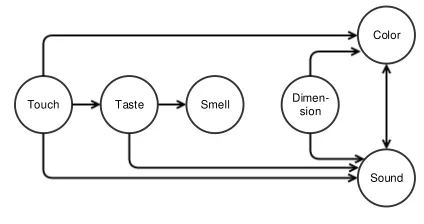
Figure 1: Directionality of sensory modalities as pro-posed by Williams(1976).
thetic metaphors (Williams, 1976). According to Williams, the mapping between the source and tar-get sense of a synaesthetic adjective is more likely to flow in some directions and not in others, as exem-plified in Figure 1. For example, while synaesthetic metaphors could be constructed with touch related adjectives and taste related nouns, the opposite di-rection, a taste related adjective and touch related noun, is less likely to occur. In our study, we em-ployed simplified version of the directionality map-ping in Figure 1 by identifying sight modality with
dimension andcolor. For an AN relation, we first assign a sense to each component (i.e., adjective and noun) by choosing the highest sense association in DPC. We decided to employ DPC instead of Sen-sicon in the definition of this feature since by con-struction it provides a more direct association be-tween words and senses. The value ofRis set to 1.0 if the sense associations of the adjective and noun satisfies a direction in Figure 1. If the associations violate the directions in the figure, the value of the feature is set to 0.5. In all other cases it is set to 0.
Feature Name Abbreviation # of the Features
Baseline B 183
Baseline - VSM B0 55
Sensicon S 10
Sensicon Pearson pS 1
DPC D 10
DPC Pearson pD 1
Sensicon Seeds W 10
Lynott-Connell Sense Words L 10
Directionality Rules R 1
[image:6.612.72.298.64.192.2]All sensorial features A 43
Table 1: Feature sets used in the experiments.
To replicate the experimental setup of Tsvetkov et al. (2014a) as closely as possible, for our experi-ment we also use a Random Forest classifier, which was demonstrated to outperform other classification algorithms and to be robust to overfitting (Breiman, 2001). To fine tune the classifier and find the best Random Forest model for each feature set combi-nation, we perform a grid search over the number of the generated trees (in the range between 50 and 300) and the maximum depth of the tree (in the range between 0 and 50) using 10-fold cross validation on AN training data. We choose the best model for each feature combination based on the maximumaverage cross validation accuracy - standard deviationvalue obtained by applying the given parameters.
4.3 Evaluation of the Baseline Features
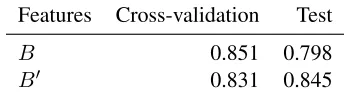
The first row in Table 2 demonstrates the accuracy obtained with the complete set of baseline features. As it can be observed from the results, there is a significant drop of accuracy when moving from training to test data. We suspect that this perfor-mance loss might be due to the high dimensionality of the vector space feature set. Since according to Tsvetkov et al. (2014a) these features were designed mostly to deal with the multilinguality of their ex-perimental setting, we evaluate the performance of the baseline excluding the vector space features. The row labeledB0reports the resulting accuracy values. The figures show that this simpler model has better generalization performance on monolingual English data. Hence, we decide to add our sensorial features on top of the simplifiedB0baseline.
Features Cross-validation Test
B 0.851 0.798
[image:6.612.339.511.66.115.2]B0 0.831 0.845
Table 2: The cross validation and test accuracies of the baseline with and without vector space features.
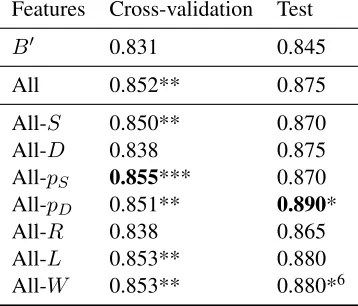
4.4 Evaluation of the Sensorial Features The second row labeled ‘All’ in Table 3 shows the cross validation and test accuracies of the sensorial features added on top of B0. The following rows show the outcome of the ablation experiments in which we remove each feature set at a time. The results that are marked with one or more∗indicate a statistically significant improvement in compari-son toB0 according to McNemar’s test (McNemar, 1947). From the results it can be observed that the model including all sensorial features outperforms the baseline in both cross-validation and testing even though the difference on test data is not significant.
According to the ablation experiments, sensorial transaction rules (R) yield the highest contribution. While the Pearson correlation value calculated with Sensicon (pS) results in an improvement, the feature
representing the correlation with DPC (pD) causes a
decrease in the performance of the model. In gen-eral, all models using any tested subset of the senso-rial features outperform the very competitive base-line even though the difference is significant only in two cases. To have more conclusive insights about the importance of each feature, an analysis on a larger dataset would be necessary. Overall, all the results demonstrate the useful contribution of the sensorial features to the task.
4.5 Error Analysis
The analysis that we performed on the test results shows that the noticeable performance differences among test results arise from the number of the in-stances in the test set. Indeed, a more comprehen-sive and bigger test set would provide better insights about the performance of sensorial features in the metaphor identification task.
6For two classifiers that have the same accuracy, McNemar
Features Cross-validation Test
B0 0.831 0.845
All 0.852** 0.875
All-S 0.850** 0.870
All-D 0.838 0.875
All-pS 0.855*** 0.870
All-pD 0.851** 0.890*
All-R 0.838 0.865
All-L 0.853** 0.880
[image:7.612.96.275.69.222.2]All-W 0.853** 0.880*6
Table 3: Performance of theB0 baseline in combination
with the different sets of sensorial features. Statistical significance: ***,p < .001; **,p < .01; *,p < .05.
Regarding the impact of the sensorial features, the test results indicate that sensorial association of the words could be beneficial in resolving the metaphors that include at least one sensorial component. For instance, the best configuration All-pD could
iden-tify thequiet revolutionas metaphorical while iden-tifyingquiet voiceas literal with the sensorial adjec-tivequiet.
A highly observable problem that causes error in the predictions is the limited coverage of the sen-sorial association resources. As an example, the lit-eral AN pairwoolly mammothcould not be resolved, since the adjectivewoolly, which is highly related to touch modality, can not be found in either Sensicon or DPC.
As another type of error, for less direct relations to sensory modalities, DPC might not provide the right information. For instance, in the literal AN re-lation blind man, the adjective blind is associated with taste as the highest sensory relation while asso-ciating man with sight modality. This might lead to the classification of this literal pair as metaphorical. Considering the shortcomings of the current sen-sorial resources, a better sensen-sorial lexicon differen-tiating various aspects of sensorial words such as direct sensorial properties (e.g., coldness, odor or
touch), perceptibility of the concepts such as the visible concept (e.g., cloud), or tasteable concept (e.g., food), and also deeper cognitive relations of the words with senses such asmicrophonewith hear-ing or blind with sight, could increase the
perfor-mance of the metaphor identification systems.
5 Conclusion
In this paper, we investigated the impact of senso-rial features on the identification of metaphors in the form of adjective-noun pairs. We adopted a lexical approach for feature extraction in the same vein as the other cognitive features employed in metaphor identification, such as imageability and concrete-ness. To this end, we first utilized a state-of-the-art lexicon (i.e.Sensicon) associating English words to sensorial modalities. Then, we proposed a novel technique to automatically discover these associa-tions from a dependency-parsed corpus. In our ex-periments, we evaluated the contribution of the sen-sorial features to the task when added to a state-of-the art model. Our results demonstrate that sen-sorial features are beneficial for the task and they generalize well as the accuracy improvements ob-served on the training data constantly reflect on test performance. To the best of our knowledge, this is the first model explicitly using sensorial features for metaphor detection. We believe that our results should encourage the community to explore further ways to encode sensorial information for the task and possibly to also use such features for other NLP tasks.
As future work, we would like to investigate the impact of sensorial features on the classification of other metaphor datasets such as VU Amsterdam Metaphor Corpus (Steen et al., 2010) and TroFi (Trope Finder) Example Base7. It would also be interesting to explore the contribution of these fea-tures for other figure of speech types such as simi-les. Furthermore, we plan to extend DPC approach with the automatic discovery of sensorial associa-tions of verbs and adverbs in addition to adjectives and nouns. These efforts could result in the compi-lation of a new sensorial lexicon.
Acknowledgements
We would like to thank Daniele Pighin for reviewing our paper, his insightful comments and valuable suggestions.
References
Collin F Baker, Charles J Fillmore, and John B Lowe. 1998. The berkeley framenet project. pages 86–90. Association for Computational Linguistics.
Beata Beigman Klebanov, Ben Leong, Michael Heil-man, and Michael Flor. 2014. Different texts, same metaphors: Unigrams and beyond. InProceedings of
the Second Workshop on Metaphor in NLP, pages 11–
17, Baltimore, MD, June. Association for Computa-tional Linguistics.
Julia Birke and Anoop Sarkar. 2006. A clustering ap-proach for nearly unsupervised recognition of nonlit-eral language. InEACL.
Leo Breiman. 2001. Random forests.Machine learning, 45(1):5–32.
George Aaron Broadwell, Umit Boz, Ignacio Cases, Tomek Strzalkowski, Laurie Feldman, Sarah Taylor, Samira Shaikh, Ting Liu, Kit Cho, and Nick Webb. 2013. Using imageability and topic chaining to locate metaphors in linguistic corpora. InSocial Computing,
Behavioral-Cultural Modeling and Prediction, pages
102–110. Springer.
Max Coltheart. 1981. The mrc psycholinguistic database. The Quarterly Journal of Experimental
Psy-chology, 33(4):497–505.
Dan Fass. 1991. met*: A method for discriminating metonymy and metaphor by computer. Computational
Linguistics, 17(1):49–90.
Matt Gedigian, John Bryant, Srini Narayanan, and Bran-imir Ciric. 2006. Catching metaphors. InProceedings of the Third Workshop on Scalable Natural Language
Understanding, pages 41–48. Association for
Compu-tational Linguistics.
Dirk Hovy, Shashank Srivastava, Sujay Kumar Jauhar, Mrinmaya Sachan, Kartik Goyal, Huiying Li, Whit-ney Sanders, and Eduard Hovy. 2013. Identifying metaphorical word use with tree kernels. Meta4NLP 2013, page 52.
George Lakoff and Mark Johnson. 1980. Metaphors We
Live By. University of Chicago press.
Dermot Lynott and Louise Connell. 2013. Modality ex-clusivity norms for 400 nouns: The relationship be-tween perceptual experience and surface word form.
Behavior research methods, 45(2):516–526.
Quinn McNemar. 1947. Note on the sampling error of the difference between correlated proportions or per-centages. Psychometrika, 12(2):153–157, jun. Michael Mohler, David Bracewell, David Hinote,
and Marc Tomlinson. 2013. Semantic signa-tures for example-based linguistic metaphor detection.
Meta4NLP 2013, page 27.
Yair Neuman, Dan Assaf, Yohai Cohen, Mark Last, Shlomo Argamon, Newton Howard, and Ophir
Frieder. 2013. Metaphor identification in large texts corpora. PloS one, 8(4):e62343.
G¨ozde ¨Ozbal, Daniele Pighin, and Carlo Strapparava. 2014. Automation and evaluation of the keyword method for second language learning. In Proceed-ings of the 52nd Annual Meeting of the Association for Computational Linguistics (Volume 2: Short
Pa-pers), pages 352–357. Association for Computational
Linguistics.
Mario Pricken. 2008. Creative Advertising Ideas and
Techniques from the World’s Best Campaigns. Thames
& Hudson, 2ndedition.
Marc Schulder and Eduard Hovy. 2014. Metaphor de-tection through term relevance. ACL 2014, page 18. Yeshayahu Shen. 1997. Cognitive constraints on poetic
figures. Cognitive Linguistics (includes Cognitive
Lin-guistic Bibliography), 8(1):33–72.
Ekaterina Shutova and Lin Sun. 2013. Unsupervised metaphor identification using hierarchical graph fac-torization clustering. InHLT-NAACL, pages 978–988. Ekaterina Shutova, Lin Sun, and Anna Korhonen. 2010. Metaphor identification using verb and noun cluster-ing. InProceedings of the 23rd International
Confer-ence on Computational Linguistics, pages 1002–1010.
Association for Computational Linguistics.
Gerard J Steen, Aletta G Dorst, J Berenike Herrmann, Anna A Kaal, and Tina Krennmayr. 2010. Metaphor in usage. Cognitive Linguistics, 21(4):765–796. Serra Sinem Tekiroglu, G¨ozde ¨Ozbal, and Carlo
Strappa-rava. 2014. Sensicon: An automatically constructed sensorial lexicon. In Proceedings of the 2014 Con-ference on Empirical Methods in Natural Language
Processing (EMNLP), pages 1511–1521, Doha, Qatar,
October. Association for Computational Linguistics. Yulia Tsvetkov, Leonid Boytsov, Anatole Gershman, Eric
Nyberg, and Chris Dyer. 2014a. Metaphor detection with cross-lingual model transfer. InProceedings of the 52nd Annual Meeting of the Association for
Com-putational Linguistics, pages 248–258. Association for
Computational Linguistics.
Yulia Tsvetkov, Nathan Schneider, Dirk Hovy, Archna Bhatia, Manaal Faruqui, and Chris Dyer. 2014b. Aug-menting english adjective senses with supersenses. In
Proc. of LREC.
Peter D Turney, Yair Neuman, Dan Assaf, and Yohai Cohen. 2011. Literal and metaphorical sense iden-tification through concrete and abstract context. In
Proceedings of the 2011 Conference on the Empirical
Methods in Natural Language Processing, pages 680–
690.
Akira Utsumi and Maki Sakamoto. 2007. Computational evidence for two-stage categorization as a process of adjective metaphor comprehension. In Proceedings of the Second European Cognitive Science Conference
(EuroCogSci2007), pages 77–82.