Using phone features to improve dialogue state tracking generalisation to
unseen states
I˜nigo Casanueva, Thomas Hain, Mauro Nicolao, and Phil Green Department of Computer Science, University of Sheffield, United Kingdom
{i.casanueva, t.hain, m.nicolao, p.green}@sheffield.ac.uk
Abstract
The generalisation of dialogue state track-ing to unseen dialogue states can be very challenging. In a slot-based dialogue sys-tem, dialogue states lie in discrete space where distances between states cannot be computed. Therefore, the model param-eters to track states unseen in the training data can only be estimated from more gen-eral statistics, under the assumption that every dialogue state will have the same un-derlying state tracking behaviour. How-ever, this assumption is not valid. For ex-ample, two values, whose associated con-cepts have different ASR accuracy, may have different state tracking performance. Therefore, if the ASR performance of the concepts related to each value can be esti-mated, such estimates can be used as gen-eral features. The features will help to re-late unseen dialogue states to states seen in the training data with similar ASR per-formance. Furthermore, if two phoneti-cally similar concepts have similar ASR performance, the features extracted from the phonetic structure of the concepts can be used to improve generalisation. In this paper, ASR and phonetic structure-related features are used to improve the dialogue state tracking generalisation to unseen states of an environmental control system developed for dysarthric speakers.
1 Introduction
Dialogue state tracking (DST) (Thomson and Young, 2010) is a key component for spoken in-terfaces for electronic devices. It maps the dia-logue history up to the current diadia-logue turn (Spo-ken language understanding (SLU) output, actions
taken by the device, etc.) to a probabilistic repre-sentation over the set ofdialogue states1called the
belief state (Young et al., 2013). This represen-tation is the input later used by the dialogue pol-icy to decide the next action to take (Williams and Young, 2007; Gaˇsi´c and Young, 2014; Geist and Pietquin, 2011). In the Dialogue State Tracking Challenges (DSTC) (Williams et al., 2013; Hen-derson et al., 2014), it was shown that data driven discriminative models for DST outperform gen-erative models in the context of a slot based dia-logue system. However, generalisation to unseen dialogue states (e.g. changing the dialogue do-main or extending it) redo-mains an issue. The 3rd DSTC (Henderson et al., 2014b) evaluated state trackers in extended domains, by including dia-logue states not seen in the training data in the evaluation data. This challenge showed the diffi-culty for data-driven approaches to generalise to unseen states, as several machine learned track-ers were outperformed by the rule-based baseline. Data driven state trackers with slot-specific mod-els cannot handle unseen states. Therefore, gen-eral state trackers track each value independently using general value-specific features (Henderson et al., 2014c; Mrksic et al., 2015). However, di-alogue states are by definition in discrete space where similarities cannot be computed. Thus, a general state tracker has to include a general value-tracking model that can combine the statistics of all dialogue states. This strategy assumes that dif-ferent dialogue states have the same state track-ing behaviour, but such assumption is rarely true. For example, two values, whose associated con-cepts have different ASR accuracy, have
differ-1In a slot based dialogue system the dialogue states are
defined as the set of possible value combinations for each slot. However, in this paper we usedialogue statesto refer to the set ofslot-valuepairs andjoint dialogue statesto the actual dialogue states.
ent state tracking performance. A general feature able to define similarities between dialogue states would improve state tracking generalisation to un-seen states, as the new values could be tracked us-ing statistics learned from the most similar states seen in the training data.
Dialogue management was shown to improve the performance of spoken control interfaces per-sonalised to dysarthric speakers (Casanueva et al., 2014; Casanueva et al., 2015). For these type of interfaces (e.g. homeService (Christensen et al., 2013; Christensen et al., 2015)), the user interacts with the system using single word commands2.
Each slot-value in the system has its associated command. It is a reasonable assumption that two dialogue states or values associated to commands with similar ASR accuracy will also have simi-lar DST performance. If the ASR performance of commands can be estimated (e.g. in a held out set of recordings), the measure can be used as a gen-eral feature to help the state tracker relate unseen dialogue states to similar states seen in the training data.
However, a held out set of recordings can be costly to obtain. If it is assumed that phoneti-cally similar commands will have similar recogni-tion rates, general features extracted from the pho-netic structure of the commands can be used. For example, the ASR can find “problematic phones”, i.e. phones or phone sequences that are consis-tently misrecognised. Therefore, the state tracker can learn to detect such problematic phones and adapt its dialogue state inference to the presence of these phones. If an unseen dialogue state that contains these phone patterns is tracked, the state tracker can infer the probability of that state more efficiently. Using the command phonetic structure as additional feature for state tracking can be inter-preted as moving from state tracking in the “com-mand space”, where similarities between dialogue states cannot be computed, to state tracking in the “phone space”, where those similarities can be es-timated.
In this paper, we propose a method to use ASR and phone-related general features to im-prove the generalisation of a Recurrent Neural Network (RNN) based dialogue state tracker to unseen states. In the next section, state-of-the-art methods for generalised state tracking are
de-2Severe dysarthric speakers cannot articulate complete
[image:2.595.309.527.66.199.2]sentences.
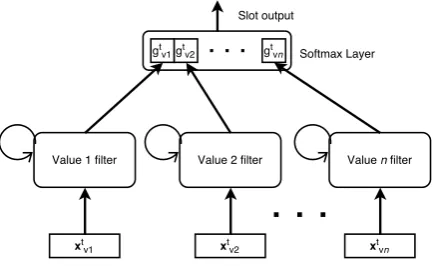
Figure 1:General DST for a single slot.
scribed. Following section describes the proposed ASR and phone-related features as well as differ-ent approaches to encode variable length phone se-quences into fixed length vectors. Section 4 de-scribes the experimental set-up. Sections 5 and 6 present results and conclusions.
2 Generalised dialogue state tracking
In slot-based dialogue state tracking, theontology
defines the set of slots S and the set of possible values for each slotVs. A dialogue state tracker is
hence a classifier, where classes correspond to the joint dialogue states. However, slot-based trackers often factorise the joint dialogue state into slots and therefore use a classifier to track each slot in-dependently (Lee, 2013). Then, the set of values for that slotVsare the classes. The joint dialogue
state is computed by multiplication and renormal-isation of individual probabilities for each slot. Even if the factorisation of the dialogue state helps to generalise by reducing the number of effective dialogue states or values to track, slot specifically trained state trackers are not able to generalise to unseen values as they learn the specific statistics of each slot and value. State trackers able to gen-eralise to unseen values track the probability of each value independently using value specific gen-eral features, such as the confidence score of the concept associated to that value in the SLU output (Henderson et al., 2014d).
2.1 Rule based state tracking
it was demonstrated in the 3rd DSTC. However, low adaptability can reduce the performance in do-mains that are challenging for ASR.
2.2 Slot-value independent data-driven state tracking
In the first two DSTC, most of the data driven ap-proaches to dialogue state tracking learned spe-cific statistics for each slot and value (Lee, 2013; Williams, 2014). However, in some cases (Lee and Eskenazi., 2013), parameter tying was used across slot models, thereby assuming that the statistics of two slots can be similar. The 3rd DSTC ad-dressed domain extension, and state trackers able to generalise to unseen dialogue states had to be developed. One of the most successful approaches (Henderson et al., 2014d) combined the output of two RNNs trackers: one represented slot-specific statistics and the other modelled slot-value inde-pendent general statistics. Later, (Mrksic et al., 2015) modified this model to be able to track the dialogue state in completely different domains by using only the general part of the model of (Hen-derson et al., 2014d). The slot-value independent model (shown in Fig. 1) comprises of a set of bi-nary classifiers orvalue filters3, one for each
slot-value pair, with parameters shared across all fil-ters. These filters track each value independently, and the slotsoutput distribution in each turn is ob-tained by concatenating the outputs of each value filter gt
v in Vs, followed by applying a softmax
function. The set of filters only differs from each other in two aspects: in the input composed by value specific general features (also called delexi-calized features); and in the label used during the training. An RNN-based general state tracker4
up-dates the probability of each valuept
v in each turn
tas follows:
ht
v =σ(Wxxtv+Whhtv−1+bh)
gvt =σ(wghtv+bg)
pt
v = exp(g
t
v)
P
v0∈V exp(gtv0) (1)
Whereht
vis the hidden state of each filter,xtvare
the value specific inputs and Wx, Wh, bh, wg
andbgare the parameters of the model.
3Addressed asfiltersdue to their resemblance with
con-volutional neural networks filters.
4This is a simplified version of the model described in
[image:3.595.308.526.61.210.2](Mrksic et al., 2015).
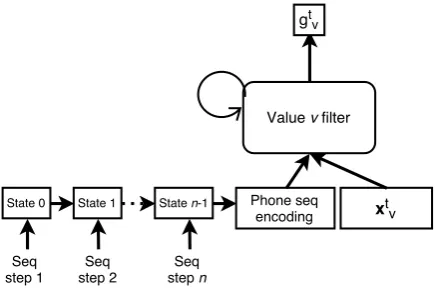
Figure 2:Joint RNN encoder.
3 ASR and phone-related general features
The model explained in section 2.2 works with value-specific general featuresxt
v (e.g. the
confi-dence score seen for that particular value in that turn). These features do not help to relate di-alogue states with similar state tracking perfor-mance, thus the model has to learn the mean statis-tics from all the states. However, different values have different state tracking performance. Fea-tures that can give information about the ASR per-formance or that can be used to relate the state tracking performance of values seen in the training data to unseen states, should allow to generalise to new dialogue states. In the following section, we introduce various features that can improve gener-alisation.
3.1 ASR features
In a command-based environmental control sys-tem, if recordings of the commands related to the unseen dialogue states are available, they can be used to estimate the ASR performance for the new commands. Then, the value specific features for each filter can be extended by concatenating the ASR accuracy of that specific value. When the tracker faces a value not seen in the training data, it can improve the estimation of the probability of that value by using the statistics learnt form values with similar ASR performance.
3.2 Phone related features
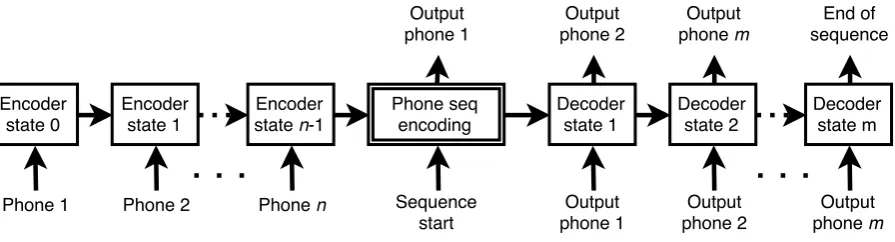
Figure 3:Seq2seq phone encoder.
the commands can be used to find similarities be-tween dialogue states with similar ASR perfor-mance. The phonetic structure of the commands can be seen as a space composed by subunits of the commands, where similarities between states can be computed.
Phone related features can be extracted in sev-eral ways. A deep neural network trained jointly with the ASR can be used to extract a sequence of phone posterior features, one vector per speech frame (Christensen et al., 2013b). Another way is to use a pronunciation dictionary to decompose the output of the ASR into sequences of phones. The later method can be also used to extract a “phonetic fingerprint” of the associated value for each filter. For example, a filter which is tracking the value “RADIO”, would have the sequence of phones “r-ey-d-iy-ow” as phonetic fingerprint.
In each dialogue turn, these features are based on sequences of different length. In the case of the ASR phone posteriors, the sequence length is equal to the number of speech frames. When using a pronunciation dictionary, the length is equal to the number of phonemes in the command. How-ever, in each dialogue turn, a fixed length vec-tor should be provided as input of the tracker. Thus, a method to transform these sequences into fixed length vectors is needed. A straightforward method is to compute the mean vector of the se-quence, thereby loosing the phone order informa-tion. In addition, the number of phones that the sequence has would affect the value of each phone in the mean vector. To compress these sequences in fixed length vectors while maintaining the or-dering and the phone length of the sequence, we propose to use a RNN encoder (Cho et al., 2014). We propose two ways to train this encoder, jointly with the model, and with a large pronunciation dictionary.
3.2.1 Joint RNN phone encoder
The state of an RNN is a vector representation of all the previous sequence inputs seen by the model. Therefore, the final state after process-ing a sequence can be seen as a fixed length en-coding of the sequence. If this enen-coding is put to the filters of the state tracker (Fig. 2), the tracker and the encoder can be trained jointly using back-propagation. We propose to concatenate the en-coding of the phonetic sequence in each turn with the value specific features xt
v for each filter as
shown in Fig. 2. This defines a structure with two stacked RNNs, one encoding the phonetic quences per turn and the other processing the se-quence of dialogue turns.
3.2.2 Seq2seq phone encoder
in-WHEN ZULU THEM THERE THAN SHE OTHER DELTA CAN LINE NUMBER WHAT
ZERO THEN THEIR THAT SHIFT WERE DELETE CALL LIKE NOVEMBER
[image:5.595.77.292.65.253.2]0.0 0.2 0.4 0.6 0.8 1.0 1.2 1.4
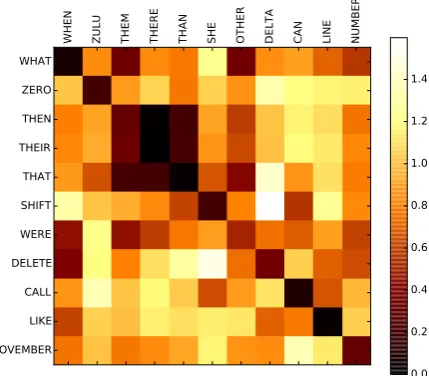
Figure 4: Cosine distance in the phone encod-ing space of different words of the UASpeech database.
put and target sequences are the same, forcing the model to learn to reconstruct the input sequence. The final state of the encoder RNN (the two-line block in Fig. 3) is taken as dense representation of the phone sequence. For this task, thecombilex
pronunciation dictionary (Richmond et al., 2010) is used to train the model. An RNN composed of two layers of 20 LSTM units is able to recon-struct 95% of the phone sequences in an indepen-dent evaluation set. This means compressing se-quences of one-hot vectors of size 45 (the number of phones in US English) into a vector of size 20. In Fig. 4, the cosine distance between the dense phone representations of two sets of words of the UASpeech database (see sec. 4.1.1) is plotted, il-lustrating that these encodings are able to effec-tively relate words with similar phone composi-tion.
4 Experimental setup
The experiments are performed within the con-text of a voice-enabled control system designed to help speakers with dysarthria to interact with their home devices (Christensen et al., 2013; Casanueva et al., 2016). The user can interact with the system in a mixed initiative way, speaking single-word commands from a total set of 36. As the ASR is configured to recognise single words (Christensen et al., 2012), the SLU operates a direct mapping from the ASR output, an N-Best list of words, to an N-Best list of commands. The dialogue state of the system is factorized into three slots, with
the values of the first slot representing the devices to control (TV, light, bluray...), the second slot its functionalities (channel, volume...) and the third slot the actions that these functionalities can per-form (up, two, off...). The slots have 4, 17 and 15 values respectively, and the combination of the values of the three slots compose the joint dia-logue state orgoal(e.g. TV-channel-five, bluray-volume-up). The set of valid5joint goalsJ has a
cardinality of 63, and the belief state for each joint goal j is obtained by multiplying the slot proba-bilities of each of the individual slot values and normalising:
P(j) = P Ps1(j1)Ps2(j2)Ps3(j3)
h∈J Ps1(h1)Ps2(h2)Ps3(h3) (2)
wherePsx(jx)is the probability of the valuejxin
slotsxandj= (j1, j2, j3).
4.1 Dialogue corpus
One of the main problems in dialogue manage-ment research is the lack of annotated dialogue corpora. The corpora released for the first three DSTCs aimed to mitigate this problem. How-ever, this corpus does not include acoustic data. Hence, features extracted from the acoustics such as phone posteriors cannot be used. A large part of dialogue management research relies onsimulated users (SU) (Georgila et al., 2006; Schatzmann et al., 2007; Thomson et al., 2012) for collection of the data needed. The dialogue corpus used in the following experiments has been generated with simulated users interacting with a rule based dia-logue manager. To simulate data collected from dysarthric speakers, a set of 6 SUs with dysarthria has been created.
To simulate data in two different domains, two environmental control systems are simulated, each controlled with a different vocabulary of 36 com-mands. 72 commands selected from the set of 155 more frequent words in the UASpeech database (Kim et al., 2008), and split into 2 groups, which are named domain A and domain B. 1000 dia-logues are collected in each domain6. To be sure
that the methods work independently of the set of commands selected, 3 different vocabularies of 72 words are randomly selected and the results psented in the following section show the mean re-sults for the 3 vocabularies.
5Many combinations of slot values are not valid
se-quences, e.g. light-channel-on.
6200 extra dialogues are collected indomain Bfor the
4.1.1 Simulated dysarthric users
Each SU is composed of a behaviour simulator
and an ASR simulator. The behaviour simula-tor decides on the commands uttered by the SU in each turn. It is rule-based and depending on the machine action, it chooses a command corre-sponding to the value of a slot or answers a con-firmation question. To simulate confusions by the user, it uses a probability of producing a different command, or of providing a value for a different slot than the requested one. The probabilities of confusion vary to simulate different expertise lev-els with the system. Three different levlev-els are used to generate the corpus to increase its variability.
The ASR simulatorgenerates ASR N-best out-puts. These N-best lists are sampled from ASR outputs of commands uttered by dysarthric speak-ers from the UASpeech database, using the ASR model presented in (Christensen et al., 2014). To increase the variability of the data generated, the time scale of each recording is modified to 10% and 20% slower and 10% and 20% faster, gener-ating more ASR outputs to sample from. Phone posterior features are generated as described in (Christensen et al., 2013b) without the principal component analysis (PCA) dimensionality reduc-tion. Six different SUs, corresponding to low-and mid-intelligible speakers, are created from the UASpeech database. ASR accuracy on these users ranges from 32% to 60%.
4.1.2 Rule-based state tracker
One of the trackers used in the DSTCs as baseline (Wang and Lemon., 2013) has been used to collect the corpus. This baseline tracker performed com-petitively in the 3 DSTCs, proving its capability to generalise to unseen states. The state tracking ac-curacy of this tracker is also used as the baseline in the following experiments.
4.1.3 Rule-based dialogue policy
The dialogue policy used to collect the corpus fol-lows simple rules to decide the action to take in each turn. For each slot, if the maximum belief of that slot is below a threshold, the system will ask for that slot’s value. If the belief is above that threshold but below a second one, it will confirm the value. If the maximum beliefs of all slots are above the second threshold, it will take the action corresponding to the joint goal with the highest probability. The thresholds values are optimised by grid search to maximise the dialogue reward. In addition, the policy implements a stochastic
be-haviour to induce variability in the collected data; choosing a different action with probabilitypand requesting the values of the slots in a different or-der. The corpus is collected using two different policy parameter sets.
4.2 General LSTM-based state tracker
A general dialogue state tracker, based on the model described on section 2.2, has been imple-mented. Each value filter is composed by a lin-ear feedforward layer of size 20 and a LSTM (Hochreiter and Schmidhuber, 1997) layer of size 30. Dropout (Srivastava et al., 2014) regularisa-tion is used in order to reduce overfitting with dropout rate of 0.2 in the input connections and 0.5 in the remaining non-recurrent connections. The models are trained for 60 iterations with stochas-tic gradient descent. A validation set consisting on 20% of the training data is used to choose the parameter set corresponding to the best iteration. Model combination is also used to avoid overfit-ting. Every model is trained with 3 different seeds, and 5 different parameter sets are saved for each seed, one for the best iteration in the first 20, and then another for the best iteration in each interval of 10 iterations.
4.2.1 ASR and phone related general features
In each turn t, each value-specific state tracker (filter) takes as input the value-specific input fea-tures xt
v. In this model, these correspond to the
confidence score of the command related to the specific value, the confidence scores of the meta-commands such as “yes” or “no” and a one-hot encoding of the last system action. In addition, the models are evaluated concatenating the value specific featuresxt
v with the following ASR and
phone related general featureszt
v:
•ValAcc: The ASR performance of the command corresponding to the value of the tracker can be used as general feature. In this paper, the accuracy per command is used, definingzt
vas the estimated
ASR accuracy of the valuev.
•PhSeq: A weighted sequence of phones is gen-erated form the ASR output (N-best list of com-mands) as described below. A pronunciation dic-tionary is used to translate each word into a se-quence of one-hot encodings of phones (the size of the one-hot encoding is 45, as the number of phones in US English). Each of these encodings is weighted by the confidence score of that com-mand in the N-best list. This sequence is fed into an RNN as explained in section 3.2.1, andzt
de-Joint Slot 1 Slot 2 Slot 3 Mean
Baseline 50.51% 81.00% 51.53% 55.72% 62.75%
General 68.87% 87.59% 66.57% 67.68% 73.95%
ValAcc 74.13% 88.90% 72.16% 66.59% 75.88%
PhSeq 68.38% 89.30% 66.20% 67.74% 74.41%
PostSeq 67.92% 89.20% 65.94% 67.61% 74.25%
ValPhEnc 57.93% 77.91% 61.56% 59.31% 66.26%
[image:7.595.139.459.62.178.2]PhSeq-ValPhEnc 58.56% 79.85% 62.03% 58.97% 66.95%
Table 1: Joint, mean and per slot state tracking accuracy of trackers trained ondomain Aand tested on
domain Bfor trackers using different features.
fined as the vector corresponding to the final state of this RNN. The RNN is composed by a single
GRU(Chung et al., 2014) layer of size 15.
•PostSeq: A sequence of vectors (one vector per speech frame) with monophone-state level pos-terior probabilities are extracted from the output layers of a Deep Neural Network trained on the UASpeech corpus. The extracted vectors contain the posteriors of each of the 3 states (initial, cen-tral, and final) for the 45 phones of US English. To reduce the dimensionality of vectors, the posteri-ors of the each phone states are merged by sum-ming them. To reduce the length of the sequence, the mean of each group of 10 speech frames is taken. This produces a sequence of vectors of size 45 and maximum length of 20, which is fed into an RNN in the same way asPhSeqfeatures to obtain
zt
v.
•ValPhEnc: For each value filter,zt
v is defined as
the 20 dimensional encoding of the sequence of phones of the command associated to the valuev, extracted from theseq2seqmodel defined in sec-tion 3.2.2. The encoder and decoder RNNs of the seq2seq model are composed of two layers of 20 LSTM units and the model is trained on the com-bilexdictionary (Richmond et al., 2010).
Note that two different kinds of features can be distinguished;value identityfeatures andASR output features. Value identity features (ValAcc
and ValPhEnc) give information about the value tracked. These features are different for each fil-ter (as each filfil-ter has a different associated value), but they do not change over turns (time invariant). ASR output features (PhSeqandPostSeq), on the other hand, give information about the ASR out-put observed. They are the same for each filter but change in each dialogue turn.
5 Results
The results presented are the joint state tracking accuracy, the accuracy of each individual slot and the mean accuracy of the 3 slots. This is because it was found that the relation between the mean slot accuracy and the joint accuracy is highly non-linear, due to the high dependency on the ontology of the joint goals, while the costs optimized are re-lated to the mean accuracy of the slots7. All the
following numbers represent the average results for the models tested with the 6 simulated users described in sec. 4.1.1.
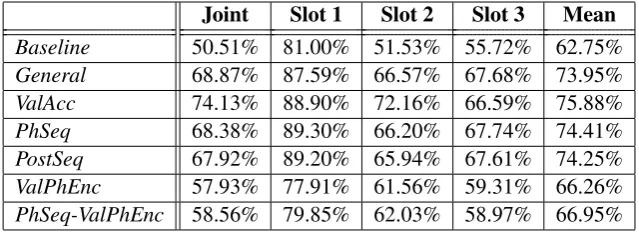
Table 1 presents the accuracy results for the model described in section 4.2, using only value specific general features (General) and using the different features described in section 4.2.1. The models are trained on data from domain A
and evaluated on data from domain B. Baseline
presents the state tracking accuracy for the rule-based state tracker presented in section 4.1.2. It can be seen that theGeneral tracker outperforms the baseline by more than 10%, suggesting that the baseline tracker does not perform well in ASR challenging environments. As it is expected, in-cluding the accuracy estimates (ValAcc) outper-forms all the other approaches, especially on the joint goal. IncludingPhSeqfeatures has a slightly worse performance in the joint but outperforms the General features in the mean slot accuracy. Comparing the slot by slot results, it can be seen that PhSeqfeatures outperform General features in slot 1 accuracy by almost 2% while having sim-ilar behaviour in the other 2 slots. PostSeq fea-tures have a performance very similar to PhSeq, suggesting that both features carry very similar information. Surprisingly, ValPhEncand PhSeq-7When joining the slot outputs, the “invalid goals” are
Joint Slot 1 Slot 2 Slot 3 Mean
General 68.97% 87.81% 66.91% 67.55% 74.09%
PhSeq 69.27% 89.54% 66.14% 68.24% 74.64%
ValAcc 74.65% 89.62% 72.73% 67.24% 76.53%
ValPhEnc 72.98% 89.88% 72.87% 75.66% 79.47%
PhSeq-ValPhEnc 73.48% 91.61% 74.03% 77.20% 80.95%
[image:8.595.138.458.63.165.2]ValId 60.83% 86.38% 66.95% 75.08% 76.14%
Table 2: Joint, mean and per-slot state tracking accuracy of trackers when including 200 dialogues from
domain Bin the training data.
ValPhEncperform much worse than the other fea-tures. A detailed examination of the training re-sults showed that, compared to General features, these features were performing about 10% better in the validation set (domain A) while getting 10% worse results in the test set (domain B). This sug-gests a strong case of overfitting to the training data, probably caused because the vocabulary size (36 words for train and other 36 words for test) is not large enough for the model to find similarities between the phone encoding vectors.
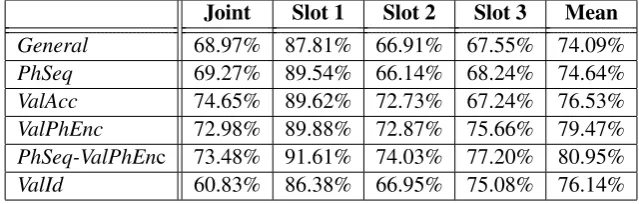
To partially deal with this problem, Table 2 shows the accuracy results when 200 dialogues fromdomain B are included in the training data. Including these dialogues in the training data has a very slight effect with theGeneralandPhSeq fea-tures. ValPhEncfeatures, however, show a large improvement, outperformingGeneralfeatures by 4% in the joint goal and more than 5% in the mean slot accuracy. This improvement is seen in all the slots individually. To be sure that the model is not just learning the identities of the words,ValId fea-tures extend theGeneralfeatures including a one-hot encoding of the word identity. As it can be seen, even if the performance in the joint goal is very low the mean slot accuracy improves the per-formance ofGeneralfeatures by 2%. However, it is still more than 3% below theValPhEncfeatures, showing thatValPhEncfeatures are not just learn-ing the value identity, they are effectively correlat-ing the performance of values similar in the phone encoding space. Finally, including the concatena-tion ofPhSeqandValPhEncfeatures, outperforms all the other approaches, evenValAccfeatures for the mean slot accuracy by more than 4%.
6 Conclusions
This paper has shown how the generalisation to unseen states of a dialogue state tracker can be improved by extending the value specific
fea-tures with ASR accuracy estimates. Using an RNN encoder jointly trained with the general state tracker to encode phone-related sequential fea-tures slightly improved state tracking generalisa-tion. However, when the model was trained using dense representations of phone sequences encoded with aseq2seqmodel, the tracker strongly overfit-ted to the training data, even ifdropout regulariza-tion and model combinaregulariza-tion was used. This might be caused by the small variability of the command vocabulary (36 commands in each domain), which was not large enough for the model to find use-ful correlations between phone encodings. When a small amount of data from the unseen domain was included into the training data, phone encod-ings greatly boosted performance. This showed that phone encodings are useful as dense repre-sentations of the phonetic structure of the com-mand, helping the model correlate state tracking performance of values close in the phonetic en-coding space. This method was tested on a single-word command-based environmental control in-terface, where slot-value accuracies can easily be estimated. In addition, in this domain, the se-quences of phonetic features are usually short. However, this method could be adapted to larger spoken dialogue systems by estimating the con-cept error rate of the SLU output of concon-cepts re-lated to slot-value pairs. Longer phonetic feature sequences could also be used to detect “problem-atic phones”, or correlate sentences with similar phonetic composition, given enough variability of the training dataset to avoid overfitting.
Acknowledgments
References
I. Casanueva, H. Christensen, T. Hain, and P. Green.
2014. Adaptive speech recognition and dialogue
management for users with speech disorders. Pro-ceedings of Interspeech.
I. Casanueva, T. Hain, H. Christensen, R. Marxer, and
P. Green 2015. Knowledge transfer between
speak-ers for pspeak-ersonalised dialogue management.. 16th Annual Meeting of the Special Interest Group on Discourse and Dialogue
I. Casanueva, T. Hain, and P. Green 2016. Improving
generalisation to new speakers in spoken dialogue state tracking.. Proceedings of Interspeech.
H. Christensen, S. Cunningham, C. Fox, P. Green, and
T. Hain. 2012. A comparative study of adaptive,
au-tomatic recognition of disordered speech. Proceed-ings of Interspeech.
H. Christensen, I. Casanueva, S. Cunningham, P.
Green, and T. Hain. 2013. homeService:
Voice-enabled assistive technology in the home using cloud-based automatic speech recognition. Pro-ceedings of SLPAT.
H. Christensen, I. Casanueva, S. Cunningham, P.
Green, and T. Hain. 2014. Automatic selection of
speakers for improved acoustic modelling: recogni-tion of disordered speech with sparse data. Proceed-ings of SLT.
H. Christensen, M. B. Aniol, P. Bell, P. Green, T. Hain,
S. King, and P. Swietojanski 2013. Combining
in-domain and out-of-domain speech data for auto-matic recognition of disordered speech. proceedings of Interspeech.
H. Christensen, Nicolao, M., Cunningham, S., Deena,
S., Green, P., and Hain, T. 2015. Speech-Enabled
Environmental Control in an AAL setting for peo-ple with Speech Disorders: a Case Study. arXiv preprint arXiv:1604.04562.
K. Cho, B. van Merrienboer, C. Gulcehre, D. Bah-danau, F. Bougares, H. Schwenk, and Y. Bengio
2014. Learning Phrase Representations using RNN
Encoder-Decoder for Statistical Machine
Transla-tion. EMNLP.
J. Chung, C. Gulcehre, K. Cho, and Y. Bengio
2014. Empirical evaluation of gated recurrent
neu-ral networks on sequence modeling. arXiv preprint arXiv:1412.3555.
M. Gaˇsi´c and S. Young. 2014. Gaussian Processes
for POMDP-based dialogue manager opimisation. IEEE Transactions on Audio, Speech and Language Processing.
M. Geist and O. Pietquin. 2011.Managing uncertainty
within the KTD framework. Proceedings of JMLR.
K. Georgila, J. Henderson and O. Lemon. 2006. User
simulation for spoken dialogue systems: learning and evaluation. proceedings of INTERSPEECH M. Henderson, B. Thomson, and J. Williams. 2014.
The second dialog state tracking challenge. 15th Annual Meeting of the Special Interest Group on Discourse and Dialogue
M. Henderson, B. Thomson, and J. Williams. 2014.
The third dialog state tracking challenge. Spoken Language Technology Workshop (SLT)
M. Henderson, B. Thomson and S. Young. 2014.
Word-Based Dialog State Tracking with Recurrent Neural Networks. Proceedings of the SIGDIAL 2014 Conference
M. Henderson, B. Thomson and S. Young 2014.
Ro-bust dialog state tracking using delexicalised recur-rent neural networks and unsupervised adaptation. Spoken Language Technology Workshop (SLT)
S. Hochreiter and J. Schmidhuber. 1997. Long
short-term memory.. Neural computation
H. Kim, M. Hasegawa-Johnson, A. Perlman, J. Gun-derson, T. Huang, K. Watkin, and S. Frame. 2008.
Dysarthric speech database for universal access re-search. Proceedings of Interspeech.
S. Lee and M. Eskenazi. 2013. Recipe For Building
Robust Spoken Dialog State Trackers: Dialog State Tracking Challenge System Description. Proceed-ings of the SIGDIAL 2013 Conference
S. Lee 2013. Structured discriminative model for
di-alog state tracking. Proceedings of the SIGDIAL 2013 Conference
R. Lowe, Pow, N., Serban, I., and Pineau, J. 2015.
The ubuntu dialogue corpus: A large dataset for re-search in unstructured multi-turn dialogue systems. SIGDial conference
N. Mrksic, D. O. Saghdha, B. Thomson, M. Gai, P.
H. Su, D. Vandyke, and S. Young 2015.
Multi-domain dialog state tracking using recurrent neural networks. arXiv preprint arXiv:1506.07190. T. Mikolov, I. Sutskever, K. Chen, G. S. Corrado, and
J. Dean 2013. Distributed Representations of Words
and Phrases and their Compositionality. Advances in neural information processing systems.
K. Sun, L. Chen, S. Zhu and K. Yu. 2014. The SJTU
System for Dialog State Tracking Challenge 2. Pro-ceedings of the SIGDIAL 2014 Conference.
K. Sun, L. Chen, S. Zhu and K. Yu. 2014. A
general-ized rule based tracker for dialogue state tracking. Spoken Language Technology Workshop (SLT).
K. Richmond, R. Clark, and S. Fitt. 2010. On
N. Srivastava, G. Hinton, A. Krizhevsky, I. Sutskever
and R. Salakhutdinov. 2014. Dropout: A simple
way to prevent neural networks from overfitting. The Journal of Machine Learning Research
J. Schatzmann, B. Thomson, K. Weilhammer, H. Ye
and S. Young. 2006. Agenda-based user simulation
for bootstrapping a POMDP dialogue system. Hu-man Language Technologies
B. Thomson, and S. Young. 2010. Bayesian update
of dialogue state: A POMDP framework for spoken dialogue systems. Computer Speech and Language. B. Thomson, M. Gasic, M. Henderson, P. Tsiakoulis
and S. Young. 2012. N-best error simulation for
training spoken dialogue systems. Spoken Lan-guage Technology Workshop (SLT)
P. Vincent, H. Larochelle, Y. Bengio, and P. A.
Man-zagol 2008. Extracting and composing robust
fea-tures with denoising autoencoders. Proceedings of the 25th international conference on Machine learn-ing
Z. Wang, and O. Lemon. 2013. A simple and generic
belief tracking mechanism for the dialog state track-ing challenge: On the believability of observed in-formation. Proceedings of the SIGDIAL 2013 Con-ference
J. Williams and S. Young. 2007. Partially
observ-able Markov decision processes for spoken dialog systems. Computer Speech and Language.
J. Williams. 2014. Web-style Ranking and SLU
Com-bination for Dialog State Tracking. Proceedings of SIGDIAL.
J. Williams, A. Raux, D. Ramachandran, and A. Black.
2013.The dialog state tracking challenge.
Proceed-ings of the SIGDIAL 2013 Conference
T. Wen, Gasic, M., Mrksic, N., Rojas-Barahona, L. M.,
Su, P. H., Ultes, S., and Young, S. 2016.A
Network-based End-to-End Trainable Task-oriented Dialogue System. arXiv preprint arXiv:1604.04562.
S. Young, M. Gaˇsi´c, B. Thomson and J. D. Williams.
2013. POMDP-Based Statistical Spoken Dialog