DIRECT SYNTHESIS OF
g
-BUTYROLACTONES VIA
g
-PHENYL
SUBSTITUTED BUTYRIC ACIDS MEDIATED
BENZYL RADICAL CYCLIZATION
N. O. Mahmoodi* and M. Jazayri
Organic Research Laboratory, Department of Chemistry, University of Guilan, Rasht, P.O. Box1914, Iran
ABSTRACT
Synthesis of several g-butyrolactones with aromatic substitution at carbon 5 from comparativeg-aryl acids with 25–85% yield are covered. The straight oxidation in the pre-sence of peroxydisulphate-copper(II)chloride system in aqu-eous medium was applied. The reaction is highly regioselective and leads exclusively to g-butyrolactone, through stable benzylic radical intermediate.
Oxidative addition of carboxylic acids and alkenes was used as a mild methodology for formation of g-butyrolactones.1–4 The oxidative systems such as S2O28-Ag
þ
, S2O28-Ag
þ
-Cu,5–7 different oxidants’ derivatives of Pb(IV), Co(III), Ag(II), other polyvalent metals,8–10 and KMnO411 can interact with carboxylic acids, resulting usually in their
decarboxylation and creation of alkyl radicals. Direct oxidative systems such as oxidative lactonization of carboxylic acids in the presence of
1467
Copyright&2001 by Marcel Dekker, Inc. www.dekker.com
peroxydisulphate-containing systems have been published. However, the yields of conversion are either very low or the reaction is not selective, e.g., 3.3–9.5% and 4–10%, respectively, for mixtures that contain 5- and 6-member ring lactones together with some decarboxyllated compounds.12 The objectives of this study are to convert 4-substituted aryl acids in the presence of an oxidative system such as S2O28-Cu2þ from mild to high yields, and to monitor the conversion to exclusively 5-member lactone ring. Recently, we synthesized several mono, and di-substitutedg -butyro-lactones with aryl and aliphatic substitution at carbon 5, 3,5 and 3,4 as an essence,13an anti-glaucoma, and an anti-tumor,14–17respectively. The direct oxidation system in the presence of peroxydisulphate-copper chloride, and in the aqueous solution at 90C was applied. The reaction is regioselective and leads mainly tog-butyrolactone (Scheme 1).
Several 4-aryl carboxylic acids for one-pot direct conversion to the corresponding butyrolactones were elected. These acids were prepared from available starting materials by using straightforward procedures. The lactonization was entirely regioselective and only the g-butyrolactones are isolated with 25–84% yields (Table 1).
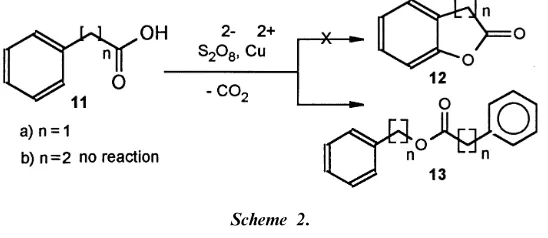
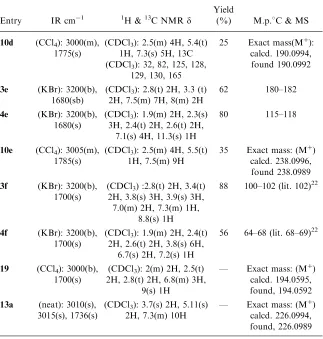
Utilization of this oxidation reagent for intramolecular reaction of aryl acids of 11 (Scheme 2) to expected 5- and 6-members fused lactones 12 failed, and, in one case, lead to ester 13a. Spectroscopic data for all compounds are shown in (Table 2).
Formation of lactone10c in high yield (Table 1) with hydroxy sub-stitution instead of methoxy group of starting aryl acids 4c at the para position, implies that the reaction has involved some extent of ‘‘through conjugaction’’18 (Scheme 3).
For the same reason, the 4-(2,5-dimethoxy phenyl) butyric acid4fwas not converted to the corresponding lactone10f; instead, that entirely led to the formation of comparable p-benzoquinone, 4-(2,5-cyclohexadiene-1,4-dione) butanoic acid 19, probably through stable radical17 and biradical 18(Scheme 4).
[image:3.422.72.346.338.457.2]Scheme 2.
Table 1. Yield of Lactonization from 4-Aryl Acids
Lactone R1 R2 R3 Yield %
10a H H H 41
10b H H Me 51
10c H H OH 84
10d Me Me H 25
10e H H PH 35
Table 2. Physical Property of All Synthesized Compounds
Entry IR cm1 1H &13C NMRd
Yield
(%) M.p.C & MS
3a (KBr): 3200(b), 1690(b)
(CDCl3): 2.4(t) 2H, 3.4(t) 2H, 7.5(m) 3H, 8(m) 2H
90 114–116 (lit. 115)19
4a (KBr): 3200(b), 1700(s)
(CDCl3): 2.1(m) 2H, 2.5(t) 2H, 2.7(t) 2H, 7.3(m) 5H,
11.1(s) 1H
89 47–48 (lit. 47–48)19
10a (neat): 1770(s) (CDCl3): 2.5(m) 4H, 5.4(t) 1H, 7.3(s) 5H, 13C (CDCl3): 32, 82, 125, 128,
129, 130, 165
41 Exact mass(Mþ): calcd.¼162.0681, found 162.0675
3b (KBr): 3200(b), 1680(sb)
(CDCl3): 2.5(s) 3H, 2.9(t) 2H, 3.3(t) 2H, 7.4(m) 2H,
7.9(m) 2H, 9.9(s) 1H
83 122–125
4b (KBr): 3200(b), 1690(s)
(CDCl3): 1.9(m) 2H, 2.3(s) 3H, 2.4(t) 2H, 2.6(t) 2H,
7.1(s) 4H, 11.3(s) 1H
— 52–55 (lit. 57–48)20
10b (CCl4): 3005(m), 1780(s)
(CDCl3): 2.3(m) 2H, 2.6(t) 3H, 5.5(t) 1H, 7.2(s) 4H 13C(CDCl3): 21, 29, 30, 81,
125, 126, 128, 129, 165
51 62–64 Exact mass(Mþ):calcd.
176.0837, found 176.0836
3c (KBr): 3200(b), 1700(s)
(CDCl3): 2.7(t) 2H, 3.2(t) 2H, 3.8(s) 3H, 6.9(d) 2H,
7.9(d) 2H
82 144–152 (lit. 148–150)21
4c (KBr): 3200(b), 1700(s)
(CDC13): 1.9(t) 2H, 2.3(m) 2H, 2.6(m) 2H, 3.8(s) 3H,
7.0(m) 4H
71 56–58 (lit. 56–59)21
10c (neat): 3010(m), 1765(s)
(CDCl3): 2.5(m) 4H, 5.4(t) 1h, 7.3(m) 4H, 8.7(s) 1H 13C(CDC13): 29, 30, 81,
126, 128, 176
84 Exact mass: (Mþ):
calcd. 178.0630, found 178.0627
3d (KBr): 3200(b), 1680(sb)
(CDCl3): 2.3(s) 3H, 2.5(s) 3H, 2.7(t) 2H, 3.1(t) 2H,
7.0(s) 2H, 7.6(m) 1H, 11.3(s) 1H
85 100–102
4d (KBr): 3200(b), 1685(s)
(CDCl3): 2(m) 2H, 2.5(s) 6H, 2.8(t) 2H, 5.8(t) 1H,
7.2(m) 3H
82 62–66
Table 2. Continued
Entry IR cm1 1H &13C NMRd
Yield
(%) M.p.C & MS
10d (CCl4): 3000(m), 1775(s)
(CDCl3): 2.5(m) 4H, 5.4(t) 1H, 7.3(s) 5H, 13C (CDCl3): 32, 82, 125, 128,
129, 130, 165
25 Exact mass(Mþ): calcd. 190.0994,
found 190.0992
3e (KBr): 3200(b), 1680(sb)
(CDCl3): 2.8(t) 2H, 3.3 (t) 2H, 7.5(m) 7H, 8(m) 2H
62 180–182
4e (KBr): 3200(b), 1680(s)
(CDCl3): 1.9(m) 2H, 2.3(s) 3H, 2.4(t) 2H, 2.6(t) 2H,
7.1(s) 4H, 11.3(s) 1H
80 115–118
10e (CCl4): 3005(m), 1785(s)
(CDCl3): 2.5(m) 4H, 5.5(t) 1H, 7.5(m) 9H
35 Exact mass: (Mþ)
calcd. 238.0996, found 238.0989
3f (KBr): 3200(b), 1700(s)
(CDCl3) :2.8(t) 2H, 3.4(t) 2H, 3.8(s) 3H, 3.9(s) 3H, 7.0(m) 2H, 7.3(m) 1H,
8.8(s) 1H
88 100–102 (lit. 102)22
4f (KBr): 3200(b), 1700(s)
(CDCl3): 1.9(m) 2H, 2.4(t) 2H, 2.6(t) 2H, 3.8(s) 6H,
6.7(s) 2H, 7.2(s) 1H
56 64–68 (lit. 68–69)22
19 (CCl4): 3000(b), 1700(s)
(CDCl3): 2(m) 2H, 2.5(t) 2H, 2.8(t) 2H, 6.8(m) 3H,
9(s) 1H
— Exact mass: (Mþ) calcd. 194.0595, found, 194.0592
13a (neat): 3010(s), 3015(s), 1736(s)
(CDCl3): 3.7(s) 2H, 5.11(s) 2H, 7.3(m) 10H
— Exact mass: (Mþ) calcd. 226.0994, found, 226.0989
EXPERIMENTAL General
Yields refer to isolated pure center cut from column chromatography or scratched from preparative TLC. Products were characterized by com-parison with authentic samples (IR, NMR, GC, TLC, and m.p.). Melting points are uncorrected and determined by Metller Fp5 melting point apparatus. The 1H and 13C NMR spectra were recorded on a Bruker spectrometer, generally with TMS as internal standard. The IR spectra were recorded with a Shimadzu model 470. The high-resolution mass spectra were obtained from a Fisons Trio-1000 instrument.
Synthesis of 4-Phenyl-4-oxobutanoic Acids 3a: A Typical Procedure
Twenty mL (17.5 g, 0.225 mol) benzene (Na-dried and free of thio-phene) and 3.4 g (0.034 mol) succinic anhydride were combined in a 100 -mL flask equipped with a refluxcondenser connected through a Y-junction to a single efficient gas absorption device. The succinic anhydride dissolved in the benzene, 10 g (0.075 mol) of powdered anhydrous aluminum chloride was added and stirred in the mixture solution. The reaction started immediately; HCl evolved and the mixture became hot. The resulting mix-ture was then allowed to warm up at room temperamix-ture and then again allowed to warm up for 30 m at gentle reflux. The solution was cooled in cold water. Then 15 mL water and 5 mL conc. HCl were added. Excess benzene was removed by steam distillation. The residue was cooled and filtered on a Buchner funnel and washed with 10 mL (1:3) dilute HCl and
1 mL H2O. The crystals were boiled in Na2CO3(4 g in 25 mL H2O) for 15 m.
The filtrate was cooled and acidified by conc. HCl at 0C, 5.4 g (90%) crystals m.p. 114–116C (lit.,19 115C) was separated. The IR and NMR were recorded and shown in Table 2.
Preparation of 4-Phenyl Butanoic Acids 4a: A Typical Procedure
Zn powder (4.3 g), 0.43 g (1.58 mmol) mercury (II) chloride, 0.2 mL conc. HCl, and 5.5 mL water, were combined in a 50-mL flask. The mixture was stirred at room temperature for several minutes to produce a homo-genous solution. After homogenization was completed, the stirring was stopped and the liquid was decanted as completely as possible. In a flask equipped with a refluxcondenser, 2.7 mL water, 0.65 mL conc. HCl, 3.6 mL toluene(as solvent) and 1.8 g (0.01 mol) 4-phenyl-4-oxobutanoic acid3awere combined. The flask was refluxed vigorously for 30 h. During this period, 1.8 mL conc. HCl was added to the flask at approximately 6-h intervals during the refluxing period to maintain the conc. of HCl. After cooling, two layers were seperated water (7.2 mL) was added to the aqueous layer, and was extracted with 330 mL ether. The extracted layer was added to toluene, washed with water, and dried over MgSO4. The solvent was
evaporated and the residue was distilled 185C 20 mmHg (1.49 g, 89%),
(m.p. 47–48C, lit.20 47–48C). The IR and NMR spectra were recorded (Table 2).
Preparation of 5-Phenyl-g-butyrolactone 10a: A Typical Procedure
4-Phenyl butanoic acid 4a (4.92 g, 30 mmol), 27 mL water, and 5.1 g (30 mmol) copper (II) chloride 2H2O were combined in a 250-mL, two-neck,
[image:7.422.49.369.476.575.2]round-bottom flask equipped with a refluxcondenser and an additional
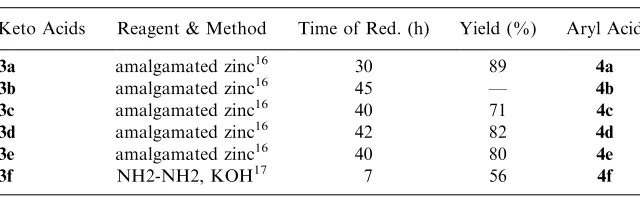
Table 3. Red. Condition for Conversion of Keto Acids to 4-Aryl Acids
Keto Acids Reagent & Method Time of Red. (h) Yield (%) Aryl Acid
3a amalgamated zinc16 30 89
4a 3b amalgamated zinc16 45 — 4b 3c amalgamated zinc16 40 71
4c 3d amalgamated zinc16 42 82 4d 3e amalgamated zinc16 40 80 4e
funnel. A solution of 8.5 g (30 mmol) Na2S2O8and 15 mL water was added
to the additional funnel. The reaction mixture was allowed to reflux by vigorous stirring while the temperature of solution was adjusted to 85– 90C. The solution from the additional funnel was added dropwise to a flask during 40 m, and the flask was refluxed for 3.5 h. After this time, the reaction was stopped. The flask was cooled and extracted with 330 mL ether and dried with MgSO4. The solvent was removed and 2 g (41%) of10a
was collected as a pure center cut from silica gel column chromatography. The solvent system used was 5–10% EtOAc:ligroin. The IR,1H,13CNMR spectra and Exact mass (Mþ) were recorded (Table 2).
Synthesis of 4-(4-Methoxyphenyl)-4-oxobutanoic Acid 3c
Nitrobenzene (60 mL redistilled and dried) as a solvent and 2.5 g (0.025 mol) succinic anhydride were combined in a 250-mL, 2-neck, round-bottom flask equipped with a refluxcondenser connected through a y-junction to a single efficient gas absorption device and an additional funnel. Then 6.67 g (0.05 mol) anhydrous AlCl3 powder and 15 mL
nitro-benzene (redistilled) from the additional funnel dropwise was added to the solution during 45 m. The resulting mixture was then stirred at room temperature for an additional 6 h. After this time, the reaction mixture was transferred to the solution of 300 mL HCl (20%) and 200 g ice, stirred vigorously, and extracted with 430 mL ether. The ether layers were com-bined and washed with 330 mL water, and extracted with 530 mL conc. NaHCO3. The aqueous layers were washed with 320 mL ether, and
acid-ified with HCl. The white precipitate (3.4 g, 82% yield), m.p. 144–152C lit.21148–150C. The IR, and NMR are recorded (Table 2)
Synthesis of 4-(4-Methoxy phenyl)butanoic Acid 4c
A similar procedure as used for4awas applied, but instead of reflux for 30 h, the solution was refluxed for a 40-h period and 1.8 mL conc. HCl was added to the flask at 8-h intervals.
Preparation of 5-(4-Hydroxy phenyl)-g-butyrolactone 10c
ACKNOWLEDGMENTS
We appreciate the Research Committee of Guilan University for the partial support given to this study.
REFERENCES
1. Corey, E.J.; Kang, M. J. Am. Chem. Soc.1984,106, 5384.
2. Snider, B.B.; Mohan, R.; Kates, S.A. J. Org. Chem. 1985,50, 3661. 3. Fristad, W.E.; Hershberger, S.S. J. Org. Chem. 1985,50, 1026. 4. Kraus, G.A.; Landgrebe, K. Tetrahedron Lett. 1984,25, 3939. 5. Ogibin, Y.N.; Rakhmatulline, L.K.; Nikishin, G.I. Izu. An SSSR, Ser.
Khim.1975, 2723.
6. Anderson, J.M.; Kochi, J.K. J. Am. Chem. Soc.1970,92, 1651. 7. Ogibin, Y.N.; Troyansky, E.I.; Nikishin, G.I.; Kadentsev, V.I.;
Lubuzh, E.D.; Chizhov, O.S. Izu. An SSSR, Ser. Khim.1976, 2518. 8. Bacha, J.D.; Kochi, J.K. Tetrahedron 1968,24, 2215.
9. Anderson, J.M.; Kochi, K.J. J. Org. Chem.1970,35, 986. 10. Lande, S.S.; Kochi, J.K. J. Am. Chem. Soc.1968,90, 5196. 11. Kenyon, J.; Symons, M.C.R. J. Chem. Soc.1953,2129, 3580.
12. Nikishin, G.I.; Svitanko, I.V.; Troyansky, E.I. J. Chem. Soc., Perkin Trans. 21983, 595.
13. Mahmoodi, N.O.; Mirmohammadi, S.H., Submitted for Publication, in press.
14. Belletire, J.L.; Mahmoodi, N.O. Tetrahedron Lett.1989,30, 4363. 15. Belletire, J.L.; Mahmoodi, N.O. Synth. Commun.1989,19, 3371. 16. Belletire, J.L.; Mahmoodi, N.O. J. Nat. Prod.1992,55, 194.
17. Mahmoodi, N.O., Dissertation Abstracts International, University of Michigan, MI, USA 1992,52, 8.
18. Brown, H.C.; Okamato, Y. J. Am. Chem. Soc.1958,80, 4979. 19. Brown, P.M.; Russell, J.; Thomsoon, R.H.; Wylile, A.G. J. Chem.
Soc. (c)1968, 842.
20. Dictionary of Organic Compounds, 5th Ed.; Chapman and Hall: Pennsylvania, 1982.
21. Aldrich Catalog-Handbook of Fine Chemicals, 1993–1994. 22. Shoekravi, A. Iran J. Chem. and Chem. Eng.1995,14, 23. 23. Clemmensen, E. Ber.1913,46, 1837.
24. Cannizzaro, S. Ann.1835,88, 129.