Empty Categories in Hindi Dependency Treebank: Analysis and Recovery
Chaitanya GSK Intl Institute of Info. Technology
Hyderabad, India chaitanya.gsk @research.iiit.ac.in
Samar Husain
Intl Institute of Info. Technology Hyderabad, India
samar
@research.iiit.ac.in
Prashanth Mannem Intl Institute of Info. Technology
Hyderabad, India prashanth
@research.iiit.ac.in
Abstract
In this paper, we first analyze and classify the empty categories in a Hindi dependency tree-bank and then identify various discovery pro-cedures to automatically detect the existence of these categories in a sentence. For this we make use of lexical knowledge along with the parsed output from a constraint based parser. Through this work we show that it is possi-ble to successfully discover certain types of empty categories while some other types are more difficult to identify. This work leads to the state-of-the-art system for automatic inser-tion of empty categories in the Hindi sentence.
1 Introduction
Empty categories play a crucial role in the annota-tion framework of the Hindi dependency treebank1 (Begum et al., 2008; Bharati et al., 2009b). They are inserted in a sentence in case the dependency analysis does not lead to a fully connected tree. In the Hindi treebank, an empty category (denoted by a NULL node) always has at least one child. These elements have essentially the same properties (e.g. case-marking, agreement, etc.) as an overtly real-ized element and they provide valuable information (such as predicate-argument structure, etc.). A dif-ferent kind of motivation for postulating empty cate-gories comes from the demands of natural lan- guage processing, in particular parsing. There are several types of empty categories in the Hindi dependency
1The dependency treebank is part of a Multi
Representa-tional and Multi-Layered Treebank for Hindi/Urdu (Palmer et al., 2009).
treebank serving different purposes. The presence of these elements can be crucial for correct auto-matic parsing. Traditional parsing algorithms do not insert empty categories and require them to be part of the input. The performance of such parser will be severely affected if one removes these ele-ments from the input data. Statistical parsers like MaltParser (Nivre, 2003), MSTParser (McDonald, 2005), as well as Constraint Based Hybrid Parser (CBHP) (Bharati et al., 2009a) produce incorrect parse trees once the empty categories are removed from the input data. Hence there is a need for auto-matic detection and insertion of empty categories in the Hindi data. Additionally, it is evident that suc-cessful detection of such nodes will help the annota-tion process as well.
There have been many approaches for the recov-ery of empty categories in the treebanks like Penn treebank, both ML based (Collins, 1997; Johnson, 2002; Dienes and Dubey, 2003a,b; Higgins, 2003) and rule based (R Campbell, 2004). Some ap-proaches such as Yang and Xue (2010) follow a post processing step of recovering empty categories after parsing the text.
In this paper we make use of lexical knowledge along with the parsed output from a constraint based parser to successfully insert empty category in the input sentence, which may further be given for pars-ing or other applications. Throughout this paper, we use the term recovery (of empty categories) for the insertion of different types of empty categories into the input sentence.
The paper is arranged as follows, Section 2 dis-cusses the empty nodes in the treebank and classifies
NULL NP tokens 69 NULL VG tokens 68 NULL CCP tokens 32 Sentences with more than
[image:2.612.103.269.60.133.2]one empty category in them 159
Table 1: Empty categories in Hindi Tree bank
them based on their syntactic type. In section 3 we provide an algorithm to automatically recover these elements. Section 4 shows the performance of our system and discusses the results. We conclude the paper in section 5.
2 An overview of Empty Categories in Hindi dependency Treebank
Begum et al., (2008) proposed a dependency frame-work in which an empty node is introduced dur-ing the annotation process only if its presence is required to build the dependency tree for the sen-tence (Figures 1, 2, 3)2. Empty categories such as those discussed in Bhatia et al. (2010) which would be leaf nodes in the dependency tree are not part of the dependency structure and are added during Propbanking3. Consequently, the empty categories
in Hindi treebank do not mark displacement as in Penn treebank (Marcus et al., 1993) rather, they rep-resent undisplaced syntactic elements which happen to lack phonological realization. In the Hindi depen-dency treebank, an empty category is represented by a ‘NULL’ word. Sentences can have a missing VG or NP or CCP4. These are represented by ‘NULL’ token and are marked with the appropriate Part-of-speech tag along with marking the chunk tag such as NULL NP, NULL VGF, NULL CCP, etc. in Ta-ble 2
2Due to space constraints, sentences in all the figures only
show chunk heads. Please refer to examples 1 to 6 for entire sentences with glosses
3
These empty categories are either required to correctly cap-ture the argument struccap-ture during propbanking or are required to successfully convert the dependency structure to phrase struc-ture (Xia et al., 2009)
4
VG is Verb Group, NP is Noun Phrase and CCP is Conjunct Phrase.
Type of empty Inst- Chunk tag
categories ances (CPOS)
Empty subject 69 NULL NP Backward gapping 29 NULL VG Forward gapping 21 NULL VG Finite verb ellipses 18 NULL VG Conjunction ellipses
(verbs) 20 NULL CCP
Conjunction ellipses
(nouns) 12 NULL CCP
Total 169
Table 2: Empty category types.
2.1 Empty category types
From the empty categories recovery point of view, we have divided the empty categories in the treebank into six types (Table 2).
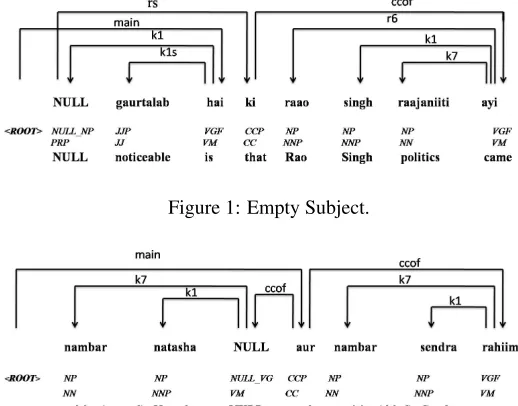
The first type of empty category isEmpty Subject (Figure 1), example.1 where a clause ‘rava ke kaaran hi manmohan singh rajaneeti me aaye’ is dependent on the missing subject of the verb‘hai’ (is).
(1) NULL gaurtalab hai ki raao NULL ‘noticeable’ ‘is’ ‘that’ ‘Rao’ ke kaaran hi manmohan sing ‘because’ ‘only’ ‘Manmohan‘ ‘singh‘
raajaniiti me aaye ‘politics’ ‘in’ ‘came.
‘it is noticeable that because of Rao, Manmohan Singh came in politics’
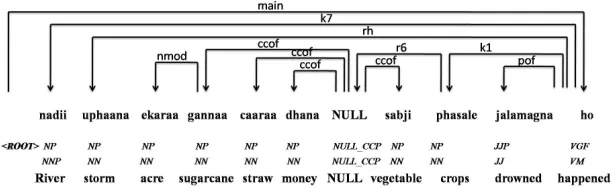
The second type of empty category is due to Backward Gapping (Figure 2), example.2 where the verb is absent in the clause that occurs before a co-ordinating conjunct.
(2) doosare nambara para misa roosa ‘second’ ‘position’ ‘on’ ‘miss’ ‘Russia’
natasha NULL aur tiisare nambara ‘Natasha’ NULL ‘and’ ‘third’ ‘position’
[image:2.612.326.530.61.215.2]Figure 1: Empty Subject.
Figure 2: Backward Gapping.
Figure 3: Forward Gapping.
Figure 4: Finite verb ellipses.
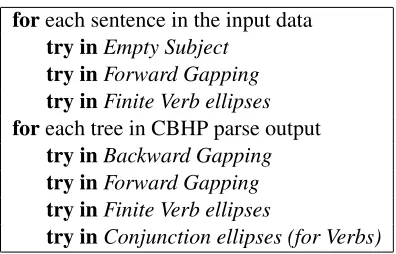
[image:3.612.170.429.69.272.2]Figure 6: Conjunctuon ellipses (nouns).
‘Miss Russia stood second and Miss Lebanan was third’
The third type of empty category is Forward Gapping (Figure 3), example 3, which is similar to the second type but with the clause with the missing verb occurring after the conjunct rather than before. The reason for a separate class for forward gapping is explained in the next section.
(3) divaalii ke dina jua Kele magara ‘Diwali’ ‘GEN’ ‘day’ ‘gamble’ ‘play’ ‘but’
NULL gar me yaa hotala me ‘NULL’ ‘home’ ‘in’ ‘or’ ‘hotel’ ‘in’
‘Played gamble on Diwali day but was it at home or hotel’
The fourth type of empty category is due toFinite verb ellipses (Figure4), example 4, where the main verb for a sentence is missing.
(4) saath me vahii phevareta khadaa pyaaja ’along’ ’in’ ’that’ ’favorite’ ’raw’ ’onion’ NULL.
NULL
‘Along with this, the same favorite semi-cooked onion’
The fifth type of empty category is Conjunction ellipses (Verbs), example 5 (Figure 5).
(5) bacce bare ho-ga-ye-hai NULL ‘children’ ‘big’ ‘become’ ‘NULL’
kisii ki baat nahiin maante ‘anyone’ ‘gen’ ‘advice’ ‘not’ ‘accept’
‘The children have grown big (and) do not listen to anyone’
The sixth type of empty category is the Conjunc-tion ellipses (for nouns), example 6(Figure 6).
(6) yamunaa nadii me uphaana se ‘Yamuna’ ‘river’ ‘in’ ‘storm’ ‘INST’
sekado ekara gannaa, caaraa, ‘thousands’ ‘acre’ ‘sugarcane’ ‘straw’
dhana, NULL sabjii kii phasale ‘money’ ‘NULL’ ‘vegetable’ ‘GEN’ ‘crops’
jala-magna ho-gai-hai . ‘drowned’ ‘happened’
‘Because of the storm in the Yamuna river, thou-sand acres of sugarcane, straw, money, vegetable crops got submerged’
3 Empty categories recovery Algorithm
Given the limited amount of data available (only 159 sentences with at least one empty category in them out of 2973 sentences in the Hindi treebank, Table 12 ), we follow a rule based approach rather than us-ing ML to recover the empty catogories discussed in the previous section. Interestingly, a rule-based ap-proach was followed by R Campbell, (2004) that re-covered empty categories in English resulting in bet-ter performance than previous empirical approaches. This work can be extended for ML once more data becomes available.
foreach sentence in the input data
try inEmpty Subject
try inForward Gapping
try inFinite Verb ellipses
foreach tree in CBHP parse output
try inBackward Gapping
try inForward Gapping
try inFinite Verb ellipses
[image:5.612.87.285.60.187.2]try inConjunction ellipses (for Verbs)
Table 3: Empty categories Recovery Algorithm.
the empty categories are always internal nodes in the dependency trees (Figure 2).
In this section we describe an algorithm which recovers empty categories given an input sentence. Our method makes use of both the lexical cues as well as the output of the Constraint Based Hybrid Parser (CBHP). Table 3 presents the recovery algo-rithm which first runs on the input sentence and then on the output of the CBHP.
3.1 Empty Subject
Framing rule 1 requires the formation of a set (Cue-Set) based on our analysis discussed in the previ-ous section. It contains all the linguistic cues (lex-ical items such as gaurtalab ‘noticeable’, maloom ‘known’, etc). We then scan the input sentence searching for the cue and insert an empty category (NULL NP)5 if the cue is found. Table 4 illustates the process where we search for ‘CueSethe ki’ or ‘CueSetho ki’ phrases. In Table 4, W+1 represents word next to W, W+2 represents word next to W+1.
3.2 Backward Gapping
To handle backward gapping cases, we take the in-termediate parse output from CBHP6for the whole data. The reason behind choosing CBHP lies in its rule based approach. CBHP fails (or rather gives a visibly different parse) for sentences with miss-ing verbs. And when it fails to find a verb, CBHP
5
We insert a token ‘NULL’ with NULL NP as CPOS
6
CBHP is a two-stage parser. In the 1st stage it parses intra-clausal relations and inter-intra-clausal relations in the 2nd stage. The 1st stage parse is an intermediate parse.
foreach word W in the Sentence
ifWCueSet
ifW+1 & W+2 =he or ho & ki
InsertNULL with PRP as POS,
[image:5.612.321.535.168.322.2]NULL NP as CPOS
Table 4: Rule for identifying Empty Subject.
foreach node N in tree T
ifhead of N =φ
insertN in unattached subtrees[]
foreach node X in unattached subtrees[] while POS(X) is not VG
traverse in the array of unattached subtrees
if∃a conjunct, thenrecovery=1
if recovery = 1
insert NULL, with VM as POS, NULL VG as CPOS
Head of NULL =φ
Table 5: Rule for identifying Backward Gapping using CBHP.
gives unattached subtrees7(Figure 7, 8, 9 illustrates the unattached subtrees where the parser is unable to find a relation between the heads of each unattached subtree). Similarly whenever the parser expects a conjunction and the conjunction is absent in the sen-tence, CBHP again gives the unattached subtrees.
We analyze these unattached sub-trees to see whether there is a possibility for empty category. The array, in Table 5 represents all the nodes hav-ing no heads. POS represents part of speech and CPOS represents chunk part of speech andφ repre-sents empty set.
3.3 Forward gapping
The main reason for handling the forward gapping as a separate case rather than considering it along with backward gapping is the prototypical SOV word-order of Hindi, i.e. the verb occurs after subject and object in a clause or sentence. We take the interme-diate parse output from the CBHP for the whole data and when ever a verb is absent in a clause occurring immediately after a conjunct, we search for a VG
af-7CBHP gives fully connected trees in both the stages. We
foreach node N in tree T
ifhead of N =φ
insertN in unattached subtrees[]
foreach node X in unattached subtrees[]
if!∃a verb between two conjuncts
if those conjuncts belongs to conjunct set
insertinsert NULL with VM as POS,
[image:6.612.79.292.62.177.2]NULL VG as CPOS
Table 6: Rule for identifying Forward Gapping using CBHP.
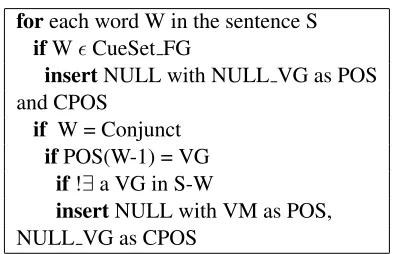
foreach word W in the sentence S
ifWCueSet FG
insertNULL with NULL VG as POS
and CPOS
if W = Conjunct
ifPOS(W-1) = VG
if!∃a VG in S-W
insertNULL with VM as POS,
[image:6.612.320.532.150.249.2]NULL VG as CPOS
Table 7: Rule for identifying Forward Gapping .
ter the conjunct and insert an empty category if the VG is absent (an example of such cases can be seen in Figure 7). This procedure is given in Table 6. In addition, we use the lexical cues (such asya nahii‘or not’, ya ‘or’) for recovering certain types of empty categories. CueSet FG is the set that contains the lexical cues and conjunct set contains lexical cues like (kiandya). This procedure is shown in Table 7.
Figure 7: Unattached sub trees in CBHP parse output of an input sentence (forward gapping).
3.4 Finite Verb ellipses
In the cases where there is no VG at all in the sen-tence, we insert a NULL VG before the EOS (End-Of-Sentence) in the input sentence. For this case, finite verb ellipses can be recovered directly from
if!∃a VG in S-W
insertNULL with VM as POS,
NULL VG as CPOS
Table 8: Rule for identifying Finite Verb ellipses in sen-tence.
foreach node N in tree T
ifhead of N =φ
insertN in unattached subtrees[]
if!∃a verb in unattached subtrees[]
if those conjuncts belongs to conjunct set
insertinsert NULL with VM as POS,
NULL VG as CPOS
Table 9: Rule for identifying Finite Verb ellipses using CBHP.
the input sentence using the rule in Table 8 .Also, in a sentence with a VG, we use CBHP to ascertain if this VG is the root of the sentence. If its not, we insert an additional NULL VG. This algorithm will correctly recover VG in the sentence but the position can be different from the gold input at times not be-cause the recovery algorithm is wrong, but there is no strict rule that says the exact position of empty category in this case of finite verb ellipse and anno-tators might choose to insert an empty category at any position. For example, in Figure 8, we can in-sert an empty category either after first NP sub tree or second or the third etc, all these possibilities are accepted syntactically. For simplicity purposes, we insert the empty category just before the EOS. This procedure is shown in Table 9.
3.5 Conjunction ellipses (for verbs)
[image:6.612.87.286.221.348.2]Figure 8: Unattached Subtrees (Finite verb ellipses).
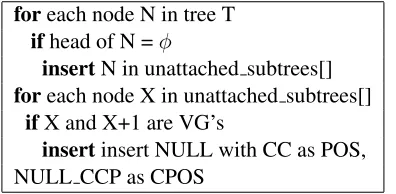
Figure 9: Unattached Subtrees in the case of conjunction ellipses.
foreach node N in tree T
ifhead of N =φ
insertN in unattached subtrees[]
foreach node X in unattached subtrees[]
ifX and X+1 are VG’s
insertinsert NULL with CC as POS,
NULL CCP as CPOS
Table 10: Rule for identifying Finite Verb ellipses using CBHP.
4 Results and Discussion
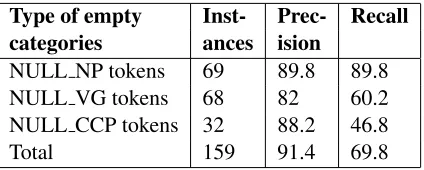
We have presented two sets of results, the overall empty categories detection along with the accuracies of individual types of empty categories in Table 11 and Table 12.
The results in Table 12 show that the precision in recovering many empty categories is close to 90%. A high precision value of 89.8 for recovery of Empty subject type is due to the strong lexical cues that were found during our analysis. CBHP parse out-put proved helpful in most of the remaining types. Few cases such as backward gapping and
conjunc-Type of empty Inst- Prec- Recall
categories ances ision
Empty subject 69 89.8 89.8 Backward gapping 29 77.7 48.3 Forward gapping 21 88.8 72.7 Finite verb ellipses 18 78.5 61.1 Conjunction ellipses 20 88.2 75 (verbs)
Conjunction ellipses 12 0 0 (nouns)
Total 169 91.4 69.8
Table 11: Recovery of empty categories in Hindi tree-bank.
[image:7.612.89.287.381.478.2] [image:7.612.317.536.381.532.2]Type of empty Inst- Prec- Recall
categories ances ision
NULL NP tokens 69 89.8 89.8 NULL VG tokens 68 82 60.2 NULL CCP tokens 32 88.2 46.8
[image:8.612.81.293.62.147.2]Total 159 91.4 69.8
Table 12: Empty categories in Hindi Tree bank
parser ends up producing a fully formed tree (which of course is a wrong analysis) that is of no use for us.
Similar problem is faced while handling conjunc-tion ellipses (for nouns). Here as in the previous case, CBHP is fooled into treating two coordinat-ing nominals as independent nouns. We note here that both the cases are in fact notoriously difficult to automatically detect because of the presence (or absence) of any robust linguistic pattern.
These results show that our system can be used to supplement the annotators effort during treebanking. We plan to use our system during the ongoing Hindi treebanking to ascertain it effect. As mentioned ear-lier, automatic detection of empty categories/nodes will prove to be indis pensable for parsing a sen-tence. We also intend to see the effect of our system during the task of parsing.
5 Conclusion
In this paper we presented an empty category recov-ery algorithm by analyzing the empty categories in the Hindi treebank. This, we noticed, uses lexical cues and parsed output of a constraint based parser. The results show that our system performs consid-erably high ( 90%) for many types of empty cate-gories. Few types, on the other hand, such as back-ward gapping and nominal coordinating conjunc-tions were very difficult to handle. Our approach and analysis will be useful in automatic insertion of empty nodes during dependency annotation. It will also benefit data-driven/statistical approaches either as a post-processing tool or in recovering empty cat-egories by helping in feature selection for various machine learning techniques.
Acknowledgments
We would like to thank Prof. Rajeev Sangal for pro-viding valuable inputs throughout the work.
References
R. Begum, S. Husain, A. Dhwaj, D. Sharma, L. Bai, and R. Sangal. Dependency annotation scheme for Indian languages. 2008. In proceedings of Third International Joint Conference on Natural Language Processing (IJCNLP), Hyderabad, India
A. Bharati, S. Husain, D. Misra, and R. Sangal. Two stage constraint based hybrid approach to free word order language dependency parsing. 2009a. In Proceedings of the 11th International Conference on Parsing Technologies (IWPT). Paris.
A. Bharati, D. Sharma, S. Husain, L. Bai, R. Begam, and R. Sangal. Anncorra: Treebanks for indian languages, guidelines for annotating hindi treebank. 2009b. http://ltrc.iiit.ac.in/MachineTrans/research/tb/DS-guidelines/DS-guidelines-ver2-28-05-09.pdf
A. Bhatia, R. Bhatt, B. Narasimhan, M. Palmer, O. Ram-bow, D. Sharma, M. Tepper, A. Vaidya, and F. Xia. Empty Categories in a Hindi Treebank. 2010. In the Proceedings of the 7th International Conference on Language Resources and Evaluation (LREC).
R. Campbell. Using linguistic principles to recover empty categories. 2004. In Proceedings of the 42nd Annual Meeting of the Association for Computational Linguistics
A. Chanev. Portability of dependency parsing algorithms–an application for Italian. 2005. In Proc. of the fourth workshop on Treebanks and Linguistic Theories (TLT). Citeseer.
M. Collins. Three generative, lexicalised models for statistical parsing. 1997. In Proceedings of the 35th Annual Meeting of the Association for Computational Linguistics and Eighth Conference of the European Chapter of the Association for Computational Lin-guistics.
P. Dienes and A. Dubey. Deep syntactic processing by combining shallow methods. 2003b. In Proceedings of the 41st Annual Meeting on Association for Com-putational Linguistics-Volume 1.
D. Higgins. A machine-learning approach to the identifi-cation of WH gaps. 2003. In Proceedings of the tenth conference on European chapter of the Association for Computational Linguistics-Volume 2.
X. Fei, O. Rambow, R. Bhatt, M. Palmer, and D. Sharma. Towards a multi-representational treebank. 2008. Proc. of the 7th Int’lWorkshop on Treebanks and Linguistic Theories (TLT-7)
M. Johnson. A simple pattern-matching algorithm for recovering empty nodes and their antecedents. 2002. In Proceedings of the 40th Annual Meeting on Association for Computational Linguistics.
M. Marcus, M. Marcinkiewicz, and B. Santorini. Build-ing a large annotated corpus of English: The Penn Treebank. 1993. Computational linguistics.
R. McDonald, F. Pereira, K. Ribarov, and J. Hajiˇc. Non-projective dependency parsing using spanning tree algorithms. 2005. In Proceedings of the confer-ence on Human Language Technology and Empirical Methods in Natural Language Processing.
J. Nivre. An efficient algorithm for projective depen-dency parsing. 2003. In Proceedings of the 8th International Workshop on Parsing Technologies (IWPT).
M. Palmer, R. Bhatt, B. Narasimhan, O. Rambow, D. Sharma, and F. Xia. Hindi Syntax: Annotating Dependency, Lexical Predicate-Argument Structure, and Phrase Structure. 2009. In The 7th International Conference on Natural Language Processing.