On the optimal use of put options under
trade restrictions
Bell, Peter N
30 October 2014
Online at
https://mpra.ub.uni-muenchen.de/62155/
On the optimal use of put options under trade restrictions
Peter N. Bell
Department of Economics, University of Victoria
Mailing address: BEC 360, 3800 Finnerty Road (Ring Road), Victoria, BC V8P 5C2 Canada.
Abstract
Consider an agent who holds a stock, but is allowed to buy and hold some quantity of
at-the-money put options on the stock. Such an agent must decide the optimal use of financial
derivatives under trade restrictions. This paper uses simulation to compare the optimal quantity
when the agent maximizes mean-variance utility or Value at Risk over wealth at option expiry.
The optimal quantity is larger than the stock holding under mean-variance utility and precisely
the same under value at risk. The options do not remove all variation in returns but still benefit
the agent.
Keywords: Portfolio optimization; put option; trade restrictions; simulation.
JEL Classification: C00, C15, C63, G11, G22.
On the optimal use of put options under trade restrictions
1. Introduction
My objective is to analyze a basic portfolio optimization problem with trade restrictions.
Such a problem is motivated by executive hedging and agricultural insurance, which are two
situations where an agent must hold a risky asset but can trade some kind of financial derivative
on the asset. In general, the agent faces restrictions in terms of their stock holding, the type of
derivatives available, and their ability to trade the derivatives over time; such restrictions are
relevant to a broad set of important portfolio optimization problems.
Corporate executives face trade restrictions on both their stock holdings and their hedging.
Executives often hold large amounts of stock that they cannot trade due to vesting rules or
blackout periods. Executives in the USA are legally able to trade financial derivatives on their
own stock under securities legislation and evidence suggests that it is done (Bettis, Bizjak, &
Kalpathy, 2013). However, executives are subject to a ‘swing profit rule’ that requires them to
forfeit gains from trades on their stock that open and close within a six month period (Schizer,
2000), which means they cannot hedge with dynamic trading strategies.
Farmers also face trade restrictions on their holdings and hedging. Farmers have restrictions
on their holdings because shares in farms do not trade on exchanges like public companies. Crop
insurance provides a hedge for farmer’s production, but the crop insurance contract is restricted
in important ways. For one, farmers can only buy insurance at the start of the growing season
and hold until the end of the season. For another, farmer’s choice over the quantity of coverage
I study the restrictions on executive hedging and crop insurance using simulation. I assume
the agent can only buy at the money (ATM) put options on the stock and must hold the portfolio
constant until option expiry. I suppose that they pick the optimal quantity of options in order to
maximize an objective over wealth at option expiry, either mean-variance utility or the Value at
Risk (VaR) measure. I compare how aggressively the agent hedges under each objective and
find that the agent generally buys such a large quantity of options that the notional value exceeds
the underlying position. However, in each case the option does not remove all variation in
returns.
2. Literature Review
Brown and Toft (2002) suggest that optimal use of financial derivatives deserves more
attention. Perhaps this is because optimal use is generally solved by Mossin’s (1968) result that
it is optimal for a risk-averse agent to buy full insurance when facing risk neutral prices. This
classic result implies the following: if there is an agent who holds a stock and can trade in a
liquid forward market in the stock, then the optimal choice is to sell forwards on the entire stock
position, which eliminates all variation in returns. However, an agent who faces trading
restrictions may not be able to achieve full insurance.
Optimal use of derivatives is generally an issue of complete market models. Carr and Madan
(2001) present a model with a bond, stock, and a continuum of options available at
Black-Scholes prices for all strike prices. Carr and Madan find that investors mainly use ATM strike
prices in equilibrium, which is in line with market experience that ATM options are most liquid.
Liu and Pan (2003) present a model with a stock and two derivatives: one option with strike out
of the money driven by jump risk, and another with strike ATM driven by volatility risk. They
In contrast, optimal use under trade restrictions is an issue of incomplete markets. Duffie and
Richardson (1991) make a pioneering contribution to this literature with a model of an agent who
holds a constant amount of one stock and is only allowed to trade continuously in a futures
contract on another stock with positively correlated returns.
Ahn, Boudoukh, Richardson, and Whitelaw (1999) extend optimal use with incomplete
markets to consider put options. Ahn et al. force the agent to hold a constant amount of stock
and allow them to buy any quantity of put options with any strike. The agent picks the quantity
and strike to minimize VaR for the portfolio, subject to a constraint on the total cost of the hedge.
Deelstra, Vanmaele, and Vyncke (2010) extend the analysis to a general risk measure. Ahn et al.
find the optimal strike is always the same, deep out of the money, while the quantity of options
adjusts to satisfy the constraint. As in my paper, Ahn et al. show that there is more to the
optimal use of options than achieving full insurance.
Ahn et al. (1999) is the most similar to my analysis because the agent holds a constant
position in a stock and buys put options on the same stock. However, there are three differences.
First, Ahn et al. assume the agent has a maximum amount of money to spend on the hedge. I
assume the agent has flexible access to capital, which allows me to identify the optimum in a
broader sense. Second, I assume that the agent uses ATM options. Ahn et al. allow the agent to
buy any quantity of options with any strike price at a cost given by the Black-Scholes model,
which is problematic because tail options are generally illiquid (Carr & Madan, 2001) and more
expensive than Black-Scholes suggests (Liu & Pan, 2003). Third, I use simulation experiments
rather than analytic solutions in order to compare different objective functions.
Research on executive hedging addresses concerns that executives can effectively undo
the Principal-Agent model to explore the effects of executive hedging (Gao, 2009; Boǧaçhan and
Özertürk, 2007). The Principal-Agent model helps study the strategic interaction between an
executive and their company, but it does not identify the optimal use of derivatives in isolation.
This limitation leads me to use the following simulation framework to explore optimal use of
derivatives.
3. Simulation Framework
3.1 Pricing models
I use a standard log-normal probability model for stock prices. I draw a sample of
observations and denote the i-th random draw of the stock price at expiry as Si in Equation (1),
where i is a positive integer. The initial stock price is S0=100 and the returns are normally
distributed Zi with mean µ=0 and standard deviation σ=0.10.
( 1 ) Si = S0e x p (µ+σZi) .
The initial put option price, P, is given by the Black-Scholes model in Equations (2) and (3).
The strike is at the money K=100 and time to expiry is τ=1. For simplicity, the interest rate is
zero throughout, r=0.
( 2 ) d1= ( 1 /σ√τ) ( l o g ( S0/ K ) + ( r + ½σ2)τ) , d2= d1-σ√τ.
( 3 ) P = K e-r τΦ( - d
2)–S0Φ( - d1) .
The agent’s wealth at expiry is a random variable determined by Equation (4). Wealth is a
function of the random stock price and it depends on the non-random quantity of options as a
parameter, which I denote as W(Si|Qi).
3.2 Objective Functions
I use two objectives defined over the distribution of wealth to identify the optimal quantity.
Both objectives are functions of quantity because they are expectations of wealth conditional on
the quantity of options. I calculate each objective based on a random sample of prices rather
than a population estimates; thus, there is some variation in the estimate of optimal quantity.
The first objective, O1, is the mean-variance utility given in Equation (5). I set the risk
aversion coefficient λ equal to 1.0, which is conventional for simulation experiments and in line
with empirical estimation (Post, van den Assam, Baltussen, & Thaler, 2008).
( 5 ) O1( Qj) = E ( W ( Si| Qj) ) -λV( W ( Si| Qj) ) .
The second objective, O2, is the 5% quantile from the wealth distribution given in Equation
(6). I assume the agent attempts to maximize this objective, which is equivalent to minimizing
VaR because VaR is defined as (S0exp(rt)-w(Qj)) (Ahn et al., 1999).
( 6 ) O2( Qj) = w ( Qj) , w h e r e w ( Qj) : P r ( W ( Si| Qj) < w ( Qj) ) = 0 . 0 5 .
3.3 Solution Method
I use the brute-force search algorithm to estimate the optimal quantity for each objective
function. Brute-force search is a standard algorithm that enumerates the objective function at all
values of the choice variable and identifies the optimum. This algorithm is applicable here
because the optimization is one dimensional (quantity of put options).
The input for the algorithm is a search set for the optimal quantity, Qj∈{Q1,Q2,…QM}, and a
sample of stock prices at expiry,{Si}i=1:N. I use the same search set throughout, which covers an
approximate an exact solution and later use small samples to explore robustness of the optimum.
Given a search set and a random sample, the search algorithm proceeds as follows:
(a) Pick a candidate for optimal quantity, Qj, from the search set.
(b) For each observation on the stock price Si, calculate the wealth W(Si|Qj) as if the agent
bought the quantity Qj. This generates a sample of observations on wealth, {W(Si|Qj)}.
(c) Calculate the objective function based on the sample of observations on wealth.
(d) Repeat steps (a)-(c) for all quantities in the search set. The optimal quantity is that which
gives the largest value for the objective function.
Please note that I provide Matlab code to implement the algorithm and replicate all results in
an appendix.
4. Results and Discussion
4.1 Optimum in large sample
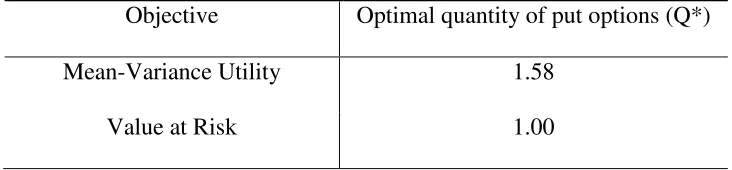
[image:9.612.123.489.508.593.2]I report the large sample estimate of optimal quantity (Q*) for each objective in Table 1.
Table 1: Optimal quantity of put options for each objective
Objective Optimal quantity of put options (Q*)
Mean-Variance Utility 1.58
Value at Risk 1.00
Table 1 shows that the optimal quantity for the mean-variance utility is larger than one
(Q*≥1). In other words, the notional value for the optimal put option is larger than the
et al. (1999) that the quantity of options must be strictly less than one (p. 363). It also suggests
that the optimal use of financial derivatives may be very different from traditional insurance,
where total coverage must not exceed the value of the asset because of moral hazard (Mossin,
1968).
Table 1 also shows that the optimal quantity for the Value at Risk objective is precisely one
(Q*=1). This gives an example of so-called full insurance, where the amount of coverage equals
the value of the asset and indemnities occur whenever the asset falls below the initial value. This
is a novel result in the literature. In contrast, Ahn et al. find that the optimal strike is always the
same and the optimal quantity adjusts to clear the constraint on the cost of the hedge (1999, p.
368).
4.2 Distribution of wealth with optimal quantity of put options
The cost of the optimal hedge for mean-variance utility is small relative to the total portfolio
value ($6.28 for the hedge versus $100 for the portfolio), but the hedge changes the distribution
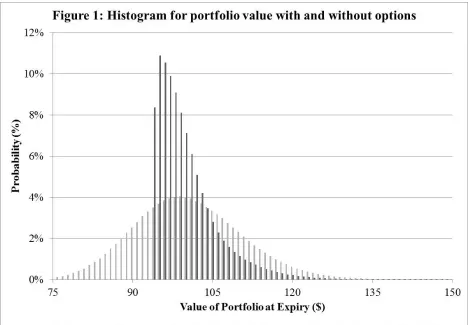
of wealth at expiry in a significant way. Figure 1 shows the probability distribution for the
Figure 1 shows that the portfolio with the optimal quantity of put options is very different
from the distribution without any options. The probability of either high or low value is smaller
with the portfolio than without. By reducing the frequency and severity of both high and low
values for the portfolio and not changing the average value, the option reduces the variance of
portfolio value and increases the level of mean-variance utility.
4.3 Further analysis of optimal quantity according to Value at Risk
Table 2 shows that VaR is decreasing for small values of quantity and increasing for large
values of quantity. Thus, there is a well-defined minimum for VaR and maximum for the
objective function O2. The columns in Table 2 denote values for quantity of put options and the
Table 2: Value at Risk across different quantities of options
Quantity 0.0 0.2 0.4 0.6 0.8 1.0 1.2 1.4 1.6 1.8 2.0
Value at Risk ($) 15 13 11 8 6 4 5 5 6 7 7
The results in Table 2 challenge the claim in Ahn et al. (1999) that “The VaR is linear in the
hedging expenditure, so each additional dollar generates the same reduction in VaR. There are no
diminishing benefits to hedging” (p. 368). Although I corroborate their result for small
quantities, I find that it is not true for large quantities of options; VaR is actually increasing for
large quantities because the options require large premium payments. The difference in our
results is due to the fact that Ahn et al. use a constrained optimization model, whereas I do not;
Ahn et al. and I consider different subsets of all possible put options. The results in Table 2
suggest that there may be a globally optimal hedge, which would be a new insight for the
literature described here.
4.4 Sampling distribution of optimal quantity
Since the optimal quantity in my model is a sample estimate, it has a sampling distribution. I
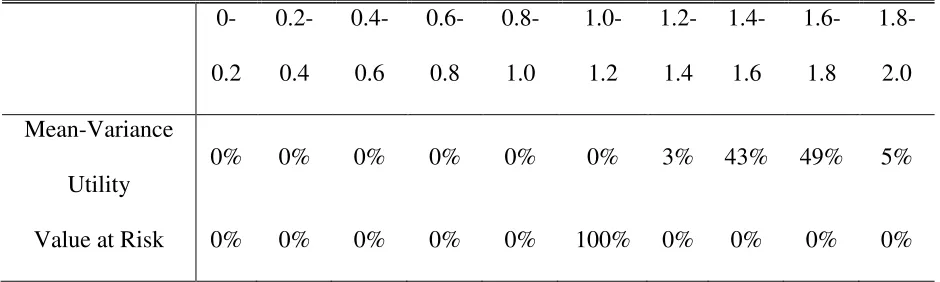
report the distribution of optimal quantity in Table 2. I calculate the optimal quantity for 10,000
different samples, each with sample size N=1,000. I use a smaller sample size than Section 4.1
to develop a sense for the robustness of the results to small samples. The columns in Table 3
denote intervals that are closed on the left and open on the right: 0-0.2 denotes the interval [0,
0.2). The entries in Table 3 show the proportion of time that the optimum falls in the interval
Table 3: Sampling distribution of optimal quantity (Q*) for each objective function 0-0.2 0.2-0.4 0.4-0.6 0.6-0.8 0.8-1.0 1.0- 1.2 1.2-1.4 1.4-1.6 1.6-1.8 1.8-2.0 Mean-Variance Utility
0% 0% 0% 0% 0% 0% 3% 43% 49% 5%
Value at Risk 0% 0% 0% 0% 0% 100% 0% 0% 0% 0%
Table 3 shows that the economic interpretation of the optimal quantity for each objective is
robust to resampling under smaller sample size. For mean-variance utility, it is always optimal
to buy options with notional value larger than the underlying position, Q*>1. The difference
between notional and underlying value varies from 20% to 100%, but the interpretation is the
same across all results. For Value at Risk, it is always optimal to take full insurance, Q*=1.
This shows that the knife-edge result first reported for Value at Risk in Table 1 is not restricted
to large samples.
5. Further work
My analysis requires assumptions about the data generating process for asset prices, trade
restrictions, and the agent’s objective function. It is possible to combine different versions of
these assumptions to tackle a broad set of related problems. For example, Bettis et al. (2013)
report that executives typically hedge one third of stock using forwards or collars; it is possible
to replace the put option in my model with a forward or collar and compare the optimal quantity
against the revealed preferences of executives in practice.
For another example, there is some controversy around the appropriate use of mean-variance
1997; Markowitz, 2014). It is possible to consider different objective functions, such as those
described in Post et al. (2008) to further explore the robustness of the optimal choice to model
specification.
Acknowledgements
This research was supported by the Joseph-Armand Bombardier Canada Graduate Scholarship –
Doctoral from the Social Sciences and Humanities Research Council of Canada.
References
Ahn, D.H., Boudoukh, J., Richardson, M., & Whitelaw, R.F. (1999). Optimal risk management using options. The Journal of Finance, 54(1), 359-375.
Barnett, B.J., & Coble, K. (2013). Why do we subsidize crop insurance? American Journal of
Agricultural Economics, 95(2), 498—504.
Basak, S., & Shapiro, A. (2001). Value-at-risk management: optimal policies and asset prices.
Review of Financial Studies, 14, 371–405.
Bettis, J.C., Bizjak, J.M., & Lemmon, M.L. (2001). Managerial ownership, incentive
contracting, and the use of zero-cost collars and equity swaps by corporate insiders. Journal of Financial and Quantitative Analysis, 36(3), 345—370.
Bettis, J.C., Bizjak, J.M., & Kalpathy, S.L. (2013). Why Do Insiders Hedge Their Ownership? An Empirical Examination. Available at SSRN: http://ssrn.com/abstract=1364810
Boǧaçhan, C., & Özertürk, S. (2007). Implications of executive hedge markets for firm value maximization. Journal of Economics & Management Strategy, 16(2), 319—349.
Brown, G.W., & Toft, K.B., (2002). How firms should hedge. The Review of Financial Studies, 15(4), 1283-1324.
Carr, P. & Madan, D. (2001). Optimal positioning in derivative securities. Quantitative Finance, 1, 19-37.
Deelstra, G., Vanmaele, M., & Vyncke, D. (2010). Minimizing the risk of a financial product using a put option, The Journal of Risk and Insurance, 77(4), 767-800.
Duffie, D. & Richardson, H.R. (1991). Mean-variance hedging in continuous time. The Annals
of Applied Probability, 1(1), 1-15.
Gao, H. (2009). Optimal compensation when managers can hedge. Journal of Financial
Economics, 97(2), 218—238.
Jarrow, R.A. & Madan, D.B. (1997). Is mean-variance analysis vacuous: or was beta still born.
Liu, J. & Pan, J. (2003). Dynamic derivative strategies. Journal of Financial Economics, 69, 401-430.
Markowitz, H. (2014). Mean-variance approximations to expected utility. European Journal of Operational Research, 234, 346-355.
Mossin, J. (1968). Aspects of rational insurance purchasing. Journal of Political Economy,
76(4), 553-568.
Post, T., van den Assam, M.J., Baltussen, G., & Thaler, R.H. (2008). Deal or No Deal?
Decision making under risk in a large-payoff game show. American Economic Review, 98(1), 38-71.
Appendix A – Code to replicate results
%% Code Appendix -- Optimal Use of Derivatives % By Peter Bell, October 10 2014
% Written for Matlab to produce all results used in working paper. %
%% Section 1: Global Parameters % Set random number generator
clear all
stream = RandStream('mt19937ar','Seed',12); RandStream.setGlobalStream(stream);
% Calculate option price
S0 = 100; sigma=0.1; K = 100; r = 0;
d1 = (1/sigma)*(log(S0/K)+r+sigma^2/2); d2 = d1 - sigma; O = cdf('norm',-d2,0,1)*K - cdf('norm',-d1,0,1)*S0;
delta = - cdf('norm',-d1,0,1); putPriceDelta=[O delta]; save('Bell-putPriceDelta.txt','putPriceDelta', '-ascii', '-tabs')
% Agent Utility
lambda = 1; %
% Search Set for Optimal Quantity
numQuantSearch = 201; quantScale=100; qStep=1/quantScale;
% numQuantSearch represents # points in search set for quantity % quantScale is parameter to make search set equal to [0,2]
% Parameters for Section 2 -- Large Sample Analysis
sampSizeLarge = 10^6; objectiveTable = zeros(3,numQuantSearch);
% Parameters for Section 3 -- Resampling Analysis
numSimTwo= 10^4; sampSizeSmall = 1000;
% numSimTwo represents # of times that identify optimal quantity (q*) % sampSizeSmall is length of time series, which replaces numPrice
% Goal: Calculate material for Table 1, 2, and Figure 1. %
for numChoice = 1:numQuantSearch qLoop = (numChoice-1)/quantScale; objectiveTable (1,numChoice) = qLoop;
% Simulate large number of prices for each q, calculate objective
S = zeros(1,1); W = zeros(1,1);
S = S0*exp(randn(sampSizeLarge,1)*sigma); W = S + qLoop*(max(K-S,0)-O);
% Mean-Variance Utility
objectiveTable (2,numChoice) = mean(W) - lambda/2*var(W);
% 5% Quantile for distribution
temp2 = sort(W);
objectiveTable (3,numChoice) = -(100-temp2(length(temp2)*5/100)); end
% Table 1: Optimal Choice by Utility
[uMaxMeanVar iMaxMeanVar] = max(objectiveTable (2,:)); [uMaxQuantile iMaxQuantile] = max(objectiveTable (3,:));
qStarMeanVar = (iMaxMeanVar-1)*qStep; qStarQuantile = (iMaxQuantile-1)*qStep;
optimalQuantLarge = [qStarMeanVar qStarQuantile ]
save('Bell-Table1-OptimalQuantityLargeSample.txt','optimalQuantLarge', ... '-ascii', '-tabs');
% Figure 1: Calculate histogram for wealth with optimal derivative
WStarMeanVar = S + qStarMeanVar*(max(K-S,0)-O); histIndex = 75:1:150;
[nZeroPut xOutOne] = hist(S, histIndex);
(nOptimalPut./sampSizeLarge)'];
save('Bell-Figure1-HistogramPortfolioValue.txt','figureOne', ... '-ascii', '-tabs');
% Table 2:
qTemp = 1:20:220;
objectiveQuantile = [(qTemp-1)*qStep;objectiveTable(3, qTemp)]; save('Bell-Table2-ShapeVAR.txt','objectiveQuantile', ...
'-ascii', '-tabs');
%% Section 3: Robustness of results to resampling with small samples % Goal: Build Table 3 in paper (histogram of q* for each utility) %
for simCount = 1:numSimTwo simCount
objectiveTableTemp = zeros(3,numQuantSearch); for numChoice = 1:numQuantSearch
qLoop = (numChoice-1)/quantScale;
S = S0*exp(randn(sampSizeSmall,1)*sigma); W = S + qLoop*(max(K-S,0)-O);
% Log Utility
objectiveTableTemp(1,numChoice) = exp(mean(log(W))); % Mean-Variance Utility
objectiveTableTemp(2,numChoice) = mean(W) - lambda*var(W); % 5% Quantile for distribution
temp2 = sort(W);
objectiveTableTemp(3,numChoice) = temp2(length(temp2)*5/100); end
% Optimal Choice by Utility
[uMaxLog iMaxLog] = max(objectiveTableTemp(1,:));
[uMaxMeanVar iMaxMeanVar] = max(objectiveTableTemp(2,:)); [uMaxQuantile iMaxQuantile] = max(objectiveTableTemp(3,:));
qStarLoop(simCount,1) = (iMaxLog-1)*qStep; qStarLoop(simCount,2) = (iMaxMeanVar-1)*qStep; qStarLoop(simCount,3) = (iMaxQuantile-1)*qStep; end
% Calculate histogram for optimal choice q* across resampling
histIndexTwo = 0:0.2:2;
[qStarHistMeanVar xOut] = hist(qStarLoop(:,2), histIndexTwo); [qStarHistQuantile xOut] = hist(qStarLoop(:,3), histIndexTwo);
tableThree = [ (qStarHistMeanVar./numSimTwo); ... (qStarHistQuantile./numSimTwo)];
save('Bell-Table3-ResamplingOptimum.txt','tableThree', ... '-ascii', '-tabs');