NATIONAL INSTITUTE OF OCEANOGRAPHY
WORMLEY, GODALMING, SURREYAcoustic Command System
by
M . J . H A R R I S
^f-i
#
N . I . O , INTERNAL REPORT N O . A I ' 6 1
- X
m-? •••»•
r..
yJA'ATrr/.r-v,,:,
F E B R U A R Y 1973
e«£C£^:
NATIONAL INSTITUTE OF OCEANOGRAPHY
Wormley, Godalming, Surrey.
Acoustic Commami System
by
M.J. Harris
N.I.O. Internal Report No. A.&1
CCMTENTS
PaSf
Summary 1
Introduction 1
Design factors - shipboard equipment 1
Design factors - acoustic receiver 2
Safety precautions 2
Application of the Acoustic Command 3
ACOUSTIC COMMAND SYSTEM
Summary
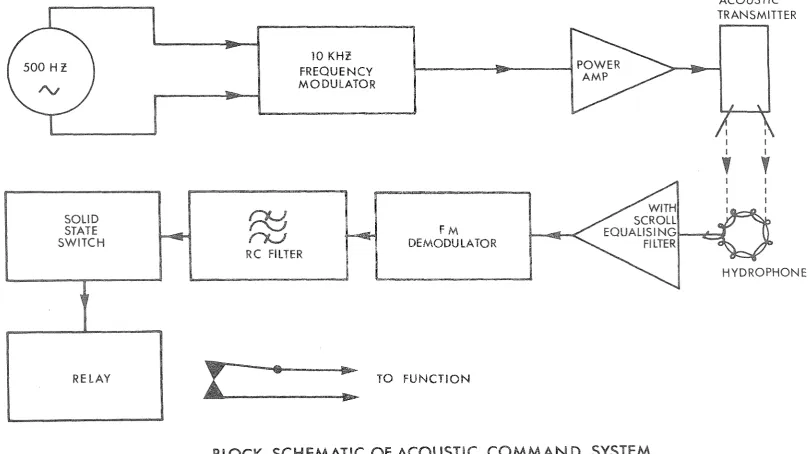
The acoustic command system has been developed to provide the facility of remote controlled switching for underwater devices. This is achieved by transmitting from the command station a 10kHz carrier frequency modulated by a precise sub-carrier tone in the
region of 500Hz. The acoustic signal on being received by a
hydrophone is amplified and fed to a discriminator. The signal
after demodulation passes through an RC active filter which in
turn activates the switching circuit. To avoid erroneous switching
the system relies on the following factors.
(a) The good signal to noise ratio provided by the FM transmission.
(b) The high signal to noise acceptance from the RC
active filters. These filters are adjusted to
provide a Q of about 100.
(c) A transmission time for switching of approximately 60 seconds.
The maximum operational range for the present system is 5 N. miles.
Introduction
The system was developed in the first place for releasing the anchors of submerged buoy systema thus allowing them to rise to the surface for recovery and also to switch acoustic beacons. At the time development was undertaken, satisfactory commercial
systems were not available. It was later adapted to open and
close deep-sea research nets allowing catches to be obtained from a single depth without contamination during lowering or recovery.
At the time of development there was a requirement for a slant acoustic range of 5km with the receiver having an operating
depth of 5000m and a life of six months. The whole system being
operative in sea state 4. This specification together with the
convenience of compatibility with previously existing equipment
led to the choice of 10kHz for the carrier frequency. The
absorption in sea water at this frequency is approximately IdB per 1000m and the deep water ambient noise -50dB relative to l^bar.
The system has now been in use for 5 years and has proved to be operative in sea states up to 8 while ranges of 6Kma are
obtained in depths up to 5000m.
Design factors - shipboard equipment
It was calculated that 5 acoustic watts at lOkHz would be
required to obtain an acoustic link over an 8Km range. Allowing
a 50% efficiency for the transducer, the transmitter (Fig.2) was
designed to produce 10 watts of electrical power. As there was
2 .
produce the sub-carrier. This allowed the selection of ai^y frequency,
the precise frequency being checked with a frequency meter (Fig. 2). To obtain maximum efficiency, the output impedance of the transmitter
was matched to that of the transducer (Fig. 2 ) and its cable. This
transducer is a lead zirconate titanate stack resonant at 10kHz with
a Q of 5 and with a nearly omnidirectional beam pattern. The deviation
of the FM transmission is limited to approximately ±1 kHz by the Q of
the transducer. If the Q were reduced at the expense of efficiency,
it would be possible to increase the value of the sub-carrier frequency. However, in the present system it has proved practical to use
sub-carriers as high as 530Hz.
Design factors - acoustic receiver
The transmitted signal is received by a magnetostrictive nickel
scroll (Fig. 1 ) which resonates at 10kHz and has a Q of 10. After
acoustic reception the signal is fed to an amplifier that has a band pass filter shaped to compensate for the frequency characteristics
of the scroll. The gain of the amplifier is such that it will limit
on ambient sea noise. The amplified signal is demodulated by a
cross-over discriminator network using two tuned circuits and then passes
through an RC active filter. The filter is adjusted to have a Q of
100 giving a bandwidth of about ±2Hz. Narrower bandwidths are not
possible because the relative motion of the transmitter on board a ship and the receiver can introduce an appreciable change in frequency
due to the doppler effect. A relative velocity of 6 knots changes
the sub-carrier frequency by lHz. The output provided by the filter
is used to charge a large capacitor. When the potential across this
capacitor reaches 24V a zener diode conducts and operates a triggering circuit which discharges the capacitor through the electromagnetic
device of the command system. The circuit has been designed to make
it relatively easy to set up. This is particularly useful when
effect-ing repairs at sea. In order to have a working life in excess of six
months in the standby mode, the receiver was designed to draw 6mW of
power from a battery pack. Mallory cells are used in the battery pack
as they have the required high capacity and long storage life. The
electronics are protected from the high pressure by being housed in high strength aluminium alloy (Type RR77) tubular canisters and the end caps
of which are screwed in using castellated threads. These units are
sealed with face mounted ring seals. Marsh and Marine plugs and
sockets are used for the cable connectors.
Safety Precautions
Certain precautions have been taken to reduce the chance of
accidental switching to a safe level. The 1OkHz carrier signal is
frequency modulated instead of amplitude modulated because apart from the gaussian 'sea-state' noise, most noise in the sea due to ships,
biological sources etc. is amplitude modulated. Some animals such
as whales and porpoises do produce frequency modulated signals but these are of a completely different nature to that used in the present
FM system. In the receiver there are three stages of tuning and a
narrow band filter. Thus the receiver is a highly selective system
and it is most unlikely that any naturally produced noise could have
of the capacitor being charged by the filter is made as long as possible to give safety against accidental operation.
An electrolytic capacitor is used to store the charge required, and apart from its natural leakage, a leakage resistor is
connected across it to prevent the slow build up charge by
an occasional break-through of noise at the filter. In
practise it has been found that a 5 second switching time gives adequate protection over a period of six months.
Application of the Acoustic Command
At the present time the command unit is being used to switch acoustic beacons, release underwater buoy systems, and operate the opening and closing mechanism of biological nets.
In the first application (Fig. 3) two frequency channels are
used to switch the acoustic beacon on and off. The beacon used
is type BMK III pinger. This instrument emits keyed 10kHz pulses
with an adjustable duration in the range 1 to 5 milliseconds and has a pulse repetition frequency controlled by a multivibrator
running at a P.R.F. in the range 0.9 to 1.4 P.P.S. Ohce fixed,
this P.R.F. remains stable to better than 1 part in 1000 over the working ranges of battery voltages and temperature, allowing pulse-to-pulse correlation to be used in the receiving display.
The second application (Fig. 4) requires maximum safety
in all respects. The release receiver must be capable of
releasing the ballast of a buoy system at any time during a six
month period. To guard against the loss of costly equipment
and data due to accidental release, the following additional precautions are taken.
The release relay is a 12 position uniselector. This makes
it necessary to activate the uniselector 11 times before the
release position is reached. One bank of the uniselector switches
is connected to an acoustic pinger. Ttte pinger provides an
audible signal on the first operation of the uniselector. This
enables the correct operation of the receiver to be monitored
before final release. Also since the release is armed with a
detonator, for the safety of the operators it is essential to have audible warning of accidental switching of the release. Apart from this warning there is also a hydrostatic pressure
switch in series with the explosive release which arms the release only when it is in the water.
These command systems are arranged to have a working life of six months and an operating depth of 5000 metres.
In the third application (Fig. 5) the command system is
mounted on the bridle of a biological trawl. Two sub-carrier
channels are used to open and close the net. Despite the
additional noise generated by the trawl the command link has
been used at ranges of 3000m and depths of 2000m. In this
Conclusion
This system has been used over 150 times in different mooring applications over the past 6 years and there has not been any evidence to suggest that it has been switched on by
noise. Where moorings have not been recovered and the cause
A C O U S T I C TRANSMITTER
1 0 K H Z F R E Q U E N C Y M O D U L A T O R
P O W E R A M P
WITH SCROLL E Q U A L I S I N G FILTER S O L I D
STATE S W I T C H
F M
D E M O D U L A T O R RC FILTER
RELAY T O F U N C T I O N
[image:8.846.28.839.52.506.2]