Identifying News from Tweets
Jesse Freitas and Heng Ji Computer Science Department Rensselaer Polytechnic Institute
Troy, NY, USA
{freitj,jih}@rpi.edu
Abstract
Informal genres such as tweets provide large quantities of data in real time, which can be exploited to obtain, through ranking and clas-sification, a succinct summary of the events that occurred. Previous work on tweet ranking and classification mainly focused on salience and social network features or rely on web documents such as online news articles. In this paper, we exploit language independent journalism and content based features to iden-tify news from tweets. We propose a novel newsworthiness classifier trained through ac-tive learning and investigate human assess-ment and automatic methods to encode it on both the tweet and trending topic levels. Our findings show that content and journalism based features proved to be effective for rank-ing and classifyrank-ing content on Twitter.
1 Introduction
Due to the massive amount of tweets posted on a daily basis, automatic tweet ranking has become an important task to assist fast information distillation. Previous work (Inouye and Kalita, 2011; Yang et al., 2011; Liu et al., 2012; Ren et al., 2013; Shou et al., 2013; Chua and Asur, 2013; Chang et al., 2013) focused on selecting informative tweets based on a variety of criteria such as readability, author’s influ-ence and users’ interest. In addition, (ˇStajner et al., 2013) studied selection of user’s responses to news by optimizing an objective function which jointly models the messages’ utility scores and their en-tropy. (Wei and Gao, 2014) proposed using learning-to-rank techniques to help conduct single-document
summarization.
Additional work has been done to improve event detection on Twitter. Previous methods relied on metadata from tweets (Cui et al., 2012) while others focus on open-domain categorization using tools trained specifically for micro-blogging ser-vices(Ritter et al., 2012a). In addition, (Cataldi et al., 2010) incorporated temporal knowledge while formalizing content to compensate for informal and short text.
Tweet ranking is also related to the previous work concerning tweet summarization which summarized important information from tweet streams. Mod-ern summarization approaches rank sentences or phrases from informal genres such as social media, web forums, and micro-blogging sites. Some meth-ods determine semantic relations of manually an-notated hashtags and user replies using social net-work and web document graphs (e.g., (Huang et al., 2012)). Our goal is to accomplish ranking of micro-blogging content using natural language fea-tures to identify sentences with the most newswor-thiness and relevance to the event that occurred.
We introduce a novel newsworthiness model to improve topic classification, and investigate both hu-man assessment and automatic linguistic features in-depth for this new measure. Once topics are iden-tified, we apply these methods to an ordinal rank-ing model to identify the tweets that make this topic newsworthy. Compared with previous work, we fo-cus more on analysis of text than social network fea-tures for ranking and classifying tweets. In order to determine newsworthiness, we use news values based on journalism theory to encode features
stead of traditional methods based on social features.
2 Approach
2.1 News Values and Definition
Newsworthiness describes the amount of new infor-mation for a general audience. (Galtung and Ruge, 1965) describe news as a spike in human communi-cation or a signal that can be measured, and trending topics on Twitter behave this way. However, trend-ing topics on social media can also be jokes, and ongoing and commemorative events. We hypothe-size that newsworthiness would be an important fac-tor in human distillation of media regarding events because it is a subset of salience that contains only novel information that is time relevant and new com-pared to an existing knowledge base. We define the following novel criteria to determine the newswor-thiness of content based on news values defined by Galtung and Ruge (1965):
1. The content tends to refer to a negative event more than a positive event
2. The content must be well composed
3. The content typically refers to elite nations, people, or organizations
4. The content must have human interest
The basis behind newsworthy criteria is that (1) the content must be important to the general viewer but must provide new insight to an event that oc-curred; (2) because news content is salient, but salient content is not always newsworthy, under-standing this subset is critical for automatic news summarization; (3) negative news is typically more viewed than positive news and usually pertains to named entities that are high profile; and (4) news must also have human interest meaning it must affect many people. Using Galtung and Ruge’s metaphor of a signal for news, these principles should indicate a strong signal or spike in news.
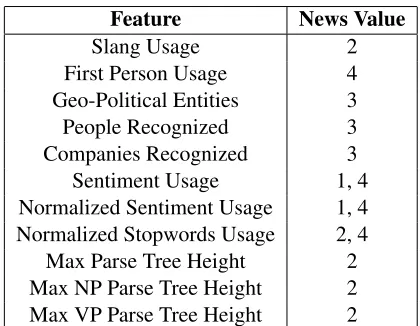
The non-syntactic features listed in Table 1 are calculated as the number of words in the tweet and the normalized features are calculated as the ratio of the number of sentiment words to the total num-ber of words in the tweet not including stopwords. The named entities and slangs were extracted using
Feature News Value
Slang Usage 2
First Person Usage 4
Geo-Political Entities 3
People Recognized 3
Companies Recognized 3
Sentiment Usage 1, 4
Normalized Sentiment Usage 1, 4 Normalized Stopwords Usage 2, 4
Max Parse Tree Height 2
Max NP Parse Tree Height 2
[image:2.612.320.530.58.221.2]Max VP Parse Tree Height 2
Table 1: Newsworthiness features and news values they en-code.
the Twitter NLP toolkit (Ritter et al., 2011; Ritter et al., 2012b) which was designed specifically for tweet content. The syntax tree features were cal-culated using the Stanford parser (Manning et al., 2014) trained using the English caseless model (de Marneffe et al., 2006). The premise behind using the parse tree as a feature is that more complex speech is more likely to be newsworthy because it is well com-posed. Sentiment terms were determined based on lexical matching from gazetteers(Hu and Liu, 2004; Taboada and Grieve, 2004; Wiebe et al., 2004; Bac-cianella et al., 2010; Joshi et al., 2011) and compiled into one sentiment dictionary (Li et al., 2012). Nor-malized stopword usage is important for both com-position and human interest particularly because of the structure of a tweet. Since tweets are short and contain few words, if a tweet uses a high propor-tion of stopwords, it likely doesn’t have many novel terms that would contain human interest. The re-maining features are encoded based on the princi-ple that generally recognized names and events are important for detecting topically familiar and impor-tant materials.
2.2 Newsworthiness Identification
classification on trending topics and ordinal regres-sion for ranking tweets in the topic. The models are trained using an eighth order polynomial kernel with default parameters and we tune the cost parameter based on the task. In order to train these models, we use the same 11 features in both tasks based on news criteria journalists use to write articles.
For identifying trending topics, our goal was to improve the precision and recall of existing systems so the model was tuned to maximize F-score per-formance using three fold cross validation to main-tain consistency with the validation used by Huang et al. (2012). The ordinal regression model for rank-ing tweets was tuned usrank-ing the same cross validation method to minimize the squared error from ground truth ranking.
We also evaluate an actively trained model for classification similar to the committee method used by Zubiaga et al. (2015). We choose candidates using Query-By-Committee (QBC) (Settles, 2009) where multiple models are trained using the same data and predict the class of each Twitter trend. For our committee we use our journalism based model and Zubiaga’s Twitter based model. The contra-dicting predictions from the two models are used to choose the new training data. We use one iteration for creating candidates and our journalism model is then retrained using the new training data subset se-lected by the committee.
3 Experiments
3.1 Data
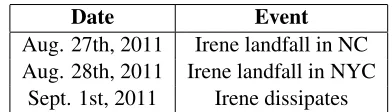
Our first ground truth dataset for classifying tweets was collected using CrowdFlower1 to annotate the newsworthiness of 3,482 topically related tweets in English about Hurricane Irene. The dataset was collected during three separate hours during three different days shown in Table 2. We hypothesize that the subevents related to the topic will affect the amount of newsworthy content we are attempting to rank and may affect the performance of the ordinal regression model.
The ordinal regression dataset is composed of the same tweets used by Huang et al. (2012). Five annotators labeled the tweets’ newsworthiness from
1http://www.crowdflower.com/
Date Event
Aug. 27th, 2011 Irene landfall in NC Aug. 28th, 2011 Irene landfall in NYC
[image:3.612.326.522.59.115.2]Sept. 1st, 2011 Irene dissipates
Table 2:Tweets were collected for one hour on each day during the storm
one to three where three is most newsworthy. An-notators were given a brief summary of the events that occurred regarding Hurricane Irene and the ar-eas that were impacted by flooding and power out-ages. They were provided a guideline for newswor-thiness and asked to score the tweets on whether they contained new information at the time it was tweeted and would be noteworthy content in the me-dia. The tweets were filtered to remove annotations if the CrowdFlower site’s annotator confidence score was below 50 percent.
The second dataset is comprised of 2,593 trending topics used by Zubiaga (2013). The topics were col-lected from February 1 to 28, 2012, and five topics were randomly sampled per hour. Each topic con-tains at most 1,500 tweets and the topic is labeled newsworthy or not newsworthy. The tweets are in multiple languages including English, Spanish, and Portuguese and were translated to English by both human and machine translators. This dataset was se-lected to evaluate the news features on a set of more diverse events than Hurricane Irene.
In order to demonstrate the effectiveness of our approaches, we evaluated the features on both the tweet ranking and trend classification tasks by com-paring them to the performance of other approaches.
3.2 Evaluation
The ordinal regression and classification models were evaluated separately from each other to deter-mine individual performance.
To compare our ranking method we used
Normal-ized Discounted Cumulative Gain(nDCG) (J¨arvelin
and Kek¨al¨ainen, 2002) and evaluated the results on the three individual hours of data.
so-2 4 6 8 10 0.6
0.7 0.8 0.9 1
k
Av
e.
nDCG@k
[image:4.612.79.298.62.196.2]Ord. Reg. Het. Net. TextRank
Figure 1: nDCG@k for Ordinal Regression, Heterogeneous Networks, TextRank
cial features such as user diversity, hashtag usage, and retweets about the topic, but does not consider as many language and content features.
4 Results
4.1 Ranking Individual Tweets
Figure 1 illustrates the evaluation of each method on nDCG@k from 1 to 10. The results indicate that our ordinal regression model performed bet-ter in bet-terms of nDCG than the traditional TextRank method using the standard dampening factor with filtering and heterogeneous networks without web documents (Huang et al., 2012). The edges are cal-culated using cosine similarity between tweets and the filtering used removed tweets that used excessive slang or punctuation. The ordinal regression curve in Figure 1 represents the average performance of our model after evaluating the model on three dif-ferent time periods of data described in Section 3.1.
4.2 Trend Classification
Method Precision Recall F-Score
Baseline Features 0.582 0.670 0.623 Content Features 0.604 0.743 0.663
[image:4.612.320.531.196.307.2]Active Training 0.814 0.745 0.778
Table 3:Trend Classification
Using journalism content features we were able to achieve better performance than our base-line(Zubiaga et al., 2015) in terms of precision and F-score while maintaining recall as shown in Ta-ble 3. Further, the model performed best when
ac-tively trained using the same journalism features and achieved a final F-score of 77.8%.
5 Discussion
We determine the statistical significance of each fea-ture for both the trend classifier and the tweet ranker. We found features in each task were highly corre-lated and share overlap. For the sake of clarity, we only show significant features in Table 4.
Feature Rank Class
Slang Usage ***
Geo-Political Entities **
Normalized Stopword Usage ***
Sentiment Terms ***
Company Entities * ***
First Person Usage *** ***
NP Parse Tree Height . ***
Table 4:F-statistic significant features. We show only signif-icant features (significance codes: 0 (***) 0.001 (**) 0.01 (*) 0.05 (.) 0.1 ( )).Rankis the significance of the features in the tweet ranking task andClassis the significance of the features in the trend classification task.
Newsworthiness can affect how quickly and how much novel information can be discerned respec-tively. One of the goals of incorporating different criteria into ranking and classification other than tra-ditional importance ranking was to demonstrate that salience is not the only factor that users and jour-nalists consider when digesting material from social media. Another goal is to demonstrate that content based features can perform as well as other mod-ern approaches that rely on web documents and so-cial media graphs in order to bypass the challenge of understanding the short context-free nature of mi-croblog posts.
[image:4.612.79.299.558.616.2]While the features we used are not advanced, the application of them encode Galtung and Ruge’s standards of world news for journalists and news re-porting agencies. Our features attempt to capture a journalism perspective instead of previous work which focused on social media networks and social features. While this approach has limitations, the application of this approach in conjunction with web documents could improve news summarization tasks using Twitter data.
6 Acknowledgements
This work was supported by the U.S. ARL NS-CTA No. W911NF-09-2-0053, DARPA DEFT No. FA8750-13-2-0041, and NSF IIS-1523198. The views and conclusions contained in this document are those of the authors and should not be interpreted as representing the official policies, either expressed or implied, of the U.S. Government. The U.S. Gov-ernment is authorized to reproduce and distribute reprints for Government purposes notwithstanding any copyright notation here on.
References
Stefano Baccianella, Andrea Esuli, and Fabrizio Se-bastiani. 2010. Sentiwordnet 3.0: An enhanced lexical resource for sentiment analysis and opinion mining. In Nicoletta Calzolari (Conference Chair), Khalid Choukri, Bente Maegaard, Joseph Mariani, Jan Odijk, Stelios Piperidis, Mike Rosner, and Daniel Tapias, editors, Proceedings of the Seventh Interna-tional Conference on Language Resources and Evalu-ation (LREC’10), Valletta, Malta, may. European Lan-guage Resources Association (ELRA).
Mario Cataldi, Luigi Di Caro, and Claudio Schifanella. 2010. Emerging topic detection on twitter based on temporal and social terms evaluation. InProceedings of the Tenth International Workshop on Multimedia Data Mining, MDMKDD ’10, pages 4:1–4:10, New York, NY, USA. ACM.
Yi Chang, Xuanhui Wang, Qiaozhu Mei, and Yan Liu. 2013. Towards twitter context summarization with user influence models. In Proceedings of the sixth ACM international conference on Web search and data mining, pages 527–536. ACM.
Freddy Chong Tat Chua and Sitaram Asur. 2013. Auto-matic summarization of events from social media. In
ICWSM. Citeseer.
Anqi Cui, Min Zhang, Yiqun Liu, Shaoping Ma, and Kuo Zhang. 2012. Discover breaking events with popular hashtags in twitter. InProceedings of the 21st ACM International Conference on Information and Knowl-edge Management, CIKM ’12, pages 1794–1798, New York, NY, USA. ACM.
Marie-Catherine de Marneffe, Bill MacCartney, and Christopher D. Manning. 2006. Generating typed de-pendency parses from phrase structure parses. InIN PROC. INTL CONF. ON LANGUAGE RESOURCES AND EVALUATION (LREC, pages 449–454.
Johan Galtung and Marie Holmboe Ruge. 1965. The structure of foreign news. The Journal of Peace Re-search, 2(2):64–91.
Minqing Hu and Bing Liu. 2004. Mining and summa-rizing customer reviews. In KDD ’04: Proceedings of the tenth ACM SIGKDD international conference on Knowledge discovery and data mining, pages 168– 177, New York, NY, USA. ACM.
Hongzhao Huang, Arkaitz Zubiaga, Heng Ji, Hongbo Deng, Dong Wang, Hieu Khac Le, Tarek F. Abdelza-her, Jiawei Han, Alice Leung, John P. Hancock, and others. 2012. Tweet Ranking Based on Heteroge-neous Networks. InCOLING, pages 1239–1256. David Inouye and Jugal K Kalita. 2011. Comparing
twit-ter summarization algorithms for multiple post sum-maries. InPrivacy, Security, Risk and Trust (PASSAT) and 2011 IEEE Third Inernational Conference on So-cial Computing (SoSo-cialCom), 2011 IEEE Third Inter-national Conference on, pages 298–306. IEEE. Kalervo J¨arvelin and Jaana Kek¨al¨ainen. 2002.
Cumu-lated gain-based evaluation of ir techniques. ACM Trans. Inf. Syst., 20(4):422–446, October.
Aditya Joshi, Balamurali A. R., Pushpak Bhattacharyya, and Rajat Kumar Mohanty. 2011. C-feel-it: A sen-timent analyzer for micro-blogs. In Proceedings of the 49th Annual Meeting of Association for Compu-tational Linguistics (Demo).ACL.
Hao Li, Yu Chen, Heng Ji, Smaranda Muresan, and De-quan Zheng. 2012. Combining social cognitive theo-ries with linguistic features for multi-genre sentiment analysis. InProceedings of the 26th Pacific Asia Con-ference on Language, Information, and Computation, pages 127–136, Bali,Indonesia, November. Faculty of Computer Science, Universitas Indonesia.
Xiaohua Liu, Yitong Li, Furu Wei, and Ming Zhou. 2012. Graph-based multi-tweet summarization using social signals. InCOLING, pages 1699–1714.
Christopher D. Manning, Mihai Surdeanu, John Bauer, Jenny Finkel, Steven J. Bethard, and David McClosky. 2014. The stanford corenlp natural language process-ing toolkit. InProc. ACL2014).
tweets summarization. InProceedings of the 36th in-ternational ACM SIGIR conference on research and development in information retrieval, pages 513–522. ACM.
Alan Ritter, Sam Clark, Mausam, and Oren Etzioni. 2011. Named entity recognition in tweets: An experi-mental study. InEMNLP.
Alan Ritter, Mausam, Oren Etzioni, and Sam Clark. 2012a. Open domain event extraction from twitter. In Proceedings of the 18th ACM SIGKDD Interna-tional Conference on Knowledge Discovery and Data Mining, KDD ’12, pages 1104–1112, New York, NY, USA. ACM.
Alan Ritter, Mausam, Oren Etzioni, and Sam Clark. 2012b. Open domain event extraction from twitter. In
KDD.
Burr Settles. 2009. Active learning literature survey. Lidan Shou, Zhenhua Wang, Ke Chen, and Gang Chen.
2013. Sumblr: continuous summarization of evolv-ing tweet streams. In Proceedings of the 36th in-ternational ACM SIGIR conference on Research and development in information retrieval, pages 533–542. ACM.
Tadej ˇStajner, Bart Thomee, Ana-Maria Popescu, Marco Pennacchiotti, and Alejandro Jaimes. 2013. Auto-matic selection of social media responses to news. In
Proceedings of the 19th ACM SIGKDD international conference on Knowledge discovery and data mining, pages 50–58. ACM.
Maite Taboada and Jack Grieve. 2004. Analyzing ap-praisal automatically. InIn Proceedings of the AAAI Spring Symposium on Exploring Attitude and Affect in Text: Theories and Applications, pages 158–161. Zhongyu Wei and Wei Gao. 2014. Utilizing microblogs
for automatic news highlights extraction. COLING. Janyce Wiebe, Theresa Wilson, Rebecca Bruce, Matthew
Bell, and Melanie Martin. 2004. Learning subjective language.Computational Linguistics, 30(3):277– 308, January.
Zi Yang, Keke Cai, Jie Tang, Li Zhang, Zhong Su, and Juanzi Li. 2011. Social context summarization. In
Proceedings of the 34th international ACM SIGIR con-ference on Research and development in Information Retrieval, pages 255–264. ACM.
Arkaitz Zubiaga, Heng Ji, and Kevin Knight. 2013. Cu-rating and contextualizing twitter stories to assist with social newsgathering. InProc. International Confer-ence on Intelligent User Interfaces (IUI2013). Arkaitz Zubiaga, Damiano Spina, Raquel Martnez, and