A Study of Imitation Learning Methods for Semantic Role Labeling
Travis Wolfe Mark Dredze Benjamin Van Durme Human Language Technology Center of Excellence
Johns Hopkins University
Abstract
Global features have proven effective in a wide range of structured prediction problems but come with high inference costs. Imita-tion learning is a common method for train-ing models when exact inference isn’t feasi-ble. We study imitation learning for Seman-tic Role Labeling (SRL) and analyze the ef-fectiveness of the Violation Fixing Perceptron (VFP) (Huang et al., 2012) and Locally Opti-mal Learning to Search (LOLS) (Chang et al., 2015) frameworks with respect to SRL global features. We describe problems in applying each framework to SRL and evaluate the ef-fectiveness of some solutions. We also show that action ordering, including easy first in-ference, has a large impact on the quality of greedy global models.
1 Introduction
In structured prediction problems, global features express dependencies between related pieces of a label and make inference non-trivial. In Semantic Role Labeling (SRL) (Gildea and Jurafsky, 2002), global features and constraints have been studied ex-tensively (Punyakanok et al., 2004; Toutanova et al., 2008; T¨ackstr¨om et al., 2015) inter alia. SRL has many phenomenon that relate labels such as syn-tactic control, role mutual exclusion, and structural constraints like span overlap.
Previous work on inference for models with global features has studied a variety of method in-cluding dynamic programming, reranking, and ILP solvers. Greedy search and beam search are rel-atively understudied areas due to the difficulty in
training models which perform well with the weak guarantees provided by greedy search. The Viola-tion Fixing Perceptron (VFP) framework (Huang et al., 2012) is a notable exception which has been used to great effect in a range of structured problems. Learning to Search (L2S) (Daum´e III and Marcu, 2005; Chang et al., 2015) is another line of work for training greedy models with no assumptions about features. These training methods are appealing be-cause they decouple the definition of (global) fea-tures from the (exact) inference and training proce-dures. This allows easier specification of models (features not algorithms) and the ability to use in-ference methods which scale with the difficulty of the problem rather than the type of features used.
In this work, we study VFP and L2S methods for training greedy global SRL models. We find that both methods are far from ideal. VFP is inconsistent and often doesn’t perform better than unstructured perceptron training. L2S leads to models which under-predict arguments and do not perform as well as pipeline training. We describe the causes of these problems and offer some solutions.
Finally, we study the effect of the transition sys-tem on the usefulness of global features. We find that the order that actions are performed in can be as important as the training method, leading to bet-ter models with the same features and computational complexity.
2 Problem Formulation
Semantic role labeling (Gildea and Jurafsky, 2002) (SRL) is the task of locating and labeling (with roles) the semantic arguments to predicates. Adding
a step, frame semantic parsing (Das et al., 2010) (FSP), seeks to first disambiguate predicates by la-beling them with a frame before performing SRL. Semantic roles abstract over grammatical function and provide information about particular arguments relation to an event, state, or fact. SRL has been shown to be helpful in a variety of NLP tasks in-cluding information extraction, question answering, and coreference resolution.
Letxrefer to a sentence and its POS tags and de-pendency parse. For this work, we are givenxand a vector of predicate locationst= [t1, t2, ...tn], where
eachti is a span, most often representing a single
verb like “love” in the sentence “John loves Mary”. SRL and FSP are defined with respect to a schema which provides a set of frames and roles which will serve as labels for predicates and arguments. We consider two schemas, Propbank (Kingsbury and Palmer, 2002) and FrameNet (Fillmore, 1982; Baker et al., 1998). Propbank frames concern different senses of a lexical unit (a lemma and POS tag), so the correct frame for “love” in the case above is the frame love-v-1, as opposed tolove-v-2, which is only used in modal cases like “I would love to go on vacation”. In the FrameNet schema, frames are coarser grain situations which may have many lexical units which map to them. In this case frame would beExperiencer focuswhich could also be evoked by theadore.vor despise.vlexical units. These frames will constitute another vector f = [f1, f2, ...fn]of frames for each predicate int.
Once t and f are known, the schema defines a function mapping a frame to a set of roles K(fi)
which each frame must have filled explicitly (by some mention span in the sentence) or implicitly (by some other discourse entity not directly men-tioned in the sentence). For the latter case we say that an unfilled role is filled by a special dummy span called ∅. For the former case, we could in principle predict any span within the sentence, but to make systems faster and more accurate, a prun-ing step is often used which picks out only the spans which are plausible arguments to a particular predicate conditioned on a syntactic parse (Xue and Palmer, 2004). We call this setS(ti)1and it always
1Extensions like the one described in T¨ackstr¨om et al.
(2015) consider the role during the pruning step, but we gloss
includes∅. SRL is the task of predicting a matrix
k = {kij : i ∈ [1..n], j ∈ K(fi), kij ∈ S(ti)}
wherekij is the location of thejthrole for framefi
evoked by the predicate atti. For the rest of this
pa-per, we will concern ourselves with the FSP task of predicting bothf andk.
Transition System A transition system provides a way to break down an assignment to(f, k)into a se-quence of actions. The transition systems we use in this work all use the trivial definition that an action is a variable index and value (i.e. an assignment). A state is comprised of a sequence of actions and constitutes a partial assignment. A state is written
st= [a0, a1, ...at−1].
Transition systems in this work vary by their or-dering over variable indices to fill in.
Other orders will be discussed further in§7, but for now our transition system will predict frames first, in left-to-right sentence order, followed by roles for each frame (in the same order). The roles for a given frame are ordered by how many times they were instantiated in the training and dev data.
3 Global Features
Global features are important for a couple reasons. First, a variety of insights and statistical regulari-ties from previous work (Punyakanok et al., 2004; Toutanova et al., 2008; T¨ackstr¨om et al., 2015) can be described using global features on states and ac-tions. Our definitions will not be fully equivalent to the formulation in previous work, but will draw on the same set of information. Second, global features are by their nature very expressive, and using ap-proximate inference, they will serve as a stress test for various imitation learning methods. In this sec-tion we will list our global features and their moti-vations.
numArgs is a global feature template which
counts how many arguments a given predicate has realized in a sentence. This is perhaps the simplest type of information which is expressable in a global model but not a local one. This is useful because it serves as a dynamic or contingent intercept. Nor-mally an argument is predicted if its score exceeds 0 (or the score of the action corresponding∅), but
with this global feature that threshold also depends on how many arguments have already been labeled.
The remaining global features are pairwise fea-tures, meaning they can be expressed as templates of the formh(ai, at) where ai is any action in the
historystandatis the current action to be scored. roleCoocis a feature template which expresses which roles co-occur with each other in a predi-cate argument structure. There are some hard role co-occurrence constraints in the annotation guide-lines for both Propbank and FrameNet which this feature aims to learn. For Propbank, continuation and reference roles may not appear without their base counterpart. FrameNet does not have this distinction between base, continuation, and refer-ence roles, but instead has some mutual exclusion relationships between frame elements (roles) such as the Entities, Entity 1, and Entity 2
roles for the Similarity frame. Entity 1
andEntity 2require each other’s realization and both are mutually exclusive with the Entities
role. These roles exist so that there is a sen-sible way to annotate sentences like “[The two painters]Entities were [alike]Similarity” as well
as “[Our economy]Entity 1 is [like]Similarity [a
healthy plant]Entity 2”
IfR(at)is a function which returns the role of an
actionat (assuming at assigns a value ink), then
the pairwise definition of this feature ish(ai, at) =
(R(ai), R(at)).
argLocis a feature template which describes the linear relationship between argument spans. This relationshippos(s1, s2) is the all-pairs relationship
between the starts and end indices of the two spans, where two indices are said to be either “left”, “left and bordering”, “equal”, “right and bordering”, or “right”. If E(at) is a function which returns the
span of an actionat (assuming at assigns a value
ink), thenh(ai, at) = pos(E(ai), E(at))This can
encode overlap, nesting, or boundary relationships between argument spans.
roleCoocArgLocis the pointwise product of
roleCoocandargLoc. This feature can capture regularities like “a continuation role is to the non-bordering left of the base role” which depend on in-formation from bothargLocandroleCooc.
Finallyfullrefers to all templates together.
Refinements We designed the features in a way as to be overly general. For example, consider
numArgs and its effects for various frames. A value like 4 may be very unlikely for a frame like
see-v-3which was instantiated with exactly one argument in each of the 24 times it appeared in Prop-bank. But, a value of 4 is below average for a frame
like afford-v-1 which was observed 43 times
with an average of 4.2 realized arguments.
While numArgs seems like it should de-pend on the frame, there are other cases like the FrameNet role exclusion and quires relationships which should hold re-gardless of frame. For example, the frames
Amalgamation, Becoming separated,
Cause to amalgamate, and Separating
all have the same pattern concerning the Parts,
Part 1, and Part 2 roles. These frames were
seen only 2, 2, 9, and 12 times in training data respectively, so generalizing this rule by pooling training data is crucial.
To choose the right granularity for the global fea-ture templates, we consider multiple refinements. A refinement of a template is the result of taking the pointwise product of the template with one or two label features templates. The label feature templates we consider are constant (a backoff feature), frame, role, and frame-role. For each global feature tem-plate, we try each refinement and use the one with the best dev set F-measure when trained with LOLS.
4 Experimental Design
We measure performance on two data sets, the Propbank annotations (Kingsbury and Palmer, 2002) available in the Ontonotes 5.0 corpus (Pradhan et al., 2012) and FrameNet 1.5 (Baker et al., 1998).
For all learning methods we average the weights across all iterations of training (Freund and Schapire, 1999). This is explicitly called for as a part of LOLS and is also a standard trick used with the structured perceptron.
We are studying the fully greedy case of infer-ence in this work (i.e. a beam size of 1). As far as we know, efficient greedy and easy first inference are mutually exclusive goals, and we focus on the latter. Our implementation uses a heap to store ac-tions in a manner similar to Goldberg and Elhadad (2010). This way actions can be generated once, in-stead of once per transition, and global features per-form sparse updates to the actions on the heap. For beam search, states cannot share a heap (since their histories, and thus global features, would be differ-ent), so actions generation, global features, and ac-tion sorting would have to occur at every transiac-tion.
All performance values shown here are measured for the task of frame semantic parsing (FSP), mean-ing that we measure precision, recall, and F-measure where every index inf and k are considered pre-dictions. Predictions ink are not correct unless the frame that they correspond to are also correct. We show two scenarios: goldf refers to the case where the frame labels are given and autof refers to when they are predicted by the model. All figures and plots are on dev set performance.
Unless specified, we set the loop order over roles by how frequently they occur in the dev data, which will be described asfreqin§7.
5 Violation Fixing Perceptron
Violation Fixing Perceptron (VFP) (Huang et al., 2012) is a family of perceptron updates which are in-tended to train machines which operate using beam search. The beam holds states, and at every step an action is appended to each state to reach a successor state which is put on the next beam.
In VFP, the core concept is a violation. A tu-ple(x, y, z), wherex is a sentence as defined ear-lier andyis a string of correct actions (having zero cost/loss), andzis a string of predicted actions, is a
violationifθ·f(x, z)> θ·f(x, y)andzis “incor-rect”. There are multiple ways of defining incorrect which yield different algorithms in the VFP family. In all variantsy andzmust be the same length and if there is more than one incorrect(x, y, z), the one with the largest difference in score is chosen. In the early update variant, first described by Collins and Roark (2004),zis incorrect if it differs fromyonly
in thelastposition. In max violationzis incorrect if
Goldf Autof
Global Feature PB∆` FN∆` PB∆` FN∆`
numArgs -0.4 -0.1 -1.3 +0.3
roleCooc -0.4 -0.3 -0.1 +0.6
argLoc -1.2 -0.4 -1.9 +0.2
roleCoocArgLoc -2.0 -0.2 0.0 +0.2
[image:4.612.316.537.60.139.2]full -1.5 -0.7 -2.0 +0.2
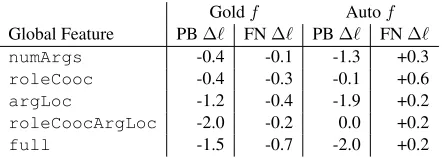
Figure 1: Global model advantage using max viola-tion VFP andfreq.
it differsanyposition. In latest updatezis incorrect if it differs in thelastposition (but can include other differences, unlike early update).
Results In figure 1 we plot the difference in per-formance between a model which includes a particu-lar global feature type and the baseline model which only uses local features. Almost across the board the values are negative, indicating that the global model performs worse, even though the local model is nested within the global model (i.e. there exists a parameter setting in the global model such that it is equivalent to the local model). This result is at odds with previous results which have successfully used max violation perceptron to train models with non-local features. We hypothesize that the reason performance goes down is due to the expressivity of our global features and the inconsistency problem described in Chang et al. (2015).
Briefly, the inconsistency comes from the fact that the weights derived from VFP training simultane-ously, and ambigusimultane-ously, reflect what to do condi-tioned on being in a state arrived at by theoracleor thepredictor. These two distributions over states are different if the predictor cannot perfectly mimic the oracle (the beam separability assumption). At test time, all of the states will be reached from the pre-dictor’s actions, so the contribution of what to do by possibly incorrectly assuming the state/history was created by theoracleis misleading. This can be very bad when the global features are expressive and the predictor makes a significant number of mistakes.
Goldf Autof
Global Feature PB∆` FN∆` PB∆` FN∆`
numArgs 0.0 0.0 +0.2 +0.7
roleCooc -0.6 -0.3 -0.1 +0.5
argLoc -0.4 +0.1 -0.1 -0.4
roleCoocArgLoc +0.4 +0.4 +0.1 -0.1
[image:5.612.78.298.61.138.2]full +0.6 +0.4 -0.1 +0.3
Figure 2: Global model advantage using LOLS and
freq.
●
● ● ●
● ●
● ●
● ●
●
●
0.5 0.6 0.7 0.8 0.9
−0.4
0.0
0.2
0.4
cheating
Global − Local
Figure 3: Benefit ofroleCoocglobal features as a function of inconsistency in the model.
make the task easier, we added a binary feature to the local features which was either 1 or -1 based on whether the action has cost 0. We flip the sign of this feature with probability1−α. A model with
α= 1should get perfect accuracy andα= 1 2 offers
no extra information.
Figure 3 shows the difference between a global model usingroleCoocand a local model (both re-ceiving the “cheating” feature) for various values of
α. This experiment used FrameNet data and max violation VFP. The local model does better than the global model (below the red line) where the incon-sistency is high (α < 0.75) and worse where it is low. Though the plot is noisy, whenα = 1the two models have the same performance.
This result explains why max violation training has been shown to be successful in tasks like POS tagging and shift-reduce parsing, where the accu-racy of the model is in the 90s. VFP with global features improves over local models on these tasks because the inconsistency is small, and the benefit from global features is great.
6 Learning to Search
Learning to search (L2S) is a family of imitation learning algorithms including early update percep-tron (Collins and Roark, 2004), LaSO (Daum´e III and Marcu, 2005), SEARN (Daum´e III et al., 2009), DAgger (Ross et al., 2011), and LOLS (Chang et al., 2015). The unifying feature of these algorithms is that they all are a reduction of training transition based models to a cost-sensitive classification prob-lem over(st, at)pairs.
Chang et al. (2015) showed that when the refer-ence (oracle) policy is optimal, which we can guar-antee in our case,2the cost estimates may be derived from reference roll-outs, which can be easily com-puted in constant time. Given reference cost esti-mates, the only way to distinguish within this fam-ily is with respect to the roll-in distribution. The LOLS algorithm prescribes using the current pol-icy for rolling-in, which does not always work well, which we will return to in§8.2.
Results In figure 2 we plot global model advan-tage using thefreqaction orderings and LOLS train-ing. There are mixed results; some global features are actually improving over the local model (some-thing which was not achieved by VFP training). We will return to why this is in §8.2, but first we will analyze an orthogonal aspect of the model.
7 Action Ordering
So far our transition system considers actions sorted by frequency of a role, which may not be optimal. Here we measure the effect of other orderings.
Easy First The first motivation is related to easy first inference (Shen et al., 2007; Raghunathan et al., 2010) inter alia. The idea is that the “easi-est” decisions should be made first because there is less risk that they are wrong and may be more safely conditioned on in making future decisions than any other action. To implement this heuristic, we define two variants of theeasyfirstmeta action ordering. easyfirst-dynamic chooses the variable index corresponding to the highest scoring action.
easyfirst-static chooses variable indices sorted by
2Every action fills in a label and we can say whether it is
[image:5.612.75.285.194.331.2]the dev set F-measure of the local model (most ac-curate visited first).3
Baselines Thefreq ordering sorts actions by how frequently their role appears in the training set, most frequent first. This be seen as a very naive version ofeasyfirst, but with the nice property that it is in-dependent of the local model.
From a model (estimator) bias and variance point of view, we should expect dynamic orderings to have higher variance (whether they have lower bias is a somewhat related but empirical question). In our case, we could track this variance by proxy and look at the number of nonzero global features, as is com-mon in the sparsity-inducing regularization litera-ture. Consider training a model with theroleCooc
global feature on single example, a frame withK
roles. With easyfirst-dynamic, there are K2
pos-sible roleCooc nonzero features, whereas with
easyfirst-staticand freq the maximum is K(K−2 1) since the order is fixed at training time.
To see if increased variance is responsible for po-tential differences in theeasyfirstvariants, we con-struct a parallel situation with random orderings:
rand-staticand rand-dynamic. The first chooses a random ordering over roles which is used through-out training and testing, and the second chooses a random ordering every time inference is run.
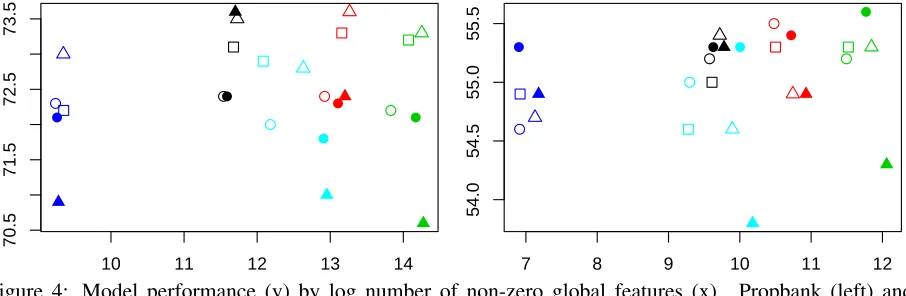
Results In figure 4 we have plotted models trained with each global feature type and each action order-ing. The first thing to notice is the variance across different action orderings is generally larger than the variance across different global features (for the best action ordering). This indicates that action ordering is important, perhaps more so than the global fea-tures used. This is an important result considering that most previous work on transition based infer-ence has not addressed automatic ordering.
Next, there is little consistency between Propbank and FrameNet. We believe the major reason for this is the amount of training data (Propbank has 20.7 times more instances and 1.58 more instances per type), causing overall accuracy to be higher and
easyfirstinference to work better.
Looking at the number of non-zero global
fea-3F-measure is computed from MAP estimates of precision
and recall under aβ(1,5
4)prior, slightly rewarding frequency.
tures, we see virtually no correlation between that measure of capacity and performance, on either data set. While this metric is often used in static (local) models to describe capacity, we believe this metric is less meaningful with global features.
Note that rand-dynamic works well on FrameNet, only losing to a non-random order-ing once (easyfirst-static on argLoc). Given the overall worse performance of our model on FrameNet, and the dearth of training data, we hypothesize that rand-dynamic is actually pro-viding a regularizing effect similar to dropout (Hinton et al., 2012). Since both rand-static and
rand-dynamic are random, they offer no real signal they could differ on (bias is the same), and using the standard bias-variance argument we should expect rand-static to do no worse since
rand-dynamic introduces additional variance into the model estimate. Our only explanation for the results is that rand-static is overfitting in a way whichrand-dynamicisn’t capable of.
Consistent with overfitting, we see that on both data setseasyfirst-staticusually does as well or bet-ter thaneasyfirst-dynamic. In the opposite fashion of the random orderings, here the dynamic version is more expressive and likely to overfit.
8 Error Analysis
Neither VFP nor LOLS worked for our transition transition systems out of the box. Here we discuss problems encountered with each algorithm and of-fer some solutions for fixing them. We do not claim these solutions are robust, but hopefully offer insight into potential difficulties in training models like this.
8.1 Violation Fixing Perceptron
The max violation version of VFP dictates that the violation to be corrected is the solution to argmin(x,y,z)∈C,z∈S
i{Bi[0]}wt·∆Φ(x, y, z)Where
Bi is the beam holding actions at stepith and C is
un-●
● ●
● ●
●
● ●
●
●
10 11 12 13 14
70.5
71.5
72.5
73.5
log(nnz)
De
v P
erf
or
mance
●
● ●
●
● ●
● ●
● ●
7 8 9 10 11 12
54.0
54.5
55.0
55.5
log(nnz)
De
v P
erf
or
[image:7.612.81.534.77.225.2]mance
Figure 4: Model performance (y) by log number of non-zero global features (x). Propbank (left) and FrameNet (right). Global feature type by color: numArgs,roleCooc, argLoc, argLocRoleCooc, and full.
easyfirstis triangle,freqis square,randis circle. Filled in means dynamic, hollow is static.
structured perceptron update and both global and lo-cal features are only updated with respect to a prefix of the oracle and predicted trajectory.
This prefix update may mean that mistakes at the end of the trajectory will not be corrected until the mistakes at the beginning are fixed.4 Skipping train-ing data puts global models at a disadvantage over local ones, and we attribute the poor performance of the global models to this issue.
This problem was one of the motivations of max violation over the early update strategy introduced by Collins and Roark (2004). Huang et al. (2012) described an update called “latest update” which chooses the longest prefix which was still a viola-tor, presumably to address the problem of skipping training data. While this may help, it is still possible to construct examples where a classification update would be made but a “latest update” would not.
For example, let s(yi) = w · φ(x, yi) and s(y[1:i]) = w · φ(x, y[1:i]), such that w · ∆Φ(x, y[1:i], z[1:i]) = s(y[1:i])−s(z[1:i]). Assume
local scoress(yi)are derived from one-hot vectors
indexed by(i, yi). Assume a global model with the
form: s(y[1:i]) = Pk<jw ·f(yk, yj) +Pjs(yj)
Take a sequence of binary decisions over the alpha-bet{a, b}with mistakes at indicesiandjsuch that
4This is the intended behavior under the beam separability
assumption, but this may lead to very poor performance in gen-eral.
i < j. Assume greedy search.
yi=a, yj=b, zi=b, zj =a
w·f(b, a) =−3, w·f(x, y) = 0∀(x, y)6= (b, a)
s(yi) = 0, s(yj) = 0
s(y[1:i]) = 0, s(y[1:j]) = 0
s(zi) = 1, s(zj) = 1
s(z[1:i]) = 1, s(z[1:j]) = 1 + 1 +−3 =−1
s(y[1:j])> s(z[1:j])⇔∆Φ(x, y[1:i], z[1:i])<0
(x, y[1:j], z[1:j])is in the confusion set, but is not a
violator, even thoughyj 6=zj, and the classification
update would changes(yj)ands(zj).
Both max violation and latest update would choose to update on(x, y[1:i], z[1:i])in hopes of
fix-ing it before movfix-ing on to the mistake at j. This happens consistently in our experiments (on the FrameNet data withroleCooc, by the end of train-ing more than 10% of violators contain a mistake in the suffix not chosen by max violation).
Results In figure 5 we show the performance of max violation and latest update variants of VFP along with an augmentation (+CLASS) intended to
fix the issue of missing suffix mistakes. Global models were trained with the roleCooc feature template and easyfirst-dynamic action ordering. +CLASSadds an unstructured perceptron update for
Goldf Autof Training PB∆` FN∆` PB∆` FN∆` max violation -3.5 -0.9 -1.3 -0.4 latest update -1.4 -0.7 -1.4 -0.3 max violation +CLASS -3.0 +1.8 -2.2 +2.4 latest update +CLASS -2.4 +1.2 -2.4 +2.4
Figure 5: Global model advantage using
roleCooc and easyfirst-dynamic across VFP
variations and +CLASS.
which is a pure CLASS update, so you can think
of the +CLASSvariants as a linear interpolation
be-tween a global and local objective.
8.2 LOLS
LOLS performs a roll-in with the current policy. This causes many updates which are derived from mistakes during frame identification. Once the wrong frame is predicted, in argument identifica-tion the model’s cost incentives flip towards trying to predict ∅ for all roles so as not to incur false positives. The roles in FrameNet are defined based on the frame5 and in Propbank they are not consis-tent across frames.6 This is arguably a pathological property of a transition system: action costs strongly depend on state.
Using LOLS (model roll-in), there is a strong bias towards choosing∅for all roles, leading to high pre-cision, low recall, and overall sub-optimal models. We found that when training the argument identi-fication parameters of the model it was better to perform a hybrid model/oracle roll-in whereby the frame identification actions were chosen by the ora-cle. This may not be the fault of LOLS, but the of Hamming loss for action costs, which is a bad sur-rogate for F-measure.
Another important component of LOLs is the choice of cost in the cost-sensitive classification re-duction. We found that defining costs based on the Hamming loss of an action performed very poorly. We found much better results with the multiclass hinge encoding described in Lee et al. (2004). In figure 6 we show performance with various choices of roll-in and cost definitions. The best LOLS global
5If you label a span as the Cognizer role for the frame
Opin-ion and that span was the Cognizer role for the Judgment frame, then the label is wrong.
6with the exception ofARG0andARG1which typically
cor-respond to proto-Agent and proto-Patient roles.
Goldf Autof
Roll-in Cost PB∆` FN∆` PB∆` FN∆`
model Hamming -24.5 -15.5 -10.1 -4.9
model Hinge -1.7 -1.1 -0.4 +0.2
hybrid Hamming -22.1 -12.9 -8.9 -1.0 hybrid Hinge +0.8 +1.0 +0.9 +1.1
Figure 6: Global model advantage using
roleCooc and easyfirst-dynamic across LOLS
variations: roll-in and cost function.
models consistently improve over local models.
8.3 Absolute Performance
Throughout the paper we have listed relative per-formance. Our absolute performance is 73.0 for Propbank (dev) and 55.3 for FrameNet (dev). This falls significantly short of the work of Zhou and Xu (2015) at 81.1 (PB dev), FitzGerald et al. (2015) at 79.2 (PB dev), and 72.0 (FN). Those works used non-linear neural models with multi-task distributed representations, which are not comparable to our re-sults. However, the models of Pradhan et al. (2013) at 77.5 (PB test) and Das et al. (2012) at 64.6 (FN test) are roughly comparable, and the performance gap is still significant. While our efforts do not ad-vance the state of the art in SRL, we hope that they are enlightening with respect to the application of various imitation learning methods.
9 Related Work
Berant and Liang (2015) used imitation learning for learning a semantic parser. Choi and Palmer (2011) explored transition based SRL and proposed some global features (e.g. copy ARG0 from controlling predicates) but did not consider action (re-)ordering or imitation learning. Wiseman and Rush (2016) de-rive a learning to search framework which is related to LaSO (Daum´e III and Marcu, 2005). Similar to our hybrid roll-in, they “reset” the beam as soon as the oracle prefix falls off.
10 Conclusion
for improving them. We also study the effect of in-ference order on learning and the utility of global features, finding that it is a very important factor of overall performance in greedy models.
Acknowledgements This work was supported in part by the Human Language Technology Center of Excellence (HLTCOE), and a Bloomberg Data Sci-ence Research Grant.
References
Collin F Baker, Charles J Fillmore, and John B Lowe. 1998. The berkeley framenet project. In Proceed-ings of the 36th Annual Meeting of the Association for Computational Linguistics and 17th International Conference on Computational Linguistics-Volume 1. ACL.
Jonathan Berant and Percy Liang. 2015. Imitation learn-ing of agenda-based semantic parsers.Transactions of the Association for Computational Linguistics, 3:545– 558.
Kai-Wei Chang, Akshay Krishnamurthy, Alekh Agarwal, Hal Daume, and John Langford. 2015. Learning to search better than your teacher. In David Blei and Francis Bach, editors,Proceedings of the 32nd Inter-national Conference on Machine Learning (ICML-15), pages 2058–2066. JMLR Workshop and Conference Proceedings.
Jinho D Choi and Martha Palmer. 2011. Transition-based semantic role labeling using predicate argument clustering. InProceedings of the ACL 2011 Workshop on Relational Models of Semantics, pages 37–45. As-sociation for Computational Linguistics.
Michael Collins and Brian Roark. 2004. Incremen-tal parsing with the perceptron algorithm. In Pro-ceedings of the 42Nd Annual Meeting on Association for Computational Linguistics, ACL ’04, Stroudsburg, PA, USA. Association for Computational Linguistics. Dipanjan Das, Nathan Schneider, Desai Chen, and
Noah A Smith. 2010. Probabilistic frame-semantic parsing. InHuman language technologies: The 2010 annual conference of the North American chapter of the association for computational linguistics, pages 948–956. Association for Computational Linguistics. Dipanjan Das, Andr´e F. T. Martins, and Noah A. Smith.
2012. An exact dual decomposition algorithm for shallow semantic parsing with constraints. In Se-mEval, SemEval ’12. Association for Computational Linguistics.
Hal Daum´e III and Daniel Marcu. 2005. Learning as search optimization: Approximate large margin
meth-ods for structured prediction. InInternational Confer-ence on Machine Learning (ICML), Bonn, Germany. Hal Daum´e III, John Langford, and Daniel Marcu. 2009.
Search-based structured prediction.
Charles Fillmore. 1982. Frame semantics.Linguistics in the morning calm.
Nicholas FitzGerald, Oscar T¨ackstr¨om, Kuzman Ganchev, and Dipanjan Das. 2015. Semantic role la-belling with neural network factors. InProceedings of the 2015 Conference on Empirical Methods in Natural Language Processing, Lisboa, Portugal, September. Association for Computational Linguistics.
Yoav Freund and Robert E Schapire. 1999. Large margin classification using the perceptron algorithm.Machine learning, 37(3):277–296.
Daniel Gildea and Daniel Jurafsky. 2002. Automatic la-beling of semantic roles. Computational linguistics, 28(3):245–288.
Yoav Goldberg and Michael Elhadad. 2010. An effi-cient algorithm for easy-first non-directional depen-dency parsing. In Human Language Technologies: The 2010 Annual Conference of the North American Chapter of the Association for Computational Linguis-tics, HLT ’10, pages 742–750, Stroudsburg, PA, USA. Association for Computational Linguistics.
Karl Moritz Hermann, Dipanjan Das, Jason Weston, and Kuzman Ganchev. 2014. Semantic frame identifica-tion with distributed word representaidentifica-tions. In Pro-ceedings of the 52th Annual Meeting of the Association for Computational Linguistics.
Geoffrey E Hinton, Nitish Srivastava, Alex Krizhevsky, Ilya Sutskever, and Ruslan R Salakhutdinov. 2012. Improving neural networks by preventing co-adaptation of feature detectors. arXiv preprint arXiv:1207.0580.
Liang Huang, Suphan Fayong, and Yang Guo. 2012. Structured perceptron with inexact search. In Proceed-ings of the 2012 Conference of the North American Chapter of the Association for Computational Linguis-tics: Human Language Technologies, NAACL HLT ’12, pages 142–151, Stroudsburg, PA, USA. Associ-ation for ComputAssoci-ational Linguistics.
Paul Kingsbury and Martha Palmer. 2002. From tree-bank to proptree-bank. InLREC. Citeseer.
Yoonkyung Lee, Yi Lin, and Grace Wahba. 2004. Multi-category support vector machines, theory, and applica-tion to the classificaapplica-tion of microarray data and satel-lite radiance data. Journal of the American Statistical Association, 99:67–81.
Sixteenth Conference on Computational Natural Lan-guage Learning (CoNLL 2012), Jeju, Korea.
Sameer Pradhan, Alessandro Moschitti, Nianwen Xue, Hwee Tou Ng, Anders Bj¨orkelund, Olga Uryupina, Yuchen Zhang, and Zhi Zhong. 2013. Towards robust linguistic analysis using ontonotes. InProceedings of the Seventeenth Conference on Computational Natu-ral Language Learning. Sofia, Bulgaria: Association for Computational Linguistics, pages 143–52. Vasin Punyakanok, Dan Roth, Wen tau Yih, Dav Zimak,
and Yuancheng Tu. 2004. Semantic role labeling via generalized inference over classifiers. In In: Proc. of the 8th Conference on Natural Language Learning (CoNLL-2004), pages 130–133.
Karthik Raghunathan, Heeyoung Lee, Sudarshan Ran-garajan, Nathanael Chambers, Mihai Surdeanu, Dan Jurafsky, and Christopher Manning. 2010. A multi-pass sieve for coreference resolution. InProceedings of the 2010 Conference on Empirical Methods in Natu-ral Language Processing, pages 492–501. Association for Computational Linguistics.
Stphane Ross, Geoffrey J. Gordon, and Drew Bagnell. 2011. A reduction of imitation learning and struc-tured prediction to no-regret online learning. In Geof-frey J. Gordon and David B. Dunson, editors, Proceed-ings of the Fourteenth International Conference on Ar-tificial Intelligence and Statistics (AISTATS-11), vol-ume 15, pages 627–635. Journal of Machine Learning Research - Workshop and Conference Proceedings. Libin Shen, Giorgio Satta, and Aravind Joshi. 2007.
Guided learning for bidirectional sequence classifica-tion. InProceedings of the 45th Annual Meeting of the Association of Computational Linguistics, pages 760–767, Prague, Czech Republic, June. Association for Computational Linguistics.
Oscar T¨ackstr¨om, Kuzman Ganchev, and Dipanjan Das. 2015. Efficient inference and structured learning for semantic role labeling. Transactions of the Associa-tion for ComputaAssocia-tional Linguistics, 3:29–41.
Kristina Toutanova, Aria Haghighi, and Christopher D. Manning. 2008. A global joint model for semantic role labeling.Comput. Linguist., 34(2):161–191, June. Sam Wiseman and Alexander M. Rush. 2016. Sequence-to-sequence learning as beam-search optimization.
CoRR, abs/1606.02960.
Nianwen Xue and Martha Palmer. 2004. Calibrating fea-tures for semantic role labeling. InEMNLP.
Jie Zhou and Wei Xu. 2015. End-to-end learning of se-mantic role labeling using recurrent neural networks. InProceedings of the 53rd Annual Meeting of the As-sociation for Computational Linguistics and the 7th International Joint Conference on Natural Language