A prototype of a social and economic based resource allocation system in grid
computing
Gabriele Pierantoni, Eamonn Kenny, Brian Coghlan
Trinity College Dublin, Computer Architecture Group
Rm-005, CALab1, INS building, TCD, Dublin 2, Ireland
[email protected], [email protected], [email protected]
Abstract
Nowadays the grid community is facing complex chal-lenges. Among them three are particularly interesting: the existence of many different grid middlewares; the increas-ing complexity of the submitted jobs; and the many different ways in which actors and resources can be arranged. In this paper we propose a combined solution to these prob-lems which is based on the union of two concepts: a meta-grid concept that tackles the issues posed by the variety of different middlewares and the complexity of jobs, and a con-cept of Social Grid Agents that tackles the issue of resource sharing and allocation.
1. Introduction
Grid computing was born as an elegant way to bring to-gether resources, their owners and their users in the digital world. By doing so, it allowed users to harness more re-sources than they owned and allowed rere-sources to be more fully used than would otherwise have been possible.
Many different grid middlewares were developed, each with strengths and weaknesses. The users continue to re-quest the execution of tasks of growing complexity and the social relationships among resource owners and consumers continue to become more and more intricate.
The grid community tries to cope with these problems by offering sophisticated grid middlewares. Particularly the growing complexity of the tasks submitted is tackled by the workflow engine field of research, the ever increasing num-ber of different grid middlewares is coped with by the grid interoperability community and the increasing complexity in the resources allocation schemes is dealt with by re-search in the resource brokerage community. The various solutions[6],[11] envisaged by the scientific community to tackle the complexities of resource brokerage and allocation in grids encompass genetic algorithms, simulated
anneal-ing and hybrid solutions[3]. In addition to these, there are economy-based approaches that range from pure competi-tive liberalism to pure cooperation and from uncontrolled markets[5][21] to centralized controlled economies[12][9]. Nonetheless, all of these enable in effect low-level (the ma-jority) or mid-level (the minority) resource brokerage. In this paper we describe the architecture of the prototype of the solution we proposed for these three combined prob-lems. Our solution, which we term,Social Grid Agents[2] has been described from an abstract and theoretical per-spective, from a resource allocation perspective[16][17] and with regard to the issue of interoperability[20][19] and, fi-nally, with regard to the growing number of different work-flow engines[18]. The prototype allows us to elucidate the architecture in more detail.
2
Paradigm used in the design of the
Proto-type
characteris-tics.
2.1
A socio-economic perspective of grid
Computing
The design we offer tries to cope with these complexities and constraints. It is based on three flows of information:
• The production chain : The starting point of the design was to model a grid as amicroeconomic[15] produc-tion chainthat spawns from basic goods, orfactors, to intermediate commoditiesand, in the end, to the final job, orproduced commodity. Existing grid resources (job submission, information systems and file manage-ment services) are, in reality, produced commodities but we treat them as factors as their internal produc-tion chain is not modeled directly in economic terms.
• The ownership flow: At each of the production steps an actor (either a human or a program) assembles fac-tors and, possibly, intermediate commodities to create a produced commodity. If at any given time an ac-tor has not enough facac-tors to produce the commodities he wants he may engage in social or economic trans-actions to obtain the commodities he needs. These types of relations can be: co-operative relations con-sisting of access to resources without the need for a balancing transaction representing a payment such as donations,lending and borrowing, Keynesian invest-ments1andcommon goods2, Non-monetary economic
relations such as bartering, and Monetary economic relations that involve payments such as Posted Price Model, Auctions and Calls for Tender.
• The policies flow: The production process and the so-cial interactions are also bound to policies that con-strain the way the agents engage in production or in so-cial and economic exchange. Policies also define what kind of economic or co-operative agreements bind two or more agents.
2.2
General Architecture
The architecture is based on two layers as described in Figure 1; one whereProduction Grid Agentscompose var-ious grid services as in a microeconomic supply chain and another layer where the Social Grid Agentsthat own and control the agents in the lower layer engage in social and economic exchange.
1We termKeynesian Investment, in honor of John Maynard Keynes, a
relationship where an Institution invests in grid resources binding their use, partially or fully, to a certain user or use
[image:2.612.312.563.73.190.2]2We detail these two relationships in Section 3.
Figure 1. A socio-economic perspective of a grid.
This design allows for a large variety of connection topologies among the Social and Production Grid Agents. Each Social Grid Agent can own, control or temporarily use none, one or more Production Grid Agents. A Social Grid Agent can also exchange the control of, or the services produced by, the Production Grid Agent it controls. There-fore, the design of the agents had primarily to focus on how to handle the three flows of information (production, owner-ship and policies) in a consistent, flexible and scalable man-ner. This they do in ametagridenvironment (see section 4) in order that a Production Agent can be anything from a single resource to an entire grid like EGEE[8].
3
The Agent Design
In order to achieve the design requirements and con-straints listed in section 2, the agents must be able to as-semble different resources and accept or reject requests from other agents depending on the relationship that binds them; moreover both the Production and Social Grid Agents should share a common design in order to reduce implemen-tation and maintainance complexity. The architecture of the agents is composed from two or three main entities. Pro-duction Grid Agents that encompass existing grid resources (or Border Agents, see section 4) have aGrid Body consist-ing of existconsist-ing grid services surrounded by a GT4 service3 that enable it to be used by the other metagrid components. The link between the GT4 service and the existing grid ser-vice usually consists of API invocations but can also be per-formed with system calls if an API is lacking. All other agents such as Native Metagrid Agents (again see section 4) or Social Grid Agents contain aSkeletonthat consists of the services offered by the GT4 services. Finally, aJava Brain implements the production or social behavior with which the agent controls the existing grid service. The most com-plex of these components, the Java Brain, is described in
detail in Figure 2.
[image:3.612.311.563.75.177.2]All Java Brains expose a minimal interface composed of the methodprocess(message)that returns anothermessage. This important design decision was made in order to reduce to a minimum the complexity of the agent’s skeleton. When a message is received by a Java Brain, itsProcessor Man-agerchecks whether there is anyProcessor(PR in Figure 2) able to manage it. A Processor is a Java class that contains the “knowledge“ of what to do with one or more messages. The processor will behave according to its current policies.
Figure 2. Agent Architecture.
The Processor Manager is capable of match-making a Processor to a message, its sender and a policy through hash maps. These maps are used to describe set relations between message types, values of the fields of the mes-sage, policies and Processors capable of handling them. If a Processor capable of handling that message with that pol-icy is found, it is instantiated and it is passed the message. The Processor then analyzes the message and compiles a list of services it needs, which it then passes to theService Providers Manager that instantiates the necessaryService Providers(SP in Figure 2) using a very similar mechanism to the Processor Manager. The Processor also queries the Policy Managerto obtain the policies that must be enforced during the execution.
The detailed working of this mapping technique is de-scribed in Figure 3. Firstly a messagemof type t is re-ceived by the agent from a senders. This message is part of a hierarchy of Java classes that implement all the messages accepted by the agents. The message also has some fields vithat are useful for the selection of the processor.
The first step in the mapping process is to link the sender to a relationships→r. Then the message type, the sender and the relationship map to a policy:(t, s, r)→p. Finally the message type, the field values and the policy map to a processor:(t,{vi}, p)→processor.
Agents must take different actions depending on the sender identity and the message; for example an agent may accept service execution requests for free from an agent it has a cooperative relationship with, it may ask for a
stan-Figure 3. Mapping a message to a processor.
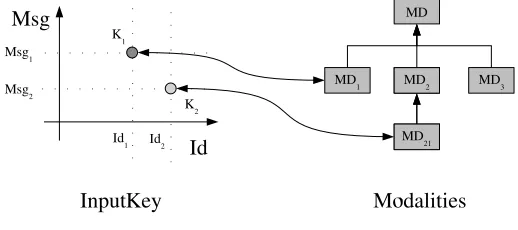
dard price for a different set of agents and have a particular set of prices for a third set of agents with whom it has a par-ticular economic relationship. In order to achieve this flex-ible behavior every Policy Manager also deals with access rights, offering an AccessMap service that tells whether and how a certain message must be replied to by the agent. The AccessMap service behavior is described in Figure 4; it is also a good example to explain the behavior of the Policy Manager and all the managers in general. When a message M sgiis received from the Agent with identityIdjthe mes-sage type and the identity are combined into a new object, the AccessKey Ak(M sgi, Idj). This AccessKey is then used as a key to a HashMap that contains the policies (in this case access modalities) which the agent must adhere to. Policies are arranged in type hierarchies stemming from an abstract class. Such policies mainly cover relationships be-tween Social and Production Grid Agents (control and ac-cess modalities) or between Social Grid Agents (social and economic modalities).
Figure 4. Access Map.
3.1
Production control topologies
[image:3.612.51.306.205.331.2] [image:3.612.307.566.472.587.2]for example, exposes a common methodisGranted(sender, request)that returns True if the sender can submit a request to the agent. Some of the access modalities are:
• The Absolute Modality: Either True or False, it is mostly used to represent ownership relationships of Production Grid Agents.
• TheToken Modality: Allows an Agent to submit a cer-tain number of requests to a Production Grid Agent. It is mostly used in simple Service Rental scenarios where a Social Grid Agent buys (or receives) a given amount of service execution rights on Production Grid Agents it does not control or own.
• The Deadline Modality: Allows an Agent to control another agent for a given amount of time. It is mostly used in more complex Service Rental scenarios where a Social Grid Agents rents (or gets for free) control of other Production Grid Agents to engage in the execu-tion of a complex service.
• The TimeSlot Modality: Allows an Agent to use the services of another agent until the allowed amount of time has been used. It is mostly used to reserve pro-cessing and storage services.
• The Combined Modalities: Some of the above men-tioned modalities can be combined together. Token and Deadline modality can be combined to obtain a modality where tokens have expiry dates while TimeS-lot and Deadline modalities can be combined to obtain a ”perishable” reservation on computational and stor-age services.
Agents can have different roles with respect to a Produc-tion Grid Agent. These roles are: theownersthat have com-plete control over a Production Grid Agent; they can sell, rent or donate the Production Grid Agent to other agents; they can set access rights for Controllers and Users and they can set policies for the Production Grid Agent, the con-trollers that have partial control and can set access rights for Users and set production policies, and theusersthat can access the services granted by a controller or an owner.
It is clear that some form of control has to be provided over the modalities with which each of the actors sets the rights of the others. If no such control is provided there may be cases in which agents gain control of other agents in an unforeseen way. As an example, let us suppose that an owner O grants control to an agent C to one of his produc-tion agents P, with a deadline modality that expires at a date T. As the controller can set any kind of access rights for the user it is possible for the controller to set absolute rights to a user U. These rights, being absolute, will outlive the range of time in which C is allowed to control P. To avoid such problems the setting of the access rights are as follows.
• For owners: Owners can set any kind of access rights and they are enforced directly.
• For controllers: the access rights that controllers en-force depend on the access rights they have, specifi-cally:
– Absolute modality: enforced directly.
– Deadline modality: If the controller has Deadline modality access rights, its commands change in the following way.
∗ Absolute modality→Deadline modality.
∗ Deadline modality → Deadline modality with an expiry date that is the minimum be-tween the controller’s and the target’s set-tings.
∗ TimeSlot modality→ TimeSlot and Dead-line modality.
∗ Token modality → Deadline and Token modality.
– Token modality: not used. Token modality is granted to users, not controllers.
• For users: Users cannot set any access right.
To allow flexibility at the startup of the container hosting the agents an “imprinting“ mechanism has been designed. At startup an agent has a secret code. Any agent that knows that secret code is allowed to set itself or any other agent as Owner. This mechanism also allows it to sell or buy a Production Grid Agent. In this case the owner selling the Production Grid Agent to a client sets a new startup code, then it passes it to the client. This architecture allows many different production topologies. Three of these are now de-scribed.
3.1.1 Simple Producer
Figure 5. Simple Producer.
3.1.2 Service Rental
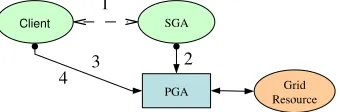
A slightly more complex control topology is the Service Rentalas shown in Figure 6. Here a Social Grid Agent sells or donates the services of one or more of the Production Grid Agents it is in control of. After the social or economic agreement (step 1), the Social Grid Agent instructs the Pro-duction Grid Agent to accept requests from the Client with a certain modality (usually token modality, time slot modal-ity, deadline modality or combined modalities) (step 2). The Client is now capable of directly using the Production Grid Agent (steps 3 and 4).
Figure 6. Service Rental.
3.1.3 A Complex Scenario
A more complex scenario is represented in Figure 7. Here a client asks for a complex service, the execution of which requires three different grid resources (a, b and c). These resources can represent (as in the use case) two different job submission systems and a workflow engine or, in other cases, storage devices and computational power. The Social Grid Agent interacting with the client directly controls only “grid resource a“ through one of its Production Grid Agents. When the Social Grid Agent receives the request from the client (step 1) it checks if the other Social Grid Agents with which it has a relation are able to fulfill the services that are needed (step 2 and 3). If this is so, a social arrangement is made to allow the Social Grid Agent to gain control of the Production Grid Agents for the necessary time (step 4). The Social Grid Agent then instructs its Production Grid Agent about the other Production Grid Agents it can use for the completion of the complex service (step 5). The service is then executed and the result is sent back to the client (step 6 and 7).
3.2
Social topologies
[image:5.612.53.306.75.107.2]As for the production topologies where Social Grid Agents control Production Grid Agents, the agents in the
Figure 7. A more complex scenario.
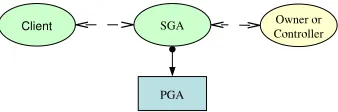
social layer can also be arranged in different structures. In order to achieve this the same design used for the produc-tion control is replicated with a few changes. Firstly anyone (either humans or agents) can take control of an agent if he/she/it knows the appropriate startup code. If the code is correct the owner of the Social Grid Agent is set. Owners can set social/economic policies and access rights for con-trollers. Controllers can set social and economic policies for clients. Such policies encompass the type of purchase to which an actor is entitled, such as: theFree Exchangewhere services can be used without the need of a payment. This modality is usually present between agents that have co-operative relationships. This modality can also be enforced in Keynesian scenarios, e.g. Standard Purchasewhere ser-vices can be bought for a standard price (this modality is usually the default one and open to all agents) and the Dis-counted Purchasewhere services can be bought for a dis-count price. This modality is usually used in the Keynesian Scenarios and co-operative relationships.
As for the Production Grid Agents, social and economic access modalities can be set by role: theOwnersthat have complete control over a Social Grid Agent can set access rights for Controllers and Users and they can set social policies; the Controllers that have partial control can set access rights for users and set social and economic poli-cies that control pricing (controllers are usually used to en-force specific policies on a subset of resources for a set of users), and theusers that can access the services with the social/economic policies enforced by a controller or owner. This mechanism allows the implementation of many dif-ferent social topologies:
3.2.1 Simple Relationship
[image:5.612.95.265.302.358.2]Figure 8. Simple Relationships.
3.2.2 Tribe
[image:6.612.310.566.113.236.2]In a Tribe, such as that in Figure 9, the Social Grid Agents accept the pricing and access policies of the tribe (usually free or discounted prices for all the members of the tribe). Then all Social Grid Agents can use part of the resources of the tribe to fulfill their needs.
Figure 9. Tribe.
3.2.3 Keynesian Scenario
In a Keynesian Scenario, such as that in Figure 10, the So-cial Grid Agents accept pricing and access policies from an Authority; these pricing and access policies usually refer to a subset of all the clients of the Social Grid Agents.
Figure 10. Keynesian Scenario.
4
The agent’s environment: A metagrid
We now describe the architecture of the environment where the agents ”live”, see Figure 11. The environment is a metagrid composed from a variety of (otherwise possi-bly incompatible) components that are made interoperable via the activities of the agents and some basic services. At
[image:6.612.62.292.262.366.2]the center of the architecture is the user, who communicates with all the other components through a user interface.
Figure 11. metagrid architecture.
The communication among all the metagrid components is provided by the metagrid Transport Layer that allows the communication between three main groups of metagrid services. The first group is the Middleware Services, on the right of Figure 11, comprising all the existing middle-wares that are to be encompassed by the metagrid architec-ture. These components are divided into two types: work-flow middleware such as WebCom[14], and grid middle-ware such as LCG2 and GT4[1]. Each of these components is extended with an agent (either a Production Grid Agent or a Social plus a Production Grid Agent) that allows com-munication with the metagrid transport services.
The second group is theNative Metagrid Services, on the left of Figure 11, that comprises those services that were de-veloped to tackle specific metagrid issues. Thus far there are just two of these services: the Metagrid Security eXchange (MSX) service that provides a central market for security credentials, and the Metagrid Job eXchange (MJX), a mar-ket where any middleware can exchange job-related actions with any other middleware. Below we briefly describe these components.
4.1
Transport Layer
[image:6.612.94.264.493.575.2]4.2
Border Agents
Border Agents have the duty to link the agents to exist-ing grid resources. They can link to job submission systems, storage services, information systems or workflow engines. They usually consist of a single Production Grid Agent con-trolling the existing grid resources under the direct control of some Social Grid Agents in the metagrid or they consist of a couple of Production/Social Grid Agents representing a simple production unit able to sell/donate the services of-fered by the existing grid resource. Workflow engines, on the other hand, can be modeled in two different ways:
• Monolithic workflow engines where the entire service of the workflow and the services it relies upon is sold or controlled as a single item.
• Open workflow engines that can execute a workflow where every action is just a new message sent to a Pro-duction or Social Grid Agent. In this case the added value of this service consits solely in the ability to ex-ecute the workflow whilst the services triggered by the workflow may be controlled by other agents.
4.3
Metagrid Job eXchange
The Metagrid Job eXchange (MJX) enables any middle-ware to exchange job-related actions with any other mid-dleware. These actions include job submission and status requests. It is the duty of this service to submit a job, de-scribed in the job description language of one middleware, to any other middleware. The Metagrid Job eXchange also offers a Social Grid Agent that has the duty to find the opti-mal solution for the submitted jobs
4.4
Metagrid Security eXchange
The Metagrid Security eXchange (MSX) is a central market that enables different middlewares to trade security credentials in a tightly controlled manner. The KeyNote Credential Authority (KNCA) and Delegation Service are components of the MSX that are particularly important for interoperability between WebCom, which uses KeyNote [4] for authorization, and grid middleware that uses GSI-based security [10].
5
Use Case
This use case encompasses three different grids: LCG2, GT4 and WebCom, and two native metagrid services: the Metagrid Job eXchange and the Metagrid Security eX-change. In this example, the Metagrid Job eXchange, the Metagrid Security eXchange and WebCom are directly con-trolled by the same Social Grid Agent while LCG2 and GT4
Service Providers are controlled by two separate Social Grid Agents with which social and/or economic exchange is to be established to gain the necessary services.
[image:7.612.312.565.170.286.2]The social topology is described by the upper part of Fig-ure 12. The control/ownership relations are drawn with ver-tical lines. The production topology is represented in the lower part of Figure 12.
Figure 12. Topology of the use case.
The behavior of the system is as follows:
1. Job submission: The user submits a complex job, the execution of which requires LCG2, GT4 and WebCom resources.
2. Execution planning: The Social Grid Agent (SGAMJX) that controls the Metagrid Job eX-change Service decides whether to accept to try to submit the job or not
3. Needs evaluation: SGAMJX assesses the needs for the successful submission of the job: these are the Metagrid Security eXchange and LCG2, GT4 and We-bCom resources. It then checks this list against the resources it directly controls: the Metagrid Security eXchange and WebCom. This results in a list of the resources that are needed and that must be obtained through social exchange
P GAMJX. The job is then passed to the Production Grid Agent (P GAMJX) with the list of the other Pro-duction Grid Agents that will be needed (P GAMSX, P GAW EBCOM,P GALCG2andP GAGT4).
5. Job execution: P GAMSX submits the job to the Pro-duction Grid Agent that controls the WebCom re-source. WebCom unfolds the workflow graph that rep-resents the job and starts executing it. When a node representing an operation that needs an LCG2 or a GT4 resource is encountered, the job description (JDL or RSL) is sent to the Production Grid Agent that con-trol the resources (P GALCG2 andP GAGT4). This Production Grid Agent allows this execution as it was instructed to do so by its Social Grid Agent (either as Owner or Controller).
6. Job termination: When the complete job has been ex-ecuted the results are passed back to the Metagrid Job eXchange and thence passed back to the user.
6
Conclusion
The first prototype of this combined architecture has proven that the design is sound and flexible enough to cope with different scenarios and different allocation methods. This prototype also shows that the design of the agents al-lows for the creation of arbitrarily complex social struc-tures that encompass co-operative systems such as Tribes and Keynesian Scenarios and purely competitive systems. Future work will deal with the introduction of a banking system to replace the credit tokens that are now used for the payments, and also the introduction of workflow engines other than WebCom. Finally we will pursue the design of more sophisticated social relations and credit/debit based systems able to allow temporary imbalances in the way re-sources are consumed (to cope with urgent and unforeseen needs by one or more Social Grid Agents).
References
[1] Globus toolkit web page.
[2] Social Grid Agents Sourceforge project page.
[3] A. Abraham, R. Buyya, and B. Nath. Nature heuristics for scheduling jobs on computational grids. InThe 8th IEEE In-ternational Conference on Advanced Computing and Com-munications (ADCOM 2000), Cochin, India, Dec. 2000. [4] M. Blaze. Using the KeyNote Trust Management System,
March 2001.
[5] R. Buyya, D. Abramson, J. Giddy, and H. Stockinger. Eco-nomic models for management of resources in peer-to-peer and grid computing. InTechnical Track on Commercial Ap-plications for High-Performance Computing, SPIE Interna-tional Symposium on The Convergence of Information Tech-nologies and Communications (ITCom 2001), Denver, Col-orado, USA, Aug. 2001.
[6] R. Buyya, S. Chapin, and D. DiNucci. Architectural mod-els for resource management in the grid. In The First IEEE/ACM International Workshop on Grid Computing (GRID 2000), Bangalore, India, Dec. 2000.
[7] B. Coghlan, G. Quigley, S. Maad, J. Ryan, E. Kenny, and D. OCallaghan. A transparent grid filesystem. InPARA’06 Workshop on State-of-the-Art in Scientific and Parallel Com-puting, Umea, Sweden, 18 - 21 June 2006.
[8] Enabling Grids for E-sciencE (EGEE), 2006.
[9] E. Elmroth and P. Gardfjll. Design and Evaluation of a De-centralized System for Grid-wide Fairshare Scheduling. In First IEEE Conference on e-Science and Grid Computing, May 2005.
[10] I. Foster, C. Kesselman, G. Tsudik, and S. Tuecke. A Se-curity Architecture for Computational Grids. InACM Con-ference on Computers and Security, pages 83–91. ACM-P, 1998.
[11] J. Foster, C. Kasselman, C. Lee, B. Lindell, K. Nahrsted, and A. Roy. A distributed resource management architecture that supports advanced reservations and co-allocation. In Seventh International Workshop on Quality of Service, 1999. [12] P. Gardfjll, E. Elmroth, L. Johnsson, O. Mulmo, and T. Sandholm. Scalable Grid-wide Capacity Allocation with the SweGrid Accounting System (sgas). 2006. Draft ver-sion. Final version to be submitted for journal publication. [13] S. Maad, B. Coghlan, G. Quigley, J. Ryan, E. Kenny, and
D. O’Callaghan. Towards a complete grid filesystem func-tionality. Future Generation Computer System (Elsevier) -Special issue on Data Analysis, Access and Management on Grids, to appear 2006.
[14] J. P. Morrison, J. J. Kennedy, and D. A. Power. WebCom: A Web Based Volunteer Computer.The Journal of Supercom-puting, 18:47–61, 2001.
[15] A. Mukherji.Walrasian and Non-Walrasian Equilibria: An Introduction to General Equilibrium Analysis. Oxford Uni-versity Press, 1990.
[16] G. Pierantoni, E. Kenny, and B. Coghlan. An Architecture Based on a Social-Economic Approach for Flexible Grid Resource Allocation. InCracow Grid Workshop (CGW05), Cracow, Poland, November 2005.
[17] G. Pierantoni, E. Kenny, and B. Coghlan. An Agent-based Architecture for Grid Societies. InPARA 06, Umea, Sweden, June 2006.
[18] G. Pierantoni, E. Kenny, and B. Coghlan. Social Grid Agents as a Metagrid Technology: An approach for flexible resource allocation in heterogeneous Grid Middlewares. In Cracow Grid Workshop (CGW06), Cracow, Poland, October 2006.
[19] G. Pierantoni, E. Kenny, B. Coghlan, O. Lyttleton, D. O’Callaghan, and G. Quigley. Interoperability using a Metagrid Architecture. InHDPC 06, Paris, France, June 2006.
[20] G. Pierantoni, O. Lyttleton, D. O’Callaghan, G. Quigley, E. Kenny, and B. Coghlan. Multi-Grid and Multi-VO Job Submission based on a Unified Computational Model. In Cracow Grid Workshop (CGW05), Kracow, Poland, Novem-ber 2005.