Learning Grammar Specifications from IGT: A Case Study of Chintang
Emily M. Bender Joshua Crowgey Michael Wayne Goodman Fei Xia Department of Linguistics
University of Washington Seattle, WA 98195-4340 USA
{ebender,jcrowgey,goodmami,fxia}@uw.edu
Abstract
We present a case study of the methodol-ogy of using information extracted from interlinear glossed text (IGT) to create of actual working HPSG grammar fragments using the Grammar Matrix focusing on one language: Chintang. Though the re-sults are barely measurable in terms of coverage over running text, they nonethe-less provide a proof of concept. Our expe-rience report reflects on the ways in which this task is non-trivial and on mismatches between the assumptions of the methodol-ogy and the realities of IGT as produced in a large-scale field project.
1 Introduction
We explore the possibility of learning precision grammar fragments from existing products of doc-umentary linguistic work. Aprecision grammaris a grammar which encodes a sharp notion of gram-maticality and furthermore relates strings to elabo-rate semantic representations. Such objects are of interest in the context of documentary linguistics because: (1) they are valuable tools in the explo-ration of linguistic hypotheses (especially regard-ing the interaction of various phenomena); (2) they facilitate the search for examples in corpora which are not yet understood; and (3) they can support the development of treebanks (see Bender et al., 2012a). However, they are expensive to build. The present work is carried out in the context of the AGGREGATION project,1which is exploring
whether such grammars can be learned on the ba-sis of data already collected and enriched through the work of descriptive linguists, specifically, col-lections of IGT (interlinear glossed text).
The grammars themselves are not likely targets for machine learning, especially in the absence of 1http://depts.washington.edu/uwcl/aggregation/
treebanks, which are not generally available for languages that are the focus of descriptive and documentary linguistics. Instead, we take advan-tage of the LinGO Grammar Matrix customiza-tion system (Bender et al., 2002; Bender et al., 2010) which maps from collections of statements of linguistic properties (encoded in choices files) to HPSG (Pollard and Sag, 1994) grammar frag-ments which in turn can be used to parse strings into semantic representations in the format of Min-imal Recursion Semantics (MRS; Copestake et al., 2005) and conversely, to generate strings from MRS representations. The choices files are a much simpler representation than the grammars derived from them and therefore a more approach-able learning target. Furthermore, using the Gram-mar Matrix customization system to produce the grammars results in much less noise in the auto-matically derived grammar code than would arise in a system learning grammars directly.
Here, we focus on a case study of Chintang, a Kiranti language of Nepal, described by the Chin-tang Language Research Project (CLRP) (Bickel et al., 2009). Where Lewis and Xia (2008) and Bender et al. (2013) apply similar methodologies to extract large scale properties for many guages, we focus on a case study of a single lan-guage, looking at both the large scale properties and the lexical details. This is important for two reasons: First, it gives us a chance to look in-depth at the possible sources of difficulty in ex-tracting the large scale properties. Second, while large-scale properties are undoubtedly important, the bulk of the information specified in a preci-sion grammar is far more fine-grained. In this case study we apply the methodology of Bender et al. (2013) to extract general word order and case properties and examine the sources of error affect-ing those results. We also explore extensions of those methodologies and that of Wax (2014) to ex-tract lexical entries and specifications for
logical rules. Together with a few default spec-ifications, this information is enough to allow us to define grammars through the Grammar Matrix customization system and thus evaluate the results in terms of parsing coverage, accuracy and am-biguity over running text. Chintang is particu-larly well-suited for this case study because it is an actual endangered language subject to active descriptive research, making the evaluation of our techniques realistic. Furthermore, the descriptive research on Chintang is fairly advanced, having produced both large corpora of high-quality IGT and sophisticated linguistic descriptions, making the evaluation and error analysis possible.
2 Related Work
This work can be understood as a task related to both grammar induction and grammar extraction, though it is distinct from both. It also connects with and extends previous work using interlinear glossed text to extract grammatical properties.
Grammar induction (Clark, 2001; Klein and Manning, 2002; Klein and Manning, 2004; Haghighi and Klein, 2006; Smith and Eisner, 2006; Snyder et al., 2009, inter alios) involves the learning of grammars from unlabeled sentences. Here, unlabeledmeans that the sentences are of-ten POS tagged, but no syntactic structures for the sentences are available. Most of those stud-ies choose probabilistic context-free grammars (PCFGs) or dependency grammars as the gram-mar framework, and estimate the probability of the context-free rules or dependency arcs from the data. These studies improve parsing performance significantly over some baselines such as the EM algorithm, but the induced grammars are very dif-ferent from precision grammars with respect to content, quality, and grammar framework.
Grammar extraction, on the other hand, learns grammars (sets of rules) from treebanks. Here the idea is to use heuristics to convert the syntactic structures in a treebank into derivation trees con-forming to a particular framework, and then ex-tract grammars from those trees. This has been done in a wide range of grammar frameworks, in-cluding PCFG (e.g. Krotov et al., 1998), LTAG (e.g. Xia, 1999; Chen and Vijay-Shanker, 2000), LFG (e.g. Cahill et al., 2004), CCG (e.g. Hock-enmaier and Steedman, 2002, 2007), and HPSG (e.g. Miyao et al., 2004; Cramer and Zhang, 2009). However, this approach is not applicable to work
word-order=v-final has-dets=yes
noun-det-order=det-noun ...
case-marking=erg-abs erg-abs-erg-case-name=erg erg-abs-abs-case-name=abs ...
verb4_valence=erg-abs verb4_stem1_orth=sams-i-ne verb4_stem1_pred=_sams-i-ne_v_re ...
verb-pc3_inputs=verb-pc2
verb-pc3_lrt1_name=2nd-person-subj verb-pc3_lrt1_feat1_name=pernum verb-pc3_lrt1_feat1_value=2nd verb-pc3_lrt1_feat1_head=subj verb-pc3_lrt1_lri1_inflecting=yes
verb-pc3_lrt1_lri1_orth=a-Figure 1: Excerpts from a choices file
on endangered language documentation, as tree-banks are not available for such languages.
A third line of research attempts to bootstrap NLP tools for resource-poor languages by taking advantage of IGT data and resources for resource-rich languages. The canonical form of an IGT in-stance includes a language line, a word-to-word or morpheme-to-morpheme gloss line, and a trans-lation line (typically in a resource-rich language). The bootstrapping process starts with word align-ment of the language line and translation line with the help of the gloss line. Then the translation line is parsed and the parse tree is projected to the lan-guage line using the alignments (Xia and Lewis, 2007). The projected trees can be used to answer linguistic questions such as word order (Lewis and Xia, 2008) or bootstrap parsers (Georgi et al., 2013). Our work extends this methodology to the construction of precision grammars.
3 Methodology
Our goal in this work is to automatically create choices fileson the basis of IGT data. The choices files encode both general properties about the lan-guage we are trying to model as well as more spe-cific information including lexical classes, lexical items within lexical classes and definitions of lexi-cal rules. Lexilexi-cal rule definitions can include both morphotactic information (ordering of affixes) as well as morphosyntactic information, though here our focus is on the former. Sample excerpts from a choices file are given in Fig 1. These choices files are then input into the Grammar Matrix cus-tomization system2 which produces HPSG
mar fragments that meet the specifications in the choices files. The Grammar Matrix customization system provides analyses of a range of linguistic phenomena. Here, we focus on a few that we con-sider the most basic: major constituent word or-der, the general case system, case frames for spe-cific verbs, case marking on nouns, and morpho-tactics for verbs. In§3.1 we describe the dataset we are working with. §3.2 describes the different approaches we take to building choices files on the basis of this dataset. §3.3 explains the metrics we will use to evaluate the resulting grammars in§4.
3.1 The Chintang Dataset
Chintang (ISO639-3: ctn) is a language spoken by about 5000 people in Nepal and believed to be-long to the Eastern subgroup of the Kiranti lan-guages, which in turn are argued to belong to the larger Tibeto-Burman family (Bickel et al., 2007; Schikowski et al., in press). Here we briefly sum-marize properties of the language that relate to the information we are attempting to automatically detect in the IGT, and in many cases make the problem interestingly difficult.
Schikowski et al. (in press) describe Chintang as exhibiting information-structurally constrained word order: All permutations of the major senten-tial constituents are expected to be valid, with the different orders subject to different felicity condi-tions. They state, however, that no detailed analy-sis of word order has yet been carried out, and so this description should be taken as preliminary.
In contrast, much detailed work has been done on the marking of arguments, both via agree-ment on the verb and via case marking of depen-dents (Bickel et al., 2010; Stoll and Bickel, 2012; Schikowski et al., in press). The case marking sys-tem can be understood as following an ergative-absolutive pattern, but with several variations from that theme. In an ergative-absolutive pattern, the sole argument of an intransitive verb (here called S) is marked the same as the most patient-like ar-gument of a transitive verb (here called O) and differentiated from the most agent-like argument of a transitive verb (here called A). Most A ar-guments are marked with an overt case marker called ergative, while S and O arguments appear without a case marker. In most writing about the language, this unmarked case is called nomina-tive; here we will use the term absolutive. Simi-larly, verbs agree with up to two arguments, and
the agreement markers for S and O are generally shared and distinguished from those for A.
Divergences from the ergative-absolutive pat-tern include variable marking of ergative case on first and second person pronouns as well as va-lence alternations such as one that licenses oc-currences of transitive verbs with two absolutive arguments (and S-style agreement with the A ar-gument) when the O argument is of an indefinite quantity (Schikowski et al., in press). Further-more, the language allows dropping of arguments (A, S, and O). Finally, there are of course valences beyond simple intransitive and transitive, as well as case frames even for two-argument verbs other than{ERG,ABS}. As a result of the combination of
these facts, the actual occurrence of ergative-case-marked arguments in speech is relatively low: Ex-amining a corpus of speech spoken to and around children, Stoll and Bickel (2012) find that only 11% of (semantically) transitive verb tokens have an overt, ergative-marked NP A argument. As dis-cussed below, these properties make it difficult for automated methods to detect both the overall case system of the language and accurate information regarding the case frames of individual verbs.
The dataset we are using contains 9793 (8863 train, 930 test) IGT instances which come from the corpus of narratives and other speech col-lected, transcribed, translated and glossed by the CLRP.3 An example is shown in Fig. 2. As can
be seen in Fig. 2, the glossing in this dataset is ex-tremely thorough. It is also supported by a detailed Toolbox lexicon that encodes not only alternative forms for each lemma as well as glosses in English and Nepali, but also valence frames for most verb entries which list the expected case marking on the arguments. Finally, note that morphosyntactic properties without a morphological reflex are sys-tematically unglossed in the data, so thatABSnever
appears (nor doesSGfor singular nouns, etc.).
In our experiments, we abstract away from the problem of morphophonological analysis in order to focus on morphosyntax and lexical acquisition. Accordingly, our grammars target the second line of the IGT, which represents each form as a se-quence of phonologically regularized morphemes.
3.2 Grammars
In this section, we describe the different means we use for extracting the different kinds of
unisaNa
u-nisa-Na
3sPOSS-younger.brother-ERG.A
khatte khatt-e take-IND.PST
mo mo
DEM.DOWN
kosi kosi-i river-LOC
moba mo-pe
DEM.DOWN-LOC
‘The younger brother took it to the river.’ [ctn] (Bickel et al., 2013c)
Figure 2: Sample IGT
tion required to build the choices files (see Fig 1 above). We first describe our points of comparison (oracle,§3.2.1 and baseline,§3.2.2), and then con-sider different ways of detecting the large-scale properties (word order, §3.2.3; overall case sys-tem,§3.2.4). Next we turn to different ways of ex-tracting two kinds of lexical information: the con-straints on case (i.e. case frames of verbs and the case marking on nouns, §3.2.5) and verbal mor-photactics (§3.2.6). Finally, we describe a small set of hand-coded ‘choices’ which are added to all choices files (except the oracle one) in order to cre-ate working grammars (§3.2.7).
The alternative approaches to extracting the var-ious kinds of information can be cross-classified with each other, giving the set of choices files de-scribed in Table 1. The first column gives iden-tifiers for the choices files. The second specifies how the lexicon was created, the third how the value for major constituent word order was deter-mined, and the fourth how the values for case were determined, including the overall case system, the case frames, and the case values for nouns. These options are all described in more detail below.
3.2.1 Oracle choices file
As an upper-bound, we use the choices file de-veloped in Bender et al., 2012b. This file in-cludes hand-specified definitions of lexical rules for nouns and verbs as well as lexical entries cre-ated by importing lexical entries from the Tool-box lexicon developed by the CLRP. This lex-icon, as noted above, lists valence frames for most verbal entries. As the Grammar Matrix customization system currently only provides for simple transitive and intransitive verbs, only two verb classes were defined: intransitives with the case frame {ABS} and transitives with the case
frame {ERG,ABS}. In addition, there is one class of nouns. Finally, the choices file includes hand-coded lexical entries for pronouns. As an upper-bound, this choices file can be expected to repre-sent high precision and moderate recall: verbs that don’t fit the two classes defined aren’t imported.
Note that the Grammar Matrix customization
system does not currently support the definition of adjectives, adverbs, or other parts of speech out-side of verb, noun, determiner, (certain) adposi-tions, conjunctions and auxiliaries. Thus while we expect each grammar to be able to parse at least some sentences in the corpus, to the extent that sentences tend to include words outside the classes noun, verb and determiner, we expect relatively low coverage, even from our upper-bound.
3.2.2 Baseline choices file
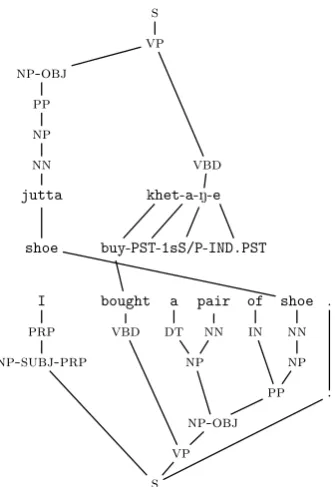
Our baseline choices file is designed to create a working grammar, without particular high-level information about Chintang, that focuses on cov-erage at the expense of precision. We hand-specified the (counter-factual) assertion that there is no case marking in Chintang, and in addi-tion that Chintang allows free word order (on the grounds that this is the least constrained word or-der possibility). It also defines bare-bones classes of nouns, determiners and transitive verbs, and then populates the lexicon by using a variant of the methodology in Xia and Lewis 2007. In particu-lar, we parse the translation line using the Char-niak parser (CharChar-niak, 1997) and then use the cor-respondences inherent in IGT to create a projected tree structure for the language line, following Xia and Lewis. An example of the result for Chintang is shown in Fig 3. The projected trees include part of speech tags for each word that can be aligned. For each such word tagged as noun, verb, or deter-miner, we create an instance in the corresponding lexical type. In this baseline grammar, all verbs are assumed to be transitive, but since all argu-ments can (optionally) be dropped, the grammar is expected to be able to cover intransitive sentences, even if the semantic representation is wrong.
Choices file Lexicon Word order Case
[image:5.595.178.421.63.216.2]ORACLE Manual Manual Manual BASELINE Fullform Default None FF-AUTO-NONE Fullform Auto None FF-DEFAULT-GRAM Fullform Default Auto (GRAM) FF-AUTO-GRAM Fullform Auto Auto (GRAM) FF-DEFAULT-SAO* Fullform Default Auto (SAO) FF-AUTO-SAO* Fullform Auto Auto (SAO) MOM-DEFAULT-NONE MOM Default None MOM-AUTO-NONE MOM Auto None MOM-DEFAULT-GRAM* MOM Default Auto (GRAM) MOM-AUTO-GRAM* MOM Auto Auto (GRAM) MOM-DEFAULT-SAO* MOM Default Auto (SAO) MOM-AUTO-SAO* MOM Auto Auto (SAO)
Table 1: Choices files generated
s
vp
np-obj
pp
np
nn vbd
jutta khet-a-N-e
shoe buy-PST-1sS/P-IND.PST
I bought a pair of shoe .
prp vbd dt nn in nn
np-subj-prp np np
pp .
np-obj
vp
s
Figure 3: Projected tree structure (ex. from (Bickel et al., 2013d))
3.2.3 Word order
We applied the methodology of Bender et al. (2013) for determining major constituent order. For our dataset, the algorithm chose ‘v-final’, which matches what is in theORACLEchoices file,
but is not necessarily correct. We created two ver-sions of each of the other choices files, one with the default (baseline) answer of ‘free word order’ and one with this automatically supplied answer.
3.2.4 Case system
Similarly, we applied extended versions of the two methods for automatically discovering case sys-tems from Bender et al. 2013: GRAMwhich looks
for known case grams in glosses (not using pro-jected trees) andSAOwhich extends the
structure-projection methodology of Xia and Lewis (2007) to detect S, A and O arguments and then looks for the most frequent gram associated with each of these.4 The GRAM method determines the
case system of Chintang to be ergative-absolutive, while the SAOmethod indicates ‘none’ (no case).
Specifying a case system in a choices file has no effect on the coverage or precision of the resulting grammar if the lexical items don’t constrain case. Thus the case system choices only make sense in combination with the case frames choices (§3.2.5).
3.2.5 Case frames and case values
The HPSG analysis of case involves a featureCASE
which is constrained by both verbs and nouns: Nouns constrain their ownCASEvalue, while verbs
constrain theCASEvalue of the arguments they
se-lect for.5 In order to constrain verbs and nouns
appropriately, we first need a range of possible case values. For choices files built based on the
GRAMsystem, we consider case markers to be any
of those included in the set of grams defined by the Leipzig Glossing Rules (Bickel et al., 2008):
ABL, ABS, ACC, ALL, COM, DAT, ERG, GEN, INS, LOC,
andOBL. For choices files built based on theSAO
system, we consider as case markers only those grams (automatically) identified as marking S, A, or O. In the present study, that should only be erga-tive; as there is no marked case for absolutive, all other nouns were treated as absolutive (regardless of their actual case marking, since theSAOsystem
has no way to detect other case grams).
4Our extensions involved making the system able to
han-dle the situation where one or more of S, A and O are morpho-logically unmarked and therefore unreflected in the glosses.
5For the details of the analyses of case systems provided
[image:5.595.99.267.253.497.2]In choices files which specify case systems, we constrain the case value for nouns by creating one noun class for every case value, and then assigning the lexical entries for nouns to those lexical classes based on the grams in the gloss of the noun.6
Similarly, we create lexical classes for each case frame identified for transitive and intransitive verbs: We look for case grams on each argument of the verb, as determined by the function tags in the projected tree (e.g.NP-SUBJ-PRPin Fig 3).7 For
each case frame we identify, we create a lexical class, and we create lexical entries for verbs based on the case frames we extract for them. When the system identifies both an overt subject and an overt object, it considers the verb to be transitive and constrains the case of its two arguments based on the observed case values. If either argument is overt but not marked for case, the verb is con-strained to select for the default case on that argu-ment, according to the detected case marking sys-tem (i.e. ergative for transitive subjects and absolu-tive for transiabsolu-tive objects, in this instance). When there is an overt subject but no overt object, the verb is treated as intransitive and is constrained to select for a subject of the observed case (or the default case, here absolutive, if the overt subject bears no case marker). When there is an overt ob-ject but no subob-ject, the verb is assumed to be tran-sitive and the object’s case assigned as with other transitives but the subject’s case is constrained to the default (i.e. ergative, in this instance). Verbs with no overt arguments are not matched.
3.2.6 MOM choices file: Automatically extracted lemmas and lexical rules
The final refinement we try on our baseline is to apply the ‘Matrix-ODIN Morphology’ (MOM) methodology of Wax 2014. This methodology at-tempts to automatically identify affixes and cre-ate appropricre-ate descriptions of lexical rules in a choices file to model those affixes. As a result, it also identifies stems. Thus we use the same ba-sic choices as in the baseline choices file, but now populate the lexicon with stems rather than full-forms. Compared toBASELINE, this one should
re-sult in a grammar with better lexical coverage on held-out data, to the extent that the MOM system 6In future work, we plan to extend the MOM approach
(§3.2.6) from verbs to nouns, but for now, the nouns are treated as full-form lexical entries across all choices files.
7While the GRAM method doesn’t require the projected
trees to determine the overall case system, we do need them here to find case frames for particular verbs.
is able to correctly extract both stems and inflec-tional rules. We note that while the MOM system uses the same conceptual approach to alignment as that in theBASELINE,GRAMandSAOapproaches, the
implementation is separate, and so does not find exactly the same set of verbs.
3.2.7 Shared choices
The ORACLE choices file ran as-is. For the
re-maining choices files, we also needed to answer the questions about determiners (whether there are any, position with respect to the noun). Based on initial experiments, we chose ‘yes’ for the pres-ence of determiners and ‘det-noun’ order. In an attempt to boost coverage generally, we also coded the choices that allow any argument to be dropped. While the determiner-related choices are specific to Chintang, the latter set of choices could be ex-pected to boost coverage (at the cost of some pre-cision) for any language.
3.2.8 Summary
Table 1 shows the 10 logical possibilities that arise from combining the methods discussed in this sec-tion, in addition to the ORACLE grammar and the BASELINEgrammar. However, we test only a subset
of these possibilities for the following reasons:8
The SAOsystem chose no case as the case system
for Chintang. As a result, this makes FF-DEFAULT -SAOandFF-AUTO-SAOthe same asBASELINEandFF
-AUTO-NONE, respectively. In future work, we aim
to improve the SAO system but until it is
effec-tive enough to pick some case system for Chin-tang, these options do not require further testing. Secondly, while it is possible in principle to com-bine the output of the MOM system (which classi-fies verbs based on their morphological combina-toric potential) with the output of the system be-hind theGRAMchoices files (which classifies verbs
based on their case frames), doing so is non-trivial because these classifications are orthogonal, yet each verb must inherit from each dimension. We thus leave the exploration of MOM-DEFAULT-GRAM
and MOM-AUTO-GRAM(and likewise MOM-DEFAULT -SAOandMOM-AUTO-SAO) for future work.
3.3 Evaluation
‘test’ data; 930 items). We run both of these eval-uations because we are actually testing two sepa-rate questions. The first is whether the grammars generated in this way can provide useful analyti-cal tools to linguists. In this primary use-case, we expect a linguist to provide the system with all of their IGT and then use the generated grammars in order to gain insights into that same data. This does not amount to a case of testing on the train-ing data because the annotations provided to the system (IGT) are not the same as those produced by the system (full parses, including semantic rep-resentations). However, we are still interested in also testing on held-out data in order to answer the second question: whether grammars generated in this way can also generalize to further texts.
We evaluate the grammars generated by the choices files we create in terms of lexical cov-erage, parse coverage, parse accuracy and am-biguity. Lexical coverage measures how many items consist only of word forms recognized by the grammar. Any item with unknown lexical items won’t parse.9 Parse coverage is the
num-ber of items that receive any analysis at all, where ambiguity is the number of different analyses each item receives. To measure parse accuracy, we examined the items that parse and determined which parses had semantic representations whose predicate-argument structures plausibly matched what was indicated in the gloss.
4 Results
Table 2 compares the lexical information encoded in each of the choices files in a quantitative fash-ion. The first thing to note is that the grammars vary widely in the size of their lexicons. TheBASE
-LINE/FFlexicons are expected to be larger than the
others because they take each fully inflected form encountered as a separate lexical entry. On the other hand, theORACLEchoices file was built on the
basis of the Toolbox lexicon (dictionary) from the CLRP and thus is effectively created on the basis of a much larger dataset. TheGRAM choices files
only contain verbs for which a case frame could be identified. If the projected tree was not inter-pretable by our extraction heuristics or if the ex-ample had no overt arguments, then the verb will not be extracted. The MOM choices files, on the
9There are methods for handling unknown lexical items
(e.g. Adolphs et al., 2008) in more mature grammars of this type, but these are not applicable at this stage.
other hand, only need to identify verbs in the string to be able to extract them, and should be able to generalize across different inflected forms of the same verb. This gives a number of verb entries intermediate between that forBASELINE/FFand the GRAMfiles. For nouns, there is less variation: the MOMfiles use the same data as theBASELINE, while
the GRAM method faces as simpler problem than
for verbs: it only needs to identify the case gram (if any) in a noun’s gloss. The slightly larger num-bers of nouns in theGRAMfiles v. the others can be
explained by the same form being glossed in two different ways in the training data.
The remaining differences can be briefly ex-plained as follows: TheORACLE choices file does
not contain any entries for determiners. The oth-ers all contain the same 240 entries; one for any word aligned by the algorithm to a determiner in the English translation. Only theORACLEandMOM
choices files attempt to handle morphology, and so farMOMonly does verbal morphology.
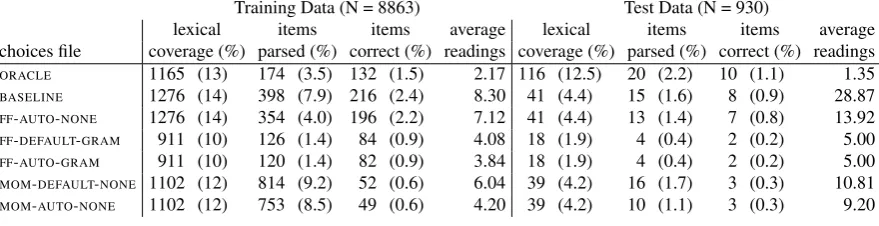
Table 3 presents the results of parsing training and test data with the various grammars, in abso-lute numbers and in percentages of the entire data set. The ‘lexical coverage’ columns indicate for how many items the grammars were able to rec-ognize each constituent word form. The ‘items parsed’ columns show the number of items that received any analysis at all, while ‘items correct’ show the number of items that were judged (by one of the authors) to have a predicate-argument structure that plausibly reflects the gloss given in the IGT. The final column shows the average num-ber of distinct analyses the grammars find for the items they parse at all.
The results are in fact barely measurable with these metrics (especially on the test data), but nonetheless speak to the differences between the grammars. Regarding lexical coverage, the ORA -CLE grammar does best on the test data set. This
is because it is the only choices file not derived from the training data. Not surprisingly, theBASE -LINEgrammar has the highest number of readings
per item parsed, followed closely byFF-AUTO-NONE
which adds only a minor constraint on word or-der.10 On the other hand, comparing the number
of items parsed to the number judged correct, ex-cept for the MOMchoices files, the ‘survival rate’
was over 50% for all other tests.11 This suggests
10It is in this relative lack of constraint that BASELINE
mostly clearly forms a baseline to improve upon.
Choices file # verb entries # noun entries # det entries # verb affixes # noun affixes
ORACLE 900 4751 0 160 24
BASELINE 3005 1719 240 0 0
FF-AUTO-NONE 3005 1719 240 0 0 FF-DEFAULT-GRAM 739 1724 240 0 0
FF-AUTO-GRAM 739 1724 240 0 0
[image:8.595.107.493.63.153.2]MOM-DEFAULT-NONE 1177 1719 240 262 0 MOM-AUTO-NONE 1177 1719 240 262 0
Table 2: Amount of lexical information in each choices file
Training Data (N = 8863) Test Data (N = 930)
lexical items items average lexical items items average choices file coverage (%) parsed (%) correct (%) readings coverage (%) parsed (%) correct (%) readings
ORACLE 1165 (13) 174 (3.5) 132 (1.5) 2.17 116 (12.5) 20 (2.2) 10 (1.1) 1.35 BASELINE 1276 (14) 398 (7.9) 216 (2.4) 8.30 41 (4.4) 15 (1.6) 8 (0.9) 28.87 FF-AUTO-NONE 1276 (14) 354 (4.0) 196 (2.2) 7.12 41 (4.4) 13 (1.4) 7 (0.8) 13.92 FF-DEFAULT-GRAM 911 (10) 126 (1.4) 84 (0.9) 4.08 18 (1.9) 4 (0.4) 2 (0.2) 5.00 FF-AUTO-GRAM 911 (10) 120 (1.4) 82 (0.9) 3.84 18 (1.9) 4 (0.4) 2 (0.2) 5.00 MOM-DEFAULT-NONE 1102 (12) 814 (9.2) 52 (0.6) 6.04 39 (4.2) 16 (1.7) 3 (0.3) 10.81 MOM-AUTO-NONE 1102 (12) 753 (8.5) 49 (0.6) 4.20 39 (4.2) 10 (1.1) 3 (0.3) 9.20
Table 3: Results
that, despite the noise introduced by the automatic methods of lexical extraction, the precision gram-mar backbone provided by the Gramgram-mar Matrix can still provide high-quality parses.
For example, the BASELINE grammar produces
six parses of the string in (1):
(1) din din day
khiptukum khipt-u-kV-m
count-3P-IND.NPST-1/2nsA
‘(We) count days.’ [ctn] (Bickel et al., 2013b)
Among these six is one which produces the se-mantic representation in (2). While this grammar does not yet capture any of the agreement mor-phology that indicates that the subject is first per-son plural, it does correctly link the ‘day’ to the semantic ARG2 of ‘count’.
(2) hh1,
h3: din n day(x4),
h5: exist q rel(x4,h6,h7),
h6: khipt-u-kv-m v count(e2,x9,x4) {h6 =qh3} i
Finally, we note that the longest items we are able to parse consist of one verb and two NPs, each of which can have only up to two words (a deter-miner and a noun). Most of the examples that do parse consist of only one or two words, while the full data set ranges from items of length 1 to items of length 25 (average 4.5 words/item in training,
choices files involved analyses of words for ‘yes’, ‘well’, ‘what’ and the like as verbs. Note that one form of ‘yes’ is the copula, and such examples were accepted. Another source of incorrect parses for many grammars involves homophony be-tween the focus particle and a verb meaning ‘come’.
5 words/item in test). The Grammar Matrix al-ready supports some longer sentences in the form of coordination, so one avenue for future work is to explore the automatic detection of coordination strategies. Otherwise, branching out to longer sen-tences will require additions to the Grammar Ma-trix allowing the specification of modifiers and a wider range of valence types for verbs.
5 Error Analysis
The opportunity to work closely with one lan-guage has allowed us to observe several ways in which the assumptions of the systems we are building on do not match what we find in the data. Here we briefly review some of those mismatches and reflects on what could be done to handle them. The first observation concerns the non-glossing of zero-marked morphosyntactic features, such as absolutive case in Chintang. From the point of view of a consumer of IGT it is certainly desirable to have as much information as possible made ex-plicit in the glossing. From the point of view of a project creating IGT in the context of on-going fieldwork, however, it is likely often difficult to reliably gloss zero morphemes and thus the de-cision to leave them systematically unglossed is quite sensible. Both the GRAM method and
espe-cially the SAOmethod for detecting case systems,
[image:8.595.80.520.182.295.2]While we extended them to a certain extent in this work, there is still more to be done on this front.
A second observation concerns the glossing of proper names, as in (3):
(3) pailego paile-ko first-GEN
ubhiyauti u-bhiya 3A-marriage
paphuma paphu-ma
a.clan.of.Rai.people-F ‘His first marriage was with a Phuphu woman.’ [ctn] (Bickel et al., 2013a)
We use statistical alignment between the trans-lation line and the gloss line and between the gloss line and the language line in order to project information from the analysis of the translation line onto the language line. Glosses such as ‘a.clan.of.Rai.people’ tend to confuse this align-ment process, though they are very informative to a human reader of the IGT. Error analysis of sen-tences for which we were unable to extract subject and object arguments at all suggested that many of the errors were caused by misalignments likely due to the aligner not being able to cope with this kind of glossing. Future work will explore how to train the aligner to function better in such cases.
In addition to properties of the glossing conven-tions, there are also properties of the language that proved challenging for our system. The first is the intricate nature of the case-marking system as dis-cussed in§3.1. In particular, our system does not model any distinction between 1st and 2nd per-son pronouns and other nouns, such that when the pronouns appear without a case marker, they are taken to be in the unmarked case (i.e. absolutive), though this is not necessarily so. The second prop-erty of the language that our system found diffi-cult is the optionality of arguments. We were able to adapt our case frame extraction strategy to han-dle dropped subjects, but dropped objects are more confounding: our system is unable so far to distin-guish such verbs from intransitives. One possible way forward in this case is to draw more informa-tion from the English translainforma-tion in the IGT: En-glish tends not to drop arguments, and so when we find an object (especially a pronominal object) in the English translation that is not aligned to any-thing in the language line, we would have evidence that the verb in question may be transitive.
Finally, we looked closely at the items in the test data for which we had complete lexical analysis, but which still failed to parse. We did this both for the fullform and MOM-based lexicons. The goal here was to evaluate whether (a) our assignment of
items to lexical categories was correct (and there was some other issue standing in the way of an-alyzing the item) or (b) we should have parsed a given item, but our system had misidentified the words in question in such a way that no syntactic analysis could be found. For the baseline system, we found that although some items had misidenti-fied categories (specifically, pronouns and adverbs were sometimes misidentified as determiners), the two major obstacles to parsing came from multi-verb constructions or sentential fragments. Of the 26 unparsed items with lexical coverage, 10 con-tained multiple verbs and 12 were NP or interjec-tory fragments (eg: ‘Yes, yes, yes.’). We observed a similar pattern among 23 unparsed items from the MOM-based lexicon. We can take two lessons from this assessment: (1) since much of our data comes from naturally occurring speech, it may be useful to rerun our tests with an NP fragment as a valid root symbol in our grammars; (2) proper identification of auxiliary verbs is an important next step for improving our system.
6 Conclusion
In this paper we have taken the first steps towards creating actual precision grammars by creating Grammar Matrix customization system choices files on the basis of automated analysis of IGT. Measured in terms of coverage over held-out data, the results are hardly impressive and might seem discouraging. However, we see in these initial for-ays rather a proof-of-concept. Moreover, the pro-cess of digging into the details of getting an IGT-to-grammar system working for one particular lan-guage has been a very rich source of information on the mismatches between the assumptions of systems built to handle high-level properties and the linguistic facts and glossing conventions of the kind of data they are meant to handle.
7 Acknowledgments
This material is based upon work supported by the National Science Foundation under Grant No. BCS-1160274. Any opinions, findings, and con-clusions or recommendations expressed in this material are those of the author(s) and do not nec-essarily reflect the views of the NSF.
References
Peter Adolphs, Stephan Oepen, Ulrich Callmeier, Berthold Crysmann, Dan Flickinger, and Bernd Kiefer. 2008. Some fine points of hybrid natural language parsing. Marrakech, Morocco, May. Emily M. Bender, Dan Flickinger, and Stephan Oepen.
2002. The grammar matrix: An open-source starter-kit for the rapid development of cross-linguistically consistent broad-coverage precision grammars. In John Carroll, Nelleke Oostdijk, and Richard
Sut-cliffe, editors, Proceedings of the Workshop on
Grammar Engineering and Evaluation at the 19th International Conference on Computational Lin-guistics, pages 8–14, Taipei, Taiwan.
Emily M. Bender, Scott Drellishak, Antske Fokkens, Laurie Poulson, and Safiyyah Saleem. 2010.
Gram-mar customization. Research on Language &
Com-putation, pages 1–50. 10.1007/s11168-010-9070-1. Emily M. Bender, Sumukh Ghodke, Timothy Baldwin, and Rebecca Dridan. 2012a. From database to tree-bank: Enhancing hypertext grammars with grammar engineering and treebank search. In Sebastian
Nord-hoff and Karl-Ludwig G. Poggeman, editors,
Elec-tronic Grammaticography, pages 179–206. Univer-sity of Hawaii Press, Honolulu.
Emily M. Bender, Robert Schikowski, and Balthasar Bickel. 2012b. Deriving a lexicon for a precision grammar from language documentation resources:
A case study of Chintang. InProceedings of
COL-ING 2012, pages 247–262, Mumbai, India, Decem-ber. The COLING 2012 Organizing Committee. Emily M. Bender, Michael Wayne Goodman, Joshua
Crowgey, and Fei Xia. 2013. Towards creating pre-cision grammars from interlinear glossed text: Infer-ring large-scale typological properties. In Proceed-ings of the 7th Workshop on Language Technology for Cultural Heritage, Social Sciences, and Human-ities, pages 74–83, Sofia, Bulgaria, August. Associ-ation for ComputAssoci-ational Linguistics.
Balthasar Bickel, Goma Banjade, Martin Gaenszle, Elena Lieven, Netra Paudyal, Ichchha Rai, Manoj Rai, Novel Kishor Rai, and Sabine Stoll. 2007. Free
prefix ordering in Chintang. Language, 83(1):43–
73.
Balthasar Bickel, Bernard Comrie, and Martin Haspel-math. 2008. The Leipzig glossing rules: Con-ventions for interlinear morpheme-by-morpheme glosses. Max Planck Institute for Evolutionary An-thropology and Department of Linguistics, Univer-sity of Leipzig.
Balthasar Bickel, Martin Gaenszle, Novel Kishore Rai, Elena Lieven, Goma Banjade, Toya Nath Bhatta, Netra Paudyal, Judith Pettigrew, Ichchha P. Rai, Manoj Rai, Robert Schikowski, and Sabine Stoll. 2009. Audiovisual corpus of the chintang lan-guage, including a longitudinal corpus of language
acquisition by six children, plus a trilingual dic-tionary, paradigm sets, grammar sketches,
ethno-graphic descriptions, and photographs. DOBES
Archive,http://www.mpi.nl/DOBES. Balthasar Bickel, Manoj Rai, Netra P. Paudyal, Goma
Banjade, Toya N. Bhatta, Martin Gaenszle, Elena Lieven, Ichchha Purna Rai, Novel Kishore Rai, and Sabine Stoll. 2010. The syntax of three-argument verbs in Chintang and Belhare (Southeastern Ki-ranti). InStudies in Ditransitive Constructions: A Comparative Handbook, pages 382–408. Mouton de Gruyter, Berlin.
Balthasar Bickel, Martin Gaenszle, Novel Kishore Rai, Vishnu Singh Rai, Elena Lieven, Sabine Stoll, G. Banjade, T. N. Bhatta, N Paudyal, J Pettigrew, and M Rai, I. P.and Rai. 2013a. Hatuwa. Accessed: 15 January 2013.
Balthasar Bickel, Martin Gaenszle, Novel Kishore Rai, Vishnu Singh Rai, Elena Lieven, Sabine Stoll, G. Banjade, T. N. Bhatta, N Paudyal, J Pettigrew, and M Rai, I. P.and Rai. 2013b. Khadak’s daily life. Accessed: 15 January 2013.
Balthasar Bickel, Martin Gaenszle, Novel Kishore Rai, Vishnu Singh Rai, Elena Lieven, Sabine Stoll, G. Banjade, T. N. Bhatta, N Paudyal, J Pettigrew, and M Rai, I. P.and Rai. 2013c. Tale of a poor guy. Accessed: 15 January 2013.
Balthasar Bickel, Martin Gaenszle, Novel Kishore Rai, Vishnu Singh Rai, Elena Lieven, Sabine Stoll, G. Banjade, T. N. Bhatta, N Paudyal, J Pettigrew, and M Rai, I. P.and Rai. 2013d. Talk of kazi’s trip. Accessed: 15 January 2013.
Aoife Cahill, Michael Burke, Ruth O’Donovan, Josef Van Genabith, and Andy Way. 2004. Long-distance dependency resolution in automatically acquired wide-coverage pcfg-based lfg approximations. In Proceedings of the 42nd Meeting of the Association for Computational Linguistics (ACL’04), Main Vol-ume, pages 319–326, Barcelona, Spain, July. Eugene Charniak. 1997. Statistical parsing with a
context-free grammar and word statistics. In
Pro-ceedings of AAAI-1997.
John Chen and K. Vijay-Shanker. 2000. Automated Extraction of TAGs from the Penn Treebank. In Proc. of the 6th International Workshop on Parsing Technologies (IWPT-2000), Italy.
Alexander Clark. 2001. Unsupervised induction
of stochastic context-free grammars using
distri-butional clustering. In Proc. of the 5th
Confer-ence on Computational Natural Language Learning (CoNLL-2001).
Ann Copestake, Dan Flickinger, Carl Pollard, and Ivan A. Sag. 2005. Minimal recursion semantics:
An introduction. Research on Language &
Bart Cramer and Yi Zhang. 2009. Construction of a german hpsg grammar from a detailed treebank. In Proceedings of the 2009 Workshop on Grammar En-gineering Across Frameworks (GEAF 2009), pages 37–45, Suntec, Singapore.
Scott Drellishak. 2009. Widespread But Not
Uni-versal: Improving the Typological Coverage of the Grammar Matrix. Ph.D. thesis, University of Wash-ington.
Ryan Georgi, Fei Xia, and William D. Lewis. 2013. Enhanced and portable dependency projection algo-rithms using interlinear glossed text. InProceedings of ACL 2013 (Volume 2: Short Papers), pages 306– 311, Sofia, Bulgaria, August.
Aria Haghighi and Dan Klein. 2006.
Prototype-driven grammar induction. In Proceedings of the
21st International Conference on Computational Linguistics and 44th Annual Meeting of the Associ-ation for ComputAssoci-ational Linguistics (COLING/ACL 2006), pages 881–888, Sydney, Australia, July. As-sociation for Computational Linguistics.
Julia Hockenmaier and Mark Steedman. 2002.
Acquiring compact lexicalized grammars from a
cleaner treebank. In Proc. of LREC-2002, pages
1974–1981.
Julia Hockenmaier and Mark Steedman. 2007. Ccg-bank: A corpus of ccg derivations and dependency
structures extracted from the penn treebank.
Com-putational Linguistics, 33(3):355–396.
Dan Klein and Christopher Manning. 2002. A gen-eral constituent context model for improved
gram-mar induction. In Proceedings of the 40th Annual
Meeting of the Association for Computational Lin-guistics (ACL-2002), Philadelphia, PA.
Dan Klein and Christopher Manning. 2004. Corpus-based induction of syntactic structure: models of
de-pendency and constituency. In Proceedings of the
42nd Annual Meeting of the Association for Compu-tational Linguistics (ACL-2004), Barcelona, Spain. Alexander Krotov, Mark Hepple, Robert Gaizauskas,
and Yorick Wilks. 1998. Compacting the Penn
Treebank Grammar. In Proc. of the 36th Annual
Meeting of the Association for Computational Lin-guistics (ACL-1998), Montreal, Quebec, Canada. William D. Lewis and Fei Xia. 2008.
Automati-cally identifying computationally relevant typolog-ical features. InProceedings of the Third Interna-tional Joint Conference on Natural Language Pro-cessing, pages 685–690, Hyderabad, India.
Yusuke Miyao, Takashi Ninomiya, and Junichi Tsu-jii. 2004. Corpus-oriented grammar development for acquiring a head-driven phrase structure gram-mar from the penn treebank. InProc. of the First In-ternational Joint Conference on Natural Language Processing (IJCNLP-2004), Hainan, China.
Carl Pollard and Ivan A. Sag. 1994. Head-Driven
Phrase Structure Grammar. Studies in Contempo-rary Linguistics. The University of Chicago Press and CSLI Publications, Chicago, IL and Stanford, CA.
Robert Schikowski, Balthasar Bickel, and Netra Paudyal. in press. Flexible valency in Chintang.
In B. Comrie and A. Malchukov, editors, Valency
Classes: A Comparative Handbook. Mouton de Gruyter, Berlin.
Noah A. Smith and Jason Eisner. 2006. Annealing structural bias in multilingual weighted grammar
in-duction. In Proceedings of the 21st International
Conference on Computational Linguistics and 44th Annual Meeting of the Association for Computa-tional Linguistics (ACL/COLING 2006), pages 569– 576, Sydney, Australia, July. Association for Com-putational Linguistics.
Benjamin Snyder, Tahira Naseem, and Regina Barzi-lay. 2009. Unsupervised multilingual grammar
in-duction. InProceedings of the Joint Conference of
the 47th Annual Meeting of the ACL and the 4th In-ternational Joint Conference on Natural Language Processing of the AFNLP, pages 73–81, August. Sabine Stoll and Balthasar Bickel. 2012. How to
measure frequency? Different ways of counting ergatives in Chintang (Tibeto-Burman, Nepal) and their implications. In Frank Seifart, Geoffrey Haig, Nikolaus P. Himmelmann, Dagmar Jung, Anna Mar-getts, and Paul Trilsbeek, editors,Potentials of Lan-guage Documentation: Methods, Analyses, and Uti-lization, pages 83–89. University of Hawai‘i Press, Manoa.
David Wax. 2014. Automated grammar engineering for verbal morphology. Master’s thesis, University of Washington.
Fei Xia and William D. Lewis. 2007. Multilin-gual structural projection across interlinear text. In Proc. of the Conference on Human Language Technologies (HLT/NAACL 2007), pages 452–459, Rochester, New York.
Fei Xia. 1999. Extracting Tree Adjoining
Gram-mars from Bracketed Corpora. InProc. of 5th