The SAS Statistical Machine Translation System for WAT 2014
Rui Wang, Xu Yang and Yan Gao
SAS Institute Inc
Beijing, China
rui.wang|xu.yang|[email protected]
Abstract
This paper is a description of the tech-niques and experiment results by SAS In-stitute Inc in WAT 2014 evaluation cam-paign. We participate in two subtasks of WAT 2014: the Chinese to Japanese track and the English to Japanese track. Our baseline system is MOSES statistical ma-chine translation toolkit. We propose syn-tactic reordering approaches for English to Japanese and Chinese to Japanese trans-lation which transform the order of source sentence into the target-like order. In ad-dition, we apply the segmentation tool in SAS® Text Miner to enhance the transla-tion results. Several contrastive experi-ments are presented based on the auto-matic evaluation results.
1
Introduction
This paper describes the machine translation
system employed by SAS Institute Inc in the 1st
Workshop on Asian Translation. We participate in two subtasks in this year’s WAT evaluation cam-paign:
1) Chinese to Japanese; 2) English to Japanese.
We apply MOSES toolkit as the baseline system. The sentence structure of Japanese is different with that of English and Chinese. Japanese is typ-ically a Subject-Object-Verb (SOV) language while Chinese and English are Subject-Verb-Ob-ject (SVO) languages, as illustrated in Figure 1. The statistic machine translation between Japa-nese and the SVO language is particularly diffi-cult because of the long distance difference of word orders. We propose a simple syntactic reor-dering approach for Chinese to Japanese and Eng-lish to Japanese SMT in order to transform
Chi-nese and English into SVO languages. Our sub-mission mainly focuses on using the syntactic ap-proaches to improve effectively improve the translation results. In addition, unlike the alpha-betic languages, Chinese and Japanese need to be segmented into words of characters before trans-lation. The accuracy of segmentation highly influ-ences the performance of translation for Chinese and Japanese. We apply the tokenization tool in SAS® Text Miner to the corpus and obtain im-provement of the translation results.
Japanese: 私は 日本語 を好きです 。
( I ) (Japanese) (like) (.) S O V
Chinese: 我 喜欢 日语 。
( I ) (like) (Japanese) (.) S V O
English: I like Japanese . S V O
English: I like Japanese .
[image:1.595.320.509.372.506.2]S V O
Figure 1: Word order differences of Japanese, Chinese and English.
The rest of this paper is organized as follows: in section 2 we describe the background; in sec-tion 3 we present the architecture of our system; Section 4 is the detailed description of the syntac-tic reordering rules we propose; experiment re-sults are shown in section 5 and conclusion is made in section 6.
2
Background
The state of the art Statistical Machine Translation (SMT), phrase-based SMT (Koehn et al., 2003), works well on the translation between short phrases as well as on long sentences pairs with similar word orders. However the phrase-based SMT has limited capacity for long distance reor-dering since it does not consider the syntactic in-formation in the translation. A great deal of recent research enhances the translation results by add-ing syntactic features, such syntactic-based SMT 64
(Liu et al., 2006), or forest-based SMT (Mi et al., 2008). The language-independent methods parse the input sentences and then train reordering model from these parsed trees, such as Quirk et al. (2005), Li et al. (2007). These approaches im-prove the translation considerably but they are time consuming during decoding. Syntactic reor-dering approaches effectively improve the trans-lation results by transforming the order of source-side language into target-like order.
Previous studies have proposed the syntactic reordering approach which is regarded as a pre-processing step on the source side language. Xia et al. (2004) automatically extract reordering rules on source side for English to French translation. Collins et al. (2005) improve the German to Eng-lish translation by combining morphological and syntactical information into SMT system. Wang et al. (2007) extract the syntactic reordering rules manually on Chinese to English translation. Isozaki et al. (2010) propose a simple head final-ized approach to reorder English into Japanese
or-der based on Enju parser. We apply the head fi-nalized method to our system and achieve im-provement on the translation from English to Jap-anese. Dan et al. (2012) carry out a similar head finalized approach for Chinese to Japanese trans-lation using a Chinese Enju parser (Yu et al., 2011). We propose a simple reordering methods for Chinese based on the accurate Berkeley Parser (Petrov et al., 2006).
3
System Architecture
We use the open-source SMT toolkit MOSES as the baseline to train translation model and to de-code the test set for submission. SRILM (Stolcke et al. 2002) toolkit is applied to train the N-gram statistical language model. All the corpus are to-kenized and lowercased before training and de-coding. All the submitted results are detokenized. In addition to the basic phrase-based model, we also try hierarchical model (Chiang et al., 2007) using MOSES.
We use the segementation tool in SAS® Text Miner to tokenize Japanese and Chinese corpus
(IP (NP (NR 本文(this paper) )) (VP (VV 汇总 (summarize) )
(AS 了)
(NP (NP (CP (IP (VP (NP (NT 目前(current) )) (VP (VRD (VV 查) (VV 到) (found) )))) (DEC 的(of) ))
(NP (NN 影响(influence) ))) (CC 以及(and) )
(NP (CP (IP (VP (NP (NT 今后(future) )) (VP (VV 预测(predicted) )))) (DEC 的(of) ))
(NP (NN 影响(influence) ))))) (PU 。))
(IP (NP (NR 本文 (this paper) ))
(VP (NP (NP (CP (IP (VP (NP (NT 目前 (current) )) (VP (VRD (VV 查) (VV 到) (found) )))) (DEC 的 (of) ))
(NP (NN 影响 (influence) ))) (CC 以及 (and) )
(NP (CP (IP (VP (NP (NT 今后 (future) )) (VP (VV 预测 (predicted) )))) (DEC 的 (of) ))
(NP (NN 影响 (influence) ))))) (VV 汇总(summarize) )
(AS 了) (PU 。))
(IP (NP (NR 本文(this paper) ))
(VP (NP (NP (CP (IP (VP (NP (NT 目前(current) )) (VP (VRD (VV 查) (VV 到) (found) )))) (DEC 的(of) ))
(NP (NN 影响(influence) ))) (CC 以及(and) )
(NP (CP (IP (VP (NP (NT 今后(future) )) (VP (VV 预测(predicted) )))) (DEC 的(of) ))
(NP (NN 影响(influence) )))))
(VV 汇总 (summarize) )
(AS 了)
(PU 。))
本文 汇总了 目前 查到的 影响 以及 今后 预测的 影响 。
時点で 検出されている 影響 および 今後 予測さ れる 影響 をまとめた。 時点時点でで 検出されて検出されているいる 影響影響 およびおよび 今後今後 予測さ予測さ れるれる 影響影響 ををまとめたまとめた。。 本文 目前 查到 的 影响 以及 今后 预测 的 影响 汇总了 。
本文 目前 查到的 影响 以及 今后 预测的 影响 汇总了 。
(IP (VP (PP (P 根据 (based on) )
(NP (ADJP (JJ 大型(large) ))
(NP (NN 零售(retail) ) (NN 商店(shop) ) (NN 选址法(locating method) )))) (VP (VV 进行 (process) )
(NP (NN 方针(policy) )) (DEC 的))
(NP (NN 修改(modify) ))))
(IP (VP (PP(NP (ADJP (JJ 大型 (large) ))
(NP (NN 零售 (retail) ) (NN 商店 (shop) ) (NN 选址法 (locating method) )))) (P 根据(based on) )
(VP (NP (NN 方针 (policy) )) (DEC 的))
(NP (NN 修改 (modify) )))) (VV 进行(process) ) (IP (VP (PP(NP (ADJP (JJ 大型(large) ))
(NP (NN 零售(retail) ) (NN 商店(shop) ) (NN 选址法(locating method) )))) (P 根据 (based on) )
(VP (NP (NN 方针(policy) )) (DEC 的))
(NP (NN 修改(modify) )))) (VV 进行 (process) )
根据 大型 零售商店 选址法 进行 方针 的 修改 大規模小売店舗立地法に基づく指針の改定について
大型 零售商店 选址法 根据 方针 的 修改 进行
大規模小売店舗立地法に基づく指針の改定について
大型 零售商店 选址法 根据 方针 的 修改 进行 大規模小売店舗立地法に基づく指針の改定について
(a)
for training, tuning and testing. Then we use MO-SES tool to lowercase the corpus and to clean long sentences. The syntactic reordering approach is applied on source-side cleaned sentences for Eng-lish and Chinese. Finally the cleaned and reor-dered corpus is sent to MOSES to train models and decode results.
We use Berkeley parser (Petrov et al., 2006) to parse the source side Chinese sentence into syn-tactic tree and develop the reorder rules based on the grammatical structure of the sentence. English sentence is parsed by Enju parser and the head fi-nalized reorder is applied as described by Isozaki et al. (2010).
4
Syntactic Reordering Approach
4.1 Chinese to Japanese reordering
The Chinese sentence is parsed into a grammatical tree using Pen Treebank syntactic tagset as illus-trated in Figure 2. The main difference between Chinese and Japanese is the position of Verb Phrase (VP) and Prepositional Phrase (PP). We develop two simple reordering rules, VP-rule and PP-rule, based on the syntactic tree.
We develop the VP-rule, ‘VP (VV AS (XXX))
→VP ( (XXX) VV AS)’, which means to move
the verb (VV) and the auxiliary word (AS) behind VV to the end of the verb phrase (VP). For
exam-ple, in Figure 2 (a), ‘VV汇总 (summarize)’ and
‘AS 了’ are moved to the end of VP. The
reor-dered Chinese sentence has more similar order with the Japanese translation than the original one.
The Preposition (P) is always at the end the Prepositional Phrase (PP) in Japanese while in Chinese P is located at the beginning of PP. We
imply the PP-rule, ‘PP (P (XXX))→PP ((XXX)
P)’, to move P to the end of PP. In Figure 2 (b),
the preposition ‘根据 (based on)’ is move to the
end of PP. The reordered sentence reduce the long distance order differences between the source Chinese and the target Japanese.
4.2 English to Japanese reordering
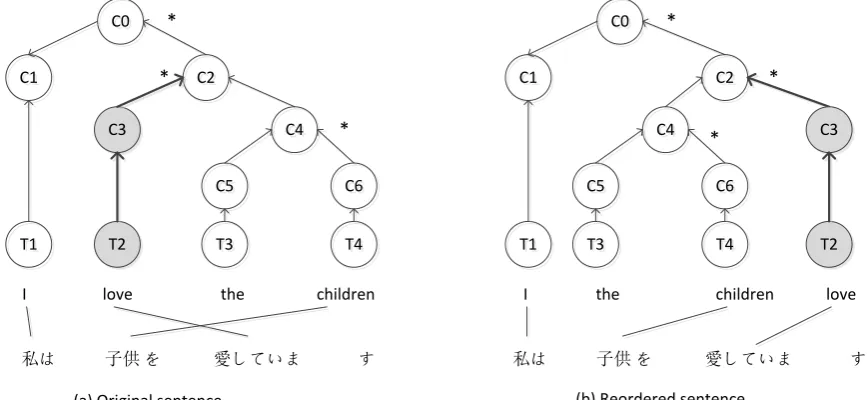
For English to Japanese translation, we use the head finalization approach proposed by Isozaki et al. (2010). In Japanese, the syntactic head word is located behind the dependent words while English is the opposite. The dependency parser, Enju par-ser, is applied on the source side which can output syntactic head, as illustrated in Figure 3. A simple reorder rule is defined: to move the syntactic head to the end of non-head words. In Figure 3, node C3 is the head of node C2. According to the head finalized reordering rule, C3 should be moved be-hind the other child of C2, C4. After reordering, the English sentence has the similar order with the Japanese sentence.
The head finalized reorder rule will reorder the coordination expressions such as, ‘A and B’, into ‘B and A’. We add a coordination exception rule to stop reordering at coordination nodes.
5
Experiments
[image:3.595.76.510.519.719.2]The experiment is conducted on the training data from ASPEC, consists of approximately 3 million
Figure 3: Example of reordering rules for English to Japanese translation. * represents the head of the node. (a) is the original sentence; (b) is the reordered sentence by head finalized rule.
C0
C0
C1
C1 C2C2
C3 C4C4
C5
C5 C6C6
T1
T1 T2 T3T3 T4T4
I love the children
私は 子供を 愛していま す
*
*
*
C0
C0
C1
C1 C2C2
C4
C4
C5
C5 C6C6
T1
T1 T3T3 T4T4
I the children love
私は 子供を 愛していま す
*
*
* C3
T2
Japanese-English parallel sentences and approxi-mately 0.7 million Japanese-Chinese. BLEU and RIBES are used as evaluation metrics. On the evaluation websites, for Chinese to Japanese and English to Japanese evaluation, the results of BLEU and RIBES are measured under three Jap-anese segmentation tools: Juman, Kytea and Mecab. For the sake of brevity, we calculate the average score of the three segmentation tools for each evaluation metric.
5.1 Effect of the segmentation tool of SAS®
Text Miner
We use phrase-based model as baseline for the Chinese to Japanese track to evaluate the effect of SAS segmentation tool. The result of baseline is provided by the WAT organizer (Toshiaki, et al. 2014). Table 1 shows that both the BLEU and RIBES are increased by using the segmentation tool of SAS® Text Miner for Chinese and Japa-nese corpus compared with the Juman segmenta-tion tool for Japanese and Stanford Word Seg-menter for Chinese. We conduct the other experi-ments using the segmentation tool of SAS® Text Miner because of its good performance.
BLEU RIBES
Baseline 34.86 0.769962
SAS segmentation 35.31 0.809631
Table 1: Effect of the segmentation tool of SAS®
Text Miner.
5.2 Chinese to Japanese translation
BLEU RIBES
Baseline 34.86 0.769962
Baseline+VP 36.19 0.826146
Baseline+PP 36.30 0.815694
Baseline+PP+VP 36.40 0.826015
Hierarchical 36.06 0.814207
Hierarchical+PP+VP 37.38 0.830909
Table 2: Effect of reordering rules for Chinese to Japanese translation.
Table 2 shows the effect of reordering rules for Chinese to Japanese translation. The baseline is the results from the WAT organizer (Toshiaki, et al. 2014). We propose two reordering rules: VP rule and PP rule. The baseline is the phrase-based machine translation using MOSES. We apply the VP rule, PP rule and the combination of the two rules to the corpus separately and send the reor-dered sentences to the baseline system. Both the
VP rule and PP rule have contribution to the im-provement of BLEU scores. We also apply the reorder rules to the hierarchical model and gain 2.07 in BLEU scores compared with the baseline system.
5.3 English to Japanese translation
The effect of the head finalized reordering rule for English to Japanese translation is reported in Table 3. The phrase-based model is applied as baseline system. After head finalized reordering, the BLEU score is increased from 28.52 by the or-ganizer (Toshiaki, et al. 2014) to 31.09. We gain 3.13 in BLEU score by applying the hierarchical model with pre-reordering.
BLEU RIBES
Baseline 28.52 0.690350
Baseline+reorder 31.09 0.765005
Hierarchical 31.23 0.743135
Hierarchical+reorder 31.65 0.767323
Table 3: Effect of the head finalized reordering rule for English to Japanese translation.
6
Conclusion
This paper describes the techniques and experi-ment results in WAT 2014 evaluation campaign submitted by SAS Institute Inc. By applying the tokenization tool in SAS® Text Miner and the syntactic reordering rules, we achieve significant improvements on Chinese to Japanese translation and English to Japanese translation. We also re-port some extensive experiment results to illus-trate the contribution on different parts.
In the future, we intend to consider case mark-ers in Japanese which other languages do not have. Since the form of Japanese case markers is known, we may define rules to insert particular tags to the source languages. We expect improve-ments of translation by adding the rules of case markers in Japanese.
Reference
Koehn, Philipp, Franz Josef Och, and Daniel Marcu. 2003. "Statistical phrase-based translation." Pro-ceedings of the 2003 Conference of the North Amer-ican Chapter of the Association for Computational Linguistics on Human Language Technology-Vol-ume 1. Association for Computational Linguistics.
44th annual meeting of the Association for Compu-tational Linguistics.
Mi, Haitao, Liang Huang, and Qun Liu. 2008. "Forest-Based Translation." ACL.
Quirk, Chris, Arul Menezes, and Colin Cherry. 2005. "Dependency treelet translation: Syntactically in-formed phrasal SMT." Proceedings of the 43rd An-nual Meeting on Association for Computational Lin-guistics.
Li, Chi-Ho, et al. 2007. "A probabilistic approach to syntax-based reordering for statistical machine translation." ANNUAL MEETING-ASSOCIATION FOR COMPUTATIONAL LINGUISTICS. Vol. 45. No. 1.
Xia, Fei, and Michael McCord. 2004. "Improving a sta-tistical MT system with automatically learned re-write patterns." Proceedings of the 20th interna-tional conference on Computainterna-tional Linguistics. Association for Computational Linguistics.
Collins, Michael, Philipp Koehn, and Ivona Kučerová. 2005. "Clause restructuring for statistical machine translation." Proceedings of the 43rd annual meet-ing on association for computational lmeet-inguistics. Association for Computational Linguistics.
Wang, Chao, Michael Collins, and Philipp Koehn. 2007. "Chinese Syntactic Reordering for Statistical Machine Translation." EMNLP-CoNLL.
Isozaki, Hideki, et al. 2010. "Head finalization: A sim-ple reordering rule for sov languages." Proceedings of the Joint Fifth Workshop on Statistical Machine Translation and MetricsMATR. Association for Computational Linguistics.
Dan, Han, et al. 2012. "Head finalization reordering for Chinese-to-Japanese machine translation." Pro-ceedings of the Sixth Workshop on Syntax, Seman-tics and Structure in Statistical Translation. Associ-ation for ComputAssoci-ational Linguistics.
Yu, Kun, et al. 2011. "Analysis of the difficulties in Chinese deep parsing."Proceedings of the 12th In-ternational Conference on Parsing Technologies. Association for Computational Linguistics.
Stolcke, Andreas. 2002. "SRILM-an extensible lan-guage modeling toolkit."INTERSPEECH.
Chiang, David. 2007. "Hierarchical phrase-based translation." computational linguistics 33.2: 201-228.
Petrov, Slav, et al. 2006. "Learning accurate, compact, and interpretable tree annotation." Proceedings of the 21st International Conference on Computa-tional Linguistics and the 44th annual meeting of the Association for Computational Linguistics. Associ-ation for ComputAssoci-ational Linguistics.