Generating Natural-Language Video Descriptions
Using Text-Mined Knowledge
Niveda Krishnamoorthy∗ UT Austin
Girish Malkarnenkar∗ UT Austin
Raymond Mooney UT Austin [email protected]
Kate Saenko UMass Lowell [email protected]
Sergio Guadarrama UC Berkeley [email protected]
Abstract
We present a holistic data-driven technique that generates natural-language descriptions for videos. We combine the output of state-of-the-art object and activity detectors with “real-world” knowledge to select the most proba-ble subject-verb-object triplet for describing a video. We show that this knowledge, automat-ically mined from web-scale text corpora, en-hances the triplet selection algorithm by pro-viding it contextual information and leads to a four-fold increase in activity identification. Unlike previous methods, our approach can annotate arbitrary videos without requiring the expensive collection and annotation of a sim-ilar training video corpus. We evaluate our technique against a baseline that does not use text-mined knowledge and show that humans prefer our descriptions 61% of the time.
1 Introduction
Combining natural-language processing (NLP) with computer vision to to generate English descriptions of visual data is an important area of active research (Farhadi et al., 2010; Motwani and Mooney, 2012; Yang et al., 2011). We present a novel approach to generating a simple sentence for describing a short video that:
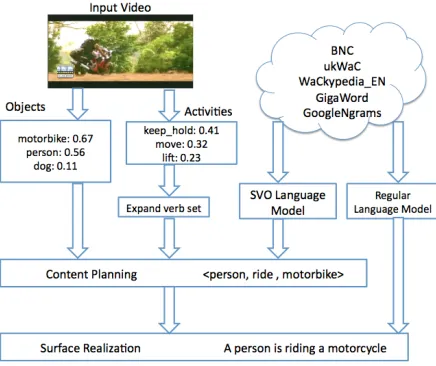
1. Identifies the most likely subject, verb and object (SVO) using a combination of visual object and activity detectors and text-mined knowledge to judge the likelihood of SVO triplets. From a natural-language generation
∗
Indicates equal contribution
(NLG) perspective, this is thecontent planning
stage.
2. Given the selected SVO triplet, it uses a simple template-based approach to generate candidate sentences which are then ranked using a statis-tical language model trained on web-scale data to obtain the best overall description. This is thesurface realizationstage.
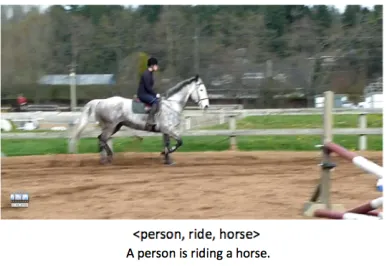
Figure 1 shows sample system output. Our ap-proach can be viewed as a holistic data-driven three-step process where we first detect objects and ac-tivities using state-of-the-art visual recognition al-gorithms. Next, we combine these often noisy de-tections with an estimate of real-world likelihood, which we obtain by mining SVO triplets from large-scale web corpora. Finally, these triplets are used to generate candidate sentences which are then ranked for plausibility and grammaticality. The resulting natural-language descriptions can be usefully em-ployed in applications such as semantic video search and summarization, and providing video interpreta-tions for the visually impaired.
Using vision models alone to predict the best sub-ject and obsub-ject for a given activity is problematic, especially while dealing with challenging real-world YouTube videos as shown in Figures 4 and 5, as it requires a large annotated video corpus of simi-lar SVO triplets (Packer et al., 2012). We are in-terested in annotating arbitrary short videos using off-the-shelf visual detectors, without the engineer-ing effort required to build domain-specific activity models. Our main contribution is incorporating the pragmatics of various entities’ likelihood of being
Figure 1: Content planning and surface realization
the subject/object of a given activity, learned from web-scale text corpora. For example, animate ob-jects like people and dogs are more likely to be sub-jects compared to inanimate obsub-jects like balls or TV monitors. Likewise, certain objects are more likely to function as subjects/objects of certain activities, e.g., “riding a horse” vs. “riding a house.”
Selecting the best verb may also require recog-nizing activities for which no explicit training data has been provided. For example, consider a video with a man walking his dog. The object detectors might identify the man and dog; however the action detectors may only have the more general activity, “move,” in their training data. In such cases, real-world pragmatics is very helpful in suggesting that “walk” is best used to describe a man “moving” with his dog. We refer to this process asverb expansion.
After describing the details of our approach, we present experiments evaluating it on a real-world corpus of YouTube videos. Using a variety of meth-ods for judging the output of the system, we demon-strate that it frequently generates useful descriptions of videos and outperforms a purely vision-based ap-proach that does not utilize text-mined knowledge.
2 Background and Related Work
Although there has been a lot of interesting work done in natural language generation (Bangalore and Rambow, 2000; Langkilde and Knight, 1998), we use a simple template for generating our sentences as we found it to work well for our task.
Most prior work on natural-language descrip-tion of visual data has focused on static images (Felzenszwalb et al., 2008; Kulkarni et al., 2011; Kuznetsova et al., 2012; Laptev et al., 2008; Li et al.,
2011; Yao et al., 2010). The small amount of exist-ing work on videos (Dexist-ing et al., 2012; Khan and Go-toh, 2012; Kojima et al., 2002; Lee et al., 2008; Yao and Fei-Fei, 2010) uses hand-crafted templates or rule-based systems, works in constrained domains, and does not exploit text mining. Barbu et al. (2012) produce sentential descriptions for short video clips by using an interesting dynamic programming ap-proach combined with Hidden Markov Models for obtaining verb labels for each video. However, they do not use any text mining to improve the quality of their visual detections.
Our work differs in that we make extensive use of text-mined knowledge to select the best SVO triple and generate coherent sentences. We also evaluate our approach on a generic, large and diverse set of challenging YouTube videos that cover a wide range of activities. Motwani and Mooney (2012) explore how object detection and text mining can aid activity recognition in videos; however, they do not deter-mine a complete SVO triple for describing a video nor generate a full sentential description.
With respect to static image description, Li et al. (2011) generate sentences given visual detections of objects, visual attributes and spatial relationships; however, they do not consider actions. Farhadi et al. (2010) propose a system that maps images and the corresponding textual descriptions to a “meaning” space which consists of an object, action and scene triplet. However, they assume a single object per image and do not use text-mining to determine the likelihood of objects matching different verbs. Yang et al. (2011) is the most similar to our approach in that it uses text-mined knowledge to generate sen-tential descriptions of static images after performing object and scene detection. However, they do not perform activity recognition nor use text-mining to select the best verb.
3 Approach
Figure 2: Summary of our approach
3.1 Dataset
We used the English portion of the YouTube data collected by Chen et al. (2010), consisting of short videos each with multiple natural-language descrip-tions. This data was previously used by Motwani and Mooney (2012), and like them, we ensured that the test data only contained videos in which we can potentially detect objects. We used the object de-tector by Felzenszwalb et al. (2008) as it achieves the state-of-the-art performance on the PASCAL Vi-sual Object Classes (VOC) Challenge. As such, we selected test videos whose subjects and objects be-long to the 20 VOC object classes -aeroplane, car, horse, sheep, bicycle, cat, sofa, bird, chair, motor-bike, train, boat, cow, person, tv monitor, bottle, dining table, bus, dog, potted plant. During this filtering, we also allow synonyms of these object names by including all words with a Lesk similar-ity (as implemented by Pedersen et al. (2004)) of at least 0.5.1 Using this approach, we chose 235 po-tential test videos; the remaining 1,735 videos were reserved for training.
All the published activity recognition methods that work on datasets such as KTH (Schuldt et al., 2004), Drinking and Smoking (Laptev and Perez, 2007) and UCF50 (Reddy and Shah, 2012) have a very limited recognition vocabulary of activity classes. Since we did not have explicit activity
la-1Empirically, this method worked better than using WordNet synsets.
Figure 3: Activity clusters discovered by HAC
bels for our YouTube videos, we followed Motwani and Mooney (2012)’s approach to automatically dis-cover activity clusters. We first parsed the train-ing descriptions ustrain-ing Stanford’s dependency parser (De Marneffe et al., 2006) to obtain the set of verbs describing each video. We then clustered these verbs using Hierarchical Agglomerative Clustering (HAC) using the res metric from WordNet::Similarity by Pedersen et al. (2004) to measure the distance be-tween verbs. By manually cutting the resulting hi-erarchy at a desired level (ensuring that each clus-ter has at least 9 videos), we discovered the 58 ac-tivity clusters shown in Figure 3. We then filtered the training and test sets to ensure that all verbs be-longed to these 58 activity clusters. The final data contains 185 test and 1,596 training videos.
3.2 Object Detection
We used Felzenszwalb et al. (2008)’s discriminatively-trained deformable parts mod-els to detect the most likely objects in each video. Since these object detectors were designed for static images, each video was split into frames at one-second intervals. For each frame, we ran the object detectors and selected the maximum score assigned to each object in any of the frames. We converted the detection scores, f(x), to estimated probabilitiesp(x)using a sigmoidp(x) = 1+e−1f(x).
3.3 Activity Recognition
[image:3.612.314.541.59.191.2]Corpora Size of text British National Corpus (BNC) 1.5GB WaCkypedia EN 2.6GB
ukWaC 5.5GB
Gigaword 26GB
[image:4.612.81.293.55.142.2]GoogleNgrams 1012words
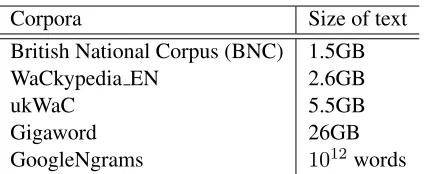
Table 1: Corpora used to Mine SVO Triplets
of Oriented Gradients) and HoF (Histograms of Op-tical Flow) features over a 3-dimensional space-time volume. These descriptors are then randomly sam-pled and clustered to obtain a “bag of visual words,” and each video is then represented as a histogram over these clusters. We experimented with different classifiers such as LIBSVM (Chang and Lin, 2011) to train a final activity detector using these features. Since we achieved the best classification accuracy (still only 8.65%) using an SVM with the intersec-tion kernel, we used this approach to obtain a prob-ability distribution over the 58 activity clusters for each test video. We later experimented with Dense Trajectories (Wang et al., 2011) for activity recogni-tion but there was only a minor improvement.
3.4 Text Mining
We improve these initial probability distributions over objects and activities by incorporating the like-lihood of different activities occuring with particular subjects and objects using two different approaches. In the first approach, using the Stanford dependency parser, we parsed 4 different text corpora covering a wide variety of text: English Gigaword, British Na-tional Corpus (BNC), ukWac and WaCkypedia EN. In order to obtain useful estimates, it is essential to collect text that approximates all of the written lan-guage in scale and distribution. The sizes of these corpora (after preprocessing) are shown in Table 1.
Using the dependency parses for these corpora, we mined SVO triplets. Specifically, we looked for subject-verb relationships usingnsubjdependencies and verb-object relationships usingdobj and prep
dependencies. The prep dependency ensures that we account for intransitive verbs with prepositional objects. Synonyms of subjects and objects and con-jugations of verbs were reduced to their base forms (20 object classes, 58 activity clusters) while form-ing triplets. If a subject, verb or object not belongform-ing
to these base forms is encountered, it is ignored dur-ing triplet construction.
These triplets are then used to train a backoff lan-guage model with Kneser-Ney smoothing (Chen and Goodman, 1999) for estimating the likelihood of an SVO triple. In this model, if we have not seen train-ing data for a particular SVO trigram, we “back-off” to the Subject-Verb and Verb-Object bigrams to co-herently estimate its probability. This results in a sophisticated statistical model for estimating triplet probabilities using the syntactic context in which the words have previously occurred. This allows us to effectively determine the real-world plausibility of any SVO using knowledge automatically mined from raw text. We call this the “SVO Language Model” approach (SVO LM).
In a second approach to estimating SVO prob-abilities, we used BerkeleyLM (Pauls and Klein, 2011) to train an n-gram language model on the GoogleNgram corpus (Lin et al., 2012). This sim-ple model does not consider synonyms, verb con-jugations, or SVO dependencies but only looks at word sequences. Given an SVO triplet as an in-put sequence, it estimates its probability based on n-grams. We refer to this as the “Language Model” approach (LM).
3.5 Verb Expansion
As mentioned earlier, the top activity detections are expanded with their most similar verbs in order to generate a larger set of potential words for describ-ing the action. We used the WUP metric from Word-Net::Similarity to expand each activity cluster to in-clude all verbs with a similarity of at least 0.5. For example, we expand the verb “move” withgo 1.0, walk 0.8, pass 0.8, follow 0.8, fly 0.8, fall 0.8, come 0.8, ride 0.8, run 0.67, chase 0.67, approach 0.67, where the number is the WUP similarity.
3.6 Content Planning
(Vorig) and expanded (Vsim) verbs. The NLP score
is obtained from either the “SVO Language Model” or the “Language Model” approach, as previously described.
score=w1∗vis score+w2∗nlp score (1)
(2)
vis score=P(S|vid)∗P(Vorig|vid) ∗Sim(Vsim, Vorig)∗P(O|vid)
After determining the top n=5 object detections and top k=10 verb detections for each video, we generate all possible SVO triplets from these nouns and verbs, including all potential verb expansions. Each resulting SVO is then scored using Equation 1, and the best is selected. We compare this approach to a “pure vision” baseline where the subject is the highest scored object detection (which empirically is more likely to be the subject than the object), the object is the second highest scored object detection, and the verb is the activity cluster with the highest detection probability.
3.7 Surface Realization
Finally, the subject, verb and object from the top-scoring SVO are used to produce a set of candi-date sentences, which are then ranked using a lan-guage model. The text corpora in Table 1 are mined again to get the top three prepositions for every verb-object pair. We use a template-based approach in which each sentence is of the form:
“Determiner (A,The) - Subject - Verb (Present, Present Continuous) - Preposition (optional) - De-terminer (A,The) - Object.”
Using this template, a set of candidate sentences are generated and ranked using the BerkeleyLM lan-guage model trained on the GoogleNgram corpus. The top sentence is then used to describe the video. This surface realization technique is used for both the vision baseline triplet and our proposed triplet.
In addition to the one presented here, we tried al-ternative “pure vision” baselines, but they are not included since they performed worse. We tried a non-parametric approach similar to Ordonez et al. (2011), which computes global similarity of the query to a large captioned dataset and returns the
nearest neighbor’s description. To compute the sim-ilarity we used an RBF-Chi2 kernel over bag-of-words STIP features. However, as noted by Ordonez et al. (2011), who used 1 million Flickr images, our dataset is likely not large enough to produce good matches. In an attempt to combine information from both object and activity recognition, we also tried combining object detections from 20 PASCAL ob-ject detectors (Felzenszwalb et al., 2008) and from Object Bank (Li et al., 2010) using a multi-channel approach as proposed in (Zhang et al., 2007), with a RBF-Chi2 kernel for the STIP features and a RBF-Correlation Distance kernel for object detections.
4 Experimental Results
4.1 Content Planning
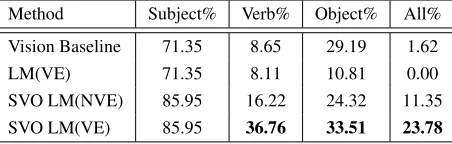
We first evaluated the ability of the system to iden-tify the best SVO content. From the∼ 50 human descriptions available for each video, we identified the SVO for each description and then determined the ground-truth SVO for each of the 185 test videos using majority vote. These verbs were then mapped back to their 58 activity clusters. For the results pre-sented in Tables 2 and 3, we assigned the vision score a weight of 0 (w1 = 0) and the NLP score
a weight of 1 (w2 = 1) since these weights gave us
the best performance for thresholds of 5 and 10 for the objects and activity detections respectively. Note that while the vision score is given a weight of zero, the vision detections still play a vital role in the de-termination of the final triplet since our model only considers the objects and activities with the highest vision detection scores.
Method Subject% Verb% Object% All%
Vision Baseline 71.35 8.65 29.19 1.62
LM(VE) 71.35 8.11 10.81 0.00
[image:6.612.74.300.59.131.2]SVO LM(NVE) 85.95 16.22 24.32 11.35 SVO LM(VE) 85.95 36.76 33.51 23.78
Table 2: SVO Triplet accuracy: Binary metric
Method Subject% Verb% Object% All%
Vision Baseline 87.76 40.20 61.18 63.05
LM(VE) 85.77 53.32 61.54 66.88
[image:6.612.315.538.61.204.2]SVO LM(NVE) 94.90 63.54 69.39 75.94 SVO LM(VE) 94.90 66.36 72.74 78.00
Table 3: SVO Triplet accuracy: WUP metric
In order to account for such similarities, we also measure the WUP similarity between the predicted and correct items. For the examples above, the rel-evant scores are: wup(motorbike,bicycle)=0.7826, wup(motorbike,dog)=0.1, wup(slice,chop)=0.8, wup(slice,go)=0.2857. The results for the WUP metric are shown in Table 3.
4.2 Surface Realization
Figures 4 and 5 show examples of good and bad sen-tences generated by our method compared to the vi-sion baseline.
4.2.1 Automatic Metrics
To automatically compare the sentences gener-ated for the test videos to ground-truth human de-scriptions, we employed the BLEU and METEOR metrics used to evaluate machine-translation output. METEOR was designed to fix some of the prob-lems with the more popular BLEU metric. They both measure the number of matching n-grams (for various values ofn) between the automatic and hu-man generated sentences. METEOR takes stem-ming and synonymy into consideration. We used the SVO Language Model (with verb expansion) ap-proach since it gave us the best results for triplets. The results are given in Table 4.
4.2.2 Human Evaluation using Mechanical Turk
Given the limitations of metrics like BLEU and METEOR, we also asked human judges to evalu-ate the quality of the sentences generevalu-ated by our
ap-Figure 4: Examples where we outperform the baseline
Figure 5: Examples where we underperform the baseline
proach compared to those generated by the baseline system. For each of the 185 test videos, we asked 9 unique workers (with>95% HIT approval rate and who had worked on more than 1000 HITs) on Ama-zon Mechanical Turk to pick which sentence better described the video. We also gave them a “none of the above two sentences” option in case neither of the sentences were relevant to the video. Qual-ity was controlled by also including in each HIT a gold-standard example generated from the human descriptions, and discarding judgements of workers who incorrectly answered this gold-standard item. Overall, when they expressed a preference, hu-mans picked our descriptions to that of the baseline
Method BLEU score METEOR score Vision Baseline 0.37±0.05 0.25±0.08 SVO LM(VE) 0.45±0.05 0.36±0.27
[image:6.612.315.529.242.383.2]61.04% of the time. Out of the 84 videos where the majority of judges had a clear preference, they chose our descriptions65.48%of the time.
5 Discussion
Overall, the results consistently show the advantage of utilizing text-mined knowledge to improve the se-lection of an SVO that best describes a video. Below we discuss various specific aspects of the results.
Vision Baseline: For the vision baseline, the sub-ject accuracy is quite high compared to the obsub-ject and activity accuracies. This is likely because the person detector has higher recall and confidence than the other object detectors. Since most test videos have a person as the subject, this works in favor of the vision baseline, as typically the top ob-ject detection is “person”. Activity (verb) accuracy is quite low (8.65% binary accuracy). This is be-cause there are 58 activity clusters, some with very little training data. Object accuracy is not as high as subject accuracy because the true object, while usually present in the top object detections, is not always the second-highest object detection. By al-lowing “partial credit”, the WUP metric increases the verb and object accuracies to 40.2% and 61.18%, respectively.
Language Model(VE): The Language Model ap-proach performs even worse than the vision baseline especially for object identification. This is because we consider the language model score directly for the SVO triplet without any verb conjugations and presence of determiners between the verb and ob-ject. For example, while the GoogleNgram corpus is likely to contain many instances of a sentence like “A person is walking with a dog”, it will probably not contain many instances of “person walk dog”, resulting in lower scores.
SVO Language Model(NVE): The SVO Lan-guage Model (without verb expansion) improves verb accuracy from 8.65% to 16.22%. For the WUP metric, we see an improvement in accuracy in all cases. This indicates that we are getting semanti-cally closer to the right object compared to the ob-ject predicted by the vision baseline.
SVO Language Model(VE): When used with verb expansion, the SVO Language Model approach results in a dramatic improvement in verb
accu-racy, causing it to jump to 36.76%. The WUP score increase for verbs between SVO Language Model(VE) and SVO Language Model(NVE) is mi-nor, probably because even without verb expansion, semantically similar verbs are selected but not the one used in most human descriptions. So, the jump in verb accuracy for the binary metric is much more than the one for WUP.
Importance of verb expansion: Verb expansion clearly improves activity accuracy. This idea could be extended to a scenario where the test set contains many activities for which we do not have any ex-plicit training data. As such, we cannot train activ-ity classifiers for these “missing” classes. However, we can train a “coarse” activity classifier using the training data that is available, get the top predictions from this coarse classifier and then refine them by using verb expansion. Thus, we can even detect and describe activities that were unseen at training time by using text-mined knowledge to determine the de-scription of an activity that best fits the detected ob-jects.
Effect of different training corpora: As men-tioned earlier, we used a variety of textual cor-pora. Since they cover newswire articles, web pages, Wikipedia pages and neutral content, we compared their individual effect on the accuracy of triplet se-lection. The results of this ablation study are shown in Tables 5 and 6 for the binary and WUP met-ric respectively. We also show results for training the SVO model on the descriptions of the training videos. The WaCkypedia EN corpus gives us the best overall results, probably because it covers a wide variety of topics, unlike Gigaword which is re-stricted to the news domain. Also, using our SVO Language Model approach on the triplets from the descriptions of the training videos is not sufficient. This is because of the relatively small size and nar-row domain of the training descriptions in compari-son to the other textual corpora.
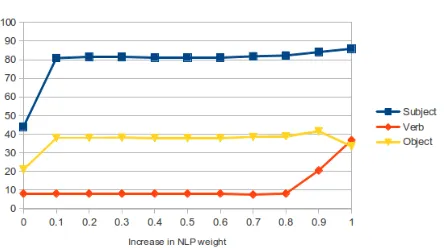
Effect of changing the weight of the NLP score
Method Subject% Verb% Object% All%
Vision Baseline 71.35 8.65 29.19 1.62
Train Desc. 85.95 16.22 16.22 8.65
Gigaword 85.95 32.43 20.00 14.05
BNC 85.95 17.30 29.73 14.59
ukWaC 85.95 34.05 32.97 22.16
WaCkypedia EN 85.95 35.14 40.00 28.11
[image:8.612.72.305.58.171.2]All 85.95 36.76 33.51 23.78
Table 5: Effect of training corpus on SVO binary accu-racy
Method Subject% Verb% Object% All%
Vision Baseline 87.76 40.20 61.18 63.05 Train Desc. 94.95 45.12 61.43 67.17
Gigaword 94.90 63.99 65.71 74.87
BNC 94.88 51.48 73.93 73.43
ukWaC 94.86 60.59 72.83 76.09
WaCkypedia EN 94.90 62.52 76.48 77.97
All 94.90 66.36 72.74 78.00
Table 6: Effect of training corpus on SVO WUP accuracy
improvement in verb accuracy as the NLP weight is increased towards 1. However, for objects we notice a slight increase in accuracy until the weight for the NLP component is 0.9 after which there is a slight dip. We hypothesize that this dip is caused by the loss of vision-based information about the objects which provide some guidance for the NLP system.
BLEU and METEOR results: From the results in Table 4, it is clear that the sentences generated by our approach outperform those generated by the vision baseline, using both the BLEU and METEOR evaluation metrics.
MTurk results: The Mechanical Turk results show that human judges generally prefer our sys-tem’s sentences to those of the vision baseline. As previously seen, our method improves verbs far more than it improves subjects or objects. We hy-pothesize that the reason we do not achieve a simi-larly large jump in performance in the MTurk evalu-ation is because people seem to be more influenced by the object than the verb when both options are partially irrelevant. For example, in a video of a per-son riding his bike onto the top of a car, our pro-posed sentence was “A person is a riding a motor-bike” while the vision sentence was “A person plays
Figure 6: Effect of increasing NLP weights (Binary met-ric)
a car”, and most workers selected the vision sen-tence.
Drawback of Using YouTube Videos: YouTube videos often depict unusual and “interesting” events, and these might not agree with the statistics on typ-ical SVOs mined from text corpora. For instance, the last video in Figure 5 shows a person dragging a cat on the floor. Since sentences describing people moving or dragging cats around are not common in text corpora, our system actually down-weights the correct interpretation.
6 Conclusion
[image:8.612.320.542.62.186.2]7 Acknowledgements
This work was funded by NSF grant IIS1016312 and DARPA Minds Eye grant W911NF-10-2-0059. Some of our experiments were run on the Mastodon Cluster (NSF Grant EIA-0303609).
References
Bangalore, S. and Rambow, O. (2000), Exploiting a probabilistic hierarchical model for generation,
in‘Proceedings of the 18th conference on Com-putational linguistics-Volume 1’, Association for Computational Linguistics, pp. 42–48.
Barbu, A., Bridge, A., Burchill, Z., Coroian, D., Dickinson, S., Fidler, S., Michaux, A., Mussman, S., Narayanaswamy, S., Salvi, D. et al. (2012), Video in sentences out, in ‘Proceedings of the 28th Conference on Uncertainty in Artificial In-telligence (UAI)’, pp. 102–12.
Chang, C. and Lin, C. (2011), ‘LIBSVM: a li-brary for support vector machines’, ACM Trans-actions on Intelligent Systems and Technology (TIST)2(3), 27.
Chen, D., Dolan, W., Raghavan, S., Huynh, T., Mooney, R., Blythe, J., Hobbs, J., Domingos, P., Kate, R., Garrette, D. et al. (2010), ‘Collecting highly parallel data for paraphrase evaluation’,
Journal of Artificial Intelligence Research (JAIR)
37, 397–435.
Chen, S. and Goodman, J. (1999), ‘An empirical study of smoothing techniques for language mod-eling’,Computer Speech & Language13(4), 359– 393.
De Marneffe, M., MacCartney, B. and Manning, C. (2006), Generating typed dependency parses from phrase structure parses,in‘Proceedings of the In-ternational Conference on Language Resources and Evaluation (LREC)’, Vol. 6, pp. 449–454. Ding, D., Metze, F., Rawat, S., Schulam, P., Burger,
S., Younessian, E., Bao, L., Christel, M. and Hauptmann, A. (2012), Beyond audio and video retrieval: towards multimedia summarization, in
‘Proceedings of the 2nd ACM International Con-ference on Multimedia Retrieval’.
Farhadi, A., Hejrati, M., Sadeghi, M., Young, P., Rashtchian, C., Hockenmaier, J. and Forsyth, D.
(2010), ‘Every picture tells a story: Generating sentences from images’, Computer Vision– European Conference on Computer Vision (ECCV)pp. 15–29.
Felzenszwalb, P., McAllester, D. and Ramanan, D. (2008), A discriminatively trained, multi-scale, deformable part model, in‘IEEE Confer-ence on Computer Vision and Pattern Recognition (CVPR)’, pp. 1–8.
Khan, M. and Gotoh, Y. (2012), ‘Describing video contents in natural language’, European Chapter of the Association for Computational Linguistics (EACL).
Kojima, A., Tamura, T. and Fukunaga, K. (2002), ‘Natural language description of human activities from video images based on concept hierarchy of actions’, International Journal of Computer Vi-sion (IJCV)50(2), 171–184.
Kulkarni, G., Premraj, V., Dhar, S., Li, S., Choi, Y., Berg, A. and Berg, T. (2011), Baby talk: Understanding and generating simple image de-scriptions,in‘IEEE Conference on Computer Vi-sion and Pattern Recognition (CVPR)’, pp. 1601– 1608.
Kuznetsova, P., Ordonez, V., Berg, A. C., Berg, T. L. and Choi, Y. (2012), Collective genera-tion of natural image descripgenera-tions, in ‘Proceed-ings of the 50th Annual Meeting of the Associa-tion for ComputaAssocia-tional Linguistics: Long Papers-Volume 1’, Association for Computational Lin-guistics, pp. 359–368.
Langkilde, I. and Knight, K. (1998), Generation that exploits corpus-based statistical knowledge, in
‘Proceedings of the 17th international conference on Computational linguistics-Volume 1’, Associ-ation for ComputAssoci-ational Linguistics, pp. 704–710. Laptev, I., Marszalek, M., Schmid, C. and Rozen-feld, B. (2008), Learning realistic human actions from movies,in‘IEEE Conference on Computer Vision and Pattern Recognition (CVPR)’, pp. 1–8.
Laptev, I. and Perez, P. (2007), Retrieving actions in movies,in‘Proceedings of the 11th IEEE Interna-tional Conference on Computer Vision (ICCV)’, pp. 1–8.
(2008), Save: A framework for semantic anno-tation of visual events,in‘IEEE Computer Vision and Pattern Recognition Workshops (CVPR-W)’, pp. 1–8.
Li, L., Su, H., Xing, E. and Fei-Fei, L. (2010), ‘Ob-ject bank: A high-level image representation for scene classification and semantic feature sparsifi-cation’,Advances in Neural Information Process-ing Systems (NIPS)24.
Li, S., Kulkarni, G., Berg, T., Berg, A. and Choi, Y. (2011), Composing simple image descriptions using web-scale n-grams, in‘Proceedings of the Fifteenth Conference on Computational Natural Language Learning (CoNLL)’, Association for Computational Linguistics (ACL), pp. 220–228.
Lin, Y., Michel, J., Aiden, E., Orwant, J., Brockman, W. and Petrov, S. (2012), Syntactic annotations for the google books ngram corpus, in ‘Proceed-ings of the 50th Annual Meeting of the Associa-tion for ComputaAssocia-tional Linguistics (ACL)’.
Motwani, T. and Mooney, R. (2012), Improving video activity recognition using object recogni-tion and text mining,in‘European Conference on Artificial Intelligence (ECAI)’.
Ordonez, V., Kulkarni, G. and Berg, T. (2011), Im2text: Describing images using 1 million captioned photographs, in ‘Proceedings of Ad-vances in Neural Information Processing Systems (NIPS)’.
Packer, B., Saenko, K. and Koller, D. (2012), A combined pose, object, and feature model for ac-tion understanding,in‘IEEE Conference on Com-puter Vision and Pattern Recognition (CVPR)’, pp. 1378–1385.
Pauls, A. and Klein, D. (2011), Faster and smaller n-gram language models, in ‘Proceedings of the 49th annual meeting of the Association for Com-putational Linguistics: Human Language Tech-nologies’, Vol. 1, pp. 258–267.
Pedersen, T., Patwardhan, S. and Michelizzi, J. (2004), Wordnet:: Similarity: measuring the re-latedness of concepts, in‘Demonstration Papers at Human Language Technologies-NAACL’, As-sociation for Computational Linguistics, pp. 38– 41.
Reddy, K. and Shah, M. (2012), ‘Recognizing 50 human action categories of web videos’,Machine Vision and Applicationspp. 1–11.
Schuldt, C., Laptev, I. and Caputo, B. (2004), Rec-ognizing human actions: A local SVM approach,
in ‘Proceedings of the 17th International Con-ference on Pattern Recognition (ICPR)’, Vol. 3, pp. 32–36.
Wang, H., Klaser, A., Schmid, C. and Liu, C.-L. (2011), Action recognition by dense trajectories,
in ‘IEEE Conference on Computer Vision and Pattern Recognition (CVPR)’, pp. 3169–3176. Yang, Y., Teo, C. L., Daum´e, III, H. and Aloimonos,
Y. (2011), Corpus-guided sentence generation of natural images, in ‘Proceedings of the Confer-ence on Empirical Methods in Natural Language Processing (EMNLP)’, Association for Computa-tional Linguistics, pp. 444–454.
Yao, B. and Fei-Fei, L. (2010), Modeling mutual context of object and human pose in human-object interaction activities, in ‘IEEE Confer-ence on Computer Vision and Pattern Recognition (CVPR)’.
Yao, B., Yang, X., Lin, L., Lee, M. and Zhu, S. (2010), ‘I2t: Image parsing to text description’,
Proceedings of the IEEE98(8), 1485–1508. Zhang, J., Marszałek, M., Lazebnik, S. and Schmid,