D S Sharma, R Sangal and J D Pawar. Proc. of the 11th Intl. Conference on Natural Language Processing, pages 232–239, Goa, India. December 2014. c2014 NLP Association of India (NLPAI)
Sangam: A Perso-Arabic to Indic Script Machine Transliteration Model
Gurpreet Singh Lehal
Tejinder Singh Saini
Department of Computer Science Advanced Center for Technical Development of Punjabi University, Patiala Punjabi Language Literature and Culture
147002 Punjab, India Punjabi University, Patiala Punjab, India
[email protected] [email protected]
Abstract
Indian sub-continent is one of those unique parts of the world where single languages are written in different scripts. This is the case for example with Punjabi, written in Indian East Punjab in Gurmukhi script (a Left to Right script based on Devnagri) and in Pakistani West Punjab, it is written in Shahmukhi (a Right to Left script based on Perso-Arabic). This is also the case with other languages like Urdu and Hindi (whilst having different names, they are the same language but written in mutually incomprehensible forms). Similar-ly, Sindhi and Kashmiri languages are written in both Persio-Arabic and Devanagri scripts. Thus there is a dire need for development transliteration tools for conversion between Perso-Arabic and Indic scripts. In this paper, we present Sangam, a Perso-Arabic to Indic script machine transliteration system, which can convert with high accuracy text written in Perso-Arabic script to one of the Indic script sharing the same language. Sangam is a hybr-id system which combines rules as well as word and character level language models to transliterate the words. The system has been designed in such a fashion that the main code, algorithms and data structures remain un-changed and for a adding a new script pair on-ly the databases, mapping rules and language models for the script pair need to be devel-oped and plugged in. The system has been successfully tested on Punjabi, Urdu and Sindhi languages and can be easily extended for other languages like Kashmiri and Konka-ni.
1
Introduction
Indian sub-continent is one of those unique parts of the world where single languages are written in different scripts. This is the case for example with Punjabi, spoken by tens of millions of people, but written in Indian East Punjab (20 million) in Gur-mukhi script (a Left to Right script based on Dev-nagri) and in Pakistani West Punjab (80 million), it is written in Shahmukhi (a Right to Left script based on Perso-Arabic). Whilst in speech, Punjabi spoken in the Eastern and the Western parts is mu-tually comprehensible in the written form it is not. This is also the case with other languages like Ur-du and Hindi (whilst having different names, they are the same language but written, as with Punjabi, in mutually incomprehensible forms). Hindi is written in the Devnagri script from left to right, Urdu is written in a script derived from a Persian modification of Arabic script written from right to left. A similar problem resides with the Sindhi language, which is written in a Persio-Arabic script in Pakistan and both in Persio-Arabic and Devana-gri in India. Similar is the case with Kashmiri lan-guage too. Konkani is probably the only lanlan-guage in India which is written in five scripts Roman, Devnagri, Kannada, Persian-Arabic and Malaya-lam (Carmen Brandt. 2014). The existence of mul-tiple scripts has created communication barriers, as people can understand the spoken or verbal com-munication, however when it comes to scripts or written communication, the number diminishes, thus a need for transliteration tools which can con-vert text written in one language script to another script arises. A common feature of all these
guages is that, one of the script is Perso-Arabic (Urdu, Sindhi, Shahmukhi etc.), while other script is Indic (Devnagri, Gurmukhi, Kannada, Malaya-lam). Perso-Arabic script is a right to left script, while Indic scripts are left to right scripts and both the scripts are mutually incomprehensible forms. Thus is a dire need for development of automatic machine transliteration tools for conversion be-tween Perso-Arabic and Indic scripts.
Machine Transliteration is an automatic method to generate characters or words in one alphabetical system for the corresponding characters in another alphabetical system. The transformation of text from one script to another is usually based on pho-netic equivalencies. Transliteration is usually cate-gorized as forward and backward transliteration. Forward transliteration refers to transliteration from the native language to foreign language, while the process of recalling a word in native lan-guage from a transliteration is defined as back-transliteration. Forward transliteration plays an important role in natural language applications such as information retrieval and machine transla-tion, especially for handling proper nouns, technic-al terms and out of vocabulary words. While back transliteration is popularly used as an input me-chanism for certain languages, where typing in the native script is not very popular. In such cases, the user types the native language words and sentences (usually) in Roman script, and a transliteration en-gine automatically converts the Roman input back to the native script. This input mechanism is popu-larly used for all Indian languages including Hindi, Punjabi, Tamil, Telugu, etc., and also, Arabic, Chinese etc.
In this paper, we present Sangam, a Perso-Arabic to Indic script machine transliteration sys-tem, which can convert with high accuracy text written in Perso-Arabic script to one of the Indic script sharing the same language. The system has been successfully tested on Punjabi (Shahmukhi-Gurmukhi) , Urdu (Urdu-Devnagri) and Sind-hi(Sindhi Perso Arabic - Sindhi Devnagri) lan-guages and can be easily extended for other languages like Kashmiri and Konkani. One should note that the transliteration model presented in this paper can neither be categorized as forward nor as backward since it is concerned with script conver-sion in same language, so the usual techniques for forward or backward transliteration cannot be ap-plied here and we have to develop a special
me-thodology to handle the transliteration issues re-lated to conversion between scripts of same lan-guage.
2
Related Work
The first transliteration system for a Perso-Arabic to Indic script was presented by Malik (2006), where he described a Shahmukhi to Gurmukhi transliteration system with 98% accuracy. But the accuracy was achieved only when the input text had all necessary diacritical marks for removing ambiguities, even though the process of putting missing diacritical marks is not practically possible due to many reasons like large input size, manual intervention, person having knowledge of both the scripts and so on. Saini et al. (2008) developed a system, which could automatically insert the miss-ing diacritical marks in the Shahmukhi text and convert the text to Gurmukhi. The system had been implemented with various research techniques based on corpus analysis of both scripts and an accuracy of 91.37% at word level had been re-ported.
Durrani et al. (2010) presented an approach to integrate transliteration into Hindi-to-Urdu statis-tical machine translation. They proposed two prob-abilistic models, based on conditional and joint probability formulations and have reported an ac-curacy of 81.4%. Lehal and Saini (2012) presented an Urdu to Hindi transliteration system and had claimed achieving an accuracy of 97.74% at word level. The various challenges such as multiple/zero character mappings, missing diacritic marks in Ur-du, multiple Hindi words mapped to an Urdu word, word segmentation issues in Urdu text etc. have been handled by generating special rules and using various lexical resources such as n-gram language models at word and character level and Urdu-Hindi parallel corpus. Recently Malik et al. (2013) have analysed the application of statistical machine translation for solving the problem of Urdu-Hindi transliteration using a parallel lexicon. The authors reported a word level accuracy of 77.8% when the input Urdu text contained all necessary diacritical marks and 77% when the input Urdu text did not contain all necessary diacritical marks, which is much below the accuracy reported in earlier works. A rule based converter for Kashmiri language from Persio-Arabic to Devanagari script has been
developed by Kak et al. (2010) and authors have claimed 90% conversion accuracy.
Leghari and Rehman (2010) have discussed the different issues, complexities and problems of Sindhi transliteration and presented a model for transliteration between Perso-Arabic and Devana-gari scripts of Sindhi language, which is based on an intermediate Roman script.
Malik et al. (2010) described a finite-state scrip-tural translation model based on Finite State Ma-chines to convert the scripts for Urdu, Punjabi and Seraiki languages. But the transliteration results for Urdu-Hindi, Punjabi Shahmukhi-Gurmukhi and Seraiki Shahmukhi-Gurmukhi have not been very encouraging, with transliteration accuracy at word level ranging from 31.2% to 58.9% for Urdu-Devnagri script pair and 67.3% for Shahmukhi-Gurmukhi.
3
Challenges in Perso-Arabic to Indic
Script Transliteration
Transliteration is not trivial to automate, but trans-literation of Perso-Arabic script to Indic scripts is even more challenging problem. Since the lan-guage does not change, so it becomes important the correct spellings and context of the words is maintained in target script. The major challenges of transliteration of languages using Perso-Arabic script to Indic scripts are as follows:
3.1 Missing Diacritical marks and short Vo-wels
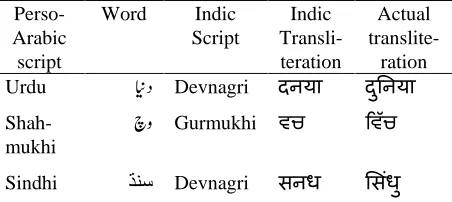
Diacritical marks are critical for correct pronuncia-tion and sometimes even for disambiguapronuncia-tion of certain words. The diacritical marks are also used for gemination (doubling of a consonant) and mark the absence of a vowel following a base consonant. But the diacritical marks and short vowels are spa-ringly used in Perso-Arabic script writings. These missing diacritical marks and short vowels create substantial difficulties for transliteration systems, as the missing diacritic marks and vowels have to be guessed by the system and added for correct transliteration. For example in Table 1, we see how the words in Perso-Arabic script, which are com-monly written without diacritic marks, will be transliterated in Indic script, if we go in for charac-ter by characcharac-ter substitution and do not put the missing short vowels.
Perso-Arabic
script
Word Indic Script
Indic Transli-teration
Actual translite-ration Urdu �دد Devnagri दनया दु�नया
Shah-mukhi
چچوو Gurmukhi ਵਚ ਿਵੱਚ
[image:3.612.316.542.72.173.2]Sindhi ﮅﻨﺳ Devnagri सनध �संधु Table 1. Transliteration without diacritical marks
3.2 Filling the Missing Script Maps
There are many characters which are present in the Perso-Arabic script, corresponding to those having no character in Indic script, e.g. Hamza ء, Do-Zabar ً◌Aen ع, ٰ◌ (Khadi Zabar) etc.
3.3 Multiple Mappings for Perso-Arabic Characters
It is observed that corresponding to many Perso-Arabic characters there are multiple mappings into Indic script as shown in Table 2. Additional infor-mation such as grammar rules and context are needed to select the appropriate Indic script cha-racter for such Perso-Arabic chacha-racters.
Perso-Arabic Script
Char Indic script
Equivalent Mappings Urdu و Devnagri व, ◌ो, ◌ौ, ◌ु,
◌ू , ऊ, ओ, औ Shahmukhi ن Gurmukhi ◌ਂ, ◌ੰ, ਨ, ਣ Table 2. Multiple Mappings of Perso-Arabic characters
3.4 Transliteration Ambiguity at Word level
[image:3.612.313.544.586.681.2]Due to multiple character mappings and missing short vowels, many words in Perso-Arabic script get mapped to multiple Indic words as shown in Table 3. Higher level language information will be needed to choose the most relevant word in Indic script.
Perso-Arabic script
Word Indic script
Equivalent words in Indic
script Urdu � Devnagri क्या, �कया Shahmukhi � Gurmukhi ਹਨ, ਹੁਣ
Sindhi ن ا� Devnagri जां, जान, जा�न Table 3. Multiple Mappings of Perso-Arabic words
3.5 Word-Segmentation Issues
Space is not consistently used in Perso-Arabic words, which makes word segmentation a non-trivial task. Many times the space is deleted result-ing in many Perso-Arabic words beresult-ing jumbled together and many other times extra space is put in word resulting in over segmentation of that word. This problem is more pronounced in Urdu and Shahmukhi scripts as compared to Sindhi script. We see in Table 4, samples of Urdu and Shahmuk-hi words containing multiple merged words and their transliterations if the words are transliterated as such without splitting them at proper positions.
Word Perso-Arabic
Transliteration without splitting
Actual translite-ration
�اايندد�رر�اا
(Urdu script)
अनकारकरदयाहे (Devnagri script)
इन्कारकर�दयाहै (Devnagri script)
رر��
(Shahmukhi script)
ਪਹਲਾਸ਼ਕਾਰ (Gurmukhi script)
ਪਿਹਲਾਿਸ਼ਕਾਰ (Gurmukhi script)
Table 4. Merged Perso-Arabic Words and their Transli-terations without splitting words
4
System Architecture
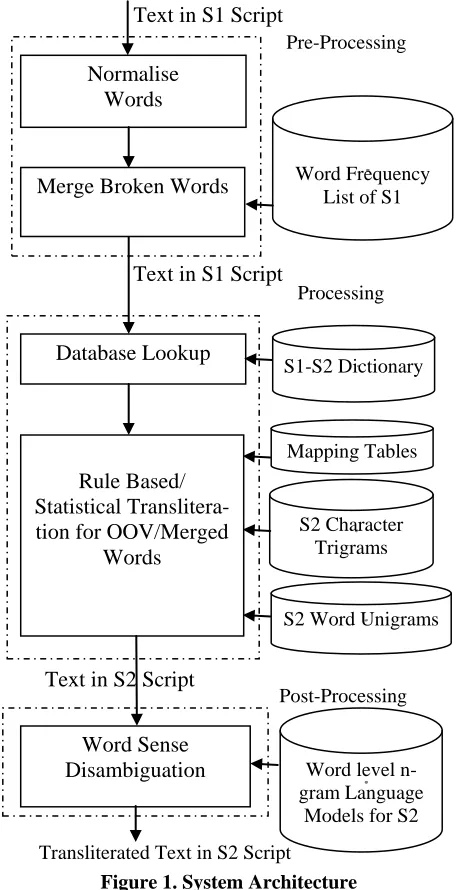
The system architecture of the general Perso-Arabic - Indic transliteration model developed by us is shown in Figure 1. The system has been de-signed in such a fashion that the main code, algo-rithms and data structures remain unchanged while depending on the script pair, the databases, map-ping rules and language models need to be plugged in. The source text is in S1 script while the target text is in script S2. For example if text in Urdu script has to be converted to Devnagri, then we need to plug in word frequency list of Urdu and Urdu-Devnagri dictionary along with n-gram lan-guage models at word and character level for Dev-nagri script and mapping tables for Urdu to Devnagri transliteration. The system has been suc-cessfully tested on three script pairs(Urdu-Hindi, Sindhi-Devnagri and Shahmukhi-Gurmukhi) and has been able to successfully handle most of the issues raised in the previous section. We have de-veloped the lexical resources for all the scripts and depending on our need, the relevant data is used. In case a new script pair has to be added, only the lexical resources have to be created As can be seen in figure 1, the complete transliteration system is divided into three stages: pre-processing, processing and post-processing. In the
pre-processing stage, the text in S1 script is cleaned and prepared for transliteration by normalizing and joining the broken Perso-Arabic words. In the processing stage, corresponding to each word in S1 script, one or several possible words in S2 are gen-erated. If only one word is produced, then that word is finalised. Otherwise for multiple alterna-tives, the final decision is taken in the post processing stage.
In the post-processing stage, the final decision about choosing from multiple S2 alternatives is made using language models for S2. The three stages are discussed in detail in the following sec-tions.
4.1 Pre-Processing
In the pre-processing stage, the Urdu words are cleaned and prepared for transliteration by norma-lizing the Urdu words as well as joining the broken Urdu words. The two main stages in pre-processing are:
4.1.1 Normalizing Perso-Arabic words
Two kinds of normalization are required for Perso-Arabic words. First, a letter may be represented by multiple Unicode points, and thus the redundancy in encoding has to be cleaned in raw text before further processing. As for example, from translite-ration point of view, ى(0649), ي(064a) and ی(06cc) represent the same character in Perso-Arabic script. Secondly, a letter or a ligature is sometimes encoded in composed form as well as decomposed form. Thus, the two equivalent representations must also be reduced to same underlying form be-fore further processing. For example, آ (0622) can be also be represented by the combination ا (0627) + ٓ◌ (0653). All such forms are normalized to have only one representation.
4.1.2 Joining the broken Perso-Arabic words
The transliteration system faces many problems related to word segmentation of Perso-Arabic script, as in many cases space is not properly put between words. Sometimes it is deleted resulting in many Perso-Arabic words being jumbled together and many other times extra space is put in word resulting in over segmentation of that word. The space insertion problem is handled in pre-processing stage, while the space deletion problem is handled in the processing stage. The space
tion problem usually occurs due to conventional way of writing in Perso-Arabic script or due to ex-tra space being inserted during typing. The typing related space insertion problems are handled by using the word frequency list of script S1 (Lehal, 2009). If the product of probability of occurrence of two adjacent words in S1 is lesser than the prob-ability of occurrence of the word formed by joining the two, then the two words are joined together.
Figure 1. System Architecture
4.2 Processing Stage
This is the main stage and in this stage, corres-ponding to each word in S1 script, one or several
possible words in S2 script are generated. For mul-tiple alternatives, the final decision is taken in the post processing stage. First the word is searched in the S1-S2 dictionary and if it is found, then all its alternatives are passed onto post processing stage. In case the word is not found, then it is fed to a multi-stage transliteration engine. In the first stage a Hybrid-wordlist-generator (HWG) is used to convert the word. The HWG uses the mapping rules and a trigram character language model to generate a set of words in S2. A unigram word language model is then used to rank these words, after dropping words with zero probability. If there is no word with non-zero probability, then the word is inspected for presence of merged words which can be transliterated to non empty sets of words in S2 words. If no such sets can be generat-ed then we use the simple character mapping rules to convert the word to S2.
We now discuss in detail, the main modules used in the multi-stage transliteration engine. These modules are:
4.2.1 Hybrid-wordlist-generator (HWG)
This is the major module in the transliteration en-gine. It generates multiple transliterations for a word in S1. The multiple outputs are produced due to ambiguity both at character and word level as already mentioned in above sections.
The sequence of probable Indic words is pro-duced by a hybrid system, which uses rule based character mapping tables and a trigram character Language Model. The Perso-Arabic word is processed character by character, which are mapped directly to their corresponding similar sounding Indic characters based on their position in word and syntax rules (snippet shown in the Ta-ble 5). In most of the cases, there is a 1-1 mapping, but a few characters such as و ن, ی, which have multiple mappings and also some character combi-nations in Perso-Arabic script such as ﮭﺗ (062A+06BE) have single representation in some of Indic scripts such as in Devnagri (थ) or Gur-mukhi (ਥ), while in Sindhi(Devnagri) we have character combination तह. Similarly the character ۾ (U06FE) gets mapped to word म� in Sind-hi(Devnagri) script, while it has no equivalent mapping in Devnagri and Shahmukhi scripts. In some cases the mapping is dependent on the posi-tion of the character. As for example, the character ا (U0627) is mapped to character अ if it is in be-ginning of the word else it gets mapped to अ and ◌ा in Devnagri script. Similarly, the character ن Normalise
Words
Database Lookup
Text in S1 Script Merge Broken Words
Text in S1 Script
Word Frequency List of S1
Word Sense Disambiguation
S1-S2 Dictionary Pre-Processing
Processing
Mapping Tables
S2 Character Trigrams
Word level n-gram Language
Models for S2 Post-Processing Rule Based/
Statistical Translitera-tion for OOV/Merged
Words
Text in S2 Script
S2 Word Unigrams
Transliterated Text in S2 Script
(U0646) gets mapped to character न in Sind-hi(Devnagri), if it is in the starting of the word, and gets mapped to न, ◌ं and ◌ँ otherwise. The same character, ن (U0646), gets mapped to न and ण in Devnagri, if it comes in beginning or ending of a word, else it gets mapped to न, ण, ◌ं and ◌ँ .
Char At
Perso Arabic
Devna-gri
Gurmukhi Sindhi (Dev)
Any بب ब ਬ ब
� थ ਥ तह
۾ - - म�
Start وو व, ऊ, ओ,
औ ਵ, ਊ, ਓ, ਔ वओ, ऊ, औ, Start نن न, ण ਨ, ਣ न
Start اا अ ਅ अ
Mid نن न, ण, ◌ं,
◌ँ ਨ, ਣ, ◌ਂ, ◌ੰ न, ◌ं, ◌ँ Mid/
end
اا अ, ◌ा ਅ, ◌ਾ अ, ◌ा
Mid /end
وو व, ◌ो, ◌ौ, ◌ु, ◌ू , ऊ, ओ, औ
ਵ, ◌ੂ, ◌ੋ, ◌ੌ,
ਊ, ਓ, ਔ व◌ौ, , ◌ो◌ु, , ◌ू , ऊ, ओ, औ End نن न, ण ਨ, ਣ न, ◌ं, ◌ँ
Table 5. Portion of Perso Arabic - Indic character map-ping Tables
As already mentioned, the short vowels and di-acritical marks are usually omitted in Perso-Arabic text and there are no half characters in Perso-Arabic script, so the result is that the resultant text in Indic script has poor accuracy. For example, the Urdu word in Perso-Arabic script, �, gets transli-terated to क़समत, while the actual word in Devna-gri should be �क़स्मत. This is because the character स is written as half character in Devnagri while the short vowel ि◌ which is missing in original Perso-Arabic word has to written in Devnagri to maintain proper spellings in Devnagri. To fill these missing diacritical marks and put half characters at appro-priate locations in Indic word, we consider all its possible mappings in Indic which include the miss-ing short vowels and half characters. So we modify our mapping table to include all such forms for all the Perso-Arabic characters resulting in multiple mappings. Thus for example the character combi-nation ﮭﺗ (062a+06be) and character و (0648) get mapped to as shown in in Table 6.
We form all possible combinations, which could be generated from these multiple mappings and the top N combinations are retained. The cha-racter based trigram language model for Indic script is used to select the top N combinations. To
avoid processing exponential number of candi-dates, we process the input characters one at a time and use the character trigram probability for prun-ing the partially generated candidates at each step. Char
At
Perso Arabic
Devnagri Gurmuk-hi
Sindhi (Dev) Any ﮭﺗ थ, थ ्, �थ,
थु ਥ, ਿਥ, ਥੁ तह, त�ह, �त�ह, �तह, तुह, तुहु, तहु Start و व, व ्, वु,
�व, व्व, व्वु, िव्व, ऊ, ओ, औ
ਵ, ਿਵ, ਵੁ,
ਊ, ਓ, ਔ ववु, �व, , व ्, व्व, व्वु, िव्व, ऊ, ओ, औ Mid/
end
و व, व ्, वु, �व, व्व, व्वु,, िव्व, ◌ो, ◌ौ, ◌ु, ◌ू , ऊ, ओ, औ
ਵ, ਿਵ, ਵੁ, ◌ੂ, ◌ੋ, ◌ੌ, ਊ, ਓ, ਔ
व, व ्, वु, �व, व्व, व्वु,, िव्व, ◌ो, ◌ौ, ◌ु, ◌ू , ऊ, ओ, औ Table 6. Portion of Modified Perso Arabic - Indic
cha-racter mapping Tables
It should be noted that not all the suggestions generated by the character language model are va-lid words in Indic script. To further rank these words, we use the Unigram Word Model for Indic script. Words with zero probability in the Unigram word model are ignored and rest of the words are ranked on their probabilities. It could also happen that all the top N alternatives suggested by the cha-racter level trigram may be having zero probabili-ties, in which case no alternative is returned by HWG.
4.2.2 Merged word segmentation
As already discussed above, space is not consis-tently used in Perso-Arabic, which gives rise to both space omission and space insertion errors. Due to the space deletion problem, a sequence of words is jumbled together as a single word and when the HWG tries to generate the equivalent Indic alternatives it fails. The sequence of Perso-Arabic words written together without space is still readable because of the character joining property in Perso-Arabic. We have used the space deletion algorithm presented by Lehal (Lehal, 2010) to split the Perso-Arabic words. The algorithm makes use of unigram wordlist of S2 and statistical word dis-ambiguation techniques to first detect if the
Arabic word contains multiple words. And in case multiple words are present, the algorithm splits them at appropriate positions. The Indic Script al-ternatives for these individual Perso-Arabic words are then generated using the HWG module.
4.2.3 Handling Out of Vocabulary Words
For out of vocabulary words, no possible sugges-tions will be generated by the dictionary or HWG. So if after passing through all the modules, still no transliteration alternatives are generated, it implies that the word is out of vocabulary. For such words the Indic Script word is generated by using the mapping rules and trigram character language model and the top most alternative is selected for further processing.
4.3 Post Processing Stage
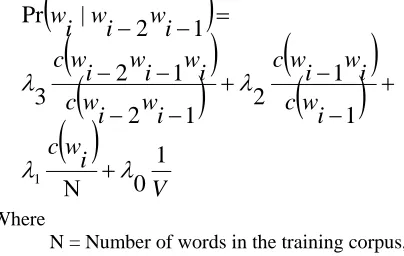
The main task of post processing is to select the best alternative amongst the various transliteration options. The HWG module presents a set of ranked transliterations instead of a single transliteration, due to multiple character mappings as shown in Table 5 and 6. Up to this point, we were only con-sidering the Indic words in isolation, without any consideration to their neighbouring words. Now we consider the whole sentence instead of isolated words.
Where
N = Number of words in the training corpus, V = Size of the vocabulary
To choose between the different alternatives we have used the word trigram probability. To take care of the sparseness in the trigram model, we have used deleted interpolation, which offers the solution of backing away from low count trigrams by augmenting the estimate using bigram and uni-gram counts. The deleted interpolation triuni-gram model assigns a probability to each trigram which is the linear interpolation of the trigram, bigram, unigram and uniform models. The weights are set
automatically using the Expectation-Maximization (EM) algorithm.
5. Experimental Results
[image:7.612.76.278.445.573.2]We have tested our system on text in Perso-Arabic script in Urdu, Punjabi and Sindhi languages and converted it to respective Indic scripts. The transli-terated text has been manually evaluated. The re-sults are tabulated in Table 7. We can see from the table, that the transliteration accuracy for the three scripts ranges from 91.68% to 97.75%, which is the best accuracy reported so far in literature for script pairs in Perso-Arabic and Indic scripts. As can be observed the transliteration accuracy for Sindhi language is much lesser as compared to Ur-du and Punjabi languages. The main reasons for this are:
a) Lack of linguistic resources and digital text in Sindhi(Devnagri).
b) High level of ambiguity at word level in Sind-hi(Perso-Arabic) words, which is much more pro-nounced than Shahmukhi and Urdu words.
A sample of the output for the three scripts is shown in Figure 2.
Script Pair Words Transliteration Accuracy Urdu-Devnagri 30,248 97.75% Shahmukhi-Gurmukhi 26,141 97.02% Sindhi (Perso Arabic) to
Sindhi (Devnagri)
29,131 91.68%
Table 7. Word level Transliteration Accuracy of differ-ent script pairs
�� � � � �۔�� اانن� م� � ۔� �� � � تب�وو �اا م� ببس
۔��
सबकामअपनेवक़्तपरह�होतेह�।हम�कामकरना चा�हए।फलक��फ़क्रनह�ंकरनीचा�हए।
a) Urdu-Devnagri
� � �اا � ےررااس
� يدد � ،� اا�� اانن� � ن�ااس ۔� ے� �
۔ ي�� �� �
ਸਾਰੇ ਕੰ ਮ ਆਪਣੇ ਸਮ� ਿਸਰ ਹੀ ਹੁੰਦੇ ਹਨ। ਸਾਨੂੰ ਕੰ ਮ ਕਰਨਾ ਚਾਹੀਦਾ ਹੈ, ਫਲ ਦੀ ਿਚੰਤਾ ਨਹ� ਕਰਨੀ ਚਾਹੀਦੀ।b) Shahmukhi-Gurmukhi
س
ڀ
ڪ
م
و ﻲﺠﻨﮭﻨﭘ
ڪ
ت
ﻲﺋ ﻲﺗ
ٿ
اﺪﻨﯾ
ﻲﮐ نﺎﺳا ۔ﻲﻨھآ
सभु कम पं�हंजे वक़्त ते ई थींदा आहनी। असां खे कमु करणु घुज�, फल जी �चंता न करणु घुज� ।
c) Sindhi (Perso-Arabic) - Sindhi (Devnagri)
Figure 2. Samples of Transliteration output of text in three languages (Urdu, Punjabi and Sindhi) by
Sangam
Conclusion
In this paper, we have presented Sangam, a Perso-Arabic to Indic script machine transliteration mod-el, which can convert with high accuracy text writ-ten in Perso-Arabic script to one of the Indic script sharing the same language. The system has been successfully tested on Punjabi, Urdu and Sindhi languages and can be easily extended for other languages like Kashmiri and Konkani. The transli-teration accuracy for the three languages ranges from 91.68% to 97.75%, which is the best accura-cy reported so far in literature for translateration from Perso-Arabic to Indic script. The system has been designed in such a fashion that the main code, algorithms and data structures remain unchanged and for a adding a new script pair only the databas-es, mapping rules and language models for the script pair need to be developed and plugged in.
Acknowledgments
The authors would like to acknowledge the support provided by PAN ASIA Grants Singapore and ISIF grants Australia for carrying out this research. The Sindhi language support provided by Dr. Bharat Ratanpal and Ms. Madhuri Wardey, Faculty of Technology & Engineering, MSU Baroda is also duly acknowledged.
References
Aadil Amin Kak, Nazima Mehdi and Aadil Ahmad La-waye. 2010. Building a Cross Script Kashmiri Con-verter: Issues and Solutions, In Proceedings of Oriental COCOSDA (The International Committee for the Co-ordination and Standardization of Speech Databases and Assessment Techniques). web access :
http://desceco.org/O-COCOSDA2010/proceedings/paper_38.pdf
Carmen Brandt. 2014. Script as a Potential Demarcator and Stabilizer of Languages in South Asia Lan-guage, Documentation & Conservation Special Pub-lication No. 7 in Language Endangerment and
Preservation in South Asia, ed. by Hugo C. Cardoso, pp. 78-99
Durrani, N., Sajjad, H., Fraser, A. and Schmid, H. 2010. Hindi-to-Urdu Machine Translation through Transli-teration. In Proceedings of the 48th Annual Confe-rence of the Association for Computational Linguistics, pp 465–474, Uppsala, Sweden.
G. S. Lehal, 2009. A Two Stage Word Segmentation System For Handling Space Insertion Problem In Ur-du Script, Proceedings of World Academy of Science, Engineering and Technology, Bangkok, Thailand, Vol. 60, pp 321-324.
G. S. Lehal, 2010. A Word Segmentation System for Handling Space Omission Problem in Urdu Script,
Proceedings of the 1st Workshop on South and Southeast Asian Natural Language Processing (WSSANLP), the 23rd International Conference on Computational Linguistics (COLING), pp. 43–50, Beijing.
Gurpreet S. Lehal and Tejinder S. Saini. 2012. Devel-opment of a complete Urdu-Hindi transliteration sys-tem. In Proceedings of the 24th International Conference on Computational Linguistics, pp 643– 652, Mumbai, India.
Leghari, M., and Rahman, M. U. 2010. Towards Trans-literation between Sindhi Scripts by using Roman Script. Conference on Language and Technology. Is-lamabad: National Language Authority, Pakistan.
http://www.cle.org.pk/clt10/papers/Towards%20Tran sliteration%20between%20Sindhi%20Scripts%20 by%20using%20Roman%20Script.pdf
M. G. Abbas Malik, Christian Boitet, and Pushpak Bhattacharyya. 2010. Finite-state scriptural transla-tion. In Proceedings of the 23rd International Confe-rence on Computational Linguistics:
Posters (COLING '10). ACL, pp 791-800,
Stroudsburg, PA, USA.
Malik, M. G. Abbas. 2006. Punjabi Machine Transliteration. Proceedings of the 21st International Conference on Computational Linguistics and 44th Annual Meeting of the ACL, pp 1137-1144.
Malik. M. G. Abbas, Boitet. Christian, Besacier. Lau-rent, Bhattcharrya. Pushpak. 2013 Urdu Hindi Ma-chine Transliteration using SMT, The 4th Workshop on South and Southeast Asian Natural Language Processing (WSSANLP), a collocated event at Inter-national Joint Conference on Natural Language Processing (IJCNLP), pp. 43-57, Nagoya, Japan. T. S. Saini, G. S. Lehal and V. S. Kalra. 2008.
Shah-mukhi to GurShah-mukhi Transliteration System, Coling: Companion volume: Posters and Demonstrations, pp. 177-180, Manchester, UK.