Distinguishing Degrees of Compositionality in Compound Splitting
for Statistical Machine Translation
Marion Weller1,2, Fabienne Cap2, Stefan M¨uller1
Sabine Schulte im Walde1, Alexander Fraser2 1IMS, University of Stuttgart
{wellermn;muellesn;schulte}@ims.uni-stuttgart.de
2CIS, Ludwig-Maximilian University of Munich
{cap;fraser}@cis.uni-muenchen.de
Abstract
The paper presents an approach to morphological compound splitting that takes the degree of compositionality into account. We apply our approach to German noun compounds and particle verbs within a German–English SMT system, and study the effect ofonly splitting compositional compoundsas opposed to an aggressive splitting. A qualitative study explores the translational behaviour of non-compositional compounds.
1 Introduction
In German, as in many other languages, two (or more) simplex words can be combined to form a pound. This is a productive process, leading to a potentially infinite number of sound German com-pounds. As a consequence, many NLP applications suffer from coverage issues for compounds which do not appear or appear only infrequently in language resources. However, while many compounds are not covered, their component words are often found in lexical resources or training data. Compound processing allows access to these component words and thus can overcome these sparsity issues.
We use Statistical Machine Translation (SMT) as an example application for compound processing. Our SMT system translates from German to English, where compounds are usually split in the German source language prior to training and decoding. The benefits are obvious: vocabulary size is reduced and the languages are adjusted in terms of granularity, as exemplified by the compoundHolzzaun. This
fence wooden
Holzzaun Holz
Zaun
wooden fence
1:1 alignment 1:n alignment
results in better alignment quality and model estimation. Compound splitting also enables the translation of com-pounds not occurring in the parallel data, if the parts have been seen and can thus be translated individually. However, these assumptions only hold for
compo-sitional compounds like Holzzaun(’wooden fence’), whose meanings can be derived from the
mean-ings of their constituents, namely Holz(’wood’) andZaun(’fence’). In contrast, the splitting of non-compositionalcompounds may lead to translation errors: e.g. the meaning ofJ¨agerzaun(’lattice fence’) cannot be represented by the meanings of its constituentsJ¨ager(’hunter’) andZaun(’fence’). Here, an erroneous splitting of the compound can lead to wrong generalizations or translation pairs, such asJ¨ager
→lattice, in the absence of other evidence about how to translate J¨ager. When splitting compounds for SMT, two important factors should thus be considered: (1) whethera compound is compositional and should be split, and if so (2)howthe compound should be split. Most previous approaches mainly focused on the second task,howto split a compound, e.g. using frequency statistics (Koehn and Knight, 2003) or a rule-based morphology (Fritzinger and Fraser, 2010), and all of them showed improved SMT quality for compound splitting. The decision aboutwhetherthe compound is compositional and should be split at all has not received much attention in the past.
In this work, we examine the effect ofonly splitting compositional compounds, in contrast to splitting all compounds. To this end, we combine (A) an approach relying on the distributional similarity be-tween compounds and their constituents, to predict the degree of compositionality and thus to determine
whetherto split the compound with (B) a combination of morphological and frequency-based features
This work is licenced under a Creative Commons Attribution 4.0 International License. Page numbers and proceedings footer are added by the organizers. License details:http://creativecommons.org/licenses/by/4.0/
to determinehowto split a compound. We experiment with this novel semantically-informed compound splitting on the source-side data of a German-English SMT system. As far as we know, we are the first to study the impact of compositionality-aware compound splitting in SMT. We evaluate our systems on a standard and on a specifically created test set, both for noun compounds and particle verbs. Our re-sults show that phrase-based SMT is generally robust with regard to over-splitting non-compositional compounds, with the exception of low-frequency words. This is in line with corresponding assumptions from previous work. Furthermore, we present a small-scale study about the translational behaviour of non-compositional compounds, which can surprisingly often be translated component-wise.
2 Related Work
We combine morphology-based compound splitting with distributional semantics to improve phrase-based SMT. Here, we discuss relevant work of compound splitting in SMT and distributional semantics.
2.1 Compound Splitting in SMT
Compound splitting in SMT is a well-studied task. There is a wide range of previous work, including purely string- and frequency-based approaches, but also linguistically-informed approaches. All lines of research improved translation performance due to compound splitting. In Koehn and Knight (2003), compounds are split through the identification of substrings from a corpus. The splitting is performed without linguistic knowledge (except for the insertion of the filler letters “(e)s”), which necessarily leads to many erroneous splittings. Multiple possible splitting options are disambiguated using the frequencies of the substrings. Starting from Koehn and Knight (2003), Stymne (2008) covers more morphological transformations and imposes POS constraints on the subwords. Nießen and Ney (2000) and Fritzinger and Fraser (2010) perform compound splitting by relying on morphological analysers to identify suitable split points. This has the advantage of returning only linguistically motivated splitting options, but the analyses are often ambiguous and require disambiguation: Nießen and Ney (2000) use a parser for context-sensitive disambiguation, and Fritzinger and Fraser (2010) use corpus frequencies to find the best split for each compound. Other approaches use a two-step word alignment process: first, word alignment is performed on a split representation of the compounding language. Then, all former compound parts for which there is no aligned counterpart in the non-compounding language are merged back to the compound again. Finally, word alignment is re-run on this representation. See Koehn and Knight (2003) for experiments on German, DeNeefe et al. (2008) for Arabic and Bai et al. (2008) for Chinese. This blocks non-compositional compounds from being split if they are translated as one simplex English word in the training data (e.g. Heckensch¨utze, lit. ’hedge|shooter’; ’sniper’) and aligned correctly. However, cases likeJ¨agerzaun, ’lattice fence’ are not covered.
In the present work, we identify compounds with a morphological analyser, disambiguated with corpus frequencies. Moreover, we restrict splitting to compositional compounds using distributional semantics. We are not aware of any previous work that takes semantics into account for compound splitting in SMT.
2.2 Distributional Semantics and Compounding
Distributional information has been a steadily increasing, integral part of lexical semantic research over the past 20 years. Based on thedistributional hypothesis(Firth, 1957; Harris, 1968) that ”you shall know a word by the company it keeps”, distributional semantics exploits the co-occurrence of words in corpora to explore the meanings and the similarities of the words, phrases, sentences, etc. of interest.
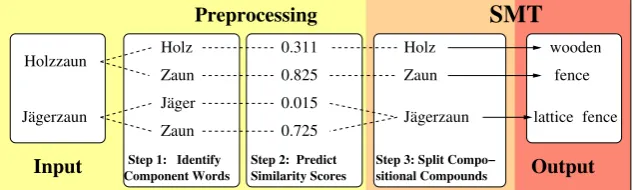
Output Input
Preprocessing
Step 1: Identify
Component Words Similarity Scores Step 2: Predict
sitional Compounds Step 3: Split Compo− 0.311
0.825
0.015
0.725
Holzzaun wooden
fence Holz
Zaun Zaun
Holz
Jägerzaun Jäger lattice fence
Zaun Jägerzaun
[image:3.595.141.459.65.160.2]SMT
Figure 1: Semantically-informed compound processing in SMT.
compound. The underlying assumption is that a compound which is similar in meaning to a constituent (as inHolzzaun–Zaun(‘wooden fence’–‘fence’) but not inL¨owenzahn–Zahn(‘lion|tooth (dandelion)’– ‘tooth’)) is also similar to the constituent with regard to co-occurrence information.
Most related to this work on noun compounds, Reddy et al. (2011) relied on window-based distribu-tional models to predict the composidistribu-tionality of English noun compounds, and Schulte im Walde et al. (2013) compared window-based against syntax-based distributional models to predict the composition-ality of German noun compounds. Zinsmeister and Heid (2004) used subcategorising verbs to predict compound–head similarities of German noun compounds. Most recently, Salehi et al. (2014) extended the previous approaches to take multi-lingual co-occurrence information into account, regarding English and German noun compounds, and English particle verbs.
3 Methodology
We integrate our semantically-informed compound splitting as a pre-processing step to the German source language of an SMT system. See Figure 1 for an illustration of our compound processing pipeline.
3.1 Target Compounds
German compounds are combinations of two (or more) simplex words. In some cases, a morphological transformation is required: for example, when combining the two nouns Ausflug(‘excursion’) andZiel
(‘destination’)→Ausflugsziel(‘excursion destination’), a filler letter (here: “s”) needs to be inserted. Other such transformations include more filler letters or the deletion/substitution of letters.
Noun compoundsare formed of a head noun and a modifier, which can consist of nouns, verbs, adjec-tives or proper nouns.
Particle verbsare productive compositions of a base verb and a prefix particle, whose part-of-speech varies between open-class nouns, adjectives, and verbs, and closed-class prepositions and adverbs. In comparison to noun compounds, the constituents of German particle verbs exhibit a much higher degree of ambiguity: Verbs in general are more ambiguous than nouns, and the largest sub-class of particles (those with a preposition particle) is highly ambiguous by itself (e.g. Lechler and Roßdeutscher (2009) and Springorum (2011)). For example, inanknabbern(‘to nibble partially’), the particleanexpresses a partitive meaning , whereas inankleben(‘to glue onto sth.’)anhas a topological meaning (to glue sth. onto an implicit background). In addition, particle verb senses may be transparent or opaque with respect to their base verbs. For example,abholen‘fetch’ is rather transparent with respect to its base verbholen
‘fetch’, whereasanfangen‘begin’ is more opaque with respect tofangen‘catch’. In contrast,einsetzen
has both transparent (e.g. ‘insert’) and opaque (e.g. ‘begin’) verb senses with respect tosetzen‘put/sit (down)’. The high degree of ambiguity makes particle verbs a challenge for NLP. Moreover, particle and base verb can occur separately (er f¨angt an: ‘he begins’) or in one word (dass er anf¨angt: ‘that he begins’), depending on the clausal type. This makes consistent treatment of particle verbs difficult.
3.2 Identification of Component Parts
inflection. In this paper, we will not consider splitting into derivational affixes (as needed for, e.g., Arabic and Turkish), but instead identify simplex words that may also occur independently. Moreover, we only keep noun compounds and particle verbs consisting of two constituents. The resulting set consists of 93,299 noun compound types and 3,689 particle verb types.
3.3 Predicting Compositionality based on Distributional Similarity
Starting from this set of compounds as derived from our parallel training data, we collected distributional co-occurrence information from two large German web corpora and the machine translation training data: (i) the GermanCOW corpus (Sch¨afer and Bildhauer (2012),∼9 billion words), (ii) theSdeWaC(Faaß and Eckart (2013),∼880 million words), (iii) our MT parallel corpus (∼40 million words) and (iv) MT language model training data (∼146 million words). We relied on earlier work and used the 20,000 most frequent nouns from the SdeWaC as co-occurrence features, looking into a window of 20 words to the left and to the right of our target compounds and their constituents. We thus obtained a co-occurrence matrix of all compounds and their constituents with the 20,000 selected nouns. As co-occurrence strength (i.e., how strong is a co-occurrence between a target word and a co-occurring noun), we collected frequencies and transformed them intolocal mutual information (LMI)values, cf. Evert (2005). Finally, we calcu-lated the distributional similarity between the compounds and their constituents, relying on the standard measurecosine. The cosine value is then used to predict the degree of compositionality between the respective compound–constituent pairs. For example, the cosine value of the pairBaumschule–Baum1is
0.38, while the cosine value of the pairBaumschule–Schuleis only0.01.
3.4 Semantically-Informed Compound Splitting
In the two preceding sections, we described how we identified component words and calculated distribu-tional composidistribu-tionality scores for all of the compounds found in our training data. Here, we give details on how we include the semantic information into the compound splitting process. Recall that we only want to split compositional compounds and keep non-compositional compounds together.
The splitting decision (to split/not split a compound) is based on the compositionality score of the compound that takes into account either one or both of the compound–constituent cosine values: if the predicted degree of compositionality is high, the compound is split. We consider and combine four dif-ferent criteria: i) only the compound–modifier similarity (mod); (ii) only the compound–head similarity (head); a combination of the compound–modifier and the compound–head similarities, relying on (iii) the geometric mean (geom) or (iv) on the arithmetic mean (arith). We used different thresholds for each of these criteria throughout our experiments, with a specific focus on distinguishing the contributions of the modifiers vs. the heads in the splitting decision, following insights from recent work in psycholinguistic studies (Gagn´e and Spalding, 2009; Gagn´e and Spalding, 2011) as well as in computational approaches on noun compounding (Reddy et al., 2011; Schulte im Walde et al., 2013). Furthermore, we compare the effects of splitting with regard to two types of compounds, noun compounds and particle verbs: Both types are very productive and can generate a potentially infinite number of new forms.
4 Experimental Setting
This section gives an overview on the technical details of the SMT system and our data sets. Compound splitting is applied to all source-language data, i.e. the parallel data used to train the model, as well as the input for parameter tuning and testing.2
Translation Model Moses is a state-of-the-art toolkit for phrase-based SMT systems (Koehn et al., 2007). We use it with default settings to train a translation model and we do so separately for each of the different compound splittings. Word alignment is performed using GIZA++ (Och and Ney, 2003). Fea-ture weights are tuned using Batch-Mira (Cherry and Foster, 2012) with’-safe-hope’until convergence.
Training Data Our parallel training data contains the Europarl corpus (version 4, cf. Koehn (2005)) and also newspaper texts, overall ca. 1.5 million sentences3(roughly 44 million words). In addition, we
1Baum|schule: ‘tree|school’ (tree nursery)
2Compounds not contained in the parallel data are always split, as they cannot be translated otherwise.
use an English corpus of roughly 227 million words (including the English part of the parallel data) to build a target-side 5-gram language model with SRILM (Stolcke, 2002) in combination with KENLM (Heafield, 2011). For parameter tuning, we use 1,025 sentences of news data.
Standard Test set1,026 sentences of news data (test set from the 2009 WMT Shared Task): this set is to measure the translation quality on a standard SMT test and make it comparable to other work.
Noun/Verb Test setAs our main focus lies on sentences containing compounds, we created a second test set which is rich in compounds. From the combined 2008-2013 Shared Task test sets, we extracted all sentences containing at least one noun compound for which we have compound-constituent similarity scores. Moreover, we excluded sentences containing nouns that are not in the parallel training data: such compounds can only be translated when split which allows to translate their components. The final test set consists of 2,574 sentences. Similarly, we also created a set rich in particle verbs (855 sentences).
Opaque Test setAs the two first test sets mainly contain compositional compounds, we use a third test set consisting of sentences with only non-compositional compounds. The underlying compounds were chosen based on a list containing noun compounds and human ratings for compositionality (von der Heide and Borgwaldt (2009)). As before, the compounds must have occurred in the parallel data. The result is a list of 14 compounds, of which 11 have a low modifier-compound similarity and 3 have a low head-compound similarity. We then extracted sentences containing these compounds (5 per compound = 70 in total) from German newspaper data4. In contrast to the other sets, we use this test set in a qualitative study, to approximate the translation quality by counting the number of correctly translated compounds. 5 SMT Results
In this section, we present and discuss the results of our machine translation experiments. We first report results for two test sets in terms of a standard evaluation metric (BLEU) and then continue with a small-scale qualitative study on the translational behaviour of non-compositional compounds.
5.1 Compound Splitting within a Standard SMT Task
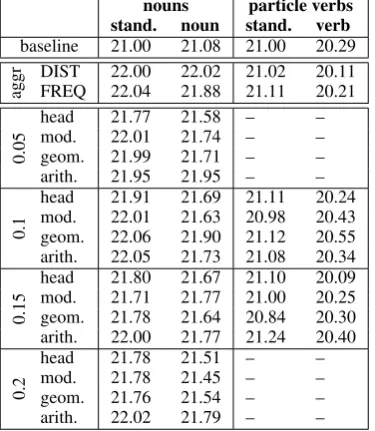
BLEU (Papineni et al., 2002) is a common metric to automatically measure the quality of SMT output by comparing n-gram matches of the SMT output with a human reference translation. Table 1 lists the results for our SMT-systems: we report on different compound-constituent scores and thresholds, for noun compounds and particle verbs respectively. Note that BLEU scores are not comparable across
dif-nouns particle verbs stand. noun stand. verb
baseline 21.00 21.08 21.00 20.29
aggr DISTFREQ 22.0022.04 22.0221.88 21.0221.11 20.1120.21
0.05
head 21.77 21.58 – –
mod. 22.01 21.74 – –
geom. 21.99 21.71 – –
arith. 21.95 21.95 – –
0.1
head 21.91 21.69 21.11 20.24 mod. 22.01 21.63 20.98 20.43 geom. 22.06 21.90 21.12 20.55 arith. 22.05 21.73 21.08 20.34
0.15
head 21.80 21.67 21.10 20.09 mod. 21.71 21.77 21.00 20.25 geom. 21.78 21.64 20.84 20.30 arith. 22.00 21.77 21.24 20.40
0.2
head 21.78 21.51 – –
mod. 21.78 21.45 – –
geom. 21.76 21.54 – –
[image:5.595.83.271.478.694.2]arith. 22.02 21.79 – –
Table 1: BLEU scores for all compound-constituent variations.
ferent test sets, but only illustrate system differences within one test set. We compare our systems to the scores of abaseline system(without compound process-ing) and an aggressive split system in which all noun compounds and particle verbs are split. The labelsDIST
andFREQindicate how several possible splittings were disambiguated:DISTmeans we chose the splitting option having the higher geometric mean of the two compound-constituent scores, assuming that the variant expressing a higher compositionality score leads to the more probable splitting analysis. ForFREQ, the decision is based on the geometric mean of corpus frequencies of the respective components of the compound, as is common practise for the disambiguation of multiple splitting options in SMT (Koehn and Knight, 2003; Fritzinger and Fraser, 2010). In terms of BLEU, there is little difference for these two variants. For further experiments, we thus decided to al-ways useFREQfor disambiguation, assuming that com-ponents chosen by frequency are potentially better
rating compound gloss mod. head translation HIGHLY Staats|bankrott nation|bankruptcy 0.4779 0.6527 national bankruptcy
COMP. Staats|gebilde nation|structure 0.6955 0.3431 national structure MEDIUM Industrie|staat industry|nation 0.0258 0.1488 industrial nation
[image:6.595.106.491.62.137.2]COMP. Staats|kasse nation|cash box 0.0718 0.2757 public purse, treasury LOW Staats|spitze nation|top 0.0024 0.0040 top/head of state COMP. Staats|monotheismus nation|monotheism 0.0071 0.0071 national monotheism
Table 2: Examples for different compound-constitutent score ranges: HIGH: highly compositional, MEDIUM: cases of doubt,LOW: highly non-compositional, according to their scores.
sented in the training data. Thus, we first use frequencies to determine the best split option in the case of several possibilities, and then we apply distributional semantics to determine whether to split at all. The remainder of Table 1 reports on different variants of the semantically-informed splitting criteria we used. The notationhead/mod/geom/arithindicates which (combination of) compound-constituent scores were applied as criterion, with the threshold indicated by the vertical number. We performed the first set of experiments with different thresholds for noun compounds, and then applied the medium-range thresholds to the particle verbs. Generally, there are no considerable differences between the systems with semantically restricted splitting and theaggressive splitsystems, even though there seems to be a slightly positive effect for particle verbs. Having a closer look, we find that for noun compounds on the standard test set, the best results (threshold: 0.1) are at the same level as theaggressive split systems; with some small losses in BLEU on some of the other settings.
5.2 Discussion
All settings clearly outperform the baseline system (without compound processing). This indicates that phrase-based SMT is rather robust with regard to non-semantic splitting as it is can often recover from over-splitting by translating the word sequence as a phrase. This is in line with previous observations of Koehn and Knight (2003). The results for the noun test set, which is biased towards containing more nominal compounds, even suggests that less splitting might harm the system, as the BLEU scores tend to drop when increasing the threshold. For particle verbs,5the picture is slightly different: first, splitting only particle verbs does not lead to a considerable improvement over the baseline, as in the case of noun compounds. For the verb test set, it even leads to a drop in BLEU. However, a more restricted splitting leads to improved BLEU scores, even though not significantly better than the un-split baseline system. Even though the handling of particle verbs needs to be refined in terms of dealing with their structural behaviour (split vs. unsplit depending on the sentence structure) or ambiguities of the particle verb, we consider this an encouraging result indicating that particle verbs can benefit from a semantically-informed splitting process.
There are several possible reasons why a more restricted splitting might not lead to an improvement, even though the idea of splitting only compositional compounds is intuitive and straightforward.
Inconsistent SplittingCompositionality is a continuum rather than a binary decision, with the scores of many (compositional) compounds being in the medium range. Thus, it happens that some compounds containing a certain constituent are split, whereas others are not: such inconsistent splittings do not contribute to the generalization compound splitting aims for. Table 2 gives examples for compounds with different degrees of compositionality, which illustrate this issue: for Industriestaat (’industrial nation’) and Staatskasse (’public purse’) in the middle part of the table, a splitting decision based on theheadscores for thresholds of 0.15 or 0.2 leads to inconsistent splitting. Only compounds with high scores, as the examples at the top of Table 2 are always split. The bottom part gives examples with comparatively low compound-constituent scores that would benefit from splitting, but which will not be split in any of our systems.
compound gloss translation unsplit f split f
Seehunde sea|dogs seals seals 5 seals 5
Flohmarkt flea|market flea market flea market 5 flea market 5
Kopfsalat head|salad lettuce lettuce 5 lettuce 5
Handtuch hand|cloth towel towel 5 towel 5
Kronleuchter crown|candelabra chandelier chandelier 5 crown leuchter 5 G¨urteltiere belt|animal armadillo armadillos 5 belt animals 5 Wasserhahn water|rooster tap tap 5 water tapwater supply 23 Meerschweinchen sea|piglet guinea pig guinea pig 5 guinea pig 4
sea pig 1
[image:7.595.101.497.61.268.2]Taschenbuch pocket|book paperback paperback 5 paper backpocket book 32 Kronkorken crown|cork crown cap *kronkorken 5 crown corks 5 Taschenlampe pocket|lamp flashlight *taschenlampe 5 pocket lampbag lamp 41 Fleischwolf meat|wolf meat grinder *fleischwolf 5 meat wolf 5 Marienk¨afer Mary|bug ladybug *marienk¨afer 5 *marie k¨afer 5 Blockfl¨oten block|flute recorder *blockfl¨oten 5 block mightbloc might 41
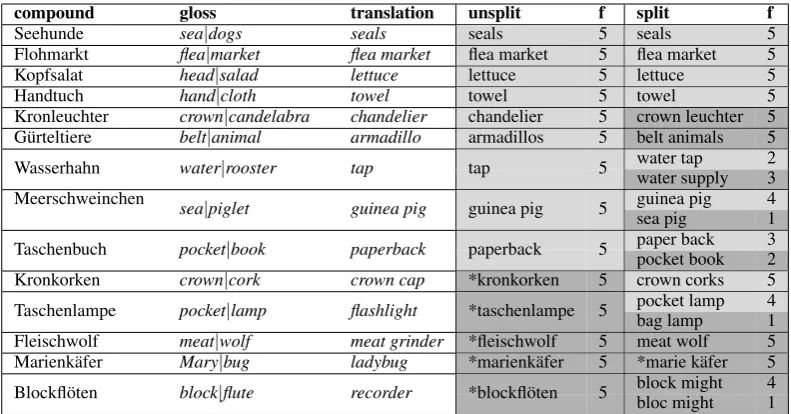
Table 3: correct vs. wrong – Translation of non-compositional compounds (opaque test set) without being split (unsplit) vs. beingsplitprior to translation. ’*’ highlights untranslated compounds.
Coverage of Opaque CompoundsAnother relevant factor concerns the frequency ranges of compounds that are most interesting for this approach. High/mid frequency compounds are usually well-covered by the training data of an SMT system, and in most cases they are translated correctly even if they have been split erroneously. This is due to the fact that split compounds can be learned and translated as a phrase if there were enough instances for the system to learn a valid translation. In the case of low-frequency compounds, the system is less likely to learn a correct translation from the parallel data. However, low-frequency compounds are not well covered by the system and splitting should thus be highly beneficial. Newly created, i.e. highly compositional compounds, tend to be of low frequency, as is illustrated by the example ofStaatsmonotheismus(freq=1 in the parallel data) in Table 2. However, a wrong splitting decision for a non-compositional compound of low frequency is likely to lead to an incorrect translation as the SMT system has better statistics for the individual parts than for the sequence of the compounds constituents. We assume that for low-frequency compounds the distributional similar-ity scores are generally less reliable, even though using LMI helps to minimize this. To a certain extent, we expect non-compositional compounds –which are typically considered as lexicalized– to occur with higher frequencies than novel compositional compounds.6 Furthermore, there are considerably more compositional than non-compositional compounds in standard text. Thus, being in favor of splitting in the case of low-frequency words should be reasonable in most contexts.
6 A Closer Look at Translating Opaque Compounds
In this section, we compare the translations of non-compositional compounds when they are unsplit and when they are split. We use a small test set containing 70 sentences, 5 for each of the 14 non-compositional compounds (see Section 4). Then we conduct a small-scale qualitative analysis focusing on the correct translation of opaque compounds.
Table 3 reports on correct translations for the non-compositional compounds for an experiment where they have been splitor not split (unsplit) prior to translation. Even though all compounds occurred in the parallel data, five (which are marked with ’*’) cannot be translated by the unsplit system due to not being aligned correctly. The other compounds are translated correctly (marked with “+” in Table 3). In the course of our study, we found that many of the correct translations remain the same (seals, flea market, lettuce, towel). In the case ofguinea pig, paperbackandtapthere are mixed results of correct and incorrect translations. Only in the cases ofchandelier(“crown leuchter”) andarmadillo(“belt animal”), 6It has to be noted, though, that the model is influenced by the somewhat different domain of the parallel data (European
compound gloss translation compound gloss translation
[image:8.595.115.491.62.124.2]B¨arlauch bear|leek bear leek Handtasche hand|bag handbag Baumschule tree|school tree nursery Hirschk¨afer stag|beetle stag beetle L¨owenanteil lion|share lion’s share H¨uttenk¨ase cottage|cheese cottage cheese Fliegenpilz fly|mushroom fly agaric Kronkorken crown|cork crown cap Flohmarkt flea|market flea market Teelicht tea|light tea candle
Table 4: Examples for (near) literal translation of non-compositional compounds.
which were translated correctly with theunsplitsystem, all translations obtained with thesplitsystem are wrong. Somewhat surprisingly, in some cases there even is a benefit from splitting the non-compositional compounds:Kronkorken, previously not translated at all, is correctly generated ascrown cork. For other previously untranslated words, Fleischwolf and Taschenlampe, literal translations of the constituents are given: whilemeat wolf(instead ofmeat grinder) is probably not understandable, the translation of
Taschenlampeaspocket lampis certainly preferable to the untranslated compound.
Due to the observed unexpected translational behaviour of 2 of the 14 non-compositional compounds (FlohmarktandKronkorken), which can be translated literally and thus –in theory– benefit from splitting, we present a small study illustrating that this phenomenon is not as rare as one would intuitively expect. This study is not meant to be comprehensive, but rather to point out that the translational behaviour of non-compositional compounds can correspond to that of compositional compounds; Table 4 lists a few such examples. We assume that this behaviour is due to the fact that English and German are similar languages with a similar background. Thus, the “images” used in non-compositional words often tend to be similar. For some of the compounds (e.g.Flohmarkt) this is even true for some Romance languages, too (IT:mercato delle pulci, FR:march´e aux puces) .
Generally, the SMT system should even be able to handle cases where the translation of one part is not strictly literal (e.g. cap–corkoragaric–mushroom). In comparison to a dictionary, which only lists few translations, the translation model offers a large choice of translation options that are not always strictly synonymous, but can cover a large range of related meanings. In combination with the target-side language model, this could allow to “guess” good translations of such compounds. However, the component-wise translation of non-compositional compounds only works if the source- and target lan-guage compounds contain the same number of constituents. For example, consider translating the word
Faultier(lazy|animal: “sloth”): even if the SMT system offers the translationfaul–sloth, it would also need to produce a translation for the constituenttier, probably resulting in something likesloth animal.
In conclusion, while phrase-based SMT is often able to recover from over-splitting by translating a word sequence as a phrase, this is not always necessary for opaque compounds as they can have a literal or near-literal translation. Thus, for explicitly handling non-compositional compounds in SMT, a monolingual estimation of compositionality is not the only relevant factor. The translational behaviour of compounds should also be taken into account.
7 Conclusion and Future Work
We studied the impact of compositionality in German-English SMT by restricting compound splitting to compositional compounds. The decision about compositionality is based on the distributional similarity between a compound and its constituents. We experimented with different threshold/score combinations on a standard and a specifically created test set. Our results indicate that phrase-based SMT is very robust with regard to over-splitting non-compositional noun compounds, with the exception of low-frequency compounds. Furthermore, we studied the translational behaviour of non-compositional compounds with a special focus on the fact that non-compositional compounds can in some cases be translated component-wise, leading to the conclusion that a monolingual estimation of compositionality is not sufficient for an optimal explicit handling of compounds in SMT applications.
Acknowledgements
This work was funded by the DFG Research Projects ”Distributional Approaches to Semantic Related-ness” (Marion Weller, Stefan M¨uller) and “Models of Morphosyntax for Statistical Machine Transla-tion – Phase 2” (Fabienne Cap, Alexander Fraser, Marion Weller) and the DFG Heisenberg Fellowship SCHU-2580/1-1 (Sabine Schulte im Walde).
References
Ming-Hong Bai, Keh-Jiann Chen, and Jason S Chang. 2008. Improving word alignment by adjusting chinese word segmentation. In IJCNLP’08: Proceedings of the 3rd International Joint Conference on Natural Language Processing, pages 249–256.
Collin Bannard. 2005. Learning about the Meaning of Verb–Particle Constructions from Corpora. Computer
Speech and Language, 19:467–478.
Stefan Bott and Sabine Schulte im Walde. 2014. Optimizing a Distributional Semantic Model for the Prediction of German Particle Verb Compositionality. InProceedings of the 9th Conference on Language Resources and Evaluation, Reykjavik, Iceland.
Colin Cherry and George Foster. 2012. Batch tuning strategies for statistical machine translation. In HLT-NAACL’12: Proceedings of the Human Language Technology Conference of the North American Chapter of the Association for Computational Linguistics, volume 12, pages 34–35.
Paul Cook and Suzanne Stevenson. 2006. Classifying Particle Semantics in English Verb-Particle Constructions.
InProceedings of the ACL/COLING Workshop on Multiword Expressions: Identifying and Exploiting
Underly-ing Properties, pages 45–53, Sydney, Australia.
Steve DeNeefe, Ulf Hermjakob, and Kevin Knight. 2008. Overcoming vocabulary sparsity in mt using lattices.
In AMTA’08: Proceedings of the 8th Biennial Conference of the Association for Machine Translation in the
Americas.
Stefan Evert. 2005. The Statistics of Word Co-Occurrences: Word Pairs and Collocations. Ph.D. thesis, Institut f¨ur Maschinelle Sprachverarbeitung, Universit¨at Stuttgart.
Gertrud Faaß and Kerstin Eckart. 2013. SdeWaC – a Corpus of Parsable Sentences from the Web. InProceedings of the International Conference of the German Society for Computational Linguistics and Language Technology, pages 61–68, Darmstadt, Germany.
John R. Firth. 1957. Papers in Linguistics 1934-51. Longmans, London, UK.
Fabienne Fritzinger and Alexander Fraser. 2010. How to Avoid Burning Ducks: Combining Linguistic Analysis and Corpus Statistics for German Compound Processing. InProceedings of the Fifth Workshop on Statistical
Machine Translation, pages 224–234. Association for Computational Linguistics.
Christina L. Gagn´e and Thomas L. Spalding. 2009. Constituent Integration during the Processing of Compound Words: Does it involve the Use of Relational Structures? Journal of Memory and Language, 60:20–35. Christina L. Gagn´e and Thomas L. Spalding. 2011. Inferential Processing and Meta-Knowledge as the Bases for
Property Inclusion in Combined Concepts. Journal of Memory and Language, 65:176–192.
Zellig Harris. 1968. Distributional Structure. In Jerold J. Katz, editor, The Philosophy of Linguistics, Oxford Readings in Philosophy, pages 26–47. Oxford University Press.
Kenneth Heafield. 2011. Kenlm: faster and smaller language model queries. InEMNLP’11: Proceedings of the 6th workshop on statistical machine translation within the 8th Conference on Empirical Methods in Natural
Language Processing, pages 187–197.
Philipp Koehn and Kevin Knight. 2003. Empirical methods for compound splitting. InEACL ’03: Proceedings of the 10th Conference of the European Chapter of the Association for Computational Linguistics, pages 187–193, Morristown, NJ, USA. Association for Computational Linguistics.
Philipp Koehn. 2005. Europarl: a parallel corpus for statistical machine translation. InMT Summit’05: Proceed-ings of the 10th machine translation summit, pages 79–86.
Natalie K¨uhner and Sabine Schulte im Walde. 2010. Determining the Degree of Compositionality of German Par-ticle Verbs by Clustering Approaches. InProceedings of the 10th Conference on Natural Language Processing, pages 47–56, Saarbr¨ucken, Germany.
Andrea Lechler and Antje Roßdeutscher. 2009. German Particle Verbs withauf. Reconstructing their Composition in a DRT-based Framework.Linguistische Berichte, 220.
Diana McCarthy, Bill Keller, and John Carroll. 2003. Detecting a Continuum of Compositionality in Phrasal Verbs. InProceedings of the ACL-SIGLEX Workshop on Multiword Expressions: Analysis, Acquisition and Treatment, pages 73–80, Sapporo, Japan.
Sonja Nießen and Hermann Ney. 2000. Improving SMT quality with morpho-syntactic analysis. InCOLING’00:
Proceedings of the 18th International Conference on Computational Linguistics, pages 1081–1085. Morgan
Kaufmann.
Franz Josef Och and Hermann Ney. 2003. A systematic comparison of various statistical alignment models.
Computational Linguistics, 29(1):19–51,.
Kishore Papineni, Salim Roukos, Todd Ward, and Wei-Jing Zhu. 2002. Bleu: A method for automatic evaluation of machine translation. InACL’02: Proceedings of the 40th Annual Meeting of the Association for Computa-tional Linguistics, pages 311–318.
Siva Reddy, Diana McCarthy, and Suresh Manandhar. 2011. An Empirical Study on Compositionality in Com-pound Nouns. InProceedings of the 5th International Joint Conference on Natural Language Processing, pages 210–218, Chiang Mai, Thailand.
Bahar Salehi, Paul Cook, and Timothy Baldwin. 2014. Using Distributional Similarity of Multi-Way Translations to Predict Multiword Expression Compositionality. InProceedings of EACL 2014.
Roland Sch¨afer and Felix Bildhauer. 2012. Building Large Corpora from the Web Using a New Efficient Tool Chain. In Proceedings of the 8th International Conference on Language Resources and Evaluation, pages 486–493, Istanbul, Turkey.
Helmut Schmid, Arne Fitschen, and Ulrich Heid. 2004. Smor: A German computational morphology covering derivation, composition and inflection. InLREC ’04: Proceedings of the 4th Conference on Language Resources
and Evaluation, pages 1263–1266.
Sabine Schulte im Walde, Stefan M¨uller, and Stephen Roller. 2013. Exploring Vector Space Models to Predict the Compositionality of German Noun-Noun Compounds. InProceedings of the 2nd Joint Conference on Lexical
and Computational Semantics, pages 255–265, Atlanta, GA.
Sylvia Springorum. 2011. DRT-based Analysis of the German Verb Particle”an”. Leuvense Bijdragen, 97:80– 105.
Andreas Stolcke. 2002. SRILM – an extensible language modelling toolkit. InICSLN’02: Proceedings of the international conference on spoken language processing, pages 901–904.
Sara Stymne. 2008. German compounds in factored statistical machine translation. InGoTAL ’08: Proceedings
of the 6th International Conference on Natural Language Processing, pages 464–475. Springer Verlag.
Claudia von der Heide and Susanne Borgwaldt. 2009. Assoziationen zu Unter, Basis und Oberbegriffen. In
Proceedings of the 9th Norddeutsches Linguistisches Kolloquium, pages 51–74.
Heike Zinsmeister and Ulrich Heid. 2004. Collocations of Complex Nouns: Evidence for Lexicalisation. In