Estimation of Sensitivity of the DS/AHP Method While
Solving Foresight Problems with Incomplete Data
N. Pankratova, N. Nedashkovskaya
Institute for Applied Systems Analysis, National Technical University of Ukraine “Kyiv Polytechnic Institute”, Kyiv, Ukraine Email: [email protected], [email protected]
Received September 20, 2012; revised October 20, 2012; accepted October 28, 2012
ABSTRACT
The paper provides mathematical analysis of sensitivity of different combination rules in the DS/AHP method when an alternative is added to the set of decision alternatives while solving foresight problems. Different cases of rank reversals are defined and two sets of conditions for these cases using the method DS/AHP are considered. Rank reversals are il- lustrated when the DS/AHP method is used to solve practical problem of critical technologies of energy conservation and power efficiency evaluation in Ukraine. It is shown that the DS/AHP method is not sensitive to exclusion (or addi- tion) of an irrelevant decision alternative from (or to) the set of decision alternatives.
Keywords: Analytic Hierarchy Process; Dempster-Shafer Theory; Incomplete Expert Information; Multiple Criteria
Analysis; Combination Rules; Rank Reversal; Foresight Problems
1. Introduction
Technological foresight is a decision making relative to complex systems with human factor concerning their po- tential behavior in future [1]. Foresight problems have innovation character. Mainly information of qualitative character in a form of expert estimates, which is often incomplete, fuzzy and contradictory, serves as input data for these problems. Therefore, technique of decision- making support must include methods for processing in- formation of the mentioned character and also means of estimation of sensitivity and validity for the obtained re- sults.
One of the methods, which are applied in the tech- nique of scenario analysis [1] for solving problems of technological foresight, is the Analytic Hierarchy Process (AHP). Elaborated by T. Saaty AHP and its generaliza- tion the Analytic Network Process are popular decision tools used to weight items based on pairwise compari- sons in terms of multiple criteria [2-5]. Nowadays AHP and its extensions are used to determine relative weights of items and probabilities of scenarios for solving fore- sight problems [6,7].
While solving foresight problems, information about decision alternatives may be incomplete due to time limi- tations, ignorance, intangible nature of some attributes, limited information processing capabilities etc. Besides, a decision maker is not always able to make pairwise comparisons between all decision alternatives. However, this is a prerequisite for the application of AHP. The
DS/AHP method [8,9], which incorporates AHP with the Dempster-Shafer theory (DST) of evidence [10] solves a multiple-criteria decision-making (MCDM) problem di- rectly based on its incomplete expert judgments in terms of criteria. Different combination rules in DST represent different treatment of conflict in the aggregated result.
One of the problems associated with the use of MCDM techniques is the possibility to change the ranking of de- cision alternatives when an alternative is added or de- leted (the rank reversal). A detailed discussion on differ- ent types of rank reversals in the AHP method will be found in the literature of the subject [11-16]. Some rank reversal cases also occur when other MCDM methods, in particular the ELECTRE II, III, the TOPSIS methods and others, are used [17,18]. Several numerical examples are given to validate the DS/AHP method with respect to the Pareto optimality and the independence of irrelevant de- cision alternatives [19].
This paper provides mathematical analysis and simula- tion study of sensitivity of different combination rules of the DS/AHP method when an alternative is added to the set of decision alternatives while solving foresight prob- lems.
2. The DS/AHP Method and the
Combination Rules
the DS/AHP method of MCDM is introduced [8]. DS/AHP (as in AHP) is based on a hierarchical structure of a pro- blem.
In DS/AHP measures of probability are assigned to groups of decision alternatives (DAs), each group of identified DAs is compared to the frame of discernment
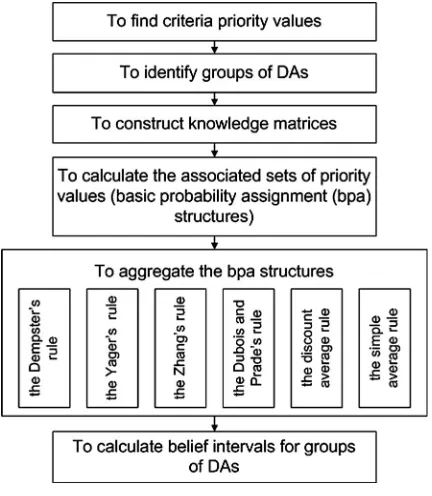
(all possible DAs), and expert expresses some degree of “favorable knowledge” on each of these groups. This differs from AHP, which makes pairwise comparisons between individual DAs. Number of identified groups reflects the amount of knowledge the expert has on a criterion. Let us consider steps of the DS/AHP method (Figure 1):
Step 1: to find criteria priority values (CPVs) using the standard eigenvector method of AHP.
Step 2: to identify groups of DAs for each criterion. The number of identified groups is decided by the expert and may reflect the amount of knowledge the expert has on the criterion. Within one group, DAs have equal fa- vorability to the frame of discernment .
Step 3: to construct the knowledge matrix
i j, 1, ,r 1
c
w i1, d d
S
c
w
1
r ij
D d for each criterion where
, 1
i r i i i
ures of favorability of the groups of DAs i with respect to in terms of the criterion, is the CPV;
d d , ,r, values are the meas-
1, 1 0 i j
c
r i i
d d w , i1,,r; dii 1, dij for , ; r-number of groups of DAs on the crite- rion.
, 1, , r i j
Step 4: to calculate the associated sets of priority val- ues for the knowledge matrices for each criterion (basic probability assignment (bpa) structures for groups of
Figure 1. Steps of the DS/AHP method.
DAs and in terms of the criteria) again using the standard eigenvector method of AHP. Analytic functions
: 2 0,1
m
are constructed to find the bpa [9]:
1
r
c c
i i j
j
m S d w d w r
, Si , i1, 2, , r
1
r c j j
m r d w r
m m m m
Step 5: to aggregate the bpa structures founded in step 4 into a single bpa aggr 1 2 p
aggr
m
using a rule of combination, where p is a number of decision criteria. The resulting bpa structure represents the amounts of exact belief in groups of DAs based on the combined evidence from all the criteria. is the value of combined uncertainty.
Step 6: to calculate values of the belief
Bel: 2
0,1
Pls: 2
0,1
and plausibility
,
Bel Pls
functions and obtain the belief interval :
aggr
B A
Bel A m B
,
1 aggr
B A
Pls A m B
A for each group of DAs .
There are different ways where evidence can be com- bined in DST. The original Dempster’s rule of combina- tion is considered as AND-operation and ignores the conflict between the evidence. In the DS/AHP method proposed in [8,9] the Dempster’s rule is used instead of distributive and ideal modes of AHP to combine the mea- sures of evidence (bpa values) from different sources (decision criteria). This rule assumes that these sources are independent. According to the rule combined evi- dence from all criteria is defined by the function
1 2: 2 0,1
m m
, which is a bpa:
1 2 1 2
1 Dpstr
X Y A
m m A m X m Y
K
A and
m1 m2
Dpstr
0if
,
X Y
, where m1, m2 are
bpa structures to be aggregated, are focal elements, the normalization factor
1 2 1 1 2
X Y X Y
K m X m Y m X m Y
1 2
1
2Ygr
X Y A
m m A q A m X m Y
is interpreted as a measure of conflict between the pieces of evidence.
Other combination rules represent different treatment of conflict in the aggregated result. The Yager’s rule of combination is as follows [20]:
[image:2.595.65.281.477.725.2]sent the conflict the value q
0 is used. This con-flict value is added to the aggregated probability assign- ment of the frame, i.e. conflict is attributed to the frame and the evidence is not changed through the normaliza- tion.
In the Zhang’s combination rule the intersection of focal elements is considered as follows [21]:
m X m Y1
2
1 2
.Zhang m m
1 2m X m Y
1 2
Zhang
X Y A A
m m A K
X Y
where |.| defines a cardinality of a set, K is a normaliza- tion factor to provide the sum of the
to add to 1.
The Dubois and Prade’s combination rule is OR-
based and therefore any normalization is required [22]:
1 2
DbsPd
X Y A
m m A
,
If all sources of evidence are reliable, an AND-based operation is appropriate. If only one source is considered reliable, an OR-based operation has to be used.
The described Yager’s, Zhang’s, Dubois and Prade’s rules represent modified Dempster’s rule. Other combi- nation rules are based on a weighted average function. The discount average combination rule is as follows [10]:
i
Bel Ai
1
1
1
1 p 1
discnt p
i
m m A
p
,where the i
Bel
’s are degrees of trust in the belief functions i’s to be aggregated, i 0,1
. The ruleis used when all belief functions are highly conflicting and also to eliminate the influence of single strongly con- flicting belief function.
Also the simple average combination rule which may be considered as the distributive synthesis mode is used:
1
1 p
p i i
i
w m A p
w m
1
averg
m m A ,
where the i’s are degrees of trust in the sources, i’s are the bpa’s for the belief structures to be aggregated,
0,1 i
w
S S
.
A combination rule has to aggregate evidence obtained from more than two sources (decision criteria). All of the above rules are commutative. The Dempster’s, Dubois and Prade’s and average rules are associative. The Ya- ger’s rule is quasi-associative.
One of the problems with a MСDM technique is a possibility to change the ranking of DAs when a DA is added or deleted (so called rank reversal). In the next Section the estimation of sensitivity of the above combi-nation rules while adding a DA is provided.
3. Estimation of Sensitivity of the DS/AHP
Method
Suppose n DAs A1, A2,···, An are evaluated in terms of
two decision criteria C1 and C2. For these criteria d1 and
d2 groups of DAs S11, S12,···, 1d1 and S21, S22,···, 2d2,
respectively, are identified as being comparable to the frame of discernment , where ,
2p 2r
1k 1l
S S
S S , k l, 1, , d1 p r, 1, , d2
Bel
, . Using the
DS/AHP method, the belief measures and belief intervals Bel
,Pls
are calculated for each group of DAs and the frame .We are interested in the conditions of changes in the DA ranking orders obtained by the DS/AHP method when a DA is added to the set of DAs. Two sets of such conditions are defined [23]. The first set of conditions deals with the changes in the belief-based ranking orders of DAs. Belief measures Bel S
i and Bel
S
S
i de- note the amounts of exact belief in a group i based on combined evidence from two criteria before and after a DA is added to the set of DAs, respectively. The second set of conditions of changes in the DA ranking orders concerns the comparison of belief intervals
i ,
iBel S Pls S
and Bel
Si ,Pls
Si , where
plausibility measures Pls S
Pls
SS
S
i and i denote
the maximum probability of possible support to a group
i before and after a DA is added to the set of DAs, respectively.
Condition#1 ofrank reversal: Preference relation de- fined by belief measures for groups i and Sj is changed after a DA is added to the set of DAs:
0 0 0
0 0
ij ij ij ij
ij ij
Bel Bel Bel Bel
Bel Bel
ij i j
Bel Bel S Bel S
,
where
ij i j
Bel Bel S Bel S
Condition#2 ofrank reversal: Preference relation de- fined by belief intervals for groups Si and Sj is changed after a DA is added to the set of DAs.
To obtain the preference relations among groups of DAs the evidential reasoning ranking method is used [23] to generate the rank of groups of DAs based on their be- lief intervals.
In this paper, three known criteria are used to test sen- sitivity of the DS/AHP method while adding a DA. These criteria were applied to test other MCDM methods [17].
unchanged. The same should also be true for the relative rankings of the rest of the unchanged DAs.
Testcriterion#2: The rankings of DAs by an effective MCDM method should follow the transitivity property.
Test criterion#3: For the same decision problem and while using the same MCDM method, after combining the rankings of the smaller problems that an MCDM problem is decomposed into, the new overall ranking of the DAs should be identical to the original overall rank- ing of the un-decomposed problem.
Let us consider different cases of rank reversals when the DS/AHP method is used. Suppose that an irrelevant DA is added to the set of DAs, it will be the most inter- esting result for solving foresight problems.
Case 1: New DA AN1 is irrelevant and forms a
separategroupwithrespect toeach oneofthe decision criteria, i.e.
AN1
S1i and
AN1
S2k ,
k d
, ,
,
, .
1 2
The intersections’ sub-matrix 1i 2k for groups of DAs 1
1, ,
1,
i d
S S
N
A A in the Dempster’s, Yager’s and Zhang’s
combination rules remains unchanged when such DA
1
N
A is added. However, the normalization constants K in the Dempster’s and Zhang’s rules are changed. There- fore the values of aggregated mass function and therefore the corresponding belief measures for groups of DAs
1, , N
A A may be changed disproportionately when
these rules are applied. Thus, rank reversals in the rules may occur under the Condition #1. In the Yager’s com- bination rule rank reversals do not occur when such new DA is added.
Case 2: New DA AN1 is irrelevant and forms a
separategroupintermsofonlyonedecisioncriterion. In terms ofthe otherdecisioncriterionthis DA AN1 has
the samemeasure offavorabilitywith respect to as one or several previously existing DAs, i.e. AN1 is
includedintooneoftheexistinggroupsof DAs.
Let DA AN1 be included into the group 21 (with-
out loss of generality, the choice of 21 is not detrimen-
tal). Then, after introduction of the DA N 1
S S
A the groups S11, S12,···, S1D1 and
are identified in terms ofcriterion C1 and the groups 2 2
1
21
N A
22
, , , D
S S S
A
, ,
in terms of criterion C2, where 21 21 N1 . The intersec- tions’ sub-matrix in each of the Dempster’s, Yager’s and Zhang’s combination rules for the groups of “previously existing” DAs is changed, since the intersection of group
21 with the frame is changed. The normalization
constants in the Dempster’s and Zhang’s combination rules are also changed. Therefore, the values of aggre- gated mass function and therefore the corresponding be- lief measures for groups of DAs 1
S S
S
N
A A
S
may be changed disproportionately when these rules are used. Thus, rank reversal in these rules may occur under the Condition #1.
Let us consider the possibility of rank reversal in the DS/AHP method under the test criterion #2. Suppose that the DS/AHP method has ranked a set of DAs of a deci- sion problem. Next, assume that this problem is decom-posed into a set of smaller problems each defined on two DAs at a time and the same number of decision criteria as in the original problem. Then, according to the test criterion #2, all the partial rankings deriving from the smaller problems should comply with the transitivity property. Let us denote groups of DAs in terms of two decision criteria C1 and C2 as 1i and S2j. Suppose each of the groups consists of a single element, namely
, ,
S S A S S A
i
11 21 1 1N 2N N . Assume that the
groups of DAs are considered in pairs and rankings of two arbitrary pairs are A Aj and AjAk
i
. Then the aggregated mass of DA A under the Dempster’s com-
bination rule is
1 2
1 2 2 1 2
1
Dpstr
i i i
m m A
m A m A m m m A K
j
.
Then rankings AiA and Aj Ak lead to the following inequalities:
1 2 2 1 2
1 2 2 1 2 0
i i i
j j j
m A m A m m m A
m A m A m m m A
1 2 2 1 2
1 2 2 1 2 0
j j j
k k k
m A m A m m m A
m A m A m m m A
After combination of these inequalities we have AiAk. Thus, if each group of DAs consists of a single element, then the transitivity property is satisfied, and, hence, rank reversal does not appear in the Dempster’s combination rule under the test criterion #2. The same conclusion is true for the Yager’s and Zhang’s combination rules.
4. Evaluation of Critical Technologies of
Energy Conservation and Power
Efficiency in Ukraine
The DS/AHP method was used to calculate relative pri- ority values for critical technologies (CTs) of energy conservation and power efficiency in Ukraine. Quantita- tive information of passports of CTs and qualitative in-formation in a form of expert estimates serves as input data for this problem.
chine building) and in energy networks (electrical power engineering and technologies of burning). Renewable energy CTs include geothermal, wind, solar and bio- energetics technologies. Problem of power efficiency is included in a notion of eco-house only as a part along with building materials production, construction of eco- house and waste utilization. Therefore the technology of effective eco-house was considered separately. Relative priority values for the 14 CTs A1 - A14 were calculated using the DS/AHP method on basis of information of passports of the CTs and expert judgments about relative importance of CTs in terms of risk factors and relative importance of decision criteria.
Groups of DAs were as follows:
- In terms of criterion C1: S1 = {A1, A2, A5, A6, A12}, S2 = {A3, A8, A9, A10, A13}, S3 = {A7, A11}, S4 = {A4},
- In terms of criterion C2: S1 = {A11, A12, A13}, S2 = {A6, A10}, S3 = {A2, A3}, S4={A4, A7, A8, A9}, S5 = {A1, A5},
- In terms of criterion C3: S1 = {A12}, S2 = {A11, A13}, S3 = {A6, A7}, S4 = {A3, A4, A5}, S5 = {A1, A2, A8, A9, A10},
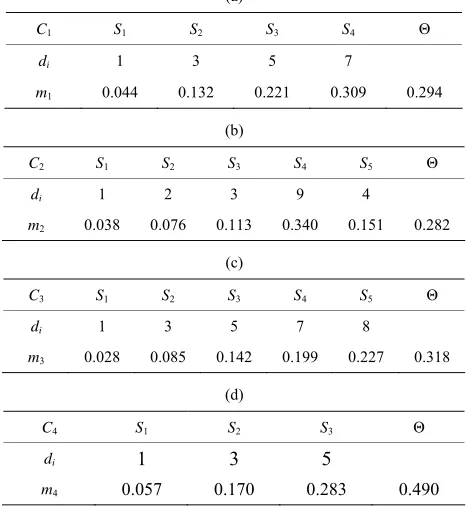
- In terms of criterion C4: S1 = {A3}, S2 = {A1, A2, A4, A8, A9, A10, A11, A12}, S3 = { A5, A6, A7, A13}. CPVs of the criteria were equal to 0.3, 0.3, 0.2 and 0.2. Measures of favorability di i of the groups of DAswith respect to and bpa structuresof the groups of DAs in terms of criteria are illustrated in Table 1.
d
3 4
m m m
3
m m m
0.093
A11
0.070
A10
0.067
5 0.059
A
9, 10, 13A A
0.042
Next step is to aggregate the bpa structures into a sin-
gle bpa 1 . For example, an ag-
gregated bpa structure aggr 1 using the Demp-
ster’s combination rule is as follows:
2
aggr
m m
m1m3
A4 0.160,
m1 m3
,
m1 m3
A7, ,
m1 m3
A A1, 2, 8, 9,A A
,
1 3 3, 4,
m m A A
m m
A A A3, 8,,
1 3
m1m3
A6, 7A
0.042,
,
m1m3
A7
0.031.026
A11, 13A
0.025
0.019
A A1, 2, 5, 6, 12A A A
0.014
m1m3
A8,A A9, 10
0.030,
m1m3
A3
0 ,
m1 m3
,
m1 m3
A11
, [image:5.595.306.539.129.382.2]
m1 m3
,Table 1.Measures of favorability di and bpa structures of
the groups of DAs in terms of decision criteria C1 (a), C2 (b), C2 (c) and C4 (d).
(a)
C1 S1 S2 S3 S4 Θ
di 1 3 5 7
m1 0.044 0.132 0.221 0.309 0.294
(b)
C2 S1 S2 S3 S4 S5 Θ
di 1 2 3 9 4
m2 0.038 0.076 0.113 0.340 0.151 0.282
(c)
C3 S1 S2 S3 S4 S5 Θ
di 1 3 5 7 8
m3 0.028 0.085 0.142 0.199 0.227 0.318
(d)
C4 S1 S2 S3 Θ
di 1 3 5
m4 0.057 0.170 0.283 0.490
m1m3
A13
0.011,
m1m3
A A1, 2
0.010
m1m3
A12
0.010,
m1m3
A5
0.009,
m1m3
A6
0.006
.
As a result, based on the aggregated bpa structure
,maggr m1m3 m2 m4 ranking of the CTs
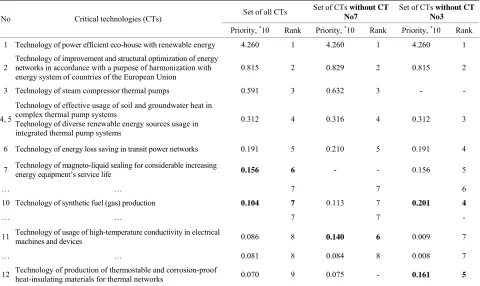
was constructed. CTs with the highest priorities are pre- sented in Table 2.
Exclusion from consideration priority DA may lead to significant changes of results. Thus, exclusion of DA No3 “Technology of steam compressor thermal pumps” which is in a group of optimal DAs in terms of one of the criteria, results in redistribution of priority rating and DA “Technology of synthetic fuel (gas) production” receives 4th rank. Exclusion of DA of lower rank, which is less priority, in fact has no influence on the solution.
5. Conclusions
Table 2. Priorities and ranks of the energy conservation and power efficiency CTs.
Set of all CTs Set of CTs without CT
No7
Set of CTs without CT No3
No Critical technologies (CTs)
Priority, *10 Rank Priority, *10 Rank Priority, *10 Rank
1 Technology of power efficient eco-house with renewable energy 4.260 1 4.260 1 4.260 1
2
Technology of improvement and structural optimization of energy networks in accordance with a purpose of harmonization with energy system of countries of the European Union
0.815 2 0.829 2 0.815 2
3 Technology of steam compressor thermal pumps 0.591 3 0.632 3 - -
4, 5
Technology of effective usage of soil and groundwater heat in complex thermal pump systems
Technology of diverse renewable energy sources usage in integrated thermal pump systems
0.312 4 0.316 4 0.312 3
6 Technology of energy loss saving in transit power networks 0.191 5 0.210 5 0.191 4
7 Technology of magneto-liquid sealing for considerable increasing energy equipment’s service life 0.156 6 - - 0.156 5
… … 7 7 6
10 Technology of synthetic fuel (gas) production 0.104 7 0.113 7 0.201 4
… … 7 7 -
11 Technology of usage of high-temperature conductivity in electrical machines and devices 0.086 8 0.140 6 0.009 7
… … 0.081 8 0.084 8 0.008 7
12 Technology of production of thermostable and corrosion-proof heat-insulating materials for thermal networks 0.070 9 0.075 - 0.161 5
each decision criterion, and as a result overall less prior- ity. Our investigation reveals that exclusion of such deci- sion alternative while solving foresight problems with in- complete data using the DS/AHP method doesnotresult in redistributions in a subset of high priority decision alternatives and, therefore has no influence on the choice of high priority solution. Thus, the DS/AHP method is not sensitive to exclusion (or addition) of an irrelevant decision alternative from (or to) the set of decision alter- natives.
It is the very first time that the DS/AHP method is used to solve foresight problems, as well as rank rever- sals are reported to occur while using this method. There- fore, determination of priority critical technologies a pri- ori requires additional investigations concerning possi- bility of rank reversals when a decision alternative is added or excluded.
REFERENCES
[1] M. Z. Zgurovsky and N. D. Pankratova, “System Analy- sis: Theory and Applications,” Springer, Berlin, 2007. [2] T. L. Saaty, “The Analytic Hierarchy Process,” McGraw-
Hill, New York, 1980.
[3] T. L. Saaty, “Theory of the Analytic Hierarchy Process, Part 2.1,” SystemResearch &InformationTechnologies, No. 1, 2003, pp. 48-72.
[4] T. L. Saaty, “Theory of the Analytic Hierarchy and Ana-
lytic Network Processes—Examples, Part 2.2,” System Research &InformationTechnologies, No. 2, 2003, pp. 7-34.
[5] T. L. Saaty, “The Analytic Network Process, Examples, Part 2.3,” SystemResearch&InformationTechnologies, No. 4, 2003, pp. 7-23.
[6] N. D. Pankratova and N. I. Nedashkovskaya, “Method for Processing Fuzzy Expert Information in Prediction Prob- lems. Part I,” Journal of Automation and Information Sciences, Vol. 39, No. 3, 2007, pp. 22-36.
doi:10.1615/JAutomatInfScien.v39.i4.30
[7] N. D. Pankratova and N. I. Nedashkovskaya, “Method for Processing Fuzzy Expert Information in Prediction Prob- lems. Part II,” Journal of Automation and Information Sciences, Vol. 39, No. 6, 2007, pp. 30-44.
doi:10.1615/JAutomatInfScien.v39.i6.20
[8] M. J. Beynon, B. Curry and P. H. Morgan, “The Demp- ster-Shafer Theory of Evidence: An Alternative Approach to Multicriteria Decision Modeling,” Omega, Vol. 28, No. 1, 2000, pp. 37-50. doi:10.1016/S0305-0483(99)00033-X
[9] M. J. Beynon, “DS/AHP Method: A Mathematical Analy- sis, Including an Understanding of Uncertainty,” Euro- peanJournalofOperationalResearch, Vol. 140, No. 1, 2002, pp. 148-164. doi:10.1016/S0377-2217(01)00230-2
[10] G. Shafer, “A Mathematical Theory of Evidence,” Prin- ceton University Press, Princeton, 1976.
[12] V. Belton and T. Gear, “On a Shortcoming of Saaty’s Method of Analytic Hierarchies,” Omega, Vol. 11, No. 3, 1983, pp. 228-230. doi:10.1016/0305-0483(83)90047-6
[13] J. S. Dyer, “Remarks on the Analytic Hierarchy Process,” ManagementScience, Vol. 36, No. 3, 1990, pp. 249-258.
doi:10.1287/mnsc.36.3.249
[14] E. Triantaphyllou, “Two New Cases of Rank Reversals When the AHP and Some of Its Additive Variants Are Used That Do Not Occur with the Multiplicative AHP,” JournalofMulti-CriteriaDecisionAnalysis, Vol. 10, No. 1, 2001, pp. 11-25. doi:10.1002/mcda.284
[15] T. L. Saaty, “Rank Generation, Preservation and Reversal in the Analytic Hierarchy Process,” Decision Sciences, Vol. 18, No. 2, 1987, pp. 157-177.
doi:10.1111/j.1540-5915.1987.tb01514.x
[16] T. L. Saaty, “Rank from Comparisons and from Ratings in the Analytic Hierarchy/ Network Processes,” European JournalofOperationalResearch, Vol. 168, No. 2, 2006, pp. 557-570. doi:10.1016/j.ejor.2004.04.032
[17] X. Wang and E. Triantaphyllou, “Ranking Irregularities When Evaluating Alternatives by Using Some ELECTRE Methods,” Omega, Vol. 36, No. 1, 2008, pp. 45-63.
doi:10.1016/j.omega.2005.12.003
[18] V. G. Totsenko, “On Problem of Reversal of Alternatives Ranks While Multicriteria Estimating,” JournalofAuto- mationand Information Sciences, Vol. 38, No. 6, 2006,
pp. 1-11. doi:10.1615/J Automat Inf Scien.v38.i6.10
[19] M. J. Beynon, “The Role of the DS/AHP in Identifying Inter-Group Alliances and Majority Rule within Group Decision Making,” GroupDecisionandNegotiation, Vol. 15, No. 1, 2006, pp. 21-42.
doi:10.1007/s10726-005-1159-9
[20] R. Yager, “On the Dempster-Shafer Framework and New Combination Rules,” InformationSciences, Vol. 41, No. 2, 1987, pp. 93-137. doi:10.1016/0020-0255(87)90007-7
[21] L. Zhang, “Representation, Independence, and Combina- tion of Evidence in the Dempster-Shafer Theory,” In: R. R. Yager, J. Kacprzyk and M. Fedrizzi, Eds., Advancesin theDempster-ShaferTheoryof Evidence, John Wiley & Sons, Inc., New York, 1994, pp. 51-69.
[22] D. Dubois and H. Prade, “A Set-Theoretic View on Belief Functions: Logical Operations and Approximations by Fuzzy Sets,” International Journal of General Systems, Vol. 12, No. 3, 1986, pp. 193-226.
doi:10.1080/03081078608934937
[23] N. I. Nedashkovskaya, “Multi-Criteria Decision Making in the Presence of Ignorance Using the DS/AHP Me- thod,” Proceedingsofthe 11thInternational Symposium fortheAHP/ANP (ISAHP), Naples, 15-18 June 2011.