Multi-source Cross-lingual Delexicalized Parser Transfer:
Prague or Stanford?
Rudolf Rosa
Charles University in Prague Faculty of Mathematics and Physics Institute of Formal and Applied Linguistics
Czech Republic
Abstract
We compare two annotation styles, Prague dependencies and Universal Stanford De-pendencies, in their adequacy for pars-ing. We specifically focus on comparing the adposition attachment style, used in these two formalisms, applied in multi-source cross-lingual delexicalized depen-dency parser transfer performed by parse tree combination. We show that in our set-ting, converting the adposition annotation to Stanford style in the Prague style train-ing treebanks leads to promistrain-ing results. We find that best results can be obtained by parsing the target sentences with parsers trained on treebanks using both of the ad-position annotation styles in parallel, and combining all the resulting parse trees to-gether after having converted them to the Stanford adposition style (+0.39% UAS over Prague style baseline). The score im-provements are considerably more signif-icant when using a smaller set of diverse source treebanks (up to +2.24% UAS over the baseline).
1 Introduction
Dependency treebanks are annotated in various styles, with annotations based on Prague depen-dencies (B¨ohmov´a et al., 2003) and (Universal) Stanford Dependencies (De Marneffe and Man-ning, 2008; de Marneffe et al., 2014) being the most popular and widespread.1 In last years,
several treebank collections with unified annota-tion have been published. The largest of them, HamleDT, currently offers 30 treebanks, semi-automatically converted both to Prague
dependen-1We use the termannotation styleto refer to the set of
annotation conventions, as applied in annotating a given tree-bank, typically also defined by an annotation manual.
bar of chocolate
nmod case
AuxP Atr
chocolate bar
nmod
[image:1.595.312.498.207.276.2]Atr
Figure 1: Stanford style (above) and Prague style (below) analysis of the phrases “bar of chocolate” and “chocolate bar”. Note that in Stanford style, these phrases have a more similar structure, both featuring an nmod edge directly from “bar” to “chocolate”. This shows the principle of construc-tions with a similar meaning also having a similar dependency structure.
cies and Universal Stanford Dependencies (Ze-man et al., 2012; Rosa et al., 2014), and featur-ing morphological annotation usfeatur-ing Interset (Ze-man, 2008). Another collection, Google Universal Treebanks, contains 11 treebanks, generally anno-tated from scratch using a version of Stanford De-pendencies (McDonald et al., 2013) and Univer-sal POS (Petrov et al., 2012). Recently, these ef-forts have joined to produce Universal Dependen-cies (UD), which currently contain 18 treebanks annotated with a newly defined annotation scheme based on Universal Stanford Dependencies, Uni-versal POS tags and Interset (Agi´c et al., 2015). UD are now becoming the de facto standard; how-ever, we used the HamleDT collection for our ex-periments, as at the time of performing the exper-iments, HamleDT was much larger than UD, as well as more diverse in terms of language families represented.
1.1 Prague versus Stanford
One of the prominent features of Stanford style dependencies is their approach to function words. The general rule is that all function words, such
as adpositions2 or conjunctions, are attached as
leaf nodes. This is a result of a standpoint which favours direct dependency relations between lexi-cal nodes, not mediated by function words. This also makes dependency structures more similar cross-lingually, as it is very common that the same function is expressed by an adposition in one lan-guage, but by other means, such as morphology or word order, in another language – or even within the same language, as shown in Figure 1. On the other hand, Prague style dependencies anno-tate adpositions as heads of adpositional groups.3
While Stanford style trees may be more use-ful for further processing in NLP applications, it has been argued that Prague style trees are eas-ier to obtain by using statistical parsers. Among other differences, adpositions provide important cues to the parser for adpositional group attach-ment, which is one of the most notorious parsing problems. This information becomes harder to ac-cess when the adpositions are annotated as leafs. The issue of dependency representation learnabil-ity has been studied by several authors, gener-ally reaching similar conclusions (Schwartz et al., 2012; Søgaard, 2013; Ivanova et al., 2013). The approach suggested by de Marneffe et al. (2014) is to use a different annotation style for parsing, with Prague style adposition annotation, among other, and to convert the dependency trees to full Stan-ford style only after parsing for subsequent appli-cations.
Still, while the aforementioned observations seem to hold in the general case, in multilingual parsing scenarios, the higher cross-lingual simi-larity of Stanford style dependency trees may be of benefit. From all of the differences between Prague and Stanford, the adposition attachment seems to be the most interesting, as adpositions are usually very frequent and diverse in languages, as well as very important in parsing. Therefore, in this work, we evaluate the influence of adposi-tion annotaadposi-tion style in cross-lingual multi-source delexicalized parser transfer.
2Adposition is a general term for prepositions,
postposi-tions and circumposipostposi-tions.
3The lexical nodes are only directly connected in Prague
tectogrammatical (deep-syntax) dependency trees, where function words are removed and their functions are captured via node attributes. It is worth noting that in general, there is little difference between representing information by means of node attributes or leaf nodes; thus, Stanford trees and Prague tectogrammatical trees are actually very similar in structure.
1.2 Delexicalized parser transfer
In the approach of single-source delexicalized dependency parser transfer (Zeman and Resnik, 2008), we train a parser on a treebank for a resource-rich source language, using non-lexical features, most notably part-of-speech (POS) tags, but not using word forms or lemmas. Then, we apply that parser to a POS-tagged corpus of an under-resourced target language, to obtain a de-pendency parse tree. Delexicalized transfer typ-ically yields worse results than a fully supervised lexicalized parser, trained on a treebank for the tar-get language. However, for a vast majority of lan-guages, there are no manually devised treebanks, in which case it may be useful to obtain at least a lower-quality parse tree for tasks such as informa-tion retrieval or machine translainforma-tion. Still, in this work, we do not apply delexicalized parser trans-fer to under-resourced languages, since there is no easy way of evaluating such experiments. Rather, we follow the usual way of using target languages for which there is a treebank available and thus the experiments can be easily evaluated, but we do not use the target treebank for training, thus sim-ulating the under-resourcedness of the target lan-guage.
ported from a monolingual to a multilingual set-ting, where the individual parsers are trained over different languages.
A possible research path which we do not fol-low in this work is the choice or weighting of the source languages according to their similarity to the target language, which has been successfully employed by several authors (Naseem et al., 2012; Søgaard and Wulff, 2012; T¨ackstr¨om et al., 2013; Rosa and ˇZabokrtsk´y, 2015). This may have sim-ilar effect to our annotation style conversions, or it may be that these two approaches will behave rather orthogonally, as they might target differ-ent interlingual differences. Also, selection of a source language similar to the target may weaken the need for increasing annotation similarity, but this approach may still be useful for targets very dissimilar to the available sources. We believe these to be interesting questions that deserve fur-ther research.
1.3 This work
In this work, we use the HamleDT 2.0 collection and the MSTParser (McDonald et al., 2005b) to evaluate the potential benefit of employing Stan-ford style adposition attachment instead of the Prague style in parsing. We first show that in a monolingual setting, Prague style adposition an-notation performs better than the Stanford style, both for lexicalized and delexicalized parsing. We also show that fully Stanfordized dependency trees perform even worse, but we further focus on adpo-sition attachment only; the other annotation differ-ences are of less interest for us, as they concern less frequent phenomena and/or do not seem so promising for cross-lingual experiments. We then perform extensive delexicalized parser transfer ex-periments, both using the full HamleDT collection as source treebanks (in a leave-one-out fashion), as well as using various smaller subsets consist-ing of languages with different adpositional char-acteristics. We also investigate a number of setups for parsing and combining the dependency trees with conversions between Prague style and Stan-ford style in between.
We conclude that the Stanford style of ad-position attachment seems to be beneficial in multi-source cross-lingual delexicalized depen-dency parser transfer. Overall, best results are obtained by training parsers on source treebanks both in Prague and Stanford style, parsing the
target text by all of the parsers, converting the Prague style parser outputs into Stanford style, and combining all of the parse trees. This approach achieves an average improvement of +0.39% UAS absolute over using Prague style only. When the set of source treebanks is small and the languages differ a lot in terms of adpositions, the improve-ments are even larger, up to +2.24% UAS absolute over the Prague style baseline.
2 Method
2.1 Dependency parser
Throughout this work, we use MSTperl (Rosa, 2015b), an implementation of the MSTParser of McDonald et al. (2005b), with first-order features and non-projective parsing. The parser is a single-best one, returning exactly one parse tree for each input sentence. It is trained using 3 iterations of MIRA (Crammer and Singer, 2003). The parser performs unlabelled parsing, returning only the dependency tree, with no dependency relation la-bels. We only evaluate unlabelled parsing in this work.
Our delexicalized feature set is based on (Mc-Donald et al., 2005a), with lexical features re-moved, and consists of various conjunctions of the following features:
POS tags We use the coarse 12-value Universal POS Tagset (UPT) of Petrov et al. (2012).4
For an edge, we use information about the POS tag of the head, dependent, their neigh-bours, and all of the nodes between them.
Token distance We use signed distance of head and dependent (orderhead−orderdependent),
bucketed into the following buckets:
+1; +2; +3; +4; ≥+5; ≥+11;
−1; −2; −3; −4; ≤−5; ≤−11.
We use exactly the same settings of the parser in all experiments. For lexicalized parsing, we also include the word form and word lemma of the head and dependent node, in various conjunctions with the POS tags and token distance as well as with each other. The configuration files that con-tain the feature sets and other settings, as well as the scripts we used to conduct our experiments, are available in (Rosa, 2015a).
4These 12 values are: NOUN, VERB, PUNCT, ADJ,
Size (kTokens) Language Train Test
ar Arabic 250 28
bg Bulgarian 191 6
bn Bengali 7 1
ca Catalan 391 54
cs Czech 1,331 174
da Danish 95 6
de German 649 33
el Greek 66 5
en English 447 6
es Spanish 428 51
et Estonian 9 1
eu Basque 138 15
fa Persian 183 7
fi Finnish 54 6
grc Ancient Greek 304 6
hi Hindi 269 27
hu Hungarian 132 8
it Italian 72 6
ja Japanese 152 6
la Latin 49 5
nl Dutch 196 6
pt Portuguese 207 6
ro Romanian 34 3
ru Russian 495 4
sk Slovak 816 86
sl Slovenian 29 7
sv Swedish 192 6
ta Tamil 8 2
te Telugu 6 1
[image:4.595.102.259.59.388.2]tr Turkish 66 5
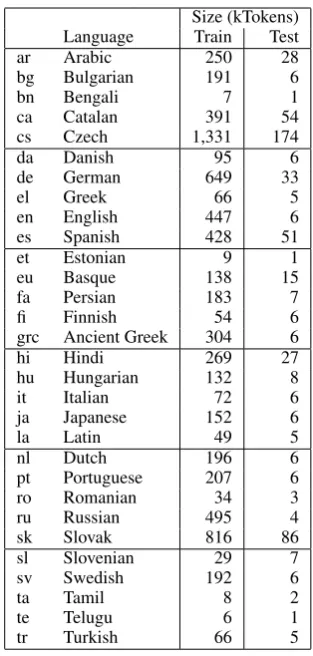
Table 1: List of HamleDT 2.0 treebanks.
Please note that our conclusions are only valid for the MSTperl parser, and may not hold e.g. for higher order graph based parsers or transition based parsers. In this work, we decided to focus on breadth of evaluated parsing and combination se-tups; we intend to evaluate a wider range of parsers in future.
2.2 Dataset and its conversions
We use the HamleDT 2.0 collection of 30 dependency treebanks, which had been semi-automatically harmonized to Prague dependencies and then Stanfordized into Universal Stanford De-pendencies. We list the treebanks and their sizes in Table 1. More information about the treebanks contained in the dataset, as well as the dataset it-self, can be obtained online.5
In most experiments, we use the Prague style version of HamleDT, as the Stanford version per-forms much worse for parsing (see Section 3.1). Instead of using the full Stanford version, we only focus on one of its prominent features – adposition attachment. Thus, we alternate between Prague adposition attachment as head (denoted “P”), and
5https://ufal.mff.cuni.cz/hamledt
trains with sausages and chocolate
P
P
P P
S
S S
S
Figure 2: Original Prague style adposition analysis (above), and Stanford style adposition analysis as produced by the conversion (below). Note that the coordination stays in the Prague style. Edge labels are not shown as we do not use them in this work.
trains with sausages and chocolate
S
S S
S
P P
P
P
Figure 3: Stanford style adposition analysis (above), and Prague style adposition analysis as produced by the conversion (below). Together with Figure 2, this shows a case where our conver-sion is imperfect, as we are unable to obtain the original structure after the conversion roundtrip.
Stanford adposition attachment as leaf node (de-noted “S”), using simple conversion scripts.
• The conversion from P to S takes each ad-position and attaches it as a dependent of its left-most non-adpositional child, together with all of its other non-adpositional chil-dren. Thus, the adposition becomes a leaf node, unless it has adpositional dependent nodes (typically this signifies a compound adposition). Coordinating conjunctions are passed through (recursively) – if the left-most non-adpositional child is a coordinating con-junction, then its dependent leftmost non-adpositional conjunct is used instead as the new head of the adposition (see Figure 2).
[image:4.595.310.518.62.159.2] [image:4.595.311.519.249.358.2]The roundtrip of the conversion (UAS after con-verting from P to S and back) is around 98% in total, and around 94% for adposition nodes alone.
2.3 Parse tree combination
The inference component of the MSTParser is also applied to perform the combination of parse trees obtained for a sentence from different parser in-stances. In that setting, each potential dependency edge is assigned a score equal to the number of in-put parse trees in which it is contained. The MST algorithm then finds and returns a dependency tree in which the edges are confirmed by the highest possible number of input trees.
The general experiment setup is as follows. One of the 30 treebanks is taken as the target treebank, and the remaining 29 treebanks become source treebanks. Then, delexicalized parsers are trained on the source treebanks, resulting in 29 trained parser models. Next, each of the parsers is ap-plied to each sentence in the test section of the target treebank. And finally, the obtained parse trees for each sentence are combined together as has been described above, and the resulting depen-dency tree is evaluated using the target treebank.
Note that there are three places where a con-version from one annotation style to another may take place – conversion of the source treebank be-fore training a parser, conversion of the parser out-put before the parse tree combination, and con-version of the parse tree combination output. We will denote the setups using the pattern“X/Y/Z”, where “X” denotes the annotation style used for parser training and parsing, “Y” is the style into which the parser outputs are converted before be-ing combined, and “Z” is the style into which the result of the combination is converted. Further-more, “P,S/Y/Z” will refer to parsing both with “P” style parsers and “S” style parsers, thus re-sulting in 58 trees for each sentence to combine, rather than 29. In many setups, there is no con-version after the combination, or there is even no combination performed (in monolingual setups); therefore, we will often omit the last part of the pattern, using only “X/Y”.
3 Experiments and Evaluation
We use the training sections of the treebanks for parser training and their testing sections for evalu-ation. We report the results using UAS (unlabelled attachment score).
Setup Lex Delex Transfer
Prague 80.54 74.12 56.68
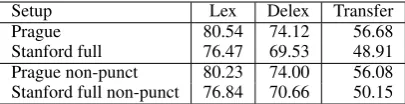
[image:5.595.315.518.62.114.2]Stanford full 76.47 69.53 48.91 Prague non-punct 80.23 74.00 56.08 Stanford full non-punct 76.84 70.66 50.15 Table 2: Prague versus full Stanford annotation style, UAS averaged over 30 target languages. TheLexicalized andDelexicalized parsers are monolingual. TheTransferparser is a combination of 29 sources parsers applied to the remaining target language.
3.1 Full Universal Stanford Dependencies
As a preliminary experiment, we compared the Prague version with its fully Stanfordized version. The results are shown in Table 2. It can be seen that the Stanford version performs much worse than the Prague one – its results are lower by around 5% UAS absolute.
Closer inspection showed that many of the er-rors are actually due to sentence-final punctuation attachment. In Stanford style, sentence-final punc-tuation is to be attached as a dependent node of the root node of the sentence (typically the main predicate). However, this is difficult for the first-order parser, as it has no knowledge of the root node when scoring the potential edges, and thus the punctuation gets often attached to some other verb. In Prague style, the sentence-final punctua-tion is attached to the technical root node, which is marked by special values of the node features, and thus the assignment is very easy to make. While this is an important point to keep in mind when parsing into full Stanford style, it is of little rele-vance to the goal of this paper – punctuation at-tachment is rarely important in NLP applications, and is not very likely to significantly contribute to cross-lingual dependency structure similarity ei-ther. For this reason, we also include UAS mea-sured only on non-punctuation nodes. Still, adpo-sition attachment, which we are mostly interested in, accounts for only a part of the score difference.
3.2 Prague versus Stanford adpositions
Further on, we only use the Prague style annota-tion of the treebanks, with adposiannota-tions annotated either in Prague style (P) or Stanford style (S).
3.2.1 Supervised parsers
Setup Lexicalized Delexicalized P/P 80.54 74.12
S/P 78.44 72.65
S/S 79.77 73.91
[image:6.595.346.488.61.144.2]P/S 80.23 73.94
Table 3: Average UAS of supervised monolingual parsers, both lexicalized and delexicalized.
Setup P/P S/S
UAS >S/S ? >P/P UAS
[image:6.595.108.256.61.113.2]Lexicalized 80.54 13 16 1 79.77 Delexicalized 74.12 11 16 3 73.91
Table 4: Pairs of supervised parser setups. “UAS” = Average UAS as in Table 3
“>S/S”, “>P/P” = Number of languages for which the setup
performed significantly better
“?” = Number of languages for which neither setup per-formed significantly better
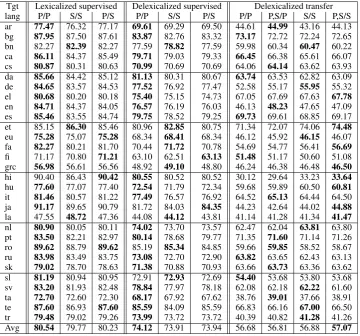
above the S style parser, and Table 4 confirms that the P parser is significantly better than the S parser for nearly half of the languages.6 Actually, to
ob-tain S style parse trees, it is better to parse the text using a parser trained on a P style treebank, and then convert the output parse trees (this yields a +0.46% higher UAS than parsing directly using an S style parser). Here, the adpositions clearly pro-vide important information to the parser, and their annotation as heads benefits the results.
In the delexicalized setting, the P style parser scores higher than the S style one only by a small margin (+0.21% UAS), although still being signif-icantly better for a third of the languages. More-over, parsing directly using the S style is now com-parable to parsing using P style and then convert-ing to S style. This suggests that the most impor-tant piece of information for correctly attaching an adposition is its lemma, and delexicalizing a parser thus reduces the advantage of P style anno-tation for correct adposition attachment.
3.2.2 29-to-1 delexicalized parser transfer
We now move on to the main focus of our work, evaluating the effect of adposition annotation style in multilingual transfer of 29 delexicalized source parsers to a target language using parse tree com-bination.
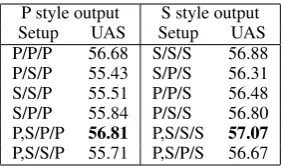
Table 5 shows that using either P or S for every-thing leads to comparable results, with the S style now achieving a slightly better score (+0.20% UAS absolute on average). The results tend to get worse when additional conversions are performed;
6We used McNemar’s test with significance level 5%.
P style output S style output Setup UAS Setup UAS P/P/P 56.68 S/S/S 56.88 P/S/P 55.43 S/P/S 56.31 S/S/P 55.51 P/P/S 56.48 S/P/P 55.84 P/S/S 56.80 P,S/P/P 56.81 P,S/S/S 57.07
P,S/S/P 55.71 P,S/P/S 56.67
Table 5: Average UAS of various setups of delexi-calized parser transfer, always using 1 language as target and the remaining 29 languages as source.
Setup A Setup B
UAS >B ? >A UAS
S/S 56.88 8 13 9 56.68 P/P
[image:6.595.76.288.159.203.2]P,S/P 56.81 5 22 3 56.68 P/P P,S/S 57.07 9 19 2 56.88 S/S P,S/S 57.07 8 17 5 56.81 P,S/P P,S/S 57.07 7 20 3 56.68 P/P
Table 7: Pairs of delexicalized transfer setups. “UAS” = Average UAS as in Table 5
“>B”, “>A” = Number of target languages for which the
setup performed significantly better
“?” = Number of target languages for which neither setup performed significantly better
we thus omit such setups from further evaluation. Interestingly, slight improvements can be obtained by applying both P parsers and S parsers and com-bining them after conversion of the resulting trees to the S style, achieving a total average increase of +0.39 UAS absolute over the P style baseline.
[image:6.595.317.516.211.283.2]Tgt Lexicalized supervised Delexicalized supervised Delexicalized transfer
lang P/P S/S P/S P/P S/S P/S P/P P,S/P S/S P,S/S
ar 77.47 76.32 77.17 69.61 69.29 69.50 44.61 44.99 43.16 44.13 bg 87.95 87.50 87.61 83.87 82.76 83.32 73.17 72.72 72.24 72.65 bn 82.27 82.39 82.27 77.59 78.82 77.59 59.98 60.34 60.47 60.22 ca 86.11 84.37 85.49 79.71 79.03 79.33 66.45 66.38 65.61 66.07 cs 80.87 80.31 80.63 70.99 70.69 70.69 64.06 64.14 63.62 63.93 da 85.66 84.42 85.12 81.13 80.31 80.67 63.74 63.53 62.82 63.09 de 84.65 83.57 84.53 77.52 76.92 77.47 52.58 55.17 55.95 55.32 el 80.68 80.20 80.18 75.40 75.15 74.73 67.05 67.69 67.63 67.78
en 84.71 84.37 84.05 76.57 76.19 76.03 46.13 48.23 47.65 47.09 es 85.46 83.55 84.74 79.75 78.52 79.25 69.73 69.61 68.85 69.17 et 85.15 86.30 85.46 80.96 82.85 80.75 71.34 72.07 74.06 74.48
eu 75.28 75.07 75.28 68.34 68.41 68.34 46.12 45.92 46.15 46.07 fa 82.27 80.21 81.70 70.44 71.72 70.78 54.69 54.77 56.41 56.69
fi 71.17 70.80 71.21 63.10 62.51 63.13 51.48 51.17 50.60 51.08 grc 56.98 56.61 56.56 48.92 49.10 48.80 46.24 46.38 46.48 46.50
hi 90.40 86.43 90.42 80.55 80.52 80.52 30.12 29.64 33.23 33.64
hu 77.60 77.07 77.40 72.54 71.79 72.34 59.68 59.89 60.50 60.81
it 81.46 80.57 81.22 77.49 76.57 76.92 64.52 65.13 64.44 64.50 ja 91.17 89.65 90.79 81.72 84.03 84.35 44.23 42.64 44.02 44.88
la 47.55 48.72 47.36 44.08 44.12 43.81 41.14 41.28 41.34 41.47
[image:7.595.120.481.228.564.2]nl 80.90 80.05 80.11 74.02 73.70 73.57 62.47 62.04 63.81 63.80 pt 83.50 82.21 82.97 80.14 78.68 79.77 71.35 71.60 71.14 71.26 ro 89.62 88.79 89.62 85.19 85.34 84.85 59.66 59.85 58.52 58.67 ru 83.98 83.49 83.75 73.08 72.70 72.90 63.82 63.65 62.43 63.13 sk 79.02 78.70 78.63 71.38 70.88 70.93 63.66 63.73 63.36 63.62 sl 81.19 80.94 80.95 72.91 72.93 72.69 54.40 53.68 53.80 53.68 sv 83.20 81.93 82.48 78.84 77.97 78.18 62.08 62.18 62.22 61.60 ta 72.70 72.60 72.30 68.17 67.92 67.62 38.76 39.01 37.66 38.91 te 87.60 86.93 87.60 85.59 84.09 85.59 66.83 66.16 67.00 66.50 tr 79.48 79.02 79.26 73.99 73.72 73.72 40.39 40.82 41.28 41.26 Avg 80.54 79.77 80.23 74.12 73.91 73.94 56.68 56.81 56.88 57.07
Subset ADP freq. Language 15% Spanish
High 19% Hindi
19% Japanese 9% Czech
Med 8% English
9% Swedish 0% Basque
Low 4% Ancient Greek
1% Hungarian 15% Spanish
Mix 9% Swedish
[image:8.595.329.505.59.399.2]1% Hungarian
Table 8: Subsets of source treebanks, selected ac-cording to their frequency of adposition tokens.
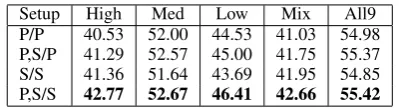
Setup High Med Low Mix All9 P/P 40.53 52.00 44.53 41.03 54.98 P,S/P 41.29 52.57 45.00 41.75 55.37 S/S 41.36 51.64 43.69 41.95 54.85 P,S/S 42.77 52.67 46.41 42.66 55.42
Table 9: UAS of delexicalized parser transfer, av-eraged over 21 target languages, with the specified subset treebanks as sources.
3.2.3 Smaller source treebank subsets
For a deeper insight and further confirmation of our findings, we also performed a set of experi-ments with smaller 3-member subsets of the tree-bank collection. We selected several treetree-bank groups, based on the ratio of adposition tokens to all tokens. We also only chose large enough tree-banks (more than 100,000 tokens). The subsets are listed in Table 8; we also used a larger “All9” set of all the 9 selected treebanks. Only these were then used for training; the remaining 21 languages were used for testing as target languages.
The summary results are to be found in Table 9; the statistical significance of the setups is evalu-ated in Table 10. For these datasets, the advantage of employing the S style in combination with P style becomes clearly visible, frequently leading to significantly better results than when using only the P style (however, using only S style parsers performs rather poorly). Moreover, converting the parse trees to S style before combining them is also often significantly better than converting them to P style. The improvements are large especially for the High, Low and Mix datasets. This sug-gests that the role of Stanford style is stronger with small and highly diverse datasets, where its bene-fit of making the dependency trees more similar becomes rather important.7 For the High dataset,
7Of course, this is only a speculation, as there are many
Source Setup A Setup B
subset UAS >B ? >A UAS
S/S P/P
High 41.36 12 8 1 40.53
Med 51.64 1 16 4 52.00
Low 43.69 2 8 11 44.53
Mix 41.95 9 10 2 41.03
All9 54.85 3 12 6 54.98
P,S/P P/P
High 41.29 9 12 0 40.53
Med 52.57 8 13 0 52.00
Low 45.00 6 14 1 44.53
Mix 41.75 8 13 0 41.03
All9 55.37 6 14 1 54.98
P,S/S S/S
High 42.77 15 6 0 41.36
Med 52.67 15 6 0 51.64
Low 46.41 15 5 1 43.69
Mix 42.66 11 9 1 41.95
All9 55.42 9 12 0 54.85
P,S/S P,S/P
High 42.77 15 6 0 41.29
Med 52.67 4 11 6 52.57
Low 46.41 15 6 0 45.00
Mix 42.66 9 10 2 41.75
All9 55.42 3 12 6 55.37
P,S/S P/P
High 42.77 19 2 0 40.53
Med 52.67 5 16 0 52.00
Low 46.41 15 6 0 44.53
Mix 42.66 13 8 0 41.03
[image:8.595.104.257.62.195.2]All9 55.42 7 11 3 54.98
Table 10: Pairs of delexicalized transfer setups us-ing specific source treeebank subsets.
“UAS” = Average UAS as in Table 9
“>B”, “>A” = Number of target languages for which the
setup performed significantly better
“?” = Number of target languages for which neither setup performed significantly better
the best result surpasses the Prague-only baseline by as much as +2.24% UAS absolute on average, yielding a significantly better result for 19 of the 21 target languages.
4 Conclusion
[image:8.595.81.281.240.295.2]than other annotation styles.
We managed to confirm that for supervised parsing, Prague annotation style is favourable over Stanford style, as has been already stated in litera-ture. However, in the parser transfer setting, Stan-ford style adposition attachment tends to perform better than the Prague style, presumably thanks to its abstraction from the high interlingual variance in adposition usage. Best results are achieved by at once combining outputs of parsers trained on tree-banks of both Prague and Stanford adposition at-tachment style, reaching an average improvement of +0.39% UAS absolute over the Prague style baseline. Our results are further confirmed by ex-periments using smaller and more diverse subsets of training treebanks, where the advantage of com-bining Prague and Stanford adposition annotation style becomes even more pronounced, reaching average improvements of up to +2.24% UAS ab-solute over the Prague style baseline.
We used the first-order non-projective MST-Parser in all experiments; therefore, our conclu-sions are valid only for that parser. The next log-ical research step is thus to apply other parsers in a similar setting to determine whether our findings can be further generalized, or whether using a dif-ferent parser leads to difdif-ferent effects when com-paring and combining Prague and Stanford adpo-sition annotation styles.
Acknowledgments
This research was supported by the grants GAUK 1572314, SVV 260 224, and FP7-ICT-2013-10-610516 (QTLeap). This work has been using lan-guage resources developed, stored and distributed by the LINDAT/CLARIN project of the Ministry of Education, Youth and Sports of the Czech Re-public (project LM2010013).
References
ˇZeljko Agi´c, Maria Jesus Aranzabe, Aitziber Atutxa, Cristina Bosco, Jinho Choi, Marie-Catherine de Marneffe, Timothy Dozat, Rich´ard Farkas, Jennifer Foster, Filip Ginter, Iakes Goenaga, Koldo Gojenola, Yoav Goldberg, Jan Hajiˇc, An-ders Trærup Johannsen, Jenna Kanerva, Juha Kuokkala, Veronika Laippala, Alessandro Lenci, Krister Lind´en, Nikola Ljubeˇsi´c, Teresa Lynn, Christopher Manning, H´ector Alonso Mart´ınez, Ryan McDonald, Anna Missil¨a, Simonetta Monte-magni, Joakim Nivre, Hanna Nurmi, Petya Osen-ova, Slav Petrov, Jussi Piitulainen, Barbara Plank, Prokopis Prokopidis, Sampo Pyysalo, Wolfgang
Seeker, Mojgan Seraji, Natalia Silveira, Maria Simi, Kiril Simov, Aaron Smith, Reut Tsarfaty, Veronika Vincze, and Daniel Zeman. 2015. Universal de-pendencies 1.1. http://hdl.handle.net/ 11234/LRT-1478.
Alena B¨ohmov´a, Jan Hajiˇc, Eva Hajiˇcov´a, and Barbora Hladk´a. 2003. The Prague dependency treebank. In
Treebanks, pages 103–127. Springer.
Yoeng-Jin Chu and Tseng-Hong Liu. 1965. On shortest arborescence of a directed graph. Scientia Sinica, 14(10):1396.
Koby Crammer and Yoram Singer. 2003. Ultracon-servative online algorithms for multiclass problems.
The Journal of Machine Learning Research, 3:951–
991.
Marie-Catherine De Marneffe and Christopher D Man-ning. 2008. The Stanford typed dependencies rep-resentation. In Coling 2008: Proceedings of the workshop on Cross-Framework and Cross-Domain Parser Evaluation, pages 1–8. Association for Com-putational Linguistics.
Marie-Catherine de Marneffe, Natalia Silveira, Tim-othy Dozat, Katri Haverinen, Filip Ginter, Joakim Nivre, and Christopher D. Manning. 2014. Univer-sal Stanford dependencies: A cross-linguistic typol-ogy. InProc. of LREC’14, Reykjavk, Iceland. Euro-pean Language Resources Association (ELRA).
Jack Edmonds. 1967. Optimum branchings. Journal of Research of the National Bureau of Standards B, 71(4):233–240.
Angelina Ivanova, Stephan Oepen, and Lilja Øvrelid. 2013. Survey on parsing three dependency repre-sentations for English. In ACL (Student Research
Workshop), pages 31–37.
Ryan McDonald, Koby Crammer, and Fernando Pereira. 2005a. Online large-margin training of dependency parsers. In Proceedings of the 43rd annual meeting on association for computational linguistics, pages 91–98. Association for Computa-tional Linguistics.
Ryan McDonald, Fernando Pereira, Kiril Ribarov, and Jan Hajiˇc. 2005b. Non-projective dependency pars-ing uspars-ing spannpars-ing tree algorithms. InProceedings of the conference on Human Language Technology and Empirical Methods in Natural Language
Pro-cessing, pages 523–530. Association for
Computa-tional Linguistics.
Ryan McDonald, Slav Petrov, and Keith Hall. 2011. Multi-source transfer of delexicalized dependency parsers. In Proceedings of the Conference on
Em-pirical Methods in Natural Language Processing,
Ryan McDonald, Joakim Nivre, Yvonne Quirmbach-Brundage, Yoav Goldberg, Dipanjan Das, Kuzman Ganchev, Keith Hall, Slav Petrov, Hao Zhang, Os-car T¨ackstr¨om, Claudia Bedini, N´uria Bertomeu Castell´o, and Jungmee Lee. 2013. Universal depen-dency annotation for multilingual parsing. In Pro-ceedings of the 51st Annual Meeting of the Associa-tion for ComputaAssocia-tional Linguistics, pages 92–97.
Tahira Naseem, Regina Barzilay, and Amir Globerson. 2012. Selective sharing for multilingual dependency parsing. InProceedings of the 50th Annual Meet-ing of the Association for Computational LMeet-inguis-
Linguis-tics: Long Papers - Volume 1, ACL ’12, pages 629–
637, Stroudsburg, PA, USA. Association for Com-putational Linguistics.
Slav Petrov, Dipanjan Das, and Ryan McDonald. 2012. A universal part-of-speech tagset. InProc. of LREC-2012, pages 2089–2096, Istanbul, Turkey. European Language Resources Association (ELRA).
Rudolf Rosa and Zdenˇek ˇZabokrtsk´y. 2015. KLcpos3
– a language similarity measure for delexicalized parser transfer. InProceedings of the 51st Annual Meeting of the Association for Computational Lin-guistics and the 7th International Joint Conference on Natural Language Processing of the Asian Fed-eration of Natural Language Processing, Short Pa-pers, Stroudsburg, PA, USA. Association for Com-putational Linguistics, Association for Computa-tional Linguistics.
Rudolf Rosa, Jan Maˇsek, David Mareˇcek, Martin Popel, Daniel Zeman, and Zdenˇek ˇZabokrtsk´y. 2014. HamleDT 2.0: Thirty dependency tree-banks Stanfordized. In Nicoletta Calzolari, Khalid Choukri, Thierry Declerck, Hrafn Loftsson, Bente Maegaard, and Joseph Mariani, editors, Proceed-ings of the 9th International Conference on
Lan-guage Resources and Evaluation (LREC 2014),
pages 2334–2341, Reykjav´ık, Iceland. European Language Resources Association.
Rudolf Rosa. 2015a. MSTperl delexicalized parser transfer scripts and configuration files. http:// hdl.handle.net/11234/1-1485.
Rudolf Rosa. 2015b. MSTperl parser (2015-05-19). http://hdl.handle.net/11234/1-1480.
Kenji Sagae and Alon Lavie. 2006. Parser combi-nation by reparsing. In Proceedings of the Human Language Technology Conference of the NAACL,
Companion Volume: Short Papers, pages 129–132.
Association for Computational Linguistics.
Roy Schwartz, Omri Abend, and Ari Rappoport. 2012. Learnability-based syntactic annotation design. In
Proceedings of COLING 2012: Technical Papers.
Anders Søgaard and Julie Wulff. 2012. An empiri-cal etudy of non-lexiempiri-cal extensions to delexiempiri-calized transfer. InCOLING (Posters), pages 1181–1190.
Anders Søgaard. 2013. An empirical study of dif-ferences between conversion schemes and annota-tion guidelines. In Proceedings of the Second In-ternational Conference on Dependency Linguistics (DepLing 2013), Prague, Czech Republic: Charles University in Prague, Matfyzpress, pages 298–307.
Oscar T¨ackstr¨om, Ryan McDonald, and Joakim Nivre. 2013. Target language adaptation of discriminative transfer parsers. NAACL HLT 2013, pages 1061– 1071.
Daniel Zeman and Philip Resnik. 2008. Cross-language parser adaptation between related lan-guages. InIJCNLP 2008 Workshop on NLP for Less
Privileged Languages, pages 35–42, Hyderabad,
In-dia. Asian Federation of Natural Language Process-ing, International Institute of Information Technol-ogy.
Daniel Zeman, David Mareˇcek, Martin Popel, Loganathan Ramasamy, Jan ˇStˇep´anek, Zdenˇek ˇZabokrtsk´y, and Jan Hajiˇc. 2012. HamleDT: To parse or not to parse? In Nicoletta Calzolari (Con-ference Chair), Khalid Choukri, Thierry Declerck, Mehmet Uur Doan, Bente Maegaard, Joseph Mar-iani, Jan Odijk, and Stelios Piperidis, editors, Pro-ceedings of the Eight International Conference on
Language Resources and Evaluation (LREC’12),
Is-tanbul, Turkey, May. European Language Resources Association (ELRA).
Daniel Zeman. 2008. Reusable tagset conversion us-ing tagset drivers. InProceedings of the 6th Interna-tional Conference on Language Resources and
Eval-uation (LREC 2008), pages 213–218, Marrakech,