Natural Language Processing for Dialectical Arabic: A Survey
Abdulhadi Shoufan Khalifa University Abu Dhabi, U.A.E.
Sumaya Al-Ameri Khalifa University Abu Dhabi, U.A.E.
Abstract
This paper presents a wide literature re-view of natural language processing for di-alectical Arabic. Four main research areas were identified and the dialect coverage in research work was outlined. The paper can be used as a quick reference to identify rel-evant contributions that address a specific NLP aspect for a specific dialect.
1 Introduction
The last ten years have experienced a growing in-terest in natural language processing for dialecti-cal Arabic. This growth can be attributed to sev-eral factors including the wide usage of Arabic di-alects in social media. The topics treated by com-putational linguists for Arabic dialects range from fundamental language aspects including morphol-ogy up to sophisticated solutions such as machine translation.
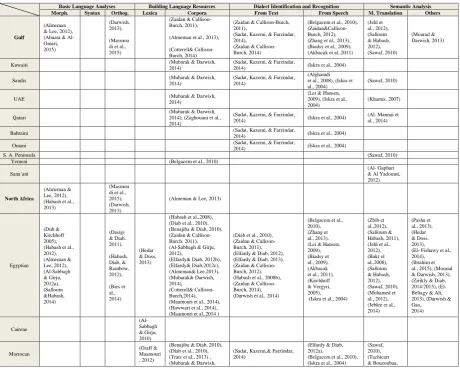
To have an overview of the research that has been done in this area we went through as many papers as possible and tried to specify the main contributions of each paper. We could identify four main categories, whereas each category has some subcategories. The main categories are basic language analyses, building language resources, semantic-level analysis and synthesis, and identi-fying Arabic dialects. Then, we mapped each pa-per to categories and subcategories as well as to the addressed dialect or dialects in a matrix form as given in Table 1. By this means, it can be easily identified what has been done in the Arabic NLP, by whom, and for what dialects.
The following four sections describe the related work in the four main categories. For space rea-sons, however, we limited the description to main aspects. The final section provides a brief discus-sion of the findings of this survey.
2 Basic Language Analyses
Several solutions have been proposed for the mphological analysis, syntactical analysis, and or-thographic analysis and generation. The follow-ing three sections describe these solutions, respec-tively.
2.1 Morphological Analysis and POS Tagging
The morphology of dialectal Arabic had gained early attention by computational linguists. In (Habash & Rambow, 2006), a morphological an-alyzer and generator, denoted MAGED, was pre-sented. This tool is able to analyze the Levantine dialect and to convert MSA to Levantine. In a later publication the authors detailed the morpho-phonemic and the orthographic rules encoded in MAGEAD (Habash & Rambow, 2007).
In (Habash, Eskander, & Hawwari, 2012), a morphological analyzer for Egyptian Arabic is proposed with further development in (Salloum & Habash, 2014).
In (Almeman & Lee, 2012), two morphologi-cal analyzers for Gulf, Levantine, Egyptian, North African, Sudani, and Iraqi dialects were presented. The first one relies on a MSA morphological ana-lyzer. The second one applies word segmentation and uses web data as a corpus to produce statis-tical information about the frequency of different segment combinations. In (Zribi, Khemakhem, & Belguith, 2013), a morphological analyzer for the Tunisian dialect based on a MSA analyzer was proposed. Furthermore, a lexicon for the Tunisian dialect is built as an expansion of a MSA lexi-con. An unsupervised approach for morphologi-cal segmentation was applied to improve machine translation from the Qatari dialect to English (Al-Mannai et al., 2014).
In (Duh & Kirchhoff, 2005), a part-of-speech tagger for Egyptian Arabic was proposed based on a morphological analyzer for MSA and a
imally supervised approach that requires raw text data from several Arabic varieties.
In (Al-Sabbagh & Girju, 2012a), a function-based POS tagger is proposed that was trained on a manually-annotated Egyptian Arabic corpus.
In (Habash et al., 2013) a MSA morphological tagger is retargeted to Egyptian Arabic. The so-lution performs part-of-speech tagging, diacritiza-tion, lemmatizadiacritiza-tion, and tokenization.
A rule-based stemmer for Arabic Gulf dialect was proposed in (Abuata & Al-Omari, 2015), and a fine-grained POS tagger for Tunisian dialect was presented in (Boujelbane et al., 2014).
2.2 Syntax and Parsing
The syntax of Arabic dialects was purely ad-dressed in the context of computational linguistics. In (Brustad, 2000), the author presented a com-parative study of Moroccan, Egyptian, Syrian, and Kuwaiti dialects with respect to syntax however without computational aspects.
In (Chiang et al., 2006) a parser for the Lev-antine Arabic is proposed. The parser doesn’t rely on annotated Levantine corpus or a paral-lel Levantine-MSA corpus. Rather, the Levantine word is translated into a bag of MSA words that are scored and decoded relying on MSA corpus. The resulting text is then parsed using an MSA parser. Finally, the terminal nodes in the result-ing parse structure are replaced with the original Levantine words.
Levantine was also the dialect treated in (Maamouri et al., 2006). In this work a pi-lot Levantine Arabic Treebank is developed by a morphological and syntactic annotation of 26,000 words of Levantine Arabic conversational tele-phone speech. The Treebank was used to de-velop and evaluate parsers for Levantine texts. Grammatical mapping rules were defined to pro-vide language resources for machine translation from Tunisian dialect to MSA and other target lan-guages in (Sadat, Mallek, et al., 2014).
2.3 Orthographic Analysis
In contrast to MSA, dialectical Arabic has no or-thographic standard. The same word can be writ-ten in different forms. This poses difficulties to NLP tools. In (Dasigi & Diab, 2011), first steps towards normalizing Arabic dialects orthography for Levantine and Egyptian were made. For that, different similarity measures were employed that
exploit string similarity and contextual semantic similarity.
In (Habash, Diab, & Rambow, 2012), a con-ventional orthography is proposed to help build-ing computational models for Arabic dialects in general and Egyptian in particular. The rules and guidelines produced were named CODA.
Recently, a conventional orthography for Tunisian Arabic was proposed in (Zribi et al., 2014). Also, Several papers on the transliteration from Arabizi into Arabic orthography appeared (Bies et al., 2014), (Darwish, 2013), (Masmoudi et al., 2015). Arabizi is Arabic text written in Latin characters.
In (Zribi, Graja, et al., 2013), orthography guidelines for Tunisian dialect were presented for the purpose of transcribing a Tunisian speech cor-pora. The rules presented are based on the stan-dard Arabic transcription conventions. This work was later used in (Zribi, Khemakhem, & Belguith, 2013) for morphological analysis presented in the Morphological Analysis and POS Tagging section.
3 Building Resources for Dialectal Arabic
The problem of the lack of language resources in dialectical Arabic is well known. Many re-searchers addressed this problem by creating lexi-cons, wordnets, corpora, and treebanks.
In (Zaghouani, 2014), a useful survey of freely available Arabic corpora including lexicons was presented. The author highlighted the huge lack of freely available dialectal corpora because only two resources could be identified (Graja et al., 2010), (Almeman & Lee, 2013)
In (Sans`o, 2004), the MED-TYP project was presented which aimed at building a typological database for Mediterranean languages including MSA and Arabic dialects. While the researchers found out that the Mediterranean could not be identified as a linguistic area in the traditional sense, a number of significant contact phenomena were discovered.
3.1 Building Lexicons and Lexical Analysis
tools.
In (Al-Sabbagh & Girju, 2010) a lexicon for Egyptian Cairene Arabic is described. Each Cairene entry was mapped to its MSA synonym and tagged with its part-of-speech. Additionally, the entry is tagged with its top-ranked meaning ac-cording to web queries.
A spelling corrector for the Iraqi dialect was presented in (Rytting et al., 2011). An ortho-graphic density metric is used to motivate the need for a fine-grained ranking method for candidate words.
In (Graff & Maamouri, 2012), the update of three bilingual dictionaries for English-speaking learners of Moroccan, Syrian and Iraqi Arabic was presented. The original editions of the dictionar-ies were developed by the Linguistic Data Con-sortium and Georgetown University Press in the 1960’s. In the updated dictionaries, both Ara-bic script and International Phonetic Alphabet or-thographies are used. A web interface enables searching, editing, reviewing and managing the lexicon efficiently.
In (Boujelbane et al., 2013), a Tunisian dialect text corpus as well as a method for building a bilin-gual dictionary are described. The target is to cre-ate a language model for a speech recognition sys-tem for the Tunisian Broadcast News.
In (Duh & Kirchhoff, 2006), a Levantine lexi-con was built using transductive learning through partially annotated text. For the purpose of senti-ment analysis of social networks data, a dedicated lexicon for slang sentimental words and idioms was developed in (Hedar & Doss, 2013).
In (Cavalli-Sforza et al., 2013) an Iraqi Word-Net is presented based on the MSA WordWord-Net, the English WordNet, and an English-Iraqi dic-tionary. A Tunisian dialect WordNet was built in (Bouchlaghem & Elkhlifi, 2014) starting from a Tunisian corpus.
3.2 Building Corpora and Treebanks
In (Al-Sabbagh & Girju, 2012b), a primary work on building a multi-genre corpus for Egyptian Arabic was described. The corpus data is com-piled from Twitter, blogs, forums, and online knowledge market services. The paper addresses different aspects related to building dialectal Ara-bic corpora such as function-based web harvest-ing, dialect identification, vowel-based spelling variation, linguistic hypercorrection, unsupervised
part-of-speech tagging and base phrase chunking for dialectal Arabic.
Using the web as a source was also described in (Almeman & Lee, 2013), where multi-dialect Ara-bic corpora were built for Gulf, Levantine, Egyp-tian and North African dialects. The work by Bou-jelbaneon et al. on building a lexicon for Tunisian dialect can be recited here due to building a corpus from Tunisian broadcast news (Boujelbane et al., 2013).
In (Cotterell & Callison-Burch, 2014), a multi-dialect, multi-genre corpus for Egyptian, Gulf, Levantine, Maghrebi, and Iraqi dialects was pre-sented. Another multi-dialecti corpus based on twitter data was built in (Mubarak & Darwish, 2014) for seven different dialects. A preliminary work on a corpus for Palestinian dialect with 43K words was presented in (Jarrar et al., 2014). A parallel corpus for Algerian dialect and MSA was proposed in (Harrat et al., 2014) for the purpose of machine translation.
In (Maamouri et al., 2006), which was cited in Section 2.2, a pilot Levantine Arabic Tree-bank was presented. A conversational telephone speech with about 26,000 words was annotated with morphological and syntactic data. Recently, Maamouri et al. presented a treebank for the Egyptian Dialect (Maamouri et al., 2014).
As the quality of the annotation process is es-sential for building accurate language resources, some researchers payed special attention to this process. In (Diab et al., 2010), multiple systems to develop NLP resources for Arabic dialects in-cluding Levantine, Egyptian, Moroccan, and Iraqi were presented. The systems utilized MAGEAD (Habash & Rambow, 2006) as well as Buckwalter morphological analyzer and generator (BAMA) (Buckwalter, 2004). The COLABA ability to pro-cess Arabic dialects was evaluated through the COLABA information retrieval system.
au-thors of (Elfardy & Diab, 2012b) presented a set of guidelines for detecting code switching in Ara-bic on the word and token levels. These guide-lines were used to annotate a corpus that is rich in Egyptian, Levantine, and Iraqi dialects with fre-quent code switching to MSA. In (Habash et al., 2008a), guidelines for identifying the level of di-alectalness of a certain text were presented. Three levels for dialectalness were proposed: MSA with non-standard orthography, MSA words with di-alect morphology, and a Didi-alectal lexeme.
In (Hawwari et al., 2014), a framework for clas-sifying and annotating Egyptian multi-word ex-pressions in a specialized computational lexicon was proposed. A graphical tool for annotating Mo-roccan tweets was presented in (Tratz et al., 2013). In (Zaghouani et al., 2014), comprehensive guidelines for annotating an Arabic corpus includ-ing Qatar dialect was proposed. The corpus is de-noted Qatar Arabic Language Bank (QALB). A special attention in this work is paid to the man-ual correction which should provide training data for learning-based Arabic error correction tools.
4 Semantic-Level Analysis and Synthesis
Most work in this area relates to machine transla-tion from or to Arabic dialects. Some papers treat other tasks such as information retrieval and senti-ment analysis.
4.1 Machine Translation
In (Bakr et al., 2008), the authors proposed a hy-brid approach to convert an Egyptian sentence into its corresponding diacritized MSA. The approach is generic, i.e., it can be extended to other Arabic dialects. Some techniques for lexical acquisition of colloquial words are developed.
In (Sawaf, 2010), a hybrid machine transla-tion system was extended to handle Arabic di-alects from 15 regions including Northern Iraq, Baghdad, Southern Iraq, Saudi-Arabia, Southern Arabic Peninsula, Egypt, Sudan, Libya, Morocco, Tunisia, Lebanon, North Syria, Damascus, Pales-tine and Jordan. A decoding algorithm was devel-oped to normalize non-standard, spontaneous and dialectal Arabic into Modern Standard Arabic.
In (Salloum & Habash, 2011), the quality of Arabic-English statistical machine translation was improved to deal with Levantine and Egyptian di-alects using morphological knowledge. A simple rule-based approach was used to generate MSA
paraphrases for dialectal Arabic out-of-vocabulary words and low frequency words.
In (Zbib et al., 2012), crowdsourcing was ap-plied to build Levantine-English and Egyptian-English parallel corpora, consisting of 1.1M words and 380k words, respectively. The dialectal sen-tences were selected from a large corpus of Ara-bic web text, and translated using Amazon’s Me-chanical Turk. The data was used to build dialectal machine translation systems.
In (Jehl et al., 2012), the authors collected bilin-gual sentence pairs for training statistical machine translation systems to translate microblog mes-sages. The paper addressed the Gulf, Levantine, and Egyptian dialects as well as MSA. The tech-nique presented was found to perform better than other methods such as techniques based on ex-tracting phrases from similar text.
In (Al-Gaphari & Al-Yadoumi, 2012) an algo-rithm was proposed that normalizes Sana´ani di-alect to MSA based on morphological rules. Input text was tokenized and each token was analyzed into stem and affixes. The stem and the affixes can be either dialect-specific, MSA-specific, or both. For each morphological rule the algorithm checks the possibility of applying such a rule.
In (Salloum & Habash, 2012), a rule-based ap-proach for machine translation from Arabic di-alects to MSA was presented. The approach relies on morphological analysis, morphological transfer rules and dictionaries in addition to language mod-els to produce MSA paraphrases of dialectal sen-tences. The treated dialects are Levantine, Egyp-tian, Iraqi, and Gulf Arabic.
In (Mohamed et al., 2012), a translator from MSA to the Egyptian dialect was presented. Among others, this process helps in the annota-tion of the Egyptian dialect and in the translaannota-tion from this dialect to English.
In (Soltau et al., 2011), a corpus-based transla-tor from MSA to Levantine was described. The translator is trained on corpora with a mixture of Levantine dialect and MSA.
difficulties it presents on machine translation qual-ity evaluation.
In (Jeblee et al., 2014), domain and dialect adaptation was suggested to produce a statisti-cal machine translation system from English to the Egyptian dialect with MSA as a pivot. A machine translation system of the Moroccan di-alect into MSA based on statistical models and a rule-based approach was proposed in (Tachicart & Bouzoubaa, 2014).
4.2 Other Semantic Tasks
Sentiment and subjectivity analysis (SSA) was treated in several papers. In (Abdul-Mageed et al., 2014), the authors investigated how to treat Arabic dialects and whether genre-specific features have a measurable impact on performance of a sentiment analyzer.
In (Hedar & Doss, 2013), a classifier for Ara-bic slang that applies sentiment analysis to classify news and comments on Facebook was presented.
In (Mourad & Darwish, 2013), the issue of lim-ited Arabic SSA lexicons was addressed by viding baselines that employ Arabic specific pro-cessing including stemming, POS tagging, and tweets normalization. Also, a random graph walk-ing algorithm was employed to expand SSA lexi-cons. Open issues in sentiment analysis were dis-cussed in (El-Beltagy & Ali, 2013) and a senti-ment lexicon for Egyptian dialect was presented.
Recently, other sentiment analysis systems for social media data were proposed in (Duwairi et al., 2014) and (Ibrahim et al., 2015) for the Jordanian and Egyptian dialects, respectively.
In (El-Fishawy et al., 2014), a microblog sum-marization technique based on machine learning for Egyptian dialect was presented. The results achieved were compared to several well-known al-gorithms such as SumBasic, TF-IDF, PageRank, MEAD, and human summaries.
(Pasha et al., 2013) addressed the challenges of retrieving information in Arabic dialects, which have significant linguistic differences from Stan-dard Arabic. The presented tool automatically generates dialect search terms with relevant mor-phological variations from English or Standard Arabic query terms.
In (Zirikly & Diab, 2014) and (Zirikly & Diab, 2015) different approaches for Named En-tity Recognition in the Egyptian dialect were pro-posed. Named entity recognition in microblogs
was also treated by Darwish and Gao, however, for MSA mainly (Darwish & Gao, 2014).
In (Darwish & Magdy, 2014), a general study of Arabic information retrieval was presented. The survey includes different domains and applications of Arabic IR systems as well as the specific chal-lenges in this NLP area.
5 Dialect Identification and Recognition
The recognition of dialectal content in an Arabic text or speech gained a special interest in the liter-ature.
5.1 Dialect Identification in Text
Some of the previously cited work on text an-notation, e.g. (Diab et al., 2010) and (Zaidan & Callison-Burch, 2011), or machine translation, e.g., (Soltau et al., 2011), implicitly include com-ponents for dialect identification.
In (Habash et al., 2008b), standard annotation guidelines to identify a switching between MSA and an Egyptian or a Levantine dialect in written text were presented. The guidelines can be used to annotate large collections of data used for training and testing NLP tools.
In (Elfardy & Diab, 2013), a supervised ap-proach on the sentence level is proposed to dif-ferentiate between MSA and the Egyptian dialect. Token level labels are used to derive sentence-level features that are employed with other core and meta features to train a generative classifier that predicts the correct label for each sentence in the given input text. This work was extended to the Iraqi, Levantine and Moroccan dialects by the same authors in (Elfardy & Diab, 2012a).
In (Zaidan & Callison-Burch, 2012), the authors used a large annotated dataset to train and evalu-ate automatic classifiers for the sake of Arabic di-alect identification. Given an Arabic sentence, the task consists in determining the variety of Arabic in which it is written. The variety can be MSA, Maghrebi, Egyptian, Levantine, Iraqi, or Gulf.
Recently, a native Bayes classifier based on character bi-gram model was proposed to iden-tify 18 different Arabic dialects (Sadat, Kazemi, & Farzindar, 2014). In (Darwish et al., 2014), the authors based their identification approach of the Egyptian dialect on lexical, morphological, as well as phonological information.
Table 1. Dialectical Arabic NLP- Literature Overview
Basic Language Analyses Building Language Resources Dialect Identification and Recognition Semantic Analysis Morph. Syntax Orthog. Lexica Corpora From Text From Speech M. Translation Others
Gulf
(Almeman & Lee, 2012), (Abuata & Al- Omari, 2015)
(Darwish, 2013), (Masmou di et al., 2015)
(Zaidan & Callison- Burch, 2011), (Almeman et al., 2013), (Cotterell& Callison- Burch, 2014)
(Zaidan & Callison-Burch, 2011),
(Sadat, Kazemi, & Farzindar, 2014),
(Zaidan & Callison- Burch, 2014)
(Belgacem et al., 2010), (Zaidan&Callison-Burch, 2012), (Zhang et al., 2013), (Biadsy et al., 2009), (Akbacak et al.,2011)
(Jehl et al., 2012), (Salloum & Habash, 2012), (Sawaf, 2010) (Mourad & Darwish, 2013)
Kuwaiti (Mubarak & Darwish, 2014) (Sadat, Kazemi, & Farzindar, 2014) )Iskra et al., 2004)
Saudis (Mubarak & Darwish, 2014) (Sadat, Kazemi, & Farzindar, 2014)
(Alghamdi et al., 2008), )Iskra et al., 2004)
(Sawaf, 2010)
UAE (Mubarak & Darwish, 2014)
(Lei & Hansen, 2009), )Iskra et al., 2004)
(Khamis, 2007)
Qatari
(Mubarak & Darwish, 2014), (Zaghouani et al., 2014)
(Sadat, Kazemi, & Farzindar,
2014) )Iskra et al., 2004)
(Al- Mannai et al., 2014) Bahraini (Sadat, Kazemi, & Farzindar, 2014) )Iskra et al., 2004)
Omani (Sadat, Kazemi, & Farzindar, 2014) )Iskra et al., 2004)
S. A. Peninsula (Sawaf, 2010)
Yemeni (Belgacem et al., 2010) Sana´ani
(Al- Gaphari & Al Yadoumi, 2012)
North Africa
(Almeman & Lee, 2012), (Habash et al., 2013)
(Masmou di et al., 2015), (Darwish, 2013)
(Almeman & Lee, 2013)
Egyptian (Duh & Kirchhoff 2005), (Habash et al., 2012), (Almeman & Lee, 2012), (Al-Sabbagh & Girju, 2012a), (Salloum &Habash, 2014) (Dasigi & Diab, 2011), (Habash, Diab, & Rambow, 2012), (Bies et al., 2014) (Hedar & Doss, 2013)
(Habash et al.,2008), (Diab et al., 2010), (Benajiba & Diab, 2010), (Zaidan & Callison-Burch, 2011), (Al-Sabbagh & Girju, 2012),
(Elfardy& Diab, 2012b), (Elfardy& Diab,2012c), (Almeman& Lee,2013), (Mubarak& Darwish, 2014), (Cotterell& Callison- Burch,2014), (Maamouri et al., 2014), (Hawwari et al., 2014), (Maamouri et al.,2014 )
(Diab et al., 2010), (Zaidan & Callison- Burch, 2011), (Elfardy & Diab, 2012), (Elfardy & Diab, 2013), (Zaidan & Callison- Burch, 2012), (Habash et al., 2008b), (Zaidan & Callison- Burch, 2014), (Darwish et al., 2014)
(Belgacem et al., 2010), (Zhang et al., 2013), (Lei & Hansen, 2009), (Biadsy et al., 2009), (Akbacak et al., 2011), (Kirchhoff & Vergyri, 2005), )Iskra et al., 2004)
(Zbib et al.,2012), (Salloum & Habash, 2011), (Jehl et al., 2012), (Bakr et al.,2008), (Salloum & Habash, 2012), (Sawaf, 2010), (Mohamed et al., 2012), (Jeblee et al., 2014) (Pasha et al., 2013), (Hedar & Doss, 2013), (El- Fishawy et al., 2014), (Ibrahim et al., 2015), (Mourad & Darwish, 2013), (Zirikly & Diab, 2014/2015), (El-Beltagy & Ali, 2013), (Darwish & Gao, 2014) Cairene (Al- Sabbagh & Girju, 2010) Morrocan (Graff & Maamouri , 2012)
(Benajiba & Diab, 2010), (Diab et al., 2010), (Tratz et al., 2013) , (Mubarak & Darwish,
(Sadat, Kazemi,& Farzindar, 2014)
(Elfardy & Diab, 2012a),
(Belgacem et al., 2010), )Iskra et al., 2004)
Basic Language Analyses Building Language Resources Dialect Identification and Recognition Semantic Analysis Morph. Syntax Orthog. Lexica Corpora From Text From Speech M. Translation Others
2014) 2014)
Tunisian (Zribi, Khemakhem, & Belguith, 2013), (Boujelbane et al., 2014) (Zribi et al., 2013), (Zribi et al., 2014) (Boujelba ne et al., 2013)
(Boujelbane et al., 2013), (Zribi,
Graja, et al., 2013)
(Sadat, Kazemi, & Farzindar, 2014)
(Belgacem et al., 2010), (Boujelbane et al., 2013), )Iskra et al., 2004)
(Sawaf,2010), (Sadat, Mallek, et al., 2014)
Libyan (Graja et al., 2010) (Sadat, Kazemi, & Farzindar, 2014) )Iskra et al., 2004) (Sawaf, 2010) Sudani (Almeman & Lee, 2012) (Mubarak & Darwish, 2014) (Sadat, Kazemi, & Farzindar, 2014) (Sawaf, 2010)
Algerian (Harrat et al., 2014)
(Harrat et al., 2015), (Sadat, Kazemi, & Farzindar, 2014)
)Iskra et al., 2004)
Maghrebi*
(Cotterell & Callison- Burch, 2014)
Zaidan & Callison-Burch, 2012),
(Zaidan & Callison-Burch, 2014) Levantine (Habash &Rambow, 2006), (Habash &Rambow,200 7) (Almeman & Lee, 2012), (Chian g et al., 2006), (Maam ouri et al., 2006) (Habash &Rambo w, 2007), (Dasigi & Diab, 2011), (Darwish, 2013), (Masmou di et al., 2015)
(Duh & Kirchhoff 2006)
(Maamouri et al., 2006), (Diab et al., 2010), (Benajiba & Diab, 2010), (Soltau et al., 2011), (Zaidan & Callison- Burch, 2011), (Elfardy& Diab, 2012b), (Almeman& Lee,2013), (Almeman et al., 2013), (Cotterell & Callison- Burch, 2014)
(Habash et al., 2008), (Habash et al., 2008b), (Diab et al., 2010), (Zaidan & Callison-Burch, 2011),
(Zaidan & Callison-Burch, 2012),
(Elfardy & Diab, 2012c), (Zaidan & Callison- Burch, 2014)
(Elfardy & Diab, 2012a), (Zhang et al., 2013), (Biadsy et al., 2009), (Akbacak et al., 2011), )Iskra et al., 2004)
(Zbib et al., 2012), (Salloum & Habash, 2011), (Jehl et al., 2012), (Salloum & Habash, 2012), (Soltau et al., 2011) (Mourad & Darwish, 2013) Syrian (Graff & Maamouri , 2012)
(Harrat et al., 2015), (Sadat, Kazemi, & Farzindar, 2014)
(Belgacem et al., 2010),
(Lei & Hansen, 2009), )Iskra et al., 2004)
North Syrian (Sawaf, 2010)
Damascus (Sawaf, 2010)
Lebanese (Sadat, Kazemi, & Farzindar, 2014) )Iskra et al., 2004) (Sawaf, 2010)
Jordanian (Salloum &Habash, 2014)
(Sadat, Kazemi, & Farzindar,
2014) )Iskra et al., 2004) (Sawaf, 2010)
(Duwairi et al., 2014)
Palestinian (Jarrar et al., 2014)
(Harrat et al., 2015), (Sadat, Kazemi, & Farzindar, 2014)
(Lei & Hansen, 2009), )Iskra et al., 2004)
(Sawaf, 2010)
Iraqi (Almeman & Lee, 2012)
(Masmou di et al., 2015), (Darwish, 2013) (Graff et al., 2006), (Rytting et al., 2011), (Graff & Maamouri 2012), (Cavalli- Sforza et al., 2013)
(Diab et al., 2010), (Habash et al., 2008a), (Benajiba & Diab, 2010), (Elfardy & Diab, 2012b), (Cotterell& Callison- Burch, 2014)
(Zaidan & Callison-Burch, 2012),
(Zaidan & Callison-Burch, 2014),
(Sadat, Kazemi, & Farzindar, 2014)
(Elfardy & Diab, 2012), (Belgacem et al., 2010), (Zhang et al., 2013), (Lei & Hansen, 2009), (Biadsy et al., 2009), (Akbacak et al., 2011) (Condon et al., 2010), (Salloum & Habash, 2012)
South Iraqi (Sawaf, 2010)
North Iraqi (Sawaf, 2010)
Baghdadi (Sawaf, 2010)
annotations to identify Levantine, Gulf, Egyptian, Iraqi, and Maghrebi dialects. The identification of several Maghrebi dialects in addition to Syrian and Palestinian Arabic was an aspect in the cross-dialectical study proposed in (Harrat et al., 2015).
5.2 Dialect Recognition in Speech
In (Lei & Hansen, 2009), a factor analysis-based modeling technique was proposed to describe the composition of the supervector defined by the Gauss Mixture Model for dialect identification. The method utilizes knowledge types of informa-tion contained in the transcript file of the data. The addressed dialects in this work are the Emirati, the Egyptian, the Iraqi, the Palestinian, and the Syrian dialects.
In (Biadsy et al., 2009), the authors described a system that automatically identifies the Arabic di-alect (Gulf, Iraqi, Levantine, Egyptian and MSA) of a speaker given a sample of his/her speech.
In (Akbacak et al., 2011), the authors studied the effectiveness of recently developed language recognition techniques based on speech recogni-tion models for the discriminarecogni-tion of Arabic di-alects.
In (Belgacem et al., 2010), an automatic recog-nition system for Arabic dialects was proposed. The analyzed dialects are Tunisian, Moroccan, Al-gerian, Egyptian, Syrian, Lebanese, Yemeni, Iraqi, and Gulf. The proportion of vocalic intervals and the standard deviation of consonantal intervals are analyzed using the platform Alize and Gaussian Mixture Models.
In (Zhang et al., 2013), the authors investi-gated variations to supervector pre-processing for dialect identification based on phone recognition-support vector machines. They studied the nor-malization of supervector dimensions in the pre-squashing stage, the impact of alternative squash-ing functions, and the N-gram selection for super-vector dimensionality reduction. Addressed di-alects include Iraqi, Gulf, Egyptian, and Levan-tine.
Speech recognition for Arabic dialects was addressed in (Kirchhoff & Vergyri, 2005), (Boujelbane et al., 2013), and (Alghamdi et al., 2008) for the Egyptian, Tunisian and Saudi di-alects, respectively. In (Kirchhoff & Vergyri, 2005), the authors described the use of MSA acoustic data to improve the recognition of Egyp-tian conversational dialect. To simplify this task,
the MSA data is vowelized automatically before combining it with the Egyptian conversational di-alect data. The corpus building in (Boujelbane et al., 2013) was motivated by the need to create lan-guage models towards a speech recognition sys-tem for the Tunisian Broadcast News.
Recently, Ali et al. presented a system for Egyp-tian speech recognition that reduces word error rate using micro blog data(Ali, 2014).
In (Alghamdi et al., 2008), the authors aimed to present a speech database by native speakers across Saudi Arabia. The paper shows an ap-proach that enables researchers to select samples from a population to produce a speech database where a dialect map is unobtainable. The resulted corpus was used to train a speech recognition sys-tem.
In (Iskra et al., 2004), the results of the Orien-Tel project were presented. This European project dealt with building telephony databases across Northern Africa and the Middle East.
6 Discussion
Table 1 summarizes the discussed research work on Arabic NLP. The columns represent the differ-ent research areas and the rows show the differdiffer-ent covered dialects. Based on this table and on the discussions in the previous sections the following comments can be made.
1. By counting all published works, it can be seen that the research on computational lin-guistics for dialectal Arabic, as an alterna-tive to Modern Standard Arabic, is emerging. Given that the different Arabic dialects are spoken by more than 390 million people in total, the total amount of research conducted in this area is still very limited.
3. Most research work has been spent on build-ing and annotatbuild-ing dialectical corpora due to the fact that dialectical Arabic is still a resource-poor language. Dialect identifica-tion and speech recogniidentifica-tion were also re-searched intensively. Recall that these two tasks are frequently performed towards build-ing language resources. While the morphol-ogy of dialectical Arabic was addressed in some papers, the syntactical analysis is al-most ignored in research.
4. The selection of the geographic granularity level on which Arabic dialects are treated is not clear. The majority of related work that addresses Levantine, for instance, treats this variety as one dialect. Levantine, however, is spoken in Syria, Jordan, Lebanon, and Pales-tine. In each of these countries, furthermore, a lot of varieties can be identified.
From this discussion it is obvious that the re-search on Arabic dialects should be enhanced both on the dialect as well as on the topic level. A hier-archical scheme should be introduced to define the granularity of Arabic dialects so that researchers can be more specific in assigning their work to some dialect or dialects. The built language re-sources especially annotated corpora should be made available to accelerate the research in this area. More research on the syntactical analysis of Arabic dialects is required to improve the quality of related tools.
Acknowledgments
This work was partially funded by Lockheed Mar-tin Company.
References
Abdul-Mageed, M., Diab, M., & K¨ubler, S. (2014, January). Samar: Subjectivity and senti-ment analysis for arabic social media.
Com-put. Speech Lang., 28(1), 20–37.
Re-trieved from http://dx.doi.org/10
.1016/j.csl.2013.03.001 doi: 10
.1016/j.csl.2013.03.001
Abuata, B., & Al-Omari, A. (2015). A rule-based stemmer for arabic gulf dialect. Journal of King Saud University-Computer and
Infor-mation Sciences.
Akbacak, M., Vergyri, D., Stolcke, A., Scheffer, N., & Mandal, A. (2011). Effective arabic
dialect classification using diverse phono-tactic models. InInterspeech(Vol. 11, pp. 737–740).
Al-Gaphari, G., & Al-Yadoumi, M. (2012). A method to convert sanaani accent to mod-ern standard arabic. International Jour-nal of Information Science and
Manage-ment (IJISM),8(1), 39–49.
Alghamdi, M., Alhargan, F., Alkanhal, M., Alkhairy, A., Eldesouki, M., & Alenazi, A. (2008). Saudi accented arabic voice bank. Journal of King Saud University-Computer
and Information Sciences,20, 45–64.
Ali, A. (2014). Advances in dialectal arabic speech recognition: A study using twitter to improve egyptian asr. InProceedings of the international workshop on spoken language translation (iwslt).
Al-Mannai, K., Sajjad, H., Khader, A., Al Obaidli, F., Nakov, P., & Vogel, S. (2014). Unsuper-vised word segmentation improves dialectal arabic to english machine translation.ANLP 2014, 207.
Almeman, K., & Lee, M. (2012). Towards de-veloping a multi-dialect morphological ana-lyzer for arabic. In4th international confer-ence on arabic language processing, rabat, morocco.
Almeman, K., & Lee, M. (2013). Automatic building of arabic multi dialect text corpora by bootstrapping dialect words. In Commu-nications, signal processing, and their ap-plications (iccspa), 2013 1st international
conference on(pp. 1–6).
Al-Sabbagh, R., & Girju, R. (2010). Mining the web for the induction of a dialectical arabic lexicon. InLrec.
Al-Sabbagh, R., & Girju, R. (2012a). A super-vised pos tagger for written arabic social networking corpora. InProceedings of kon-vens(pp. 39–52).
Al-Sabbagh, R., & Girju, R. (2012b). Yadac: Yet another dialectal arabic corpus. InLrec(pp. 2882–2889).
Bakr, H. A., Shaalan, K., & Ziedan, I. (2008). A hybrid approach for converting written egyptian colloquial dialect into diacritized arabic. In The 6th international confer-ence on informatics and systems, infos2008. cairo university.
(2010). Automatic identification of arabic dialects. InLrec.
Benajiba, Y., & Diab, M. (2010). A web ap-plication for dialectal arabic text annota-tion. In Proceedings of the lrec workshop for language resources (lrs) and human guage technologies (hlt) for semitic lan-guages: Status, updates, and prospects. Biadsy, F., Hirschberg, J., & Habash, N. (2009).
Spoken arabic dialect identification using phonotactic modeling. InProceedings of the eacl 2009 workshop on computational
ap-proaches to semitic languages(pp. 53–61).
Bies, A., Song, Z., Maamouri, M., Grimes, S., Lee, H., Wright, J., . . . Rambow, O. (2014). Transliteration of arabizi into arabic or-thography: Developing a parallel annotated arabizi-arabic script sms/chat corpus.ANLP 2014, 93.
Bouchlaghem, R., & Elkhlifi, A. (2014). Tunisian dialect wordnet creation and enrichment using web resources and other wordnets.
ANLP 2014, 104.
Boujelbane, R., BenAyed, S., & Belguith, L. H. (2013). Building bilingual lexicon to create dialect tunisian corpora and adapt language model. ACL 2013, 88.
Boujelbane, R., Mallek, M., Ellouze, M., & Bel-guith, L. H. (2014). Fine-grained pos tag-ging of spoken tunisian dialect corpora. In Natural language processing and
informa-tion systems(pp. 59–62). Springer.
Brustad, K. (2000). The syntax of spoken arabic: A comparative study of moroccan, egyptian,
syrian, and kuwaiti dialects. Georgetown
University Press.
Buckwalter, T. (2004). Buckwalter arabic mor-phological analyzer version 2.0. ldc catalog
number ldc2004l02(Tech. Rep.). ISBN
1-58563-3-0.
Cavalli-Sforza, V., Saddiki, H., Bouzoubaa, K., Abouenour, L., Maamouri, M., & Goshey, E. (2013). Bootstrapping a wordnet for an arabic dialect from other wordnets and dictionary resources. InComputer systems and applications (aiccsa), 2013 acs
interna-tional conference on(pp. 1–8).
Chiang, D., Diab, M. T., Habash, N., Rambow, O., & Shareef, S. (2006). Parsing arabic di-alects. InEacl.
Condon, S., Parvaz, D., Aberdeen, J. S., Doran, C.,
Freeman, A., & Awad, M. (2010). Evalua-tion of machine translaEvalua-tion errors in english and iraqi arabic. InLrec.
Cotterell, R., & Callison-Burch, C. (2014). A multi-dialect, multi-genre corpus of infor-mal written arabic. In Proceedings of the language resources and evaluation confer-ence (lrec).
Darwish, K. (2013). Arabizi detection and conversion to arabic. arXiv preprint
arXiv:1306.6755.
Darwish, K., & Gao, W. (2014). Simple effective microblog named entity recognition: Arabic as an example. Proc. of LREC, Reykjavik,
Iceland.
Darwish, K., & Magdy, W. (2014). Arabic
infor-mation retrieval. Now Publishers.
Darwish, K., Sajjad, H., & Mubarak, H. (2014). Verifiably effective arabic dialect identifica-tion.EMNLP-2014.
Dasigi, P., & Diab, M. T. (2011). Codact: Towards identifying orthographic variants in dialec-tal arabic. InIjcnlp(pp. 318–326).
Diab, M., Habash, N., Rambow, O., Altantawy, M., & Benajiba, Y. (2010). Colaba: Arabic dialect annotation and processing. InLrec workshop on semitic language processing (pp. 66–74).
Duh, K., & Kirchhoff, K. (2005). Pos tag-ging of dialectal arabic: a minimally super-vised approach. In Proceedings of the acl workshop on computational approaches to
semitic languages(pp. 55–62).
Duh, K., & Kirchhoff, K. (2006). Lexicon ac-quisition for dialectal arabic using transduc-tive learning. In Proceedings of the 2006 conference on empirical methods in natural
language processing(pp. 399–407).
Duwairi, R., Marji, R., Sha’ban, N., & Rushai-dat, S. (2014). Sentiment analysis in arabic tweets. InInformation and communication systems (icics), 2014 5th international
con-ference on(pp. 1–6).
El-Beltagy, S. R., & Ali, A. (2013). Open is-sues in the sentiment analysis of arabic so-cial media: A case study. InInnovations in information technology (iit), 2013 9th
inter-national conference on(pp. 215–220).
conference (project papers)(pp. 83–83). Elfardy, H., & Diab, M. T. (2012b). Simplified
guidelines for the creation of large scale di-alectal arabic annotations. InLrec(pp. 371– 378).
Elfardy, H., & Diab, M. T. (2013). Sentence level dialect identification in arabic. In Acl (2) (pp. 456–461).
El-Fishawy, N., Hamouda, A., Attiya, G. M., & Atef, M. (2014). Arabic summarization in twitter social network.Ain Shams
Engineer-ing Journal,5(2), 411–420.
Graff, D., Buckwalter, T., Jin, H., & Maamouri, M. (2006). Lexicon development for vari-eties of spoken colloquial arabic. In Pro-ceedings of the fifth international confer-ence on language resources and evaluation
(lrec)(pp. 999–1004).
Graff, D., & Maamouri, M. (2012). Developing lmf-xml bilingual dictionaries for colloquial arabic dialects. InLrec(pp. 269–274). Graja, M., Jaoua, M., & Hadrich Belguith, L.
(2010). Lexical study of a spoken dialogue corpus in tunisian dialect. InThe interna-tional arab conference on information tech-nology (acit), benghazi–libya.
Habash, N., Diab, M. T., & Rambow, O. (2012). Conventional orthography for dialectal ara-bic. InLrec(pp. 711–718).
Habash, N., Eskander, R., & Hawwari, A. (2012). A morphological analyzer for egyptian ara-bic. InProceedings of the twelfth meeting of the special interest group on computational
morphology and phonology(pp. 1–9).
Habash, N., & Rambow, O. (2006). Magead: a morphological analyzer and generator for the arabic dialects. In Proceedings of the 21st international conference on computa-tional linguistics and the 44th annual meet-ing of the association for computational lin-guistics.
Habash, N., & Rambow, O. (2007). Morpho-phonemic and orthographic rules in a multi-dialectal morphological analyzer and gener-ator for arabic verbs. InInternational sym-posium on computer and arabic language (iscal), riyadh, saudi arabia.
Habash, N., Rambow, O., Diab, M., & Kanjawi-Faraj, R. (2008a). Guidelines for annotation of arabic dialectness. InProceedings of the lrec workshop on hlt & nlp within the arabic
world(pp. 49–53).
Habash, N., Rambow, O., Diab, M., & Kanjawi-Faraj, R. (2008b). Guidelines for annotation of arabic dialectness. InProceedings of the lrec workshop on hlt & nlp within the arabic
world(pp. 49–53).
Habash, N., Roth, R., Rambow, O., Eskander, R., & Tomeh, N. (2013). Morphological analy-sis and disambiguation for dialectal arabic.
InProceedings of naacl-hlt(pp. 426–432).
Harrat, S., Meftouh, K., Abbas, M., Jamoussi, S., Saad, M., & Smaili, K. (2015). Cross-dialectal arabic processing. In Computa-tional linguistics and intelligent text
pro-cessing(pp. 620–632). Springer.
Harrat, S., Meftouh, K., Abbas, M., & Smaili, K. (2014). Building resources for alge-rian arabic dialects. Corpus (sentences), 4000(6415), 2415.
Hawwari, A., Attia, M., & Diab, M. (2014). A framework for the classification and anno-tation of multiword expressions in dialectal arabic. ANLP 2014, 48.
Hedar, A. R., & Doss, M. (2013). Mining so-cial networks arabic slang comments. IEEE Symposium on Computational Intelligence
and Data Mining (CIDM).
Ibrahim, H. S., Abdou, S. M., & Gheith, M. (2015). Sentiment analysis for modern stan-dard arabic and colloquial. arXiv preprint
arXiv:1505.03105.
Iskra, D. J., Siemund, R., Borno, J., Moreno, A., Emam, O., Choukri, K., . . . others (2004). Orientel-telephony databases across north-ern africa and the middle east. InLrec. Jarrar, M., Habash, N., Akra, D., & Zalmout, N.
(2014). Building a corpus for palestinian arabic: a preliminary study. ANLP 2014, 18.
Jeblee, S., Feely, W., Bouamor, H., Lavie, A., Habash, N., & Oflazer, K. (2014). Domain and dialect adaptation for machine transla-tion into egyptian arabic. ANLP 2014, 196. Jehl, L., Hieber, F., & Riezler, S. (2012).
Twitter translation using translation-based cross-lingual retrieval. In Proceedings of the seventh workshop on
statisti-cal machine translation (pp. 410–421).
.cfm?id=2393015.2393074
Kirchhoff, K., & Vergyri, D. (2005). Cross-dialectal data sharing for acoustic modeling in arabic speech recognition. Speech
Com-munication,46(1), 37–51.
Lei, Y., & Hansen, J. H. (2009). Factor analysis-based information integration for arabic di-alect identification. In Acoustics, speech and signal processing, 2009. icassp 2009.
ieee international conference on(pp. 4337–
4340).
Maamouri, M., Bies, A., Buckwalter, T., Diab, M., Habash, N., Rambow, O., & Tabessi, D. (2006). Developing and using a pilot dialec-tal arabic treebank. In Proceedings of the fifth international conference on language resources and evaluation, lrec06.
Maamouri, M., Bies, A., Kulick, S., Ciul, M., Habash, N., & Eskander, R. (2014). De-veloping an egyptian arabic treebank: Im-pact of dialectal morphology on annotation and tool development.Proc. of LREC,
Reyk-javik, Iceland.
Masmoudi, A., Habash, N., Ellouze, M., Est`eve, Y., & Belguith, L. H. (2015). Arabic transliteration of romanized tunisian dialect text: A preliminary investigation. In Com-putational linguistics and intelligent text
processing(pp. 608–619). Springer.
Mohamed, E., Mohit, B., & Oflazer, K. (2012). Transforming standard arabic to colloquial arabic. In Proceedings of the 50th an-nual meeting of the association for compu-tational linguistics: Short papers-volume 2 (pp. 176–180).
Mourad, A., & Darwish, K. (2013). Subjectiv-ity and sentiment analysis of modern stan-dard arabic and arabic microblogs. In Pro-ceedings of the 4th workshop on computa-tional approaches to subjectivity, sentiment
and social media analysis(pp. 55–64).
Mubarak, H., & Darwish, K. (2014). Using twitter to collect a multi-dialectal corpus of arabic.
ANLP 2014, 1.
Pasha, A., Al-Badrashiny, M., Altantawy, M., Habash, N., Pooleery, M., Rambow, O., . . . Diab, M. (2013). Dira: Dialectal ara-bic information retrieval assistant. In The companion volume of the proceedings of in-ternational joint conference on natural
lan-guage processing (ijcnlp)(pp. 13–16).
Rytting, C. A., Zajic, D. M., Rodrigues, P., Way-land, S. C., Hettick, C., Buckwalter, T., & Blake, C. C. (2011). Spelling correction for dialectal arabic dictionary lookup.ACM Transactions on Asian Language
Informa-tion Processing (TALIP),10(1), 3.
Sadat, F., Kazemi, F., & Farzindar, A. (2014). Automatic identification of arabic language varieties and dialects in social media.
So-cialNLP 2014, 22.
Sadat, F., Mallek, F., Sellami, R., Boudabous, M. M., & Farzindar, A. (2014). Collabo-ratively constructed linguistic resources for language vari-ants and their exploitation in nlp applications–the case of tunisian arabic and the social media. InWorkshop on lexi-cal and grammatilexi-cal resources for language
processing(p. 102).
Salloum, W., & Habash, N. (2011). Dialectal to standard arabic paraphrasing to improve arabic-english statistical machine transla-tion. InProceedings of the first workshop on algorithms and resources for modelling
of dialects and language varieties(pp. 10–
21).
Salloum, W., & Habash, N. (2012). Elissa: A dialectal to standard arabic machine transla-tion system. InColing (demos) (pp. 385– 392).
Salloum, W., & Habash, N. (2014). Adam: Ana-lyzer for dialectal arabic morphology. Jour-nal of King Saud University-Computer and
Information Sciences,26(4), 372–378.
Sans`o, A. (2004). Med-typ: A typological database for mediterranean languages. In Lrec.
Sawaf, H. (2010). Arabic dialect handling in hy-brid machine translation. InProceedings of the conference of the association for ma-chine translation in the americas (amta), denver, colorado.
Soltau, H., Mangu, L., & Biadsy, F. (2011). From modern standard arabic to levantine asr: Leveraging gale for dialects. In Au-tomatic speech recognition and
understand-ing (asru), 2011 ieee workshop on(pp. 266–
271).
inter-national conference on(pp. 1–5).
Tratz, S., Briesch, D., Laoudi, J., & Voss, C. (2013). Tweet conversation annotation tool with a focus on an arabic dialect, moroccan darija. LAW VII & ID, 135.
Zaghouani, W. (2014). Critical survey of the freely available arabic corpora. In Proceedings of the workshop on free/open-source arabic corpora and corpora processing tools
work-shop programme(p. 1).
Zaghouani, W., Habash, N., & Mohit, B. (2014). The qatar arabic language bank guidelines. Zaidan, O., & Callison-Burch, C. (2011). The
arabic online commentary dataset: an an-notated dataset of informal arabic with high dialectal content. InAcl (short papers)(pp. 37–41).
Zaidan, O., & Callison-Burch, C. (2012). Arabic dialect identification. Computational
Lin-guistics (submitted).
Zaidan, O., & Callison-Burch, C. (2014). Arabic dialect identification. Computational
Lin-guistics,40(1), 171–202.
Zbib, R., Malchiodi, E., Devlin, J., Stallard, D., Matsoukas, S., Schwartz, R., . . . Callison-Burch, C. (2012). Machine translation of arabic dialects. InProceedings of the 2012 conference of the north american chapter of the association for computational
lin-guistics: Human language technologies(pp.
49–59).
Zhang, Q., Boril, H., & Hansen, J. H. (2013). Su-pervector pre-processing for prsvm-based chinese and arabic dialect identification.
IEEE ICASSP 2013.
Zirikly, A., & Diab, M. (2014). Named entity recognition for dialectal arabic.ANLP 2014, 78.
Zirikly, A., & Diab, M. (2015). Named entity recognition for arabic social media. In
Pro-ceedings of naacl-hlt(pp. 176–185).
Zribi, I., Boujelbane, R., Masmoudi, A., Ellouze, M., Belguith, L., & Habash, N. (2014). A conventional orthography for tunisian ara-bic. In Proceedings of the language re-sources and evaluation conference (lrec), reykjavik, iceland.
Zribi, I., Graja, M., Khmekhem, M. E., Jaoua, M., & Belguith, L. H. (2013). Ortho-graphic transcription for spoken tunisian arabic. In Computational linguistics and
intelligent text processing (pp. 153–163).
Springer.
Zribi, I., Khemakhem, M. E., & Belguith, L. H. (2013). Morphological analysis of tunisian dialect. In International joint conference
on natural language processing (pp. 992–