Syntactic Polygraphs
A Formalism Extending Both Constituency and Dependency
Sylvain Kahane Université de Paris Ouest
Laboratoire Modyco (CNRS UMR 7114)
Nicolas Mazziotta Universität Stuttgart Institut für Linguistik/Romanistik
Abstract
Syntactic analyses describe grouping opera-tions that explain how words are combined to form utterances. The nature of these operations depends on the approach. In a constituency-based approach, grouping oper-ations are ordered, or stratified, part-whole relations. In a dependency-based approach, grouping operations identify a governor (or head), i.e. they are directed hierarchical rela-tions between words. It is possible to convert a constituency tree into a dependency tree by dereifying the nodes, by identifying the gov-ernor and by removing the stratification of the part-whole relations. Polygraphs combine the two types of information into a single structure and are therefore a more powerful formalism. By relaxing constraints, polygraphs also allow tounderspecifyboth kinds of information.
Keywords: syntactic structure, immediate con-stituents analysis, dependency tree, headedness, phrase structure tree, polygraph, reification, strati-fication, underspecification.
1 Introduction
Despite their differences, syntacticians agree on the fact that they study the way words combine to form utterances, either from a hierarchical point of view (abstract model) or focussing on word order.1 Word
order and distributional properties are beyond the scope of this study. The focus is on the means of 1In this paper,wordsare considered to be minimal linguis-tic units. However, the argument is easily extendable to mor-phemes as in X-bar syntax since the introduction of IP instead of S; see also Groß (2011) a.o. for a syntactic analysis of mor-phemic combinations in dependency.
modelling the hierarchy of words. Moreover, the aim of this paper is to explore the formal aspect of syntactic description rather than to propose gram-matical rules or make predictions: the examples in this paper do not necessarily reflect the point of view of the authors as linguists, but are provided to illus-trate that various formal points of view on syntac-tic combination can be encoded by the mathemasyntac-tical structures proposed here.
Dependency and constituency are often seen as alternative frameworks that describe how words combine to form utterances. For many linguists, choosing between these two alternatives is an im-portant point that needs to be resolved early on2,
since dependency-based descriptions cannot be to-tally translated into a constituency-based counter-part and vice versa. By investigating the operations that allow this kind of conversion, an understand-ing of the differences between them as well as their similarities is promoted. The exploration of depen-dency and constituency provided here defines a new kind of linguistic structure: thesyntactic polygraph. These structures encompass the expressive power of the other two formalisms.
In short, the aim of this paper is to compare imme-diate constituent analysis with dependency analysis and to provide a joint formalism that takes advan-tage of both approaches, making it possible to ex-press more than either of the two formalisms would
2However, phrase structure grammars have been the dom-inant paradigm in syntax since (Chomsky, 1957) and people working in PSGs generally do not discuss whether dependency could be an option. Most of the discussions on that subject have been conducted by syntacticians working in dependency syntax (Hudson, 1980; Mel’ˇcuk, 1988; Osborne et al., 2011; Kahane, 2012).
allow. While a large part of the paper is devoted to presenting a new process of conversion between constituency and dependency, the conversion itself is not the main point. An extensive literature al-ready exists on the conversion of syntactic treebanks from constituency-based formats to dependency-based formats and vice versa. The question in such studies is to see how to add missing information (for instance headedness) during conversion. Our con-cern here is to see how to encode information when you have it, how to make it explicit, structurally visi-ble, and also how to avoid adding irrelevant informa-tion with formalisms that force you to express things you do not want to express.
Sec. 2 introduces the specific grouping opera-tions of constituency and dependency from a lin-guistic perspective, with respect to the way they ac-knowledge combinations of words and gives a for-mal definition of syntactic trees. Sec. 3 evaluates the transformations that models undergo when con-verted from constituency to dependency and high-lights the better expressiveness of polygraphs. Sec. 4 shows how to extend both formalisms, taking de-pendency trees as the starting point. The conclusion summarizes what is achieved in this paper (sec. 5).
2 How to group words: constituency and dependency
The minimal consensus between syntacticians is that words combine to form sets of words that follow some organizational rules allowing them to func-tion together. Operafunc-tions that describe these associa-tions can be calledgrouping operations, for the sake of neutrality. Unlike words, which are observable units (see note 1), thegroupsthat result from group-ing operations are constructs that can also combine with other words or groups to build a hierarchy. Both constituency and dependency models acknowl-edge this, but the nature of the grouping operation, i.e. the constructed relation uniting the grouped el-ements, is somewhat different. This section gives a general linguistic definition of grouping operations in a constituency-based approach as well as in a dependency-based approach (sec. 2.1) and a general formal definition of the tree-like objects they use to represent groups (sec. 2.2).
2.1 Syntactic tree archetypes: linguistic definitions
This section describes how grouping operations differ in a constituency-based approach and in a dependency-based approach. To do this, it focuses on strict constituency and strict dependency, al-though many linguists actually blend these two ways of describing grouping operations.
Strict constituency: stratification of part-whole relations. This approach is grounded in Bloom-field’s description of groups (Bloomfield uses the termconstructions) in terms ofpart-wholerelations (Bloomfield, 1933, § 10.2). Grouping operations re-sult in complex units thatcontainlesser units called immediate constituents. The analysis thus consists of strata of constructions, each stratum being recur-sively divisible into smaller constructions until the lowest stratum is reached. Thisstratification3can be
represented in various ways: bracketing, embedded boxes or trees. The latter representation (henceforth constituency tree) has become the most popular.4
(1) Mary loves red cars
The constituency tree of (1) appears as fig. 1(a): internal nodes represent various groups that can be labelled and terminal nodes represent words (POS are marked as superscripts to words and will not be discussed here), but edges express only one kind of link between linguistic elements: the part-whole re-lation. This approach generates nodes in the tree, each of them corresponding to a stratum.
Strict dependency: directed relations between words. In a dependency-based approach, group-ing operations are essentially directed connections between words (Tesnière, 1959; Tesnière, 2015, ch. 1). Such an approach implies that some words are more important than others with respect to their
3The termstratificationhas the same meaning as in our pre-vious work (Kahane, 1997), where stratification is applied in a dependency-based representation.
MaryN
lovesV
redAdj carsN
S VP
NP
(a) Constituency tree
MaryN
lovesV
redAdj carsN
subject object
modifier
(b) Dependency tree
Figure 1:Constituency and dependency trees
syntactic position. Therefore, the proposed hierar-chy is not based on constructed part-whole relations, but on constructed dependency relations that asso-ciates pairs ofgovernoranddependentwords – see Mel’ˇcuk (1988) for this terminology. Unlike part-whole relations, dependencies are associated with specific labels indicating the kind of grouping op-eration. The most common way to represent a set of dependencies is a tree-like structure (henceforth de-pendency tree).5The dependency tree of (1) appears
as fig. 1(b), with traditional labels on top-down lines between governors (top) and dependents (bottom).
Hybrid models. Linguists often combine part-whole relations and governor-dependent dependen-cies. An extended review of all hybrid models is not needed: one example will suffice. X-bar trees anal-yse all phrases as a combination of a governor X (the head) and two dependents that aggregate with the head at their distinct strata (the complement at the ¯X level and the specifier at theSX level). Al-though many scholars refer to this kind of mod-elling by using the word constituency, it should be clear that does not consist ofstrict constituency: it combines the two kinds of grouping operations that have just been introduced. This hybrid approach is based on Bloomfield’s description of endocentric constructions (Bloomfield, 1933, § 12.10). The hy-brid model introduced in this paper is compared with such headed constituency trees in sec. 3.2. Note that even if the headedness can be added in a con-stituency tree, it can only be introduced in the la-belling and it will not be part of the topology of the structure as it would be in a classical dependency
5Our dependency tree corresponds to the so-called surface-syntax structure in the Meaning-Text Theory (Mel’ˇcuk, 1988). Other levels of representation in the same theory and other the-ories – e.g.: Word Grammar (Hudson, 2010) – may use graphs where a node can have several governors.
tree.
2.2 Syntactic trees as graphs: formal definitions
Intuitively it is obvious that dependency and con-stituency trees can be described as tree objects, i.e. constrained forms of graphs. The following anal-ysis is grounded on the basic hypergraph structure (Bergé, 1973). Ahypergraphon a set X is a setE of subparts ofX. The elements ofX are called the nodes and the elements of E are the edges of the hypergraph. An edgeeis a subset ofX whose ele-ments are called itsvertices(e.g.e={x,y,z}, where x,y,z∈X). Agraphis a hypergraph whose edges are pairs, i.e. edges have two vertices (e.g.e={x,y}).
Since the distinction becomes important further on, it should be noted that nodes and vertices are different concepts, the latter being slots that the for-mer occupy. In other words, a node can be the ver-tex of several edges. Vertices of a hypergraph can also be assigned atype that is bound to their asso-ciation with an edge. An edge of a typed hyper-graph is a subset of X×T, where T is the set of types. Adirected graphis a particular case of typed graph where each vertex is associated to a type car-rying appropriate semantics: T ={source,target}; e.g. e={(x,source),(y,target)}withxandyinX,
usually abbreviated in (x,y) and represented by an
arrow fromxtoy(x→y) or, as in a tree, by a verti-cal line with the source on top.
3 Constituency and dependency dialectics This section describes what formal operations must be applied to strict constituency trees (fig. 1(a)) in order to obtain a strict dependency tree (fig. 1(b)) and vice versa. Although it is possible to apply these operations to any strict constituency tree, the focus is on binary-branching trees and abstracts away from other constituency structures.6 It is possible to
con-vert a binary-branching strict constituency tree into a strict dependency tree in five steps:7 converting
the branching nodes into edges (sec. 3.1), specifying the direction of the edges (sec. 3.2), delinearizing the graph (sec. 3.3), selecting more specific vertices (sec. 3.4) and relabelling the edges (sec. 3.5). Some of these formal transformations alter the amount of information, either by addition or by substraction. Additionally, the graphical means used to express the syntactic structure achieves a variable level of semiotic coherence and readability.
There exists another way to convert a constituency tree into a dependency tree presented by Lecerf (1961), consisting of collapsing all the constituents with their lexical head, i.e. , in an X-bar approach, turning any specifier, complement or adjunct into a dependent of this head. This classical conver-sion gives the same result as the one presented here for headed binary-branching constituents, but it can only be applied to headed constituency trees. The conversion presented here can be applied to headed constituents as well as non-headed ones, preserv-ing the non-headedness (sec. 4.2). Additionally, it shows that constituents and dependencies encode the same groups of words and that the dependency itself can be viewed as a grouping operation. The two con-version processes also differ for non-binary branch-ing trees, givbranch-ing interestbranch-ing insight into the different uses of ternary branchings in constituency trees (sec. 4.3).
3.1 Node/edge conversions
From a purely formal point of view, graphs can un-dergo transformations that convert edges into nodes or nodes into edges, namelyreificationand
dereifi-6A tree isbinary-branchingif each node is the source of 0 or 2 edges.
7Provided that dereification is the first step, the conversion can perform the other steps in any order.
cation. As pointed out in sec. 2.1, constituency trees contain nodes that result from the description pro-cess. These nodes can be translated into edges by dereification without changing the structure of the analysis. To understand dereification, one has to be familiar with reification.
Reification. For the sake of clarity, reification will be illustrated by conversions on the semantic repre-sentation of (2). The focus will come back to syn-tactic trees when dereification is applied to them.
(2) Mary loves Peter
Modelling verbs as predicates is very common. In the semantic structure of (2), ‘love’ (the mean-ing of the lexeme LOVE) is a binary predicate
tak-ing ‘Mary’ and ‘Peter’ as arguments: ‘love’(‘Mary’, ‘Peter’). The first argument, ‘Mary’, can be called the agent, and the second argument, ‘Peter’, the patient. This semantic representation can be en-coded by different graphs according to different con-ventions that are provided here for illustration only (fig. 2): in (a), ‘loves’ is associated to an edge di-rected from the agent to the patient (represented as nodes); in (b), the meaning ‘love’ is a node, bound to two other nodes by edges that make semantic roles explicit through their label (agent and patient); in (c),agent andpatient are represented as nodes and their relations to their sources and targets have been made explicit.8
The reification of an edge e is the conversion e into a node and creating a directed edge (e,x) for each vertex x ofe. If the graph is typed, the edge representing a vertex relation typedawill be labeled bya. For instance the reification of a directed edge egives a nodeeand asourceand atarget edge. The edge of graph (a) is reified in graph (b). The edges of graph (b) are reified in graph (c), where the numbers are simple indices that distinguish the relations.
Dereification. Dereification is the reverse opera-tion. It can be applied to any oriented graph. For-mally, a node n0 that is the source of two edges
‘Mary’ ‘love’ ‘Peter’
(a) ‘love’labels an edge
‘Mary’ ‘love’
‘Peter’
agent patient
(b) ‘love’labels a node
‘Mary’
‘love’
‘Peter’
agent patient
1 1
2 2
(c) agentandpatientlabel nodes
Figure 2:Various structures corresponding to ‘love’(‘Mary’, ‘Peter’)
e1= (n0,n1)ande2= (n0,n2)will become an edge
e0={n1,n2}. Ife1 ande2have the labelsaandb,
e0becomes a typed edge{(n1,a),(n2,b)}.
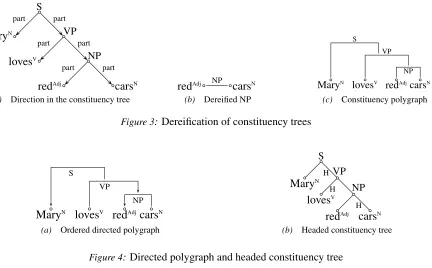
One can dereify all non-terminal nodes of the constituency tree. The terminal nodes (express-ing words) remain nodes, whereas the nodes corre-sponding to groups become edges. The constituency tree in fig. 1(a) can be dereified since a tree is a directed graph (see fig. 3(a), where the orientation of the part-whole relation is explicit). By dereify-ing the NP representation (red cars), the NP node and the two part-whole edges of which it is the source become a single edge (fig. 3(b)) that represent the grouping operation rather than its result. This NP edge remains undirected because the immediate constituents have the same hierarchical status in a strict constituency approach (both are the target of part-whole directed edges sharing the same source). Applying dereification to all nodes expressing con-structions results in the structure in fig. 3(c). The starting constituency tree is binary-branching, hence the edges obtained are binary. However, the result is not exactly a tree: vertices can be edges as well as nodes. Henceforth, this type of structure will be called apolygraph.9 In a polygraph, an edgee
1can
have another edgee2as vertex. In other words, if a
polygraph has a setXof nodes and a setEof edges, each edgeeinE is associated with a set of vertices inX∪E; e.g.: e1={x,e2}, where e2={y,z}with
x,y,z∈X.
From a formal point of view, the resulting poly-graph expresses exactly the same stratification as the constituency tree, and will be called aconstituency polygraph. However, it achieves two straightfor-ward semiotic correspondences:
9The termpolygraphis used in category theory for a fam-ily of objects that are a particular case of the structures called polygraphs here (Burroni, 1993; Bonfante and Guiraud, 2008).
• Nodes always correspond to words (i.e. “ob-servable” units, see note 1).
• Edges always correspond to grouping opera-tions/constructions (i.e. linguistic analysis).
Since it shares these characteristics with dependency trees, the constituency polygraph can be considered as a better starting point for the conversion that will be performed.
3.2 Specification of the governors: directing the edges
The constituency polygraph does not represent the governor-dependent relations of the dependency ap-proach. To be able to do so, the polygraph must be directed, by typing the vertices of each edge with either the type source or the type target (see sec. 2.2).10 Graphically, lines are turned into arrows
to express the direction of the edges according to the target dependency tree (fig. 1(a)). This operation re-sults in fig. 4(a) – which will be compared to fig. 4(b) below. In fig. 4(a), the nodes of the polygraph are also linearly ordered.
Contrary to the dereification process, direction specification actually adds information to the struc-ture:
• Edges still express grouping operations and the stratification of the constituency tree.
• In addition, edges now express governor-dependent relations.
MaryN lovesV
redAdj carsN
S
VP NP part part
part part
part part
(a) Direction in the constituency tree
redAdj NP carsN (b) Dereified NP
MaryN lovesV redAdjcarsN
S
VP
NP
(c) Constituency polygraph
Figure 3:Dereification of constituency trees
MaryN
lovesV
redAdjcarsN
S
VP NP (a) Ordered directed polygraph
MaryN lovesV
redAdj carsN S
VP
NP H
H
H
[image:6.612.90.522.55.323.2](b) Headed constituency tree
Figure 4: Directed polygraph and headed constituency tree
combines constituency with dependency by specify-ing the governor (or head) at each level of aggre-gation. In fig. 4(b), each governor is identified by the label H on the part-whole relation linking it to the source construction.11 When the dereification
is applied to a constituent C with two immediate constituentsAandB,Abeing the head,Cbecomes the edge {(A,H),(B,NH)}. If H and NH are
in-terpreted as, namely, source and target typing, the structure becomes a directed polygraph (fig. 4(a)).
Again, the comparison of the two structures with respect to the information they carry must be supple-mented with the evaluation of their relative semiotic efficiency. The directed polygraph is more coher-ent (because of the aforemcoher-entioned correspondences nodes/observed units and edges/constructed analy-ses). It is also more readable:
• All directed edges have exactly the same inter-pretation (direction and label).
• All directed edges express relations of the same kind, whereas the edges in the headed con-stituent tree express both part-whole relations 11The conceptual means to define the governor and its graph-ical expression may vary, e.g., ¯XandXlabels in phrase structure trees (Jackendoff, 1977) or labelled edges such asHandNHin HPSG (Pollard and Sag, 1994).
and headedness.
3.3 Graphical delinearization
The structures in fig. 4(a) actually combine two structures: the proper polygraph, which expresses the hierarchical order – i.e. the structural order of Tesnière (1959) – and the linear order, which is rep-resented by the position of the nodes on the same horizontal line. Since the focus is on the compari-son between strict constituency and dependency, the disposition of the nodes is not relevant: changing it will not modify the hierarchical structure. The di-rected polygraph in fig. 4 can be drawn as in fig. 5(a) by abstracting away from word order and placing the source of directed edge above the target.12
3.4 Underspecification of the grouping orders: node selection
MaryN
lovesV
redAdj
carsN
S VP
NP
(a) Directed constituency polygraph
MaryN
lovesV
redAdj
carsN
S VP
NP
(b) Destratified constituency polygraph
MaryN
lovesV
redAdj carsN
subject object
modifier
[image:7.612.83.522.63.138.2](c) Dependency tree
Figure 5: From directed polygraph to dependency tree
to each edge recursively: if e= (v1,v2), top(e) =
top(e1)and ifnis a node, top(n) =n.13 To each
di-rected polygraph, a graph is associated by replacing any edge(v1,v2)by the edge(top(v1),top(v2)).
For instance, in the polygraph in fig. 5(a), top(S) =top(V P) =lovesand top(NP) =cars. The
corresponding graph after selection is then the tree in fig. 5(b). From the geometrical point of view, the selection can be viewed as a down-shifting of edges along other edges.
Selection corresponds to deleting the order of grouping operations in the constituency tree. The operation substracts information from the original constituency tree: namely, its stratification. The polygraph expresses the stratification of groups and each instance of selection underspecifies this order for a couple of grouping operations.
Geometrically, the edgeVPcan be slid along the edgeS(andlovesbecomes the source ofS) and the edgeNPcan be slid alongVP(andcarsbecomes the target ofVP), as seen in the tree in fig. 5(b).
3.5 Relabelling
By relabelling the edges of the polygraph obtained after selection with names of grammatical functions, one generates fig. 5(c), which is the dependency tree of fig. 1(b) plus arrows that express the directions of the governor/dependent relations. We can see that the grouping operation namedS in phrase structure grammar (Chomsky, 1957) is the grouping operation that dependency grammar names the subject rela-tion (Mel’ˇcuk, 1988). In works preceding Chom-sky’s formalization (Chomsky, 1957), groupings are more clearly interpreted as constructions. Bloom-13The top node of an edge is nothing else than the lexical head of the corresponding constituent. This step, the replacement of a constituent by its lexical head, is equivalent to the step in Lecerf’s procedure collapsing all the nodes with their common lexical head.
field (1933, §12, 2) calls this groupingactor-action construction– Bloomfield’s actiondoes not corre-spond exactly to a VP constituent, since thedirect objectrelation (likewatch me) is called the action-goal construction in §12.8. Even Chomsky (1957, ch. 4) introduces the constituency tree as a deriva-tion tree. Following Vijay-Shanker (1992), one can extend the notion of derivation tree to TAG, where each node must be interpreted as a rule. In other words, the S node of the derivation tree can be in-terpreted as αS = [S→NP+V P]and the relation
betweenS andV Pas the substitution of a ruleαV P
into a ruleαS.
Constituency and dependency are two ways to en-code grouping operations on the same words. Con-stituency focuses on the stratification, that is the re-spective order of the grouping operations (a verb groups with its object before grouping with its sub-ject), while dependency focuses on headedness, that is the governor-dependent relation inside each group (a verb governs its subject and its object). Conse-quently, when a word is defined as a governor in the latter approach, it is aggregated with each of its de-pendents in several groups at the same level. Con-stituency generally acknowledges the same associa-tions, but it has the means to stratify it through the definition of smaller nested groups.
The conversion is complete and reverting the pro-cess would allow one to go from the dependency tree to the constituency tree.
3.6 Intermediate conclusion
The five steps can be summarized with respect to the information carried by each strict formalism (the most important steps14appear in fig. 6). Polygraphs,
which have been used as a temporary step in the pro-cess can be regarded as an independent modelling
A B YP
XP
C
(a) Constituency tree
Reification Dereification
A B
YP XP
C
(b) Undirected polygraph
Direction removal Direction addition
A
B
C
YP
XP
(c) Directed polygraph
Stratification Destratification
A
B
C
YP XP
[image:8.612.72.532.61.124.2](d) Dependency tree
Figure 6:Synthesis of constituency tree/dependency tree conversion steps
tool that achieves better expressiveness.
Descriptive powers compared Governor specifi-cationadds dependency information (sec. 3.2), that isheadedness, to the polygraph andselectiondeletes the order of grouping operations (sec. 3.4), that is stratification, from the polygraph. What this means is that neither strict constituency trees nor strict de-pendency trees can really be considered to be a more powerful formalism, because neither of them can ex-press everything that can be exex-pressed by the other. A formalism A ismore powerfulthan B if there ex-ists a one-to-one map from A to B preserving the topology of the structures in A. In other words, ev-ery structureawritten with the formalism A can be converted into a structurebwritten in the formalism B without losing any information, that is,a can be recovered fromb.
Constituency is able to acknowledge stratifica-tion; e.g.: in fig. 1(a),red carsaggregates withloves before Mary aggregates with the rest of the sen-tence. Choosing between one order or the other is an important methodological issue that should not be overlooked (Gleason, 1955; Wells, 1947). The drawback of constituency is that part-whole rela-tions do not express any hierarchy between immedi-ate constituents of a single construction (Mary and loves red cars share the same level). On the other hand, dependency provides an explicit way to de-scribe the relative importance of individual words in comparison with the other words that surround them. Therefore, identifying the head of a group is a major concern (Mel’ˇcuk, 2009, 27-34) and is even compul-soryin a strict dependency approach.
Polygraph as a synthesis Polygraphs can be con-sidered a gateway for the conversion of one type of structure into the other. They can contain both the stratificational information of constituency trees and the dependency structure. They can potentially ex-press everything that both strict approaches can.
Di-rected polygraphs can be drawn as in fig. 5(a), a rep-resentation close to a dependency tree, in order to as-sert the hierarchical order. But an ordered polygraph can also be represented with the nodes linearly or-dered (fig. 4(a)) and looks more like a constituency tree.
Seen as an intermediate stage in a conversion pro-cess, polygraphs offer no free option: from strict constituency to strict dependency, the direction of all edges must be specified and information about the order of grouping operationsis necessarilylost. Nevertheless, polygraphs can be considered as an in-dependent modelling toolthat allows one to choose whether or not specific governors and the order of grouping operations must be specified. They there-fore allowunderspecificationin addition to combin-ing the descriptive power of concurrent formalisms. • A dependency tree is a directed polygraph that
is completely destratified.
• A constituency tree is a stratified polygraph that specifies no governor.
As an independent modelling tool, polygraphs achieve better expressiveness than strict con-stituency and strict dependency alone, for they sat-isfy the following requirements:
Descriptive power Polygraphs can structurally ex-press everything that constituency and depen-dency can express (grouping, headedness, strat-ification).
Underspecification Polygraphs can underspecify what is considered as non necessary (headed-ness, stratification)
The latter property is as important as the former: a formalism that forces one to specify irrelevant in-formation can be as problematic as a formalism that does not allow one to specify relevant information.15
that you saw yesterday cars
red
A B
(a) Original polygraph
red
cars
that you. . .
A
B
(b) Reified version
Figure 7: Stratification of dependency trees
4 Extending dependency trees
As demonstrated in sec. 3, it is possible with poly-graphs to encode both dependency and constituency, i.e. grouping, headedness and stratification. The aim of this section is to show what can be achieved by using polygraphs as an independent formalism rather than as a gateway for converting constituency trees into dependency trees. In a dependency-oriented perspective, it shows in which ways and for what purpose polygraphs can extend the formalism of dependency trees.
4.1 Stratification of dependency trees
Stratification can be acknowledged by polygraphs. It is not clear what advantage can be obtained by systematically forcing the verb to combine with its subject after its object as is done in PSGs.16 DGs
are attached to the verb centrality, defended at least since Tesnière (1959, ch. 49), who fought strongly against the bi-partition of the sentence into subject and predicate, i.e. NP and VP. Tesnière’s point of view could be reformulated by saying that strati-fication of the verbal subcategorization in current constituency-based approaches is an artefact of the encoding of the syntactic structure by a binary-branching constituency tree (Kahane and Osborne, 2015, xxxix-xlii).
In other words, the fact that dependency trees
that every formal linguist knows about. Context-free gram-mars were defined by Chomsky (1957) as rewriting systems. A
derivationin a CFG is a string of rewriting steps. Thederivation treeis a better formalism of representation of the derivation pro-cess, because it masks the order in which irrelevant steps occur in a derivation and “keeps only what is essential to understand the phrase structure” (ibid.: ch. 4). That is why the deriva-tion tree is much more adequate than the proper derivaderiva-tion for a syntactic representation of the structure of a sentence.
16As far as incremental parsing is concerned, which is cogni-tively very motivated, it seems clear that the verb will combine with its subject before its object in SVO languages.
make it possible to formalize binary groupings with-out needing stratification is viewed as a strong ad-vantage by DGs.
This preliminary remark does not mean that strat-ification cannot be useful sometimes. Consider the following example:
(3) red cars that you saw yesterday
As already noticed by Coseriu (1980, 55), Tes-nière (1959, ch. 65) proposed to represent the syn-tactic structure of (3) with a polygraph-like stemma (redrawn here in fig. 7(a)) (Tesnière, 1959, stemma 149) and provided the following justification: “By this process, the phrasered cars that you saw yes-terday can be analyzed structurally in such a way that the connecting line extending upward from the subordinate clause reaches the connection line con-necting red tocars. This means that that you saw yesterday is connected not to cars but to red cars, since what you saw yesterday was not cars, but red cars.” Indeed, this representation says thatcars com-bines first withredand after with the relative clause, as shown also by the constituency tree in fig. 7(b) which is obtained by reification of the relations in polygraph in fig. 7(a).
4.2 Headless grouping
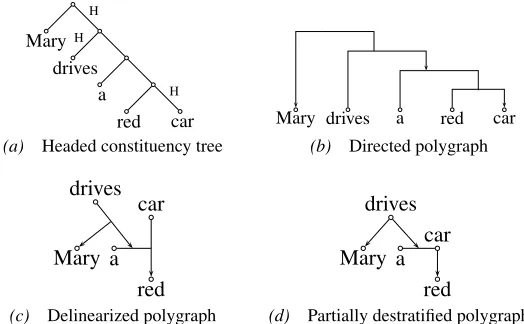
The lively debate about the DP vs. NP analysis of the determiner-noun construction – the still open dis-cussion started 30 years ago (Hudson, 1984; Abney, 1987) – could be resolved by admitting that both the determiner and the noun have head features. Neither of them should be favored. This leads to propose a syntactic structure such as fig. 8(d) for sentence (4):
(4) Mary drives a red car.
Mary drives
a
red car
H H
H (a) Headed constituency tree
Mary drives a red car (b) Directed polygraph
Mary drives
a car
red
(c) Delinearized polygraph
Mary drives
a car
red
[image:10.612.178.440.57.219.2](d) Partially destratified polygraph
Figure 8:Underspecified determiner-noun headedness
headed grouping outputs a directed dependency. De-linearization outputs the representation of fig. 8(c), where directed edges are represented by vertical lines with the head on top, while the non-directed edges are represented by horizontal lines. Selection results in the structure depicted in fig. 8(d). Non-directed edges cannot undergo selection and remain governed as a whole.
From the geometrical point of view, it means that non-directed edges cannot undergo any selection, which justifies representing them horizontally. Reed and Kellogg (1877) already use horizontal conven-tion in their famous diagram, where the subject-verb and the object-verb combinations are non hierarchi-cally organized. A linguist wishing to express a “headless” (or exocentric) structure, such as the for-mer Chomskyan schemeS→NP+VP, simply
can-not do so with a dependency tree. The transforma-tion exposed in sec. 3 applied to such a constituency tree (fig. 9(a)) produces a polygraph very similar to the Reed-Kellogg diagram (fig. 9(b)).17
(5) I think Mary loves cars.
The horizontal convention was also used by Tes-nière (1959, part II) for coordination (see sec. 4.3).
4.3 Ternary grouping
In a dependency tree, every grouping is a binary grouping between a head word and a non-head word, 17Note that Nida (1966, 17-47) consists of dozens of similar diagrams, that contrast a.o. endocentric structures and exocen-tric ones.
encoded by a dependency. Some linguists consider that function words are just markers of construc-tions. For instance,toin (6) could be analyzed not as the head of a PP but rather as the marker of the com-bination betweentalkedand its indirect object.18
(6) Mary talked to Peter.
This results in the constituency tree in fig. 10(a), with a ternary branching where talked is the head (H),tothe marker (M), andPetera non-head word. Dereification and selection result in the structure in fig. 10(b), i.e. ahyperpolygraph. Ahyperpolygraph is to a polygraph what a hypergraph is to a graph. In this case, hyperpolygraph contains a ternary “depen-dency” with three vertices: a governor, a dependent, and a third vertex put on the edge, occupied by the markerto, which must not be interpreted as a label. Such a convention already appears in dependency-based representations, even in some very early at-tempts (Kern, 1883, 17) – see also Débili (1982) for a more recent example. The representation in fig. 10(c) is also valid: the markertodepends on the relation it marks (Kahane and Mazziotta, submitted Depling 2015), indicating that the marker cannot oc-cur without the relation. Such a polygraph cannot be reified into a (constituency) tree.
I think
Mary
loves cars
S VP
S VP H
H
(a) Partially headed constituency tree
I think
Mary loves
cars
VP S
S VP
(b) Partially directed polygraph
Figure 9:Underspecified subject-verb headedness
Mary
talked to Peter
H
M H
(a) Constituency tree
Mary talked
Peter to
(b) Hyperpolygraph with marker node
Mary talked
Peter to
(c) Polygraph with marking relation
Figure 10:Ternary grouping
coordination, conjuncts are considered as co-heads, while the coordinating conjunction is a marker, as proposed by Jackendoff (1977).
(7) Mary and Peter got married.
Fig. 11 shows a constituency tree for (7) and the corresponding polygraph after dereification and slid-ing. A horizontal line is again used to encode a grouping between two co-heads. The resulting rep-resentation is similar to what Tesnière proposes from his early works (Tesnière, 1934) to his main book (Tesnière, 1959, ch. 38).
5 Conclusion
The goal of this paper was to present a new for-malism that subsumes both constituency and depen-dency, and which can be then used to extend these two formalisms in order to encode syntactic analy-ses.
Two goals have been achieved. First, a new way to associate a dependency tree to a headed binary-branching constituency tree has been pro-posed. Contrary to the previous one from Lecerf (1961), this one proves that every dependency cor-responds to a grouping.
Second, the formalism of polygraphs extends both formalisms, constituency trees as well as depen-dency trees, making stratification as well as headed-ness explicit. Interestingly these structures are simi-lar to representations that have been previously
pro-posed by other linguists (Reed and Kellogg, 1877; Kern, 1883; Nida, 1949; Nida, 1966; Tesnière, 1959; Débili, 1982) and polygraphs give them a math-ematical foundation – see Mazziotta (2014) for a more comprehensive application of polygraphs to Tesnière’s model. Beyond that, the formalism of polygraphs can be the basis for the development of new formal grammars, especially lexicalized for-mal grammars such as TAG, that derive the structure of a sentence by combination of elementary struc-tures. In particular, it seems more accurate for some problematic constructions (such as unbounded de-pendencies or complex determiners) to be formal-ized with a derivation structure which is a polygraph rather than a tree or even a graph.19
Acknowledgement
The authors would like to thank the following people for their suggestions and corrections (in no particu-lar order): Kim Gerdes, François Lareau, Timothy Osborne and Pierre Swiggers.
Mary and Peter got married H
H H
M H
(a) Headed constituency tree
Mary Peter
got
married and
(b) Polygraph with marker node
Figure 11: Ternary grouping with co-heads
References
Steven P. Abney. 1987. The English Noun Phrase in its Sentential Aspect. Ph.D. thesis, Massachusetts Insti-tute of Technology.
Claude Bergé. 1973. Graphs and hypergraphs. North-Holland, Amsterdam.
Leonard Bloomfield. 1933. Language. The University of Chicago Press.
Guillaume Bonfante and Yves Guiraud. 2008. Inten-sional properties of polygraphs. Electronic Notes in Theoretical Computer Science, 203(1):65–77. Albert Burroni. 1993. Higher-dimensional word
prob-lems with applications to equational logic. Theoretical computer science, 115(1):43–62.
Noam Chomsky. 1957. Syntactic structures. Mouton, The Hague.
Eugenio Coseriu. 1980. Un précurseur méconnu de la syntaxe structurale: H. Tiktin. InRecherches de lin-guistique: hommage à Maurice Leroy, pages 48–62. Éditions de l’Université de Bruxelles, Bruxelles. Fathi Débili. 1982. Analyse syntaxico-sémantique
fondée sur une acquisition automatique de relations lexicales-sémantiques. Ph.D. thesis, Université Paris Sud.
Henry A. Gleason. 1955.An Introduction to Descriptive linguistics. Holt, Rinehart and Winston.
Thomas Groß. 2011. Catenae in morphology. In Kim Gerdes, Elena Hajiˇcová, and Leo Wanner, editors, Pro-ceedings of Depling 2011, International Conference on Dependency Linguistics, Barcelona, pages 47–57. Barcelona.
Charles F. Hockett. 1958. A course in modern linguis-tics. The MacMillan Company.
Richard A. Hudson. 1980. Constituency and depen-dency. Linguistics, 18(3-4):179–198.
Richard Hudson. 1984. Word Grammar. Blackwell, Ox-ford.
Richard Hudson. 2010. An introduction to word gram-mar. Cambridge Textbooks in Linguistics. Cambridge University Press, Cambridge.
Ray Jackendoff. 1977. X-bar syntax: A study of phrase structure. MIT Press, Cambridge, MA.
Sylvain Kahane and Nicolas Mazziotta. submitted (Depling 2015). Dependency-based analyses for func-tion words - introducing the polygraphic approach. Sylvain Kahane and Timothy Osborne. 2015.
Transla-tors’ introduction. In Elements of structural syntax (Tesnière, 2015), pages xxix–lxxiv.
Sylvain Kahane. 1997. Bubble trees and syntactic rep-resentations. InProceedings of Mathematics of Lan-guage (MOL5) Meeting, pages 70–76. Citeseer. Sylvain Kahane. 2012. Why to choose dependency
rather than constituency for syntax: a formal point of view. In J. Apresjan, M.-C. L’Homme, M.-C. Iomdin, J. Mili´cevi´c, A. Polguère, and L. Wanner, ed-itors, Meanings, Texts, and other exciting things: A Festschrift to Commemorate the 80th Anniversary of Professor Igor A. Mel’ˇcuk, pages 257–272. Languages of Slavic Culture, Moscow.
Sylvain Kahane. 2013. Predicative adjunction in a mod-ular dependency grammar. In2nd international con-ference on Dependency Linguistics (DepLing), pages 137–146.
Franz Kern. 1883. Zur Methodik des deutschen Unter-richts. Nicolai, Berlin.
Yves Lecerf. 1961. Une représentation algébrique de la structure des phrases dans diverses langues na-turelles. Comptes rendus de l’Académie des Sciences, 252(2):232–235.
Nicolas Mazziotta. 2014. Nature et structure des rela-tions syntaxiques dans le modèle de Lucien Tesnière. Modèles linguistiques, 69:123–152.
Igor Mel’ˇcuk. 1988. Dependency syntax: theory and practice. State University of New York, Albany. Igor Mel’ˇcuk. 2009. Dependency in natural language.
In Alain Polguère and Igor Mel’ˇcuk, editors, Depen-dency in linguistic description, pages 1–110. John Benjamins, Amsterdam and Philadelphia.
Eugene Nida. 1949. Morphology: the descriptive analy-sis of words. University of Michigan press, Ann Arbor, 2 edition.
Eugene Nida. 1966.A synopsys of English Syntax. Mou-ton and Co., London, The Hague, Paris, 2 edition. Timothy Osborne, Michael Putnam, and Thomas M.
a dependency grammar? The Linguistic Review, 28(3):315–364.
Carl Pollard and Ivan A. Sag. 1994.Head-driven phrase structure grammar. University of Chicago Press. Alonso Reed and Brainerd Kellogg. 1877. Higher
Lessons in English: A Work on English Grammar and Composition. Clark and Maynard, New-York. Yves Schabes and Stuart M. Shieber. 1994. An
alterna-tive conception of tree-adjoining derivation. Compu-tational Linguistics, 20(1):91–124.
John F. Sowa. 2000. Knowledge Representation: Log-ical, PhilosophLog-ical, and Computational Foundations. Brooks Cole Publishing Co., Pacific Grove, CA. Lucien Tesnière. 1934. Comment construire une
syn-taxe. Bulletin de la Faculté des Lettres de Strasbourg, 7:219–229.
Lucien Tesnière. 1959. Éléments de syntaxe structurale. Klincksieck, Paris.
Lucien Tesnière. 2015. Elements of structural syntax, translated by Timothy Osborne and Sylvain Kahane. Benjamins, Amsterdam/Philadelphia.
K. Vijay-Shanker. 1992. Using descriptions of trees in a tree adjoining grammar. Computational Linguistics, 18(4):481–517.